FDIC and NCUA Insurance $250,000 Limits Now Permanent

The standard maximum insurance limits for both FDIC and NCUA-insured accounts have been permanently raised to $250,000 per depositor as part of the Dodd-Frank Wall Street Reform and Consumer Protection Act, signed July 21st, 2010. The limits were temporarily increased from $100,000 to $250,000 effective October 3, 2008, through December 31, 2010. On May 20, 2009, the temporary increase was extended again through December 31, 2013. (FDIC press release)

The FDIC insurance coverage limit applies per depositor, per insured depository institution for each account ownership category. You may actually have more than $250,000 of coverage, depending on how you have titled your accounts and where you hold multiple accounts. Here are the official online calculators:

NCUA Electronic Share Insurance Calculator (ESIC)
FDIC Electronic Deposit Insurance Estimator (EDIE)

The new limits were made retroactive to 1/1/2008, which makes 9,500 people really happy who exceeded the FDIC limits between January 1st and October 3, 2008, which were only $100,000 at the time. Well, they got lucky. Don’t exceed the limits! (And congrats if this is still an issue for you…)

Capital One 360 Independence Day Offers

Online bank Capital One 360 has a few specials for Independence Day that (for some reason) are only good until midnight on Friday, July 2nd. In all cases, they are slightly better versions of offers that they regularly offer. Not a bad time to pounce if you’ve been on the fence. Thanks to reader Terry for the tip.

Perkstreet Checking with 2%/5% Cashback Debit Card

Perkstreet Card BannerPerkstreet Financial is relatively new, but they’ve already tried a bunch of different ways to make their online checking account attractive, from sign-up bonuses to coffee awards. However, I think they’ve stumbled onto something with their new cashback debit card rewards structure that beats out any other online bank currently:

  • Earn 2% cash back on all non-PIN debit card purchases when your checking account balance is $5,000 or more. For new accounts, you will earn 2% cash back no matter what your balance is for the first 3 months, starting on the day that your account is opened. (Otherwise if your balance that day is below $5k, you earn 1% cash back.)
  • Earn 5% cash back at a rotating set of retailers. This appears to be the new trend amongst many rewards cards. For October 2012, you can get 5% cash back at The Cheesecake Factory®, Pottery Barn®, Pottery Barn Kids®, PotteryBarn.com, Ace Hardware®, AceHardware.com.
  • PowerPerks 2.0 with deals updated every week
  • There is no limit to the amount of cashback you can earn.

Fees. The account has no minimum balance requirement, but does require you to have some sort of activity each month to avoid a $4.50 inactivity fee. Be sure to have some sort of deposit/withdrawal (electronic transfer is fine), debit card purchase, online billpay, or a cleared check every month.

The checking account earns no interest, so you’ll have to account for that based on your usual average balances. On the website, it advertises that you could earn $600 in rewards each year. Here’s their rationale:

Making $601 in weekly non-PIN purchases will earn you $625 in perks annually (when you maintain a balance of $5,000). According to the U.S. Bureau of Labor Statistics, the average American household spends $601 per week on purchases that could be put on a debit card, including stuff like utility bills or rent.

I’d adjust your expectations according to your own situation. I’ve never had a landlord that let me charge my rent on a debit/credit card, although I’m sure some are out there. 🙂 Example: Charging $500 a month at 2% back would be $120 a year.

Opening an account. They do try to make it easy… you only need $25 to open, and you can even do your initial funding on a credit card for up to $500; they promise to run it as a purchase to avoid cash advance fees.

For folks who already have a their preferred set of cashback credit cards, this might not be enough to switch. However, this does serve as a nice alternative for the subset of folks who choose to avoid credit cards for whatever reason. I have lots of friends that prefer debit cards due to the sheer simplicity of it – they buy something, and the money gets taken out direct from the checking account. Done. No extra bills to pay. I just read that 50% of all charge card purchases this year will be done on debit cards, so they aren’t alone.

4 Stash Your Cash Deals Most People Haven’t Heard Of

Here are four places to stash your cash that aren’t advertised very heavily, so your co-workers probably haven’t heard of them. They are all FDIC-insured, and offer higher yields than most of their direct competitors. Each one is best depending on your investment time frame and deposit size.

Free Rewards Checking at DanversBank

DanversBank offers their Free Rewards Checking account paying 4.01% APY on balances up to $25,000, provided you satisfy the following each month:

* perform at least 12 debit card transactions (excluding ATMs);
* receive their monthly statement electronically;
* access Online Banking, and
* sign up for direct deposit or receive a recurring ACH.

There are no minimum balance requirement or fees, and ATM fees are refunded as well if you meet the above requirements. The branches are located in the Boston area, but accounts are open to anyone in the US. If you can be diligent every month (otherwise you get piddly interest), these types of account are great interest boosters.

Ally Bank 5-Year CD with Small Early-Withdrawal Penalty

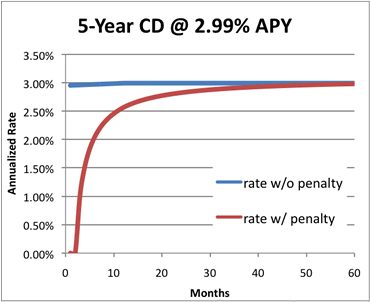
Ally Bank LogoOkay, so Ally does spend a lot of money on advertising, but a feature they rarely mention is actually the best reason to open an account with them. They only hit you with a early withdrawal penalty of 60-days of lost interest if you “break” a CD with them. The Ally Bank 5-year CD currently yields 1.60% APY (as of 10/25/13). Rates change constantly, but let’s assume you have a certificate of deposit from any bank paying 2.99% APY with an early withdrawal penalty of the last 60 days of interest. (2.99% APY ~= 2.95% rate compounded daily.) Here’s how your actual annualized interest rate would fluctuate given your holding period.

If you look carefully at this charts, you’ll see some great deals:

  • After only 4 months, your annualized rate is 1.48%. (Essentially you 2 months out of 4, which is half of 3.04%). This isn’t bad at all, considering their liquid online savings account is currently paying 0.85% APY.
  • After 1 year, your annualized rate is 2.49%. You can’t find a better rate than this at any other bank for a 1-year CD. Likewise, after 2 years, your annualized rate is 2.87%, compared to Ally’s current 2-year CD at 1.05% APY, although it does have a “raise your rate” feature that lets you bump it up once if rates rise.
  • After 3 years, your annualized rate is 2.83%, again a top rate. Thus, even opening a 5-year CD and holding for anywhere between four months and 3 years gets you a better rate than any other bank currently out there (including Ally itself). There’s also no minimum deposit required to open, so you can make each CD as small as you like!

SmartyPig FDIC-Insured Online Piggy Bank

I reviewed SmartyPig.com a while back when they had just broke onto the scene, but they have made a lot of improvements in response to customer feedback since then. You can think of them like an online piggy bank that helps you towards savings goals, but they’ve added so much flexibility that you can pretty much use them like any other savings account. The best part? They currently pay 2.15% APY on balances up to $50,000 (FDIC-insured). That’s better than any other savings account out there, with no additional requirements. No minimums, no maintenance fees.

An added feature is that if you set a savings goal and reach it, they offer “boosts” if you redeem your cash for a gift card in their mall. My favorite is the 4% boost at Amazon, which for example will get you a $260 gift card for $250 cash. Other highlights include Macy’s at 12% and Travelocity at 10% boost.

Sallie Mae Bank – Online Savings Account

Sallie Mae is best known as the huge student loan originator and servicer. Their new Sallie Mae Bank is an FDIC-insured bank that offers a very competitive 1.40% APY in their online savings account. Not a bad deal to lend out money to captive students at high interest rates, and pay much less as a bank! Hopefully this means that they can keep their rates higher than other banks.

The quickest way to describe it is as another clone of Capital One 360 (currently paying 0.75%). That means… liquid, no minimum balance, no minimum fees, and no deposit caps or tiers (just the $250k FDIC insurance limit to worry about). It’s designed to complement your existing accounts. You can link an unlimited amount of other bank accounts for easy online transfers, which take the usual 2-3 days to complete. Interest is compounded daily and credited monthly.

Also, if you have an account at Upromise, you can link your Sallie Mae account and have your Upromise earning deposited there. You can even get a 10% extra bonus if you do one of the following:

To be eligible for the 10% annual match on your Upromise earnings from Upromise you must link your High-Yield Savings Account to your Upromise Account and, within 90 days of opening your High-Yield Savings Account, either: (1) set up an Automatic Savings Plan with a monthly deposit of $25 or more, or (2) fund the account with $5,000 or more. Upromise will match 10% of your Upromise earnings posted as “funded” to your Upromise Account during the calendar year of January 1 through December 31. Your 10% annual match will be deposited into your High-Yield Savings Account in February of the following year provided that both accounts remain active and are in good standing at the time of transfer.

WT Direct $500 Promotion: Earn 5% APY For 3 Months

(The promo below was discontinued after 3 days. Sorry, I warned you guys!)

The online division of Wilmington Trust Bank, WT Direct, is running another promotion for new customers. You can get up to a $500 cash bonus on top of the standard interest rate (currently 1.16% APY) if you open a new account and maintain a certain balance for 3 months. Here is the offer text:
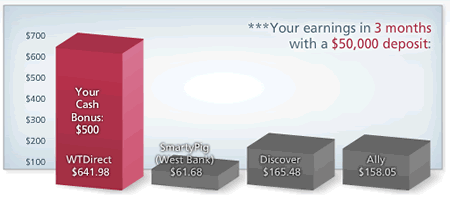


Join WTDirect now and for every $10,000 that you deposit, we’ll give you a $100 cash bonus, up to $500!* Just open and fund your account by June 15th, maintain your initial deposit for three months, and you’ll receive a cash bonus.

The Numbers: Like a 3-month CD paying over 5% APY
This offer is basically a 1% flat bonus on your deposit after only 3 months if you deposit a multiple of $10,000. How does this work out when converted to an interest rate? To start, you are already getting 1.16% APY. On $10,000 for 3 months, you’ll get $28.40 interest and $100 bonus. That’s roughly 5.15% APY during that time.

Therefore, you can treat this bonus as a 3-month CD paying over 5% APY, more than 3% higher than any other available 3-month CD out there, and works for deposits up to $50,000:

Application Process and Setup

I’ve already opened a WTDirect account for a previous bonus, so here a quick summary of what to expect when applying. First, they gather the personal info. Second, they use the now-popular Equifax ID check questions to verify your identity. Third, you can fund electronically with account and routing numbers, although you must come back and verify trial deposits later. Finally, you can electronically sign the application and disclosures. There were no physical forms to send in, although a welcome packet does arrive by mail. They state explicitly that there is no credit check.

As for practical matters, WT Direct’s online transfer system allows unlimited linked banks, and transfers to external accounts are free both in and out with a 2-3 day transfer time.

Final Details
You must click through the promotional page and not the regular front page, so that the promotion code of dxxxc01 should already be filled in for you. WT Direct offers can be pulled early (and have been in the past), so don’t dawdle too long if you’re interested…

The fine print:

This offer is available to new WTDirect clients only. Primary account holder must NOT have held a WTDirect account in the past 12 months. WTDirect account must be opened and funded via electronic (ACH) transfer received by 6/15/10. Bonus is based upon the lowest daily balance during the promotional period of 6/15/10 – 9/15/10. Bonuses will be paid approximately 2 weeks after the end of the promotional period to clients whose accounts are open and in good standing. Wilmington Trust employees and their family members are not eligible. WTDirect reserves the right to cancel or modify this promotion at any time without notice.

Quick Tip: Differences Between Bank and Credit Card Sign-up Bonuses

Just a quick tip that a reader brought up… when you receive a “bonus” from a bank, it is usually going to be reported as taxable interest income to the IRS via a 1099-INT form. Since such interest is taxed as ordinary income, you should remember that you will probably owe income tax on the bonus amount multiplied by your marginal tax rate (2010). After personal exemptions and standard deductions, students or other people with lower incomes might find that they don’t owe tax anyway, but it’s still worth noting.

Another way that this can get messy is if the bank offers an item like an mp3 player, and reports the full retail value while the actual market price is much lower. Let’s say they give you an iPod that you can find for $200 but mark it as worth $300. If you’re in the 28% tax bracket, you’ll be paying $84 in taxes for that “free” iPod. Still a good deal, but only if you would really pay that much for it! (Example: iPod Touch from KeyBank.)

However, incentives from a credit card sign-up are usually non-taxable. They don’t report any income on 1099-INTs, and due to a IRS private-letter ruling, tax experts tend to view the bonuses as a rebate on the purchases you make on the cards. (Example: $500 cash bonus from credit cards.)

[Insert “The More You Know” theme song…]

Depositing Loose Coins and Coin Jars

Coins Image

Like a lot of folks, I don’t like carrying around change and whenever I get the chance it gets deposited into a jar on my desk. Coinstar has somehow created a publicly-traded corporation (ticker CSTR) worth over 1 billion dollars based on converting these coins back into… cash? (Okay, they now also own Redbox.) I still don’t get it. Occasionally, Coinstar has a promotion that gets you a little bonus, but other than that I really don’t see why people choose to pay a 9.8% fee to get their own cash handed back to them.

[Update: A lot of people point out that you can convert to several gift certificate options with no fee. This is true, and can definitely be a better option if you shop at those stores. But you lose the ability to get credit card rewards on your purchases, which can be up to 5% on certain places like grocery stores. In addition, at several places like Starbucks I can buy gift cards for 80 cents on the dollar at places like Costco ($40 for $50 gift card). Even for the most popular Amazon.com, I can get 5x rewards back by buying things with my Citi Forward Card.]

Every single bank that I’ve asked accepts coins as deposits to a checking account. Seems like that would be a law or something. Bank of America, regional banks, and local credit unions. Some used to request that you roll them, but within the last five years they’ve all just accepted them loose. They simply place them along with a blank deposit slip into a plastic cash bag, seal it, and send it off to a central coin-counting place. Within a couple of business days, a deposit shows up in my account.

I suppose you might worry that they’ll steal some of your coins, whether through the human operator or the counting machines. However, even if you go to a place like Coinstar, the counter might also be off as well. The Wall Street Journal even investigated the accuracy of Coinstar machines and found them both off.

First try:

For consistency, we began with equal piles of $87.26 worth of pennies, nickels, dimes and quarters that we had gotten from a local bank in coin envelopes. Talk about a tough economy. The machines at both Commerce Bank and Coinstar gave us less back than we put in — Commerce Bank missed by a whopping $7.02, while Coinstar was off by 57 cents.

Second try:

Alarmed at the results, we decided to give the machines a second chance. This time, we painstakingly counted out two batches of $68.23 in change. But once again, both Commerce Bank (82 cents) and Coinstar (14 cents) were off — in the machine’s favor.

Of course, that $7.02 miscount was still less than the new 9.8% fee of Coinstar (as of March 1st). Perhaps the Commerce Bank counters open to the public aren’t maintained very well.

If you’d like to estimate the amount in your coin jar without counting, try this Coin Jar Calculator. You simply grab a handful of coins, input the breakdown along with the weight of the coins, and out pops an estimate of your jar’s value. I would say it’s only accurate to maybe 10-15%. For me, it estimated $86.73 based on a large handful, with an actual result of $94.07.

Looking for something more scientific? Check out this little dissertation. With some basic assumptions, the author figures mixed loose coins should be worth about $12.96 a pound. My jar worked out to closer to $11 a pound. I do occasionally fish out quarters for parking meters though, so that likely skewed my results.

How do you deal with your loose coinage? Share in the comments.

Ally Bank Certificate of Deposit Opening Process

I also opened up a couple of Ally Bank 5-year CDs earlier this week as one of the places for my emergency fund, following my previous positive analysis. It went pretty smoothly, here are the steps of the application:

Step 1 select accounts – Choose the account type and term, as well as opening deposit amount. You really can open with as little as $1.

Step 2 personal information – Enter and verify your personal information and identity based on information from your credit report.

Step 3 opening deposit – Either mail in a check or provide account information (routing and account numbers) for electronic funding.

Step 4 account options – Choose how you would like your interest payments deposited (monthly, quarterly, annually) for your CD. Also choose the location (mailed check, back into CD, another Ally account, or external bank account).

Step 5 congratulations – You will have to verify two small test deposits to set up a new bank account. A welcome kit with signature cards will be mailed to you. These must be mailed back in order to avoid backup withholding of interest to the IRS. However, it does not appear to affect the actual funding of the CD.

Ally Bank 5-Year Certificate of Deposit: A Closer Look

Previously, I wrote about Ally Bank CDs and how they offer flexibility in the case of rising interest rates. I finally found the time to do the analysis of the 5-year CD that I wanted to do. In particular, I felt that the current yield curve and short 60-day early withdrawal penalty make this certificate of deposit very attractive.

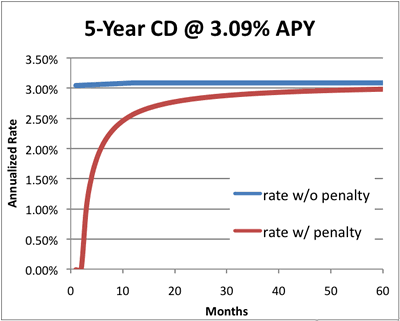
The current Ally Bank 5-year CD yields 2.00% APY (as of 1/05/15). Rates change constantly, but let’s assume you have a certificate of deposit from any bank paying 3.09% APY with an early withdrawal penalty of the last 60 days of interest. (3.09% APY = 3.04% rate compounded daily.) Here’s how your actual annualized interest rate would fluctuate given your holding period.

Some very interesting realizations come out of this:

    • After only 4 months, your annualized rate is 1.52%. (Essentially you 2 months out of 4, which is half of 3.04%). This isn’t bad at all, considering their liquid online savings account is currently paying 0.99% APY (as of 1/05/15).
    • After 1 year, your annualized rate is 2.57%. The current 1-year CD is currently paying 1.05% APY(as of 1/05/15). I can’t find any bank with a 1-year CD paying anywhere close to 2.57% APY. Try to find one!
  • After 2 years, your annualized rate is 2.83%. Ally’s current 2-year CD is currently paying 1.29% APY(as of 1/05/15), although it does have a Raise Your Rate feature.
  • After 3 years, your annualized rate is 2.91%. The current 3-year CD is currently paying 1.40% APY(as of 1/05/15). At this point, a few banks offer a similar rate, but this is still amongst the top. The only better one I could find was PenFed which was slightly better at 3.00% APY.


Final benefit: No minimum opening balance!
As icing on the cake, you can buy these CDs in increments of as little as $1. Now, I wouldn’t abuse their policy, if only to avoid the trouble of keeping track of them all. But let’s say you have $50,000 to put aside. You could buy five $10,000 CDs, and so if you must make a withdrawal of $10,000 you’ll just “break” one CD and have the other four intact. For more modest total amounts, you could go into smaller increments, for example at $1,000 a piece.

Ally Bank CDs Offer Protection From Rising Interest Rates?

Ally Bank has been making several customer-friendly tweaks to their product line which are worthy of note. First up are two that give you a way to lock in a higher rate, but with a handy exit plan in case rates start rising due to inflation or other governmental intervention.

60-day Early Withdrawal Penalties
The usual deal for a certificate of deposit (CD) is that you agree to keep your money at a bank for a fixed length of time, and the bank agrees to give you a higher interest rate in return since it allows them to lend more easily. Of course, the purchaser is hoping that rates don’t rise a lot after already being locked in.

If you break that agreement, you get hit with a hefty penalty. It is not uncommon for some banks to take half of all your interest accrued if you “break” the CD. On a 2-year CD you’d lose a year’s worth of interest. On a 4-year CD, 2 years of lost interest. But Ally CDs now have only a 60-day interest penalty for breaking their CDs, from 6 months all the way up to 5 years! (See the Fees tab.)

Since the early withdrawal penalty is so short, you can run some scenarios where you earn the 5-year CD unless rates rise significantly and you can then simply break the CD, pay the penalty, and yet still come out ahead versus going with a shorter CD. The actual break-even requirements depend on how long you’ve held the CD and how high rates go. The longer that rates stay relatively low, the more “ahead” you’ll be since you’ve been earning that higher interest for a while.

2-Year CD with One-Time Rate Bump Another new product is their Raise Your Rate CD. If rates rise, you can have your rate bumped up to whatever the current 2-year CD rate is, any time during your 2-year term. This is nice because you are essentially paying no early closure penalty at all, and you don’t have to re-commit to another 2-year term.

Finally, a few extra small-but-handy details. All Ally CDs can be opened with $5 or $50,000 as they have no minimums. They also offer a 10-day guarantee that you won’t fund your CD only to miss out on a rate hike, or to have your rate drop if your paperwork takes too long to process:

With our Ally Ten Day Best Rate Guarantee, when you fund your CD within ten days of opening or when your Ally CD renews, you automatically get the best rate we offer during those ten days. Most banks offer only one rate—the one you get the day you fund.

Best Banks With Consistently High Interest Rates

It’s one thing to find a bank with a high interest rate, and another thing to have that rate stay high. Many banks post teaser-like rates to attract deposits, and then hope you’ll be lazy and stay while they gradually become uncompetitive. A post yesterday on the NY Times Bucks blog explored ways to counter this.

Bankrate does a quarterly ranking of top banks with consistently high yields, which is “based on the number of times within the quarter that an institution’s yield was among the top 20 for the product category and the relative position of the yield in relation to the others in the product category.” But that’s only one quarter. So the Times asked them which banks have been on top for every single of the last eight consecutive quarters (Q1 2008 to Q4 2009). Good idea!

The next natural question: Which of these banks has the highest rates now? So I visited each site and found the current rates (as of 11/12/13) for their highest yielding savings account (or money market) and their 12-month CD. Since some of the rates were tiered, I picked the rate for a $10,000 deposit and also included the minimum balance needed to avoid fees. Here are the results, sorted by top overall yield:

Banks
Online Savings / Money Market
12-month CD
0.86% APY / 0.86% Intro ($5k+)
0.60% APY
Discover Bank
0.85% APY / 0.70% ($10k+)
0.95% APY
Ally Bank
0.85% APY (No min)
0.98% APY
Stonebridge Bank
1.25% APY ($1k+)
1.50% APY
Intervest National Bank
1.13% APY ($500+)
1.50% APY
American Bank
0.90% APY ($10k+)
1.30% APY
MetLife Bank
0.85% APY ($10k+)
1.15% APY
First National Bank of Baldwin County
0.50% APY ($5k+)
1.35% APY
M&T Bank, NA
0.50% APY (No min)
1.10% APY
UmbrellaBank (now Beal Bank)
0.50% APY ($1k+)
1.06% APY
0.15% APY ($10k+)
1.11% APY

ETrade Bank Savings Accounts now by Discover Bank?

Just got this e-mail from regarding my ETrade Bank online savings account:

We are writing to let you know that your E*TRADE Bank account referenced above will soon be transferred to Discover Bank, and become a Discover Online Savings Account. This follows our plan to focus more exclusively on providing optimal investing solutions to our customers. We expect the transfer to occur on or about March 7, 2010.

Discover Bank sounds okay from what I’ve read, and the APY on my whopping 3 cent balance will go up from 0.50% to 1.35% APY, but the only reason I kept the E*Trade account around was for its speedy funds transfers. I don’t use any ETrade brokerage services since they are too expensive and the phone hold times are too long. (I do enjoy the commercials, though.) Time to close the account?