Emigrant Direct Signup Bonus Update – March Payouts

Payout instructions for my Emigrant Direct Referral Bonus went out over the last two weeks for those that either sent me their Form #2’s or Claim Form A’s in March. Please let me know if there are any questions.

Emigrant Direct offers an online savings account paying 5.05% APY with no minimum balance requirements, and I have partnered with them to offer a sign-up bonus worth up to $20 if you choose to open an account with them through my specific link. Combine this with the $25 opening bonus from Capital One 360 and $20 opening bonus from VirtualBank for some quick bucks. Some have minimum opening amounts, but none have ongoing minimum balance requirements or monthly fees, so you can try each one out and just stay with the ones you like.

FNBO Direct 6% APY Savings Account Review: Opening Process, Features, and Transfer Schedule

I opened up a savings account at FNBO Direct originally for their high interest rate and no monthly fees. They are currently offering 0.85% APY as of January 2013, still competitive in this current rate environment. Here are my experiences so far as well as some first impressions of this online savings account:

Legitimacy and FDIC Insurance

FNBO Direct is a division of the First National Bank of Omaha, which is a member of the FDIC. If you call the First National Bank of Omaha, they will confirm this link and the website. For the techie folk, the nameservers and IP address range of FNBO.com and FNBODirect.com are the same. Combined with the fact that this account has been around for months, I see no need to worry about the legitimacy of this bank. Many banks choose to distance their online branches from their existing customers, as they are trying to gain new money and low-cost customers who are comfortable with things like electronic statements and online banking.

Opening Process Overview

The opening process went very smoothly. The CashEdge-based application is similar to that of HSBC Direct, but unlike with HSBC there is nothing to wait for in the mail. Nothing to send in either; No paper needed at all!

The application does include an identity verification test based on information from your credit reports. This is identical to what Washington Mutual does for its online savings account. If you have troubles with this, I recommend checking your credit reports for errors. However, a hard credit pull is not performed so it won’t affect your credit.

You can fund via wire transfer, online transfer, or by mailing a check. Here was my timeline:

  • Day 1:Apply online, pass identity verification. Receive e-mail that application was approved. I chose to do an online transfer. Trial verification deposits were sent to funding bank.
  • Day 2:Trial deposits received, and verified (free 57 cents!). FNBO Direct initiates funding transfer.
  • Day 3: I receive my new account number via e-mail, and enroll for online account access. Initial deposit hasn’t showed up, but should go in on Monday (see below). I can add link additional accounts (max of 3) and initiate other transfers.

Account Features, Transfers and Usability

Features
Overall, your basic Capital One 360 clone – $1 to open, no monthly fee, no minimum balances. Otherwise, it’s pretty barebones. No checks. No ATM rebates. You can request an ATM card, which I did, but since it costs $2.50 for each cash withdrawal, I never plan on using it. Here is their complete fee schedule.

Of course, we all know the best feature is the 6% APY interest rate 😉

Transfers
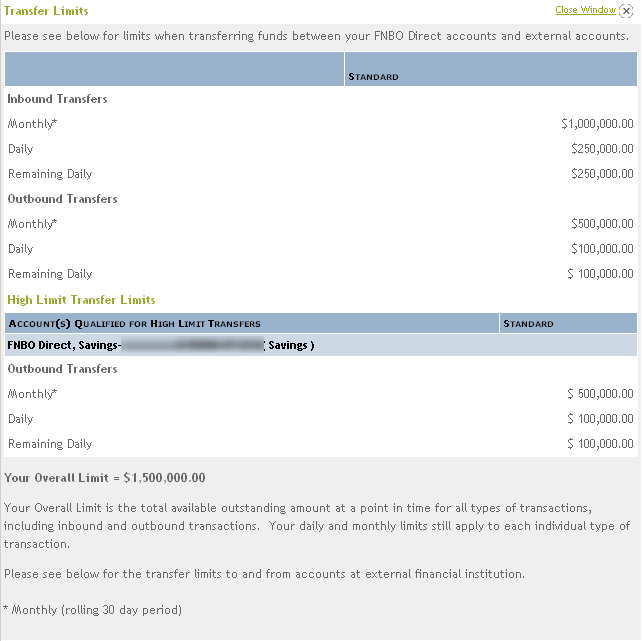
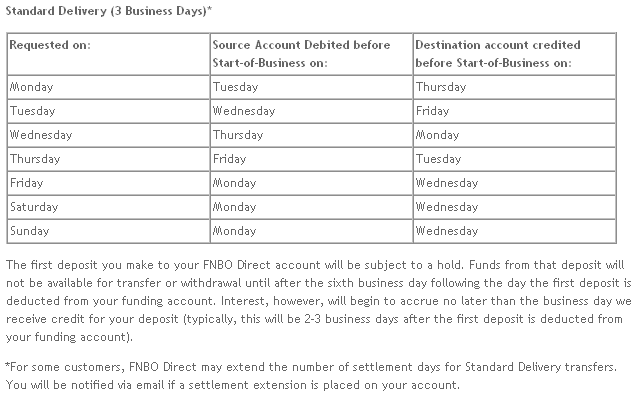
Again this is the familiar CashEdge interface behind the online fund transfers of banks like Bank of America, Presidential Bank, and HSBC Direct. All transfers are free, and the transfer limits are very generous. The transfer schedule appears to be identical to that of HSBC Direct, and takes three business days. (Worst case: If you initiate on Thursday, money is taken out on Friday, but deposit won’t show up at receiving bank until Tuesday.) I know many people dislike these slow transfers, so you should be aware. Here is a screenshot of the schedule:

altext

Note that your initial deposit will not be available for withdrawal for six business days, probably for security reasons.

Usability
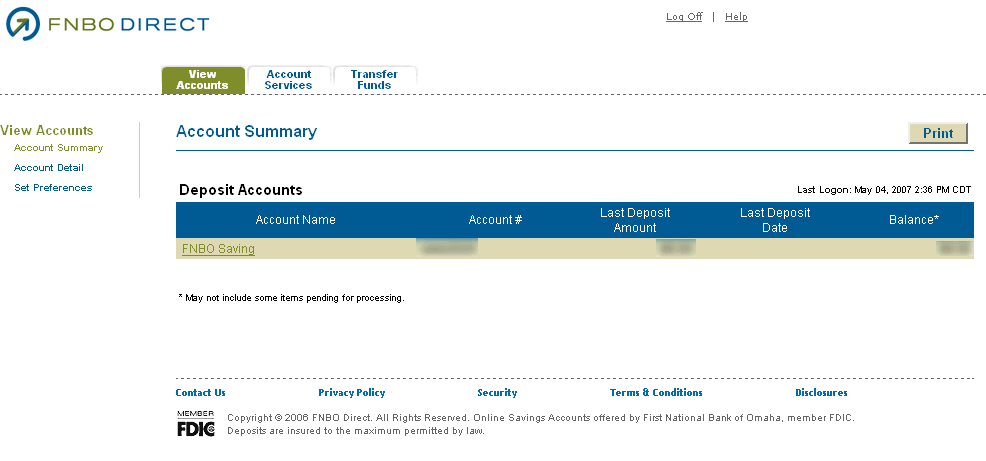
The interface is very simple and utilitarian. I like it. There are only three tabs – View Accounts, Account Services, and Transfer Funds. (Click for a full screenshot of the interface.)

altext

More Information

Customer Service: 877-370-3707, open 24/7.
I’ve called customer service a couple of times, and they do answer and are helpful. Hold times may last a few minutes, but it’s probably due to the recent rush of applicants.

Number of external bank account links allowed: 3

ABA Routing Number: 104000016
I asked them if I could set up third-party transfers like paying my credit card bill with the routing and account numbers, and they said that would be fine. Hopefully it stays that way…

Download formats available: I see no options at all for this. No MS Money, Quicken, or even .csv options.

Interest compounding frequency: Interest is calculated daily and is compounded and credited monthly. Remember, how often interest is compounded really matters very little, especially if you are comparing APYs.

Source: The official website for this online savings account is http://www.fnbodirect.com

FDIC Insurance Limits: What If My Bank Fails? Make Sure Your Money Is Covered

With all these new online banks which are pretty much just virtual branches of a lot of regional banks, I thought it would be a good idea to look more into this whole FDIC insurance thing we put so much trust into. First some quick basics, taken from the FDIC website:

What Does the FDIC Insure?
The Federal Deposit Insurance Corporation (FDIC) is a government corporation that insures all deposits at insured banks, including checking and savings accounts, money market deposit accounts, and certificates of deposit (CDs), up to the insurance limit. Use this form to find out if your bank is insured.

How Much Does It Cover?
The basic insurance amount is $100,000 per depositor per insured bank. Certain retirement accounts, such as Individual Retirement Accounts, are insured up to $250,000 per depositor per insured bank.

Way To Increase Your Coverage
Since accounts at different banks are insured separately, the easiest way to increase your coverage is to simply keep less than $100,000 at any one bank. You could have $100,000 each at 500 different banks, and be insured for $50 million in total.

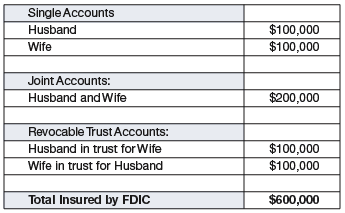
You may also qualify for more than $100,000 in coverage at one insured bank if you own deposit accounts in different ownership categories. For example, here is a way that a husband and wife could qualify for $600,000 in total insurance all at one bank:

altext

What Happens If My Bank Really Fails?
First off, I would note that the FDIC does not notify people that their bank is about to fail or has failed. The only way to you find out is when your debit card gets denied or you walk up to your bank and it has a new name. Here is a list of banks that have failed since October 2000, which includes a summary how it was handled.

The Finance Buff has a good post about what happens when your bank goes out of business. The example given is Metropolitan Savings Bank in Pittsburgh, which the FDIC took over just three months ago.

Here’s the timeline: The FDIC announced the bank’s takeover on Thursday. By Monday the deposits have been taken over by another bank, the branches were re-opened, and the insured people have access to their money again.

But, out of the $12 million in deposits in the bank, there were 30 account holders with total assets of $1.2 million not insured by the FDIC. Those people are now creditors to the receivership of the failed bank, and must wait as the FDIC liquidates the bank’s remaining assets. Waiting on the light fixtures to be sold until you can get any of your money back? Not good.

The takeaways here are

  1. Banks still fail, and without warning.
  2. If your money is insured, it is unlikely any failure will interrupt access to your funds for long. Either another bank will take over (they all want more deposits), or the FDIC will pay out from their reserves.
  3. Never exceed FDIC insurance limits, because you may never see your uninsured money again.

FNBO Direct Offering 6% APY Until 9/28

Update: Please see my FNBO Direct Review for more info!

Rate chasers rejoice! Look likes with the expiration of the HSBC Direct 6% APY promotion yesterday, the online bank FNBO Direct has decided to offer the rate of 0.85% APY as of January, 2013. $1 to open, no monthly minimums, no credit check, previous rate was 5.25% I believe. Anybody use this bank before?

As usual, check out my Ultimate Rate Chaser Calculator to see the potential profit from a move after accounting for transfer time. I hope they don’t pull what Umbrella Bank did – change their guaranteed date from 12/31 to 7/31 a day into the promotion. Thanks Steve for the tip.

What Features Make Up The Ultimate Checking Account?

If you’re comparing checking accounts, what are the features that one should consider? It’s not all about the interest rate. In no particular order, I would want:

Low minimum balance requirement – This helps include more people, and there is less stress about low-balance or maintenance fees.

Consistently high interest rate – I would think that a history of competitive rates and also the ability to keep those rates high yet still be profitable is important. I would guess that this means either restricting the accounts to people comfortable with the internet and thus less likely to need too much hand-holding or human interaction, or having a strong mortgage division.

Easy to make withdrawals – This could mean a large ATM branch network or automatic ATM fee rebates. Free wire transfers and money orders would also be a plus.

Easy to make deposits – Depending on your preference and how often you need checks, here you would need either local ATMs, postage-paid deposit envelopes, or even the new system at a few banks where you can simply scan in your check deposits from home.

Easy to transfer money between banks – This means being able to initiate transfers to other bank accounts through your account with only the routing number and account number. Also, this means being able to access your account by third parties in the same way. On the other hand, maybe some people like this to be restricted for security reasons?

Online interface – Being able to see your account balances clearly at a glance, dependable online BillPay, and a good balance between security and accessibility. Don’t require my passwords to be 18 characters long and a retina scan to log in.

Customer Service – Even though I don’t call in very often, being able to reach a knowledgeable and helpful human when needed in is very important to me. A good online messaging systems is also good for creating a paper trail.

The Rest – Some other things that come to mind are free checks, low or no overdraft fees, overdraft protection, free notary services, extended branch hours, drive-up ATMs, Quicken or MS Money synchronization, return of canceled checks, and free candy at the teller windows 🙂

I feel like I’m still missing something…

My Current Bank Account Setup To Maximize Interest

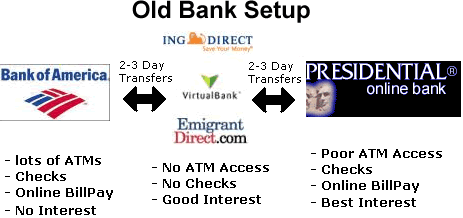
Over a year and a half ago I shared how I juggled my bank accounts to maximize interest. It was the best I could do then, although it was a bit annoying as transfers between banks still took a couple of days.

banksetup.gif

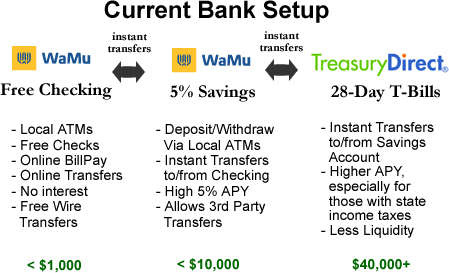
My current set up now involves fewer banks, but I feel it is also both more convenient and earns higher interest. However, whether or not it would work for others depends on their geographic location.

banksetup.gif

Washington Mutual – WaMu has a strong branch presence in my area, and there are also ATMs in the grocery stores. Since they started offering their Free Checking and 5% Savings account combo (must open online; you won’t find this advertised in any branch), I have started using it as my primary account due to the combination of convenience, decent interest, and lack of fees.

I can keep a minimal amount of money in the no-fee checking account for my daily cashflow needs, and then a larger chunk can be kept in the savings account to cover the larger monthly bills paid via scheduled online BillPay transfers. If I need to write a big check or send a wire transfer, I can just move money over from the savings account. Also, I still receive a lot of checks so I like the ability to deposit them directly into my savings account. Overall, this keeps a good chunk of my money instantly accessible yet earning decent interest.

For reference, see my WaMu Free Checking + 5% Savings review and how to fund them directly with existing WaMu accounts.

28-Day Treasury Bill Ladder – Again, this may not work for others because the main draw of T-Bills is that the interest paid is exempt from state and local income taxes, which increases their equivalent yield. For those without state income taxes, they have been yielding around 5.1%-5.3% APY. However, for those that do have such taxes, the equivalent yield is significantly higher. Mine is closer to 5.8%-5.9% APY. Thus, the money I can’t see myself needing in less than 28 days (most of it) is kept here.

In addition, I can link TreasuryDirect to my WaMu savings account, so there is no interest lost during transfers. The money is invested immediately into a Treasury Bill upon withdrawal, and upon maturity the money is immediately deposited back into my savings account.

For more information, please see my entries on converting Treasury Bill auction results to equivalent bank interest rates, and how to build a T-Bill ladder.

Emigrant Direct Signup Bonus Update – February Payouts

Payouts for my Emigrant Direct Referral Bonus went out over the last two weeks for those that either sent me their Form #2’s or Claim Form A’s in February. Please let me know if there are any questions.

Emigrant Direct offers an online savings account paying 5.05% APY with no minimum balance. They allow online transfers to and from up to 4 external checking accounts if you send them a voided check, but not other 3rd party transfers. It only takes $1 to open, and you can make another $10-20 just for signing up through me.

Emigrant Direct No Longer Allows 3rd Party Transfers

Thanks to everyone who let me know about this. I just confirmed with Emigrant Direct that as of about a week ago, they are no longer allowing you to make transfers between their savings account and other external accounts other than the “official” linked checking accounts. Some people are reporting that this only applies to withdrawals, and not deposits. Supposedly, they will be sending out letters about this. Um, why not send them out beforehand?!

This definitely hurts the flexibility of this account, but puts it in line with some other banks like E-Loan. Of course, the stated issue is “security”. But why can I still do these transfers with my other checking and savings accounts from huge banks like Bank of America, Washington Mutual, and Citibank? Anyways, please be warned if you have any transfers like Treasury Bill ladders scheduled.

Are You A “Maestro Of Money Management”?

A friend of mine sent me this link, and I think he was trying to mock me! 😉 It’s an article from the Wall Street Journal entitled Nickel-and-Diming Your Way To Riches, if That’s Your Thing Here’s an excerpt:

I thought I was fairly deft at handling money. But that was before I met the maestros of money management.

We’re talking here about the legions of Americans who manipulate their monthly cash flow like chess masters, along the way snagging frequent-flier miles, cash rewards and interest income.

Am I such a maestro? Are you? Let’s see:

Maestro Activity #1: Maximizing Bank Interest

Consider Dan Goldzband, a cost accountant in San Diego. He has his paycheck deposited directly into a high-yield savings account, where the money sits until he transfers it to his checking account to pay bills. His reward: $35 to $85 in interest each month.

“My checking-account balance rarely exceeds $100,” Mr. Goldzband says. “If it does for more than a couple of days, I am doing something wrong. Of course, only a compulsive like me could make this work. But the general idea, less rigorously applied, would still work for many people.”

Well, my checking account usually hovers around $500-$2,000, because we often have to write paper checks for weddings/graduations/baby showers/birthdays/donations. It’s not writing the checks that’s the problem, it’s that we can never tell when people are actually going to deposit them. Shrug. I also have one free overdraft per year on my Washington Mutual free checking account (review) as a backup anyhow.

But someone is exaggerating… At $35 a month in a 5% APY account, that is suggesting that he would otherwise have $8,000 sitting around earning 0%. ($85 would be $20,000+!) I doubt he needs that much for everyday cashflow. I would bet a good chunk of that is considered his emergency fund or other cushion. Not putting that away into a high-yield saving account would just be silly. The author agrees:

Meanwhile, if your checking account is on the plump side, keep enough there to avoid triggering fees and move the rest into a high-yield savings account or a money-market fund. If you shift $5,000 into an account paying 5%, you will pick up $250 in interest over the next 12 months.

Maestro Activity #2: Credit Card Arbitrage

Don’t have much money in your savings account? No problem. Maestros will borrow from credit cards with 0% introductory rates and then use the money to earn a little interest, often stashing the cash at EmigrantDirect, HSBC Direct or one of the other banks with high-yield online savings accounts.

Okay, I’m definitely guilty of this. I even got so many questions about it that I wrote a detailed, step-by-step Guide On How To Make Money From 0% APR Balance Transfers. Don’t miss the introduction though – this is definitely not for everybody.

Maestro Activity #3: Using Credit Cards But Paying In Full To Reap Rewards

When the maestros aren’t gaming those 0% offers, they’re hunting for the credit cards with the best rewards. Thanks to this strategy, Mr. Bilker says he hasn’t paid to take his family to the movies for two years. He’s also got $500 in convenience-store gift cards, and he garnered a $1,700 discount by charging $17,000 in kitchen remodeling expenses.

For many cardholders, the prize is frequent-flier miles. Bob Smith, a retiree in rural Michigan, has 30 credit cards. He charges everything, from groceries to utility bills, to whichever card is currently paying the highest reward. He figures he and his wife have collected more than 100,000 frequent-flier miles over the past year.

Yes, yes, I do this too. Here are the three cards that I keep in my wallet. The article even admits this may be worth the effort on a smaller scale:

Forget shuffling back and forth between your checking account, your savings account and the latest, greatest credit-card offer. Instead, go for the easy money. Pile your expenses onto a good rewards card and be sure to pay off the balance every month. Let’s say you charge $1,000 a month to a credit card that earns frequent-flier miles. That should give you enough points every two years to get a domestic round-trip ticket worth perhaps $400 — and maybe two or three tickets if the card pays double miles and gives you a sign-up bonus.

Maestro Activity #4: Keep Your Investment Expenses Minimal

Most important, focus first on your portfolio rather than your monthly cash flow. Suppose you revamp your $300,000 mutual-fund portfolio, cutting your annual fund expenses by half a percentage point. That would save you $1,500 a year — without the ongoing hassles that come with juggling credit cards and bank accounts.

Sure, that would be great, except my mutual fund portfolio expenses are already under 0.30% annually. 😛

Nickel and Diming, Huh, Punk?
Actually, I pretty much agree with the premise of the article. As I’ve said before, the time I spent talking about a subject is not directly proportional to how important I think it is. Mentally, I divide them into the big things that help guarantee I’ll reach my goals, and also the small things that will make those goals arrive earlier. Besides, it’s fun to have a profitable hobby. (My other hobbies aren’t cheap!)

Washington Mutual Adds Some Fees… And Freebies Too

As of May 1, 2007, WaMu is rearranging their fee schedule slightly. American Express Traveler’s Checks, ATM Mini-Statements, Money Orders, and Notary signatures will be free. However, it appears that using a non-WaMu ATM will now incur a $2 fee on their end. This works out great for me as I never use non-WaMu ATMs, but getting free money orders and notary signatures will save me a few bucks here and there. Look for a flyer in your most recent bank statement.

Also see: WaMu Free Checking and 5% APY Savings Account Review

Interest Rate Checkup – Online, Brick and Mortar, and Treasury Bills

Here is brief roundup of the top rates for short-term cash accounts with moderate balances.

Online Savings Accounts, No Minimum Balance
HSBC Direct continues it’s 6.0% APY rate on new money until April 30th, and you can open with $1. The highest non-promo rate is from Amtrust Direct at 5.36% APY, although you must open with $1,000. Overall, rates seem to be stable as of late.

Nationwide Brick and Mortar Accounts, No Minimum Balance
Washington Mutual continues to top this area, with their WaMu 5.0% APY Saving Account. You have to open online, but after that it has all the advantages of a local branch savings account; You can transfer instantly to/from their Free Checking account, deposit directly into savings via ATMs or tellers, and take cash directly out via ATMs.

28-Day Treasury Bills Possibly Good Alternative
If you are subject to state income taxes and have cash reserves that you don’t need immediate access to, you should definitely look into Treasury Bills. Rates change weekly, with the most recent auction results showing a 5.267% investment rate. Using my 28-Day T-Bill APR-to-APY calculator with my new Tax Equivalent Yield Calculator, along with an assumed 25% federal/9% state tax bracket, that is the equivalent of a taxable interest rate of 6.12% APY. Treasury Bills are backed by the full faith of the government, and also come in 3-month and 6-month terms.

The downsides to T-Bills include the fact that you will give up some liquidity and they must be bought in $1,000 increments. For more information on how to buy them online and building a T-Bill ladder, please read the posts in my Treasury Bill category archives. Look for a new visual how-to guide coming soon.

Personally, I continue to purchase T-Bills with a portion of my cash balances as I live in Oregon with a 9% state rate. It is actually very easy to have to money transferred to and from your existing high-yield bank account. For example, if you have $30,000 sitting in a bank, you might commit $20,000 to Treasury Bills and keep the rest 100% liquid. It all depends on what you feel comfortable with.

Also see: Rate Chaser Calculator.

Tax Equivalent Yield Calculator For Savings Bonds, Treasury Bills, and Tax-Exempt Money Market Funds

There are many investments out there that are exempt from certain taxes. For example, U.S. Savings Bonds and Treasury Bonds are exempt from state and local income taxes. In addition, there are money market funds available that are exempt from federal income tax and others that are even exempt from a specific state or city’s income taxes.

Therefore, it is desirable to know what the equivalent fully-taxable rate is for one of these investments. For example, is it more profitable to earn a federal tax-exempt interest rate of 3.8% or a fully taxable 5.0%? How about a Treasury Bill paying 4.8%? Several variables affect this rate, including your marginal tax brackets for each area, as well as if you itemize your state and local taxes on your federal tax return. I could not find a calculator that accurately captured all of this, so I made my own.

Tax Equivalent Yield Calculator
(You may need to be on the individual post page for it to work.)

Enter the interest rate: %
Enter your marginal federal income tax rate: %
Enter your marginal state income tax rate (if any): %
Enter your marginal city/local income tax rate (if any): %
Exempt?
Federal Tax-Exempt
State Tax-Exempt
City/Local Tax-Exempt
Itemize?
Do you itemize deductions? Yes
No
Your tax-equivalent rate:   %

Example
Let’s say you live in California, and your marginal federal tax rate is 25%, your state rate is 9.3%, and you have no local income taxes. You do not itemize your taxes. You are trying to compare the taxable Vanguard Prime Money Market Fund (VMMXX, yielding 5.08%), the federally exempt Vanguard Tax-Exempt Money Market Fund (VMSXX, yielding 3.48%), and the state and federal tax-exempt Vanguard California Tax-Exempt Money Market Fund (VCTXX, yielding 3.38%).

With that profile, the tax equivalent 7-day yields would be 4.804% for VMSXX, and 5.145% for VCTXX, making the California Tax-Exempt Fund the best bet currently for this specific situation.

How It Works (Warning: Math Ahead!)
The calculator computes the tax-equivalent rates by comparing after-tax returns. That is:

AfterTaxReturnEquivalentTaxableRate = AfterTaxReturnTaxAdvantagedRate

Using the California Tax-Exempt Fund example above:

EquivalentRate x (1 – FederalTaxes – StateTaxes) = 3.38%
EquivalentRate x (1 – 0.25 – 0.093) = 0.0338
EquivalentRate = 5.145%

So earning 3.38% free from federal and state taxes is the same as earning 5.145% in a fully taxable account.

Note that itemizing deductions means that you deduct your state income taxes from your federal taxable income. The effect is that your overall tax liability is reduced, which lowers the benefit of any tax-exemptions and thus the equivalent rates. That would change the previous equation to:

EquivalentRate x (1 – FederalTaxes – StateTaxes + (FederalTaxes x StateTaxes)) = 3.38%
EquivalentRate = 4.969%

The inclusion of this option may give different results from some of the other online calculators out there, but I believe it makes the results more complete. Another fully-worked-out example can be found here for savings bonds.

Finally, it may be handy to use this in conjunction with my Ultimate Interest Rate Chaser Calculator. Be sure to compare APRs to APRs and APYs to APYs.

Useful Resources
2007 Federal Tax Rates
State Income Tax Rates
Recent Treasury Bill Auction Results
Savings Bonds Rates