Microsoft / Activision Blizzard Merger Arbitrage $10,000 Experiment – Final Results

In January 2022, Microsoft (MSFT) announced an agreement to acquire Activision Blizzard (ATVI) for $95 per share, in an all-cash $68.7 billion transaction. However, the market placed some uncertainty about this event actually happening, which meant the ATVI share price stayed in the $70 to $80 range for most of 2022.

This created a potential event-driven opportunity. If the deal did work out, you would be cashed out at $95 per share, a ~20% premium. In my previous post Warren Buffett’s Activision Merger Arbitrage Deal, I compared his bet to a credit card bonus for us mere mortals. It was small fries to him, but still a fun and profitable thing to do.

As another educational “$10,000 experiment”, I decided to buy roughly $10,000 of ATVI (131 shares @ $76.65) on May 19, 2022.

All I had left to do was wait and see how things would unfold. This was where the education came in. It can be hard to keep holding during a constant stream of media articles about how various powerful governments were trying to block to deal. New blocks and lawsuits usually meant the ATVI stock price dropped a lot. As issues resolved, the stock price would jump back again.

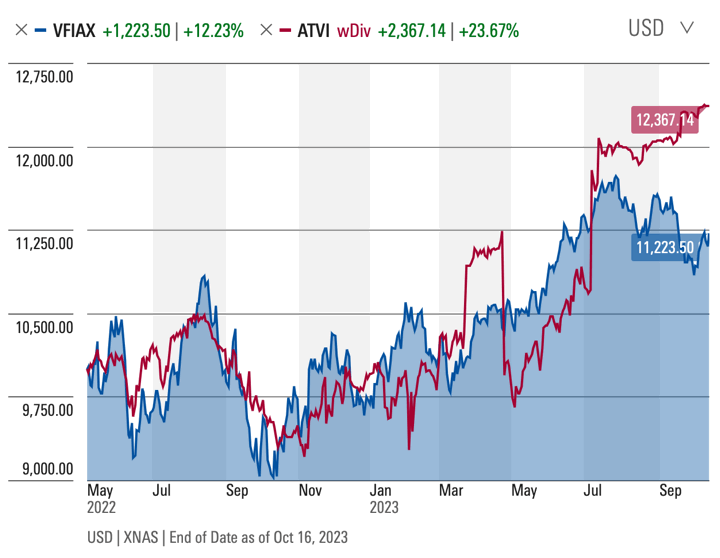
Here is a Morningstar chart that tracked the growth of $10,000 invested in either ATVI (red) or the Vanguard S&P 500 index fund (blue) from May 2022 to October 2023.
The transaction was initially marked to close around June 2023. After lengthy negotiations with US, EU, and UK regulators, the acquisition finally closed on October 18th, 2023 after Microsoft made various concessions and promises to maintain competitiveness in the gaming industry. I received my cash payment on 10/13/23.

Microsoft was a stable buyer and patient negotiator, and Warren Buffett’s instincts that this would eventually work out were correct. In the end, I received an ATVI dividend of $129.69 on 8/17/23 and my final payout of $12,445 ($95 a share x 131 shares):

ATVI never actually traded at the full $95 on the exchanges, so my final numbers were a bit better than the chart above. My net profit on my $10,040 initial investment was $2,534, as compared to the $1,357 that I could have earned from owning the S&P 500 over the same time period. That’s an extra difference of $1,177. Using the XIRR function, I calculated a 17.4% annualized rate of return.

(Side note: Warren Buffett actually sold most of his ATVI stock before this final closing, between Q3 2022 and Q2 2023. I actually don’t know how much he gained from this purchase, it appears he sold a chunk when ATVI was about $85 a share in Q2 2023.)
Best Interest Rates on Cash – October 2023

Here’s my monthly roundup of the best interest rates on cash as of October 2023, roughly sorted from shortest to longest maturities. There are often lesser-known opportunities available to individual investors. Check out my Ultimate Rate-Chaser Calculator to see how much extra interest you could earn from switching. Rates listed are available to everyone nationwide. Rates checked as of 10/10/2023.

TL;DR: Mostly minor movements upwards this month. 6% APY now (barely) available with 12-month CD and rewards checking accounts. More 5%+ savings accounts. Compare against Treasury bills and bonds at every maturity, taking into account state tax exemption.

Fintech accounts
Available only to individual investors, fintech companies often pay higher-than-market rates in order to achieve fast short-term growth (often using venture capital). “Fintech” is usually a software layer on top of a partner bank’s FDIC insurance.

  • 5.27% APY ($1 minimum). Raisin lets you switch between different FDIC-insured banks and NCUA-insured credit unions easily without opening a new account every time, and their liquid savings rates currently top out at 5.27% APY amongst multiple banks. See my Raisin review for details. Raisin does not charge depositors a fee for the service.
  • 5.36% APY (before fees). MaxMyInterest is another service that allows you to access and switch between different FDIC-insured banks. You can view their current banks and APYs here. As of 10/10/23, the highest rate is from Customers Bank at 5.36% APY. However, note that they charge a membership fee of 0.04% per quarter, or 0.16% per year (subject to $20 minimum per quarter, or $80 per year). That means if you have a $10,000 balance, then $80 a year = 0.80% per year. This service is meant for those with larger balances. You are allowed to cancel the service and keep the bank accounts, but then you may lose their specially-negotiated rates and cannot switch between banks anymore.

High-yield savings accounts
Since the huge megabanks STILL pay essentially no interest, everyone should have a separate, no-fee online savings account to piggy-back onto your existing checking account. The interest rates on savings accounts can drop at any time, so I list the top rates as well as competitive rates from banks with a history of competitive rates. Some banks will bait you with a temporary top rate and then lower the rates in the hopes that you are too lazy to leave.

  • The top rate at the moment is at Elevault (app only) at 5.50% APY, but there are catches. I see that it is only valid on balances up to $40k with a $2,500 daily deposit limit? Why? Unsure if that applies to externally-initiated transfers. BrioDirect at 5.35% APY. CIT Platinum Savings at 5.05% APY with $5,000+ balance.
  • SoFi Bank is now up to 4.50% APY + up to $275 new account bonus with direct deposit. You must maintain a direct deposit of any amount each month for the higher APY. SoFi has their own bank charter now so no longer a fintech by my definition. See details at $25 + $250 SoFi Money new account and deposit bonus.
  • There are several other established high-yield savings accounts at 4.25%+ APY that aren’t the absolute top rate, but historically do keep it relatively competitive for those that don’t want to keep switching banks.

Short-term guaranteed rates (1 year and under)
A common question is what to do with a big pile of cash that you’re waiting to deploy shortly (plan to buy a house soon, just sold your house, just sold your business, legal settlement, inheritance). My usual advice is to keep things simple and take your time. If not a savings account, then put it in a flexible short-term CD under the FDIC limits until you have a plan.

  • No Penalty CDs offer a fixed interest rate that can never go down, but you can still take out your money (once) without any fees if you want to use it elsewhere. Raisin has a 16-month No Penalty CD at 5.40% APY with $1 minimum deposit. CIT Bank has a 11-month No Penalty CD at 4.90% APY with a $1,000 minimum deposit. Ally Bank has a 11-month No Penalty CD at 4.55% APY for all balance tiers. Marcus has a 13-month No Penalty CD at 4.60% APY with a $500 minimum deposit. Consider opening multiple CDs in smaller increments for more flexibility.
  • Credit Human Federal Credit Union has a 12-month CD at 6.00% APY. Minimum opening deposit is $500. Early withdrawal penalty is a whopping 270 days interest (or $50, whichever is greater). Anyone can join this credit union via partner organization.

Money market mutual funds + Ultra-short bond ETFs*
Many brokerage firms that pay out very little interest on their default cash sweep funds (and keep the difference for themselves). * Money market mutual funds are regulated, but ultimately not FDIC-insured, so I would still stick with highly reputable firms. I am including a few ultra-short bond ETFs as they may be your best cash alternative in a brokerage account, but they may experience losses.

  • Vanguard Federal Money Market Fund is the default sweep option for Vanguard brokerage accounts, which has an SEC yield of 5.28% (works out to a compound yield of 5.41%, which is better for comparing against APY). Odds are this is much higher than your own broker’s default cash sweep interest rate.
  • The PIMCO Enhanced Short Maturity Active Bond ETF (MINT) has a 5.53% SEC yield and the iShares Short Maturity Bond ETF (NEAR) has a 5.74% SEC yield while holding a portfolio of investment-grade bonds with an average duration of ~6 months.

Treasury Bills and Ultra-short Treasury ETFs
Another option is to buy individual Treasury bills which come in a variety of maturities from 4-weeks to 52-weeks and are fully backed by the US government. You can also invest in ETFs that hold a rotating basket of short-term Treasury Bills for you, while charging a small management fee for doing so. T-bill interest is exempt from state and local income taxes, which can make a significant difference in your effective yield.

  • You can build your own T-Bill ladder at TreasuryDirect.gov or via a brokerage account with a bond desk like Vanguard and Fidelity. Here are the current Treasury Bill rates. As of 10/6/23, a new 4-week T-Bill had the equivalent of 5.43% annualized interest and a 52-week T-Bill had the equivalent of 5.42% annualized interest.
  • The iShares 0-3 Month Treasury Bond ETF (SGOV) has a 5.28% SEC yield and effective duration of 0.10 years. SPDR Bloomberg Barclays 1-3 Month T-Bill ETF (BIL) has a 5.25% SEC yield and effective duration of 0.08 years.

US Savings Bonds
Series I Savings Bonds offer rates that are linked to inflation and backed by the US government. You must hold them for at least a year. If you redeem them within 5 years there is a penalty of the last 3 months of interest. The annual purchase limit for electronic I bonds is $10,000 per Social Security Number, available online at TreasuryDirect.gov. You can also buy an additional $5,000 in paper I bonds using your tax refund with IRS Form 8888.

  • “I Bonds” bought between May 2023 and October 2023 will earn a 4.30% rate for the first six months. The rate of the subsequent 6-month period will be based on inflation again. More on Savings Bonds here.
  • In mid-October 2023, the CPI will be announced and you will have a short period where you will have a very close estimate of the rate for the next 12 months. I will have another post up at that time.
  • See below about EE Bonds as a potential long-term bond alternative.

Rewards checking accounts
These unique checking accounts pay above-average interest rates, but with unique risks. You have to jump through certain hoops which usually involve 10+ debit card purchases each cycle, a certain number of ACH/direct deposits, and/or a certain number of logins per month. If you make a mistake (or they judge that you did) you risk earning zero interest for that month. Some folks don’t mind the extra work and attention required, while others would rather not bother. Rates can also drop suddenly, leaving a “bait-and-switch” feeling.

  • Credit Union of New Jersey pays 6.00% APY on up to $25,000 if you make 15 debit card purchases, opt into online statements, and make at least 1 direct deposit, online bill payment, or automatic payment (ACH) per statement cycle. Anyone can join this credit union via $5 membership fee to join partner organization.
  • Pelican State Credit Union pays 6.05% APY on up to $10,000 if you make 15 debit card purchases, opt into online statements, log into your account at least once, and make at least 1 direct deposit, online bill payment, or automatic payment (ACH) per statement cycle. Anyone can join this credit union via partner organization membership.
  • Orion Federal Credit Union pays 6.00% APY on up to $10,000 if you make electronic deposits of $500+ each month (ACH transfers count) and spend $500+ on your Orion debit or credit card each month. Anyone can join this credit union via $10 membership fee to partner organization membership.
  • Genisys Credit Union pays 5.25% APY on up to $7,500 if you make 10 debit card purchases of $5+ each, and opt into receive only online statements. Anyone can join this credit union via $5 membership fee to join partner organization.
  • The Bank of Denver pays 5.00% APY on up to $25,000 if you make 12 debit card purchases of $5+ each, receive only online statements, and make at least 1 ACH credit or debit transaction per statement cycle. Thanks to reader Bill for the updated info.
  • All America/Redneck Bank pays 5.30% APY on up to $15,000 if you make 10 debit card purchases each monthly cycle with online statements.
  • Find a locally-restricted rewards checking account at DepositAccounts.

Certificates of deposit (greater than 1 year)
CDs offer higher rates, but come with an early withdrawal penalty. By finding a bank CD with a reasonable early withdrawal penalty, you can enjoy higher rates but maintain access in a true emergency. Alternatively, consider building a CD ladder of different maturity lengths (ex. 1/2/3/4/5-years) such that you have access to part of the ladder each year, but your blended interest rate is higher than a savings account. When one CD matures, use that money to buy another 5-year CD to keep the ladder going. Some CDs also offer “add-ons” where you can deposit more funds if rates drop.

  • Farmer’s Insurance FCU has their 3, 6, 9, 12, 18, 24, 36, 48, or 60 month CDs ALL at 5.00% APY for a limited-time. $1,000 minimum. The early withdrawal penalty for all terms longer than a year is 180 days of dividends OR half of the remaining term’s daily dividends, whichever is greater. Anyone can join this credit union via partner organization.
  • United States Senate FCU has a 60-month CD at 4.86% APY $1,000 minimum. Jumbo CDs have slightly higher rates ($100k+, $200k+). The early withdrawal penalty is 360 days of interest. Anyone can join this credit union via partner organization.
  • You can buy certificates of deposit via the bond desks of Vanguard and Fidelity. You may need an account to see the rates. These “brokered CDs” offer FDIC insurance and easy laddering, but they don’t come with predictable early withdrawal penalties. Right now, I see a 5-year non-callable CD at 4.85% APY (callable: no, call protection: yes). Be warned that now both Vanguard and Fidelity will list higher rates from callable CDs, which importantly means they can call back your CD if rates drop later.

Longer-term Instruments
I’d use these with caution due to increased interest rate risk, but I still track them to see the rest of the current yield curve.

  • Willing to lock up your money for 10 years? You can buy long-term certificates of deposit via the bond desks of Vanguard and Fidelity. These “brokered CDs” offer FDIC insurance, but they don’t come with predictable early withdrawal penalties. You might find something that pays more than your other brokerage cash and Treasury options. Right now, I see a 10-year CDs at 4.50% (callable: no, call protection: yes) vs. 4.66% for a 10-year Treasury. Watch out for higher rates from callable CDs where they can call your CD back if interest rates drop.
  • How about two decades? Series EE Savings Bonds are not indexed to inflation, but they have a unique guarantee that the value will double in value in 20 years, which equals a guaranteed return of 3.5% a year. However, if you don’t hold for that long, you’ll be stuck with the normal rate, currently 2.50% for EE bonds issued from May 2023 to October 2023. As of 10/10/23, the 20-year Treasury Bond rate was 5.13%, I’d wait to see what the new rate is for November 2023.

All rates were checked as of 10/10/2023.

Costco Now Sells 1 oz. Gold Bars (But Usually Out of Stock)

Time to clear out some of these browser tabs with interesting/funny stories that have come up this week. First up, Costco has been selling 1 ounce gold bars on its website (only pops up for a second for me), but inventory is sporadic and they sell out quickly (limit 2 per member). Per multiple media articles, the Costco CFO even addressed it in an official quarterly earnings call:

In a quarterly earnings call last week, Costco chief financial officer Richard Galanti told investors that the bars have been flying off the shelves, reported CNBC, saying, “I’ve gotten a couple of calls that people have seen online that we’ve been selling 1 ounce gold bars. Yes, but when we load them on the site, they’re typically gone within a few hours, and we limit two per member.”

At first I thought this was cute, but then I realized that there are multiple ways that the total savings is even more than just the low cost over spot:

  • First, the cost premium over spot is quite low at Costco, lower than other bullion websites.
  • You still earn credit card rewards. Most other bullion websites will add a surcharge if you pay with a credit card.
  • You can earn an additional 2% rewards if you are an Executive member.
  • You get free shipping.
  • Watch out for taxes at checkout. Depending on your area, you may or may not be subject to sales tax for gold bullion purchases over a certain amount. You may need to contact Costco after purchase to receive a refund of sales tax charged.

This could indeed work out to a good deal if you are in the market for gold bullion, but I have a feeling it’s going to be like trying to grab Taylor Swift tickets after this media coverage.

Verizon Wireless Loyalty Discount $10/mo for 12 Months (Targeted)

If you are a Verizon Wireless customer, you may be interested in this Slickdeals forum post by member gcornett that may save you $120 per line on your cellular bill ($10 a month for 12 months). Here are the simple instructions, which should just take a few moments of your time:

YMMV if it will work for you, but here are the steps to make Verizon think you are ready to leave them.

1. Open your My Verizon app.
2. Click on the Account icon at the bottom of the app.
3. Towards the top, it says “Hi (Your Name)” Click on the “Edit Profile and Settings” link underneath that.
4. On the Account Settings screen, scroll down to the Security section and click Number Lock.
5. On the Number Lock screen, turn off the Number Lock for each line. This enables other carriers to port out your line.
6. Go back to the Account Settings screen and click on Number Transfer Pin.
7. Generate a Number Transfer Pin. Since I already did it, I can’t do it again right now in order to give you step-by-step directions. It was easy. You can figure it out.

And that’s it. Wait a day or two and see if Verizon decides you are also a loyal customer worth giving a $10.00 per line loyalty discount for 12 months. YMMV.

Note: After a few days, go back into the app and turn Number Lock back on, so nefarious characters can’t try to port out your phone number without your consent.

I don’t have Verizon myself, but many forum members have reported success. Seems like it’s worth a try to try and trigger this limited-time automated discount as there is no downside risk. Look for text message that says:

Hi, it’s Verizon. Great news! As a way of saying thanks, we are applying a $10/mo discount to every active phone line on your account for the next 12 months. There is no action needed and you’ll see it in the next 1-2 bill cycles. If you have questions please contact *611 to speak with a rep. Thank you for being a loyal customer!

or:

Hi, it’s Verizon. Great news! As a valued customer, you’re eligible for an exclusive loyalty discount on your current Unlimited plan (no plan change required). This is a limited-time offer, visit m.vzw.com/loyal to accept the offer. Thank you.

Tastyworks/Tastytrade ACAT Transfer Bonus: $500 for $25k, $2,000 for $100k, $5,000 for $1M

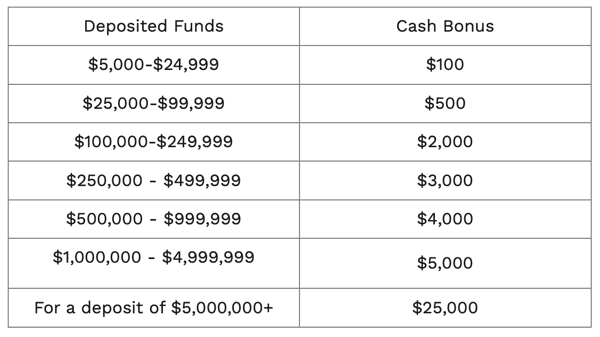
Update: New tiers added with higher bonus values, offer extended. Tastyworks is a discount brokerage targeted at active options traders, as they are cheaper than the big brokers for options trading while also having the full fancy options interface. Right now, they have a up to $25,000 ACAT transfer bonus with promo referral code MYNEWBONUS and you must keep the initial funding there for 12 months.

These ratios are pretty competitive, especially the $2,000 for $100,000 tier (2% of assets), but hey if you have more than that, why not grab more money even at a lower ratio.

New customers who open and fund a tastytrade account with $5,000 or more in cash or by an account transfer (ACATS) and enter MYNEWBONUS into their referral code field when initially registering with tastytrade will receive a cash bonus. The bonus amount is dependent on the initial funding amount. There is a 12-month withdrawal hold on the initial funding amount to retain the cash bonus. You can find each tier’s funding threshold and resulting payout in the table below.

  • $100 with $5,000+ in transferred assets or deposits
  • $500 with $25,000+ in qualifying new money
  • $2,000 with $100,000+ in qualifying new money
  • $3,000 with $250,000+ in qualifying new money
  • $5,000 with $1,000,000+ in qualifying new money
  • $25,000 with $5,000,000+ in qualifying new money

Eligible account types include individual (cash or margin), joint (cash or margin), LLC, Partnerships, S-Corp, C-Corp (cash or margin), and Autotrade enabled accounts. IRAs, trust accounts, and international customers are not eligible. Promotion extended to March 31st, 2024. Note their definitions:

WHEN CAN I WITHDRAW MY AWARDED CASH?
The deposit ($5,000+ cash deposit or account transfer) plus the value of the awarded cash are required to remain in the account for a minimum of 12 months. As mentioned previously, any principal fluctuations due to trading will not preclude you from keeping the awarded position value after 12 months.

IF MY ACCOUNT DROPS BELOW THE FUNDING REQUIREMENT, WILL I BECOME INELIGIBLE?
Principal fluctuations due to trading will not affect your eligibility to keep your awarded cash value. As long as you keep your original $5,000+ deposit in your account, then you will be able to keep your awarded cash.

WILL I BE PENALIZED IF MY ACCOUNT DROPS BELOW MY FUNDING AMOUNT?
Principal value fluctuations are not considered. As long as the initial $5,000 (or more) remains in the account for 12 months, then the awarded cash value will not be debited from your account.

WHAT HAPPENS IF I NEED TO WITHDRAW MY DEPOSIT BEFORE THE 12-MONTH HOLDING PERIOD END?
You are free to withdraw the deposit you made to your account. However, if the amount withdrawn no longer meets the minimum deposit requirements, then the value of the awarded stock position will be withheld from the withdrawal amount.

CAN I TRANSFER THE CASH OUT OF MY ACCOUNT?
Not until the 12-month hold period has lapsed.

Brokerage Asset Bonuses vs. Bank Deposit Bonuses. There is an important difference between brokerage asset bonuses and bank deposit bonuses. A bank deposit bonus pays you extra interest for holding a certain amount of cash with them. A brokerage asset bonus allows you to transfer over your existing investments like index funds, individual shares of Apple or Berkshire Hathaway, individual shares of REITs, and so on. You still own the asset and it’s still doing its thing. The brokerage bonus is on top.

In this example, if you really wanted to compare it directly against an interest rate, you should at least assume you will be holding a T-Bill ETF like SGOV, GBIL, or BIL (current SEC yield over 5%) and then adding the bonus to that yield. However, the real benefit for patient, long-term investors that you can just keep your existing assets and earn yourself a nice “self-management fee”.

Project Gutenberg + AI = Free High-Quality Audiobook Classics

Project Gutenberg is well-known as a volunteer-driven, non-profit project that digitizes free public-domain books, mostly those whose copyright has expired. However, their eBooks were often uncomfortable to read as plain text. Standard eBooks took the most popular ones and improved the typography and device-specific formatting, such that they look as modern as other retail eBooks.

The Project Gutenberg Open Audiobook Collection is a new collaboration between Project Gutenberg, Microsoft AI, and MIT to create audiobooks with natural-sounding speech using neural text-to-speech technology. I wouldn’t say it perfectly matches that of a trained voice actor, but it is certainly a huge improvement over the old robotic voice. I recently read Call of the Wild by Jack London as it was on my kid’s summer reading list, and you can compare the different versions yourself.

Here is the current full list of available audiobooks. You can also find them on Google Podcats, Apple Podcasts, and Spotify. This makes it much easier to listen to classic books during your commute and also for the visually-impaired.

For some title ideas, check out this list of the most downloaded Project Gutenburg eBooks. Here are the top 10 right now:

  • Frankenstein; Or, The Modern Prometheus by Mary Shelley
  • Romeo and Juliet by William Shakespeare
  • Pride and Prejudice by Jane Austen
  • The Scarlet Letter by Nathaniel Hawthorne
  • Dracula by Bram Stoker
  • Alice’s Adventures in Wonderland by Lewis Carroll
  • The Yellow Wallpaper by Charlotte Perkins Gilman
  • A Doll’s House : a play by Henrik Ibsen
  • Moby Dick; Or, The Whale by Herman Melville
  • The Picture of Dorian Gray by Oscar Wilde

US Bank Business Checking: Up to $800 Bonus

US Bank has up to a $800 bonus when you open a new Business Checking account using the promo code Q3BUS23 and complete the following activities. Offer valid through October 31, 2023.

  • Open a U.S. Bank Business Checking account (Silver, Gold, Platinum). The lowest Silver tier has no monthly maintenance fee and includes 125 free transactions per month.
  • Deposit $5,000 or $25,000 in new money within 30 days of account opening and then maintain your balance until the 60th day after account opening. .

Your bonus is determined by the total amount of your deposits:

  • Earn $350 when you deposit $5,000.
  • Earn $800 when you deposit $25,000.

This offer may be restricted to those states where US Bank has a physical branch presence. In addition, sometimes people outside this footprint may be allowed to open an account if they have other US Bank products. They’ll tell you when you apply, early on in the process, if your address is not allowed.

The business checking bonus will be deposited into your new U.S. Bank Silver, Gold, or Platinum Business Checking account within 30 days following the last calendar day of the month you complete all the offer requirements, as long as the account is open and has a positive available balance.

Here is their definition of “new” account:

Offer is not valid if you or any signer on the new business checking account have an existing U.S. Bank Business Checking account or had a U.S. Bank Business Checking account in the last 24 months.

Thanks to Dividend Growth Investor for the tip.

This is for business checking accounts (their personal checking offer is different each month) but this offer is worth a mention due to the relatively big bonus combined with a reasonable minimum holding period. Earning $350 for holding $5,000 for 60 days is roughly a 42% annualized return. Earning $800 for holding $25,000 for 60 days is roughly a 19% annualized return. Self-employed business owners can open a business checking account for themselves as a sole proprietorship or LLC.

TradeStation Brokerage: $150 Bonus with $500 Deposit

TradeStation is a brokerage targeted at active traders of stocks, ETFs, stock options, futures, and futures options. Right now they have a $150 bonus promotion when you deposit $500 or more into a new TradeStation Securities account with promo code BRAVAGDC:

Get an extra $150 in your account when you deposit $500 or more into a new TradeStation Securities account. Open a TradeStation account using offer code BRAVAGDC and maintain a minimum balance of $500 and look out for your reward. Additional terms apply.*

You may need to take a picture of your driver’s license during the application process, using your smartphone. I was able to get approved instantly and fund via a Plaid ACH link and transfer.

You don’t need to place any trades to qualify for this bonus, but you do need to keep your deposit there for 2 months after the funding date (first $75 bonus payment) and then until 3 months after funding date (second $75 payment). Therefore you may wish to buy something at least with your funds, like SGOV which holds short-term Treasury Bills at $100.xx per share.

Here is their fee schedule. Note that there is a $10 monthly activity fee unless one of the following criteria are met (I believe that this does not apply during first 90 days, but will once there is 90 days of inactivity): $5,000 average end-of-month equity balance OR at least ten (10) trades placed during the previous 90-day period.

The bid-ask spread for SGOV is only $0.01 on most days. Each share is only a little over $100. I plan on transferring about $505 and simply buying 1 share at a time, and then selling one share at a time, just enough to satisfy the activity requirements. I also plan to hold overnight to avoid daytrading restrictions.

Offer found via DoC. Full terms and conditions:

Only New Entity (non-Institutional) Individual or Joint equities and futures accounts with the correct promotional code entered and initially funded with New Assets (as defined below) of $500.00 or greater are eligible for this cash offer. To qualify, you must enroll by entering the promotional code on new account application or request to enroll a new account, via telephone or email, with a TradeStation Representative. You must initially fund the Account with New Assets within 45 calendar days of Account enrollment. New Assets is defined as cash or securities held at a financial institution other than TradeStation (assets transferred from an existing TradeStation account do not qualify). Your Account will not qualify for the cash offer if you withdraw or transfer assets from your Account, then redeposit them into the Account. Asset fluctuations (up or down) do not affect the calculation of Qualifying Assets. Minimum funding of $500 must be maintained through month following account fund date for first payment and through the next month for subsequent payment. The cash offer will be determined based on Qualifying Assets in the Account as follows:

Less than $500.00 – cash reward of $0;
$500 or more – 2 cash rewards of $75 (total of $150).

Cash reward will be paid out in monthly increments of $75. First deposit of $75 into the Account will be two months following the account fund date. Each subsequent credit will post in following month of qualification. This offer is not affiliated with TradingView and a subscription to TradingView is not required for qualification. This offer cannot be combined with any other offers. Only one offer per client on one qualifying account. Existing clients are not eligible for this offer. Customers who receive promotional offers from any TradeStation affiliate may be subject to IRS Form 1099-MISC reporting requirements should the total value of those items exceed $599 in a calendar year. Please consult a tax professional.

Another drop in my 2023 IRA $6,500 challenge bucket.

Michigan MESP 529 College Savings Plan: $100 Bonus Per Accountholder/Beneficiary Combo

The Michigan Education Savings Program (MESP) is offering a $100 bonus when you open a new account by 9/30/23 and deposit $1,000+ within 10 business days of establishing the account. Your $100 matching deposit will arrive by 1/31/24. The 529 account must be open with a non-zero balance to receive the bonus.

Compared to all 529 plans nationwide, MESP is a top overall plan with reasonable costs and good investment options (official plan of Michigan, run by TIAA-CREF), making it an excellent option for those without specific in-state tax incentives. See here to compare 529 tax benefits across all 50 states.

This offer is very similar to the ScholarShare 529 promo, as both are managed by TIAA-CREF and this also has a limit of “one (1) Matching Deposit pernew Michigan Education Savings Program (MESP) account per unique accountholder/beneficiary combination.” Please see that post for more background information. Additional considerations for this promo:

  • Michigan taxpayers may qualify for a state tax deduction up to $10,000 if married filing jointly ($5000 single), for contributions made into an MESP account.
  • You should be able to stack this with other 529 offers like that from California Scholarshare. If you have multiple 529 accounts from different state plans/managers, you can later transfer the balances and merge them into each other, although there may be a modest amount of paperwork required each time. You are allowed one rollover per beneficiary during a rolling 12-month period.

From the full fine print:

Offer Description: The Michigan Education Savings Program (MESP) is a 529 college saving splan administered bythe Michigan Department of Treasury, and managed by TIAA-CREF Tuition Financing, Inc. (“TFI”). To receive a $100 matching deposit (“the Matching Deposit”), eligible individuals must (a) open a new Michigan Education Savings Program (MESP) account (for a new beneficiary) online at www.MIsaves.com between September 1, 2023 at 12:01 AM Eastern Time (ET) and September 30, 2023 at 11:59 PM ET with an initial deposit of at least $1,000 to be contributed and invested at the time the new Michigan Education Savings Program (MESP) account is opened. The initial $1,000 deposit must be received within 10 business days after the account is established. The Matching Deposit will be made to the eligible Michigan Education Savings Program (MESP) account on or before 8:59 PM ET on January 31, 2024. To receive the Matching Deposit, the Michigan Education Savings Program (MESP) account must be open with a dollar balance greater than zero on the day the Matching Deposit is made. Limit: one (1) Matching Deposit per new Michigan Education Savings Program (MESP) account per unique accountholder/beneficiary combination.

Oklahoma 529 College Savings Plan: $50/$100 Bonus Per Beneficiary

The Oklahoma 529 College Savings Plan is offering a $50 or $100 bonus when you open a new account and meet these deposit requirements:

  • $50 bonus: Open with a minimum initial deposit of $250 and set up recurring contributions via bank account or direct deposit) of $50 or more per month until 3/31/2024.
  • $100 bonus: Open with a minimum initial deposit of $500 and set up recurring contributions (via bank account or direct deposit) of $100 or more per month until 3/31/2024. Note that the info on the offer page conflicts with the fine print.
  • After six months, your $50 or $100 bonus will be deposited in your account on or before 5/17/2024.

Compared to all 529 plans nationwide, MESP is an above-average overall plan with reasonable costs and investment options (official plan of Oklahoma, run by TIAA-CREF), making it an acceptable option for those without specific in-state tax incentives. See here to compare 529 tax benefits across all 50 states.

Note that this offer has a limit of “Only one Matching Deposit per new Oklahoma 529 account per beneficiary”, which is more restrictive than the ScholarShare 529 bonus promo. Please see that post for more background information. Additional considerations for this promo:

  • Oklahoma taxpayers may qualify for a state tax deduction up to $20,000 if married filing jointly ($10,000 single) for contributions made into Oklahoma 529 account.
  • You should be able to stack this with other 529 offers like that from California Scholarshare. If you have multiple 529 accounts from different state plans/managers, you can later transfer the balances and merge them into each other, although there may be a modest amount of paperwork required each time. You are allowed one rollover per beneficiary during a rolling 12-month period.

From the full fine print:

PROMOTION DESCRIPTION: To receive a $50 promotion deposit (“the Promotion Deposit”), eligible individuals must (a) open a new Oklahoma 529 account (for a new unique Account Owner/Beneficiary combination) online during the Promotion Period with an initial deposit of at least $250 to be contributed and invested at the time the new account is opened and (b) establish a recurring contribution (from a bank account or by payroll direct deposit) for the new account of at least $50 per month, and shall be maintained at minimum through 11:59 PM CT on March 31, 2024. The Promotion Deposit will be made to the eligible account on or before May 17, 2024.

To receive a $100 promotion deposit, eligible individuals must: a) open a new Oklahoma 529 account (for a new unique Account Owner/Beneficiary combination) online during the Promotion Period with an initial deposit of at least $500 to be contributed and invested at the time the new account is opened and (b) establish a recurring contribution (from a bank account or by payroll direct deposit) for the new account of at least $100 per month, and shall be maintained at minimum through 11:59 PM CT on March 31, 2024. The Promotion Deposit will be made to the eligible account on or before May 17, 2024.

Limit: Only one Matching Deposit per new Oklahoma 529 account per beneficiary. Void where prohibited or restricted by law.

Schwab Cash Sweep Options – Increase Yield 10X, Updated September 2023

Updated September 2023. Charles Schwab became a major player by offering discounted stock trades back when high commissions were the norm. These days, nearly every broker offers $0 commission trades on online equity/ETF trades. Where they differ is how they choose to squeeze out profit in such a lean environment. Even though Schwab will deny it publicly, they have chosen in many cases to focus on earning interest from their customers’ idle cash as one of their major sources of revenue.

Chase, Bank of America, Wells Fargo, they all make money by making money off your idle checking account balances while paying you nothing or 0.01% APY. They could all pay you more interest, but they don’t. This is why I post regular updates and monthly summaries of better banking options.

However, Schwab has the worst default cash sweep option for cash sweep amongst the “Big Three” brokerage firms by asset size (Vanguard, Fidelity, Schwab). Their mandatory default cash sweep pays only 0.48% APY as of 9/6/23.

For comparison, Vanguard’s default cash sweep is the Vanguard Federal Money Market Fund, which has an SEC yield of 5.27% as of 9/6/23. If I make a sale or receive a dividend distribution, my Vanguard cash automatically waits in this low-cost fund and earns a competitive interest rate. I may complain about how Vanguard is slipping in the customer service area, but this feature by itself is a major reason that I maintain my Vanguard brokerage account.

Fidelity has a FDIC cash sweep available as well, but they also let me switch my “core position” (their term for default cash sweep) to a higher-yield money market fund like Fidelity Treasury Money Market Fund (FZFXX) which has an SEC yield of 4.97% as of 9/6/23 or Fidelity Government Money Market Fund (SPAXX) which has an SEC yield of 4.97% as of 9/6/23. I find it amusing that Schwab was so chippy with Fidelity in this old article Zero Confusion: Setting the Record Straight. There is a reason why Schwab places that “one click” wall between you and a higher APY.

In the end, the most important thing is for you as the customer to understand the situation. Schwab still has other positive attributes and a reputation for good customer service. The good news is that there are several options for self-motivated individuals (like you that read posts like this!) who are willing to put forth a little effort to earn what could add up to hundreds or thousands in extra interest.

Manually invest in Schwab money market funds. The key is to visit this page: Schwab Purchased Money Funds for the most current fund options, minimums, and rates. These are not FDIC-insured, but they are still regulated by the SEC and required to hold very safe investments of a very short duration. Here the the available Schwab funds and SEC yields as of 9/5/23 with zero minimums. No transaction fees. There are higher-yielding options if you have more than $1 million.

  • Schwab Value Advantage Money Fund® – Investor Shares (SWVXX) 5.23%
  • Schwab Government Money Fund – Investor Shares (SNVXX) 5.05%
  • Schwab Treasury Obligations Money Fund – Investor Shares (SNOXX) 5.06%
  • Schwab U.S. Treasury Money Fund – Investor Shares (SNSXX) 5.03%

Again, these money market mutual funds can’t be set as an automatic sweep; you must manually move money in and out of the product. Every time you have a dividend or capital gains distribution, or you made a sale, you have to remember to move your cash (“sort”) into a higher-yielding option. This also means that if you want to for example buy new shares of stock, you would need to first put in an order to sell your money market mutual fund shares into cash (in order to have the funds available to buy that stock). The system won’t be able to automatically sell your fund. You’ll have to coordinate settlement times, and it may be helpful to have a margin account for faster funds availability.

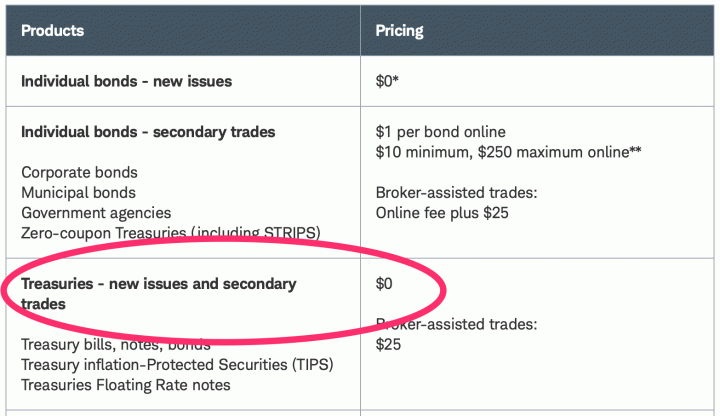
Treasury bills (auction and secondary). You can buy US Treasury bills and bonds directly through the Schwab fixed income desk. You can place either an auction order for a “new” T-Bill or buy them on the secondary market. There is no commission for online orders and a $25 fee per broker-assisted trade.

Buying an outside ETF. You can also use your free stock trades to buy an ETF that is close to cash (ultra-short duration, high-quality bonds). These will not be FDIC-insured and carry a bit of duration risk, but if your ETF holds T-Bills then those are also fully backed by the US government. Here are a few ideas (note the the reported rates may lag by up to one month):

  • The iShares 0-3 Month Treasury Bond ETF (SGOV) has an effective duration of 0.10 years. SPDR Bloomberg Barclays 1-3 Month T-Bill ETF (BIL) has an effective duration of 0.08 years.
  • The PIMCO Enhanced Short Maturity Active Bond ETF (MINT) and the iShares Short Maturity Bond ETF (NEAR) hold a portfolio of investment-grade bonds with an average duration of ~6 months.

Bottom line. Charles Schwab has a default cash sweep option with a relatively tiny interest rate. To earn more, you must do some research and manually buy one of the alternatives listed above that can earn ~10x more.

Best Interest Rates on Cash – September 2023

Here’s my monthly roundup of the best interest rates on cash as of September 2023, roughly sorted from shortest to longest maturities. There are often lesser-known opportunities available to individual investors. Check out my Ultimate Rate-Chaser Calculator to see how much extra interest you could earn from switching. Rates listed are available to everyone nationwide. Rates checked as of 9/5/2023.

TL;DR: Mostly minor movements this month. 6% APY now (barely) available with 12-month CD special and rewards checking accounts. Compare against Treasury bills and bonds at every maturity, taking into account state tax exemption.

Fintech accounts
Available only to individual investors, fintech companies often pay higher-than-market rates in order to achieve fast short-term growth (often using venture capital). “Fintech” is usually a software layer on top of a partner bank’s FDIC insurance.

  • 5.26% APY ($1 minimum). SaveBetter lets you switch between different FDIC-insured banks and NCUA-insured credit unions easily without opening a new account every time, and their liquid savings rates currently top out at 5.26% APY from multiple banks. See my SaveBetter review for details. SaveBetter does not charge a fee to switch between banks.
  • 5.30% APY (before fees). MaxMyInterest is another service that allows you to access and switch between different FDIC-insured banks. You can view their current banks and APYs here. As of 8/7/23, the highest rate is from Customers Bank at 5.30% APY. However, note that they charge a membership fee of 0.04% per quarter, or 0.16% per year (subject to $20 minimum per quarter, or $80 per year). That means if you have a $10,000 balance, then $80 a year = 0.80% per year. This service is meant for those with larger balances. You are allowed to cancel the service and keep the bank accounts, but then you may lose their specially-negotiated rates and cannot switch between banks anymore.

High-yield savings accounts
Since the huge megabanks STILL pay essentially no interest, everyone should have a separate, no-fee online savings account to piggy-back onto your existing checking account. The interest rates on savings accounts can drop at any time, so I list the top rates as well as competitive rates from banks with a history of competitive rates. Some banks will bait you with a temporary top rate and then lower the rates in the hopes that you are too lazy to leave.

  • The top rates at the moment are at Valley Direct and Milli.bank (app-only) at 5.25% APY. CIT Platinum Savings at 5.05% APY with $5,000+ balance.
  • SoFi Bank is now up to 4.50% APY + up to $275 new account bonus with direct deposit. You must maintain a direct deposit of any amount each month for the higher APY. SoFi has their own bank charter now so no longer a fintech by my definition. See details at $25 + $250 SoFi Money new account and deposit bonus.
  • There are several other established high-yield savings accounts at 4.25%+ APY that aren’t the absolute top rate, but historically do keep it relatively competitive for those that don’t want to keep switching banks.

Short-term guaranteed rates (1 year and under)
A common question is what to do with a big pile of cash that you’re waiting to deploy shortly (plan to buy a house soon, just sold your house, just sold your business, legal settlement, inheritance). My usual advice is to keep things simple and take your time. If not a savings account, then put it in a flexible short-term CD under the FDIC limits until you have a plan.

  • No Penalty CDs offer a fixed interest rate that can never go down, but you can still take out your money (once) without any fees if you want to use it elsewhere. CIT Bank has a 11-month No Penalty CD at 4.90% APY with a $1,000 minimum deposit. Ally Bank has a 11-month No Penalty CD at 4.55% APY for all balance tiers. Marcus has a 13-month No Penalty CD at 4.50% APY with a $500 minimum deposit. Consider opening multiple CDs in smaller increments for more flexibility.
  • American 1 Credit Union has a 12-month CD special at 6.00% APY. Probably won’t last long. Minimum opening deposit is $1,000. Early withdrawal penalty is 90 days interest. Anyone can join this credit union via $3 membership fee to join partner organization (must also keep $5 in share savings).
  • MapleMark Bank has a 12-month certificate at 5.75% APY. Also a limited-time offer. $25,000 minimum. Early withdrawal penalty is 6 months interest.

Money market mutual funds + Ultra-short bond ETFs*
Many brokerage firms that pay out very little interest on their default cash sweep funds (and keep the difference for themselves). * Money market mutual funds are regulated, but ultimately not FDIC-insured, so I would still stick with highly reputable firms. I am including a few ultra-short bond ETFs as they may be your best cash alternative in a brokerage account, but they may experience losses.

  • Vanguard Federal Money Market Fund is the default sweep option for Vanguard brokerage accounts, which has an SEC yield of 5.28%. Odds are this is much higher than your own broker’s default cash sweep interest rate.
  • The PIMCO Enhanced Short Maturity Active Bond ETF (MINT) has a 5.52% SEC yield and the iShares Short Maturity Bond ETF (NEAR) has a 5.57% SEC yield while holding a portfolio of investment-grade bonds with an average duration of ~6 months.

Treasury Bills and Ultra-short Treasury ETFs
Another option is to buy individual Treasury bills which come in a variety of maturities from 4-weeks to 52-weeks and are fully backed by the US government. You can also invest in ETFs that hold a rotating basket of short-term Treasury Bills for you, while charging a small management fee for doing so. T-bill interest is exempt from state and local income taxes, which can make a significant difference in your effective yield.

  • You can build your own T-Bill ladder at TreasuryDirect.gov or via a brokerage account with a bond desk like Vanguard and Fidelity. Here are the current Treasury Bill rates. As of 9/5/23, a new 4-week T-Bill had the equivalent of 5.38% annualized interest and a 52-week T-Bill had the equivalent of 5.43% annualized interest.
  • The iShares 0-3 Month Treasury Bond ETF (SGOV) has a 5.36% SEC yield and effective duration of 0.10 years. SPDR Bloomberg Barclays 1-3 Month T-Bill ETF (BIL) has a 5.18% SEC yield and effective duration of 0.08 years.

US Savings Bonds
Series I Savings Bonds offer rates that are linked to inflation and backed by the US government. You must hold them for at least a year. If you redeem them within 5 years there is a penalty of the last 3 months of interest. The annual purchase limit for electronic I bonds is $10,000 per Social Security Number, available online at TreasuryDirect.gov. You can also buy an additional $5,000 in paper I bonds using your tax refund with IRS Form 8888.

  • “I Bonds” bought between May 2023 and October 2023 will earn a 4.30% rate for the first six months. The rate of the subsequent 6-month period will be based on inflation again. More on Savings Bonds here.
  • In mid-October 2023, the CPI will be announced and you will have a short period where you will have a very close estimate of the rate for the next 12 months. I will have another post up at that time.
  • See below about EE Bonds as a potential long-term bond alternative.

Rewards checking accounts
These unique checking accounts pay above-average interest rates, but with unique risks. You have to jump through certain hoops which usually involve 10+ debit card purchases each cycle, a certain number of ACH/direct deposits, and/or a certain number of logins per month. If you make a mistake (or they judge that you did) you risk earning zero interest for that month. Some folks don’t mind the extra work and attention required, while others would rather not bother. Rates can also drop suddenly, leaving a “bait-and-switch” feeling.

  • Credit Union of New Jersey pays 6.00% APY on up to $25,000 if you make 15 debit card purchases, opt into online statements, and make at least 1 direct deposit, online bill payment, or automatic payment (ACH) per statement cycle. Anyone can join this credit union via $5 membership fee to join partner organization.
  • Pelican State Credit Union pays 6.05% APY on up to $10,000 if you make 15 debit card purchases, opt into online statements, log into your account at least once, and make at least 1 direct deposit, online bill payment, or automatic payment (ACH) per statement cycle. Anyone can join this credit union via partner organization membership.
  • Orion Federal Credit Union pays 6.00% APY on up to $10,000 if you make electronic deposits of $500+ each month (ACH transfers count) and spend $500+ on your Orion debit or credit card each month. Anyone can join this credit union via $10 membership fee to partner organization membership.
  • Genisys Credit Union pays 5.25% APY on up to $7,500 if you make 10 debit card purchases of $5+ each, and opt into receive only online statements. Anyone can join this credit union via $5 membership fee to join partner organization.
  • The Bank of Denver pays 5.00% APY on up to $25,000 if you make 12 debit card purchases of $5+ each, receive only online statements, and make at least 1 ACH credit or debit transaction per statement cycle. Thanks to reader Bill for the updated info.
  • All America/Redneck Bank pays 5.30% APY on up to $15,000 if you make 10 debit card purchases each monthly cycle with online statements.
  • Find a locally-restricted rewards checking account at DepositAccounts.

Certificates of deposit (greater than 1 year)
CDs offer higher rates, but come with an early withdrawal penalty. By finding a bank CD with a reasonable early withdrawal penalty, you can enjoy higher rates but maintain access in a true emergency. Alternatively, consider building a CD ladder of different maturity lengths (ex. 1/2/3/4/5-years) such that you have access to part of the ladder each year, but your blended interest rate is higher than a savings account. When one CD matures, use that money to buy another 5-year CD to keep the ladder going. Some CDs also offer “add-ons” where you can deposit more funds if rates drop.

  • United States Senate FCU has a 60-month CD at 4.86% APY $1,000 minimum. Jumbo CDs have slightly higher rates ($100k+, $200k+). The early withdrawal penalty is 360 days of interest. Anyone can join this credit union via partner organization.
  • Dept of Commerce FCU has a 60-month CD at 4.67% APY $500 minimum. The early withdrawal penalty is 180 days of interest. Anyone can join this credit union via partner organization.
  • You can buy certificates of deposit via the bond desks of Vanguard and Fidelity. You may need an account to see the rates. These “brokered CDs” offer FDIC insurance and easy laddering, but they don’t come with predictable early withdrawal penalties. Right now, I see a 5-year non-callable CD at 4.65% APY (callable: no, call protection: yes). Be warned that now both Vanguard and Fidelity will list higher rates from callable CDs, which importantly means they can call back your CD if rates drop later.

Longer-term Instruments
I’d use these with caution due to increased interest rate risk, but I still track them to see the rest of the current yield curve.

  • Willing to lock up your money for 10 years? You can buy long-term certificates of deposit via the bond desks of Vanguard and Fidelity. These “brokered CDs” offer FDIC insurance, but they don’t come with predictable early withdrawal penalties. You might find something that pays more than your other brokerage cash and Treasury options. Right now, I see a 10-year CDs at 4.35% (callable: no, call protection: yes) vs. 4.28% for a 10-year Treasury. Watch out for higher rates from callable CDs where they can call your CD back if interest rates drop.
  • How about two decades? Series EE Savings Bonds are not indexed to inflation, but they have a unique guarantee that the value will double in value in 20 years, which equals a guaranteed return of 3.5% a year. However, if you don’t hold for that long, you’ll be stuck with the normal rate, currently 2.50% for EE bonds issued from May 2023 to October 2023. As of 9/5/23, the 20-year Treasury Bond rate was 4.56%.

All rates were checked as of 9/5/2023.