PFS Buyers Club: New US Mint Coin Deal (Now $155+ Net Profit, August 2021)

(Updated: The commission has increased to $145.05, a $60 increase from the initial offer.)

Another new coin deal August 3rd, 2021. PFS Buyers Club has another coin deal on two limited edition Morgan Silver Dollars. See details below.

Background (skip if already familiar). The US Mint regularly releases limited-edition coins to collectors. The coin sets are often limited by household, but end up worth more than the initial cost. PFS Buyers Club is a website broker that recruits regular folks to buy their allotted coin set with a set markup amount, with the agreement that they will sell it directly to PFS Buyers Club. For example, you might pay $300 for a coin and they’ll agree to pay you $350 for it (including prepaid mailing label) – a fixed profit of $50.

I believe the closest analogy is to other collectibles like limited-edition Nike shoe drops. The US Mint benefits from the scarcity, and can continue to sell these collectibles at a profit far above the minting cost.

Deal details: On Tuesday, August 3rd at 12:00 pm Noon Eastern Time, there is a new fixed profit opportunity. Two limited edition Morgan Silver Dollars are being released, with each one having a purchase limit of three per household (2 coins x 3 sets of each = 6 coins max). The cost of each Silver Dollar is $85.00, times six coins plus $4.95 shipping charge, for a total of $514.95.

Total net profit opportunity of $155+. PFS will pay you a fixed commission of $85.05 now $145.05 for a full 6-coin order, on top of your cost for the set. ($660 total.) You’ll also earn credit card rewards on your ~$500 purchase (worth another ~$10 here at 2% cash back), or also possibly satisfying the requirements for some $500+ value credit card bonuses. This makes the net profit at least $155.

I have had reports of the Fidelity 2% back card not awarding points on US Mint purchases. I have used a BofA card (earning an effective 2.6% back with Preferred Rewards) without issue. AmEx says they don’t award points for bullion and precious metal, but in my experience US Mint purchases are not coded as bullion or precious metal. You may still choose to avoid them to be safe.

Note that the eventual value of the set may exceed that elsewhere – you may be able to get more on eBay, for example – but if you want to make that bet, don’t promise to sell to PFS Buyers Club. Just buy it on your own and try to sell it yourself. Keep in mind that eBay seller fees can be quite high, you run the risk of the buyer claiming you sent them a box of pennies, and you’ll be responsible for other costs like the proper shipping with adequate insurance. The PFS Buyers Club price includes a free prepaid mailing label (including insurance) and they will pay you via eCheck (no fees), paper check, or PayPal.

Here are the two coins: Morgan 2021 Silver Dollar w/ D Mark and Morgan 2021 Silver Dollar w/ S Mark. In May, they offered the Morgan coins with the O and CC Mint marks.

Note: This coin is not expected to ship until October, but they also won’t charge your card until October. But be around that you’ll need to be around to receive the package and then drop it off at FedEx.

My past experience. I used PFS back in March for the first time, and everything went smoothly and I was paid my money in full without issue. The amount of communication was great and better than expected; I was kept up-to-date every step of the way. The total time commitment was about 30 minutes for $400+ profit, including the stop at the Fedex store to drop off the box with prepaid label. The eCheck option worked great – I printed the check out at home and deposited immediately via mobile app. PFS has a very solid reputation online, and I referred several blog readers last time and did not receive a single complaint. The primary issue is that the coins usually sell out quick, so you have to be fast.

If you want to jump on this, you can sign up to join PFS Buyers Club here. Sometimes these deals fill up, so I would sign-up and opt-in sooner rather than later. You can still opt out of the deal until an hour prior to the coins going on sale. PFS will provide *very* detailed instructions. Read them ahead of time, and follow them carefully to help you buy the coin before it sells out. If you use that link as a first-time buyer, I will receive a referral fee the first time you successfully sell your coin for a profit. Thanks for those that use it, and for those that already used it in the past. I will be opting in myself as well.

PFS Buyers Club: New US Mint Coin Arbitrage Opportunity ($300+ Net Profit, July 2021)

New deal July 29th, 2021. The US Mint regularly releases limited-edition coins to collectors. The coin sets are often limited to one per household, but end up worth more than the initial cost. PFS Buyers Club is a website broker that recruits regular folks to buy their allotted coin set with a set markup amount, with the agreement that they will sell only to PFS Buyers Club. For example, you might pay $300 for a coin and they’ll agree to pay you $350 for it – a fixed profit of $50.

On Thursday, July 29th at 12:00 pm Noon Eastern Time, there is a new guaranteed profit opportunity. A limited edition American Eagle Four-Coin Set will be released then, with a purchase limit of one per household. The cost of the Four-Coin Set should be either $4,962.50 or $5,055.00 (depends on the spot price of Gold on 7/28). Shipping will cost $4.95.

PFS will pay you a fixed commission of $200.05 for each Four-Coin Set, on top of your cost for the set.

You’ll also earn credit card rewards on your ~$5,000 purchase (worth another ~$100 here at 2% cash back), or also possibly satisfying the requirements for some $500+ value credit card bonuses. This makes the total net profit safely over $300.

Note that the eventual value of the set may exceed that elsewhere – you may be able to get more than $200 extra for each coin on eBay, for example – but if you want to make that bet, don’t promise to sell to PFS Buyers Club. Just buy it on your own and try to sell it yourself. Keep in mind that eBay seller fees can be quite high, and you’ll be responsible for other costs like the proper shipping with adequate insurance. PFS Buyers Club will send you a free prepaid mailing label (including insurance) and pay you via eCheck, paper check, or PayPal.

My past experience. I used PFS back in March for the first time, and everything went smoothly and I was paid my money in full without issue. The amount of communication was great and better than expected; I was kept up-to-date every step of the way. The total time commitment was about 30 minutes for $400+ profit, including the stop at the Fedex store to drop off the box with prepaid label. The eCheck option worked great – I printed the check out at home and deposited immediately via mobile app. PFS has a very solid reputation online, and I referred several blog readers last time and did not receive a single complaint. (Some folks were unable to buy the coins from the US Mint before it went out of stock.)

Here is the product page: American Eagle 2021 Gold Proof Four-Coin Set. Here is a direct quote of the deal text:

On July 29th – at 12:00PM ET, the US Mint will be releasing a limited edition American Eagle Four-Coin Set. The set has a purchase limit of one per household, so you’re able to buy one set.

The cost of the Four-Coin Set should be either $4,962.50 or $5,055.00. (The Mint will only be releasing the exact price for these products on Wednesday the 28th, and it will depend on the spot price of Gold over the day.)

Each purchase will also have a $4.95 shipping charge.

You will have each order shipped to your own house or office and then ship it to PFS Buyers Club with a prepaid shipping label that we will provide for you.

PFS will be offering a commission of $200.05 for each Four-Coin Set.

This is also a great opportunity to earn valuable points/miles on your credit cards, as well as meet any spending thresholds.

If you want to jump on this, you can sign up to join PFS Buyers Club here. Sometimes these deals fill up, so I would sign-up and opt-in sooner rather than later. You can still opt out of the deal until an hour prior to the coins going on sale. They will provide very detailed instructions. Follow them carefully, and it was pretty easy for me as a first-time buyer. If you use that link, I will receive a referral fee the first time you successfully sell your coin for a profit. Thanks for those that use it, and for those that already used it last time! I will be opting in myself as well.

USDC Stablecoin Reserves Breakdown July 2021

For those following stablecoin, Centre (founded by Circle) has released another breakdown of USDC reserves as of July 16, 2021. The accounting firm Grant Thornton attests that the total fair value of US dollar denominated assets held in segregated accounts are at least equal to the now $22.2 billion of USDC in circulation. Here is their breakdown of the reserves:

I honestly don’t see why they don’t just keep it all in cash. If they maintain the highest level of trust, they can make so much money elsewhere. Yet, while I am not a fan of seeing the 9% in commercial paper and 5% in corporate bonds, this breakdown is much better than Tether (USDT) reserves breakdown. Tether reported only 3% in cash and 65% in commercial paper, which would make it one of the the largest commercial paper holders in the world, yet nobody has any idea whose paper they own! I’m disappointed in USDC, but I would never actually own USDT.

Bloomberg’s Matt Levine has observed that “most of what actually happens with Bitcoin is about rediscovering financial history and re-creating the traditional financial system from scratch.” The same goes for stablecoin deposits, as we are seeing banking without FDIC insurance to even the playing field amongst big and small banks (and protect individual depositors). As in the past, since there is the chance of a “bank failure” and/or fraud, people demand higher interest for higher risk, while the safer places can get away with paying less interest. Consider the current interest rates on USDC deposits:

Although if we keep following that history model, then at some point there will be a stablecoin crisis where some portion of folks will lose money, leading to much tighter regulations about maintaining reserves, etc.

The poor transparency about stablecoin reserves and the lack of FDIC-insurance are why I don’t list these APYs in my monthly updates on the best rates on cash. You must perform your own due diligence on stablecoin risks.

Summer of Dashpass 2021 Deals + New Chase Co-Branded $10 Doordash Credit

Doordash is running their Summer of Dashpass promotion again this year, with weekly deals from 7/20 through 9/6. First, Dashpass members will get an extra $10 in savings each week during this period. There will be a themed promotion each week:

  • July 20–26: Free cheese or pepperoni ExtraMostBestest® pizza with a Little Caesars order $20+ with code CAESARS.
  • July 27 — August 2: $10 off any Pickup order of $20+ with code HUNGRY.
  • August 3–9: $10 off a gift order of $20+ using code FRIENDLY.
  • August 10–16: Eligible DashPass members (21 yrs+) can get $10 off an alcohol order of $40+ with code THIRSTY (where available).
  • August 17–23: $10 off an order of $20+ on any Convenience or DashMart order using the code SNACKY.
  • August 24–30: $10 off any pet supply order of $20 or more using the code FLUFFY.
  • August 31 — September 6: $10 off grocery orders of $25+ using the code EASY.

DashPass is a subscription service that offers a $0 delivery fee and reduced service fees when ordering $12 or more from any DashPass-eligible restaurant (look for the checkmark), as well as 5% back on Pickup orders. The regular price is $9.99/month.

Up to 12 months of free Dashpass membership is included with many Chase credit cards, including co-branded cards, and they are throwing in an additional $10 Doordash credit to those co-branded cards on your next purchase by 9/30 if you register/add your card here. Note that after those free 12 months, you’ll automatically be charged $9.99/month for continued membership unless you cancel DashPass. Eligible co-branded cards include:

If you have a Chase Sapphire Reserve or Sapphire Preferred credit card, you can also get free DashPass benefits on eligible orders for at least 12 months (and a maximum of 24 months) after activation. Sapphire Reserve cardholders also get $60 in statement credits towards DoorDash in 2021.

If you have a Chase Freedom or Slate credit card, you can free DashPass benefits on eligible orders for 3 months after activation. After the first 3 months, the user will be auto-enrolled for the next 9 months in DashPass with a 50% discount applied to the then current membership rate. You can cancel at any time.

If you are new customer to DoorDash and sign up via my DoorDash referral link, you will get $10 off your first 3 DoorDash orders over $15 ($30 total savings). I will get food credits as well. Thanks if you use it!

Class Action Settlement Websites: The Consumer Safety Benefit

picture of gavel, https://meta.wikimedia.org/wiki/File:Legal_Gavel_(27571702173).jpgThere are multiple websites that help publicize and decipher class action lawsuit settlements for consumers. Here are just a few that look the most comprehensive:

These are privately-run websites and I wouldn’t give them your personal information or payment details, but they can be very useful for research purposes as the official lawsuit websites are often hard to understand. They can help sort through the legalese and help you understand your eligibility status and the requirements for filing a claim.

In addition, scanning them regularly can even help you protect you and your family. Today I stumbled across a banner ad regarding a Benefiber class action settlement. (I try to consume a lot of fiber in general, including Benefiber…) While researching this settlement on TopClassActions.com, I ran across news of a class action lawsuit against Philips CPAP machines. One of my children uses a Philips CPAP, and it turns out that in June, Philips somewhat quietly recalled their CPAP machines due to a defect which could release carcinogenic materials into their lungs (!). Philips never contacted me directly and I would not have found out about this otherwise.

Philips issued a voluntary recall of some of its CPAP machines and ventilators over concerns the PE-PUR sound abatement foam could degrade and become toxic, and potentially cause cancer.

When the foam deteriorates, tiny particles and gases may be inhaled or ingested. CPAP users may experience chemical exposure and develop health issues such as headache, hypersensitivity, irritation, nausea, vomiting, and potential carcinogenic effects.

I checked the serial numbers and our machine is affected. I have filed a claim and they now promise to (eventually) repair or provide me with a new CPAP machine without the defect. No timeline is provided at all.

I know that class action lawsuits are often criticized for being rather frivolous, arguing about terms like “natural” and “healthy” and whatnot, but in this case this website and the lawsuit provided me a real service. I doubt Philips is excited about shipping thousands of new replacement CPAP machines which can cost over $1,000 each. Philips is thus incentivized to be as quiet as possible about this recall. However, in the case of a class action lawsuit, they are incentivized to publicize it in order to find affected consumers like myself. Unfortunately, sometimes it takes some bad publicity to speed up remedial action. I hope that Philips does right by their customers and provides a replacement quickly. Check out the sites and you may learn about products you use that affect your own health and/or safety.

Bottom line. Scanning class action lawsuit websites periodically can help you come across important food and other safety issues that aren’t well-publicized.

Best Interest Rates on Cash – July 2021 Update

Here’s my monthly roundup of the best interest rates on cash as of July 2021, roughly sorted from shortest to longest maturities. You will find lesser-known opportunities to earn 3% APY and higher while still keeping your principal FDIC-insured or equivalent. Check out my Ultimate Rate-Chaser Calculator to see how much extra interest you’d earn by moving money between accounts. Rates listed are available to everyone nationwide. Rates checked as of 7/13/2021.

Fintech accounts
Available only to individual investors, fintech companies often pay higher-than-market rates in order to achieve fast short-term growth (often using venture capital). I define “fintech” as a software layer on top of a different bank’s FDIC insurance. These do NOT require a certain number debit card purchases per month. Read about the types of due diligences you should do whenever opening a new bank account.

  • 3% APY on up to $100,000. The top rate is still 3% APY for July through September 2021 (actually up to 3.5% APY with their credit card), and they have not indicated any upcoming rate drop. HM Bradley requires a recurring direct deposit every month and a savings rate of at least 20%. See my HM Bradley review.
  • 3% APY on 10% of direct deposits + 1% APY on $25,000. One Finance lets you earn 3% APY on “auto-save” deposits (up to 10% of your direct deposit, up to $1,000 per month). Separately, they also pay 1% APY on up to another $25,000 with direct deposit. New customer $50 bonus via referral. See my One Finance review.
  • 3% APY on up to $15,000. Porte requires a one-time direct deposit of $1,000+ to open a savings account. New customer $100 bonus via referral. See my Porte review.
  • 1.20% APY on up to $50,000. OnJuno recently updated their rate tiers, while keeping their promise to existing customers with a grandfathered rate. If you don’t maintain a $500 direct deposit each month, you’ll still earn 1.20% on up to $5k. See my updated OnJuno review.

High-yield savings accounts
While the huge megabanks pay essentially no interest, it’s easy to open a new “piggy-back” savings account and simply move some funds over from your existing checking account. The interest rates on savings accounts can drop at any time, so I list the top rates as well as competitive rates from banks with a history of competitive rates. Some banks will bait you with a temporary top rate and then lower the rates in the hopes that you are too lazy to leave.

  • T-Mobile Money is still at 1.00% APY with no minimum balance requirements. The main focus is on the 4% APY on your first $3,000 of balances as a qualifying T-mobile customer plus other hoops, but the lesser-known perk is the 1% APY for everyone. Thanks to the readers who helped me understand this. There are several other established high-yield savings accounts at closer to 0.50% APY.

Short-term guaranteed rates (1 year and under)
A common question is what to do with a big pile of cash that you’re waiting to deploy shortly (just sold your house, just sold your business, legal settlement, inheritance). My usual advice is to keep things simple and take your time. If not a savings account, then put it in a flexible short-term CD under the FDIC limits until you have a plan.

  • No Penalty CDs offer a fixed interest rate that can never go down, but you can still take out your money (once) without any fees if you want to use it elsewhere. Marcus has a 7-month No Penalty CD at 0.45% APY with a $500 minimum deposit. Ally Bank has a 11-month No Penalty CD at 0.50% APY for all balance tiers. CIT Bank has a 11-month No Penalty CD at 0.30% APY with a $1,000 minimum deposit. You may wish to open multiple CDs in smaller increments for more flexibility.
  • CommunityWide Federal Credit Union has a 12-month CD at 0.85% APY ($1,000 min). Early withdrawal penalty is calculated as the amount of the withdrawal times the remaining term (days) of this certificate at the rate of 2 times the APR (divided by 365) paid on this certificate. Anyone can join this credit union via partner organization ($5 one-time fee).

Money market mutual funds + Ultra-short bond ETFs
Many brokerage firms that pay out very little interest on their default cash sweep funds (and keep the difference for themselves). Unfortunately, money market fund rates are very low across the board right now. Ultra-short bond funds are another possible alternative, but they are NOT FDIC-insured and may experience short-term losses at times. These numbers are just for reference, not a recommendation.

  • The default sweep option is the Vanguard Federal Money Market Fund which has an SEC yield of 0.01%. Vanguard Cash Reserves Federal Money Market Fund (formerly Prime Money Market) currently pays 0.01% SEC yield.
  • Vanguard Ultra-Short-Term Bond Fund currently pays 0.28% SEC yield ($3,000 min) and 0.38% SEC Yield ($50,000 min). The average duration is ~1 year, so your principal may vary a little bit.
  • The PIMCO Enhanced Short Maturity Active Bond ETF (MINT) has a 0.25% SEC yield and the iShares Short Maturity Bond ETF (NEAR) has a 0.36% SEC yield while holding a portfolio of investment-grade bonds with an average duration of ~6 months.

Treasury Bills and Ultra-short Treasury ETFs
Another option is to buy individual Treasury bills which come in a variety of maturities from 4-weeks to 52-weeks. You can also invest in ETFs that hold a rotating basket of short-term Treasury Bills for you, while charging a small management fee for doing so. T-bill interest is exempt from state and local income taxes. Right now, this section isn’t very interesting as T-Bills are yielding close to zero!

  • You can build your own T-Bill ladder at TreasuryDirect.gov or via a brokerage account with a bond desk like Vanguard and Fidelity. Here are the current Treasury Bill rates. As of 7/13/2021, a new 4-week T-Bill had the equivalent of 0.05% annualized interest and a 52-week T-Bill had the equivalent of 0.07% annualized interest.
  • The Goldman Sachs Access Treasury 0-1 Year ETF (GBIL) has a -0.09% SEC yield and the SPDR Bloomberg Barclays 1-3 Month T-Bill ETF (BIL) has a -0.12% (!) SEC yield. GBIL appears to have a slightly longer average maturity than BIL.

US Savings Bonds
Series I Savings Bonds offer rates that are linked to inflation and backed by the US government. You must hold them for at least a year. If you redeem them within 5 years there is a penalty of the last 3 months of interest. The annual purchase limit is $10,000 per Social Security Number, available online at TreasuryDirect.gov. You can also buy an additional $5,000 in paper I bonds using your tax refund with IRS Form 8888.

  • “I Bonds” bought between May 2021 and October 2021 will earn a 3.54% rate for the first six months. The rate of the subsequent 6-month period will be based on inflation again. More info here.
  • In mid-October 2021, the CPI will be announced and you will have a short period where you will have a very close estimate of the rate for the next 12 months. I will have another post up at that time.
  • See below about EE Bonds as a potential long-term bond alternative.

Prepaid Cards with Attached Savings Accounts
A small subset of prepaid debit cards have an “attached” FDIC-insured savings account with exceptionally high interest rates. The negatives are that balances are severely capped, and there are many fees that you must be careful to avoid (lest they eat up your interest). There is a long list of previous offers that have already disappeared with little notice. I don’t personally recommend nor use any of these anymore, as I feel the work required and risk of messing up exceeds any small potential benefit.

  • Mango Money pays 6% APY on up to $2,500, if you manage to jump through several hoops. Requirements include $1,500+ in “signature” purchases and a minimum balance of $25.00 at the end of the month.

Rewards checking accounts
These unique checking accounts pay above-average interest rates, but with unique risks. You have to jump through certain hoops which usually involve 10+ debit card purchases each cycle, a certain number of ACH/direct deposits, and/or a certain number of logins per month. If you make a mistake (or they judge that you did) you risk earning zero interest for that month. Some folks don’t mind the extra work and attention required, while others would rather not bother. Rates can also drop suddenly, leaving a “bait-and-switch” feeling.

  • The Bank of Denver pays 2.00% APY on up to $25,000 if you make 12 debit card purchases of $5+ each, receive only online statements, and make at least 1 ACH credit or debit transaction per statement cycle. The rate recently dropped. If you meet those qualifications, you can also link a Kasasa savings account that pays 1.00% APY on up to $50k. Thanks to reader Bill for the updated info.
  • Devon Bank has a Kasasa Checking paying 2.50% APY on up to $10,000, plus a Kasasa savings account paying 2.50% APY on up to $10,000 (and 0.85% APY on up to $50,000). You’ll need at least 12 debit transactions of $3+ and other requirements every month.
  • Presidential Bank pays 2.25% APY on balances up to $25,000, if you maintain a $500+ direct deposit and at least 7 electronic withdrawals per month (ATM, POS, ACH and Billpay counts).
  • Evansville Teachers Federal Credit Union pays 3.30% APY on up to $20,000. You’ll need at least 15 debit transactions and other requirements every month.
  • Lake Michigan Credit Union pays 3.00% APY on up to $15,000. You’ll need at least 10 debit transactions and other requirements every month.
  • Find a locally-restricted rewards checking account at DepositAccounts.

Certificates of deposit (greater than 1 year)
CDs offer higher rates, but come with an early withdrawal penalty. By finding a bank CD with a reasonable early withdrawal penalty, you can enjoy higher rates but maintain access in a true emergency. Alternatively, consider building a CD ladder of different maturity lengths (ex. 1/2/3/4/5-years) such that you have access to part of the ladder each year, but your blended interest rate is higher than a savings account. When one CD matures, use that money to buy another 5-year CD to keep the ladder going. Some CDs also offer “add-ons” where you can deposit more funds if rates drop.

  • NASA Federal Credit Union has a special 49-month Share Certificate at 1.35% APY ($10,000 min). Early withdrawal penalty is 1 year of interest. Anyone can join this credit union by joining the National Space Society (free). Note that NASA FCU may perform a hard credit check as part of new member application.
  • Abound Credit Union has a special 18-month Share Certificate at 0.80% APY ($500 min), a special 47-month Share Certificate at 1.45% APY ($500 min), and a 59-month Share Certificate at 1.35% APY ($500 min). Early withdrawal penalty is 1 year of interest (and only with the consent of the credit union, so be aware). Anyone can join this credit union via partner organization ($10 one-time fee).
  • Lafayette Federal Credit Union has a 5-year CD at 1.26% APY ($500 min). Early withdrawal penalty is 6 months of interest. Anyone can join this credit union via partner organization ($10 one-time fee).
  • You can buy certificates of deposit via the bond desks of Vanguard and Fidelity. You may need an account to see the rates. These “brokered CDs” offer FDIC insurance and easy laddering, but they don’t come with predictable early withdrawal penalties. Right now, I see a 5-year CD at 1.00% APY. Be wary of higher rates from callable CDs listed by Fidelity.

Longer-term Instruments
I’d use these with caution due to increased interest rate risk, but I still track them to see the rest of the current yield curve.

  • Willing to lock up your money for 10 years? You can buy long-term certificates of deposit via the bond desks of Vanguard and Fidelity. These “brokered CDs” offer FDIC insurance, but they don’t come with predictable early withdrawal penalties. You might find something that pays more than your other brokerage cash and Treasury options. Right now, I see a 10-year CD at 1.80% APY vs. 1.41% for a 10-year Treasury. Watch out for higher rates from callable CDs from Fidelity.
  • How about two decades? Series EE Savings Bonds are not indexed to inflation, but they have a unique guarantee that the value will double in value in 20 years, which equals a guaranteed return of 3.5% a year. However, if you don’t hold for that long, you’ll be stuck with the normal rate which is quite low (currently 0.10%). I view this as a huge early withdrawal penalty. But if holding for 20 years isn’t an issue, it can also serve as a hedge against prolonged deflation during that time. Purchase limit is $10,000 each calendar year for each Social Security Number. As of 7/13/2021, the 20-year Treasury Bond rate was 1.96%.

All rates were checked as of 7/13/2021.

Stockpile Review: Starter Investing For Kids, Buy Stock Gifts via Credit Card With No Fee

Stockpile is a niche stock broker that is designed for beginner investors, especially children. You can purchase a gift card for $25, $50, $100, etc. and then a child/parent can redeem that gift card an open their own custodial brokerage account. They receive fractional shares of Apple, Amazon, Google, Berkshire Hathaway, or an index fund ETF which they can watch go up and down in value (or sell). Their tagline is “Starting is everything.”

There are no monthly fees or account minimums. However, until now, they did have trading fees and gift card fees. Before July 2021, Stockpile had a trading fee of 99 cents if paid with cash (fund with bank account) and 99 cents + 3% if paid with credit/debit cards. There was also an additional $2.99 e-gift fee for the first stock (+ 99 cents for each additional company). Physical gift cards had slightly higher fees. Here is how much it used to cost to gift $100 of stock:

If you give Jack one stock, the gifting fee is $2.99 + 3%. To give $100 of Nike stock, for example, you’ll pay $100 + $2.99 + $3.00 = $105.99.

No trading fees. No debit/credit card transaction fees. As of July 7th, 2021, Stockpile announced that they are getting rid of trading fees and gift card fees. You can buy a $100 stock gift card with a credit card for a total price of $100, and the recipient will receive the full $100 of Nike stock or whatever. You can email an “e-gift card”, or print out a physical voucher. (The giver can put a suggested company like Apple on the card, but the recipient can choose to buy a different company.) Here’s a screenshot from the e-mail they send out:

Here’s what they say regarding payment methods:

What payment methods do you accept?
We try to make buying stock as easy as accessible as we can! That means we offer a multitude of ways to get started with investing. The cheapest and most simple is by linking your bank to your Stockpile account. You can link your bank account by following the instructions here. You can also add cash instantly to your Stockpile account using a debit card.

When buying stock on the web, we accept all major debit cards.

You’ll notice it is silent regarding credit cards. A quiet quirk: You can’t buy stocks directly with a credit card for your own Stockpile account, but you can buy e-gift cards using a credit card which can then be redeemed for stock by anyone. Here is a screenshot of the ability to buy a gift card using a credit card with no fees.

Whenever a 3% credit card transaction fee is removed, it makes it more attractive to pay with a credit card in order to generate cash back or airline miles rewards. The possibility of earning 2% cash back upfront on every stock purchase sounds intriguing, but a potential drawback to this is that Stockpile isn’t a full-service brokerage firm, it’s more of a stock piggy bank for kids with limited customer service and support features. (It’s still SIPC-insured.) I don’t know that I’d want to build up my primary portfolio there, even if they do offer broad ETFs like Vanguard Total Stock Market ETF (VTI). Unfortunately, they don’t offer IRAs, so you can’t do your annual IRA contribution.

Another option would be to buy a cash-like ETF. Two options in their catalog are PIMCO Enhanced Short Maturity Active ETF (MINT) and Goldman Sachs Access Treasury 0-1 Year ETF (GBIL). Potential drawbacks here are that the largest gift card you can buy is for $2,000, and they may limit how many gift cards you can purchase.

I tested this out myself as I already have a Stockpile account from a previous promotion, and I was able to successfully buy a $25 gift card using a Chase credit card, but another credit card was rejected. The purchase total was exactly $25, and it was redeemed for exactly $25 of stock (Berkshire Hathaway to avoid dividends and thus extra tax paperwork).

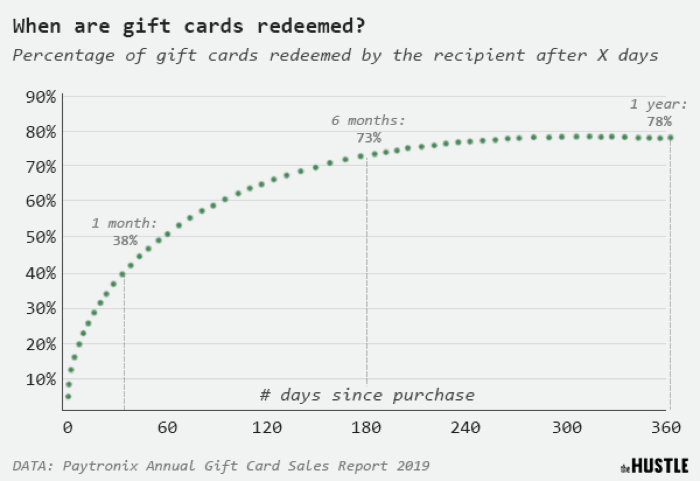
How will Stockpile make money without charging even credit card transaction fees? Even if Stockpile accepts “payment for order flow”, their volume must be relatively low (no daytraders here) and the spread percentage would be far less than 3% on a trade. A better guess is that they found their “breakage” to be sufficient to cover the fees, which refers to the fact that 20% of all gift cards are never redeemed even after a year. (Ever notice how many gift cards are 20% off face value at Costco and Sam’s Club?)

You pay upfront for the gift card, but if they are never redeemed, then Stockpile just gets to keep that as profit. Their breakage is probably less than 20%, but perhaps it is enough for them to make this move.

Bottom line. If you want to teach a kid about stock investing by giving them actual shares of stock, Stockpile is a convenient way to do so and now has no trading fees and no gift card purchase fees. Spend exactly $100 on a gift card, even using a credit card, and they’ll get exactly $100 worth of stock.

AmEx Shop Small Offer 2021: $5 off $10+ on Two Purchases

If you have any American Express credit cards, check your “Amex Offers” in either your online account or smartphone app. Most people are seeing the offer “Spend $10+, get $5 back up to 2X (total of $10) after you Shop Small”.

Get a $5 statement credit by using your enrolled eligible Card to make a single purchase of $10+ directly at any business on the Shop Small Map (or Online Directory) in the US or US territories by 08/22/21. Limit of 2 statement credits (total of $10 back)

Here’s a screenshot:

You can find eligible businesses at americanexpress.com/shopsmalloffer or americanexpress.com/shopsmallonline.

This is a smaller deal than last year, but it’s easy enough.

Our two “keeper” consumer American Express cards are the Amex EveryDay Card (keeps my Membership Rewards points active with no annual fee, helps qualify for various Amazon and AmEx promotions) and the AmEx Blue Cash Preferred (earns 6% cash back on US supermarkets, up to $6,000 annually and 6% cash back on US streaming services).

The “keeper” business American Express card that I maintain is the Blue Business Plus Card – Earn 2X Membership Rewards points on all purchases, of up to $50,000/year. There is also the Blue Business Cash Card that earns a flat 2% cash back on up to $50,000 in purchases each year. I prefer the flexibility of having MR points, but both have no annual fee.

6 Months of Disney+ Free with Amazon Music Unlimited

Amazon is running a new Amazon Music Unlimited promotion that includes up to 6 months of Disney+ streaming subscription free:

  • New Amazon Music Unlimited subscribers: Prime members pay a $7.99 month, and you get 6 months of Disney plus for free as well ($7.99 value each month). You must be a new Disney+ subscriber (with a new e-mail address not associated with any other Disney+ account). If you don’t cancel, each are $7.99 separately after the promo.
  • Past and Current Amazon Music Unlimited subscribers: Get 3 free months of Disney+. You must be a new Disney+ subscriber (with a new e-mail address not associated with any other Disney+ account).

Basically a discount for new subscribers, but a nice little freebie for existing subscribers. Especially good if you also just got the 4-month free trial from Prime Day.

(Reminder that I’m not allowed to use Amazon affiliate link in e-mails, so you may have to view the post online to see the link.)

Coinbase Interest Account: Earn 4% APY on USDC Stablecoin Deposits, Backed By Coinbase

Coinbase just announced its Coinbase Savings account product which pays 4% APY on USDC stablecoin deposits. There are several competitors in this area designed to compete against traditional bank savings accounts, even though they aren’t FDIC insured. The important difference here is that Coinbase is the most established and well-capitalized crypto exchange platform in the world. Let’s see how that changes things.

I’ve already explored the potential risks of high-interest stablecoin accounts, but they boil down to:

  • Stablecoin price risk. Every US dollar stablecoin is supposed to be backed with $1 of real US dollars and/or cash equivalents in a regulated custodial account, so that you can sell it for $1.00. Stablecoin providers hire independent auditing companies to attest that there are actually enough dollars in bank accounts. Tether is an example of a stablecoin with what I feel is questionable collateral backed by a group that has already lied in the past. USD Coin is partially controlled by Coinbase itself and has a far cleaner history as far as I can tell. You can view the USDC audit reports here done by Grant Thornton LLP.
  • Counterparty risk. At an FDIC-insured bank, you give them your dollars and the bank lends it out, but the government promises you’ll get your money back even if the bank fails. There is no FDIC insurance on this account. The guarantee is from Coinbase itself, and the positive news is that Coinbase is the largest cryptocurrency exchange platform in the world and a publicly-listed company on the Nasdaq (ticker COIN) with has a current market cap of $50 billion.

Coinbase also claims that they are safer than the competition because their lending practices are more sound:

We have recently seen the rise of crypto interest accounts that offer attractive rates on customers’ assets. While the high interest rates are appealing, they can present varying levels of risk. When you read the full terms and conditions, you may find that your assets are loaned to unidentified third parties and subject to their credit risk, which could result in a total loss of your crypto holdings.

Coinbase Borrow lets verified owners borrow up to $20,000 backed by their Bitcoin holdings as collateral, with no fees or credit checks. You are allowed to borrow up to 40% of your Bitcoin value at an interest rate of 7.9% APY. Theoretically, that means BTC could drop 60% before the outstanding principal exceeds the collateral, and as long as Coinbase sells before then, Coinbase won’t lose any money. However, that’s not the most important part. You’re not just a asset-backed lender. Coinbase itself as a $50 billion company is also guaranteeing your USDC deposits in the Coinbase Lend program.

Altogether, this makes the Coinbase Lend interest account one of the “safest” stablecoins held and guaranteed by one of the “safest” crypto exchanges. But is that safe enough? Each person will have to decide for themselves. It’s definitely not the same as an FDIC-insured bank, and I like my cash to be as safe and liquid as possible. At the same time, many folks are okay with giving up FDIC-insurance for only 1.35% APY from car demand notes backed by Toyota’s leasing arm. It’s not a question of
“Is it 100% safe?” as much as “Is it safe enough for 4% APY interest?”.

Currently, there is high demand for cash to enter the crypto-world as traditional banks are still avoiding that role, so you may decide to enjoy the arbitrage opportunity while it lasts. Note: “Pre-enrollment is currently available to eligible US residents except those residing in HI & NY.”

New users can open a Coinbase account and get $5 in free Bitcoin after your photo ID is verified. You can even earn $28+ in more free crypto when you learn more about different cryptocurrencies. More are added over time. I would view these as lottery tickets, as perhaps one of them will skyrocket in value. You can do these activities even if you skip the interest account.

Announcement: NEW New E-mail Newsletter Service!

As previously mentioned, Feedburner/Google is shutting down their e-mail service permanently as of July 1st, 2021 (very very soon!). I thought that switching over to a new provider would be easy (and free), but I was mistaken. After additional testing and feedback, I have decided against using Follow.it and instead am switching to the paid Feedblitz service instead, which includes no banner ads and faster updates. Email updates will now come directly from “jonathan@mymoneyblog.com”.

For existing Feedburner e-mail subscribers, I have already imported your e-mails to the new Feedblitz service. In fact, you should be receiving this post via Feedblitz. Ideally, this means you don’t won’t have to do anything and things will simply keep working as they did before.

If you use RSS, please update your feeds to https://logic-pipeline.live/feed%3C/a%3E for unfiltered direct access.

If you signed up for Follow.it, you will need to re-subscribe to the Feedblitz service below. I have deleted the Follow.it list completely and you should no longer receive any e-mails from them. I don’t even have access to the e-mails myself. I apologize for the inconvenience.

If you are receiving this e-mail and have previously unsubscribed and/or I have added you in error, please accept my sincere apologies!! 😞 I did a manual export and crossed my fingers. This is the first and only time that I have exported my e-mail list to another service in the 16+ years of this blog’s existence, and I hope to not have to do it for another 16 years! 😅 Unsubscribing is easy and quick. There should be a link at the bottom of every single e-mail to “Safely Unsubscribe”.

Free Updates via E-mail
If you’d like to be automatically sent an e-mail when a new post is published (roughly every weekday), please enter your e-mail address in the form below (or
click here). I’ll never use your email address for any other purpose, and you can unsubscribe at any time.

As always, thank you for reading. I truly believe that I have some of the most intelligent, discerning finance readers in the world, and I have learned so much through our interactions throughout the years.

p.s. I know that some of you also get e-mails directly from WordPress, and that should continue to work for those that wish to keep using it, but please know that unfortunately the WordPress service does NOT send out an email if it is a previously-published post that I have updated with new information. For that reason, WordPress not my recommended option. The Feedblitz service includes both my updated and refreshed posts.

Alliant Credit Union Visa Signature Card Review: Up to 2.5% Cash Back, But With Some Hoops

New rules as of July 2021. Alliant Credit Union, the 5th largest US credit union by assets, is changing up the terms of their Alliant Visa Signature Credit Card (again) as of July 2021. There are now additional hurdles to achieving the full 2.5% cash back, but the good news is that the previous $99 annual fee is going away for everyone. There are now two separate “tiers” of cash back rewards:

Tier 1: Up to 2.5% cash back

  • 2.5% cash back on up to $10,000 in qualifying purchases per billing cycle. On purchases above that $10,000 cap, you get 1.5% cash back.
  • For existing cardholders or if you open this card by 7/13/21, you automatically get Tier 1 for the July, August and September 2021 billing cycles.
  • In order to qualify for Tier 1 for October-December 2021, you must meet the requirements for an Alliant High-Rate Checking account each month of the third calendar quarter (July, August and September of 2021), AND maintain an average daily balance of $1,000 or more in their Alliant High-Rate Checking account for the last two months of the calendar quarter
    (August and September of 2021).
  • Qualification for Tier 1 repeats every future quarter in the same manner. Keep everything up for Q4 2021, and you get Tier 1 for Q1 2022, and so on.
  • No annual fee.

Tier 2: Flat 1.5% cash back

  • If you do not meet the requirements listed above, you default to Tier 2.
  • 1.5% flat cash back on all qualifying purchases.
  • No annual fee.

Redeem cash back rewards via a credit card statement credit (takes up to two billing cycles) or as a deposit into your Alliant checking or savings. Must first accrue $50 in cash back rewards.

Requirements for Alliant High-Rate Checking account

  • Must opt-in to free online statements.
  • Must have at least one monthly electronic deposit posted to your checking account in each calendar month. An electronic deposit is defined as a direct deposit, payroll deposit, ATM deposit, mobile check deposit OR transfer from another financial institution.

Competition. Please read my card-specific reviews for details.

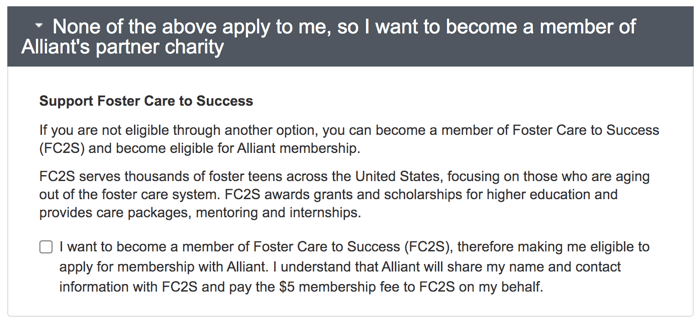
Alliant CU membership eligibility. If you start the online membership application, it does a good job of walking you through their various eligibility options. If you don’t otherwise qualify, anyone can join as a member of the Foster Care to Success (FC2S) charity group, and Alliant will now pay that $5 fee on your behalf. In other words… now anyone can join for free.

My take. Overall, I think this is a smart and practical move on their part. Historically, any credit card paying above 2% cash back with no annual fee has not been sustainable on its own. The only way to make it profitable is to offer it as part of a greater “relationship” with the financial institution. For example, Bank of America has its Preferred Rewards program to encourage additional bank and brokerage holdings. Here, Alliant is now requiring you to maintain a certain level of activity on their checking account. The one monthly direct deposit (can be a simple ACH bank-to-bank transfer) and $1,000 minimum balance is relatively easy to achieve when compared to competitors that require a payroll direct deposit or 12+ debit card transactions per month.

In exchange, earning an extra 0.5% cash back on up to $120,000 in purchases annually is worth potentially an extra $600 a year in cash back over a flat 2% card, although I’d run your own estimate as very few households will charge that much. Some people will value the simplicity of keeping a single credit card with excellent cash back on almost everything and no categories to track.

I would skip the Tier 2 option completely. At 1.5% cash back for the tier with no checking account, it’s just another ho-hum average credit card.

Bottom line. The Alliant Visa Signature Credit Card offers up to 2.5% cash back on up to $10,000 on all qualifying purchases per month (no categories) with no annual fee, but you’ll need an active Alliant High-Rate Checking account amongst other requirements. Membership is easy and free.