
Mint Mobile Review: Now $15 a Month for 4 GB, $20 a Month for 10 GB 5G/LTE Data

Update 2021: I just renewed with Mint Mobile again. I’m still happy with the service, including the new faster 5G speeds and increased data limits (added automatically without raising the price). I now pay $20/month for 10 GB 5G/LTE data (up from 8 GB). I also consolidated all the important info from my previous Mint Mobile posts into the full review below.

Full review:

Mint Mobile is a prepaid cellular MVNO which runs on the T-Mobile network. They offer very competitive pricing on 5G/LTE data plans, as long as you “buy in bulk”. To switch, they will send you a SIM card to place in your existing phone. New customers can get the lowest price for the first 3 months for a lower upfront commitment. After that, you’ll need to renew for 12 months. Here are the current plan options:

  • 4 GB 5G/LTE Data + Unlimited Talk/Text for $15/month
  • 10 GB 5G/LTE Data + Unlimited Talk/Text for $20/month
  • 15 GB 5G/LTE Data + Unlimited Talk/Text for $25/month
  • Unlimited* 5G/LTE Data + Unlimited Talk/Text for $30/month (*Throttled after 35 GB)
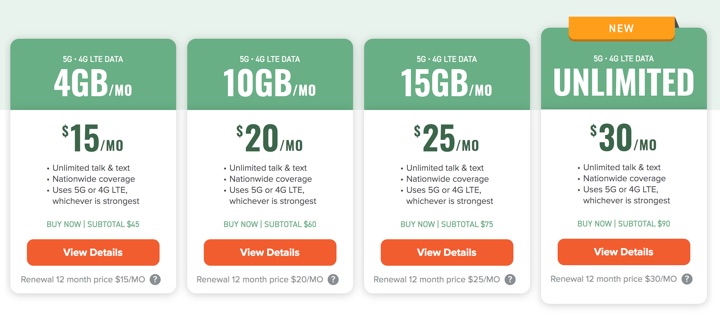
I like that Mint Mobile acts like Vanguard in that I keep automatically getting more for my money without me having to be a new customer. $15 a month used to get me 2 GB of data, then 3 GB, and now 4 GB. $20 a month used to get me 5 GB of data, then 8 GB, and now 10 GB.

After you run out of 5G/LTE high-speed data, Mint Mobile plans still include “unlimited” slow data at 2G speeds (128kbps). This is nice to keep your messages and e-mail even if you accidentally binge-watch something on Netflix over cellular. All plans also include free international calls to Mexico and Canada.

Bring your own phone. You can bring your own unlocked GSM phone including both Android and Apple iPhones. Input your zip code first and then they will help you check your phone compatibilty. The most reliable way is to look up your IMEI number in your phone settings. Alternatively, they are offering the new iPhone SE for $15 a month, which means you can get a new phone + service for $30 a month total.

eSim now available. If have an iPhone that supports eSim (iPhone XS, iPhone XS Max, iPhone XR to the current iPhone 12 line-up), you can now switch to Mint without even waiting for a physical SIM card. Look for the eSim option during the sign-up process. Android support is supposed to come mid-2021, but unfortunately there are currently no plans to support the Apple Watch.

Number porting tip. Don’t forget to collect the following info from your existing carrier before starting the transfer process: Account number, Account PIN/password, and zip code on bill. Other than that, I was able to swap SIM cards and activate everything in under 10 minutes.

Upgrade to a higher data plan later and only pay the difference. During the pandemic, I found myself eating through a lot more cellular data. After I bumped into my data cap (3 GB at the time for $15/month) for the second time, I contacted Mint to upgrade to their next tier (8 GB at the time for $20/month). They allowed me to upgrade to the higher data plan for the rest of my 12-month term by only paying for the future difference. I did not have to retroactively pay to upgrade the entire term, or even renew for a new term.

What’s the catch? Any drawbacks? I did not experience any “catch”. Otherwise, I wouldn’t have kept renewing with Mint for three years in a row. If I’m being picky, here are potential drawbacks:

  • As with all MVNOs, you don’t get the roaming that you get when you pay full price from the Big 3 carriers of Verizon, AT&T, or T-Mobile. However, I never noticed any ongoing issues with cell coverage. The only time that I remember lacking service was during a large public event (remember those?) – a music concert in a stadium.
  • As with any time you switch carriers, the porting process can sometimes be a hassle. You’ll need to call your existing carrier and get a secret passphrase, which might involve a phone call and some hold time. Mint tries to do everything online, but does have a phone number and human reps if needed.

How’s the 5G data speed? If you have a 5G-capable phone and 5G towers around, you can get download speeds that rival or perhaps exceed your home internet connection. I did various tests with the SpeedTest app and sometimes had blazing 5G speeds (200 Mbps+), while sometimes the 5G with only one bar was slower than normal LTE (50 Mbps). Supposedly, Mint will automatically allow to connect to whichever is faster, 5G or LTE.

Can I use my phone as a WiFi hotspot? All Mint plans include free hotspot tethering up to your data allotment (5 GB hotspot on unlimited plan).

7-day money back guarantee details. It is important to note that their “7-Day Money Back Guarantee” starts at activation, not order date or ship date. So activate, and make sure the coverage works for you within those 7 days. If not, you can request a full refund online (minus shipping if any). You don’t even need to ship back your SIM card.

Bottom line. Mint Mobile works best for my needs, as I get unlimited talk, text, and 10 GB of 5G/LTE data for $20 a month. Other recs? If you want to unlimited talk and text only, you can find from Tello for only $8 a month (now a T-Mobile MVNO). If you want unlimited data on Verizon towers, look into Visible Wireless at $25 to $40 a month.

Also see:

Disclosure: This post includes affiliate links. If you make a purchase through the links above, I may be compensated.

Debit Card Arbitrage: $4.7M Tax Payment Results in $47,000 Cash Back

An under-the-radar loophole is now out in the open, thanks to fintech app Jiko* publishing a PR release bragging about their $4.7 million debit card charge, which led to Axios writing about it as quite likely the “largest consumer debit transaction ever”. In a nutshell: Someone made a $4.7 million tax payment to the IRS using a Jiko debit card, paying less than $4 in fees while earning $47,000 in cash back!

As noted in my post on How Fintech Bank Apps like Chime Make Money, a significant portion of fintech revenue comes from debit card fees. Large banks have their debit card interchange fees regulated, as Durbin fee limits only apply to large banks with $10 billion in assets and above. But smaller banks are classified as exempt, and the Federal Reserve shows the average intercharge fee is 1.4% for exempt transactions. This is why small fintech banks can offer 1% cash back on debit card purchases.

Meanwhile, it appears that the fee that the IRS payment processors charge is based on the regulated interchange fee of 0.05% (yes, 1/20th of 1%!) plus 21 cents per debit card transaction. That means even a $10,000 tax payment would result in a regulated interchange fee of $5.21, and the vast majority of tax payments are much less than $10,000. Perhaps they have some sort of special agreement? Either way, they all charge a flat fee ranging from $2.55 to $3.95 on any payment amount.

This creates an arbitrage opportunity between the fees paid and cash back earned for those can that justify really large tax payments (usually those with really large incomes). On a $10,000 payment, your net profit would be about $96. Meanwhile, making an unnecessarily high payment might encourage an audit or raise other flags. You’ll also need to fund and use an appropriate fintech bank that offers 1% cash back with no limits. I’m not sure if this was a smart move by Jiko, as the added spotlight may also end this important source of revenue for all fintech banks.

* The Jiko app doesn’t act as a bank as they hold your money in a brokerage account and invest your money in US Treasury bills (essentially equally safe, but not the same). However, they do have their own bank charter, apparently to process debit card charges – Jiko Bank, a division of Mid-Central National Bank, Member FDIC. I’m confused too! But interestingly since funds are backed by T-Bills, it made it safer to hold $4.7 million at Jiko, as that huge balance would have exceeded the FDIC insurance limits.

Best Interest Rates on Cash – February 2021

Here’s my monthly roundup of the best interest rates on cash as of February 2021, roughly sorted from shortest to longest maturities. I track these rates because I keep 12 months of expenses as a cash cushion and there are many lesser-known opportunities to improve your yield while still being FDIC-insured or equivalent. Check out my Ultimate Rate-Chaser Calculator to see how much extra interest you’d earn by moving money between accounts. Rates listed are available to everyone nationwide. Rates checked as of 2/3/2021.

Fintech accounts
Available only to individual investors, fintech accounts oftentimes pay higher-than-market rates in order to achieve high short-term growth. I will define “fintech” as an app software layer on top of a different bank’s FDIC insurance backbone. You should read about the story of the Beam app for potential pitfalls and best practices. Below are some current options with decent balance limits:

  • 3% APY on up to $100,000. I am happy to see the top rate staying at 3% APY for January through March 2021. HM Bradley requires a recurring direct deposit every month and a savings rate of at least 20%. See my HM Bradley review.
  • 3% APY on 10% of direct deposits. One Finance lets you earn 3% APY on “auto-save” deposits (up to 10% of your direct deposit, up to $1,000 per month). Separately, they also pay 1% APY on up to another $25,000 with direct deposit. New $50 bonus via referral. See my One Finance review.
  • 3% APY on up to $15,000. Porte requires a one-time direct deposit of $1,000+ to open a savings account. $50 bonus via referral. See my Porte review.
  • 2.15% APY on up to $5k/$30k. Limited-time offer of free membership to their higher balance tier for 6 months with direct deposit. See my OnJuno review.

High-yield savings accounts
While the huge megabanks pay essentially no interest, it’s easy to open a new “piggy-back” savings account and simply move some funds over from your existing checking account. The interest rates on savings accounts can drop at any time, so I list the top rates as well as competitive rates from banks with a history of competitive rates. Some banks will bait you with a temporary top rate and then lower the rates in the hopes that you are too lazy to leave.

  • T-Mobile Money has the top rate at the moment at 1.00% APY with no minimum balance requirements. The main focus is on the 4% APY on your first $3,000 of balances as a qualifying T-mobile customer plus other hoops, but the lesser-known perk is the 1% APY for everyone. Thanks to the readers who helped me understand this. There are several other established high-yield savings accounts at closer to 0.50% APY for now.

Short-term guaranteed rates (1 year and under)
A common question is what to do with a big pile of cash that you’re waiting to deploy shortly (just sold your house, just sold your business, legal settlement, inheritance). My usual advice is to keep things simple and take your time. If not a savings account, then put it in a flexible short-term CD under the FDIC limits until you have a plan.

  • No Penalty CDs offer a fixed interest rate that can never go down, but you can still take out your money (once) without any fees if you want to use it elsewhere. Marcus has a 7-month No Penalty CD at 0.45% APY with a $500 minimum deposit. AARP members can get an 8-month CD at 0.55% APY. Ally Bank has a 11-month No Penalty CD at 0.50% APY for all balance tiers. CIT Bank has a 11-month No Penalty CD at 0.30% APY with a $1,000 minimum deposit. You may wish to open multiple CDs in smaller increments for more flexibility.
  • Lafayette Federal Credit Union has a 12-month CD at 0.80% APY ($500 min). Early withdrawal penalty is 6 months of interest. Anyone can join this credit union via partner organization ($10 one-time fee).

Money market mutual funds + Ultra-short bond ETFs
Normally, I would say to watch out for brokerage firms that pay out very little interest on their default cash sweep funds (and keep the difference for themselves). However, money market fund rates are very low across the board right now. The following ultra-short bond funds are a possible alternative, but they are NOT FDIC-insured and will also fluctuate in price somewhat:

  • The default sweep option is the Vanguard Federal Money Market Fund which has an SEC yield of 0.01%. Vanguard Cash Reserves Federal Money Market Fund (formerly Prime Money Market) currently pays 0.01% SEC yield.
  • Vanguard Ultra-Short-Term Bond Fund currently pays 0.44% SEC yield ($3,000 min) and 0.54% SEC Yield ($50,000 min). The average duration is ~1 year, so there is more interest rate risk.
  • The PIMCO Enhanced Short Maturity Active Bond ETF (MINT) has a 0.23% SEC yield and the iShares Short Maturity Bond ETF (NEAR) has a 0.43% SEC yield while holding a portfolio of investment-grade bonds with an average duration of ~6 months.

Treasury Bills and Ultra-short Treasury ETFs
Another option is to buy individual Treasury bills which come in a variety of maturities from 4-weeks to 52-weeks. You can also invest in ETFs that hold a rotating basket of short-term Treasury Bills for you, while charging a small management fee for doing so. T-bill interest is exempt from state and local income taxes. Right now, this section isn’t very interesting as T-Bills are yielding close to zero!

  • You can build your own T-Bill ladder at TreasuryDirect.gov or via a brokerage account with a bond desk like Vanguard and Fidelity. Here are the current Treasury Bill rates. As of 2/3/2020, a new 4-week T-Bill had the equivalent of 0.04% annualized interest and a 52-week T-Bill had the equivalent of 0.08% annualized interest.
  • The Goldman Sachs Access Treasury 0-1 Year ETF (GBIL) has a -0.01% SEC yield and the SPDR Bloomberg Barclays 1-3 Month T-Bill ETF (BIL) has a -0.06% (!) SEC yield. GBIL appears to have a slightly longer average maturity than BIL.

US Savings Bonds
Series I Savings Bonds offer rates that are linked to inflation and backed by the US government. You must hold them for at least a year. If you redeem them within 5 years there is a penalty of the last 3 months of interest. The annual purchase limit is $10,000 per Social Security Number, available online at TreasuryDirect.gov. You can also buy an additional $5,000 in paper I bonds using your tax refund with IRS Form 8888.

  • “I Bonds” bought between November 2020 and April 2021 will earn a 1.68% rate for the first six months. The rate of the subsequent 6-month period will be based on inflation again. More info here.
  • In mid-April 2021, the CPI will be announced and you will have a short period where you will have a very close estimate of the rate for the next 12 months. I will have another post up at that time.
  • See below about EE Bonds as a potential long-term bond alternative.

Prepaid Cards with Attached Savings Accounts
A small subset of prepaid debit cards have an “attached” FDIC-insured savings account with exceptionally high interest rates. The negatives are that balances are severely capped, and there are many fees that you must be careful to avoid (lest they eat up your interest). Some folks don’t mind the extra work and attention required, while others do. There is a long list of previous offers that have already disappeared with little notice. I don’t personally recommend nor use any of these anymore.

  • One of the few notable cards left in this category is Mango Money at 6% APY on up to $2,500, along with several hoops to jump through. Requirements include $1,500+ in “signature” purchases and a minimum balance of $25.00 at the end of the month.

Rewards checking accounts
These unique checking accounts pay above-average interest rates, but with unique risks. You have to jump through certain hoops which usually involve 10+ debit card purchases each cycle, a certain number of ACH/direct deposits, and a certain number of logins per month. If you make a mistake (or they judge that you did) you risk earning zero interest for that month. Some folks don’t mind the extra work and attention required, while others would rather not bother. Rates can also drop suddenly, leaving a “bait-and-switch” feeling.

  • The Bank of Denver pays 2.50% APY (dropping to 2.00% APY on 2/18/21) on up to $25,000 if you make 12 debit card purchases of $5+ each and at least 1 ACH credit or debit transaction per statement cycle. If you meet those qualifications, you can also link a Kasasa savings account that pays 1.50% APY (but dropping to 1.00% APY on 2/18/21) on up to $50k. Thanks to reader Bill for the updated info.
  • Devon Bank has a Kasasa Checking paying 3.50% APY on up to $10,000, plus a Kasasa savings account paying 3.50% APY on up to $10,000 (and 1.25% APY on up to $50,000). You’ll need at least 12 debit transactions of $3+ and other requirements every month.
  • Presidential Bank pays 2.25% APY on balances up to $25,000, with fewer hoops than some others.
  • Evansville Teachers Federal Credit Union pays 3.30% APY on up to $20,000. You’ll need at least 15 debit transactions and other requirements every month.
  • Lake Michigan Credit Union pays 3.00% APY on up to $15,000. You’ll need at least 10 debit transactions and other requirements every month.
  • Find a locally-restricted rewards checking account at DepositAccounts.

Certificates of deposit (greater than 1 year)
CDs offer higher rates, but come with an early withdrawal penalty. By finding a bank CD with a reasonable early withdrawal penalty, you can enjoy higher rates but maintain access in a true emergency. Alternatively, consider building a CD ladder of different maturity lengths (ex. 1/2/3/4/5-years) such that you have access to part of the ladder each year, but your blended interest rate is higher than a savings account. When one CD matures, use that money to buy another 5-year CD to keep the ladder going. Some CDs also offer “add-ons” where you can deposit more funds if rates drop.

  • Affinity Plus Federal Credit Union has a 5-year certificate at 1.50% APY ($500 minimum). Early withdrawal penalty is 1 year of interest. 4-year at 1.20% APY, and 3-year at 0.95% APY ($500 minimum). Anyone can join this credit union via partner organization ($25 one-time fee).
  • Hiway Federal Credit Union has a 5-year certificate at 1.34% APY ($25k minimum) and 1.24% APY with a $10,000 minimum. Early withdrawal penalty is 1 year of interest. 4-year at 1.19% APY, and 3-year at 1.10% APY ($25k minimum). Anyone can join this credit union via partner organization ($10 one-time fee).
  • You can buy certificates of deposit via the bond desks of Vanguard and Fidelity. You may need an account to see the rates. These “brokered CDs” offer FDIC insurance and easy laddering, but they don’t come with predictable early withdrawal penalties. I see nothing special right now, but it might still pay more than your other brokerage cash and Treasury options. Be wary of higher rates from callable CDs listed by Fidelity.

Longer-term Instruments
I’d use these with caution due to increased interest rate risk, but I still track them to see the rest of the current yield curve.

  • Willing to lock up your money for 10 years? You can buy long-term certificates of deposit via the bond desks of Vanguard and Fidelity. These “brokered CDs” offer FDIC insurance, but they don’t come with predictable early withdrawal penalties. You might find something that pays more than your other brokerage cash and Treasury options. Right now, I see a 10-year at Vanguard for 1.35% APY. Watch out for higher rates from callable CDs from Fidelity.
  • How about two decades? Series EE Savings Bonds are not indexed to inflation, but they have a unique guarantee that the value will double in value in 20 years, which equals a guaranteed return of 3.5% a year. However, if you don’t hold for that long, you’ll be stuck with the normal rate which is quite low (currently 0.10%). I view this as a huge early withdrawal penalty. But if holding for 20 years isn’t an issue, it can also serve as a hedge against prolonged deflation during that time. Purchase limit is $10,000 each calendar year for each Social Security Number. As of 2/3/2021, the 20-year Treasury Bond rate was 1.69%.

All rates were checked as of 2/3/2021.

Walmart Plus: Get $75+ Back on $98 Annual Membership Fee

Walmart+ membership gets you the following perks:
  • Free next-day and 2-day shipping from Walmart.com (no minimum purchase).
  • Free same-day delivery of cold Groceries & more from your local Walmart ($35 minimum purchase). Where available.
  • Scan & Go in-store. Use the Walmart app to scan barcodes as you shop in-store and skip the cashier line.
  • Save 5 cents per gallon on fuel at over 2,000 Walmart, Murphy USA and Murphy Express fuel stations. You also get to access member pricing at Sam’s Club fuel stations.

There is a free 15-day trial, and the membership retail price is $98 per year (or $12.95 per month). Right now, there are two ways to save over 75% off that $98 annual membership:

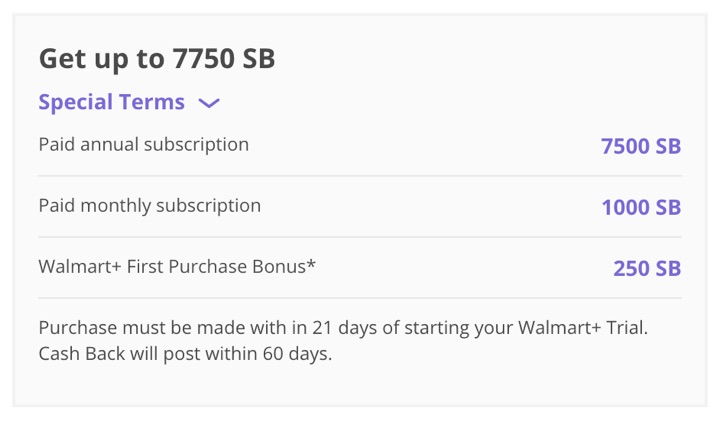
Swagbucks $75+ back. Search for “Walmart+” on the Swagbucks rewards site, and you’ll see they are offering 7,500 Swagbucks on a paid annual subscription, plus 250 Swagbucks on your first Walmart+ purchase. Purchase must be made with in 21 days of starting your Walmart+ Trial. Cash Back will post within 60 days. There is also a $10 new member bonus via Swagbucks referral link.

7,500 Swagbucks can be redeemed for at least $75 in Amazon gift cards (or similar).

MyPoints $75+ back. Search for “Walmart+” on the MyPoints rewards site, and you’ll see they are offering 12,000 points on a paid annual subscription, plus 500 Swagbucks on your first Walmart+ purchase. Purchase must be made with in 21 days of starting your Walmart+ Trial. Cash Back will post within 60 days. There is also a $10 new member bonus via MyPoints referral link.

12,000 MyPoints can be redeemed for at least $75 in Amazon gift cards (or similar).

Both Swagbucks and Mypoints are now owned by the same parent company, and I have cashed out of both without issues recently. (They also recently acquired Upromise.)

How Robinhood Really Makes Money, and Why It No Longer Matters

While it seems that Robinhood and Gamestop are officially the new gambling version of a multiplayer online video game (CNBC, BI, Bloomberg), this story reminded me of this past Matt Levine article which is my favorite detailed-yet-understandable explanation of how Robinhood makes money. There have been many similar attempts to explain their business model, but this felt the most balanced. Even the footnotes are educational.

For example, he explains how the biggest brokers like TD Ameritrade used to handle payment for order flow, which you could equate to a discount on the stock price (“price improvement”):

“We’ll buy stock for you, you’ll pay us $5 to do it, we’ll get a discount on the stock and we’ll pass on 80% of the discount to you.”

Compare this with how Robinhood chose to do handle payment for order flow:

“We’ll buy stock for you, you won’t pay us to do it, we’ll get a discount on the stock and we’ll pass on 20% of the discount to you.”

Robinhood also happens to get paid more for their order flow than other brokerage firms. I’ve also explored this question back in 2018: Does Robinhood Brokerage Make Money in Shady or Questionable Ways? My basic conclusions were that:

  • Robinhood would be breaking the law if they broke the SEC rule of National Best Bid and Offer (NBBO) that requires brokers provide the best available bid and ask prices when buying and selling securities for customers. They wouldn’t do that, would they?
  • The order flow from Robinhood is probably more valuable because it is from small, retail investors (“dumb money”).

Well, it turns out that:

If you don’t read Matt Levine’s entire explanation, here is the bottom line: Robinhood customers were essentially being charged an extra roughly 3 to 5 cents a share through poorer execution prices. If you only traded a few shares, then you still basically paid nothing. If you traded 100 shares, that might add up to $3 to $5 total. Roughly breakeven. If you traded 1,000 shares, that might add up to $30 to $50 total. For some people, Robinhood’s “free trades” were a better deal. For others, Robinhood’s “free trades” were a much worse deal.

Supposedly, Robinhood doesn’t do this anymore and satisfies NBBO again. But it still shows the general way in which Robinhood makes money today. High-frequency trading firms pay somewhat higher prices for the trading flows from Robinhood users, and Robinhood keeps as much of that money as possible while still barely satisfying NBBO. Perhaps a smaller number on the order of a half-penny a share. Other firms like Fidelity proudly boast of how they do better than NBBO (“price improvement” again), which is also a quiet dig at Robinhood.

[Fidelity’s] price improvement can save investors $18.53 on average for a 1,000-share equity order, compared to the industry average of $4.25.

All this no longer matters because Robinhood is no longer the sweet spot for newbie traders. People like to make fun of the Robinhood name because in a way they secretly stole from the “poor” average traders and sold their orders to the “rich”. However, they also forced everyone from Fidelity to Schwab to all offer commission-free trades. Robinhood did deliver something to us common folk!

The important difference is that firms like Fidelity and Schwab still have wealthy clients that demand phone numbers with helpful humans that answer after only a few rings. Meanwhile, Robinhood only provides an overwhelmed e-mail address than can take days or weeks to finally address your problems.

When Robinhood first came on the scene, they were the new sweet spot for cheap trades for small balances. However, now that free trades are everywhere, the sweet spot in my opinion has now shifted to something like a Fidelity or Schwab account. You get total commission costs either equal to or lower than Robinhood, plus better customer service from more knowledgable reps. If you still prefer a trendy new app over a stuffy old broker, check out my Big List of Free Stocks For New Commission-Free Brokerage Apps. Most of them have a phone number, and they’ll be less busy. (WeBull, M1 Finance, and Firstrade for sure have phone numbers.)

Coursera: Free Courses 2021 New Year Promotion

Online education site Coursera is offering a Learn a New Skill for Free in 2021 promotion with selected courses free until January 31, 2021. Here are a couple that are related to finance:

For example, you should see the $49 normal price adjusted to zero if you enroll in one of the courses above after visiting the promo link.

Alliant CU Ultimate Opportunity Savings Review – $100 Bonus

Alliant Credit Union, one of the top 10 largest US credit unions by assets, has teamed up with Suze Orman to promote their new Ultimate Opportunity Savings account. The interest rate of 0.55% APY and structure appears to be the same as their existing High-Rate Savings account, just with an added $100 cash bonus if you deposit at least $100 a month for 12 consecutive months. Unfortunately, it is open to new Alliant CU members only. Thanks to reader Bill for the tip.

Note that the fine print also states that you must have at least $1,200 in your account at the end of the period (you can’t have withdrawn it after the deposits).

The $100 bonus is automatically deposited into The Ultimate Opportunity Savings Account after you’ve successfully made a monthly deposit of $100 or more for 12 consecutive months. To qualify for the bonus, you must keep a minimum balance of $100 in your savings account, and have $1,200 (or more) in your account at the end of the 12-month period.1

There is no minimum balance required, but you must accept paperless statements to avoid a monthly fee.

Bonus math. In terms of equivalent interest rate, earning an extra $100 of interest for a $100 monthly deposit is roughly 16% APY, so definitely better than any other non-bonus savings account out there. (Without the bonus, this account would earn less than 4 bucks!) Add in the normal 0.55% APY, and your total APY is ~16.5% APY. It’s much less exciting for bigger deposits, but this can still be a pretty good incentive if you want to start building up an emergency fund.

Alliant CU membership eligibility. Credit unions are supposed to be a cooperative non-profit that serves a specific community, but Alliant is pretty much open to anyone nationwide. If you start the online membership application, it will walk you through their various eligibility options. Here are their membership groups:

Any employee or retiree of a Qualifying Company.
Any member of a Qualifying Organization.
Any immediate family member of an existing Alliant member.
Anyone who lives or works in a Qualifying Chicagoland Community.
Anyone who is a member of the Foster Care to Success charity group.

You’ll find that it only costs $5 to join Foster Care to Success, and Alliant will pay that fee on your behalf!

Other potential member perks. Alliant has a good checking account product and their savings account rates have been historically pretty competitive. Like many other credit unions, they also offer competitive rates on auto loans on both new and used cars.

They also have a 2.5% cashback credit card, but there is a $10,000 monthly cap on purchases plus a $99 annual fee after the first year. After that first year, you’ll need to spend at least $19,800 annually (average $1,650 monthly) and less than $10,000 per month to exceed to do better than a 2% cash back card.

Bottom line. If you’ve been meaning to join a credit union and/or start a new savings/emergency fund for the new year, this $100 bonus might be a nice incentive to reach the modest savings goal of $100 per month.

Stimulus 2nd Round, Unemployment, FSA Changes, PPP Loans 2nd Draw

I know I’m a bit late on this, but after reading several media articles, here again is my curated collection of highlights and perhaps overlooked items that might be worthy of additional research.

Second round of Economic Impact Payments. Many people have already received this direct deposited to their bank accounts, up to $600 per taxpayer ($1,200 for married filing joint) plus $600 per qualifying child under age 17. If have questions, try using the IRS Get My Payment tool.

The amount starts getting phased out at $75,000 AGI for most single filers and $150,000 AGI for most married joint filers. Here is a graphical chart per Tax Foundation:

If you made too much according to your 2019 income, but your income in 2020 was actually low enough, you will be able to claim the rebate when you file your taxes. If you qualified based on your 2019 AGI but your 2020 ended up too high, you get to keep the payment; there is no clawback.

Unemployment benefits expanded again. The new COVID-19 relief package extends certain unemployment benefit programs for 11 weeks, including an unemployment supplement of $300 a week for many people from December 26, 2020 to March 14, 2021. It also increases the maximum number of weeks of benefits to 50 from 39 for many people. Certain self-employed workers will also see an addition $100 per week benefit.

Charitable Deductions. In 2020, you were able to deduct $300 in charitable (cash-only) donations, even if you used the standard deductions. In 2021, this deduction was extended and increased to $300 for single and up to $600 for married filing joint, again even if you use the standard deduction.

Healthcare FSA, Dependent Care FSAs. If you didn’t use up all your “use-it-or-lose-it” FSA funds in 2020, the new law allows your employer the option of carrying over unused balances for an additional 12 months (through the end of 2021). For Dependent Care FSAs, the age limit was also increased from 12 to 13 (since those 2020 funds may have been for your former 12-year-old). Check with your HR department and/or benefits manager.

PPP Forgivable Loan, 2nd Draw. The new COVID-19 relief package clarifies that businesses can still deduct expenses paid with forgiven PPP loans. (Typically, forgiven debt is considered taxable income, but forgiven PPP loans are specifically marked as NOT taxable income.)

Certain small business owners can now apply for a second draw of forgivable PPP loans (up to $2 million). Applying for the first round does not prevent you from applying for the second round. Second-draw loans are limited to businesses with fewer than 300 employees and at least a 25 percent drop in gross receipts in a 2020 quarter compared to the same quarter in 2019. (If this is your first time taking a loan, there is no requirement for the drop in gross receipts.) Businesses taking a PPP loan may now also be eligible for the Employee Retention Tax Credit (ERTC).

Sources: WSJ Article, Tax Foundation, IRS.gov

Best Interest Rates on Cash – January 2021

Here’s my monthly roundup of the best interest rates on cash for January 2021, roughly sorted from shortest to longest maturities. I track these rates because I keep 12 months of expenses as a cash cushion and there are many lesser-known opportunities to improve your yield while still being FDIC-insured or equivalent. Check out my Ultimate Rate-Chaser Calculator to see how much extra interest you’d earn by moving money between accounts. Rates listed are available to everyone nationwide. Rates checked as of 1/6/2021.

Fintech accounts
Available only to individual investors, fintech accounts oftentimes pay higher-than-market rates in order to achieve high short-term growth. I will define “fintech” as an app software layer on top of a different bank’s FDIC insurance backbone. You should read about the story of the Beam app for potential pitfalls and best practices. Below are some current options with decent balance limits:

  • 3% APY on up to $100,000. New customers should be happy to see the top rate staying at 3% APY for January through March 2021. HM Bradley requires a recurring direct deposit every month and a saving rate of at least 20%. See my HM Bradley review.
  • 3% APY on 10% of direct deposits. One Finance lets you earn 3% APY on auto-save deposits (up to 10% of your direct deposit, up to $1,000 per month). See my One Finance review.
  • 3% APY on up to $15,000. Porte requires a one-time direct deposit of $1,000+ to open a savings account. See my Porte review.
  • 2.15% APY on up to $5k/$30k. Limited-time offer of free membership to their higher balance tier for 6 months with direct deposit. See my OnJuno review.

High-yield savings accounts
While the huge megabanks pay essentially no interest, it’s easy to open a new “piggy-back” savings account and simply move some funds over from your existing checking account. The interest rates on savings accounts can drop at any time, so I list the top rates as well as competitive rates from banks with a history of competitive rates. Some banks will bait you with a temporary top rate and then lower the rates in the hopes that you are too lazy to leave.

  • T-Mobile Money has the top rate at the moment at 1.00% APY with no minimum balance requirements. The main focus is on the 4% APY on your first $3,000 of balances as a qualifying T-mobile customer plus other hoops, but the lesser-known perk is the 1% APY for everyone. Thanks to the readers who helped me understand this. There are several other established high-yield savings accounts at closer to 0.50% APY for now.

Short-term guaranteed rates (1 year and under)
A common question is what to do with a big pile of cash that you’re waiting to deploy shortly (just sold your house, just sold your business, legal settlement, inheritance). My usual advice is to keep things simple and take your time. If not a savings account, then put it in a flexible short-term CD under the FDIC limits until you have a plan.

  • No Penalty CDs offer a fixed interest rate that can never go down, but you can still take out your money (once) without any fees if you want to use it elsewhere. Marcus has a 7-month No Penalty CD at 0.45% APY with a $500 minimum deposit. AARP members can get an 8-month CD at 0.55% APY. Ally Bank has a 11-month No Penalty CD at 0.50% APY for all balance tiers. CIT Bank has a 11-month No Penalty CD at 0.30% APY with a $1,000 minimum deposit. You may wish to open multiple CDs in smaller increments for more flexibility.
  • CommunityWide Federal Credit Union has a 12-month CD at 0.80% APY ($1,000 min). Early withdrawal penalty depends on how early you withdraw. Anyone can join this credit union via partner organization ($5 one-time fee).

Money market mutual funds + Ultra-short bond ETFs
If you like to keep cash in a brokerage account, beware that many brokers pay out very little interest on their default cash sweep funds (and keep the difference for themselves). The following money market and ultra-short bond funds are NOT FDIC-insured and thus come with a possibility of principal loss, but may be a good option if you have idle cash and cheap/free commissions.

  • The default sweep option is the Vanguard Federal Money Market Fund which has an SEC yield of 0.02%. Vanguard Cash Reserves Federal Money Market Fund (formerly Prime Money Market) currently pays 0.02% SEC yield.
  • Vanguard Ultra-Short-Term Bond Fund currently pays 0.49% SEC yield ($3,000 min) and 0.59% SEC Yield ($50,000 min). The average duration is ~1 year, so there is more interest rate risk.
  • The PIMCO Enhanced Short Maturity Active Bond ETF (MINT) has a 0.28% SEC yield and the iShares Short Maturity Bond ETF (NEAR) has a 0.50% SEC yield while holding a portfolio of investment-grade bonds with an average duration of ~6 months. Note that there was a sudden, temporary drop in net asset value during the March 2020 market stress.

Treasury Bills and Ultra-short Treasury ETFs
Another option is to buy individual Treasury bills which come in a variety of maturities from 4-weeks to 52-weeks. You can also invest in ETFs that hold a rotating basket of short-term Treasury Bills for you, while charging a small management fee for doing so. T-bill interest is exempt from state and local income taxes. Right now, this section isn’t very interesting as T-Bills are yielding close to zero!

  • You can build your own T-Bill ladder at TreasuryDirect.gov or via a brokerage account with a bond desk like Vanguard and Fidelity. Here are the current Treasury Bill rates. As of 1/6/2020, a new 4-week T-Bill had the equivalent of 0.09% annualized interest and a 52-week T-Bill had the equivalent of 0.11% annualized interest.
  • The Goldman Sachs Access Treasury 0-1 Year ETF (GBIL) has a -0.01% SEC yield and the SPDR Bloomberg Barclays 1-3 Month T-Bill ETF (BIL) has a -0.06% (!) SEC yield. GBIL appears to have a slightly longer average maturity than BIL.

US Savings Bonds
Series I Savings Bonds offer rates that are linked to inflation and backed by the US government. You must hold them for at least a year. If you redeem them within 5 years there is a penalty of the last 3 months of interest. The annual purchase limit is $10,000 per Social Security Number, available online at TreasuryDirect.gov. You can also buy an additional $5,000 in paper I bonds using your tax refund with IRS Form 8888.

  • “I Bonds” bought between November 2020 and April 2021 will earn a 1.68% rate for the first six months. The rate of the subsequent 6-month period will be based on inflation again. More info here.
  • In mid-April 2021, the CPI will be announced and you will have a short period where you will have a very close estimate of the rate for the next 12 months. I will have another post up at that time.
  • See below about EE Bonds as a potential long-term bond alternative.

Prepaid Cards with Attached Savings Accounts
A small subset of prepaid debit cards have an “attached” FDIC-insured savings account with exceptionally high interest rates. The negatives are that balances are severely capped, and there are many fees that you must be careful to avoid (lest they eat up your interest). Some folks don’t mind the extra work and attention required, while others do. There is a long list of previous offers that have already disappeared with little notice. I don’t personally recommend nor use any of these anymore.

  • One of the few notable cards left in this category is Mango Money at 6% APY on up to $2,500, along with several hoops to jump through. Requirements include $1,500+ in “signature” purchases and a minimum balance of $25.00 at the end of the month.

Rewards checking accounts
These unique checking accounts pay above-average interest rates, but with unique risks. You have to jump through certain hoops which usually involve 10+ debit card purchases each cycle, and if you make a mistake you won’t earn any interest for that month. Some folks don’t mind the extra work and attention required, while others would rather not bother. Rates can also drop suddenly, leaving a “bait-and-switch” feeling.

  • Consumers Credit Union Free Rewards Checking (my review) still offers up to 4.09% APY on balances up to $10,000 if you make $500+ in ACH deposits, 12 debit card “signature” purchases, and spend $1,000 on their credit card each month. The Bank of Denver has a Free Kasasa Cash Checking offering 2.50% APY on balances up to $25,000 if you make 12 debit card purchases and at least 1 ACH credit or debit transaction per statement cycle. (BoD now says debit transactions must be $5 minimum each and must reflect “normal, day-to-day spending behavior”.) If you meet those qualifications, you can also link a savings account that pays 1.50% APY on up to $50k. Thanks to reader Bill for the updated info. Presidential Bank has another competitive offering. Find a locally-restricted rewards checking account at DepositAccounts.

Certificates of deposit (greater than 1 year)
CDs offer higher rates, but come with an early withdrawal penalty. By finding a bank CD with a reasonable early withdrawal penalty, you can enjoy higher rates but maintain access in a true emergency. Alternatively, consider building a CD ladder of different maturity lengths (ex. 1/2/3/4/5-years) such that you have access to part of the ladder each year, but your blended interest rate is higher than a savings account. When one CD matures, use that money to buy another 5-year CD to keep the ladder going. Some CDs also offer “add-ons” where you can deposit more funds if rates drop.

  • Affinity Plus Federal Credit Union has a 5-year certificate at 1.50% APY ($500 minimum). Early withdrawal penalty is 1 year of interest. 4-year at 1.20% APY, and 3-year at 0.95% APY ($500 minimum). Anyone can join this credit union via partner organization ($25 one-time fee).
  • Hiway Federal Credit Union has a 5-year certificate at 1.35% APY ($25k minimum) and 1.25% APY with a $10,000 minimum. Early withdrawal penalty is 1 year of interest. 4-year at 1.20% APY, and 3-year at 1.10% APY ($25k minimum). Anyone can join this credit union via partner organization ($10 one-time fee).
  • You can buy certificates of deposit via the bond desks of Vanguard and Fidelity. You may need an account to see the rates. These “brokered CDs” offer FDIC insurance and easy laddering, but they don’t come with predictable early withdrawal penalties. I see nothing special right now, but it might still pay more than your other brokerage cash and Treasury options. Be wary of higher rates from callable CDs listed by Fidelity.

Longer-term Instruments
I’d use these with caution due to increased interest rate risk, but I still track them to see the rest of the current yield curve.

  • Willing to lock up your money for 10 years? You can buy long-term certificates of deposit via the bond desks of Vanguard and Fidelity. These “brokered CDs” offer FDIC insurance, but they don’t come with predictable early withdrawal penalties. You might find something that pays more than your other brokerage cash and Treasury options. Watch out for higher rates from callable CDs from Fidelity.
  • How about two decades? Series EE Savings Bonds are not indexed to inflation, but they have a unique guarantee that the value will double in value in 20 years, which equals a guaranteed return of 3.5% a year. However, if you don’t hold for that long, you’ll be stuck with the normal rate which is quite low (currently 0.10%). I view this as a huge early withdrawal penalty. But if holding for 20 years isn’t an issue, it can also serve as a hedge against prolonged deflation during that time. Purchase limit is $10,000 each calendar year for each Social Security Number. As of 1/6/2021, the 20-year Treasury Bond rate was 1.60%.

All rates were checked as of 1/6/2021.

Free National Emerald Club Executive Elite Upgrade (Extended Through 2023)

Back again for 2021, possibly good through 2023! Emerald Club is the loyalty program for National Car Rental that includes a unique “Emerald Aisle” where you can walk up and pick any car in that aisle based on your tier. The base Emerald tier (anyone can sign up and join this for free) may only mean picking between a Nissan Altima or a Hyundai Elantra, but it’s still a bit of fun as I like cars.

I’ve been doing this multiple years, but American Express has brought back a promotion with a free upgrade to Emerald Executive Elite status, which is the highest tier – one above Emerald Executive and two tiers above plain Emerald Club. The “Executive Emerald Aisle” includes a wider choice of nicer cars including SUVs and large sedans (while still paying only the midsize rate) and faster rewards accrual (1 free rental day after 5 rental credits). I was able to extend my existing account, but you may have to sign up for a fresh new account (or sign up your spouse/partner as the 2nd driver is free). The form doesn’t appear to ask for an American Express number. They will change your Contract ID and you should allow that, but you can always change it back later if you want.

Here is my Emerald Executive Elite status extended to February 2023:

In addition, if you enroll a new account through the promotion and also pay for your first rental with any American Express card, they will credit you with five Emerald Club Credits. Remember, 5 credits is enough for a free car rental already with Executive Elite status. Essentially, you get a free rental day after your first rental if paid with AmEx.

Enroll in National’s Emerald Club® by clicking the Executive Elite Enrollment button below, between 10/9/2020 – 2/28/2021, and automatically advance to Emerald Club Executive Elite status. After enrolling, pay for your first rental with any American Express® Card and earn five Emerald Club Credits toward a future rental day.

Status match. Once you obtain your status and/or membership kit, you can also ask for a status match with Hertz, Avis (request via email), or Enterprise. The worst thing they can say is no.

Changing your Contract ID. When you make a new reservation, there is a section for “Account Number / Coupons”. After signing up for this, it may say “AMEX EE” but you can remove it and change to whatever you wish. (You may need to keep it for 5 credit promo above.) Some discount car rental sites like AutoSlash.com will help you find and apply alternative coupons and contract ID discounts. My local credit union membership also lets me use a contract ID that sometimes offers the lowest rate.

Dunkin Donuts Gift Card Promotion: Buy $30, Get $10 Promo Credit (Ends 12/24)

Here’s another caffeine promo from Dunkin Donuts: Buy $30 worth of Dunkin gift cards, get $10 in promo gift cards. There is a banner at the top and you must use buy via this specific page, but you can use any credit card. You can buy physical gift cards with free USPS First Class shipping, but the free promo gift cards are digital-only. You can also explicitly buy it for yourself. Here is the fine print:

Minimum purchase of $30 in total Dunkin’ Gift Cards during one transaction on www.giftcards.dunkindonuts.com only. Limit 1 promo card per customer from now until 12/24/20 or while supplies lasts. Promo card value expires on 1/31/21.

Starbucks Mastercard Promo: Buy $20 eGift Card, Get $5 eGift Card Free (12/23 Only)

sbux_cupHere’s a simple Starbucks promo that expires soon: Buy a $20+ Starbucks eGift, Get a $5 Starbucks eGift Card. You should be able to see a banner on the front page of your Starbucks app, but the terms say you can order via Starbucks.com too. Surprise a friend or just give yourself the wonderful gift of caffeine. 🙂 If you’re interested I’d take advantage of this offer as soon as possible. Offer for 12/23 only. They usually take down the banner if the promo ends.

The Promotion is valid only on 12/23/20 beginning at 06:00 AM PST and ending the earlier of 11:59 PM PST) or when all 100,000 Promotional Gifts are distributed.