Credit Karma Tax Review: $0 Federal, $0 State Tax Filing w/ No Last-Minute Charges

cktax0Tax season is officially here as the IRS has started accepting E-files. For you early birds, Credit Karma Tax is now on its 4th year of offering 100% free Federal AND State tax preparation software with free e-File and no income restrictions. You can have itemized deductions, business income, self-employment tax, and/or capital gains and losses. They now also have a Max Refund Guarantee and Audit Defense if you get audited.

My favorite feature of this product is that there is no “upgrade” version, so there are no upsells and no last-minute fees. Your bill will always be $0 Federal, $0 State. I hate the feeling when you have spent hours (days?!) typing in all that data and you expect a certain price, but at the very end they charge you more. You are just too tired to do it all over again, so you accept, but it leaves a bad aftertaste.

cktax1

Is this legit? What’s the catch? Yes, they are legit. Credit Karma purchased AFJC Corporation, which was a private-label software provider and previously supplied the online tax software for Jackson Hewitt. They’ve been running this offer since 2016.

The “catch” is that you must also sign up for the main CreditKarma.com site, which takes your personal information and provides you access to your credit scores and reports from two of the three major consumer credit bureaus. They make money by also using that personal information to show you customized advertisements for things like credit cards, auto/home lending, and insurance products.

What’s included?

  • Free Federal filing with free e-File for 90%+ of filers with no income restrictions.
  • Free State filing with free e-File for 40 states + Washington DC. (Not all states require you to file state income taxes.)
  • Max Refund Guarantee
  • Free Audit Defense
  • Option to print and snail mail if you choose not to e-File.

Here are some popular forms included by Credit Karma Tax that other “Free” options often don’t cover:

  • Schedule C – Profit or Loss from Business (Sole Proprietorship)
  • Schedule D – Capital Gains and Losses (Stock Sales)
  • Schedule E – Supplemental Income and Loss (Rental property)
  • Schedule SE – Self-employment tax

What’s NOT included? Credit Karma will NOT support the following this year:

  • Multiple state filings
  • Part-year state filing
  • Foreign earned income
  • State returns for married filing separately in community property states*
  • State filing without a federal filing

While Credit Karma Tax supports Sole Proprietorships and income reported on Schedule C/E/SE, they do NOT yet support business tax returns for an S corporation, C corporation, partnership or multi-member LLC.

Tell me more about how Credit Karma makes money. Quoted from their site:

When you visit Credit Karma, we show you offers and recommendations (like credit cards or loans) that could save you money. If you take one of these offers, the bank or lender usually pays us. We never charge you a dime. And we never sell your info to marketers.

For example, if they know you have a 4% rate mortgage, they could sell you a 3.5% refinance mortgage. If they know you are older and have a paid-off home (i.e. you pay property taxes but no claim no mortgage interest), they could sell you a reverse mortgage. If they know your income, they can estimate the amount of life insurance you need. You could actually like this customization, be creeped out completely, or simply plan to ignore the ads.

Try before you commit. Nearly all online tax prep software only bills you when you are ready to file. If you’re not sold on a single product, why not sign up and fill out this and a competitor side-by-side in two different browser tabs. It’s a bit more work, but not a lot if you’re doing it simultaneously. That way, you can double-check the calculations. Ideally, you should get the same refund/due amount for both and then you can be confident that you are maximizing your filing (and still file for free).

Bottom line. Credit Karma Tax will give you free Federal and State tax returns. There is no other version, so you will never be hit with a last-minute upcharge. In exchange, you let them show you ads based on your financial data. In terms of technical accuracy, I expect that they are roughly equal to the other major providers. However, you may value the convenience factors offered by competitors (easily import last year’s data, better and/or unlimited phone support, automatic import of 1099-B tax lot data). I like the idea of using two side-by-side.

20% of Gift Cards Are Left Unused After 1 Year. How About Yours?

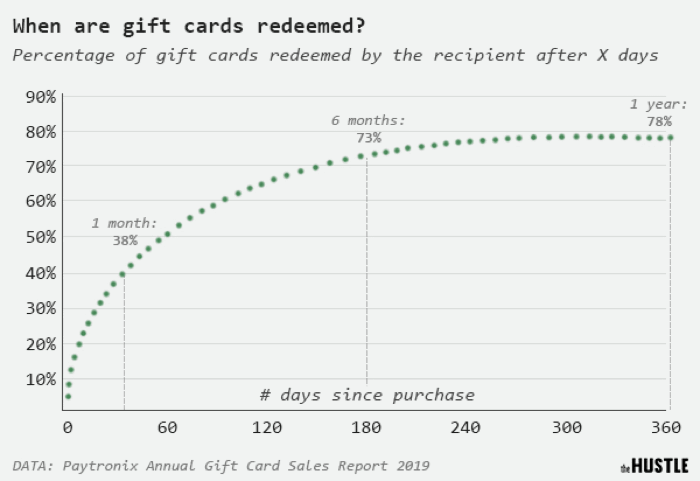
It’s now been a month since Christmas. Have you spent your gift cards yet? The odds are that you haven’t, as only 38% of all gift cards overall have been redeemed after a month. This is from a neat collection of gift card statistics from Zachary Crockett and The Hustle.

Here’s a chart of gift card redemption rates over time. Initially, it surprised me that less than 80% of gift card are used up after 12 months. That means 1 out of 5 are sitting there collecting dust after an entire year. Then I looked over at my own stack of unused gift cards, and realized that I am part of the problem!

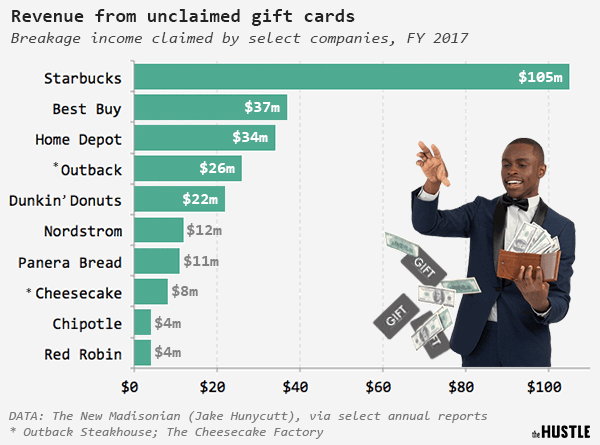
This also explains why many gift cards can be discounted 10% to 20% in stores. In addition to the embedded profit margins of each specific business, around 6% of gift cards are never used. On top of their normal profits, Starbucks makes over $100 million a year from gift cards bought and never used! They literally get paid for doing nothing.

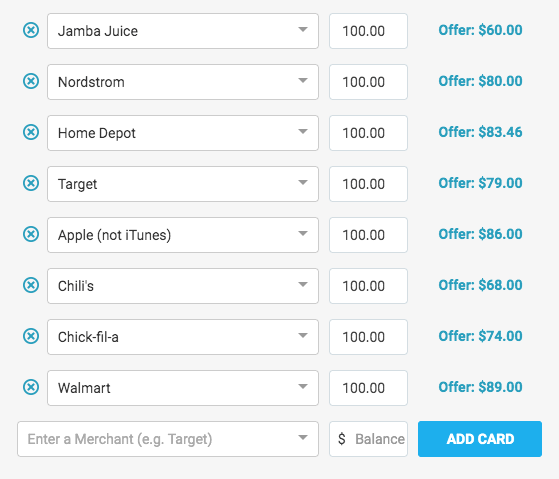
This means ~30% of gift cards that are unused after a year will never be used. Perhaps the best move is to give yourself a year and sell whatever hasn’t been used within a year. (I apply this same rule by throwing out clothes that aren’t worn after four seasons have passed.) Here are a bunch of sample quotes from card-buying site CardCash using nice round $100 numbers:

Look for extra value by exchanging for gift cards that you always use up. CardCash offered 3.5% extra over the cash offer if I exchanged into an Amazon gift card, 5% extra for Home Depot, and 7% extra for Lowe’s gift card. I have a 100% usage rate for Amazon gift cards, so that works well for my spending habits.

We all know that the solution is to give cash, but for whatever reason, giving cash in American culture is not standard practice. (Maybe some red envelopes would make it feel more classy?) In the end, I think gift cards are here to stay. I would still much rather have a gift card than a sweater that doesn’t fit. We just have to accept that there is going to be some waste in the process, like all that wrapping paper and ribbon.

Marcus Bank $100 Bonus on $10,000 Deposit (New for 2020)

Marcus by Goldman Sachs is offering a $100 bonus if you deposit $10,000+ in new funds into their online savings account within 10 days of enrollment at this special offer page. You must enroll by 11:59pm EST on 2/11/20 and maintain the new $10,000+ deposit for 60 days.

Both new and existing customers are eligible. Marcus had a very similar offer last year, but having done it in 2019 does not exclude you from doing it again in 2020 (looking at you, CIT Bank, ha). This offer is actually a bit better because their 2019 offer had a 90-day minimum holding period and this is only 60 days.

After enrollment, you must deposit $10,000 or more in new funds (internal transfers won’t count) into a Marcus Online Savings Account within 10 days of enrollment and maintain at least $10,000 of those new funds in your account in addition to your account balance at the time of enrollment for 60 consecutive days from the date of reaching the required dollar amount. Multiple deposits are allowed to reach the required dollar amount and can be made by joint owners for a joint account.

Offer available to new and existing customers. Each customer is limited to one bonus offer, which can only be applied to a single account. For eligibility purposes, each joint owner will be treated as a separate customer. For example, if you apply the bonus offer to a joint account, the remaining joint owner(s) may apply this offer to another account they own if they have not done so already. […] The bonus will be treated as interest for tax reporting purposes.

Basically a 1% bonus on $10,000 if you keep it there for 60 days, which makes the bonus itself the equivalent of ~6% APY annualized. They will deposit $100 into your account within 14 days after that 60-day period. (I usually like to wait until the bonus shows up before taking out any money.) The bonus is on top of the standard interest rate, currently 1.70% APY as of 1/22/20. This combination makes it a great short-term rate at that balance size when compared to my last monthly update of best interest rates.

H&R Block / TurboTax Desktop 2019 Sales

The benefit of “old-school” desktop tax software is that it doesn’t require your Social Security Number and financial details to be stored in the “cloud”, a fancy word for a third-party server where it can be copied or hacked. Amazon and Newegg.com often have limited-time sales (often just 24 hours) on these desktop versions, but you have to catch them in time. Apologies if you missed it!

  • H&R Block Desktop Deluxe + State 2019 is currently $19.99 at Amazon. This is a good price as the all-time low price all last year was $18. Other versions are not on sale this time. Thanks to reader Bill P for the tip.
  • TurboTax Desktop Deluxe + State 2019 is $39.88 at Amazon for the physical disc/PC download/Mac download versions. This is not a special price, although it is rarely discounted (and will go higher as the deadline nears). There may be another deal later on that shaves off another $10 or so.

Keep in mind that for both H&R Block and TurboTax desktop Fed+State products, Federal e-Files are included but State e-File is extra (about $20 each). You can print the (usually shorter) state return for free and snail mail it in if you don’t have a free State e-File option.

Best Interest Rates on Cash – January 2020

Here’s my monthly roundup of the best interest rates on cash for January 2020, roughly sorted from shortest to longest maturities. I track these rates because I keep 12 months of expenses as a cash cushion and also invest in longer-term CDs (often at lesser-known credit unions) when they yield more than bonds. Check out my Ultimate Rate-Chaser Calculator to see how much extra interest you’d earn by moving money between accounts. Rates listed are available to everyone nationwide. Rates checked as of 1/9/2020.

High-yield savings accounts
While the huge megabanks like to get away with 0.01% APY, it’s easy to open a new “piggy-back” savings account and simply move some funds over from your existing checking account. The interest rates on savings accounts can drop at any time, so I list the top rates as well as competitive rates from banks with a history of competitive rates. Some banks will bait you with a temporary top rate and then lower the rates in the hopes that you are too lazy to leave.

Short-term guaranteed rates (1 year and under)
A common question is what to do with a big pile of cash that you’re waiting to deploy shortly (just sold your house, just sold your business, legal settlement, inheritance). My usual advice is to keep things simple and take your time. If not a savings account, then put it in a flexible short-term CD under the FDIC limits until you have a plan.

  • No Penalty CDs offer a fixed interest rate that can never go down, but you can still take out your money (once) without any fees if you want to use it elsewhere. Marcus Bank has a 11-month No Penalty CD at 2.00% APY with a $500 minimum deposit. My eBanc has a 11-month No Penalty CD at 2.00% APY with a $100,000 minimum deposit. Ally Bank has a 11-month No Penalty CD at 1.85% APY with a $25,000 minimum deposit. CIT Bank has a 11-month No Penalty CD at 1.75% APY with a $1,000 minimum deposit. You may wish to open multiple CDs in smaller increments for more flexibility.
  • Quontic Bank has a 12-month CD at 2.20% APY ($1,000 minimum).

Money market mutual funds + Ultra-short bond ETFs
If you like to keep cash in a brokerage account, beware that many brokers pay out very little interest on their default cash sweep funds (and keep the difference for themselves). The following money market and ultra-short bond funds are not FDIC-insured, but may be a good option if you have idle cash and cheap/free commissions.

  • Vanguard Prime Money Market Fund currently pays an 1.69% SEC yield. The default sweep option is the Vanguard Federal Money Market Fund which has an SEC yield of 1.54%. You can manually move the money over to Prime if you meet the $3,000 minimum investment.
  • Vanguard Ultra-Short-Term Bond Fund currently pays 2.00% SEC yield ($3,000 min) and 2.16% SEC Yield ($50,000 min). The average duration is ~1 year, so there is more interest rate risk.
  • The PIMCO Enhanced Short Maturity Active Bond ETF (MINT) has a 1.97% SEC yield and the iShares Short Maturity Bond ETF (NEAR) has a 2.25% SEC yield while holding a portfolio of investment-grade bonds with an average duration of ~6 months.

Treasury Bills and Ultra-short Treasury ETFs
Another option is to buy individual Treasury bills which come in a variety of maturities from 4-weeks to 52-weeks. You can also invest in ETFs that hold a rotating basket of short-term Treasury Bills for you, while charging a small management fee for doing so. T-bill interest is exempt from state and local income taxes.

  • You can build your own T-Bill ladder at TreasuryDirect.gov or via a brokerage account with a bond desk like Vanguard and Fidelity. Here are the current Treasury Bill rates. As of 1/9/2020, a 4-week T-Bill had the equivalent of 1.53% annualized interest and a 52-week T-Bill had the equivalent of 1.54% annualized interest.
  • The Goldman Sachs Access Treasury 0-1 Year ETF (GBIL) has a 1.83% SEC yield and the SPDR Bloomberg Barclays 1-3 Month T-Bill ETF (BIL) has a 1.38% SEC yield. GBIL appears to have a slightly longer average maturity than BIL.

US Savings Bonds
Series I Savings Bonds offer rates that are linked to inflation and backed by the US government. You must hold them for at least a year. There are annual purchase limits. If you redeem them within 5 years there is a penalty of the last 3 months of interest.

  • “I Bonds” bought between November 2019 and April 2020 will earn a 2.22% rate for the first six months. The rate of the subsequent 6-month period will be based on inflation again. More info here.
  • In mid-April 2020, the CPI will be announced and you will have a short period where you will have a very close estimate of the rate for the next 12 months. I will have another post up at that time.

Prepaid Cards with Attached Savings Accounts
A small subset of prepaid debit cards have an “attached” FDIC-insured savings account with exceptionally high interest rates. The negatives are that balances are capped, and there are many fees that you must be careful to avoid (lest they eat up your interest). Some folks don’t mind the extra work and attention required, while others do. There is a long list of previous offers that have already disappeared with little notice. I don’t personally recommend nor use any of these anymore.

  • The only notable card left in this category is Mango Money at 6% APY on up to $2,500, but there are many hoops to jump through. Requirements include $1,500+ in “signature” purchases and a minimum balance of $25.00 at the end of the month.

Rewards checking accounts
These unique checking accounts pay above-average interest rates, but with unique risks. You have to jump through certain hoops, and if you make a mistake you won’t earn any interest for that month. Some folks don’t mind the extra work and attention required, while others do. Rates can also drop to near-zero quickly, leaving a “bait-and-switch” feeling. I don’t use any of these anymore.

  • Consumers Credit Union Free Rewards Checking (my review) has up to 5.09% APY on balances up to $10,000 if you make $500+ in ACH deposits, 12 debit card “signature” purchases, and spend $1,000 on their credit card each month. TAB Bank Kasasa Cash Checking has 4.00% APY on balances up to $50,000 if you make 1 ACH transfer and 15+ debit card purchases of $5+ each month, but read their vague fine print first. Find a locally-restricted rewards checking account at DepositAccounts.
  • If you’re looking for a high-interest checking account without debit card transaction requirements, the rate won’t be nearly as high, but take a look at MemoryBank at 0.90% APY.

Certificates of deposit (greater than 1 year)
CDs offer higher rates, but come with an early withdrawal penalty. By finding a bank CD with a reasonable early withdrawal penalty, you can enjoy higher rates but maintain access in a true emergency. Alternatively, consider building a CD ladder of different maturity lengths (ex. 1/2/3/4/5-years) such that you have access to part of the ladder each year, but your blended interest rate is higher than a savings account. When one CD matures, use that money to buy another 5-year CD to keep the ladder going. Some CDs also offer “add-ons” where you can deposit more funds if rates drop.

  • Financial Partners Credit Union (LFCU) has a 5-year Jumbo certificate at 3.00% APY ($100k minimum) and 2.85% APY with a $1,000 minimum. As with many credit union specials, this likely won’t last long. Anyone can join this credit union via partner organization American Consumer Council ($8 one-time fee).
  • Navy Federal Credit Union has a special 37-month IRA CD at 3.00% APY ($50 minimum + add-on feature), but you must have a military affiliation to join (includes being a relative of a veteran).
  • Andrews FCU still has their special 84-month certificate at 3.05% APY. Anyone can join this credit union via partner organization.
  • You can buy certificates of deposit via the bond desks of Vanguard and Fidelity. You may need an account to see the rates. These “brokered CDs” offer FDIC insurance and easy laddering, but they don’t come with predictable early withdrawal penalties. The rates are not competitive right now. Watch out for higher rates from callable CDs listed by Fidelity.

Longer-term Instruments
I’d use these with caution due to increased interest rate risk, but I still track them to see the rest of the current yield curve.

  • Willing to lock up your money for 10+ years? You can buy long-term certificates of deposit via the bond desks of Vanguard and Fidelity. These “brokered CDs” offer FDIC insurance, but they don’t come with predictable early withdrawal penalties. I don’t see anything noteworthy. Watch out for higher rates from callable CDs from Fidelity.
  • How about two decades? Series EE Savings Bonds are not indexed to inflation, but they have a unique guarantee that the value will double in value in 20 years, which equals a guaranteed return of 3.5% a year. However, if you don’t hold for that long, you’ll be stuck with the normal rate which is quite low (currently a sad 0.10% rate). I view this as a huge early withdrawal penalty. You could also view it as a hedge against prolonged deflation, but only if you can hold on for 20 years. As of 1/9/2020, the 20-year Treasury Bond rate was 2.17%.

All rates were checked as of 1/9/2020.

Citi® Diamond Preferred® Card: 0% Intro APR for 21 months on Balance Transfers

One of the most common resolutions is to pay down debt. Rewards-earning credit cards may not be optimal for those carrying balances and thus more impacted by 18% interest rates than a relatively puny 2% back on purchases. Consider the Citi® Diamond Preferred® Card, which doesn’t offer a fancy rewards structure but has brought back their longest 0% APR intro balance transfer period. The highlights:

  • 0% Intro APR for 21 months on balance transfers from date of first transfer and 0% Intro APR for 12 months on purchases from date of account opening. After that the variable APR will be 17.99% – 28.74%, based on your creditworthiness. Balance transfers must be completed within 4 months of account opening.
  • There is a balance transfer fee of either $5 or 5% of the amount of each transfer, whichever is greater
  • Get free access to your FICO® Score online.
  • With Citi Entertainment®, get special access to purchase tickets to thousands of events, including concerts, sporting events, dining experiences and more.
  • No annual fee.

The strong part of this card is the long 21 month period, so you can spread out payments over 1.75 years and ideally pay it all off by the end. There is a 5% balance transfer fee ($5 min). However, if you’re currently paying 18% APR, then a 5% fee is the equivalent of paying 3.33 months of interest at that previous rate, and then you’ll still be left with 17.7 months at 0% interest.

Once the intro period on all 0% cards expire, the rates will go right back up. You’ll either need to pay it off or transfer your balance again if you need more time. This card lets you spread your payments out over 21 months instead of 6 or 12.

If you are certain that you can pay it off within a shorter time period, look for a card with no balance transfer fee. Compare with other low fee 0% APR balance transfer offers.

Bottom line. The Citi® Diamond Preferred® Card is a card targeted that for those serious about paying down their balances. The 0% introductory period of 21 months on balance transfers is the longest they offer, with a one-time 5% balance transfer fee ($5 min). No annual fee.

  • Citi® Diamond Preferred® Card application link

Domino’s Pizza Gift Cards: 25% Cash Back

MyGiftCardsPlus has a promotion with 25% cash back on Domino’s Pizza gift cards for a limited time. For example, buy a $100 gift card and get $25 cash back. The gift card has no expiration. Limit $1,000 per household. While supplies last. I do enjoy the pure convenience of the Domino’s app!

There are also promos from Delta Airlines (10% cash back), Jersey Mike’s (10% back), Bed Bath and Beyond (10% back), and Fanatics (20% back).

The cash back is in the form of Swagbucks, which you can cash out via PayPal or Visa Prepaid card. Not a member? Join via my Swagbucks referral link and earn a $3 referral bonus + an additional $10 bonus if you spend at least $25 through their shopping portal within 30 days of registration. (Unfortunately, MyGiftCardsPlus purchases do not qualify.)

Keep or Close Old Bank Accounts? How To Manage Multiple Bank Accounts

In 2019, I opened new accounts at the following banks and credit unions in order to earn higher interest on my cash reserves. Some of the offers are now expired, but the idea is to show you that I do accumulate new accounts every year:

For the most part, I keep these new accounts. I also profited from these promotions via accounts I opened prior to 2019:

I’ve gotten a few questions about what I do with all of these accounts. Do I keep them forever? Close them immediately? Here’s my thought process.

Opening new accounts. In general, I will consider opening a new bank account or credit union account if the following conditions are met: Is the net benefit is roughly $100 or higher? Are the monthly fees avoidable? Is my money not already tied up elsewhere? Does it incur a hard credit check upon opening? Most banks do not perform a hard credit check for new accounts. Many credit unions do, however, as their business model is strongly dependent on lending between members. This used to matter more when you could open 20 credit cards in a year and thus you’d want to avoid having too many inquiries on your report, but nowadays the credit card issuers have limits based specifically on your credit card history and less about your number of inquiries.

However, a lot of it also depends on soft factors. Does it seem like it will be a hassle to collect the bonus? Does this bank/CU offer a history of competitive rates and offers? Does it have a reputation for good customer service?

For inactive bank accounts that you don’t care about. For a bank that is no longer offering me something useful and doesn’t look like it will in the future, I will set it to paperless statements, remove all external bank account links, and withdraw all my money. Usually, if there is no activity and $0.00 inside for over a year, the bank will quietly close the account for me. If not, there is minimal ongoing mental load and I’ll usually just let it sit idle indefinitely. If the account charges a monthly fee or somehow causes me hassle, I will go ahead and close it manually.

For inactive bank accounts that you want to keep open. For a bank where I don’t keep my cash there anymore, but I still want to keep it open in case the interest rate improves, a future promotion pops up, or to maintain a perk like free notary service, I will keep at least $10 in the account and also make a $1 in/out transaction once every 12 months. This keeps the account active so that they won’t close it without at least some sort of warning.

Finally, I track all my bank accounts using Mint and Personal Capital. I also use a password manager to keep complex, distinct passwords at each financial institution. Enable two-factor authentication where available.

By monitoring all of my open accounts using such services, I help guarantee that I will stay well within the 60-day window provided by Regulation E to notify the bank of any unauthorized activity. If you lose your debit card (“access device”) and report it lost or stolen no more than two days after becoming aware of the theft, your liability is limited to $50. If you experience an unauthorized ACH transfer, you must report it within 60 days of the statement. Here’s an example from ConsumerFinance.gov:

For example, a consumer’s account is electronically debited for $200 without the consumer’s authorization and by means other than the consumer’s access device. If the consumer notifies the institution within 60 days of the transmittal of the periodic statement that shows the unauthorized transfer, the consumer has no liability. However, if in addition to the $200, the consumer’s account is debited for a $400 unauthorized transfer on the 61st day and the consumer fails to notify the institution of the first unauthorized transfer until the 62nd day, the consumer may be liable for the full $400.

Best Interest Rates on Cash – December 2019

Here’s my monthly roundup of the best interest rates on cash for December 2019, roughly sorted from shortest to longest maturities. I track these rates because I keep a full 12 months of expenses as a cash cushion and also invest in longer-term CDs (often at lesser-known credit unions) when they yield more than bonds. Check out my Ultimate Rate-Chaser Calculator to see how much extra interest you’d earn by moving money between accounts. Rates listed are available to everyone nationwide. Rates checked as of 12/9/19.
High-yield savings accounts
While the huge megabanks like to get away with 0.01% APY, it’s easy to open a new “piggy-back” savings account and simply move some funds over from your existing checking account. The interest rates on savings accounts can drop at any time, so I list the top rates as well as competitive rates from banks with a history of competitive rates. Some banks will bait you with a temporary top rate and then lower the rates in the hopes that you are too lazy to leave.

Short-term guaranteed rates (1 year and under)
A common question is what to do with a big pile of cash that you’re waiting to deploy shortly (just sold your house, just sold your business, legal settlement, inheritance). My usual advice is to keep things simple and take your time. If not a savings account, then put it in a flexible short-term CD under the FDIC limits until you have a plan.

  • No Penalty CDs offer a fixed interest rate that can never go down, but you can still take out your money (once) without any fees if you want to use it elsewhere. My eBanc has a 11-month No Penalty CD at 2.00% APY with a $100,000 minimum deposit. Marcus Bank has a 7-month No Penalty CD at 1.90% APY with a $500 minimum deposit. Ally Bank has a 11-month No Penalty CD at 1.90% APY with a $25,000 minimum deposit. CIT Bank has a 11-month No Penalty CD at 1.85% APY with a $1,000 minimum deposit. You may wish to open multiple CDs in smaller increments for more flexibility.
  • Quontic Bank has a 12-month CD at 2.25% APY ($1,000 minimum).

Money market mutual funds + Ultra-short bond ETFs
If you like to keep cash in a brokerage account, beware that many brokers pay out very little interest on their default cash sweep funds (and keep the difference for themselves). The following money market and ultra-short bond funds are not FDIC-insured, but may be a good option if you have idle cash and cheap/free commissions.

  • Vanguard Prime Money Market Fund currently pays an 1.72% SEC yield. The default sweep option is the Vanguard Federal Money Market Fund, which has an SEC yield of 1.60%. You can manually move the money over to Prime if you meet the $3,000 minimum investment.
  • Vanguard Ultra-Short-Term Bond Fund currently pays 2.06% SEC yield ($3,000 min) and 2.16% SEC Yield ($50,000 min). The average duration is ~1 year, so there is more interest rate risk.
  • The PIMCO Enhanced Short Maturity Active Bond ETF (MINT) has a 2.05% SEC yield and the iShares Short Maturity Bond ETF (NEAR) has a 2.15% SEC yield while holding a portfolio of investment-grade bonds with an average duration of ~6 months.

Treasury Bills and Ultra-short Treasury ETFs
Another option is to buy individual Treasury bills which come in a variety of maturities from 4-weeks to 52-weeks. You can also invest in ETFs that hold a rotating basket of short-term Treasury Bills for you, while charging a small management fee for doing so. T-bill interest is exempt from state and local income taxes.

  • You can build your own T-Bill ladder at TreasuryDirect.gov or via a brokerage account with a bond desk like Vanguard and Fidelity. Here are the current Treasury Bill rates. As of 12/6/19, a 4-week T-Bill had the equivalent of 1.52% annualized interest and a 52-week T-Bill had the equivalent of 1.57% annualized interest.
  • The Goldman Sachs Access Treasury 0-1 Year ETF (GBIL) has a 1.83% SEC yield and the SPDR Bloomberg Barclays 1-3 Month T-Bill ETF (BIL) has a 1.44% SEC yield. GBIL appears to have a slightly longer average maturity than BIL.

US Savings Bonds
Series I Savings Bonds offer rates that are linked to inflation and backed by the US government. You must hold them for at least a year. There are annual purchase limits. If you redeem them within 5 years there is a penalty of the last 3 months of interest.

  • “I Bonds” bought between November 2019 and April 2020 will earn a 2.22% rate for the first six months. The rate of the subsequent 6-month period will be based on inflation again. More info here.
  • In mid-April 2020, the CPI will be announced and you will have a short period where you will have a very close estimate of the rate for the next 12 months. I will have another post up at that time.

Prepaid Cards with Attached Savings Accounts
A small subset of prepaid debit cards have an “attached” FDIC-insured savings account with exceptionally high interest rates. The negatives are that balances are capped, and there are many fees that you must be careful to avoid (lest they eat up your interest). Some folks don’t mind the extra work and attention required, while others do. There is a long list of previous offers that have already disappeared with little notice. I don’t personally recommend nor use any of these anymore.

  • The only notable card left in this category is Mango Money at 6% APY on up to $2,500, but there are many hoops to jump through. Requirements include $1,500+ in “signature” purchases and a minimum balance of $25.00 at the end of the month.

Rewards checking accounts
These unique checking accounts pay above-average interest rates, but with unique risks. You have to jump through certain hoops, and if you make a mistake you won’t earn any interest for that month. Some folks don’t mind the extra work and attention required, while others do. Rates can also drop to near-zero quickly, leaving a “bait-and-switch” feeling. I don’t use any of these anymore, but the Orion offer is worth consideration.

  • Consumers Credit Union Free Rewards Checking (my review) has up to 5.09% APY on balances up to $10,000 if you meet make $500+ in ACH deposits, 12 debit card “signature” purchases, and spend $1,000 on their credit card each month. Orion FCU Premium Checking (my review) has 3.00% APY on balances up to $15,000 if you meet make $500+ in direct deposits and 8 debit card “signature” purchases each month. Find a locally-restricted rewards checking account at DepositAccounts.
  • If you’re looking for a high-interest checking account without debit card transaction requirements, the rate won’t be nearly as high, but take a look at MemoryBank at 0.90% APY.

Certificates of deposit (greater than 1 year)
CDs offer higher rates, but come with an early withdrawal penalty. By finding a bank CD with a reasonable early withdrawal penalty, you can enjoy higher rates but maintain access in a true emergency. Alternatively, consider building a CD ladder of different maturity lengths (ex. 1/2/3/4/5-years) such that you have access to part of the ladder each year, but your blended interest rate is higher than a savings account. When one CD matures, use that money to buy another 5-year CD to keep the ladder going. Some CDs also offer “add-ons” where you can deposit more funds if rates drop.

  • You could build a CD ladder at Lafayette Federal Credit Union (LFCU) at 3.03% APY for 5-years, 2.78% APY for 4-year, 2.52% APY for 3-year, 2.27% APY for 2-year, and 2.02% APY for 1-year. As with many credit union deals, this likely won’t last long. Anyone can join this credit union via partner organization ($10 one-time fee).
  • Andrews FCU still had their special 7-year certificate at 3.05% APY. Anyone can join this credit union via partner organization.
  • You can buy certificates of deposit via the bond desks of Vanguard and Fidelity. You may need an account to see the rates. These “brokered CDs” offer FDIC insurance and easy laddering, but they don’t come with predictable early withdrawal penalties. The rates are not competitive right now. Watch out for higher rates from callable CDs listed by Fidelity.

Longer-term Instruments
I’d use these with caution due to increased interest rate risk, but I still track them to see the rest of the current yield curve.

  • Willing to lock up your money for 10+ years? You can buy long-term certificates of deposit via the bond desks of Vanguard and Fidelity. These “brokered CDs” offer FDIC insurance, but they don’t come with predictable early withdrawal penalties. I don’t see anything noteworthy. Watch out for higher rates from callable CDs from Fidelity.
  • How about two decades? Series EE Savings Bonds are not indexed to inflation, but they have a unique guarantee that the value will double in value in 20 years, which equals a guaranteed return of 3.5% a year. However, if you don’t hold for that long, you’ll be stuck with the normal rate which is quite low (currently a sad 0.10% rate). I view this as a huge early withdrawal penalty. You could also view it as a hedge against prolonged deflation, but only if you can hold on for 20 years. As of 12/9/19, the 20-year Treasury Bond rate was 2.13%.

All rates were checked as of 12/9/19.

Amazon Prime Photos: Free $15 Amazon Credit for First-Time Users

One of the perks of Amazon Prime membership is that you get unlimited cloud storage of your photos in full resolution.

Amazon Photos is currently offering targeted users a free $15 Amazon promo credit if you download the Amazon Photos app (iOS, Android, or desktop) and upload at least one photo for the first time. Offer expires at 11:59pm Pacific on December 31, 2019.

Giving Tuesday 2019: Double Your Impact With Matching Donations

givingtuesdayTuesday, December 3rd is Giving Tuesday 2019, an international day all about giving support through charities and nonprofits by donating money and goods or volunteering your time. In case you aren’t inundated with mailings already, this time of year is a big deal for charities, with 40% of donations occurring in the last six weeks of the year. Here are some ways you can “double your impact” with a matching donation.

Facebook Match (good toward any charity that accepts donations via Facebook). Starting at 8am Eastern on 12/3, Facebook and PayPal will match $7 million in donations to U.S. nonprofits – up to $100,000 per nonprofit and $20,000 per donor. Donations will be matched dollar for dollar on a first-come, first-served basis. All processing fees will be paid so 100% of your donation goes to charity.

For example, give directly with the donate button on the The Humane Society Facebook Page. You can also start your own fundraiser here or simply post up a donate button to support your favorite charity.

Check for an employer match. Try this lookup tool from DoubleTheDonation. Most of these programs don’t require you to actually give on a specific day, but you may want to start the process today so you don’t forget in the holiday rush.

Individual charities. Many charities are organizing their own matching program for #GivingTuesday. Here are some large charities have organized their own matches in the past, but I would check to make sure.

Also check with your favorite local community nonprofit. GivingTuesday.org has a local database.

Having trouble deciding where to give? Here are some charity comparison sites that will help you pick where to send your help.

  • CharityNavigator – Largest and well-publicized charity rating site, provides a 4-star rating based primarily on financial criteria.
  • GiveWell – Tries to identify the best charities, not rate them all. Focused primarily on charities working internationally
  • GreatNonProfits – Allows clients, volunteers, and funders to post personal reviews based on their experiences.
  • GuideStar – Tries to be a one-stop shop for both financial data and personal reviews of charities. Must register to see a lot of things, and pay a subscription fee for premium in-depth data.
  • Philanthropedia – Ranks non-profits based on opinions of experts, and groups them to mutual fund-like portfolios.

Looking to volunteer your time? Check out FeedingAmerica.org and find a volunteer opportunity at a food bank near you.

Amazon Black Friday Cyber Week+ 2019: Gift Cards, Apple iPad, MacBook, Samsung, Bose Deals + Stackable Discounts

Updated with new deals. Most recently added:

Full post with all the deals:

Here are the highlights of all the Amazon Black Friday/Cyber Week deals in one post, updated daily. You can view all of the Amazon Cyber Monday Deals here. Here are the Amazon Device deals.

Pay With Points promotions. First, if you have credit cards with Chase Ultimate Rewards, Citi ThankYou, AmEx Membership Rewards, Discover CashBack, or Capital One points, see if you are eligible for one of these stackable discounts. I was mostly ineligible after doing them in the past. You may also try removing any old linked cards from your profile and then adding them back if you are ineligible.

If you have a Discover card, Amazon is one of their 5% cashback categories this quarter.

Apple. If these are shipped and sold by Amazon, you can stack with above.

Electronics

Other Stuff

Amazon Services

Amazon Devices