Free FICO Score from Citi Credit Cards

citidouble200This post provides updated information and instructions regarding the free FICO score that is available to Citibank credit card holders.

Background. While their plans were announced in late 2014, Citi started offering free FICO scores to select cardholders in January 2015.

FICO Score details.

How to find the score. You can find the free FICO score on your online account access. According to a January 2015 press release, you can also request them to mail it to you. After logging in, look for either the “View your FICO Score” link or click on the “Card Benefits” tab. See screenshot below (click to enlarge):

fico_citi_1

Here are some example screenshots of what information is provided. Here is the latest score, a score meter, and the top two factors impacting your score:

fico_citi_2

They also provide a score history:

fico_citi_3

Here is a visual of the score range to help understand what each range means to lenders:

fico_citi_4

Fine print:

Your FICO® Score is calculated based on data from Equifax using the FICO® Bankcard Score 8 model and may be different from other credit scores. FICO® Scores are intended for and delivered only to the Primary cardmember and only if a FICO® Score is available. Disclosure of this score is not available for all Citi products and Citi may discontinue displaying the score at our discretion.
Free FICO Score from Discover Credit Cards

Discover it 14 ImageThis post provides updated information and instructions regarding the free FICO score that is available to Discover credit card holders.

Background. While a pilot program started in late 2013, Discover started offering a free FICO score to all cardholders in early 2014.

FICO Score details.

  • FICO Score version: FICO Score 8, or FICO 08. This is the most widely used of the many FICO flavors. Score version is directly from TransUnion representative.
  • Credit bureau: TransUnion
  • Update frequency: Monthly
  • Limitations: Available to all Discover consumer cards. This includes:

How to find the score. You can find the free FICO score on your online account access, your paper statements, and the Discover mobile app.

Here are some screenshots from the website (click to enlarge):

fico_discover1

fico_discover2

Here is a screenshot from the Discover app (click to enlarge):

fico_discover3

Here is a sample picture of a paper statement with the FICO score on it (click to enlarge):

fico_discover5

Fine print:

FICO® Credit Score Terms: Your FICO® Credit Score and key factors are based on data from TransUnion and may be different from other credit scores. This information is intended for and only provided to Primary cardmembers who have an available score. See Discover.com/FICO about the availability of your score. Your score is provided on the statement for individual accounts and on Discover.com with key factors for individual and joint accounts. You will see up to a year of recent scores starting when you become a cardmember. Discover and other lenders may use different inputs, such as a FICO® Credit Score, other credit scores and more information in credit decisions. This benefit may change or end in the future. FICO is a registered trademark of the Fair Isaac Corporation in the United States and other countries.

Amazon Underground: 450+ Free Android Apps with Free In-App Purchases

amazonundergroundIf you have an Android smartphone or tablet, Amazon just released Amazon Underground, which adds a collection of 450+ apps which have agreed to be 100% free, including all in-app purchases. Amazon will somehow pay the publishers based on how much time you spend use each specific app. You pay nothing.

Looking over the list of available apps, I see an Office document viewer, a photo editor, a mobile PDF scanner, and a bunch of games. I don’t play games much so I can’t tell which are good, but I recognize a few like Cut the Rope, Angry Birds, and Fruit Ninja. There are also several Disney apps for those with young children. I don’t really understand why a Goat Simulator is the #1 featured app, but hey it’s free!

Expedia+ Voyager Card from Citi Review

This offer is expired.

Expedia+ Credit Card from Citi Review

This offer is expired.

expediaplusExpedia.com has revamped their in-house loyalty rewards program. Citi and Expedia have partnered on a new set of co-branded credit cards.

CoPatient: Helping You Answer “Is This a Reasonable Medical Bill?”

copatient0High-deductible health plans are still growing in popularity. While these can be a great way to save on your monthly premiums, it also means that when you do have to visit the emergency room, you get to tackle nearly the entire bill instead of a small co-pay. The problem is that most medical bills cannot be understood by mere mortals. Likely, the doctors and nurses themselves have no clue how that $6,344 bill for a broken arm got generated.

Right now there are honest people that just got their bill, but they are frantically doing internet research because they have no idea if their huge bill is correct or what is “reasonable”. It would be nice for this problem not to exist, but until then I wanted to point out a service called CoPatient. They are made of health insurance company veterans and hire their own medical billers and coders.

You send them your unpaid medical bills, and they review it for free to determine if there are any errors or overcharges. They will send you a free estimate of what they think they can do for you. If you allow them to negotiate on your behalf, they work on a contingency basis and keep 35% of the actual savings. If they don’t save you money, you pay nothing.

copatient1

Here’s an example patient flowchart (click to enlarge):

copatient3small

The legwork that the consumer needs to do is request a detailed, itemized bill from the hospital providers. Some tips from ABC News:

Ask what services are covered under your room and facility charges
Ask what treatments were provided
Identify the date and time of when you were admitted
Clarify medical terminology that is confusing
Specifically look for erroneous double charges, for mischarges, and for situations where a charge defies common sense (e.g., a $22 Q tip).

Here are some quick stats, taken from their website and marketing materials:

More than 80 percent of the medical bills that CoPatient analyzes provide opportunities for meaningful savings. On average, CoPatient saves its customers 40 percent on their medical bills. Since its launch in 2014, CoPatient has saved consumers more than $1 million.

According their iPhone app page, CoPatient finds errors on 80% of all bills it reviews and saves folks an average of $3,000. Their FAQ states that it usually takes ~5 days for the review (more for complicated cases), and 3-6 weeks for the appeals and negotiation process. There is no minimum bill size, they will investigate that $500 unpaid bill.

I’ve never used CoPatient myself, but I would definitely consider it if I was faced with a $5,000+ bill that I didn’t understand. I mean, what would I have to lose?

On a related note, this is yet another consumer service that offers to save money on a contingency basis. That is, they only make money if they save you money. A few others:

  • AutoSlash: Helps you track price drops on rental cards. They make money when you rebook at a lower price with them.
  • Paribus: Helps you automatically request price adjustments on all your online retail purchases. They take a cut of the price drop savings.
  • AirHelp, Refund.Me, AirTaxBack: Get fees refunded for certain cancelled or missed flights to/from Europe. They take a cut of the refund.

History of 0% APR Interest Rates + Who’s Carrying a Monthly Balance?

From 2005 to 2007, a peek at my credit report might have revealed that I had over $30,000 in credit card debt. The good news is that I borrowed it at 0% APR and then immediately stashed it in an FDIC-insured bank account earning 6% interest at times. Just recently, a US presidential candidate disclosed an “up to $15k” credit card balance at 27% APR, which prompted Quoctrong Bui of NPR Planet Money to research how interest rates on credit cards have changed over time. I converted the interactive chart into an animated picture which cycles you from 2001 to 2013:

aprhistory

There’s also a chart showing the percentage of cardholders who pay off their balance in any given month, based on their FICO score.

0aprcredit2

Some observations:

The rise of 0% APR interest rates. In 2001, nobody was getting 0% APR interest rates. In 2004, there was a huge spike and that was basically “Peak 0% APR”. Since then, 0% rates have stayed around, gradually decreasing in popularity, until 2013 when there was again a slight uptick.

This doesn’t account for the changing length of 0% APR promotional periods. In 2005, there were a lot of 0% APR offers but they were usually for 6 to 12 months. As overall interest rates have remained very low across the board, there aren’t quite as many 0% APR offers available, but the best ones are for longer terms – up to 24 months.

Right now, you can get 0% APR for 15 months with no balance transfer fee, or 0% APR at 21 months with a balance transfer fee.

The big difference between the average cardholder with a 700 FICO and a 800 FICO score. I’ve always felt that anything above roughly 700 to 740 FICO was a “good enough” score with which I was rarely, if ever, denied credit. From the second chart above, you can flip the numbers to state that:

  • 77% of folks with a 700 FICO carry a balance each month.
  • 64% of folks with a 740 FICO carry a balance each month.
  • 27% of folks with a 800 FICO carry a balance each month.

On the other hand, even 27% is higher than I though it would be. A lot of people with “good” and even “excellent” credit carry balances each month.

How many people are carrying balances after the 0% introductory period ends? Obviously, there is a reason that 0% APR offers are still around. But that reason isn’t completely explained above. Does 0% APR encourage “new” debt from people who wouldn’t otherwise carry a balance? For example, is it possible to look at 6 or 12 months after the 0% intro period ends, and see if that marks an increase in balances? Or are 0% APRs mainly a tactic to attract balances already held at other card companies?

If you DO pay your balances in full, you can still reap the benefits of your good credit score without paying interest. It’s now been a while since I was earning thousands of dollars in “free money” from 0% balance transfers. But the silver lining is that back in 2007 a “good” sign-up bonus was $100 while nowadays you can easily find credit card bonuses with $500 value. I would say it is even less work to manage a few new cards a year vs. juggling 0% balance transfers which required making last-minute payments to maximize interest earned, and thus worrying about missing a payment deadline.

A quick smartphone snapshot of credit cards in my wallet shows well over $2,000 of accrued bonus value – 2 free nights at any Hilton hotel for which I got over $1,000 value, $800 in American Airlines airfare (separate $500 in airfare credits offset the annual fee), 40,000 Ultimate Rewards points good for $500 in travel, and 40,000 American miles (former US Airways card). This is addition to any cash back/miles/points for purchases, free checked bags, or extended warranty perks.

aprhistory2

Motif Investing Review – Be Your Own Fund Portfolio Manager, Even Get Paid By Others

motifnew0

Updated. Ever wanted to manage your own mutual or ETF? A new brokerage company called Motif Investing will let you do just that. One of their pitches is that you can invest in a group of up to 30 individual stocks that fit into a motif or theme like “Housing Recovery” or “Lots of Likes” (companies that have the most Likes on Facebook). You can buy the entire basket of stocks with just one $9.95 commission, with no ongoing management fees. The minimum motif investment amount is $250.

My initial impression was that it felt a bit too trendy and gimmicky to recommend as a long-term investment. Indeed, I don’t really care how many Facebook Likes a company has, and I doubt I would buy stocks based on my love of pets or my political views. It’s just not my style.

Since they let you customize the basket, anyone could essentially make their own ETF or mutual fund with ZERO expense ratio. You can’t track a broad index like the S&P 500, but if you do have a basket of stocks that you buy regularly, this would be a very cost-efficient way of doing it. You can add or remove stocks, and adjust the relative weighting of each stock in the motif. Here’s a screenshot (click to enlarge):

motifnew2

Horizon Motifs are preset “target date” motifs which are commision-free and with zero management fee. There are 9 different Horizon Motifs – you pick one of three time horizons (1 year, 5 year, or 15 year) and one of three risk levels (conservative, moderate, or aggressive). Kind of like a Target Date 20XX mutual fund, kind of like a roboadvisor. If you buy these specific portfolios, they waive their $9.95 commission. More information at this post: Horizon Motif Review: Commission-Free, No Advisory Fee, Index ETF Portfolios.

You can even make money when others use your Motif Portfolio with the Creator Royalty Program. Every time a client makes a $9.95 trade using your Motif, you’ll get a $1 royalty fee. For example, after reading an article about the Voya Corporate Leaders Trust Fund which bought 30 stocks in 1935 and then never sold them (but still charges a 0.52% management fee every year), I created the Depression Survivors Motif which does basically the same thing except it has zero management fees.

So far, I’ve made one entire dollar! 🙂 Recent performance has been abysmal due to recent oil price drops, as Chevron and ExxonMobil are significant holdings.

motifnew3

My plan is to someday create a custom basket of dividend-oriented stocks that hopefully will provide a long-term stream of growing income. For example, look at the SPDR S&P Dividend ETF (SDY) that holds 60 highest-yielding stocks of the S&P 1500 that have raised their dividends every year for the past 25 years. It’s a nice idea, but it leaves out some good companies and the 0.35% expense ratio eats up 10% of the original yield of the underlying companies. Why not hold most of these directly, remove some of the ones you don’t like, and keep the 0.35% as extra return for yourself?

Motif also uses dollar-based trades, which means every penny is invested, while they keep track of any fractional shares for you. No maintenance fees, no inactivity fees. In many ways, this is similar to the unlimited plan at Folio Investing, but Motif Investing has the potential to be a lot cheaper ($10 per motif trade with no minimum trade requirement vs. $29 every month for Folio) and is closer to a ETF in that they do real-time market trades. You can still do regular real-time trades of individual stocks for $4.95 per trade. Currently there is no automatic dividend reinvestment, the dividends go to cash and you reinvest yourself as desired.

Update: As of 8/13/15, Motif is adding the following features:

  • Dollar-based, real-time purchases of single stocks and ETFs (in addition to whole shares).
  • Stop loss orders by whole or fractional shares.
  • Create your own stock or ETF watch list.

New customer bonus. Right now, Motif Investing is offering new customers up to a $150 cash bonus when you open with $2,000+ and make 5 trades. If you make 1 trade, you’ll get $50. 3 trades will get $75.

Best Interest Rates for Savings Accounts and CDs – Updated August 2015

percentage2Our family keeps a year’s worth of expenses (not income) put aside in cash reserves; it provides financial insurance with the side benefits of lower stress and less concern about stock market gyrations. In my opinion, emergency funds can actually have a better return on investment than what you see on your bank statement.

I don’t chase rates nearly as much as I used to, but it still pays to shop around. Too many places are paying ZERO or close to it – the Megabanks, short-term US Treasuries, and money market sweep funds. Do you know what Chase offers on a 1-year CD? 0.02% APY. Bank of America on their 10-year CD? 0.15% APY. Meanwhile, the rates below vary from 1% up to over 3% annualized.

Best Currently Available Interest Rates
Here is a brief roundup of the best interest rates available on deposits backed by the full faith and credit of the US government (FDIC-insured, NCUA-insured, US Treasury Bonds, US Savings Bonds). I will try to sort them from the shortest to longest maturities.

    High-yield savings accounts

  • It seems every bank has their own online savings account, with the best accounts with long-term competitive rates earning around 1% APY. These savings accounts can change their interest rate at any time, so if you’re going to just pick the highest one, be ready to move your money.
    Short-term guaranteed rates (under 1 year)

  • Everbank Yield Pledge Money Market and Interest Checking account both offer 1.60% APY guaranteed (balances up to $150k on the Money Market) for the first 6 months for new accounts. Since it is fixed, this is essentially a 6-month CD with a higher rate than any other 6-month CD rate out there and with no early withdrawal penalty to worry about.
    Flexible Savings Bonds

  • “Series I” US Savings Bonds offer rates that are linked to inflation. Unfortunately, “I Bonds” bought right now will earn nothing for the first six months, and then a variable rate based on ongoing inflation after that. For new money, I would wait until mid-October when the next rate adjustment is announced. More info here.
    Rewards checking accounts

  • These unique checking accounts pay above-average interest rates, but with some risk. You have to jump through certain hoops, and if you make a mistake you won’t earn any interest for that month. Rates can also drop quickly, leaving a “bait-and-switch” feeling. But the rates can be high while they last. Consumers Credit Union offers up to 5.09% APY on up to a $20k balance, although 3.09% APY is easier to achieve unless you satisfy a long list of requirements. I list this one because the rate is guaranteed until December 31, 2015.
    Certificates of deposit

  • If you have a large cushion, it’s quite likely to just sit there for years. Why not put some money in longer-term investments where you can still take it out in a true emergency and pay an early withdrawal penalty. Synchrony Bank (formerly GE Capital Retail Bank) is offering a 5-year CD paying 2.25% APY $25k+ balances (2.20% APY for $2k+) with an early withdrawal penalty of 180 days interest. For example, if you withdraw from this CD after 2 years and pay the penalty, your effective rate earned will still be 1.69%. Capital One 360 also has a similar 5-year CD.
  • Other notable CDs… USAlliance FCU has a limited-time, callable 25-month CD paying 2.27% APY (anyone can donate to eligible charitable organization to gain membership). E-Loan Bank has a 5-year CD paying 2.45% APY but with a big early withdrawal penalty of two years of interest.
    Longer-term Instruments

  • Willing to lock up your money for 10+ years? Did you know that you can buy certificates of deposit via Vanguard’s bond desk? These “brokered CDs” offer the same FDIC-insurance and are often through commercial banks like Goldman Sachs. As of this writing, you can get a 10-year CD maturing 8/12/2025 that pays 3.05% APY. Prices will vary regularly.
  • How about two decades!? “Series EE” US Savings Bonds are not indexed to inflation, but they have a guarantee that the value will double in value in 20 years, which equals a guaranteed return of 3.5% a year. However, if you don’t hold for that long, you’ll be stuck with the normal rate which is quite low (currently a sad 0.50% APY). Think of it as a huge early withdrawal penalty. You really want to be sure you’ll keep it for 20 years.

How about my money? In terms of the opportunities above, I have opened an account at Everbank in the past for the promo rate and I have usually try to buy the max in US Savings I Bonds each year (no EE bonds, too long of a commitment). I don’t currently juggle any rewards checking accounts nor do I have any deposits with any other banks mentioned above. It’s just not worth it me to switch right now.

Besides some older CDs at higher rates, I keep a good chunk of my money at Ally Bank because right now they are the all-around “good enough” bank for me. Sure I could eek out 1.05% in a savings account somewhere, but Ally Online Savings is paying a 0.99% APY (as of 8/6/15) which serves as a no-fee overdraft companion to my Ally Interest Checking with ATM fee rebates. Along the same lines, I could get 2.25% in an outside bank’s 5-year CD, but Ally has 2.00% APY on their 5-year CDs and a relatively short 150-day early withdrawal penalty. A rate difference of 0.25% on $10,000 over a year is $25, and I’m not sure that’s enough to open a CD at another bank when my current Ally CDs mature.

All rates were checked as of 8/6/15.

Paribus: Automatically Request Price Drop Savings

paribus_logoMany online retailers offer a “Low Price Guarantee”, which doesn’t mean they actually have the lowest prices but only that they will match a lower price if you find it and ask for your money within a certain time window. Sometimes they’ll match certain competitors, and sometimes they’ll only match themselves.

For example, let’s say you buy some shoes and you find that a week later they are $25 less. If you don’t both notice and ask using the proper channels, you won’t get that $25 adjustment.

Paribus is a start-up which promises to help you automatically request price adjustments on all your online purchases. They’ll even see if you could have saved more using another coupon code. Thanks to reader Colin for the tip.

What does it cost? The service makes money on a contingency basis, taking 25% of any savings found. If it doesn’t save you money, it doesn’t get paid.

What merchants does it support? Here’s the current list:

  • Amazon.com
  • Target
  • Wal-Mart
  • Bloomingdale’s
  • Best Buy
  • Macy’s
  • Sephora.com
  • NewEgg.com
  • Staples
  • Bonobos
  • J. Crew
  • Zappos.com
  • Nordstrom
  • Gap
  • Banana Republic
  • Old Navy
  • Athleta
  • Piperlime

Any concerns or catches? Well, in order for their bots to do their thing (and basically impersonate you), you’ll need to hand them a decent amount of information. I signed for an account and this is what they wanted:

  • Control over your e-mail address. You will need an e-mail from a major provider (Gmail, Yahoo, Hotmail, or iCloud) and either need to authenticate them or give them your e-mail password. They need the ability to both scan your e-mail for receipts and send e-mails requesting refunds on your behalf.
  • Your Amazon.com password. If you want to utilize Amazon’s price match policy, you’ll have to give them your account password (which they promise to keep encrypted on their servers).
  • Your credit card information. Most retailers will credit your money onto the same payment method as the original purchase, so you’ll have to leave a credit card on file with Paribus for them to charge their finder’s fee.

A workaround for e-mail privacy concern would be to create a special e-mail address for shopping (i.e. yourname_receipts@gmail.com) and then set up auto-forwarding of everything going to that “dummy account” to your normal e-mail address (i.e. yourname@gmail.com). That way, you can just check your normal e-mail and still get all your online receipts.

I just signed up for an account today, but here’s a screenshot which shows some theoretical savings:

paribus_dash

This does seem like a good idea for a service, although the merchants probably won’t like it as they profit when we are lazy and uninformed. I don’t like the idea of giving out my Amazon password, but really that is the only online merchant that I use regularly. The final question will be if their execution lives up to the promise of “set-it-and-forget-it” savings.

More: TechCrunch

Google Translate: Free, Real-Time Language Translation While Traveling

gtranslateicoBack in 2014, Google bought Word Lens, a neat app that translated a few languages in real time using your smartphone’s camera. The live translation feature has been integrated into the Google Translate app (Android and iOS) and now works with 27 languages. If you snap a picture, it works with 37 languages.
This means when traveling to a foreign country, just point your phone at a restaurant menu, grocery store item, or street sign and you’ll see it in your home language. This counts as a deal for me because I would pay money for such a convenient and useful app. But it’s free, and you don’t even need an internet connection to use it (assuming you download the appropriate language packs ahead of time).

Here’s a cool video demonstration (embedded below, direct link):

Here’s the announcement on the official Google blog:

We started out with seven languages—English, French, German, Italian, Portuguese, Russian and Spanish—and today we’re adding 20 more. You can now translate to and from English and Bulgarian, Catalan, Croatian, Czech, Danish, Dutch, Filipino, Finnish, Hungarian, Indonesian, Lithuanian, Norwegian, Polish, Romanian, Slovak, Swedish, Turkish and Ukrainian. You can also do one-way translations from English to Hindi and Thai. (Or, try snapping a pic of the text you’d like translated—we have a total of 37 languages in camera mode.)

There is also a conversation mode where you can speak and it will provide instant translation of conversations across 32 languages (good for interactions at hotels, train stations, or taxis). I believe you’ll need an internet connection for this, but it supposedly now works better with slower connections.

I tried it out and while it really only works with clearly printed text, it is still an amazing application of augmented reality. I look forward to having it expand to even more languages like Chinese, Japanese, and Korean.

Willing.com Review: Free, Legal Online Will Software

I must admit that I procrastinated on setting up a will, much like many others. Ideally, an experienced, skilled estate lawyer would create something customized to your situation. But it is not always clear how to find such a person, or know what a fair cost would be. Maybe we just don’t like the idea of thinking about death.

If you don’t create a will, your state already has a default plan in place (look up the intestacy laws in your state) and it may not be what you would have chosen. Do you want a stranger appointing the guardian of your children? I tried to think of it as a gift to my family. A reader recently told me about Willing.com, a new website that promises a free, legal will in about 10 minutes. Is such a service a good idea?

Here’s what The Consumerist (owned by Consumer Reports) had to say about other DIY will-making software:

Our wallet-watching cousins at the Consumer Reports Money Adviser newsletter took a look at three DIY options for will-making — LegalZoom, Rocket Lawyer and Quicken WillMaker Plus — and found that while all three are better than not having a will, none of them is likely to meet the needs of anything more than the most basic of estates.

I’d never heard of Willing before, but the other software costs $35 and up, so I took it for a little spin and took a bunch of screenshots (click to enlarge).

Overall, the interface was very pleasant and modern and mobile-friendly.

First, they will ask some basic information about you and your family. Names, genders, zip codes, and birthdates, but not Social Security Numbers. I suppose they aren’t required legally? At least it’s one less source of identity theft to worry about.

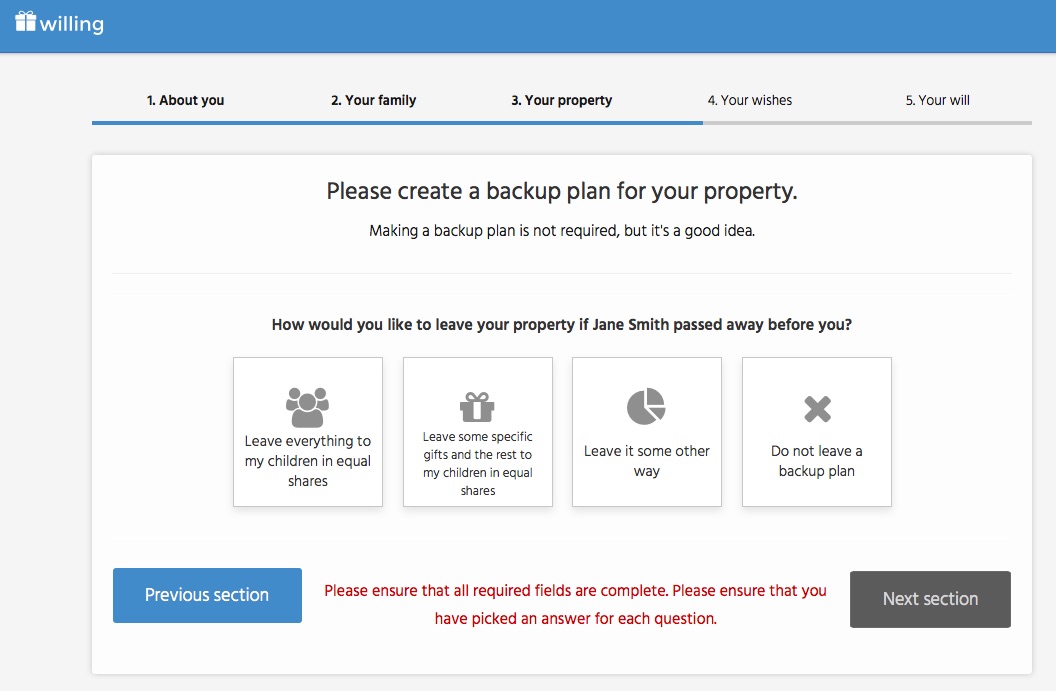
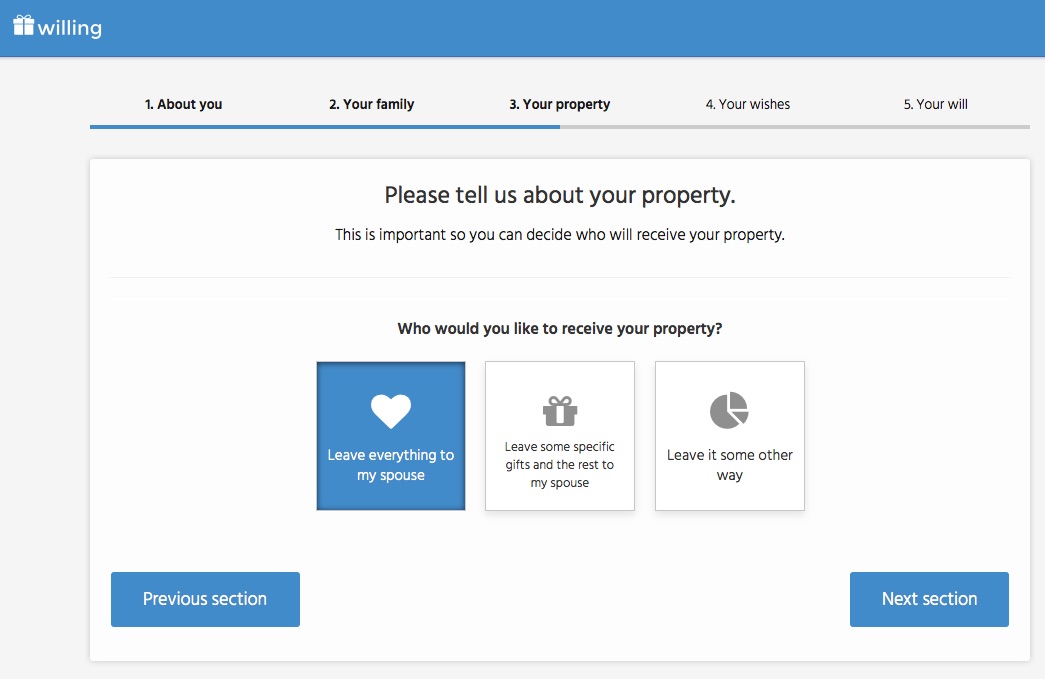
Next, they will ask you how you want to handle your property…

willing1

willing2

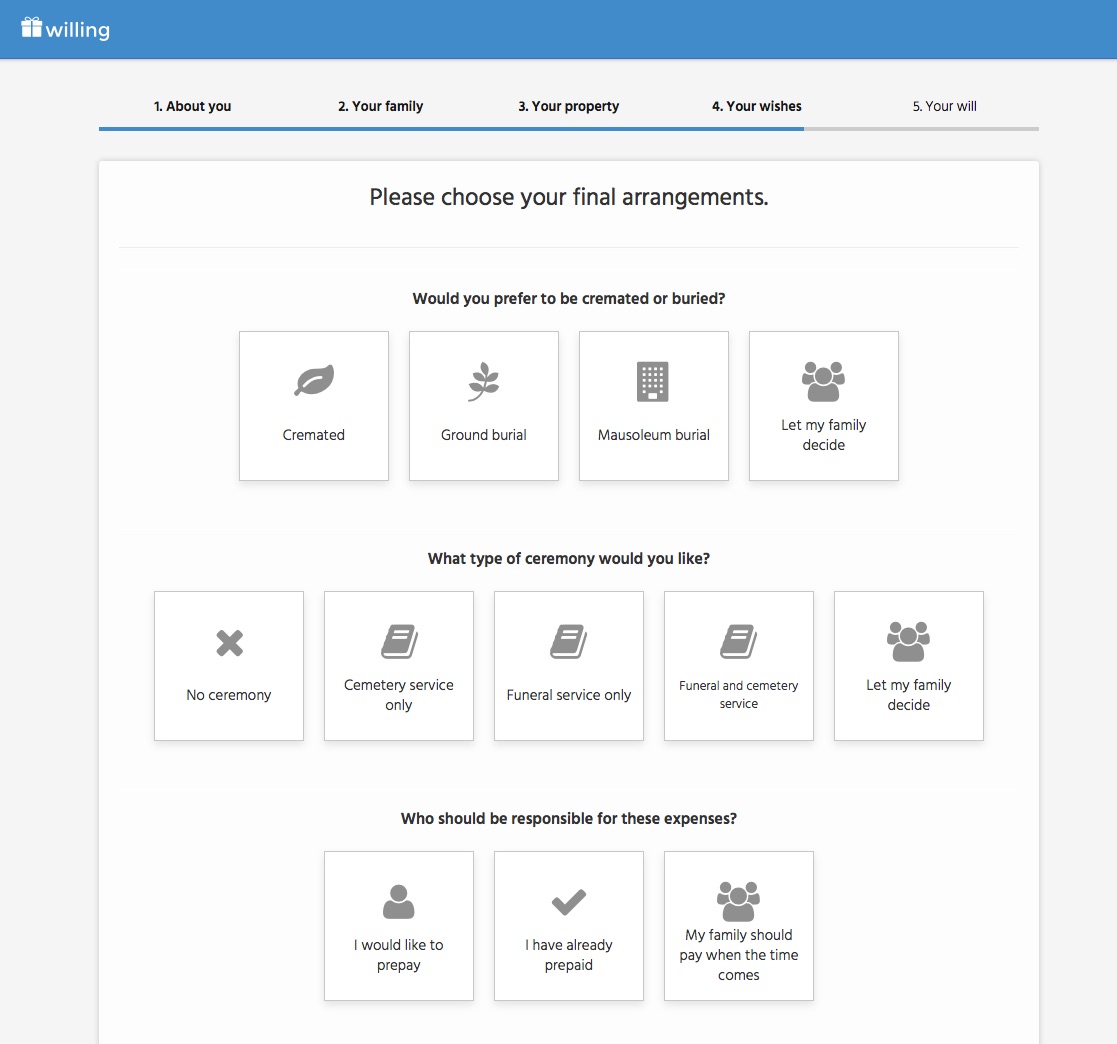
.. and final arrangements.

willing3

Who do you want to carry out your wishes?

willing4

When you’re done with the questionnaire, your will is created and customized to your state.

willing5

You can then print or download your complete will as a PDF, and also create an optional living will.

willing6

At no point do you see any advertisements nor do they ask for any payment information. The last screenshot does provide a hint as to the future revenue model for Willing – perhaps they will set up a way for you to prepay your funeral expenses (relieving your family of some stress and money) and get a little cut of that. That sounds reasonable to me if they are providing the will for free. Of course, if you live another 50 years, will you even remember shelling out that money?

I am not a lawyer and thus can’t vouch for the accuracy or quality of the will contents. As the Consumerist article states, one thing to worry about is outdated information if their software isn’t updated regularly. The final instructions tell you to sign the will along with two valid witnesses and that a notary is not required for the will to be legally binding.

The final document produced was only three pages long, although my theoretical situation was pretty simple. As I read through it, I started to see how such software would eventually become free. Indeed, while researching this post, I found several other “free will makers”, although Willing.com had the best user interface and had the least amount of annoying ads.

It may not be optimal, but at least going through the Q&A process will make you aware of the various issues you need to think about. Who will take care of your kids if your spouse dies? Who is your backup heir? Your backup estate executor? Maybe just starting the process of putting your wishes down in writing is a good thing. Otherwise, I can see someone with a simple situation using this software, but don’t know if I could recommend such a service to my friends. If I really cared about how my estate was handled (i.e. I had a significant net worth and/or dependents), I would recommend hiring a lawyer instead. The question then becomes – Is there a better way to find a good estate lawyer than relying on word-of-mouth?