Fidelity, Schwab Won’t Let You Trade Money Market ETFs (That Aren’t Theirs)

In case you aren’t aware that a huge profit source for every broker is your idle cash, Bloomberg reports that Fidelity and Schwab are blocking all new purchase trades of new money market ETFs (gift article) from Blackrock and Texas Capital. Here’s what Fidelity and Schwab say about it:

A Schwab spokesperson said its decision is consistent with the firm’s “long-standing approach” of only making available Schwab affiliate money-market mutual funds, while a Fidelity spokesperson said this is an extension of the company’s policy to “generally restrict” third-party money-market mutual funds.

The inflows to those new ETFs weren’t even that big, making this an interesting development:

Yet, the move stands out because trading platforms like Schwab and Fidelity typically don’t restrict exchange-traded funds, even if those funds are in competition with existing in-house offerings.

Indeed, I hope this doesn’t start a trend of more bans of competitor ETFs. Fidelity and Blackrock have worked very closely together in the past, so this is probably rather awkward.

For now, I still own lots of shares of iShares 0-3 Month Treasury Bond ETF (SGOV) and probably soon Vanguard 0-3 Month Treasury Bill ETF (VBIL). Fidelity and Schwab haven’t banned those, yet. Of course, Vanguard continues to not play funny games with their money market sweep funds. C’mon Vanguard, time for your own money market ETF to create even more tension…

I know that these brokers have to make their money somewhere, but they may have to become more transparent about it soon.

Best Asset Location for TIPS Ladder: Taxable, Tax-Deferred, or Roth?

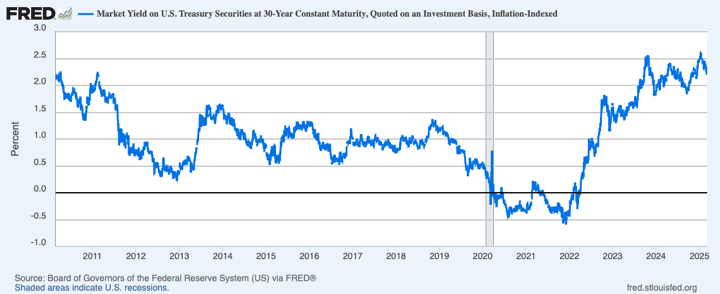
If you are a DIY investor (or professional financial planner) that is looking to geek out on the intricacies of the tax treatment for holding Treasury Inflation-Protected Securities (TIPS), check out the new paper Best Asset Location for a TIPS Ladder by Edward F. McQuarrie. I’ve been building a ladder of individual TIPS for many years, and have been extending it and filling in gaps during the recent period when long-term real rates went up to ~2.6%. Here is a chart of historical 30-year real rates (TIPS pay this much above inflation):

The paper focuses specifically on TIPS ladders, where you hold individual TIPS with staggered maturities such that when one matures each year, it creates a level, inflation-adjusted stream of annual income. The primary unique feature of this ladder is that it is guaranteed to adjust for inflation (as measured by CPI), even if it is higher than expected. Regular, nominal bonds don’t provide this protection. Of course, if inflation is lower than expected, then those nominal bonds will outperform TIPS.

The paper itself is very detailed and took a few readings to fully comprehend it all, but I definitely learned some new wrinkles. However, the overall conclusions are still useful to keep in mind if you hold TIPS. The question is, where is the preferred place to locate TIPS? In a regular taxable brokerage account? In a tax-deferred account like a pre-tax IRA or 401(k)? In a Roth IRA or 401k(k)?

Here are my takeaways, in my own words:

Individual, longer-term TIPS should be avoided if possible in a regular taxable brokerage account. This is primary due to the unique taxation of TIPS and the “phantom income” they make you pay upfront if there is inflation. You can look up “TIPS phantom income” for more details elsewhere, but the bottom line is that it’s hurts you upfront and you don’t catch up. Things only get worse at higher income tax rates, and higher inflation rates. It’s also just an extra annoyance at tax filing time.

The overall preferred location for TIPS is a Tax-Deferred Account (TDA). In other words, a pre-tax 401(K) or a Traditional pre-tax IRA where the tax is deferred but you pay taxes at ordinary income rates upon withdrawal.

It’s better to put stocks and REITs in a Roth account, so also not TIPS ideally. Roth accounts are great overall, but it’s best to take advantage of them by putting stocks and REITs inside as there is not as much added benefit for TIPS (or bonds in general).

The paper also discusses the wrinkles from state income tax and RMDs, but they don’t change the overall recommendation.

Here is a direct quote from the paper:

It follows that if the client has a more aggressive asset allocation, perhaps 2:1 stocks versus fixed income, with three accounts of roughly equal size, then stocks should first fill the Roth and then fill taxable. A TDA is always the best location among the three account types for a bond ladder, especially TIPS. Distributions are required from TDAs, and bond ladders produce distributions. Bond income is taxed as ordinary income, and distribution from TDAs are taxed as ordinary income. Characteristics of the bond asset and the TDA account are aligned.

The paper also states “The paper does not consider the best location for TIPS bonds or bond funds during the accumulation phase.” I would then add myself that if you do really want to own TIPS in a taxable account, you should consider a low-cost index ETF which is really sort of a ladder of TIPS than replenishes on its own with a roughly constant average maturity. For short-term TIPS, there is the Vanguard Short-Term Inflation-Protected Securities ETF (VTIP) with an average maturity of ~2.5 years. For a longer-term, there is the Schwab U.S. TIPS ETF (SCHP) with an average maturity of ~7 years. TIPS ETFs don’t expose you to the phantom income effect.

Again, this paper offered some additional insight for those so inclined. I hold all my individual direct TIPS in a pre-tax Solo 401(k), so I am following the advice. I am not building a strict ladder, so if I ran out of room in tax-deferred accounts, I would hold a TIPS ETF in a taxable account.

Photo by Nick Page on Unsplash

PeerStreet Bankruptcy Update (March 2025): Why I Avoid Fractional Real Estate Now

My last update on the PeerStreet bankruptcy was about a year and a half ago. PeerStreet marketed high-interest investment loans backed by real estate in $1,000 fractional increments. A few days ago, I received a big, thick envelope with lots of legalese. It appears that actual humans are manually going through each claim and verifying them against their database.

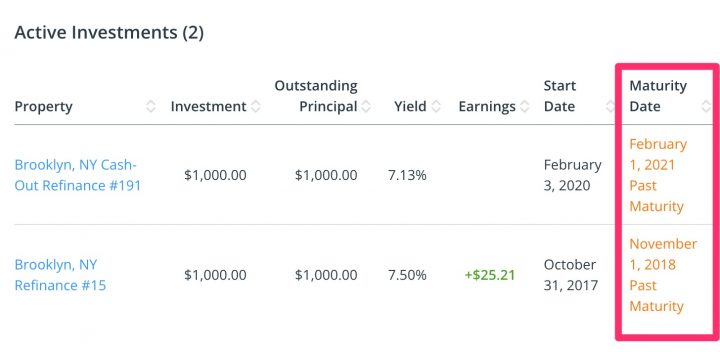
For my part, I have two $1,000 notes that are still outstanding and have been in default for a while, well before PeerStreet declared Chapter 11 bankruptcy in 2023. The bankruptcy administrators mostly agreed, but needed to point out that my notes are not “secured” claims, but instead are “Mortgage Dependent Promissory Notes” (MPDNs). Here are notes specifically responding to my claims:

The Claimant asserted a secured claim for $1,000.00, but attached a copy of a MPDN supporting a MPDN Claim in that amount.

The Debtors’ books and records reflect that the Claimant is entitled to Investment Claims in the amount of $1,000.00, as reflected in the Modified Filed Claim column.

Reclassification Adjustment: The Debtors’ books and records and the MPDN support Investment Claims and reflect that the Claimant is entitled to MPDN Claims, not secured claims. The Claimant asserts that the secured claim is secured by real estate, but provides no support for the assertion. Accordingly, the Plan Administrator requests reclassification of the asserted claim to a MPDN Claim (Class 10, 11) (to the particular MPDN reflected in the Debtors’ books and records) in the amounts reflected in the Debtors’ books and records, as detailed in the Modified Amounts column.

With this adjustment, the Plan Administrator seeks allowance of the Investment Claims in the amount of $1,000.00 against Peer Street Funding LLC, as reflected in the Modified Filed Claim column, which matches the amount of the Investment Claims in the Debtors’ books and records.

The Claimant filed two claims for two distinct MPDNs. The other claim, Claim No. [redacted], is also addressed below.

Now, this is what PeerStreet used to say about their “Mortgage Dependent Promissory Notes” (MPDNs) on their FAQ:

A mortgage-dependent promissory note, or “MDPN,” is a note in which an investor receives stated interest and principal, provided the borrower makes payment on the underlying loans. PeerStreet issues an MDPN to investors, meaning they have a direct interest in the underlying loan and indirect interest in the underlying property.

The following is a partial excerpt of what the bankruptcy documents state about MDPNs:

For avoidance of doubt, although MPDN, RWN 1-Mo., RWN 3-Mo. and PDN Claims are all unsecured, holders of those claims are entitled to their pro rata share of the relevant Underlying Loans. All amounts paid with respect to those Underlying Loans are made available pursuant to the Waterfall in section 2.6 of the Plan even if those payments result in holders receiving recoveries in excess of the principal amount of their notes and accrued interest as of the Petition Date. See McLaren Declaration I 10. Notwithstanding this entitlement, however, the Plan provides that distributions on account of MPDN, RWN 1-Mo., RWN 3-Mo. and PDN Claims are made on a pro rata basis for the claimants’ proportional share of the asset or pool of assets tied to such Investment Claims. See Plan § 4.3. In order to properly calculate each holder’s fractional, pro rata share of a particular class of Investment Claim, each Investment Claims’ pro rata interest in the underlying asset or pool of assets tied to such Investment Claims must be measured as of the same date. As a result, postpetition interest needs to be removed from all Investment Claims.

Back in 2018, this all sounded fine. Andreessen Horowitz and other VC firms invested in over $121.9 million. Famous investor Michael Burry put in $600,000 of his own money. Actual, smart lawyers were saying that this was the only practical way to create these fractional investments for real estate loans. We all were comforted by the creation of “bankruptcy remote entities”.

Even if it was really an unsecured note backed that was contractually linked to another loan to a specific property, we’d still only get that money if it was collected by what was basically a small, risky start-up fintech business that may have nobody around to well, collect anything.

My current opinion is that even if the contracts technically still might be the best workaround available, I feel the practical execution and mismatch in the alignment of interests made everything fall apart. PeerStreet was no good at servicing the loans and getting the deadbeats to pay up. They also didn’t have enough skin in the game to care. They didn’t actually hold any loans themselves, they just took a small commission off the top. They were also incentivized to loosen their underwriting standards to feed the voracious demand for new loans given their early success.

I strongly feel that if every PeerStreet executive had to hold a certain slice of every single PeerStreet loan themselves, then things would have turned out differently. Their own net worth would be at risk. They would underwrite better. They would work harder at debt recovery. Just like a certain sub-prime mortgage crisis…

In the end, I put some experimental money into multiple real-estate loans, and thought that PeerStreet was best-in-class. I am fortunate that my overall return is positive, even assuming a complete write-off of my remaining two notes, but I know that many fellow customers were not that lucky. Given these new bankruptcy documents, it seems that there are still people working on the situation and there is a possibility that I will recover some money on my last two loans.

Even today, I still get e-mail pitches for new fractional real estate start-ups. I pass on them all. In the end, the most important promises of fractional real estate are broken:

Your investments are NOT secured by real estate. In every case that I’ve seen, you invest in “notes” that are “linked” to a real mortgage on a real piece of property. The problem is that your name is not on the property, not on the mortgage, and you don’t have any control over the servicing of that mortgage. The legal gymnastics that they did to be able to use the words “direct interest” do not change the fact that you are really just lending money to a tiny, risky start-up to handle everything.

Even if these notes were secured by real estate, I have seen no evidence that PeerStreet had any skill as a servicer able to recover funds from a foreclosure. Let’s take my two Brooklyn loans from 2018 and 2021. I don’t see any possible scenario where if you sold off those properties today in 2025, even in a fire sale, even if the initial appraisal was off, that you would not be able to recover the full value of the notes. It’s not like we had a crash – real estate values have risen so far up since then!

Even if PeerStreet was still fully in business, I wonder if it would have made a difference to my situation. It has been nearly 7 years since my earliest loan was due! Now that they are bankrupt and those same smiling executives have trotted off to their next shiny business, the alignment of interests is even worse. Maybe I’ll eventually get some of this money back, but after waiting for years, my faith in the ability of these real estate fintech companies is shot.

These facts change the risk/return balance on these debt instruments. The upside is maxed out at the interest rate you charge, maybe 7% to 10%. The downside was supposed to be very, very limited because you had a physical piece of real estate to back it up. If that doesn’t hold, then there is no point.

BlackRock/iShares Target Allocation 60/40 Model ETF Portfolio (Meant for Advisors)

As a companion to my post on Fidelity Model ETF Portfolios, I also found Blackrock’s version of their 60/40 Model ETF portfolio.

The was prompted by the fact that Blackrock recently announced that it was adding a 1-2% allocation to Bitcoin in their model ETF portfolios.

The world’s biggest asset manager is finally allowing Bitcoin into its $150 billion model-portfolio universe.

BlackRock Inc. is adding a 1% to 2% allocation to the $48 billion iShares Bitcoin Trust ETF (ticker IBIT) in its target allocation portfolios that allow for alternatives, according to an investment outlook viewed by Bloomberg.

Of course, this coincided with the fact that last year they finally launched their own Bitcoin ETF, the iShares Bitcoin Trust ETF (ticker IBIT). That made me wonder, what exactly does Blackrock put into these model portfolio that are meant for advisors? The model portfolio below does not have the Bitcoin ETF added yet:

As with the Fidelity model portfolio, and probably all model portfolios meant for advisors, there is the appearance of technical complexity, with a lot of tiny allocations to ETFs to bump the total number involved to 18 different ETFs and cash (and possibly the new Bitcoin ETF as well). 1% to the iShares US Infrastructure ETF? 1% to iShares J.P. Morgan USD Emerging Markets Bond ETF? 1% to iShares Gold Trust?

However, what surprised me the most was hidden in their performance stats at the bottom. With a relatively low net weighted expense ratio of 0.16%, their gross overall performance (before all fees) was pretty good and hugged the benchmark indexes very closely. However, they had to disclose that their NET historical performance (what clients actually got) was a lot lower… why was it so much lower? Because their managed portfolio apparently comes with a 3% annual fee, charged quarterly!!!

Tucked deep at the bottom:

Net composite returns reflect the deduction of an annual fee of 3.00% typically deducted quarterly. Due to the compounding effect of these fees, annual net composite returns may be lower than stated gross returns less stated annual fee.

So you put your Managed Portfolio clients in a low-cost ETF portfolio, and then add a 3% annual fee on top. Wow, that’s… wow. I have trouble even believing it. I must be reading this wrong.

Another interesting note is that Vanguard’s new CEO, Salim Ramji, was the former global head of iShares and index investments at BlackRock and thus very involved in their push into model ETF portfolios and probably had a big hand in designing them. Will he adjust Vanguard’s suggested portfolios in a similar manner?

Best Interest Rates Survey: Savings Accounts, Treasuries, CDs, ETFs – March 2025

Here’s my monthly survey of the best interest rates on cash as of March, roughly sorted from shortest to longest maturities. Banks love taking advantage of our idle cash, and you can often earning more money while keeping the same level of safety by moving to another FDIC-insured bank or NCUA-insured credit union. Check out my Ultimate Rate-Chaser Calculator to see how much extra interest you could earn from switching. Rates listed are available to everyone nationwide. Rates checked as of 3/9/2024.

TL;DR: Short-term savings accounts dropped very slightly overall, with top rates varying widely from 3.7% to 5% APY. Short-term T-Bill rates at around 4.3%. Top 5-year CD rates are ~4.30% APY, while 5-year Treasury rate is ~4.1%.

High-yield savings accounts*
Since the huge megabanks still pay essentially no interest, everyone should at least have a separate, no-fee online savings account to piggy-back onto your existing checking account. The interest rates on savings accounts can drop at any time, so I list the top rates as well as competitive rates from banks with a history of competitive rates and solid user experience. Some banks will bait you with a temporary top rate and then lower the rates in the hopes that you are too lazy to leave.

  • The top saving rate at the moment: Roger.bank is at 5.00% APY (no min), but does require an additional companion checking account. CIT Platinum Savings is now at 4.30% APY with $5,000+ balance, but also has a $225/$300 deposit bonus you can stack on top.
  • SoFi Bank is at 3.80% APY + up to $325 new account bonus with direct deposit. You must maintain a direct deposit of any amount (even $1) each month for the higher APY. SoFi has historically competitive rates and full banking features. See details at $25 + $300 SoFi Money new account and deposit bonus.
  • Here is a limited survey of high-yield savings accounts. They aren’t the top rates, but a group that have historically kept it relatively competitive such that I like to track their history.

Short-term guaranteed rates (1 year and under)
A common question is what to do with a big pile of cash that you’re waiting to deploy shortly (plan to buy a house soon, just sold your house, just sold your business, legal settlement, inheritance). My usual advice is to keep things simple and take your time. If not a savings account, then put it in a flexible short-term CD under the FDIC limits until you have a plan.

  • No Penalty CDs offer a fixed interest rate that can never go down, but you can still take out your money (once) without any fees if you want to use it elsewhere. Marcus has a 13mo No Penalty CD at 4.15% APY ($500 minimum deposit). Farmer’s Insurance FCU has 9-month No Penalty CD at 4.25% APY ($1,000 minimum deposit). Credit Human has 12-month Liquid CD at 4.26% APY ($5,000 minimum) that allows unlimited deposits and two allowed withdrawals. Consider opening multiple CDs in smaller increments for more flexibility.
  • Security State Bank has a 12-month certificate special at 4.65% APY ($25,000 min). Early withdrawal penalty is 180 days of interest.

Money market mutual funds
Many brokerage firms that pay out very little interest on their default cash sweep funds (and keep the difference for themselves). Note: Money market mutual funds are highly-regulated, but ultimately not FDIC-insured, so I would still stick with highly reputable firms.

  • Vanguard Federal Money Market Fund (VMFXX) is the default sweep option for Vanguard brokerage accounts, which has an SEC yield of 4.24% (changes daily, but also works out to a compound yield of 4.32%, which is better for comparing against APY). Odds are this is much higher than your own broker’s default cash sweep interest rate.
  • Vanguard Treasury Money Market Fund (VUSXX) is an alternative money market fund which you must manually purchase, but the interest will be mostly (100% for 2024 tax year) exempt from state and local income taxes because it comes from qualifying US government obligations. Current SEC yield of 4.25% (compound yield of 4.33%).

Treasury Bills and Ultra-short Treasury ETFs
Another option is to buy individual Treasury bills which come in a variety of maturities from 4-weeks to 52-weeks and are fully backed by the US government. You can also invest in ETFs that hold a rotating basket of short-term Treasury Bills for you, while charging a small management fee for doing so. T-bill interest is exempt from state and local income taxes, which can make a significant difference in your effective yield.

  • You can build your own T-Bill ladder at TreasuryDirect.gov or via a brokerage account with a bond desk like Vanguard and Fidelity. Here are the current Treasury Bill rates. As of 3/7/25, a new 4-week T-Bill had the equivalent of 4.31% annualized interest and a 52-week T-Bill had the equivalent of 4.06% annualized interest.
  • The iShares 0-3 Month Treasury Bond ETF (SGOV) has a 4.20% SEC yield (0.09% expense ratio) and effective duration of 0.09 years. SPDR Bloomberg Barclays 1-3 Month T-Bill ETF (BIL) has a 4.13% SEC yield (0.136% expense ratio) and effective duration of 0.15 years. The Vanguard 0-3 Month Treasury Bill ETF (VBIL) hasn’t been around long enough to generate an SEC yield (0.07% expense ratio).

US Savings Bonds
Series I Savings Bonds offer rates that are linked to inflation and backed by the US government. You must hold them for at least a year. If you redeem them within 5 years there is a penalty of the last 3 months of interest. The annual purchase limit for electronic I bonds is $10,000 per Social Security Number, available online at TreasuryDirect.gov.

  • “I Bonds” bought between November 2024 and April 2025 will earn a 3.11% rate for the first six months. The rate of the subsequent 6-month period will be based on inflation again. More on Savings Bonds here.
  • In mid-April 2025, the CPI will be announced and you will have a short period where you will have a very close estimate of the rate for the next 12 months. I will have another post up at that time.

Rewards checking accounts
These unique checking accounts pay above-average interest rates, but with unique risks. You have to jump through certain hoops which usually involve 10+ debit card purchases each cycle, a certain number of ACH/direct deposits, and/or a certain number of logins per month. If you make a mistake (or they judge that you did) you risk earning zero interest for that month. Some folks don’t mind the extra work and attention required, while others would rather not bother. Rates can also drop suddenly, leaving a “bait-and-switch” feeling.

  • OnPath Federal Credit Union (my review) pays 7.00% APY on up to $10,000 if you make 15 debit card purchases, opt into online statements, and login to online or mobile banking once per statement cycle. Anyone can join this credit union via $5 membership fee to join partner organization. You can also get a $100 Visa Reward card when you open a new account and make qualifying transactions.
  • Genisys Credit Union pays 6.75% APY on up to $7,500 if you make 10 debit card purchases of $5+ each per statement cycle, and opt into online statements. Anyone can join this credit union via $5 membership fee to join partner organization.
  • La Capitol Federal Credit Union pays 5.75% APY (down from 6.25%) on up to $10,000 if you make 15 debit card purchases of at least $5 each per statement cycle. Anyone can join this credit union via partner organization, Louisiana Association for Personal Financial Achievement ($20).
  • (new) First Southern Bank pays 5.50% APY on up to $25,000 if you make at least 15 debit card purchases, 1 ACH credit or payment transaction, and enroll in online statements.
  • Credit Union of New Jersey pays 6.00% APY on up to $25,000 if you make 12 debit card purchases, opt into online statements, and make at least 1 direct deposit, online bill payment, or automatic payment (ACH) per statement cycle. Anyone can join this credit union via $5 membership fee to join partner organization.
  • Andrews Federal Credit Union pays 6.00% APY on up to $25,000 if you make 15 debit card purchases, opt into online statements, and make at least 1 direct deposit or ACH transaction per statement cycle. Anyone can join this credit union via partner organization.
  • Find a locally-restricted rewards checking account at DepositAccounts.

Certificates of deposit (greater than 1 year)
CDs offer higher rates, but come with an early withdrawal penalty. By finding a bank CD with a reasonable early withdrawal penalty, you can enjoy higher rates but maintain access in a true emergency. Alternatively, consider building a CD ladder of different maturity lengths (ex. 1/2/3/4/5-years) such that you have access to part of the ladder each year, but your blended interest rate is higher than a savings account. When one CD matures, use that money to buy another 5-year CD to keep the ladder going. Some CDs also offer “add-ons” where you can deposit more funds if rates drop.

  • KS State Bank has a 5-year certificate at 4.30% APY ($500 minimum), 4-year at 4.30% APY, 3-year at 4.30% APY, 2-year at 4.25% APY, and 1-year at 4.30% APY. $500 minimum. The early withdrawal penalty (EWP) for the 5-year is a huge 540 days of interest.
  • Mountain America Credit Union (MACU) has a 5-year certificate at 4.25% APY ($500 minimum), 4-year at 4.25% APY, 3-year at 4.25% APY, 2-year at 3.95% APY, and 1-year at 4.25% APY. Early withdrawal penalty for the 4-year and 5-year is 365 days of interest. Anyone can join this credit union via partner organization American Consumer Council for a one-time $5 fee (or try promo code “consumer”).
  • Lafayette Federal Credit Union (LFCU) has a 5/4/3/2/1-year certificates at 4.28% APY ($500 min). Slightly higher rates with jumbo $100,000+ balances. Note that the early withdrawal penalty for the 5-year is a relatively large 600 days of interest. Anyone nationwide can join LFCU by joining the Home Ownership Financial Literacy Council (HOFLC) for a one-time $10 fee.
  • You can buy certificates of deposit via the bond desks of Vanguard and Fidelity. You may need an account to see the rates. These “brokered CDs” offer FDIC insurance and easy laddering, but they don’t come with predictable early withdrawal penalties. Right now, I see a 5-year non-callable CD at 4.10% APY (callable: no, call protection: yes). Be warned that both Vanguard and Fidelity will list higher rates from callable CDs, which importantly means they can call back your CD if rates drop later. (Issuers have indeed started calling some of their old 5%+ CDs during 2024.)

Longer-term Instruments
I’d use these with caution due to increased interest rate risk (tbh, I don’t use them at all), but I still track them to see the rest of the current yield curve.

  • Willing to lock up your money for 10 years? You can buy long-term certificates of deposit via the bond desks of Vanguard and Fidelity. These “brokered CDs” offer FDIC insurance, but they don’t come with predictable early withdrawal penalties. You might find something that pays more than your other brokerage cash and Treasury options. Right now, I see a 10-year CDs at [n/a] (non-callable) vs. 4.32% for a 10-year Treasury. Watch out for higher rates from callable CDs where they can call your CD back if interest rates drop.

All rates were checked as of 3/9/25.

* I no longer recommend fintech companies due to the possibility of loss due to poor recordkeeping and lack of government regulation. (Ex. Evergreen Wealth at 5% APY is a fintech.)

Photo by insung yoon on Unsplash

SGOV, STIP, TIP iShares ETFs: Claim Your State Income Tax Exemption (2024/2025)

As a follow-up to my posts for Vanguard and Fidelity money market funds, iShares ETFs (Blackrock) has also recently released their US GOI percentages for 2024 tax year. US Government Obligation Interest (US GOI) like Treasury bills and bonds are generally exempt from state and local income taxes. However, in order to claim this exemption, you’ll likely have to manually enter it on your tax return after digging up a few extra details.

The tax document has a pretty good summary of the situation for all brokers:

The Form 1099-DIV (or substitute form) you received from your financial advisor or brokerage firm may include income derived from U.S. Government and agency obligations. This income may be excluded from state income tax (although in many states, only the income from Treasury obligations is exempt from personal state income tax). The information below is provided to assist with the completion of shareholder state income tax returns. The amount in Box 1a of 2024 IRS Form 1099-DIV should be multiplied by the applicable percentages below to obtain the dollar amount of income derived from the sources categorized below. Because the qualifications for exclusion vary by state (some states have investment threshold requirements), please consult your tax advisor for details.

It’s notable that even things like the iShares iBonds 20XX Term TIPS ETFs are not 100% US government obligations, so it’s important to reference this document and not assume. For iShares TIPS Bond ETF (TIP) and iShares 0-5 Year TIPS Bond ETF (STIP) the USGOI percentage for 2024 was indeed at 100.00%.

For iShares 0-3 Month Treasury Bond ETF (SGOV), the USGOI percentage for 2024 was 97.53%. This is pretty good and why SGOV is my default cash position at most brokers. The tax document also confirms that at least 50% of the assets of the fund were invested in Federal Obligations at the end of each quarter of the fiscal year. That means that SGOV met the minimum criteria for the dividend income to be exempt in the states of California, Connecticut, and New York.

Canadian Pension Plan Fund: High-Fee Active Structure Lags Passive Index Benchmark Over Last 5 Years

The Canada Pension Plan Fund (CPP) is one of the two major components of Canada’s public retirement income system, along with Old Age Security (OAS). The CPP mandates that all employed Canadians age 18+ to contribute a certain percentage of their earnings (with an match contributed by their employer) to the CPP, managed by a group called CPPI. (Source: Wikipedia.)

I learned all of this because the CPP has become an interesting example where we can compare an investment manager that has chosen to switch to the high-cost, “we can do better because we are smarter” philosophy: lots of highly-paid employees, lots of highly-compensated hedge fund and private equity managers, lots of fees paid, all in search of higher returns. Luckily, we can see if they succeed because they have to publish their results for all to see.

My sources are two interesting articles and the CPP 2024 Annual Report:

In their fiscal 2024, the CPP paid C$3.5 billion in fees to external investment managers. (The fees paid in 2006 were just C$36 million. As in only C$0.036 billion, 100 times less!) The pension fund itself has grown to over 2,000 employees (up from only 100 employees in 2006), and after adding all operating expenses and transaction costs, the fund’s total expenses now exceed C$5.5 billion annually.

The total assets are roughly C$630 billion. C$5.5 billion of costs on C$630 billion of assets means the fund’s annual expenses eat up 0.87% of the total assets every year. That is creeping very close to 1% of assets annually.

What have those costs bought? Not much so far. In fact, the 5-year performance lag in returns as compared to a passive benchmark portfolio is actually higher than that. The CPP chooses its own Reference Portfolio to match up with their mix of hedge funds and private investments, and it has shifted over the years going from 65% Global Equities/35% Bonds in 2015 to 85% Global Equities/15% Bonds in 2024. (Specifically, 85% MCSI World Index and 15% Canadian government bonds.)

After many pages in the CPP Annual Report explaining their very fancy system and why they believe they will outperform… here’s the one chart that shows their actual value-added. This is their own chart and language.

The CPPI says that we should be okay with this lag, partially because they are so “resilient” during market downturns. This is an often-cited reason for underperformance, but I question it on two levels.

First, with many of these illiquid investments, the values are essentially self-reported. Private REITs always have lower volatility than publicly-traded REITs because they get to report their own net asset value. What’s the value of a building or business that hasn’t actually sold on the open market? Who really knows? Sure, the numbers have to be within reason, but otherwise they are easily fudged. Second, you could have gotten lower volatility by simply holding a little less stocks and a little more bonds. That would have also been more resilient.

I’ve also read the follow-up defense pieces, but I wasn’t really swayed. It’s all the same old stuff. The benchmark wasn’t really a good benchmark (in retrospect), even though they picked the benchmark themselves. Our performance beat our arbitrarily-set target (’cause everything went up), even if it lagged the benchmark. You have to pay up for smart helpers! Don’t you understand?! “I have people skills!”

(Counterpoint: It’s not common, but it can be done with less bloat and lower fees. The Public Employees’ Retirement System of Nevada (NVPERS) is an example of a pension fund that uses low-cost index funds for all of their publicly-traded asset classes. They have two employees. Their overall fees are 0.13%, mostly because they do hold about 12% in private assets. Their trailing 1-year performance as of 9/30/24? 20% annualized. Source.)

Right now, the alarms are not ringing for the CPP because the markets are up a lot and they are generating solidly positive returns even if they lag the market by 1% or 2% annually. I will be on the lookout for future updates on the CPP to see if they can justify their high cost structure over the long run. In the meantime, perhaps Canadian taxpayers should re-read Warren Buffett’s parable warning us about expensive Helpers.

Fidelity Target Allocation ETF Model Portfolios (Meant for Advisors)

One of my older relatives used Fidelity to manage their investments, and it was a hodgepodge of over 10 different mutual funds with a total expense ratio nearing 1%. The last time I measured its long-term performance, it lagged the benchmark indexes by… roughly 1%. Since then, I’ve always viewed that as a big part of Fidelity’s business model. They will sell you a portfolio that looks complex and smart, with fancy-sounding names and lots of moving parts. In the end, your performance will be okay because it will capture most of the stock market return, and most folks won’t even notice the chunk that was missing from fees. From a certain perspective, you paid a fee and got what you wanted: a stamp of approval from a respectable name.
If you’re wondering how Fidelity can offer their excellent customer service and products at such a competitive prices, this is why. There are many people paying additional fees for their various advisory services. I’m okay with that – as a DIY investor I am comfortable turning down their upsell pitches for additional assistance.

So when I saw the ETF.com article Fidelity Debuts All-ETF Model Portfolios for Advisors, I admit that I had my preconceived notions. Would they surprise me? You can view all of model portfolios here. Here is a screenshot with just their moderate risk 60% stock/40% bond portfolio.

The hodgepodge of fancy names is still going strong. It’s like a checklist of industry buzz words: Dynamic Growth, Enhanced, High Dividend, Momentum, Inflation, Multifactor. I find it amusing that Dividend tends to equate to “Value”, which is the opposite of “Growth”. If you own this many different things, how different is it really from just owning the entire stock market?

There still appears to be added complexity just for the sake of looking complex. Is it really helpful to have 2% in the iShares Core Dividend ETF? Or 2% in Cash Sweep? SIX to EIGHT different US bond ETFs???

With a weighted expense ratio of 0.25%, the overall cost is much lower than their active mutual fund portfolios from 10+ years ago. Competition from Vanguard and Blackrock have forced the expense ratios lower across the industry. So while the Fidelity model seems to pretty much the same, it does now come potentially at a lower price. So that’s a good thing.

Some of these Fidelity ETFs are barely a year old, so we can’t do a backtest. I will have to remember to run another comparison 10 years from now between this 60/40 Fidelity ETF portfolio and a simple 3-ETF low-cost index portfolio from Vanguard (42% VTI/18% VXUS/40% BND) or iShares (42% ITOT/18% IXUS/40% IUSB). The low-cost index portfolio have a weighted expense ratio of about 0.04%. Can the Fidelity outperform and justify their higher fees?

Personal Finance Stack: Portfolio Simplification Progress for 2024

I recently found a handwritten note from early 2024 that outlined my goals to “SIMPLIFY!” my portfolio. The overall idea was to make things easier for my spouse to manage in case something happened to me. Even though I still have a rat’s nest of accounts overall, I wanted a streamlined “Core” group of accounts that held 99% of my portfolio. Here’s the current state of the investment side of my personal finance stack.

Vanguard. Vanguard still holds the majority of my investment portfolio, while at the same time has the least amount of transaction activity. The idea is to let it just grow, but also to avoid the need to deal with customer service. Vanguard has the best cash sweep if you don’t use automatic dividend reinvestment. I also want to give the new CEO a bit of time to see how things go.

In 2024, I did convert all my mutual funds into ETFs, so they are easily portable if I do want to move assets. In addition, perhaps the slightly lower ETF expense ratios will make a difference.

Fidelity. Fidelity holds the 2nd-largest total balance, and is where I keep my high-touch accounts. My Fidelity Cash Management Account (CMA) handles most of my monthly cashflows (direct deposit in; BillPay out). My Solo 401k with the manual contributions and ability to buy individual TIPS/Treasuries. My self-directed account with individual stock holdings. In the future, I plan on opening any custodial accounts for kids there.

TreasuryDirect (Sold all Savings Bonds!). A major reason to sell was to achieve simplification and no longer be reliant on the customer service of TreasuryDirect, mostly in for estate planning scenarios. In addition, their policy states that if my account is hacked, they maintain zero liability for any losses. I will miss the additional effective tax-deferred space of savings bonds, but it just wasn’t worth the additional hassle. I just don’t see things improving there in the future, it feels more like gradual decay. This was my 3rd largest balance.

Many of these savings bonds had fixed rates in the 0% to 1%; only a few were at higher fixed rates. The proceeds were reinvested into long-term TIPS (bought/held at Fidelity) with real yields of 2% to 2.6%. Finally, it worked out because the capital gains from this sale were offset from capital losses harvested from selling a bond fund previously when rates rose. (I did an ETF swap to harvest the tax losses while maintaining a similar bond holding without incurring a wash sale.)

Robinhood (setback!). In an unexpected setback for simplification, I ended up transferring my Vanguard IRAs to Robinhood in 2024 due to their 3% transfer promo. When the 5-year hold ends, my plan is to move them to Fidelity unless there is another lucrative offer. This was a new brokerage account to track, but I just couldn’t turn down an additional ~$18,000 in Roth IRA balances.

Utah My529. Thanks to some big early contributions and a very aggressive asset allocation, this is now my next largest investment account, although theoretically it should be completely obliterated within 12 years or so when the tuition bills hit. I consolidated 529 plans several years ago; it can be a lot of paperwork but it’s nice to have everything at one place. Utah seems to be on top of the game for 529 plans.

Bank of America/Merrill Edge to US Bank swap? I keep $100,000 in brokerage assets at Merrill Edge in order to qualify for the Bank of America Preferred Rewards Tier which essentially gets me a flat 2.625% cash back on all my purchases. However, in 2024, US Bank debuted their Smartly credit card that offers up to 4% cash back, also if you keep $100,000 in asset at their brokerage arm.

Should I set up yet another new account at US Bank to take advantage? Should I then close down BofA/Merrill Edge to offset? The problem is that I’m not convinced that US Bank will keep the 4% cash back for very long. US Bank has a history of rolling out new products and then shutting them down abruptly. On the other hand, they also have a history of sometimes keeping the existing perks for grandfathered customers. So maybe it’s best to get in early? Simplification vs. optimization. I didn’t take any action in 2024.

Honestly, as the now-5th largest balance, the BofA/Merrill Edge is the account that I should probably get rid of next, but it’s been so reliable with minimal hassles. I don’t like to mess with what works.

401k Custodians (consolidated with direct 401k-to-401k transfers). These are pre-tax accounts, so I didn’t want to go 401k-to-IRA since then I would have Pre-tax IRAs which would complicate my Backdoor Roth IRA conversions. This makes one less place I have to track my investments. Eventually, if/when our marginal tax brackets are lower, I’d plan to convert some of these accounts to Roth IRAs.

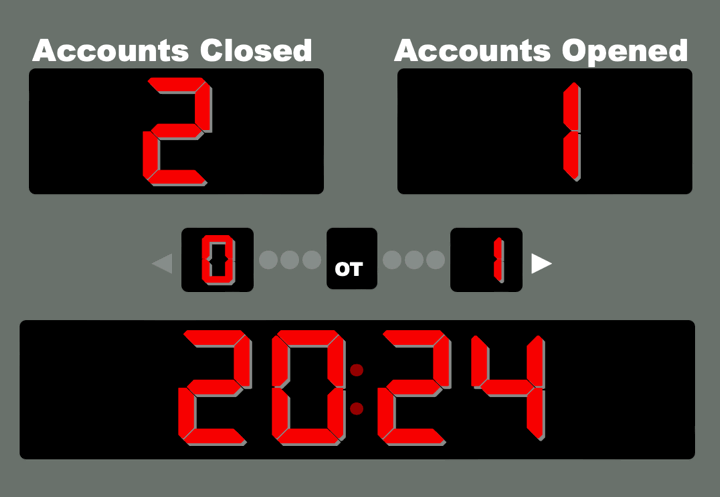
Final score: Two accounts closed (TreasuryDirect and 401k), one account opened (Robinhood).

TastyTrade Referral (Important Correction!)

Update: I’m very sorry, I was in a rush and read the offer wrong. There is no $500 for the referred person. Please don’t open and fund. If I end up getting a $500 reward for referring you, I will send you the $500. However, I don’t have a way of tracking this, so please contact me now if you opened an account with my referral code and have already funded. My recommendation is to not fund – especially due to the long 6-month holding period.

TastyTrade brokerage is offering a $500 double referral offer. However, it is only for the referring person, not the referred.

Berkshire Hathaway 2024 Annual Shareholder Letter by Warren Buffett

Berkshire Hathaway (BRK) released its 2024 Letter to Shareholders (also see full 2024 Annual Report), which Warren Buffett traditionally also uses as an educational instrument. As always, I recommend reading it yourself (only 13 pages total this year). I enjoy reading the letter first (with no spoilers), then peruse the various newspaper and media commentary, and finally re-read the letter again. Here are my personal highlights and commentary.

The total market cap of Berkshire is now over $1 trillion dollars. The total value of their public equity holdings was $272 billion. The total of their cash holdings was $334 billion. The total value of their controlled businesses was about $400 billion.

Berkshire’s businesses are doing fine overall, especially their insurance business. Their controlled businesses just continue to churn out cash, which obviously adds to the cash pile if there are no new investments. BRK parks nearly all of its cash in Treasury Bills, which made a lot of interest in 2024 as compared to the past several years.

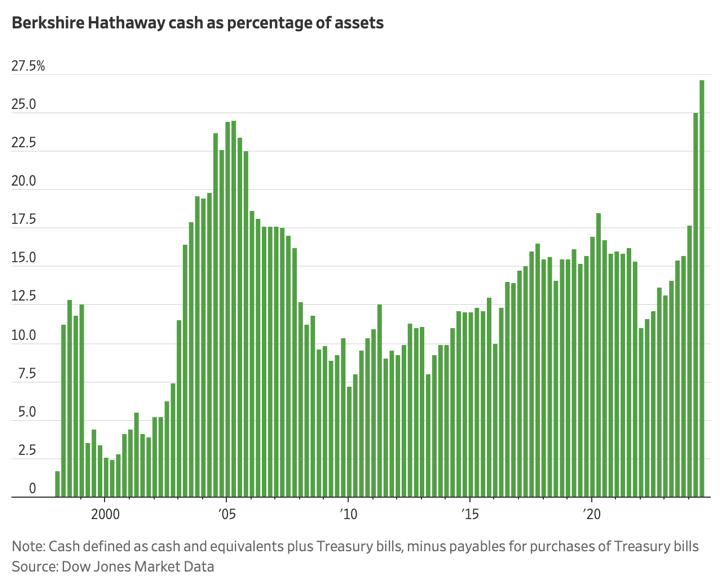
No significant new purchases, in either public or private businesses. Berkshire wants to own great businesses, but only when paying the right price. However, he didn’t give any indication that he thinks folks are completely nuts. On a relative basis, you can judge for yourself with this chart of BRK’s cash as a percentage of assets. Source: WSJ (gift article).

American businesses are still special, although it takes vigilance to stay that way. Berkshire owns some international companies based in Europe and Japan, but it has always been and remains predominantly US-based businesses.

Berkshire shareholders can rest assured that we will forever deploy a substantial majority of their money in equities – mostly American equities although many of these will have international operations of significance. Berkshire will never prefer ownership of cash-equivalent assets over the ownership of good businesses, whether controlled or only partially owned.

Paper money can see its value evaporate if fiscal folly prevails. In some countries, this reckless practice has become habitual, and, in our country’s short history, the U.S. has come close to the edge. Fixed-coupon bonds provide no protection against runaway currency.

Berkshire is not buying Berkshire anymore. BRK has ceased with the buybacks, which means that they are either at or above his estimation of fair value.

Patience and discipline may be the lesson here. Altogether, the letter was a nice, familiar reminder that the things that made Berkshire Hathaway great are still the same. No surprises, no big drama. Right now, valuations are plump so they are holding onto what they already have and other accumulating cash. Berkshire is disciplined enough to do nothing when there is nothing smart to do. I can still hear Charlie Munger saying something to the tune of “It’s not the worst place to be, drowning in cash!”

Perhaps that is the lesson. Everything is at least fairly-valued if not higher. Hold what you have. Let it compound. Be patient. There will be new opportunities eventually.

Past shareholder letter notes.

Fidelity Money Market Funds: Claim Your State Income Tax Exemption (Updated 2025)

Updated. As the brokerage 1099 forms for the 2024 Tax Year are coming out, here is a quick reminder for those subject to state and/or local income taxes. If you earned interest from a money market fund, a significant portion of this interest may have come from “US Government Obligations” like Treasury bills and bonds, which are generally exempt from state and local income taxes. However, in order to claim this exemption, you’ll likely have to manually enter it on your tax return after digging up a few extra details.

(Note: California, Connecticut, and New York exempt dividend income only when the mutual fund has met certain minimum investments in U.S. government securities. They require that 50% of a mutual fund’s assets at each quarter-end within the tax year consist of U.S. government obligations.)

Fidelity has released US GOI percentages for 2024 on their institutional website, but it’s a little hard to read since it includes a lot of funds and share classes that are used by Fidelity-affiliated financial advisors and institutional portfolios. Their tax document page still says “Expected mid February” – Update 2/22: 2024 Percentage of Income from
U.S. Government Securities now available
. The numbers from both sources are the same, although rounded off differently for some reason.

Here are the results for the most popular core Fidelity money market funds:

  • Fidelity® Treasury Only Money Market Fund (FDLXX, CUSIP 31617H300) – 97.0032%.
  • Fidelity® Government Money Market Fund (SPAXX, CUSIP 31617H102) – 55.0877%.
  • Fidelity® Government Cash Reserves (FDRXX, CUSIP 316067107) – 57.1917%.
  • Fidelity® Treasury Money Market Fund* (FZFXX, CUSIP 316341304) – 50.5640%. *FZFXX did not meet the minimum investment in U.S. Government securities required to exempt the distribution from tax in California, Connecticut, and New York.
  • Fidelity® Government Money Market Fund Premium Class (FZCXX, CUSIP 31617H706) – 55.0877%. This fund has a $100,000 minimum, but also a lower expense ratio than SPAXX, which means it earns about 0.10% more yield annually as of this writing 2/20/25.

To find the portion of Fidelity dividends that may be exempt from your state income tax, multiply the amount of “ordinary dividends” reported in Box 1a of your Form 1099-DIV by the percentage listed in the PDF. For example, if you earned $1,000 in total interest from Fidelity Treasury Only Money Market Fund (FDLXX) in 2024, then $970.03 could possibly be exempt from state and local income taxes. If your marginal state income tax rate was 10% that would be a ~$97 tax savings for every $1,000 in total interest earned.

On a net after-tax basis, folks with a ~10% state income tax rate will likely find that FDLXX earns more interest than the default core holdings of SPAXX/FZFXX, even though the gross yield of SPAXX/FZFXX is higher than that of FDLXX.

To obtain these tax savings, you’ll have to manually adjust your state/local income tax return. I don’t believe that TurboTax, H&R Block, and other tax software will do this automatically for you, as they won’t have the required information on their own. (I’m also not sure if they ask about it in their interview process.) If you use an accountant, you should also double-check to make sure they use this information. Here is some information on how to enter this into TurboTax:

  • When you are entering the 1099-DIV Box 1a, 1b, and 2a – click the “My form has info in other boxes (this is uncommon)” checkbox.
  • Next, click on the option “A portion of these dividends is U.S. Government interest.”
  • On the next screen enter the Government interest amount. This will be subtracted from your state return.

Standard disclosure: Check with your state or local tax office or with your tax advisor to determine whether your state allows you to exclude some or all of the income you earn from mutual funds that invest in U.S. government obligations.

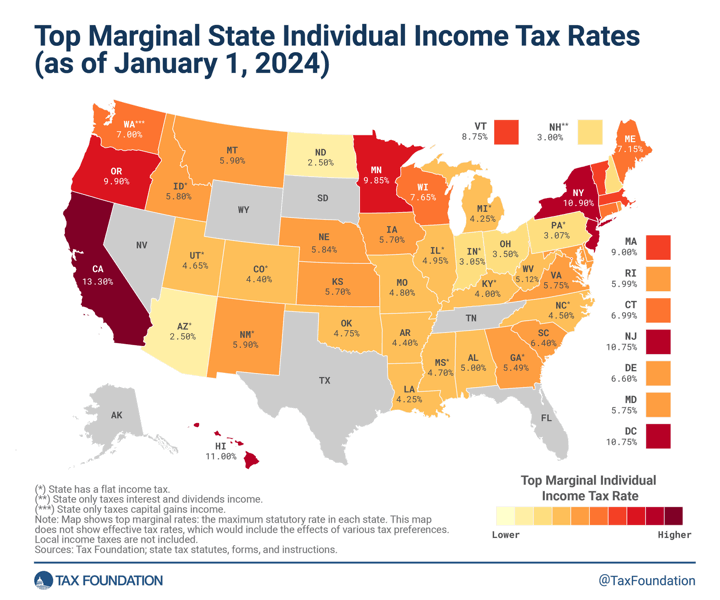
[Image credit – Tax Foundation]