The Hazards of Combining Overconfidence and Investing

Daniel Kahneman, behavioral economics guru and Nobel Prize winner, has a new book out called Thinking, Fast and Slow. This one is definitely on my to-read list. You may remember him from his TED Talk about Happiness = Earning $60,000 A Year?

He wrote an article for the NY Times called Don’t Blink! The Hazards of Confidence (a little jab at Gladwell?), which covers one of the cognitive fallacies discussed in the book caused by overconfidence amongst professional stock-pickers and money managers. First, he covers what some of you may already know about the performance of actively-managed mutual funds:

Mutual funds are run by highly experienced and hard-working professionals who buy and sell stocks to achieve the best possible results for their clients. Nevertheless, the evidence from more than 50 years of research is conclusive: for a large majority of fund managers, the selection of stocks is more like rolling dice than like playing poker. At least two out of every three mutual funds underperform the overall market in any given year.

More important, the year-to-year correlation among the outcomes of mutual funds is very small, barely different from zero. The funds that were successful in any given year were mostly lucky; they had a good roll of the dice. There is general agreement among researchers that this is true for nearly all stock pickers, whether they know it or not — and most do not. The subjective experience of traders is that they are making sensible, educated guesses in a situation of great uncertainty. In highly efficient markets, however, educated guesses are not more accurate than blind guesses.

The second story was more personal, and had to do with a small group of financial advisors.

I asked for some data to prepare my presentation and was granted a small treasure: a spreadsheet summarizing the investment outcomes of some 25 anonymous wealth advisers, for eight consecutive years. The advisers’ scores for each year were the main determinant of their year-end bonuses. It was a simple matter to rank the advisers by their performance and to answer a question: Did the same advisers consistently achieve better returns for their clients year after year? Did some advisers consistently display more skill than others?

To find the answer, I computed the correlations between the rankings of advisers in different years, comparing Year 1 with Year 2, Year 1 with Year 3 and so on up through Year 7 with Year 8. That yielded 28 correlations, one for each pair of years. While I was prepared to find little year-to-year consistency, I was still surprised to find that the average of the 28 correlations was .01. In other words, zero. The stability that would indicate differences in skill was not to be found. The results resembled what you would expect from a dice-rolling contest, not a game of skill.

My, that must have been an uncomfortable presentation! Investing is an area where it is very hard to discern skill from luck, so be careful when asked to pay a nice chunk of money for it, be it through mutual fund expense ratios or portfolio management fees.

Balanced Portfolios Do Equally Well in Economic Recessions and Expansions

Vanguard’s research division published a new report [pdf] that found that a portfolio split 50/50 between stocks and bonds had very similar inflation-adjusted returns regardless of whether the U.S. economy was growing or in recession. Here are the numbers from 1926-2009 taken from the report summary:

Given that timing recessions and expansions has been shown to be very difficult, this would suggest that making big asset allocation moves (bets, really) to 100% stocks or 100% bonds in anticipation is not worth the effort.

It also reminds me that as a portfolio asset allocation gets closer to 50/50, the swings in return each year are less wild. After 2008 and 2009, I think many people have a new appreciation for lower volatility. Maybe it would be better for many investors that don’t have full “faith” in the stock market to move their asset allocation to 60% stocks/40% bonds or similar, instead of the 80 or 90% stocks that some calculators or target-date retirement funds would suggest.

Along those same lines, Morningstar has found that most “tactical asset allocation” funds have had a hard time beating the simple-and-cheap Vanguard Balanced Index Fund (VBINX), which is basically just two index funds in a fixed 60% stock/40% bond ratio. The 10-year returns are in the top quartile of similar funds, with a below-average standard deviation.

Vanguard recently decided to kill off it’s own market timing fund, the Vanguard Asset Allocation Fund, formerly actively managed by Mellon Capital. Even a low expense ratio of 0.27% couldn’t save this one.

Higher Investment Risk and Expected Return

I’m currently reading the book The Most Important Thing: Uncommon Sense for the Thoughtful Investor by Howard Marks. Inside, he talks a lot about risk. Most people seems to grasp the idea that riskier investments offer the prospect of higher returns. Stocks are expected to offer higher returns than cash or bonds. Bonds are considered less risky, and thus return less. However, Marks states that too many people have a simplistic risk/return relationship in their heads:


Source: Table 5.1, The Most Important Thing

However, there is no requirement that riskier investments will actually provide those higher returns. It’s only the average expected returns that are higher, but since the uncertainty is also higher. Put another way, the distribution of potential returns is wider. To be more precise, he shares this risk/expected return chart instead:


Source: Table 5.2, The Most Important Thing

When I started investing several years ago, I remember reading several personal finance articles that responded to questions from older investors that had some catching up to do with their nest eggs. The solution was simple – own more stocks! You’ll need the extra return, they reasoned. That’s exactly the wrong way to think. There is no easy shortcut to saving more.

Ohio CollegeAdvantage 529 Promotion Code: $25 New Account Bonus

Updated… The Ohio CollegeAdvantage Direct 529 college savings plan is now offering a $25 bonus contribution if you open a new account and invest at least $500 of your own money. A guaranteed 50% return-on-investment! The promotion code is PLAN. Offer ends June 1, 2012. The $25 bonus will be applied on or about June 15, 2012 as long as the account is still open with the original $500 initial contribution. You can easily set up an automatic contribution of as little as $25 every month. I’ve had mine going for over two years now, and I barely notice it anymore.

How is good is the Ohio plan relative to other state plans? Well, you should always check if your own state plan has special incentives. Mine doesn’t, and I hold my 529 assets in the Ohio plan. Another good one is Utah, although most plans with Vanguard investments are going to be well below-average in costs. I like Ohio because they offer low-cost conservative investments for college, including high-yield CDs and inflation-indexed bonds. (As of early 2012, TIPS and CDs are at record-low yields, so I am shifting a small percentage in to equities.) I should have bought more of that 10-year CD at 5% APY.

Expired Promotional Codes
KIDS
PLAN (for $50 expired 11/18/2011)

Vanguard Lowers Fees and Improves My Portfolio Performance Again, Offers More Admiral Shares

Last week, Vanguard officially announced the addition of the Admiral share class to six of their existing index funds. Admiral shares have a higher minimum investment amount ($10,000 for those listed below) than the usual Investor shares ($3,000 for those listed below), but with lower annual expenses. Every time my costs and fees go down, my future performance goes up! Below is a list of the newly-available funds, along with an expense ratio comparison.

Funds with new Admiral Shares Investor Shares
expense ratio
Admiral Shares
expense ratio (est)
Vanguard Developed Markets Index Fund 0.22% 0.12%
Vanguard FTSE All-World ex-US Index Fund 0.35% 0.18%
Vanguard Mid-Cap Growth Index Fund 0.26% 0.10%
Vanguard Mid-Cap Value Index Fund 0.26% 0.10%
Vanguard Small-Cap Growth Index Fund 0.26% 0.10%
Vanguard Small-Cap Value Index Fund 0.37% 0.21%

The only one I am converting over this time is the Small Value fund. However, I did notice that this now means that for every single Vanguard stock index fund I choose to own, I can choose between both Admiral shares and ETF versions. I like mutual funds because they always trade at NAV and don’t have bid/ask spreads, as well as the ability to schedule automatic monthly investments. ETFs have the advantage of not having any purchase or redemption fees and the ability to be trade in any brokerage account. I went into more detail on the Vanguard mutual fund vs. ETF decision process here.

Vanguard even has a cost comparison tool for mutual funds vs. ETFs. But long-term expenses for me are no longer a concern because they are almost identical with all these Admiral shares. (I suspect the Small Cap Value differential is only temporary.) Here’s the list:

Funds In My Personal Portfolio ETF
expense ratio
Admiral Shares
expense ratio (est)
Vanguard Total Stock Market Index Fund 0.07% 0.07%
Vanguard Small-Cap Value Index Fund 0.23% 0.21%
Vanguard Total International Stock Index Fund 0.20% 0.20%
Vanguard Emerging Markets Stock Index Fund 0.22% 0.22%
Vanguard REIT Index Fund 0.12% 0.12%

I wrote previously about why I invest in the Vanguard Total US and Total International market funds. Want to convert your Investor shares to Admiral shares before they are automatically converted eventually? It just takes a clicks online – here’s a quick guide [pdf]. Want to convert your mutual funds to ETFs? Check out this post on Vanguard mutual fund to ETF share conversions. It turns out you can also do so easily with minimal tax implications.

Why Emergency Funds Can Provide The Best Return On Investment

Many recent articles and surveys have illustrated how many American are basically living paycheck-to-paycheck, with no significant savings cushion:

  • Most Americans can’t afford a $1,000 emergency expense – “A majority, or 64%, of Americans don’t have enough cash on hand to handle a $1,000 emergency expense, according to a survey by the National Foundation for Credit Counseling.”
  • Many don’t have $2,000 for a rainy day – “A new study by the National Bureau of Economic Research shows 50% of Americans would struggle to come up with $2,000 in a pinch.”
  • CareerBuilder.com Survey – “Forty-two percent of workers in the survey of more than 5,200 workers say they usually or always live paycheck to paycheck”

Along the same lines, a reader introduced me to an interactive poverty “game” called Spent, in which you try to make it through one month as an unemployed worker looking for a job and housing with their last $1,000. Try it out, and you’ll have to make some touch choices.

In just one month, I managed to get sick, need dental work, receive an undeserved traffic ticket, my best friend gets married and I can’t go, my mom needs money for medicine, my landlord raises the rent illegally, and my child refuses to eat the government-subsidized lunch. Seems a bit unlikely, yes. But a combination of a streak of bad luck and lack of support is exactly how you might end up in such a scenario.

In addition to the societal issues this brings up, from an individual point-of-view, I found that this simulator shows how living close to the edge is often significantly more expensive than someone with a cash cushion. Being poor can cost more than being rich. Consider the following:

  • If you don’t have enough money for a security deposit, you’ll have a hard time renting an affordable apartment. Many renters are thus forced into long-term motels that actually charge more on a monthly basis.
  • If you can’t afford a car repair, you can’t make it to work and face the prospect of losing your job.
  • If you don’t pay for preventative medicine, you can end up needing more expensive treatment later.
  • If you have a low balance on your bank account and overdraft by just $10, you’ll get hit with a $35 overdraft charge.
  • If you just don’t pay the bill, you’ll get a late fee charge.
  • If you don’t pay the bill for consecutive months, you’ll get your gas/electricity service shut off and be subject to an additional $250 deposit to get it back on.
  • If you charge any of this on a credit card and don’t pay off the balance each month, you’ll owe 15-25% interest. That’s if you have the credit history to get a credit card. If you go with a payday loan instead, you’ll owe more than 100% annualized interest.

For this reason, one of the first financial steps a person should take is to save up a cash cushion. That emergency fund can easily save you more money than a 20% increase in the stock market. I would tell my own child to forget saving for retirement until you have a least a couple months of expenses saved up. Luxuries like smartphones, alcohol, cable TV, and dining out should be off-limits until then as well.

One should expect “unexpected” expenses. Even though I have a relatively high income, I place great value on my emergency fund.

Build A Complete Stock Portfolio With Just Two ETFs: Vanguard Total US (VTI) and Total International (VXUS)

If you are constructing your own portfolio and like the idea of low-cost, passively-managed index funds, you should definitely be aware that just two ETFs that can provide you diversified exposure to stocks worldwide and all at rock-bottom fees. Given how many choices there are out there today, I can’t assume that everyone knows about these already.

The Vanguard Total US Stock index fund invests in over 3,000 stocks that represent the entire U.S. stock market, from small-cap to large-cap companies. The smallest company on their holding list is 100 shares of Qualstar Corp, worth a mere $200. The entire company is worth about $20 million. Compare that to the largest holding of Apple, worth $380 billion (that’s 19,000 times larger). The ETF and Admiral shares have a mere 0.07% expense ratio ($7 annually per $10,000 invested), which is taken out in tiny amounts daily out of the fund’s net asset value. That’s just 6% of what the average mutual fund charges. There are three versions:

  • Vanguard Total Stock Market ETF (VTI)
  • Vanguard Total Stock Market Index Fund Investor Shares (VTSMX)
  • Vanguard Total Stock Market Index Fund Admiral Shares (VTSAX)

The Vanguard Total International Stock index fund invests in over 6,000 stocks that covers 98% of the world’s investable markets excluding the US (“ex-US”). This includes 44 countries from the “European, Pacific, and emerging market regions, as well as Canada.” The fund also includes both small-cap and large-cap companies from these countries. The ETF and Admiral shares charge a 0.20% expense ratio. Three versions as well:

  • Vanguard Total International Stock ETF (VXUS)
  • Vanguard Total International Stock Index Fund Investor Shares (VGTSX)
  • Vanguard Total International Stock Index Fund Admiral Shares (VTIAX)

This graphic shows you how these two funds relate to other Vanguard ETFs you may already be aware of:


(Source, brighter red text is added by me)

(I should also mention that there is the Vanguard Total World Stock ETF (VT), which covers the entire world in one tidy fund. However, it only holds 2,904 stocks total, which is nearly 2/3rds less than a VTI/VXUS combo. On top of that, it charges a 0.25% expense ratio, which is nearly double how much a VTI/VXUS combo would cost when weighted appropriately. I personally think the added diversification and lower cost is worth the hassle of owning two separate funds.)

Implementation

As of August 31, 2011, the world market value breaks down to about 42% US and 58% Ex-US. For simplicity, I chose to own VTI and VXUS in a simple 50/50 ratio as part of my target asset allocation. I rebalance back to 50/50 regularly using new cashflows, and also at least once annually. Bonds are a separate discussion.

Side note: The reason I thought of writing this is that I previously held Vanguard FTSE All-World ex-US ETF (VEU) as my primary international holding, which as you can see above is a subset of VXUS, but realize that VXUS only arrived earlier this year. I’ve shifted most things over already, but I have been hesitant to sell some of my taxable holdings because I’d owe capital gains taxes. I noticed yesterday that I am actually at slight loss now (yay?), so I am able to do some tax-loss harvesting by selling my VEU and swapping it for VXUS. Since they are not “substantially identical” funds, I am not subject to wash sale rules.

Vanguard Allows Same-Day Trades With Bank Transfer Funding

If you have an account with Vanguard, you may have noticed them rolling out improvements to their online interface this month. If not, try logging in and see if you notice anything different. Today, I received an e-mail that they are also improving their funds availability rules when buying mutual funds with online bank transfers:

Same-day trades with electronic bank transfers
Now you can get today’s trade date if you use our electronic bank transfer service to buy a Vanguard mutual fund. Just submit your request on business days before the close of regular trading on the NYSE (generally 4 p.m., Eastern time) and you’ll receive that day’s closing price.

Finally! I placed at trade and it appears to have worked. The previous rule was that if the purchase was before 10pm Eastern of Day 1, then you will get the purchase price as of closing on Day 2. So even if I wake up at 6 am in the morning on Thursday and place a trade, I would get the price as of market close at 4pm Eastern Friday. Your bank account is debited on Day 3.

Others have reported receiving this notice weeks ago, and while I’m happy to see it in my account, I also think it was long overdue. You can already get the same-day closing price if you exchange from another mutual fund already in the account, like a money market fund. So basically what they were saying is that they don’t trust that your bank funds would clear. However, it takes 3 business days (T+3) for things to clear anyway, so it’s not like you could run off with the money. I have been able to initiate a money transfer into my Scottrade account and start buying stocks seconds later for years. This way, I don’t have to keep money sitting around in a money market fund earning zero interest.

You could argue that if I’m not timing the market then I shouldn’t really care when the trade clears. But the way I see it, I am rebalancing my account and buying what has been dropping. I would be highly annoyed if the stock market bounced up 5% the next day, meaning I shouldn’t have rebalanced at all.

Rising Rents, Flat Home Prices, and Owning REITs In My Portfolio

The NYT Economix blog points out that rents are rising again according to inflation data from the Bureau of Labor Statistics. The chart included doesn’t have zero on the y-scale, but a value of 100 corresponds to rent from 1982-1984. Rents nationwide are about 40% above their values in 2000. I recently saw the last house I used to rent on Craiglist and the rent was up 15% from 4 years ago.


Credit: NY Times, Bureau of Labor Statistics, IHS Global Insight

There is definitely an increase in the number of renters, and perhaps there is also an overall psychological shift in that less people think homeownership is a part of the American Dream. Perhaps this means it’s a better time to be landlord? Home prices are still hanging around 2003 levels:


Credit: Marketwatch, S&P/Case-Shiller Home Price Indices

Although I know many successful people who are landlords, I don’t now if I’m cut out for it. However, I do like buying real estate investment trust (REITs), which allows me to collect rent like I collect stock dividends. (Not familiar with them? Here’s a post all about REITs.) I even did a comparison post of rental property vs. REZ, a residential ETF. I see REZ has done quite well recently.

Now, I’m not pushing REZ, and don’t own it myself. I continue to get my real estate exposure through the low-cost, passively-managed Vanguard REIT Index Fund, available both as a mutual fund and ETF. It tracks the MSCI US REIT Index and includes all kinds of real estate, currently holding 20% in residential ETFs that own things like apartment complexes. It like the diversification of this fund, even though it can be a rough ride, and in a struggling economy things like commercial properties will be harder to rent out.

Here’s the growth of $10,000 chart of both the Vanguard REIT Index Fund and the S&P 500 index, from mid-1996 to today. This type of chart accounts for total return, including dividends.

The REIT fund has done better than the S&P 500, which some may find surprising (or not) given the housing bust. As you can also see, they don’t always move together, which is good. Including REITs and rebalancing has offered a way to achieve better returns even if you like a simple buy and hold portfolio. I can’t guarantee that this type of helpful diversification will continue in the future, but I’m happy with my current portfolio right now, and am glad to be a lazy “landlord” in this manner.

Jack Bogle Makes Market Prediction For Next Decade

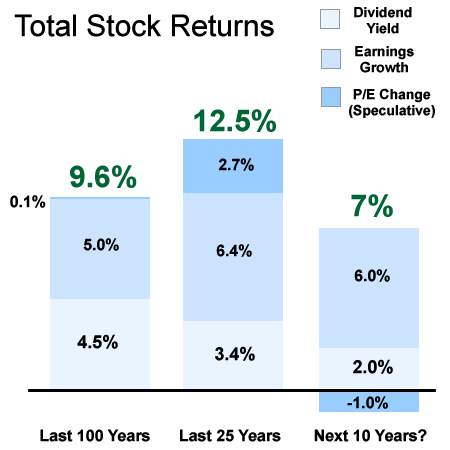
I don’t usually post market forecasts, but I just wanted to jot this one down for posterity. Jack Bogle, founder of Vanguard, is interviewed in a WSJ article Why a Legendary Market Skeptic Is Upbeat About Stocks where he makes a prediction of 7% annual returns for stocks for the upcoming decade. He correctly predicted 10%+ gains for the 1990s, and also low single-digit returns for the 2000s. Let’s see if he’s correct for the 2010s.

Over the next decade, Mr. Bogle said stocks are likely to generate an average annual return, including dividends, of around 7%. “Your money will double in 10 years,” he said. “How bad is that? People ought to get over the illusion [of higher expectations] and realize that they may have to invest for longer time periods, start earlier and save more.”

There other good observations in the article, although they won’t surprise any Bogle followers. I previously wrote about Bogle’s future return prediction methodology where total stock returns are the sum of earnings growth (aligns with GDP growth), dividend yield, and P/E ratio changes. The diagram below is reproduced from his 2007 book Little Book of Common Sense Investing, which also shows us a 7% forward prediction at the time. Well, we’ve got some catching up to do…

altext

Vanguard Target Retirement Income Fund vs. Vanguard Wellesley Income Fund

There’s a ways to go, but we’re still aiming to retire within the next 10 years. As such, I’ve been thinking about what happens when we want to live off of withdrawals from our retirement portfolio. According to the passively-managed Target Date funds by Vanguard, if you reach retirement you’re directed to the Vanguard Target Retirement Income fund. Another popular option for retirees is the Vanguard Wellesley Income Fund, which has been around for over 40 years, and is actively-managed by Wellington Management Company, an advisory company that has been around since the Great Depression. Let’s take a quick look to see how these two funds compare.

Vanguard Target Retirement Income Fund (VTINX)

This fund seeks to provide “current income and some capital appreciation”. The approximate asset allocation is 30% stocks, 65% bonds, and 5% cash. It is a fund of funds, holding the Vanguard Total Bond Market II Index Fund, Vanguard Total Stock Market Index Fund, Vanguard Inflation-Protected Securities Fund, Vanguard Prime Money Market Fund, and Vanguard Total International Stock Index Fund. Here is the current asset allocation per Vanguard as well as the equity and bond style boxes from Morningstar.

Number of stocks held: 9,958 (3,323 US + 6,635 Foreign)

Number of bonds held: 4,486 (4,450 nominal bond + 36 TIPS bonds)

Expense ratio: 0.17% ($170 a year on a $100,000 balance)

Vanguard Wellesley Income Fund Admiral Shares (VWIAX)

This is an income-oriented balanced fund, which is another way of saying the same thing as above. The approximate asset allocation is 35% stocks, 65% bonds. I am choosing the Admiral shares as opposed to the Investor shares because the great majority of people using this for their retirement will reach the $50,000 minimum balance. Here is the current asset allocation per Vanguard as well as the equity and bond style boxes from Morningstar.

Number of stocks held: 60

Number of bonds held: 559

Expense ratio: 0.21% ($210 a year on a $100,000 balance)

Commentary

The overall asset allocation of the two funds is very similar, especially since you could consider cash/short-term reserves as bonds. However, how they are constructed is very different. Target Retirement is passively indexed on a market-cap weighted distribution and holds nearly 10,000 stocks from around the world. Wellesley is actively-managed to include only 60 selected dividend stocks from primarily large, US companies.

As for bonds, Target Retirement follows another market-weighted index of the Barclays Capital U.S. Aggregate Float Adjusted Bond Index. There is a large chunk of US Treasury, US Treasury Inflation-linked, and US Agency mortage-backed bonds. Wellesley is mostly in corporate investment-grade bonds.

Wellesley is produces more of it’s returns as income through stock dividends and the higher bond yields from corporate bonds, with a current SEC yield of 3.28%. This allows the psychological benefit of possibly spending only the dividends that the fund distributes every quarter. However, there is the concern that 60 stocks is not enough diversification, or that their bond analysts might drop the ball. Here is the growth chart of $10,000 (click to enlarge):

At least historically, the managers of Wellesley have added value. Will it continue? Unknown. The good news is that with such low costs, there’s one less reason to expect underperformance in the future. These are just an example of what is out there, although on some early retirement forums I see folks simply holding a 50/50 split of these two exact funds. Sometimes I think everyone should just start with these kind of low volatility funds in the first place, and just reinvest dividends.

Poll: How Would Winning The Lottery Change Your Investment Risk Tolerance?

In a discussion about risk on the Bogleheads forum, member John Norstad brought up an intriguing question. Let’s say you won $1 million (net after taxes) in the lottery tomorrow. This money will get added to your existing investment portfolio, and may or may not be enough to allow you to fully “retire” as you would like to. As a result, how would you change your investment style?

Make it more aggressive. Sample reasoning: Now that I have a head start and a cushion, why not gamble a little and see what happens? I should buy more stocks, and perhaps I can retire even earlier or with a bigger nest egg. This is given the term Decreasing Relative Risk Aversion (DRRA).

Make it more conservative. Sample reasoning: I’ve just gotten much closer to my goal, and I don’t want to mess it up. I can now invest more in safer things like bonds and be more confident in reaching my goal eventually. Known as Increasing Relative Risk Aversion (IRRA).

Keep it the same. Sample reasoning: I have a set allocation set up, and I see no reason to change it. Anything I don’t spend, I will leave to my heirs. Known as Constant Relative Risk Aversion (CRRA).

If you won the lottery, how would you adjust your investment style?

View Results

Loading ... Loading ...