My Money Blog Portfolio Asset Allocation, March 2018

portpie_blank200

Here is a First Quarter 2018 update for my primary investment portfolio. These are my real-world holdings, not a recommendation. It includes tax-deferred 401k/403b/IRAs and taxable brokerage accounts and excludes our primary home, cash reserves, and a few side investments. The goal of this portfolio is to create enough income to cover our regular household expenses. As of 2018, we have started the phase of “early retirement” where we are spending some of the dividends and interest from this portfolio.

Actual Asset Allocation and Holdings

I use both Personal Capital and a custom Google Spreadsheet to track my investment holdings. The Personal Capital financial tracking app (free, my review) automatically logs into my accounts, tracks my balances, calculates my performance, and gives me a rough asset allocation. I still use my custom Rebalancing Spreadsheet (free, instructions) because it tells me where and how much I need to direct new money to rebalance back towards my target asset allocation.

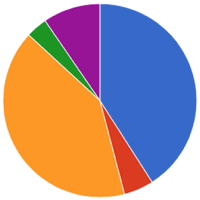
Here is my portfolio performance for the year and rough asset allocation (real estate is under alternatives), according to Personal Capital:

1803_pc1b

1803_pc2b

Here is my more specific asset allocation, according to my custom spreadsheet:

1803_spread1

Stock Holdings
Vanguard Total Stock Market Fund (VTI, VTSMX, VTSAX)
Vanguard Total International Stock Market Fund (VXUS, VGTSX, VTIAX)
WisdomTree SmallCap Dividend ETF (DES)
WisdomTree Emerging Markets SmallCap Dividend ETF (DGS)
Vanguard Small Value ETF (VBR)
Vanguard Emerging Markets ETF (VWO)
Vanguard REIT Index Fund (VNQ, VGSIX, VGSLX)

Bond Holdings
Vanguard Limited-Term Tax-Exempt Fund (VMLTX, VMLUX)
Vanguard Intermediate-Term Tax-Exempt Fund (VWITX, VWIUX)
Vanguard High-Yield Tax-Exempt Fund (VWAHX, VWALX)
Vanguard Inflation-Protected Securities Fund (VIPSX, VAIPX)
iShares Barclays TIPS Bond ETF (TIP)
Individual TIPS securities
U.S. Savings Bonds (Series I)

Target Asset Allocation. Our overall goal is to include asset classes that will provide long-term returns above inflation, distribute income via dividends and interest, and finally offer some historical tendencies to balance each other out. I personally believe that US Small Value and Emerging Market will have higher future long-term returns (along with some higher volatility) than US Large/Total and International Large/Total, although I could be wrong. I don’t hold commodities futures or gold (or bitcoin) as they don’t provide any income and I don’t believe they’ll outpace inflation significantly. I also try to imagine each asset class doing poorly for a long time, and only hold the ones where I think I can maintain faith.

Stocks Breakdown

  • 38% US Total Market
  • 7% US Small-Cap Value
  • 38% International Total Market
  • 7% Emerging Markets
  • 10% US Real Estate (REIT)

Bonds Breakdown

  • 50% High-quality, Intermediate-Term Bonds
  • 50% US Treasury Inflation-Protected Bonds

I have settled into a long-term target ratio is 67% stocks and 33% bonds (2:1 ratio) within our investment strategy of buy, hold, and rebalance. With a self-managed, simple portfolio of low-cost funds, we minimize management fees, commissions, and income taxes.

Real-world asset allocation details. For both simplicity and cost reasons, I am no longer buying DES/DGS and will be phasing them out whenever there are tax-loss harvesting opportunities. New money is going into the more “vanilla” Vanguard versions: Vanguard Small Value ETF (VBR) and Vanguard Emerging Markets ETF (VWO).

I’m still a bit underweight in TIPS and REITs mostly due to limited tax-deferred space as I don’t want to hold them in a taxable account. My taxable muni bonds are split roughly evenly between the three Vanguard muni funds with an average duration of 4.5 years. I have been seriously thinking of going back to US Treasuries due to changes in relative interest rates and our marginal income tax rate.

My stock/bond split is currently at 69% stocks/31% bonds. I continue to invest new money on a monthly basis in order to maintain the target ratios. Once a quarter, I also reinvest any accumulated dividends and interest that we did not spend. I don’t use automatic dividend reinvestment. First of all, we spend some of our dividends now. In addition, I can usually avoid creating any taxable transactions unless markets are really volatile.

Performance and commentary. According to Personal Capital, my portfolio has basically broken even so far in 2018 (-0.70% YTD). I see that during the same period the S&P 500 has lost 0.63% (excludes dividends) and the US Aggregate bond index has actually lost 1.55%.

An alternative benchmark for my portfolio is 50% Vanguard LifeStrategy Growth Fund (VASGX) and 50% Vanguard LifeStrategy Moderate Growth Fund (VSMGX), one is 60/40 and one is 80/20 so it also works out to 70% stocks and 30% bonds. That benchmark would have a total return of -0.98% YTD (as of 4/9/18).

In a separate post, I’ll share about more about the income aspect.

Graphic: The Fall of Pensions, The “Rise” of 401ks and IRAs

pension401kIRA

Above is a historical chart of US household retirement assets that helps visualize the shift from mostly pensions to mostly a combination of defined contribution plans (401k, 403b, etc) and IRAs. Pension share has gone from nearly 80% of total assets in the 1980s to about 40% today. The blips upwards in 2001 and 2009 are more a function of stock market drops than anything else. I find it interesting that annuity use is not increasing at all, i.e. people are not creating more “DIY pensions”. Found via WSJ Daily Shot.

Below is a graphic of the percentage of households who have any retirement plan at all, grouped by income percentile. This means it counts any family with one person with any retirement plan of any type with any amount saved. Via Bloomberg article about state-mandated Roth IRAs.

ira_bloomberg

My big-picture concern is – What happens when those who started jobs in the 1980s and 1990s retire in the 2030s and 2040s with no pensions? As shown above, the majority of the lowest-income workers have no retirement plan at all. If you include the highest-paid workers, the average 401(k) at retirement age is currently about $100,000. In contrast, I ran an annuity quote and a pension that pays $50,000 a year inflation-adjusted is roughly the equivalent of having $1,000,000 saved in a 401(k).

More individuals are finding themselves in charge of their own retirement every day, whether they like it or not. This is a very serious responsibility. Warren Buffett has a plaque in his office with the following saying on it:

A fool and his money are soon invited everywhere.

Lots of money floating around means lots of “helpers” will pop up. Big banks. Start-up smartphone apps. Even Overstock.com now wants to help you with investing. Read the Gotrocks parable and beware high-fee helpers.

NYT Financial Tuneup Day 4: Retirement

nyt_ftuDay 4 of the NY Times 7-Day Financial Tuneup is about retirement. (Sign up for your own personalized tune-up here.) This assumes you are eligible for a 401(k) or similar retirement plan. The key action point is bumping up your retirement contribution rate by 1% and perhaps adjusting your asset allocation if necessary. Here’s a simple chart showing you why:

nyt_tuneup_ret1

If you’re making $50,000 annually and contributing 5 percent of your salary to your retirement account, assuming an annual return of 6 percent and a 3 percent annual salary increase, in 25 years, you will have about $198,000 in your retirement account. If you start to increase that percentage by 1 percentage point annually however, you will have over $550,000 in that same account in 25 years. By increasing the amount you save by 1 percentage point each year, you’ll save an extra $354,940 for retirement.

Increase Your Savings

  • Log into your retirement savings account. (Baby steps…)
  • Increase the amount of money taken out of your paycheck by 1 percentage point annually. Also check to see if you are taking full advantage of any company match.
  • Make it automatic. If you have the option, set it to automatically escalate in the future.

Rebalance Your Account

  • Log into your retirement savings account.
  • Determine how you should rebalance your account. What is your target asset allocation? Here’s mine but it’s probably more complicated than most people need. Consider a target-date fund, especially if it is a low-cost, passive version. Fidelity, Vanguard, and Schwab all have solid versions. I put my own mom in the Vanguard one.
  • Make it automatic. If you have the option, set it to automatically escalate in the future. My provider calls it “Auto-Increase”.
  • Rebalance your account. Basically, make sure your portfolio is still what you want it to be, as it may have shifted over time. You only need to do this once or twice a year, or you can set “bands” to rebalance when things get too out of whack.

Action, action, action. This move won’t make you save enough for retirement by itself, but it’s something tangible. If you are really going for financial freedom, you should use this as a platform to do even more. We have our 401k savings rate already set at 60% (max allowed by one provider) since we are working part-time (“semi-retired” sounds better!) with a lower income but still want get as close to the annual 401k limits as possible.

Financial Tuneup Recap (still in progress)

Study: Working Longer vs. Saving More

savebuttonbankHere’s a working paper titled The Power of Working Longer by Gila Bronshtein, Jason Scott, John B. Shoven, Sita N. Slavov which compares the effect of working longer (delaying your retirement date) and increasing your savings rate while working.

The basic result is that delaying retirement by 3-6 months has the same impact on the retirement standard of living as saving an additional one-percentage point of labor earnings for 30 years. The relative power of saving more is even lower if the decision to increase saving is made later in the work life. For instance, increasing retirement saving by one percentage point ten years before retirement has the same impact on the sustainable retirement standard of living as working a single month longer.

Update: I read the full paper and here’s my view. For most households earning less than $100,000 a year with average savings rates, Social Security changes matter more than returns on investment portfolio. What really matters is delaying Social Security and getting the resulting higher monthly income for life. For most people, that’s the same as working longer as they can’t just wait around without a paycheck.

If you are close to retirement, chances are that working longer is the best practical solution to improving your financial outlook. Working longer means your portfolio grows a bit more hopefully, your Social Security check gets bigger, and your retirement length gets shorter (annuities pay more).

However, if you are young, it is quite easy to tell yourself today that you’ll simply work a bit longer far in the future. When the time comes, you may not be given the option of working longer either due to job loss or disability. If you take this too far, you could just tell yourself that you’ll simply work until you die and you won’t have to save anything at all.

You can pay $5 for the full paper, or you may be able to get free access if you have a .edu or .gov e-mail address.

Free Social Security Calculator Tool: Estimate Your Benefits

socialsecuritycardThere are some (mostly young) skeptics, but Social Security should remain a major pillar of your future retirement income. For over 60% of current retirees aged 65+, Social Security makes up the majority of their income. Therefore, it may be worth spending some extra time figuring out how it works.
First, you should sign up for a mySocialSecurity account at SSA.gov. For many people, this is the only way to view your current benefit eligibility as they are phasing out those annual green paper statements. You will find some interesting information including eligible earnings history. (For example, I earned $1,814 in the summer after high school.) Also, if you claim your account first, it prevents an potential identity thief from opening an account in your name and stealing your benefits.

Second, you can check out this unofficial Social Security helper tool to test out different scenarios. Created by an Google engineer named Greg Grothaus in his spare time, the site takes your earnings history and uses Javascript to analyze it within your browser. No data is submitted over the internet. Found via The Finance Buff.

Here are some scenarios you might test out:

  • What happens to my benefit if I earn additional wages for several more years? What if I stop working forever?
  • How does my benefit change as my total earnings grow during my lifetime?
  • What happens if I choose to take my benefits early? What if I delay and take them late?

You might not know that your eventual benefit is based on your top 35 annual indexed earnings values. Indexed earnings are simply the payroll wages you earned in a year multiplied by a number that adjusts for wage growth. I personally don’t even have 35 working years yet, so every additional year I work will be in my “Top35” and increase my future payout. Here are some charts based on my earnings history:

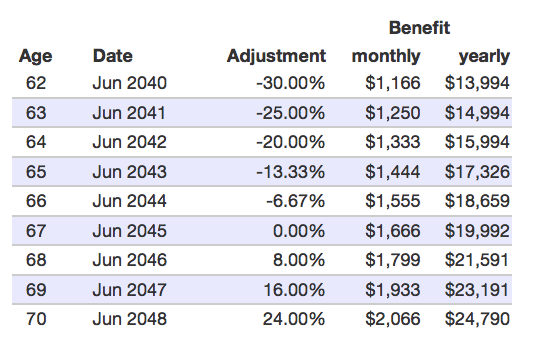
If I stop working immediately and then start taking benefits at my “normal” retirement age of 67 years, I will earn $1,666 per month ($19,992 per year). If I start taking money at age 62, I will earned a reduced $1,166 per month ($13,994 per year). Here’s the full chart:

sstool1

If I keep working for another 20 years at $50,000 per year, then my age 67 benefit will increase to $2,328 per month ($27,936 per year). If I start taking money at age 62, I will earned a reduced $1,630 per month ($19,555 per year). Here’s the updated full chart:

sstool2

Working/waiting an extra year may increase your payout enough to change your lifestyle significantly. An extra $100 per month may not seem that much, but that’s an extra $1,200 each year for the rest of your life that increases with inflation. If you don’t have adequate income from other sources, that could cover your medication copays for the year. It could be the difference between staying home and doing a video chat vs. flying and playing with your grandkids in person each year.

If you are on the early retirement track, that inserts a bunch of zeros in your “Top 35”. With this calculator, you can see how much that actually changes your eventual payout. Even if I continued to work another 25 years at $100,000 per year, my annual benefit at age 67 would be about $33,000 per year.

As a reminder, both SSA.gov and this tool only show you what your benefit will be under current law. Social Security isn’t a savings plan – current retirees are being paid from money taken from current workers. This means that changing demographics will require some sort of modification by 2035. From the Chief Actuary of the Social Security Administration:

Currently, the Social Security Board of Trustees projects program cost to rise by 2035 so that taxes will be enough to pay for only 75 percent of scheduled benefits. This increase in cost results from population aging, not because we are living longer, but because birth rates dropped from three to two children per woman. Importantly, this shortfall is basically stable after 2035; adjustments to taxes or benefits that offset the effects of the lower birth rate may restore solvency for the Social Security program on a sustainable basis for the foreseeable future.

401k Millionaire By Age 45: How Was It Possible?

millWith the ongoing bull stock market, more people are reaching $1,000,000 balances in their 401k every day. However, a more extreme claim is that someone reached this mark at age 45 with total employee contributions of only $300,000. Is that really possible? Let’s take a look at what would need to fall into place for that to happen…

Consistently high contributions from salary. If you divide $300,000 by a theoretical 25 years of savings, that works out to $12,000 per year. That is within 401k historical contribution limits, but even with 25 working years, that means nearly maxing out your 401k contributions every single year. (Employer company matches don’t count and can push you above that limit.) According to Redditor Subject_Beef, s/he indeed saved regularly in 1995 with contributions close to the max most years. Consider that only about 10% of participants max out their 401ks each year, and most of those people were over the age of 45.

401kmill

High investment gains. Next, you must have the growth of $300,000 to $1,000,000, which would require a high stock allocation, avoidance of a prolonged bear market, and not panicking during market losses. Even with a lump-sum invested 25 years ago, going from $300k to $1000k would require a compound annual growth rate of 6.2%. However, with a 401(k), you have to do this through regular contributions and dollar-cost-averaging over time. Therefore, the actual growth rate would have to be significantly higher than that. By my rough calculations, the average would have to have been around 9% annually. The current asset allocation was shown to be roughly 37% S&P 500 Index fund, 33% US Small Cap Stock Index fund, and 30% International Stock Index fund. The annualized return of the S&P 500 has been about 10% over the last 23 years, so the numbers are quite possible.

No IRA rollovers. Finally, you’d need a steady career as most people who change companies either cash out or roll their 401(k) funds into an IRA with more flexibility. It is possible to do repeated 401k-to-401k rollovers, which is apparently the case here. I can’t think of too many compelling reasons to do so besides enabling the Backdoor Roth IRA. This is also why I don’t think tracking aggregate 401k balances is a good way to measure savings or wealth. People move funds out of 401ks into IRAs all the time.

Altogether, I believe this story and the numbers do check out. However, this is not a common occurrence given the factors above that have to align. The poster does mention a significant employer match that would have help increase the effective contributions above $300,000 and make it a bit more realistic for an average worker. In any case, becoming a 401(k) millionaire by age 45 is an impressive accomplishment.

401k, 403b, 457, TSP Historical Contribution Limits 2009-2018

401k_limits

Employer-based retirement plans like the 401(k), 403(b), most 457 plans, and the federal government’s Thrift Savings Plan are not perfect, but they are often the best available option to save money in a tax-advantaged manner. For 2018, the employee elective deferral (contribution) limit for these plans increased to $18,500 (they are indexed to cost-of-living). The additional catch-up contribution allowed for those age 50+ is $6,000.

Here’s a historical chart of contribution limits for the last 10 years (2009-2018).

401k_limits_2018

Year 401k/403b Elective Deferral Limit Additional Catch-Up Allowed (Age 50+)
2009 $16,500 $5,500
2010 $16,500 $5,500
2011 $16,500 $5,500
2012 $17,000 $5,500
2013 $17,500 $5,500
2014 $17,500 $5,500
2015 $18,000 $6,000
2016 $18,000 $6,000
2017 $18,000 $6,000
2018 $18,500 $6,000


The limits are the same for both Roth and “Traditional” pre-tax 401k plans, although the effective after-tax amounts can be quite different. Employer match contributions do not count towards the elective deferral limit. Curiously, some employer plans set their own limit on contributions. A former employer of mine had a 20% deferral limit, so if your income was $50,000 the most you could put away was $10,000 a year.

Also see: IRA Historical Contribution Limits 2009-2018

Sources: IRS.gov, IRS.gov COLA Table [PDF]

Historical IRA Contribution Limits 2009-2018

ira_heartIndividual Retirement Arrangements (IRAs) are way to save money towards retirement that also saves on taxes. Each year, an individual’s total contributions to both traditional and Roth IRAs cannot be more than a certain dollar limit. If you are age 50+ at some time during the year, you can also contribute an additional amount. (You can’t contribute more than your taxable compensation for the year.)

Note that there are also income restrictions on Roth IRA contributions, although you may be able to get around these income restrictions with a Backdoor Roth IRA (non-deductible Traditional IRA + Roth conversion).

If your income is low enough (less than $63,000 AGI for married filing joint), the Saver’s Credit can get you back 10% to 50% of your contribution (of up to $2,000 per person) when you file your taxes.

Since I enjoy visual aides, here’s an updated historical chart and table of contribution limits for the last 10 years. I’m happy to say that we’ve both done the max since 2004. Have you been taking advantage of your potential IRA tax break?

ira_limits_2018

Year IRA Contribution Limit Additional Catch-Up Allowed (Age 50+)
2009 $5,000 $1,000
2010 $5,000 $1,000
2011 $5,000 $1,000
2012 $5,000 $1,000
2013 $5,500 $1,000
2014 $5,500 $1,000
2015 $5,500 $1,000
2016 $5,500 $1,000
2017 $5,500 $1,000
2018 $5,500 $1,000


Also see: 401k, 403b, 457, TSP Historical Contribution Limits 2009-2018

Sources: IRS.gov, IRS.gov COLA Table [PDF]

Backdoor Roth IRA: Now Officially Supported by Congressional Intent?

rothheartIn 2010, the tax laws were changed to eliminate the income limits on conversions from Traditional IRAs to Roth IRAs. Since Roth IRAs still have income limits on direct contributions, this opened up a “backdoor” where high-income individuals could first contribute to a non-deductible Traditional IRA and then immediately convert to a Roth IRA. If there were no capital gains upon conversion, there would be no taxes due. Thus, the term “Backdoor Roth IRA”.

Some financial experts fretted about the legality of this move due to something called the step transaction doctrine. Some financial advisors instructed people to take special steps to help ensure the legitimacy of their Roth IRA conversions. You also have to be careful if you have other Traditional IRA accounts that you are not rolling over (“IRA aggregation rule”).

Even with all this discussion, there was never any official acknowledgement of this tax move. In past years, there were explicit budget proposals that would have curbed this option. Some argued that this talk itself was implicit acknowledgement that it was legal. Confused yet?

Apparently, the official acknowledgment finally came with the new tax law when they stopped allowing Roth IRA recharacterizations (undos). According to this Forbes article Congress Blesses Roth IRAs For Everyone, Even The Well Paid, a conference committee report by Congress included the following footnotes. Thanks to reader Abel for the tip.

268 Although an individual with AGI exceeding certain limits is not permitted to make a contribution directly to a Roth IRA, the individual can make a contribution to a traditional IRA and convert the traditional IRA to a Roth IRA, as discussed below.

269 Although an individual with AGI exceeding certain limits is not permitted to make a contribution directly to a Roth IRA, the individual can make a contribution to a traditional IRA and convert the traditional IRA to a Roth IRA.

276 The provision does not preclude an individual from making a contribution to a traditional IRA and converting the traditional IRA to a Roth IRA. Rather, the provision would preclude the individual from later unwinding the conversion through a recharacterization.

277 In addition, an individual may still make a contribution to a traditional IRA and convert the traditional IRA to a Roth IRA, but the provision precludes the individual from later unwinding the conversion through a recharacterization.

Do these footnotes end all speculation? Ed Slott seems to think that this indicates “intent” by Congress, and he is a respected tax source. The same conclusion is also drawn by Natalie Choate in this Morningstar article.

Both my wife and I have made non-deductible Traditional IRA contributions every year since 2010. I think if it was really an “unintended loophole”, they would have closed it by now (as with Social Security benefits). I am not a tax professional, I’m just a guy who wishes we didn’t need experts to interpret every little thing. If there were any people who needed additional convincing, perhaps this will give them the confidence to proceed.

Charlie Munger’s Life as a Financial Independence Blueprint

blueprintCharles Munger is probably best known as the Vice Chairman of Berkshire Hathaway and partner of Warren Buffett. The University of Michigan Ross School of Business recently shared a hour-long talk with Munger on YouTube (embedded below). Munger has plenty of mentions on this site already, but my main takeaway from this talk was a more nuanced overview of his early years and how he personally achieved financial independence before really getting involved with Warren Buffett.

Here is a summary of my notes from the talk:

  • He was not born poor, but he was also not born into exceptional wealth. Munger wanted to go to Stanford for undergrad, but his father encouraged him to go to the University of Michigan as it was still an excellent school but more affordable. He ended up dropping out after only one year in 1943 to serve in the US Army Air Corps.
  • Military service, then law school. After World War II, he took college courses with the GI Bill and eventually went to Harvard Law School (getting accepted even though he never earned an undergraduate degree).
  • Successful law career. He practiced as a successful real estate lawyer until he achieved about $300,000 in assets. This was 10 years of living expenses for his family at the time (he now had a wife and multiple kids). At this point, he started doing real estate development at the same time. When this took off, he stopped practicing law.
  • Successful real estate development. When he achieved about $3 to $4 million in assets, he also wound down his real estate development firm. He was now “financially independent” but still mostly anonymous.
  • At this point, he decided to become a “full-time capitalist”. This last stage is what led him to his current status as a billionaire philanthropist. Along with his work with Warren Buffett and Berkshire Hathaway, he was also the chairman of Wesco Financial, which also grew to be a conglomerate of different wholly-owned businesses along with a carefully-run stock portfolio. Wesco Financial eventually became a wholly-owned subsidiary of Berkshire Hathaway.

Using Charlie Munger’s life as a blueprint, here’s a pathway towards financial independence.

  • Work hard, get an education, develop a valuable skill. Munger didn’t start Facebook from his dorm room or trade penny stocks in high school. He served in the military, earned a law degree, and went to work everyday for years. At this point, work means exchanging your time for money, but hopefully at a good hourly rate.
  • Use that work career and save up 10x living expenses. Munger called himself a “cautious little squirrel” saving up a pile of nuts. He dutifully saved his salary while supporting a family and kids (and some other personal family drama that a luckier person wouldn’t have to deal with). I don’t think you’ll need 10x if you don’t have a family to support.
  • To accelerate wealth accumulation, you can now take some more risk and start some sort of business. You need something that scales, something that’s not paid per hour. Munger did real estate development. If you look at people who got wealthy quickly, nearly all of them are business owners of some type.
  • At some point, your investments will enough money to support your living expenses. This is financial independence. It doesn’t matter what you do during the day, as you earn enough money while you’re sleeping. However, many people choose to continue doing one of the paths above: (1) employee-based career, (2) active business management, or (3) actively managing their investments.

Bottom line. Charlie Munger offers up great words of wisdom in this talk. He reminds us that our choice in marriage is much more important than our choice in career. He reminds us that just showing up every day and plugging away will yield great dividends over time. He reminds us that easy wealth without work is not a good thing for society. (He also says to give Bitcoin a wide berth.)

However, you can also learn a lot by noting and observing his actions. Munger was not a huge risk-taker. He grew his wealth in steps and never exposed his family to possible ruin. He worked hard for a long time and only became extraordinarily rich and famous later in his life. He primarily wanted to be independent “and just overshot”.

What If You Invested $10,000 Every Year For the Last 10 Years? 2008-2017 Edition

keepcalmInstead of just looking at one year of returns, here’s an annual exercise that helps you look at the bigger picture. You may know the 10-year historical return of the S&P 500, but most of us didn’t just invest a big lump sum of money a decade ago, and most of us don’t just invest in the S&P 500.
Investment benchmark. There are many possible choices for an investment benchmark, but I chose the Vanguard Target Retirement 2045 Fund. This all-in-one fund is low-cost, highly-diversified, and available in many employer retirement plans as well open to anyone with an IRA. In the early accumulation phase, this fund is 90% stocks (both US and international) and 10% bonds (investment-grade domestic and international). I think it’s a solid default choice where you could easily do worse over the long run.

Investment amount. For the last decade, the maximum allowable contribution to a Traditional or Roth IRA has been roughly $5,000 per person. That means a couple could put away at least $10,000 a year in tax-advantaged accounts. If you have a household income of $67,000, then $10,000 is right at the 15% savings rate mark.

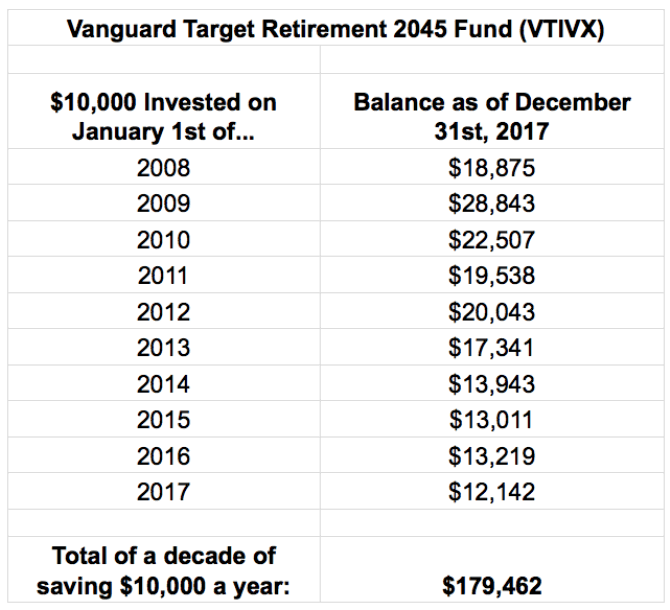
A decade of real-world savings. To create a simple-yet-realistic scenario, what would have happened if you put $10,000 a year into the Vanguard Target Retirement 2045 Fund, every year, for the past 10 years. You’d have put in $100,000 over time, but in more manageable increments. With the handy tools at Morningstar and a quick Google spreadsheet, we get this:

2008-2017x10k

For every $10,000 you put in annually over the last 10 years, you would have a ~$80,000 investment gain on top of the $100,000 in contributions. For example, if you were a couple that both maxed out their 401k and IRAs at roughly $20k each or $40k total per year, that would leave you with a gain of roughly $360,000 over the last decade (and a total balance of $760,000).

Some of that money was invested right before the crash in 2008/2009, and some has only been in the market for a few years. $10,000 invested in the beginning of 2008 would have dropped down to $5,500 in value before the rebounding. Not every year will turn out to be as good as this year, but taking it all together provides a more balanced picture.

Earn money, save a big chunk of it, and then invest it in your choice of productive assets. Keep calm and repeat. The investment side of our path to financial freedom can be mostly explained by such behavior. (Add in maxing out a 401(k) each year as well if you can.) Something as accessible and boring as the Vanguard Target Retirement Fund can make you rich. You don’t need a secret trading strategy or exclusive hedge fund manager.

My Money Blog Portfolio Asset Allocation, 2017 Year-End Update

portpie_blank200

Here is a year-end update on my investment portfolio holdings for 2017. This is my last-minute checkup in case I need to rebalance to make another other tax-related moves. This includes tax-deferred 401k/403b/IRAs and taxable brokerage holdings, but excludes things like our primary home, cash reserves, and a few other side investments. The goal of this portfolio is to create enough income to cover our regular household expenses.

Actual Asset Allocation and Holdings

I use both Personal Capital and a custom Google Spreadsheet to track my investment holdings. The Personal Capital financial tracking app (my review, join free here) automatically logs into my accounts, tracks my balances, calculates my performance, and gives me a rough asset allocation. I still use my custom Rebalancing Spreadsheet (instructions, download free here) in order to see exactly where I need to direct new investments to rebalance back towards my target asset allocation.

Here is my portfolio performance for the year and rough asset allocation (real estate is under alternatives), according to Personal Capital:

1712_pc1

1712_pc2c

Here is my more specific asset allocation, according to my custom spreadsheet:

1712_portpie

Stock Holdings
Vanguard Total Stock Market Fund (VTI, VTSMX, VTSAX)
Vanguard Total International Stock Market Fund (VXUS, VGTSX, VTIAX)
WisdomTree SmallCap Dividend ETF (DES)
WisdomTree Emerging Markets SmallCap Dividend ETF (DGS)
Vanguard Small Value ETF (VBR)
Vanguard Emerging Markets ETF (VWO)
Vanguard REIT Index Fund (VNQ, VGSIX, VGSLX)

Bond Holdings
Vanguard Limited-Term Tax-Exempt Fund (VMLTX, VMLUX)
Vanguard Intermediate-Term Tax-Exempt Fund (VWITX, VWIUX)
Vanguard High-Yield Tax-Exempt Fund (VWAHX, VWALX)
Vanguard Inflation-Protected Securities Fund (VIPSX, VAIPX)
iShares Barclays TIPS Bond ETF (TIP)
Individual TIPS securities
U.S. Savings Bonds (Series I)

Target Asset Allocation. Our overall goal is to include asset classes that will provide long-term returns above inflation, distribute income via dividends and interest, and finally offer some historical tendencies to balance each other out. I don’t hold commodities futures or gold (or bitcoin) as they don’t provide any income and I don’t believe they’ll outpace inflation significantly. I also try to imagine each asset class doing poorly for a long time, and only hold the ones where I think I can maintain faith.

Stocks Breakdown

  • 38% US Total Market
  • 7% US Small-Cap Value
  • 38% International Total Market
  • 7% Emerging Markets
  • 10% US Real Estate (REIT)

Bonds Breakdown

  • 50% High-quality, Intermediate-Term Bonds
  • 50% US Treasury Inflation-Protected Bonds

I have settled into a long-term target ratio is 67% stocks and 33% bonds (2:1 ratio) within our investment strategy of buy, hold, and rebalance. With a self-managed, simple portfolio of low-cost funds, we minimize management fees, commissions, and income taxes.

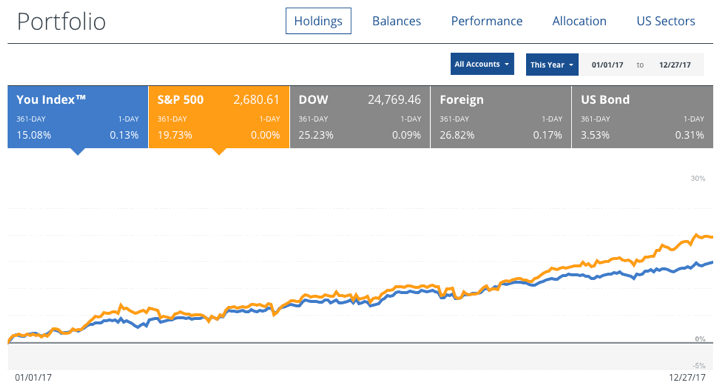
Performance, details, and commentary. According to Personal Capital, my portfolio has gained 15.08% overall in 2017 (with a few days left to go). In the same time period, the S&P 500 has gained 19.73% (excludes dividends) and the US Aggregate bond index has gained 3.53%. For the first time in a while, my sizable allocation to developed international and emerging markets stocks has boosted my overall return.

My stock/bond split is currently at 70% stocks/30% bonds due to the continued stock bull market. I continue to invest new money on a monthly basis in order to maintain the target ratios. Once a quarter, I also reinvest any accumulated dividends and interest. I don’t use automatic dividend reinvestment. This way, I can usually avoid creating any taxable transactions unless markets are really volatile.

For both simplicity and cost reasons, I am no longer buying DES/DGS and will be phasing them out whenever there are tax-loss harvesting opportunities. New money is going into the more “vanilla” Vanguard versions: Vanguard Small Value ETF (VBR) and Vanguard Emerging Markets ETF (VWO).

I’m still somewhat underweight in TIPS and REITs mostly due to limited tax-deferred space as I don’t want to hold them in a taxable account. My taxable muni bonds are split roughly evenly between the three Vanguard muni funds with an average duration of 4.5 years. I may start switching back to US Treasuries if my income tax rate changes signficantly.