Personal Finance Education, Delayed Gratification, and Marshmallows

Many people agree that there should be more personal finance education in school. This is supposed to be one of the keys to making the average person save more money, have less credit card debt, and invest wisely. You know, teach a high schooler the wonder of compound interest and the related trap of credit card minimum payments.

But I’ve perhaps the problem is even more basic than that. I recently ran across something called the Marshmallow Experiment by Walter Mischel. Check out this video (hat tip to Rob Garcia of LendingClub):

Here’s a quick summary of the original 1960s study. A group of four-year olds were put in a room with just a chair and a table. The kids could pick either a marshmallow, a cookie, or a pretzel stick. The child was then given an option. They could either eat one marshmallow right away, or if they waited until the researcher left and came back, they could have two marshmallows. How long could they wait? The researchers continued tracking them and found that those with the ability to wait were better adjusted, had less behavioral problems, and scored an average of 210 points higher on the Scholastic Aptitude Test.

Teaching Delayed Gratification
Along the same lines, I think a core requirement of good personal finance “education” is teaching people delayed gratification. Imagine how many adults wouldn’t be able to wait a year to get $500 versus getting $250 today. If you can exercise such self-control, then you won’t buy things on credit cards because you “gotta have it now”. You’ll be able to save money towards a retirement that may be decades away. It will be easy to spend less than you earn.

How do you teach delayed gratification? Since it would require years of practice, you’d want to start early and the responsibility would fall heavily on the parents. From an interview with Mischel in a related New Yorker article:

“This is where your parents are important,” Mischel says. “Have they established rituals that force you to delay on a daily basis? Do they encourage you to wait? And do they make waiting worthwhile?” According to Mischel, even the most mundane routines of childhood—such as not snacking before dinner, or saving up your allowance, or holding out until Christmas morning—are really sly exercises in cognitive training: we’re teaching ourselves how to think so that we can outsmart our desires.

But of course, not all parents will do that. So the problem is then how do we systematically teach children this skill in school, which is what researchers are working on now. In my opinion, that would be the ultimate in personal finance education. Because if you don’t have the ability to defer gratification, then learning about index funds isn’t going to help very much.
Historical Net Worth & Goal Chart Updates

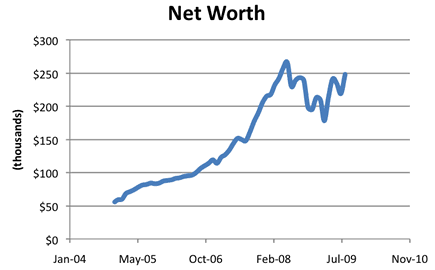
I finally got around to updating all my net worth charts and graphics. Here is my net worth since I started tracking it on this blog in December 2004:

You can also view my net worth since graduating from college in my Net Worth page. You can download my tracking template here.

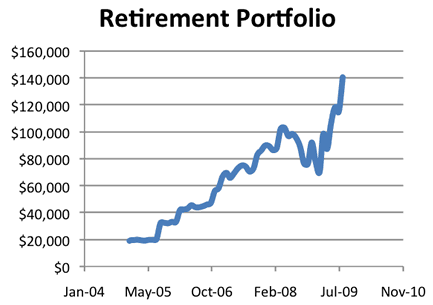
Since I had all the data handy, I also put together a chart of the value of my retirement portfolio. This is simply the sum of all the money in our 401k/IRA/403b’s over the years, including any gains/losses and contributions. Since I did a Traditional-to-Roth IRA conversion a while back, I normalized all the values by taking 30% off of any pre-tax account values. Therefore, the chart is of (estimated) after-tax balances.

As you can see, my portfolio is small enough that regular contributions have been able to counter the rather mediocre returns over the last 5 years so. The swings in our property value is also contributing to making our overall net worth very volatile recently.

Goal Tracker Chart
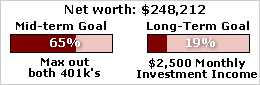
I also wanted to update my little goal meter on the top-right of every page. I updated our 401k contribution progress; we are on track to max them out for 2009. My first long-term goal is pay off my home mortgage, so I won’t have a house payment anymore. My second is to build a $750,000 investment portfolio. More details here.

At a 4% inflation-adjusted withdrawal rate, a very rough rule-of-thumb, $750k would create an annual income of $30,000 per year ($2,500 monthly). This should cover all our non-housing expenses. At the current $140,000 value, I’d theoretically be able to produce about $467 of “passive” income per month.

I’d like to come up with a better graphic to track these things, but for now I’ll stick with the progress bar. Any creative ideas out there?

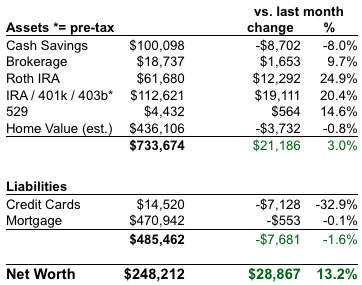
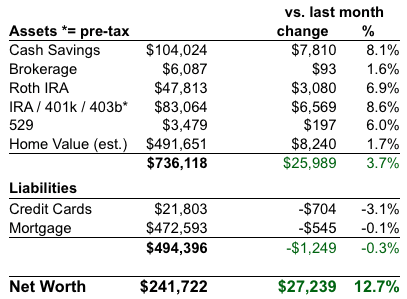
Monthly Net Worth Update – August 2009

Net Worth Chart 2009

Credit Card Debt
For newer readers, I have taken money from credit cards at 0% APR and placed it into online savings accounts, bank CDs, or savings bonds that earn 4-5% interest (much less recently), and keeping the difference as profit. I even put together a series of step-by-step posts on how to make money off of credit cards in this way. However, given the current lack of great no fee 0% APR balance transfer offers, I am mostly waiting on existing offers to end. I just paid off a large-ish balance this month.

Retirement and Brokerage accounts
Besides watching another market rally, we made a bunch of retirement contributions this month. Wife’s 401k is now maxed out at $16,500 for 2009. I made a $5,000 contribution to my Solo 401k. This makes us about 65% done with our goal of maxing out both our 401ks for 2009.

Early in the month, I also decided to go ahead and make our IRA contributions for 2009 (non-deductible due to income limits). So that’s another $10,000.

Cash Savings and Emergency Funds
We still have a little over a year’s worth of expenses in our emergency fund. I was supposed to use up some of the cash to make a principal prepayment this month, but didn’t do it due to a variety of reasons. Mainly, I wanted to do things in order and do the retirement contributions above first. We also found that we have a roof leak that may require some cash.

In addition, we have gotten some quotes on a solar hot-water system for the house, which seems like it would have a fast payback period of 2-3 years. A photovoltaic system would cost significantly more and have a payback period of around 8-9 years depending on size. Still researching this.

Home Equity
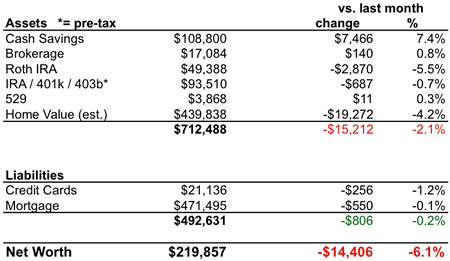
Using four different internet valuation tools – Zillow, Cyberhomes, Coldwell Banker, and Bank of America (old version) – I again took the average and took off 5% to be conservative and 6% for real estate agent commissions. The bloodshed slowed a bit this month. 🙂

All in all, more steady progress. I feel like I’m not learning a lot from these updates, but it seems to be a good habit to keep an eye on things.

Why Social Security Is Going Broke: Two Simple Charts

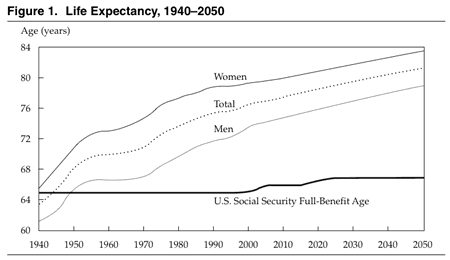
In 1940, the required age to receive full benefits from Social Security was 65. According to chart below, most people didn’t even reach 65 at that time. Today, average life expectancies are over 11 years longer (and still rising), yet the full retirement age is only 67. That’s a lot of people getting paid out.

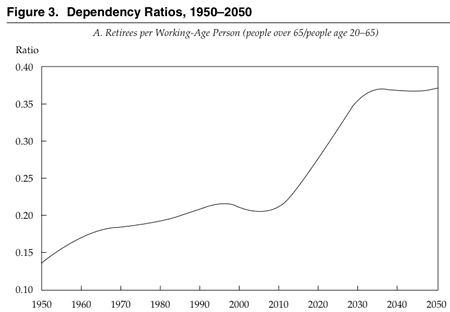
The way Social Security works, taxes from current workers go straight to paying for the benefits of current retirees. Your money is not being “saved” anywhere to be withdrawn later. In 1950, there were 7.3 working-age people for each person over 65; now, the ratio is 4.7 to 1, and it is scheduled to drop to 2.7 to 1 by 2035. That’s a lot less people paying in.

These alarming demographics don’t help Medicare either, which has even more problems! The idea of having everyone work for 40 years and then retire for 20 years is going to be very hard to sustain.

The above information was taken from the 2003 paper Demographics and Capital Market Returns, which as the title suggest also talks about the effects on future stock market performance, as well as proposing some potential solutions. Found via Capital Ideas.

Martin Lodge-on-Wheels: 10’x20′ House for $37,900

While looking for more LendingClub P2P loans to fund today, I ran across a couple that was trying to buy a tiny home called a Lodge-on-Wheels. The current model is 10 ft. by 20 ft. and costs $37,900. I thought it was pretty neat to help fund this loan for people trying to achieve financial independence.

Many more pictures here.

Inspired by her experiences after Hurricane Katrina, owner Julie Martin wanted to design an affordable tiny house that can be easily moved from place to place on a trailer. It is made primarily out of wood, unlike most of the RVs out there, which probably doesn’t make it something you want to be moving around all the time. But I love the look and feel of it, much more “homey” to me.

To get started, just park the LoW, plug in an extension cord, and connect a garden house. Some features:

  • Composting toilet, no sewer line required
  • Tankless water heater
  • Microwave/convection oven, 2-burner stove, fridge/freezer
  • Cedar countertops, and even cedar-walled shower.
  • Fully insulated
  • Hardwood (bamboo) floors
  • Loft for queen-sized bed

Beyond emergency housing, the possible uses for such a place are interesting. The site seems to be catering towards hunters and outdoorsy folks looking for a portable lake cabin. However, as the couple suggests, this could be a permanent home for anyone. You could simply “rent” someone’s backyard space and live in it. Find some cheap land and own your home for less than a BMW. If you have the yard space yourself, you could create your own rental property or in-law suite.

This also reminded me of the 250 sf condos in San Francisco that were selling for $279,000. I wonder how much they are selling for now?

Monthly Net Worth Update – July 2009

Net Worth Chart 2009

Credit Card Debt
I have taken money from credit cards at 0% APR and placed it into online savings accounts, bank CDs, or savings bonds that earn 4-5% interest (much less recently), and keeping the difference as profit. I even put together a series of step-by-step posts on how to make money off of credit cards in this way. However, given the current lack of great no fee 0% APR balance transfer offers, I am mostly waiting on existing offers to end. My credit score remains high enough that I haven’t seen any negative actions.

Retirement and Brokerage accounts
Markets most went sideways this past month. 401k contributions are still going regularly, and I want to make my 2009 non-deductible IRA contributions soon. I still think the best thing to do is to keep investing regularly, although it is quite boring to watch.

Cash Savings and Emergency Funds
We still have a year’s worth of expenses in our emergency fund, and it is still growing. Possible uses for extra cash might include capital improvements to the house, including a solar hot-water system to reduce electricity bills, or a photovoltaic system to possibly eliminate them! I love the idea of selling electricity back to the city.

Home Equity
Using four different internet valuation tools – Zillow, Cyberhomes, Coldwell Banker, and Bank of America (old version) – I took the average and took off 5% to be conservative and 6% for real estate agent commissions.

We remain “underwater”, with our outstanding mortgage balance greater than what we probably would net after selling our home. Home equity variations continue to dwarf all other activity, which is somewhat annoying since it’s not that important. Just gotta shrink that mortgage!

Creating Your Own Three Legged Stool of Retirement

You may have heard the term “three-legged stool”, taken from the idea that a stool needs three legs to maintain balance. (Photographers use tripods, no duopods or quadrapods. Even a four-legged chair will likely wobble.)

Old Three-Legged Stool of Retirement

Traditionally, the components of the three-legged stool of retirement have been presented as Social Security benefits, Pensions, and Personal Savings (401k, IRA, and other assets).

stool
image via Michigan.gov

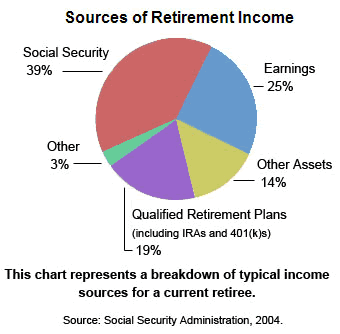
This is partially supported by data from the Social Security Administration:

pie chart
image via Pbs.org

The Qualified Retirement Plans slice combines pensions, 401ks, and IRAs together, making it hard to see the breakdown. The Other Assets include income from other investments like capital gains or dividends from taxable accounts and real estate. We observe that a quarter of all income in retirement is still from working for a paycheck.

Shaping Your Own Retirement Legs

These are just averages, and each of us will have their own path to retirement. If you’re planning on retiring early, you won’t have Social Security yet. For people born after 1960, the full retirement age for benefits is already 67, and expect it to rise even further the younger you are. I think some form of SS will still be around when I’m 70, but who knows.

1. Flexible, reliable, part-time income
We already saw that lots of people over 65 still work. Even though I want financial independence early, I’ve also come to realize that I’ll never stop working. Ask yourself what are you really going to do in retirement? In addition, I think it would be stressful to stare at a big pile of cash and think to myself – “Crap, I hope this lasts for 30+ years!” Maintaining a part-time job and the related skills would help my cashflow, and also ensure that I could return to the workforce if disaster strikes.

I would want a part-time job that could provide some socialization and a sense of improving your community or helping others. Most of my imagined jobs involve teaching, coaching, sporadic technical consulting, or something tourism-related. It can’t be 9-5, and I’d want to be able to take months off at a time. This won’t be easy to find, so I need to start developing more “fun” skills as well as personal relationships now.

2. Personal Savings: Accumulate 30 times annual (non-housing) expenses
Without a pension or Social Security, you’ll need to live off your own savings. If you invest in a balanced portfolio of 60% stocks and 40% bonds, studies have estimated that you can have a “safe withdrawal rates” of about 4% per year. By being a bit more conservative than that, this means accumulating 30 times your annual expenses.

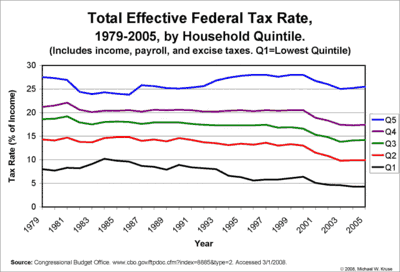
For example, if your annual expenses are $30,000, then you need to save $900,000. This is a very general rule of thumb. Taxes are tricky, but if your income is only $30,000 per year, you won’t be paying very much income tax. Check out the historical effective tax rate over a past 25 year timespan:

For reference in 1995, to be in the bottom 50% (safely in Q1/Q2) your adjusted gross income had to be under $31,000. And this even includes payroll taxes of about 9%, which you won’t have to pay on investment income. The result: very low taxes (possibly under 5%) if you keep your expenses down! Which brings me to…

3. A Paid Off House
I don’t think everyone needs to own a home. However, I happen to enjoy many of the intangibles of owning a home, I love my house and neighborhood, and plan on staying here a while. The cost of this leg can vary widely, from a $1,900 house in Detroit to… where I live, so choose where you want to live carefully. 😉

Financially, owning a home protects you from future inflation and rising rents. You are still subject to property taxes and maintenance costs.

In addition, not having to pay rent means you need less income from savings, reducing your needed nest egg in #2 above. You also pay less taxes. Withdrawing additional money from an IRA, for example, will mean subjecting them to your marginal tax rate, which could be 25% or higher. So to pay $750 in rent, you’d have to withdraw $1,000. Not very efficient.

So there, you have it, my three-legged stool. Yours may be very different – you may like renting, have a pension, own investment property, or have some other sources of income. I still worry about health insurance, but I’m still hopeful that some positive health care reform will occur that will create affordable health insurance for individuals under 65 not covered by an employer group plan.

* You can read more about the last two legs in my related post A Quick & Dirty Plan To Reach Financial Freedom.

A Bad Argument Of Why Buy-And-Hold Is Bad Advice

A regular reader Don sent me a post entitled Long Term Buy And Hold Is Still Bad Advice. Okay, fine, everyone and their mom has been telling me this recently. But I read it, and it was such a bad analysis that I had to rebut it here. I think Mish writes a lot of useful and thought-provoking stuff on his popular blog, but he really missed a big error here.

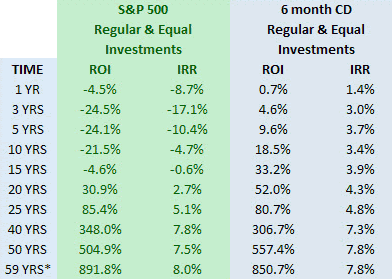
First, a recap of the post. Basically, a guy called “TC” has the idea of comparing S&P 500 returns vs. that of 6-month CDs. I’ll ignore the fact that this has been done many times already. But wait! He comes up with a startling conclusion. For long periods of time, the S&P 500 has actually lagged or been about equal to the returns of safe and steady 6-month CDs. (!!!) His graph:

Keeping my parents in mind, you’re probably wondering how someone did by simply investing in 6 month CDs. The answer is for any holding period of less than 25 years, a stock market investor who made regular and equal contributions has actually underperformed a CD investor! Yes, you read that right for time periods of 1 – 20 years a CD investor outperformed the stock market by 1.6 to 20.1 annual percentage points.

Additionally, if one extends the time window to 50 years (clearly “long term”) CDs again have outperformed the stock market by 0.3 annual percentage points. Even when one extends out the time period to the full 59+ years (the start of the S&P 500 index); the stock market has outperformed short-term CDs by a mere 0.2 annual percentage points – not much of an equity premium.

The sky is falling! Oh wait, there’s a little fine print.

TC is ignoring dividends

Let’s bold that. The analysis and data above completely ignores the dividend return of the S&P 500. This is like buying an investment property and ignoring the rent payments coming in. What? There are checks coming in every month from the tenants? Nah, let’s not cash those.

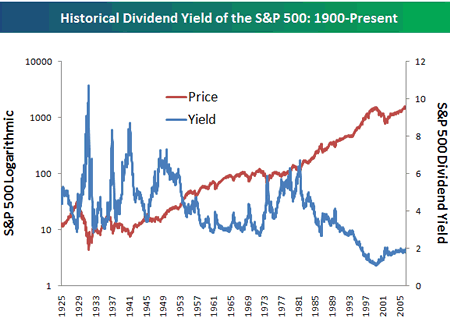
Let’s take a look at the historical dividend yield of the S&P 500, courtesy of Bespoke Investments:

For the periods compared above, the a true owner of the S&P 500 has earned 2-6% annually from dividends alone, with a long-term average of 3-4%. Now, if you add another 3-4% to the analysis above, you see again the long-term equity premium. Instead of 8% vs. 8%, it’d be more like 12% vs. 8%. That’s an enormous difference.

(I also wonder where TC got his/her data for historical 6-month CD rates. Are these averages, since every bank offers vastly different rates, and doesn’t report them to a central bureau? How does one get the average 6-month CD rate across the country in 1959? Usually studies like this use 6-month US Treasury Bill rates instead, as the data is reliable and widely-accepted.)

Massive Conflict of Interest?
Another argument given as to why buy-and-hold is bad is because there is a conflict of interest between investment advisors and their clients, as they have a “vested interest in keeping clients 100% invested 100% of the time, even if they know it is wrong.”

Actually, brokers get paid the more you trade than anything else. They earn money based on total assets, but a huge chunk is from commissions. This means convincing you to buy stocks when they’re hot (tech stocks)…. and then sell them (cash!)… and then buy others (mortgage-backed securites)…. and then sell them (cash!)… and then buy new ones. Like right now, they’ll happily sell you gold or some non-scary bond funds!

True buy-and-hold means very little trading. At Vanguard, I buy-and-hold(-and rebalance) for a total cost of about 0.20% of assets annually. That’s $20 a year per $10,000 invested. Guess what the average expense ratio of a money market fund is? According to Lipper Inc., it was 0.60% at the end of 2007. The Vanguard Prime Money Market fund (VMMXX) has an expense ratio of 0.28%. The S&P 500 fund (VFINX) charges 0.18%. Even at Vanguard, they actually get less money from me if I hold stocks instead of cash.

Same Old Story
In any case, I grow weary. Bonds have outperformed Stocks both recently and other times in the past, even if people ignored it. This is why investors need to have a balance of both stocks and bonds/cash, not just 100% one or the other. If you needed the money soon, then you should have been at the most 60/40 in stocks/bonds, if not even more conservative. In that case, your portfolio would have dropped about 15% over the last couple of years up until today, and you’d be worried but not broke.

If you use the correct numbers (ahem), stocks still have higher historical returns over extended periods, with many rocky patches. We balance this knowledge with the also-historically steadier but lower returns of bonds and cash. That’s really about it. As for the future, nobody knows, as much as they’d like to suggest they do.

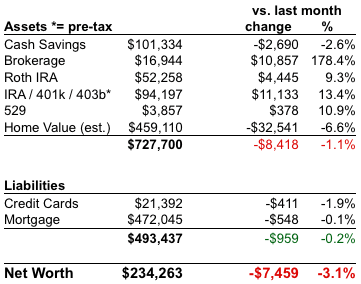
Monthly Financial Status / Net Worth Update (June 2009)

Net Worth Chart 2009

Credit Card Debt
In the past, I have taken money from credit cards at 0% APR and placed it into online savings accounts or similar safe investments that earn 4-5% interest or more, and keeping the difference as profit. I even put together a series of step-by-step posts on how to make money off of credit cards in this way. However, given the current lack of great no fee 0% APR balance transfer offers, I am have not been as active in this “game” recently. My credit score remains high enough that I haven’t seen any negative actions.

Retirement and Brokerage accounts
Markets went up, although as usual I don’t know why. I’ve been swearing off CNBC so I’m especially detached from all the buzz. Most of our retirement accounts rose about 10% the last month, which was over a $10,000 gain. I actually wish it stayed down so I could start investing some of my new cashflow at lower prices. However, waiting for it to drop again is not logical behavior, or so I keep reminding myself…

Cash Savings and Emergency Funds
We did still save a good deal of cash from our income this month, but I shifted about $10,000 of it into my brokerage account so that I can start investing in taxable accounts, which skewed the values above a bit. We still have a year’s worth of expenses in our emergency fund, which always gives me the warm fuzzies.

Home Equity
Using four different internet valuation tools – Zillow, Cyberhomes, Coldwell Banker, and Bank of America (old version) – I took the average and took off 5% to be conservative and 6% for real estate agent commissions. These sites are really wonky. Last month I was actually up, but this month my home’s estimated value dropped over $32,000 in a month. Shrug. I’m lucky that our work situation is doing well and we have no plans on moving.

According to my quick and dirty plan for financial freedom I should start paying extra towards my mortgage, but I’m having a hard time pulling the trigger on this one as well. I feel inflation coming. Should I just invest in stocks, and keep my 5% mortgage as long as possible?

Personal Finance Ratios: Savings-to-Income, Debt-to-Income, and Savings Rate-to-Income

There was a recent post on how much savings one should have at age 30 over at the Bogleheads forum. Being 30 myself, I was intrigued, but I am in the camp that believes that there is no right answer at 30. You’re still so young that you could just be out of school for a few years, and at that time it’s mostly up to how much student loan debt you racked up. Most important might be your ability to live under your means, and that you’re learning a valuable skill of some sort.

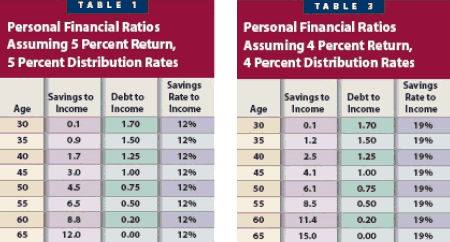
However, there was mention of a paper the the FPA Journal called Personal Financial Ratios: An Elegant Road Map to Financial Health and Retirement, where the author presents a variety of ratios as a rough benchmark to help clients determine whether they are on track to retire by age 65. These include Savings-to-Income, Debt-to-Income, and Savings Rate-to-Income.

The actual numbers depend on how you believe your investments will perform annually after inflation. (5% on the left table, 4% on the right.) Definitions below.

Savings include the current value of one’s investments, such as a 401(k), IRAs, brokerage accounts, investment real estate, and the value of any private business interests. The home is excluded as an investment. Debt comprises all debt, including mortgage, student loans, car, and consumer debt. Savings rate refers to the percentage of pre-tax income an investor is saving each year out of their total income.

A Hypothetical Example
Let’s take a look at a hypothetical 45-year-old individual to see how he might use the ratios to assess his financial circumstances. This person has the following financial statistics:

Salary $110,000
Mortgage $125,000
Auto Loan $25,000
Investments $260,000
Annual Savings $10,000
Employer 401(k) Match $3,000

Based on these statistics, the hypothetical individual ratios are as follows:

Savings to Earnings: $260,000 / $110,000 = 2.36
Debt to Earnings: ($125,000 + $25,000) / $110,000 = 1.36
Savings Rate to Earnings: ($10,000 + $3,000) / $110,000 = 11.8 %

As for us, we’re doing okay according to the table for age 30 regarding the savings-to-income ratios (0.5) and savings rate-to-income ratios (50%+). Our debt-to-income ratio is a bit high though, at around 2. Of course, this is highly dependent on our income number, which might change if we downshift with kids. I guess that’s another reason to wait until we’re a bit older to really start benchmarking like this.

One thing I don’t like about the ratios is that home equity is never included, because the author says that it’s hard to extract home equity. Okay, I agree on that point, but there is no mention of compensating for renters in the analysis. If I have no debt at age 65 + a paid-off house, that’s a lot different than no debt at 65 + still paying rent forever. My largest expense by far is housing (greater than all other expenses combined), and having that taken care of changes my retirement outlook drastically.

So… should we be using these ratios as a benchmark?

Monthly Financial Status / Net Worth Update (May 2009)

Net Worth Chart 2009

Credit Card Debt
In the past, I have taken money from credit cards at 0% APR and placed it into high-yield savings accounts or similar safe investments that earn 4-5% interest or more, and keeping the difference as profit. I even put together a series of step-by-step posts on how to make money off of credit cards in this way. However, given the current lack of great no fee 0% APR balance transfer offers, I am have not been as active in this “game” recently. My credit score remains high enough that I haven’t seen any negative actions.

Retirement and Brokerage accounts
The market rally was sustained during April, so our predominantly passive investment portfolio increased a bit. We contributed another $2,312 in 401(k) salary deferrals this month including company match. See my investment portfolio page for more details.

I get attracted to various different ideas as time passes, but I really haven’t changed my investment portfolio in about two years now. I always need to remind myself to stick to the basics.

Cash Savings and Emergency Funds
Our cash savings rose again, and although I want to keep one year of expenses for our emergency cash reserves, I need to start putting more money to work in the stock market and other investments. It’s just hard to let go of the security of cash right now. We are contemplating whether we want to save up for a rental property.

Home Equity
I used the same internet valuation tools as before – Zillow, Cyberhomes, Coldwell Banker, and Bank of America (old version).

I have zero personal input here, I just average out what the sites say. They say up. The number shown is after an additional 11% reduction to be more conservative. Not that it really matters, as I am primarily focused on paying off the mortgage, as outlined in my quick and dirty plan for financial freedom!

Quick Review of ESPlannerBasic, Free Version of ESPlanner Retirement Planning Calculator

Background
There are an increasing number of sleek but simplistic retirement calculators out there, and most of them are basically the same. You put in your savings rate and overall asset allocation, and it crunches some numbers based on historical market returns to see if you can replace 80-100% of your current income in retirement.

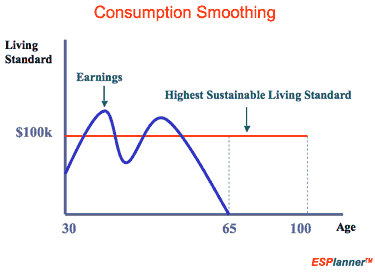
Then there’s ESPlanner, which represents “Economic Security Planner”. It is based on consumption smoothing, an economic theory where the primary goal of financial planning is instead to avoid abrupt changes in one’s standard of living. Here is one graphical explanation:

This method has gotten some extra publicity because it often tells you that you need to save less money as compared to other calculators. However, since the software cost $149, I never really got to try it out. But now, they have released ESPlannerBasic, which is a slightly stripped-down but free version that everyone can tinker with. For example, it assumes that everyone will live to 100 in its computations.

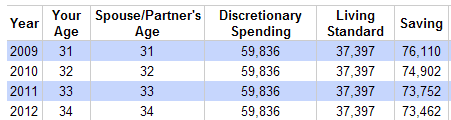
You input various financial information like income and assets, and the calculator will give you a “spending and saving plan” for each of the rest of your life. I think the most important column is savings:

Saving is the recommended increase (reduction) each year in your regular financial assets. This saving is over and above your specified contributions to retirement accounts.

Sample Run of ESPlannerBasic
Let’s take a look at some of our results, using very rough numbers and a retirement goal at age 50. (Sound familiar?) Our “standard of living” has us spending $60,000 per year as a couple forever. During the next few years, we are supposed to save about $75k per year. (I specified zero future retirement contributions for simplicity, it’s all included in the $75k.)

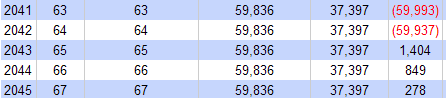
Then at my chosen retirement age of 50, things change fast, with us starting to take large withdrawals from savings:

That’s be scary! Then, at age 65, the calculator assumes that Social Security will kick in, which almost has us at a zero savings rate.

Criticisms and Compliments
My thoughts on this calculator are pretty much in line with my thoughts on consumption smoothing in general.

For starters, I don’t like the idea of a calculator telling me what I should be spending in retirement. I like the idea of constructing this on my own, based on conscious decision making. However, the fact that the calculator chose $60,000 per year is creepy. Beforehand, I had already estimated my non-housing expenses in retirement at $24,000 per year. My housing costs are current about $36,000 per year. Add them up, and you get.. $60,000! Of course, at that rate the mortgage should be paid off after 29 years. Still, just an interesting coincidence?

In addition, the calculator gives very specific results based on what are essentially wild guesses. I have no idea if my income will stay the same, increase, or decrease. I have no idea if Social Security will change the full retirement age to 75, or if benefits will be means-tested. I have no idea what tax rates will be 30 or 40 years from now. So I’d take the results with a big grain of salt.

However, since the calculator is free, I can play with many different scenarios and see how different inputs change the given results, and this may help in my retirement planning. What are the most sensitive factors? I hope to try exploring this next.

Via Bogleheads and WSJ Wallet.