One of the basic ways to adjust the risk and return characteristics of your investment portfolio is to decide what percentage to hold in stocks and bonds. This is another one of those hard questions for which there is no single best answer for everyone. You must take into account risk acceptance and time horizon amongst other factors.
An old rule of thumb is that your stock allocation percentage should be 100 minus your age. That is, a 30-year old should have 70% stocks/30% bonds, and a 70-year old should have 30% stocks/70% bonds. This was not just taken out of thin air, and has a basis from historical returns. As you near retirement, you want to have more bonds as that reduces overall volatility. More recently, others have altered this to a more aggressive “110-age” or even “120-age”.
Members of the Diehards investment forum recently performed a informal survey of member’s asset allocations versus their age, and here are the results:
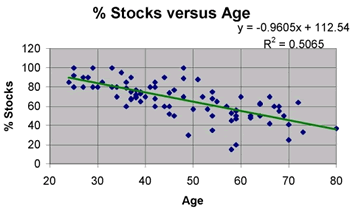
As you can see, there is definitely a lot of scatter in the data. However, if you made a linear fit, it roughly corresponds to a formula of stock percentage = 112.5 – age.
This made me curious – what about all those Target Retirement Funds? Their job is to decide an asset allocation that works for as many people as possible based on their retirement date. If I assume that people retire at 65 years old, here is what the asset allocation versus age looks like for three of the more popular fund families: Vanguard, Fidelity, and T. Rowe Price:
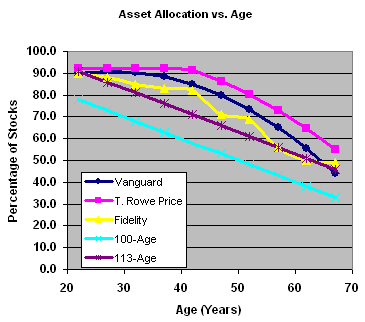
As you can see, the funds are actually pretty aggressive. (I covered previously how T. Rowe Price is more aggressive than Vanguard.) If one did force linear fits for all three fund families, it would correspond roughly to stock percentage of 119 – age. However, they don’t really adjust linearly with time. If I use a 2nd order curve fit instead, I can make a little tool that estimates their stock percentages for any age:
None of this is investment advice, it’s just an observation of what’s out there. Next, I’ll try to find some historical return and standard deviation numbers for another view of how to answer this question. What do you think of all this?
 Yodlee MoneyCenter is an account aggregation service that logs into your online accounts automatically in order to track your financial balances and transactions. It’s also a great way to see all your rewards points. While Yodlee is available for free directly, they make their money by licensing their software to financial institutions. Thus, you may know it instead as HSBC EasyView, Fidelity FullView, Wachovia OneStop, or Bank of America My Portfolio.
 In my previous post on
  The Best Credit Card Bonus Offers – 2025
 Big List of Free Stocks from Brokerage Apps
 Best Interest Rates on Cash - 2025
 Free Credit Scores x 3 + Free Credit Monitoring
 Best No Fee 0% APR Balance Transfer Offers
 Little-Known Cellular Data Plans That Can Save Big Money
 How To Haggle Your Cable or Direct TV Bill
 Big List of Free Consumer Data Reports (Credit, Rent, Work)