Best Interest Rates on Cash Savings – September 2017

percentage2

Interest rates are slowly waking up from their multi-year slumber, so I’m paying closer attention to the various changes each month. Don’t let a megabank pay you 0.01% APY or less for your idle cash. Here is my monthly roundup of the best safe rates available, roughly sorted from shortest to longest maturities. Rates checked as of 9/4/17.

High-yield savings accounts
While the huge brick-and-mortar banks rarely offer good yields, there are many online savings accounts offering competitive rates clustered around 1.0%-1.2% APY. Remember that with savings accounts, the interest rates can change at any time.

  • The Mega Money Market accounts of both Redneck Bank and All America Bank (they are affiliated) are paying 1.50% APY on balances up to $35,000. Note that amounts over $35,000 earn only 0.50% APY.
  • Other sample top rates without a balance cap: DollarSavingsDirect at 1.40% APY, Synchrony Bank and Goldman Sachs Bank are at 1.20% APY. Notice that BankDirect was 1.35% APY last month, but today is now only 0.15% APY! Boo.
  • As I’ve been “bait-and-switched” a few times myself, I’m still sticking with my Ally Bank Savings + Checking combo due to their history of competitive rates (including CDs), 1-day interbank transfers, and a overall user experience. I also like the free overdraft transfers from savings that let’s me keep my checking balance at a minimum. Ally Savings is at 1.20% APY.

Money market mutual funds + Ultra-short bond ETFs
If you like to keep cash in a brokerage account, you should know that money market and short-term Treasury rates have inched upwards. It may be worth the effort to move your money into a higher-yielding money market fund or ultrashort-term bond ETF.

  • The Vanguard Prime Money Market Fund has increased their SEC yield now to 1.10%. The default sweep option is the Vanguard Federal Money Market Fund, which only has an SEC yield of 0.97%. You can manually move the money over to Prime if you meet the $3,000 minimum investment.
  • The following bond ETFs are not FDIC-insured, but if you want to keep “standby money” in your brokerage account and have cheap/free trades, it may be worth a look. The PIMCO Enhanced Short Maturity Active Bond ETF (MINT) has a 1.55% SEC yield and the iShares Short Maturity Bond ETF (NEAR) has a 1.57% SEC yield while holding a portfolio of investment-grade bonds with an average duration of ~6 months. More info here.

Short-term guaranteed rates (1 year and under)
I am often asked what to do with a big wad of cash that you’re waiting to deploy shortly (just sold your house, just sold your business, legal settlement, inheritance). My standard advice is to keep things simple. If not a savings account, then put it in a short-term CD under the FDIC limits until you have a plan.

  • Ally Bank No-Penalty 11-Month CD is paying 1.50% APY for $25,000+ balances and 1.25% APY for $5,000+ balances. The lack of early withdrawal penalty means that your interest rate can never go down for 11 months, but you can always jump ship if rates rise.
  • Advancial Federal Credit Union has a 6-month CD at 1.63% APY ($50k min) and a 12-month CD at 1.78% APY ($50k min). If you don’t otherwise qualify, you can join this credit union with a $5 fee to Connex Professional Network and maintaining $5 in a Share savings account. Via DepositAccounts.

US Savings Bonds
Series I Savings Bonds offer rates that are linked to inflation and backed by the US government. You must hold them for at least a year. There are annual purchase limits. If you redeem them within 5 years there is a penalty of the last 3 months of interest.

  • “I Bonds” bought between May and October 2017 will earn a 1.96% rate for the first six months, and then a variable rate based on ongoing inflation after that. While that next 6-month rate is currently unknown, at the very minimum the total yield after 12 months will around 1% with additional upside potential. More info here.
  • In mid-October, the CPI will be announced and you will have a short period where you will have a very close estimate of the rate for the next 12 months. I will have another post up at that time.

Prepaid Cards with Attached Savings Accounts
A small subset of prepaid debit cards have an “attached” FDIC-insured savings account with high interest rates. The negatives are that balances are capped, and there are many fees that you must be careful to avoid (lest they eat up your interest). The other catch is that these good features may be killed off without much notice. My NetSpend card now only has an eligible balance up to $1,000.

  • Insight Card is one of the best remaining cards with 5% APY on up to $5,000 as of this writing. Fees to avoid include the $1 per purchase fee, $2.50 for each ATM withdrawal, and the $3.95 inactivity fee if there is no activity within 90 days. If you can navigate it carefully (basically only use ACH transfers and keep up your activity regularly) you can still end up with more interest than other options. Earning 4% extra interest on $5,000 is $200 a year.

Rewards checking accounts
These unique checking accounts pay above-average interest rates, but with some risk. You have to jump through certain hoops, and if you make a mistake you won’t earn any interest for that month. Rates can also drop quickly, leaving a “bait-and-switch” feeling. But the rates can be high while they last.

  • Northpointe Bank has Rewards Checking at 5% APY on up to $10k. The requirements are (1) 15 debit card purchases per month (in-person or online), (2) enrolling in e-statements, and (3) a monthly direct deposit or automatic withdrawal of $100 or more. ATM fees are rebated up to $10 per month.

Certificates of deposit (greater than 1 year)
You might have larger balances, either because you are using CDs instead of bonds or you simply want a large cash cushion. Buying finding a bank CD with a reasonable early withdrawal penalty, you can enjoy higher rates but maintain access in a true emergency. Alternatively, consider a custom CD ladder of different maturity lengths such that you have access to part of the ladder each year, but your blended interest rate is higher than a savings account.

  • Advancial Federal Credit Union (see above) has an 18-month CD at 1.89% APY ($50k min) and a 24-month CD at 2.00% APY ($50k min). The early withdrawal penalty is 180 days of interest.
  • Ally Bank also has a 5-year CD at 2.25% APY (no minimum) with a relatively short 150-day early withdrawal penalty and no credit union membership hoops. For example, if you closed this CD after 18-months you’d still get an 1.64% effective APY even after accounting for the penalty.
  • Hanscom Federal Credit Union is offering a 4-year Share Certificate at 2.50% APY (180-day early withdrawal penalty) if you also have Premier Checking (no monthly fee if you keep $6,000 in total balances or $2,000 in checking). HFCU also offers a 3% APY CU Thrive “starter” savings account with balance caps. HFCU membership is open to active/retired military or anyone who makes a one-time $35 donation to the Nashua River Watershed Association.
  • Mountain America Credit Union is offering a 5-year Share Certificate at 2.60% APY ($5 minimum) with a 365-day early withdrawal penalty. Anyone can join this credit union via partner organization American Consumer Council for a one-time $5 fee.

Longer-term Instruments
I’d use these with caution, but I still track them to see the rest of the current yield curve.

  • Willing to lock up your money for 10+ years? You can buy certificates of deposit via the bond desks of Vanguard and Fidelity. These “brokered CDs” offer the same FDIC-insurance. As of this writing, Vanguard is showing a 10-year non-callable CD at 2.65% APY (Watch out for higher rates from callable CDs.) Unfortunately, current long-term CD rates do not rise much higher even as you extend beyond a 5-year maturity.
  • How about two decades!? Series EE Savings Bonds are not indexed to inflation, but they have a guarantee that the value will double in value in 20 years, which equals a guaranteed return of 3.5% a year. However, if you don’t hold for that long, you’ll be stuck with the normal rate which is quite low (currently a sad 0.10% rate). You could view as a huge early withdrawal penalty. You could also view it as long-term bond and thus a hedge against deflation, but only if you can hold on for 20 years. Too long for me.

All rates were checked as of 9/4/17.

GiftsforBanking CD Review: 2-Year CD at 1.85% APY + Gift Valued Up to ~1% APY

applewGiftsforBanking.com has a unique FDIC-insured certificate of deposit that pays out a mix of traditional cash interest and a physical gift. The underlying bank is GObanking.com, which is in turn a division of Flushing Bank. Via DepositAccounts, they just upped their 2-Year CD to a competitive 1.85% APY of cash interest, plus a choice of gifts based on your deposit amount:

In the perfect scenario, you open a 2-year CD with $25,000 (or $50,000) and get 1.85% APY plus a gift worth another 1% APY. (Ex. $25,000 x 1% APY = $250 per year. For 2 years = $500 total.) A theoretical 2-year CD paying 2.85% APY (or even 2.5% APY) would be a top available rate in the current market.

However, it is important to note the following fine print:

*Annual Percentage Yield. APYs are effective as of 8/18/17 and are subject to change without notice. There is a substantial penalty for early withdrawals, including the value of the gift chosen. The value of all gifts will be considered as interest on your account for tax purposes in the first year the account is opened. A 1099-INT statement for the value of the gift (including applicable sales tax, shipping and handling costs) will be issued for the year of gift redemption. Please allow up to three weeks from the time that you place your gift order for delivery of gifts. Photos of gifts may not be exact model. GiftsforBanking.com reserves the right to make gift substitutions of comparable value and assumes no liability for any defects in, or consequential damages relating to gift items. The warranty is the sole responsibility of the manufacturer. CD Reward codes will expire twelve (12) months from the date that the code is first emailed to you.

This brings up the following concerns:

  • You will receive a 1099-INT for the cash interest and the value of the gift (including applicable sales tax, shipping and handling costs). It is unclear exactly what this number is for each specific gift option. It is traditionally the MSRP, but sometimes even that number is hard to figure out. How much extra will they tack on for shipping and handling? In the end, you could be on the hook for taxes on a amount significantly higher than the actual resale value. (Update: Commenter David reports that the $25k/$50k tier gifts will have a 1099 value of $575/$1,100 respectively.) You could try to dispute this amount but is it really worth the trouble?
  • The early withdrawal penalty includes both 6 months of interest plus the value of the gift. That is a relatively heavy penalty.
  • There is a minimum opening balance of $25,000 for each CD.
  • Why does the website look like it traveled in time from 1999?

The good news is that 1.85% APY on a 2-year CD all by itself is a pretty competitive rate. So if you wanted, you could simply consider the additional gift “interest” as a special discount. Instead of paying say $360 for an Apple Watch from Amazon and $80-$95 for a $100 iTunes Gift Card, you might only have to pay income taxes on $500 or so. The key is whether you actually wanted to buy a 2-year CD anyway, either for your cash reserves or as a bond replacement. For comparison, right now a 2-year US Treasury bond only yields 1.32%.

Bottom line. This is a quirky bank CD promotion with the potential to be a good deal, but some important things have to align. You already want a 2-year bank CD. You should be quite confident you won’t withdraw early. You can get good value out of the gift options or are willing to resell. Is the potential extra value worth the added hassle?

Best Interest Rates on Cash Savings – August 2017

percentage2

Interest rates are slowly waking up from their multi-year slumber, so I’m paying closer attention to the various changes each month. Don’t let a megabank pay you 0.01% APY or less for your idle cash. Here is my monthly roundup of the best safe rates available, roughly sorted from shortest to longest maturities. Rates checked as of 8/1/17.

High-yield savings accounts
While the huge brick-and-mortar banks rarely offer good yields, the online banks with a history of competitive rates offer online savings accounts clustered 1.0%-1.2% APY. Remember that with savings accounts, the interest rates can change at any time.

  • The Mega Money Market accounts of both Redneck Bank and All America Bank (they are affiliated) are paying 1.50% APY on balances up to $35,000. Note that amounts over $35,000 earn only 0.50% APY.
  • Other sample top rates without a balance cap: DollarSavingsDirect at 1.40% APY, BankDirect at 1.35% APY, Synchrony Bank and Goldman Sachs Bank are at 1.20% APY.
  • As I’ve been “bait-and-switched” a few times, I’m still sticking with my Ally Bank Savings + Checking combo due to their history of competitive rates (including CDs), 1-day interbank transfers, and a overall user experience. I also like the free overdraft transfers from savings so I can keep my checking balance at a minimum. Ally Savings is at 1.15% APY.

Money market mutual funds + Ultra-short bond ETFs
If you like to keep cash in a brokerage account, you should know that money market and short-term Treasury rates have been inching upwards. It may be worth the effort to move your money into a higher-yielding money market fund or ultrashort-term bond ETF.

  • The Vanguard Prime Money Market Fund has increased their SEC yield now to 1.10%. The default sweep option is the Vanguard Federal Money Market Fund, which only has an SEC yield of 0.92%. You can manually move the money over to Prime if you meet the $3,000 minimum investment.
  • The following bond ETFs are not FDIC-insured, but if you want to keep “standby money” in your brokerage account and have cheap/free trades, it may be worth a look. The PIMCO Enhanced Short Maturity Active Bond ETF (MINT) has a 1.52% SEC yield and the iShares Short Maturity Bond ETF (NEAR) has a 1.52% SEC yield while holding a portfolio of investment-grade bonds with an average duration of ~6 months. More info here.

Short-term guaranteed rates (under 1 year)
I am often asked what to do with a big wad of cash that you’re waiting to deploy shortly (just sold your house, just sold your business, legal settlement, inheritance). Honestly, I wouldn’t get fancy or take unnecessary risk. Just keep it safe in a short-term CD or online savings account that in insured under the FDIC limits until you have a plan.

  • The Ally Bank No-Penalty 11-Month CD is now paying 1.50% APY for $25,000+ balances and 1.25% APY for $5,000+ balances. The lack of early withdrawal penalty means that your interest rate can never go down for 11 months, but you can still jump ship if rates rise.
  • Salem Five Direct is advertising 1.25% APY on balances up to $500,000. The good news is that this rate is guaranteed until 7/1/18 – more than a year away – and since it is a savings account you can still move your money in and out without penalty. The bad news is that this rate is for new customers only.

US Savings Bonds
Series I Savings Bonds offer rates that are linked to inflation and backed by the US government. You must hold them for at least a year. There are annual purchase limits. If you redeem them within 5 years there is a penalty of the last 3 months of interest.

  • “I Bonds” bought between May and October 2017 will earn a 1.96% rate for the first six months, and then a variable rate based on ongoing inflation after that. While that next 6-month rate is currently unknown, at the very minimum the total yield after 12 months will around 1% with additional upside potential. More info here.
  • In mid-October, the CPI will be announced and you will have a short period where you will have a very close estimate of the rate for the next 12 months. I will have another post up at that time.

Prepaid Cards with Attached Savings Accounts
A small subset of prepaid debit cards have an “attached” FDIC-insured savings account with high interest rates. The risks are that balances are capped, and there are many fees that you must be careful to avoid (lest they eat up your interest). The other catch is that these good features may be killed off without much notice. My NetSpend card now only has an eligible balance up to $1,000.

  • Insight Card is one of the best remaining cards with 5% APY on up to $5,000 as of this writing. Fees to avoid include the $1 per purchase fee, $2.50 for each ATM withdrawal, and the $3.95 inactivity fee if there is no activity within 90 days. If you can navigate it carefully (basically only use ACH transfers and keep up your activity regularly) you can still end up with more interest than other options. Earning 4% extra interest on $5,000 is $200 a year.

Rewards checking accounts
These unique checking accounts pay above-average interest rates, but with some risk. You have to jump through certain hoops, and if you make a mistake you won’t earn any interest for that month. Rates can also drop quickly, leaving a “bait-and-switch” feeling. But the rates can be high while they last.

  • Northpointe Bank has Rewards Checking at 5% APY on up to $10k. The requirements are (1) 15 debit card purchases per month (in-person or online), (2) enrolling in e-statements, and (3) a monthly direct deposit or automatic withdrawal of $100 or more. ATM fees are rebated up to $10 per month.

Certificates of deposit
If you have a large cushion, it’s quite likely to just sit there for years. One option is to keep your money in longer-term investments where you can still take it out in a true emergency and pay a reasonable early withdrawal penalty. Alternatively, you could create a CD ladder of different maturity lengths such that you have access to part of the ladder each year, but your blended interest rate is higher than a savings account.

  • AmboyDirect has a 12-month CD at 1.65% APY if you deposit $10,000. Additional deposits can be made within 6 months of account opening. Note that early withdrawal penalty is a hefty 6-months of interest, however. If asked, provide offer code 601611.
  • Ally Bank also has a 5-year CD at 2.25% APY with a relatively short 150-day early withdrawal penalty and no credit union membership hoops. For example, if you closed this CD after 18-months you’d still get an 1.64% effective APY even after accounting for the penalty.
  • Hanscom Federal Credit Union is offering a 4-year Share Certificate at 2.50% APY (180-day early withdrawal penalty) if you also have Premier Checking (no monthly fee if you keep $6,000 in total balances or $2,000 in checking). HFCU also offers a 3% APY CU Thrive “starter” savings account. HFCU membership is open to active/retired military or anyone who makes a one-time $35 donation to the Nashua River Watershed Association.
  • Mountain America Credit Union is offering a 5-year Share Certificate at 2.60% APY (365-day early withdrawal penalty). $500 minimum deposit. Anyone can join this credit union via partner organization American Consumer Council for a one-time $5 fee.

Longer-term Instruments
I’d use these with caution, but I still track them to see the rest of the current yield curve.

  • Willing to lock up your money for 10+ years? You can buy certificates of deposit via the bond desks of Vanguard and Fidelity. These “brokered CDs” offer the same FDIC-insurance. As of this writing, Vanguard is showing a 10-year non-callable CD at 2.65% APY (Watch out for higher rates from callable CDs.) Unfortunately, current long-term CD rates do not rise much higher even as you extend beyond a 5-year maturity.
  • How about two decades!? Series EE Savings Bonds are not indexed to inflation, but they have a guarantee that the value will double in value in 20 years, which equals a guaranteed return of 3.5% a year. However, if you don’t hold for that long, you’ll be stuck with the normal rate which is quite low (currently a sad 0.10% rate). You could view as a huge early withdrawal penalty. You could also view it as long-term bond and thus a hedge against deflation, but only if you can hold on for 20 years. Too long for me.

All rates were checked as of 8/1/17.

Best Interest Rates on Cash Savings – July 2017

percentage2

Interest rates are slowly waking up from their multi-year slumber, so I am paying a bit more attention to the various changes each month. Don’t let a megabank pay you 0.01% APY or less for your idle cash. Here is my monthly roundup of the best safe rates available, roughly sorted from shortest to longest maturities. Rates checked as of 7/4/17.

High-yield savings accounts
While the huge brick-and-mortar banks rarely offer good yields, the online banks with a history of competitive rates offer online savings accounts clustered around 1% APY. Remember that with savings accounts, the interest rates can change at any time.

  • As I’ve been “bait-and-switched” a few times, I try to stick with savings accounts that have a consistent history of competitive rates and a good user experience. My favorite is currently Ally Bank Online Savings, which recently bumped their rate to 1.15% APY.
  • The Mega Money Market accounts of both Redneck Bank and All America Bank (they are affiliated) are paying 1.50% APY on balances up to $35,000. Note that amounts over $35,000 earn only 0.50% APY.

Money market mutual funds + Ultra-short bond ETFs
If you like to keep cash in a brokerage account, you should know that money market and short-term Treasury rates have been inching upwards. It may be worth the effort to move your money into a higher-yielding money market fund or ultrashort-term bond ETF.

  • The Vanguard Prime Money Market Fund has increased their SEC yield now to 1.07%. The default sweep option is the Vanguard Federal Money Market Fund, which only has an SEC yield of 0.87%. You can manually move the money over to Prime if you meet the $3,000 minimum investment.
  • The following bond ETFs are not FDIC-insured, but if you want to keep “standby money” in your brokerage account and have cheap/free trades, it may be worth a look. The PIMCO Enhanced Short Maturity Active Bond ETF (MINT) has a 1.49% SEC yield and the iShares Short Maturity Bond ETF (NEAR) has a 1.53% SEC yield while holding a portfolio of investment-grade bonds with an average duration of ~6 months. More info here.

Short-term guaranteed rates (under 1 year)
I am often asked what to do with a big wad of cash that you’re waiting to deploy shortly (just sold your house, just sold your business, inheritance). Honestly, I wouldn’t get fancy or take unnecessary risk. Just keep it safe in a short-term CD or online savings account that in insured under the FDIC limits until you have a plan.

  • The Ally Bank No-Penalty 11-Month CD is now paying 1.50% APY for $25,000+ balances and 1.25% APY for $5,000+ balances. The lack of early withdrawal means that you can your interest rate can never go down for 11 months, but you can still jump ship if rates rise.
  • Salem Five Direct is advertising 1.25% APY on balances up to $500,000. The good news is that this rate is guaranteed until 7/1/18 – more than a year away – and since it is a savings account you can still move your money in and out without penalty. The bad news is that this rate is for new customers only.

US Savings Bonds
Series I Savings Bonds offer rates that are linked to inflation and backed by the US government. You must hold them for at least a year. There are annual purchase limits. If you redeem them within 5 years there is a penalty of the last 3 months of interest.

  • “I Bonds” bought between May and October 2017 will earn a 1.96% rate for the first six months, and then a variable rate based on ongoing inflation after that. While that next 6-month rate is currently unknown, at the very minimum the total yield after 12 months will around 1% with additional upside potential. More info here.
  • In mid-October, the CPI will be announced and you will have a short period where you will have a very close estimate of the rate for the next 12 months. I will have another post up at that time.

Prepaid Cards with Attached Savings Accounts
A small subset of prepaid debit cards have an “attached” FDIC-insured savings account with high interest rates. The risks are that balances are capped, and there are many fees that you must be careful to avoid (lest they eat up your interest). The other catch is that these good features may be killed off without much notice. My NetSpend card now only has an eligible balance up to $1,000.

  • Insight Card is one of the best remaining cards with 5% APY on up to $5,000 as of this writing. Fees to avoid include the $1 per purchase fee, $2.50 for each ATM withdrawal, and the $3.95 inactivity fee if there is no activity within 90 days. If you can navigate it carefully (basically only use ACH transfers and keep up your activity regularly) you can still end up with more interest than other options. Earning 4% extra interest on $5,000 is $200 a year.

Rewards checking accounts
These unique checking accounts pay above-average interest rates, but with some risk. You have to jump through certain hoops, and if you make a mistake you won’t earn any interest for that month. Rates can also drop quickly, leaving a “bait-and-switch” feeling. But the rates can be high while they last.

  • Consumers Credit Union offers up to 4.59% APY on up to a $20k balance, although 3.09% APY on a $10k balance is more realistic unless you satisfy a long list of requirements. Note that the 4.59% APY requires you to apply and get approved for an additional credit card through them (other credit cards offer $500+ in sign-up bonuses) and also spend $1,000 on it every month. Keep your 12 debit purchases small as well, as for every $500 in monthly purchases you may be losing out on 2% cashback (or $10 a month on after-tax benefit). Find a local rewards checking account at DepositAccounts.

Certificates of deposit
If you have a large cushion, it’s quite likely to just sit there for years. One option is to keep your money in longer-term investments where you can still take it out in a true emergency and pay a reasonable early withdrawal penalty. Alternatively, you could create a CD ladder of different maturity lengths such that you have access to part of the ladder each year, but your blended interest rate is higher than a savings account.

  • Connexus Credit Union is offering a 1-year Share Certificate at 1.50% APY (90-day early withdrawal penalty) and a 3-year Share Certificate (180-day early withdrawal penalty) at 2.00% APY. Both have a $5,000 minimum deposit. Anyone can join this credit union via partner organization Connexus Association for a one-time $5 fee.
  • Hanscom Federal Credit Union is offering a 4-year Share Certificate at 2.50% APY (180-day early withdrawal penalty) if you also have Premier Checking (no monthly fee if you keep $6,000 in total balances or $2,000 in checking). HFCU also offer a 3% APY CU Thrive “starter” savings account. HFCU membership is open to active/retired military or anyone who makes a one-time $35 donation to the Nashua River Watershed Association.
  • Ally Bank also has a 5-year CD at 2.25% APY with a relatively short 150-day early withdrawal penalty and no credit union membership hoops. For example, if you closed this CD after 18-months, you can get a 1.64% effective APY even after accounting for the penalty.

Longer-term Instruments
I’d use these with caution, but I still track them to see the rest of the current yield curve.

  • Willing to lock up your money for 10+ years? You can buy certificates of deposit via the bond desks of Vanguard and Fidelity. These “brokered CDs” offer the same FDIC-insurance. As of this writing, Vanguard is showing a 10-year non-callable CD at 2.60% APY (2.70% if you log into Fidelity). (Unfortunately, current long-term CD rates do not rise much higher even as you extend beyond a 5-year maturity.) Prices will vary daily.
  • How about two decades!? Series EE Savings Bonds are not indexed to inflation, but they have a guarantee that the value will double in value in 20 years, which equals a guaranteed return of 3.5% a year. However, if you don’t hold for that long, you’ll be stuck with the normal rate which is quite low (currently a sad 0.10% rate). You could view as a huge early withdrawal penalty. You could also view it as long-term bond and thus a hedge against deflation, but only if you can hold on for 20 years. Too long for me.

All rates were checked as of 7/4/17.

Does Cash Make You Happier Than Income or Paying Down Debt?

happyfaceThe growing appreciation of behavioral psychology in investing is basically us admitting that we aren’t perfectly rational. When you make people automatically opt-in to 401(k) plans and make their contributions increase automatically, they save more. We value stocks more simply because we own them (“endowment effect”). We hate losing money more than we enjoy winning (“loss aversion”).

A recent research paper tells us (in my own words) that having liquid cash has a stronger correlation effect to happiness than having a bigger retirement portfolio, a higher income, or paying down your debt. This is coming from the NYT article Yes, Numbers Matter in Money Decisions, but So Do Emotions linking to the Kitces post Buying Happiness And Life Satisfaction With Greater Cash-On-Hand Reserves linking to academic paper How Your Bank Balance Buys Happiness: The Importance of “Cash on Hand” to Life Satisfaction. Here’s the abstract:

Our results suggest that having a buffer of money available in checking and savings accounts confers a sense of financial security, which in turn is associated with greater life satisfaction. The strength of this association was comparable to the effect of investments—which may themselves be liquid assets (e.g., money market accounts)—and slightly greater than the effect of debt status. By contrast, higher income and spending—the amounts going into or out of a person’s bank account—were not associated with increased financial well-being after liquid wealth was included in the model. This finding suggests that people with low liquid account balances may feel more economically distressed—and thus less satisfied with their lives—than their peers with higher balances, even if their incomes and spending, considered separately from their account balances, would predict high financial security.

Michael Kitces took the numbers from the paper and created this useful graphic:

cashlife

I dug up some more specific numbers from the paper:

To put our results into context, we found that going from having £1 to having £1,000 (a 3-log increase) in one’s bank accounts each month—not rags-to-riches, but merely rags-to-sufficiency—is associated with an average gain of 2 points (10% of a 20-point scale) in life satisfaction by virtue of feeling more secure about one’s finances. However, because liquid wealth was log transformed, further increasing liquid assets from £1,000 to £10,000 (a 1-log increase) was associated with an expected increase of just 0.7 further points on the same scale.

There are diminishing returns with accumulating cash reserves past a certain size. Going from $1 to ~$1,500 in your bank account improves your life satisfaction more than twice as much as going from ~$1,500 to ~$15,000.

This is similar to the findings that happiness increases with higher income until $60,000 to $75,000 per year. Above that level, happiness still increases but at a much lower rate.

On a certain level, this is common sense. Having a hunk of cash available for emergencies should make you feel more secure. However, in purely mathematical terms you should feel the same if you put $1,500 into your retirement account or if you paid down $1,500 of debt. Money is fungible. But your mind doesn’t necessarily agree, and perhaps it is better to work within that bias rather than fight it.

Bottom line. It may not be rational, but putting money towards a modest cash cushion can make you happier than putting every last penny towards paying down debt or your 401(k) retirement account. After a certain point this “cash is king” effect diminishes. (I might carve out an exception for 401(k) matches that effectively double your money at no risk.)

Best Interest Rates on Cash Savings – June 2017

percentage2

Over the past month, short-term interest rates have inching upwards while the overall yield curve flattened slightly. The value in chasing interest rates continues to rebound ever so slowly, especially if you have idle cash in a megabank paying 0.01% APY or less. Here is my monthly roundup of the best safe rates available, roughly sorted from shortest to longest maturities. Rates checked as of 6/5/17.

High-yield savings accounts
While the huge brick-and-mortar banks rarely offer good yields, the online banks with a history of competitive rates offer online savings accounts clustered around 1% APY. An important feature to note with savings account is that their interest rates can change at any time.

  • As I’ve been “bait-and-switched” a few times and there are no lucrative rates that make it worth taking another risk, I am currently sticking with Ally Bank Online Savings for their reliably competitive rates and overall good user experience. Their online savings is currently at 1.05% APY.

Money market mutual funds + Ultra-short bond ETFs
If you like to keep cash in a brokerage account, you should know that money market and short-term Treasury rates have been inching upwards. It may be worth the effort to move your money into a higher-yielding money market fund or ultrashort-term bond ETF.

  • The Vanguard Prime Money Market Fund has increased their SEC yield now to 0.97%. The default sweep option is the Vanguard Federal Money Market Fund, which only has an SEC yield of 0.75%. You can manually move the money over to Prime if you meet the $3,000 minimum investment.
  • The following bond ETFs are not FDIC-insured, but if you want to keep “standby money” in your brokerage account and have cheap/free trades, it may be worth a look. Both the PIMCO Enhanced Short Maturity Active Bond ETF (MINT) and the iShares Short Maturity Bond ETF (NEAR) have a 1.43% SEC yield while holding a portfolio of investment-grade bonds with an average duration of ~6 months. More info here.

Short-term guaranteed rates (under 1 year)
I am often asked what to do with a big wad of cash that you’re waiting to deploy shortly (just sold your house, just sold your business, inheritance). Honestly, I wouldn’t get fancy or take unnecessary risk. Just keep it safe in a short-term CD or online savings account that in insured under the FDIC limits until you have a plan.

  • Palladian Private Bank has a 6-month promotional rate of 1.30% APY guaranteed (maximum initial deposit of $100k) for new accounts. After the first 6 months, the rate reverts back to their normal rate (currently 0.90% APY). Since the initial promo rate is fixed, this makes it the highest guaranteed 6-month CD rate available.
  • Salem Five Direct is advertising 1.25% APY on balances up to $500,000. The good news is that this rate is guaranteed until 7/1/18 – more than a year away – and since it is a savings account you can still move your money in and out without penalty. The bad news is that this rate is for new customers only.

US Savings Bonds
Series I Savings Bonds offer rates that are linked to inflation and backed by the US government. You must hold them for at least a year. There are annual purchase limits. If you redeem them within 5 years there is a penalty of the last 3 months of interest.

  • “I Bonds” bought between May and October 2017 will earn a 1.96% rate for the first six months, and then a variable rate based on ongoing inflation after that. While that next 6-month rate is currently unknown, at the very minimum the total yield after 12 months will around 1% with additional upside potential. More info here.
  • In mid-October, the CPI will be announced and you will have a short period where you will have a very close estimate of the rate for the next 12 months. I will have another post up at that time.

Prepaid Cards with Attached Savings Accounts
A small subset of prepaid debit cards have an “attached” FDIC-insured savings account with high interest rates. The risks are that balances are capped, and there are many fees that you must be careful to avoid (lest they eat up your interest). The other catch is that these good features may be killed off without much notice. My NetSpend card now only has an eligible balance up to $1,000.

  • Insight Card is one of the best remaining cards with 5% APY on up to $5,000 as of this writing. Fees to avoid include the $1 per purchase fee, $2.50 for each ATM withdrawal, and the $3.95 inactivity fee if there is no activity within 90 days. If you can navigate it carefully (basically only use ACH transfers and keep up your activity regularly) you can still end up with more interest than other options. Earning 4% extra interest on $5,000 is $200 over a year.

Rewards checking accounts
These unique checking accounts pay above-average interest rates, but with some risk. You have to jump through certain hoops, and if you make a mistake you won’t earn any interest for that month. Rates can also drop quickly, leaving a “bait-and-switch” feeling. But the rates can be high while they last.

  • Consumers Credit Union offers up to 4.59% APY on up to a $20k balance, although 3.09% APY on a $10k balance is more realistic unless you satisfy a long list of requirements. Note that the 4.59% APY requires you to apply and get approved for an additional credit card through them (other credit cards offer $500+ in sign-up bonuses) and also spend $1,000 on it every month. Keep your 12 debit purchases small as well, as for every $500 in monthly purchases you may be losing out on 2% cashback (or $10 a month on after-tax benefit). Find a local rewards checking account at DepositAccounts.

Certificates of deposit
If you have a large cushion, it’s quite likely to just sit there for years. One option is to keep your money in longer-term investments where you can still take it out in a true emergency and pay a reasonable early withdrawal penalty. Alternatively, you could create a CD ladder of different maturity lengths such that you have access to part of the ladder each year, but your blended interest rate is higher than a savings account.

  • Connexus Credit Union is offering a 1-year Share Certificate at 1.50% APY (90-day early withdrawal penalty) and a 3-year Share Certificate (180-day early withdrawal penalty) at 2.00% APY. Both have a $5,000 minimum deposit. Anyone can join this credit union via partner organization Connexus Association for a one-time $5 fee.
  • Hanscom Federal Credit Union is offering a 4-year Share Certificate at 2.50% APY (180-day early withdrawal penalty) if you also have Premier Checking (no monthly fee if you keep $6,000 in total balances or $2,000 in checking). HFCU also offer a 3% APY CU Thrive “starter” savings account. HFCU membership is open to active/retired military or anyone who makes a one-time $35 donation to the Nashua River Watershed Association.
  • Ally Bank Savings also has a 5-year CD at 2.25% APY with a relatively short 150-day early withdrawal penalty and no credit union membership hoops. For example, if you closed this CD after 18-months, you can get a 1.64% effective APY even after accounting for the penalty.

Longer-term Instruments
I’d use these with caution, but I still track them to see the rest of the current yield curve.

  • Willing to lock up your money for 10+ years? Did you know that you can buy certificates of deposit via Vanguard’s bond desk? These “brokered CDs” still offer the same FDIC-insurance. As of this writing, you can get a 10-year non-callable CD that pays 2.75% APY. Fidelity has a new Model CD Ladder tool that will construct a ladder for you, but you need an account to see it in full action. (Unfortunately, current long-term CD rates do not rise much higher even as you extend beyond a 5-year maturity.) Prices will vary daily.
  • How about two decades!? Series EE Savings Bonds are not indexed to inflation, but they have a guarantee that the value will double in value in 20 years, which equals a guaranteed return of 3.5% a year. However, if you don’t hold for that long, you’ll be stuck with the normal rate which is quite low (currently a sad 0.10% rate). You could view as a huge early withdrawal penalty. You could also view it as long-term bond and thus a hedge against deflation, but only if you can hold on for 20 years. Too long for me.

All rates were checked as of 6/5/17.

Ally Bank vs. Goldman Sachs Bank CD Interest Rate Comparison

allygslogo

After last week’s WSJ article about interest rates, I noticed that both Goldman Sachs Bank USA (GS Bank) and Ally Bank have both been hiking rates on their CDs. Competition is good and I like that they both still show the desire to stay at the top as rates start rising again. (GS Bank is formerly GE Capital Bank, which also had a good history of maintaining high rates.) I’ll still chase a good limited-time CD rate if it’s high enough, but I like not having to move my cash around constantly.

Is Ally or Goldman Sachs a better overall place to keep your cash? Here is a direct rate comparison at various terms (as of 5/15/17). Both have hikes rates already this month.

allygs1705

In terms of side-by-side rate comparison, GS Bank is either the top or tied for the top at all the term lengths as of 5/15/17. Things could change with future rate changes. However, I would point out that their early withdrawal penalties are slightly different, with Ally being more lenient across the board.

Ally Bank Early Withdrawal Penalty Schedule

  • Terms less than 24 months = 60 days of interest
  • Terms 25 months to 36 months = 90 days of interest
  • Terms 37 months to 48 months = 120 days of interest
  • Terms 39 months and longer = 150 days of interest

Goldman Sachs Bank Early Withdrawal Penalty Schedule

  • Terms less than 12 months = 90 days of interest
  • Terms of 12 months to 5 years = 270 days of interest
  • Terms of more than 5 years = 365 days of interest

Both offer fast transfers between external bank accounts as quickly as one business day. I have not opened a Goldman Sachs Bank account (yet) so I haven’t done a side-by-side comparison of transfer speeds.

Bottom line. Both Ally Bank and Goldman Sachs Bank are solid, all-around online banks and offer least highly competitive rates across all term lengths. Goldman has slightly higher rates at certain terms lengths, but Ally has smaller early withdrawal penalty. Alliant Credit Union is another worthy all-around competitor that I also considered, but Alliant’s certificate rates are lower across the board other than their 1.05% APY savings account which is tied. I hope to continue to take regular rate snapshots.

Best Interest Rates on Cash Savings – May 2017

percentage2

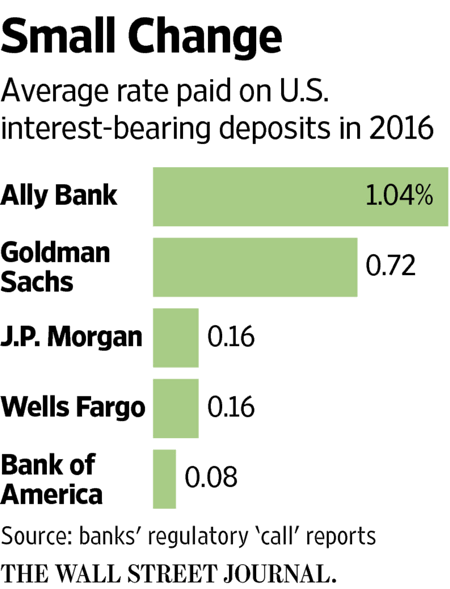
The WSJ article Bank of America Pays Peanuts for Deposits, but the Money Keeps Flowing In (paywall) outlines how BofA gets away with paying less interest on its deposits than nearly any other US bank (not that the other mega-banks are that much better). BofA only pays an average of 0.08% on $796 billion of cash deposits, including certificates of deposit:

bofa_int450

Keep your savings somewhere else! Even if you have a BofA account for the ATM network, you can avoid fees on their basic checking accounts with either a monthly direct deposit, a minimum balance of $1,500 with no direct deposit, or by keeping $20,000 in stocks/ETFs at Merrill Edge with no direct deposit and no minimum balance. Anything above that can easily earn more interest with a companion account like Ally Bank Savings that now has 1-day transfers between linked accounts.

On that note, here is my monthly roundup of the best safe rates available, roughly sorted from shortest to longest maturities. Rates checked as of 5/11/17.

High-yield savings accounts
While the huge brick-and-mortar banks rarely offer good yields, the online banks with a history of competitive rates offer online savings accounts clustered around 1% APY. An important feature to note with savings account is that their interest rates can change at any time.

  • As I’ve been “bait-and-switched” a few times and there are no lucrative rates that make it worth taking another risk, I am currently sticking with Ally Bank for their reliably competitive rates and overall good user experience. Their online savings is currently at 1.05% APY.

Money market mutual funds
If you like to keep cash in a brokerage account, you should know that money market and short-term Treasury rates have been inching upwards. It may be worth the effort to move your money into a higher-yielding money market fund.

  • The Vanguard Prime Money Market Fund has increased their SEC yield to a half-decent 0.95%. The default sweep option is the Vanguard Federal Money Market Fund, which only has an SEC yield of 0.69%. You can manually move the money over to Prime if you meet the $3,000 minimum investment.

Short-term guaranteed rates (under 1 year)
I am often asked what to do with a big wad of cash that you’re waiting to deploy shortly (just sold your house, just sold your business, inheritance). Honestly, I wouldn’t get fancy or take unnecessary risk. Just keep it safe in a short-term CD or online savings account that in insured under the FDIC limits until you have a plan.

  • Palladian Private Bank has a 6-month promotional rate of 1.30% APY guaranteed (maximum initial deposit of $100k) for new accounts. After the first 6 months, the rate reverts back to their normal rate (currently 0.90% APY). Since the initial promo rate is fixed, this makes it the highest guaranteed 6-month CD rate available.

US Savings Bonds
Series I Savings Bonds offer rates that are linked to inflation and backed by the US government. You must hold them for at least a year. There are annual purchase limits. If you redeem them within 5 years there is a penalty of the last 3 months of interest.

  • “I Bonds” bought through the end of April 2017 now will earn a 1.96% rate for the first six months, and then a variable rate based on ongoing inflation after that. While that next 6-month rate is currently unknown, at the very minimum the total yield after 12 months will around 1% with additional upside potential. More info here.
  • In mid-October, the CPI will be announced and you will have a short period where you will have a very close estimate of the rate for the next 12 months. I will have another post up at that time.

Prepaid Cards with Attached Savings Accounts
A small subset of prepaid debit cards have an “attached” FDIC-insured savings account with high interest rates. The risks are that balances are capped, and there are many fees that you must be careful to avoid (lest they eat up your interest). The other catch is that these good features may be killed off without much notice. My NetSpend card now only has an eligible balance up to $1,000.

  • Insight Card is one of the best remaining cards with 5% APY on up to $5,000 as of this writing. Fees to avoid include the $1 per purchase fee, $2.50 for each ATM withdrawal, and the $3.95 inactivity fee if there is no activity within 90 days. If you can navigate it carefully (basically only use ACH transfers and keep up your activity regularly) you can still end up with more interest than other options.

Rewards checking accounts
These unique checking accounts pay above-average interest rates, but with some risk. You have to jump through certain hoops, and if you make a mistake you won’t earn any interest for that month. Rates can also drop quickly, leaving a “bait-and-switch” feeling. But the rates can be high while they last.

  • Consumers Credit Union offers up to 4.59% APY on up to a $20k balance, although 3.09% APY on a $10k balance might be easier to achieve unless you satisfy a long list of requirements. Note that the 4.59% APY requires you to apply and get approved for an additional credit card through them (other credit cards offer $500+ in sign-up bonuses). Keep your 12 debit purchases small as well, as for every $500 in monthly purchases you may be losing out on 2% cashback (or $10 a month on after-tax benefit). Find a local rewards checking account at DepositAccounts.

Certificates of deposit
If you have a large cushion, it’s quite likely to just sit there for years. One option is to keep your money in longer-term investments where you can still take it out in a true emergency and pay a reasonable early withdrawal penalty. Alternatively, you could create a CD ladder of different maturity lengths such that you have access to part of the ladder each year, but your blended interest rate is higher than a savings account.

  • Connexus Credit Union is offering a 1-year Share Certificate at 1.50% APY (90-day early withdrawal penalty) and a 3-year Share Certificate (180-day early withdrawal penalty) at 2.00% APY. Both have a $5,000 minimum deposit. Anyone can join this credit union via partner organization Connexus Association for a one-time $5 fee.
  • Hanscom Federal Credit Union is offering a 4-year Share Certificate at 2.50% APY (180-day early withdrawal penalty) if you also have Premier Checking (no monthly fee if you keep $6,000 in total balances or $2,000 in checking). HFCU also offer a 3% APY CU Thrive “starter” savings account. HFCU membership is open to active/retired military or anyone who makes a one-time $35 donation to the Nashua River Watershed Association.

Longer-term Instruments
I’d use these with caution, but I still track them to see the rest of the current yield curve.

  • Willing to lock up your money for 10+ years? Did you know that you can buy certificates of deposit via Vanguard’s bond desk? These “brokered CDs” still offer the same FDIC-insurance. As of this writing, you can get a 10-year non-callable CD that pays 2.75% APY. (Unfortunately, current long-term CD rates do not rise much higher even as you extend beyond a 5-year maturity.) Prices will vary daily.
  • How about two decades!? Series EE Savings Bonds are not indexed to inflation, but they have a guarantee that the value will double in value in 20 years, which equals a guaranteed return of 3.5% a year. However, if you don’t hold for that long, you’ll be stuck with the normal rate which is quite low (currently a sad 0.10% rate). You could view as a huge early withdrawal penalty. You could also view it as long-term bond and thus a hedge against deflation, but only if you can hold on for 20 years. Too long for me.

All rates were checked as of 5/11/17.

Best Interest Rates on Cash Savings – April 2017

percentage2

Our family keeps a year’s worth of expenses (not income) put aside in cash reserves. Even if you think that’s too much, you still need something. There are many ways that the ROI on emergency funds can be higher than simply the interest rate on your bank statement.

If you have cash, it pays to shop around for the most highest interest rates since they are all equally “safe” as long as they are backed by the US government (FDIC-insured, NCUA-insured, US Treasury Bonds, US Savings Bonds). Chase Bank on a 1-year CD? 0.02% APY. Bank of America on a 10-year CD? 0.15% APY. Seriously, who buys these things?!? As of 4/2/2017, below is a roundup of the best safe rates available, roughly sorted from shortest to longest maturities.

High-yield savings accounts
While the huge brick-and-mortar banks rarely offer good yields, the online banks with a history of competitive rates offer online savings accounts clustered around 1% APY. An important feature to note with savings account is that their interest rates can change at any time.

  • As I’ve been “bait-and-switched” a few times and there are no lucrative rates that make it worth taking another risk, I am currently sticking with Ally Bank for their reliably competitive rates and overall good user experience. Their online savings is currently at 1.05% APY.

Short-term guaranteed rates (under 1 year)
I am often asked what to do with a big wad of cash that you’re waiting to deploy shortly (just sold your house, just sold your business, inheritance). Honestly, I wouldn’t get fancy or take unnecessary risk. Just keep it safe in a short-term CD or online savings account that in insured under the FDIC limits until you have a plan.

  • Palladian Private Bank has a 6-month promotional rate of 1.30% APY guaranteed (maximum initial deposit of $100k) for new accounts. After the first 6 months, the rate reverts back to their normal rate (currently 1.10% APY). Since the initial promo rate is fixed, this makes it the highest 6-month CD rate available.

US Savings Bonds
Series I Savings Bonds offer rates that are linked to inflation and backed by the US government. You must hold them for at least a year. There are annual purchase limits. If you redeem them within 5 years there is a penalty of the last 3 months of interest.

  • “I Bonds” bought through the end of April 2017 now will earn a 2.76% rate for the first six months, and then a variable rate based on ongoing inflation after that. While that next 6-month rate is currently unknown, at the very minimum the total yield after 12 months will be competitive with the best current 1-year CD rates. More info here.
  • In mid-April, the CPI will be announced that factors into the new fixed rate in May, which would give you a very close estimate of the rate for the next 12 months. I will have another post up at that time.

Prepaid Cards with Attached Savings Accounts
A small subset of prepaid debit cards have an “attached” FDIC-insured savings account with high interest rates. The risks are that balances are capped, and there are many fees that you must be careful to avoid (lest they eat up your interest). The other catch is that these good features may be killed off without much notice. My NetSpend card now only has an eligible balance up to $1,000.

  • Insight Card is one of the best remaining cards with 5% APY on up to $5,000 as of this writing. Fees to avoid include the $1 per purchase fee, $2.50 for each ATM withdrawal, and the $3.95 inactivity fee if there is no activity within 90 days. If you can navigate it carefully (basically only use ACH transfers and keep up your activity regularly) you can still end up with more interest than other options.

Rewards checking accounts
These unique checking accounts pay above-average interest rates, but with some risk. You have to jump through certain hoops, and if you make a mistake you won’t earn any interest for that month. Rates can also drop quickly, leaving a “bait-and-switch” feeling. But the rates can be high while they last.

  • Consumers Credit Union offers up to 4.59% APY on up to a $20k balance, although 3.09% APY on a $10k balance might be easier to achieve unless you satisfy a long list of requirements. Note that the 4.59% APY requires you to apply and get approved for an additional credit card through them (other credit cards offer $500+ in sign-up bonuses). Keep your 12 debit purchases small as well, as for every $500 in monthly purchases you may be losing out on 2% cashback (or $10 a month on after-tax benefit). Find a local rewards checking account at DepositAccounts.

Certificates of deposit
If you have a large cushion, it’s quite likely to just sit there for years. One option is to keep your money in longer-term investments where you can still take it out in a true emergency and pay a reasonable early withdrawal penalty. Alternatively, you could create a CD ladder of different maturity lengths such that you have access to part of the ladder each year, but your blended interest rate is higher than a savings account.

  • Connexus Credit Union is offering a 1-year Share Certificate at 1.50% APY (90-day early withdrawal penalty) and a 3-year Share Certificate (180-day early withdrawal penalty) at 2.00% APY. Both have a $5,000 minimum deposit. Anyone can join this credit union via partner organization Connexus Association for a one-time $5 fee.
  • Mountain America Credit Union is offering a 5-year Share Certificate at 2.75% APY (365-day early withdrawal penalty). You are even allowed a one-time rate bump if the rates on this certificate rise. $500 minimum deposit. Anyone can join this credit union via partner organization American Consumer Council for a one-time $5 fee.

Longer-term Instruments
I’d use these with caution, but I still track them to see the rest of the current yield curve.

  • Willing to lock up your money for 10+ years? Did you know that you can buy certificates of deposit via Vanguard’s bond desk? These “brokered CDs” offer the same FDIC-insurance and are often through commercial banks like Goldman Sachs. As of this writing, you can get a 10-year non-callable CD that pays 2.85% APY. (Unfortunately, current long-term CD rates do not rise much higher even as you extend beyond a 5-year maturity.) Prices will vary daily.
  • How about two decades!? Series EE Savings Bonds are not indexed to inflation, but they have a guarantee that the value will double in value in 20 years, which equals a guaranteed return of 3.5% a year. However, if you don’t hold for that long, you’ll be stuck with the normal rate which is quite low (currently a sad 0.10% rate). You could view as a huge early withdrawal penalty. You could also view it as long-term bond and thus a hedge against deflation, but only if you can hold on for 20 years. Too long for me.

All rates were checked as of 4/2/17.

Santander Bank New Checking Account $225 Bonus

sant225

sant_logoSantander Bank has a new promotion offer a $225 cash bonus for new deposit customers that satisfy the following conditions:

  • Open an eligible new checking account by 3/31/17 with the promo code WINTER225. You must not have or have had a Santander deposit account in the last 12 months.
  • Have direct deposits totaling $500 or more within the first 90 days.
  • Keep your account open for at least 90 days.
  • After you meet these conditions, the $225 bonus will be paid within 30 days. (Your account must still be open with a positive balance at time of bonus payout, so that’s a total of 120 days.)

You should be able to get this offer by visiting SantanderBank.com/winter225 and using promo code WINTER225. If you want to be extra-super-duper-sure, you can register your information here and request an “exclusive coupon” e-mail to be send to you.

There are three eligible checking types: Simply Right Checking, Basic Checking, Premier Plus Checking. Most people will probably choose the Simply Right Checking with $10 monthly fee that can be waived with at least one transaction every calendar month – a deposit, withdrawal, transfer, or payment. The Basic Checking has a fixed $3 monthly fee, but no minimum activity requirements. For both, minimum opening balance is $25 and paperless statements are free (mailed $3 each).

Note the following text regarding direct deposit. Hopefully you can split your paycheck direct deposits easily to multiple accounts.

**Direct deposits include deposits made by your employer or a federal or state government agency or retirement benefits administrator and generally payments made by corporations or other organizations. They do not include deposits to your account that are made by an individual using online banking or an Internet payment provider such as PayPal.

Here’s the rest of the Fine Print:

*Offer is not available if any account owner is a current deposit customer of Santander or had a Santander deposit account in the last 12 months prior to account opening. Cannot be combined with other offers. Eligible new account must be opened between 02/1/2017 – 03/31/2017. In order to receive the bonus, the account must remain open and in the eligible product type at the time of bonus payout. In addition, the account must have a positive balance at the time of bonus payment. Bonus is considered interest and will be reported to IRS on Form 1099-INT. If multiple accounts are opened with the same signer, only one account will be eligible for the bonus.

Ally Bank 1-Day ACH Funds Transfer Review

ally_logonew

Considering all of the things that can be done instantaneously nowadays, I’m rather disappointed that it still takes 3 business days to move money between most financial institutions. NACHA has been gradually working on same-day ACH transfers – apparently credits are live (like direct deposit), but not debits. Even then, banks may treat this as a premium service and charge a fee.

Ally Bank announced in October 2016 that they would support free 1-day ACH transfers for eligible transfers on 12/3/2016. They later announced a delay until 1/7/17. I finally got around to testing out this new feature in mid-January. Here are their own words:

We can now complete qualified transfers between your Ally Bank and non-Ally Bank accounts in 1 business day – free of charge. If 1-day delivery is unavailable, we’ll deliver your transfer in 3 business days.

Here’s their updated timing chart (note the cut-off times):

ally1day1

Here are the official reasons why a transfer would be ineligible for 1-day delivery:

  • Your one-time transfer is ineligible due to account inactivity, overdrafts or transfer returns.
  • Your transfer is part of a recurring transfer plan.

In my experience playing around with the website, there may be other additional factors. Here are the results of various combinations of to/from between Ally Savings/Checking and a sample External Bank B. This is what Ally is telling me upfront, before initiating the transfer.

  • Ally Savings to External Bank B = 1-day Transfer
  • External Bank B to Ally Savings = 1-day Transfer
  • Ally Checking to External Bank B = 3-day Transfer
  • External Bank B to Ally Checking = 1-day Transfer

Update – Here’s what a commenter Craig said an Ally CSR told him. I haven’t officially confirmed this but it appears to be consistent with my experiences.

To qualify for the 1 day transfer At Ally Bank, you have to do at least one $250 transfer in and out of the external account and then it goes into effect 2 months after that is done…so ALL your transfer accounts can qualify for 1 day transfers if you follow that rule…They should mention on the website…i found it out from a CSR….

Let us not forget that Alliant reduced the amount of outgoing transfers to $25,000 where as Ally allows $150,000 per transfer…

This usually isn’t a problem since I can make an instant transfer between Ally Checking to Ally Savings and then do a 1-day transfer from there, but savings accounts are only allowed six withdrawals per month. If I have a lot of transfers in any given month, I will eventually run into delays.

Ally has redesigned and improved the user interface of their funds transfer page. They now provide a a nice illustration of when your funds will be debited and when they will be deposited at the target location. It is also explicitly states whether it is a 1-day or 3-day transfer. Here’s an Expedited 1-day transfer:

ally1day2

Here’s a Standard 3-day transfer (in this case technically it will take only two days):

ally1day3

Bottom line. Ally Bank now offers 1 business day transfers in eligible cases with an improved user experience. Overall, I’m happy with this development as it applies most of the time (see above for details). I use Ally Bank as my central hub for cash transfers with Ally Bank Savings Account (higher interest, 6 withdrawals per month) as my default location for liquid cash savings and as a free overdraft source from Ally Checking (unlimited withdrawals per month). If I find a high-interest CD that looks good, I move money to/from my Ally account to where it needs to go, so speed can matter.

Andrews Federal Credit Union 84-Month Certificate at 3.01% APY

afcu_logo

Updated 1/23/17. It appears that Andrews FCU has quietly added back this 7-year 3% APY CD on their share certificate rates page. I don’t know how long this will last. Thanks to FI35 for the tip. Please see my Andrews Federal Credit Union Application and Account Opening Review for more details on the opening process. As I have an active account with Andrews FCU, I verified it as an option today (1/23/17) to open directly online. (Click to enlarge.)

afcu_new3

Original post:

Let’s take a closer look at this 84-month Share Certificate at 3.01% APY. The early withdrawal penalty is a rather modest 180-days of interest. The minimum opening deposit is $1,000. No maximum balance cap. I created a spreadsheet to calculate the effective interest rate if you withdraw early, and here are the results visually:

afcu_bf2016

If you withdraw after one year, you’ve still earned 1.50% APY after paying the penalty. After 2 years, you’ll have earned 2.25% APY. After 3 years, you’ll have earned 2.51% APY. At all these intervals, you are ahead of nearly all the top rates from other banks and credit unions.

If you don’t qualify directly, anyone can join the credit union by first joining the American Consumer Council for $8. Try the promo code consumer and you should be able to save that five bucks. After that, join AFCU online, and deposit the minimum $5 to open a share account. After your share account is open, you can try to open the promotional CDs online. Alternatively, you may need to call them up directly and expedite things.

Please see my Andrews Federal Credit Union Application and Account Opening Review for more details.

I am striking out the refer-a-friend bonus text below because I no longer see it advertised on their site. This way I can keep the details in case they bring it back.

$50 Refer a Friend Bonus. As part of the holiday promotion, new members can also get a $50 cash bonus if referred by an existing member. The referrer also gets $50. However, the referred person must open a checking account and set up direct deposit of $500 or more. Here are the exact terms:

Refer a friend offer available to existing Andrews Federal members who refer a new member to the credit union. New member must open a new Free or Advantage Checking account with a direct deposit of $500 or more. Direct deposit must be initiated within 30 days of opening new Free or Advantage checking account, and must be received for at least two consecutive monthly statement cycles for both members to be eligible for reward. Account must remain open and in good standing for at least 90 days; accounts closed prior to 90 days will be ineligible. $50.00 will be credited to the referring member’s and the new member’s credit union accounts within 4 weeks after the 90- day period has ended. New member must qualify for credit union membership, which includes the opening of a Base Share Savings account with a minimum balance of $5.00.

I am not exactly sure how this works in practical terms. I believe that during the application process there is a question “Where Did You Hear About Us?” and you can pick “Family/Friend Referral” and you can leave your friend’s name and Andrews FCU membership number in the comments field. If you are looking to open up a checking account and set up direct deposit, I am a member now so if you want a referral please contact me.