WT Direct Savings: $75 Bonus For Direct Deposit

WT Direct is running a new “Stay Financially Fit!” promotion for their savings account. Ostensibly it’s to help you build your emergency fund with regular savings deposits, but of course you have to do it with WT Direct. 😉 To participate, you must open a new account first or log into your existing account and look for this banner on the Account Summary page.
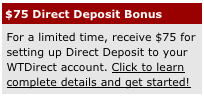
Now WTDirect can help you stick to your savings plan and bulk up your savings account. Simply take a few minutes to set up Direct Deposit from your earnings to your WTDirect account.

Act now and receive a $75 BONUS*. All you have to do is maintain a balance of at least $10,000 on July 31 and make direct deposits of at least $300 each month between 7/1/09 – 9/30/09.

Equivalent APY?
Finding out exactly how good this promotion is tricky, but I’ll make some simple assumptions. Let’s say you put $10,000 in on 7/31, the interest rate stays at the current 1.76% APY, and take everything out on 10/15. Then you take out everything including the three $300 direct deposits. This roughly equates to 4% APY during that 3.5 month period. Not bad if you can change or split your direct deposits. It seems questionable if other electronic transfers will count as direct deposit:

Bonus will be credited to your account on or about October 15, 2009. A direct deposit is defined as a recurring and automatic electronic deposit transaction of at least $300 per month initiated by a third party source of income, such as employment, pension or social security income. Direct deposit must be from a source not already being direct deposited into any existing account with Wilmington Trust or its affiliates.
FDIC and NCUA Insurance Limits $250,000 Until 2013

The standard maximum insurance limits for both FDIC and NCUA-insured accounts will remain $250,000 for at least until December 31st, 2013. Previously, it was temporarily increased from $100,000 to $250,000 only until December 31st, 2009. The extension was included as part of the Helping Families Save Their Homes Act, which was signed into law on May 20th. I wish it was made permanent, but I suppose this is better than nothing.

Here is the media release from the NCUA. Here is the FDIC fact sheet outlining the new changes. FDIC is for participating banks, and NCUA is for participating credit unions.

You may actually have more than $250,000 of coverage, depending on how you have titled your accounts and where you hold multiple accounts. Here are the official online calculators:

NCUA Electronic Share Insurance Calculator (ESIC)
FDIC Electronic Deposit Insurance Estimator (EDIE)

FDIC Will Cap Interest Rates For Weakest Banks In 2010

On May 29th, the FDIC issued a ruling [PDF] that would limit future interest rates offered by FDIC-insured banks which were deemed “less than well-capitalized”. This was viewed by some as a response to a complaint filed earlier with the FDIC by the American Bankers Association (ABA), a bank lobby group representing all the mega-banks. The ABA said that it was unfair that Ally Bank could offers such high interest rates when its parent GMAC was accepting government assistance.

How weak is weak?
A bank can be classified as “well-capitalized”, “adequately-capitalized”, and different levels of “under-capitalized”. An insured depository institution is “well capitalized” if it “significantly exceeds the required minimum level for each relevant capital measure” set by the FDIC. According to this Bloomberg article, only 3% of banks are not well-capitalized.

Rate cap details
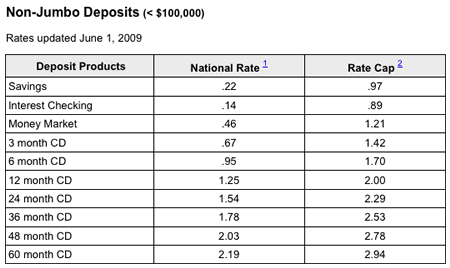
If a bank is not well-capitalized, then it cannot offer interest rates greater than 0.75% higher than the “national rate”, which is just an average of rates paid by all U.S. depository institutions. As of June 1st, these maximum rates would theoretically be:

Not exactly yields I’d whip out my SSN for. I dislike the idea of messing with free markets and competition, but I can see how the FDIC would want to prevent weak banks from offering high yields as a last ditch effort at survival, only to end up needing even more FDIC funds. However, using an average can be misleading as there are plenty of big banks (ABA members *cough*) with piddly yields for no good reason besides they have inertia and can get away with it. Of course some banks will offer yields well above market to attract money. How else do you propose they do it?

Not as bad as you think
This announced stirred up a lot of speculation that a bunch of high-yielding banks like Ally would soon be forced to lower their rates. But we have already seen that only 3% of banks are not well-capitalized, so there will still be 97% of banks competing to get our money. Also, the ruling does not become effective until January 2010, so rates aren’t going to be capped any time soon.

Specifically, the GMAC/Ally Bank CEO Molina has just publicly responded by stating that Ally Bank is definitely well-capitalized, in fact better capitalized than some of the ABA’s members. Ha!

Ally Bank Review: Online Savings, 9-month, and 12-month CDs

You may have been seeing a bunch of purple ads for something called Ally Bank recently. Actually, this “new” bank used to be GMAC Bank. But besides a cosmetic name change, they have revamped the website and tweaked their product offerings. Their pitch: “No minimum deposits. No monthly fees. No minimum balance. No sneaky disclaimers.”


Here are the products that are most compelling, with interest rates:

12-month CDAn Ally Bank 12-month CD has a top rate available for a 12-month CD with no minimum deposit restrictions. Interest is compounded daily.

No-Penalty 11-month CD – No early withdrawal penalty, daily compounded interest. With an uncertain future rate outlook, this seems like a good compromise between a savings account and a CD. If rates stay low (or get lower?!) you can stay in the CD and get a great return. If rates start rising, you can keep earning the higher rate up until you withdraw without penalty.

APY Online Savings Account – A competitive rate for an online savings account, a la Capital One 360 and such. No minimum balance, no fees, as you’d expect. Daily compounded interest. A differentiating factor to this account is their fast and easy transfers between Ally and your other banks.

FDIC Coverage & More
I noticed that they now also offer 24/7 telephone customer service and even share the current wait time online. Neat idea, I wish more sites did this:

Ally Bank is FDIC-insured, which means accounts are insured at least to $250,000. The new $250,000 limit was recently extended to at least the end of 2013, after which it is still $100,000.

EverBank Changes Fees On FreeNet Checking and Yield Pledge Savings Accounts, Makes ATM Rebates Automatic

I received a notice that EverBank is making a few changes to some of their more popular accounts as of June 1, 2009. Below is a summary.

FreeNet Checking
The Everbank FreeNet Checking account is their high-yield checking account with ATM rebates. The current promotion is a introductory rate of 1.10% for the first 6 months, and then a tiered yield from 0.70% to 0.86% APY.

  • Online Billpay Requirements. The minimum balance required to get optional online billpay for free increases from $1,500 to $5,000. Otherwise, the monthly fee for billpay rises from $4.95 to $8.95. In my opinion, this doesn’t make any sense. Most banks offer billpay for free in order to attract balances. If you pay bills, you gotta have money flowing in, right? However, if you don’t use this service, there is still no monthly fee or minimum balance requirement for just the checking account.
  • Automatic ATM Rebates. EverBank will now automatically reimburse up to $6 per calendar month in U.S. ATM fees if you maintain a $5,000 average monthly balance. Before, you had to send in ATM receipts in prepaid envelopes. They continue to not charge any ATM fees on their end, for either domestic or international ATM usage.
  • $50 Satisfaction Guarantee. They always had it, but had stopped advertising it for a while. To qualify, first you must be a new customer, open an account, and make 3 bill payments. Then, if you still choose to close your account within 30 days of your 3-month anniversary, they’ll send you a check for $50.00.

Yield Pledge Money Market
The Yield Pledge Money Market account is their high-yield savings account, offering a 6-month bonus rate of 1.10%. The regular rate is currently 0.86% APY. The account “pledges” to stay amongst the top 5% of competitive banks. Sadly, these rates are competitive these days.

  • Minimum Balance Requirements. The monthly account fee if you don’t maintain the minimum balance will rise to $8.95 from $4.95. The minimum balance itself will rise to $5,000 from $1,500.

I guess they are trying to clear out the lower balance accounts. These follow changes from Bank of America and WaMu/Chase. You can read my Everbank application review here.

WaMu Free Checking is now Chase Free Extra Checking

More changes… WaMu bank accounts are gradually being converted into Chase accounts, and customers will have to log in at Chase.com with new usernames. Mine is switching over May 22nd. The popular WaMu Free Checking account becomes the Chase Free Extra Checking account, and keeps a lot of the useful perks. I received another mailed pamphlet from Chase outlining all the details, but I couldn’t find a link online, so I typed out the highlights below.

Benefits

  • No monthly service fee, no minimum balance requirement.
  • No fee for money orders, cashier’s checks and travelers checks.
  • No Chase fee for non-Chase ATM withdrawals.
  • No fee for Domestic Outgoing for Foreign Outgoing Wire Transfers.
  • You will continue to receive your discounted or free check orders when ordered from us.
  • One insufficient funds/Returned Item Fee will be refunded annually. However, the refund will no longer be automatic, you must call in and specifically request it. Also, it will no longer carry over if unused.

Changes

  • The 0.03 Cash Back debit rewards program is discontinued.
  • We may change your account to a Chase Better Banking Checking account when you do not have at least one customer-initiated transaction over the past six monthly statement cycles (which has a $12 monthly fee if minimum balance is not met).

The WaMu Online Savings account will be converted to a Chase Premier Savings account, with the monthly fee “waived at this time”. I could not find any information on the interest rate, but I have a feeling this account will not return to its former high yields.

Added: According to the letter I received, the account numbers, checks, and ATM/debit cards will remain the same and active.

Bank of America Raises Fees on Checking Accounts

I recently received a pamphlet about the “improvements” that Bank of America is making on several of their checking accounts. But after reading through it, all I see are a bunch of small fee increases.

For example, many people have the MyAccess checking with no minimum balance requirement and no direct deposit requirement. Now, the monthly fee is either $8.95 or you need a direct deposit. And you can now be dinged by the $35 overdraft fee up to 10 times in one day. I guess they aren’t scared of another class action lawsuit. You can see all the pricing changes outlined here.

I guess they need to drum up some more money somehow, and most of the fees are still avoidable. But given that around 27% of their revenue comes from fees, and that there were $36.7 billion of overdraft charges by banks last year, I really think this is another reason banks are pushing their debit cards so much. Not only do they earn transaction fees, it makes it that much more likely that people rack up more overdraft fees. Imagine this: You lose track of your balance once, but make 5 small purchases over two days before realizing. That’ll be $175, please!

Be careful out there… those “free” checking accounts have to be paid for somehow.

My Cash Transfer Hub: E-Trade Complete Savings Account

If you have your cash spread out across several bank accounts, whether it’s to help with chasing higher interest rates, paranoia, or saving for different goals, it can become quite a hassle to transfer money between accounts. I get asked all the time about how I juggle them all.
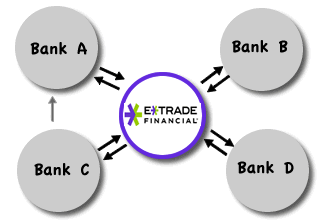

Part of my solution is to utilize the E-Trade Complete Savings account to connect them all together. This is basically E-Trade’s version of the online savings account which I’ve had for years. From my experience, the interest rate goes up and down (it is currently a so-so 1.20% APY), but it works very well for me as my bank “transfer hub”.

What are some important things to look for in such an account?

Basics and Cost
To start off, you’ll want a bank that offers a very low minimum balance and no monthly fees. A decent interest rate would be good, but a top interest rate isn’t critical since this isn’t where you’ll be keeping the bulk of your funds. You might want to keep a little bit of cash here in case you need to transfer some out quickly, and also to keep your bank from closing out an empty account.

Transfer System
Just about all banks allow ACH (automated clearing house) transactions, but you have one party initiate such transactions, and many “old-school” banks don’t do this. Accordingly, you’ll want your hub account to have the ability to “push” or “pull” funds in and out of multiple external bank accounts, with no transfer fee. Some banks only let you link one or two accounts, while others charge you to initiate transfers. For example, Bank of America allows you to move money to BofA for free, but charges if you move money from BofA using their system.

The E-Trade Complete Savings account has no minimum balance and no monthly fees, you can link an unlimited number of accounts, and there are no transfer fees.

Transfer Speed and Interest Crediting Policy
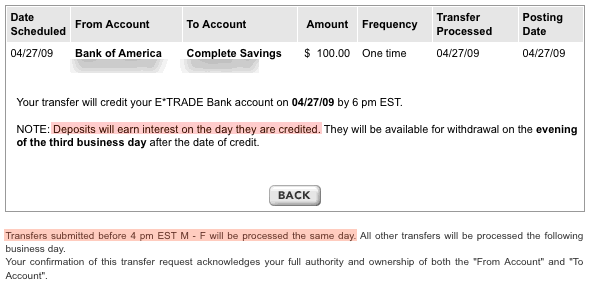
Of course, you’ll want fast transfer times. Some banks take 3 business days to move money in either direction, with your money in limbo and not earning interest anywhere. However, E-Trade is much faster, with transfer times of only 1 business day (which is how long it should take…). Also, if you schedule a funds transfer from an external account to E-Trade before the end of the business day at 4pm EST, they will actually credit your account the same day, even before they withdraw the money (although to prevent fraud you can only withdraw after 3 business days). However, you will start to earn interest starting that day, even before the money actually get debited from your source account!

Here is a sample screenshot:

In fact, if you initiate a transfer on Friday, you can earn interest at both accounts over the weekend. Here is a sample timeline:

  • Friday: You schedule a transfer of $1,000 from Bank A to E-Trade. You start earning interest at E-Trade on Friday. Nothing has happened at Bank A.
  • Monday: $1,000 is withdrawn from Bank A.
  • Thursday: $1,000 is now available to withdraw from E-Trade. You schedule a transfer to Bank B. $1,000 is debited from your account at E-Trade.
  • Friday: $1,000 arrives at Bank B.

Yes, it will take you a week to move the money, but you’ll be earning interest the entire time due to the double-interest over the weekend. Compare this to other accounts where the money is in limbo for 3-5 total days (3 business day + weekends/holidays) and you’re earning zero interest during that time.

For these reasons, I think the E-Trade Complete Savings account is very useful for the ability to connect any two bank accounts and move money relatively quickly with minimal interest loss. If you already trade stocks with them, it’s basically a no-brainer given the horrible yields on money market funds right now.

I have also heard good things about the transfer speed at GMAC Bank, but I don’t know if it’s quite this good as I don’t have any personal experience with them. I’m also concerned about how GMAC Bank will be around… if they get bought or sold to another bank, the website may disappear as well. I’m already going to miss my WaMu interface when I get forced over to Chase next month.

Opened Rewards Checking and Mega Money Market Savings Accounts at Evantage Bank

I haven’t been much of a interest rate-chaser recently, and it feels like it’s been a while since I’ve opened up a new bank account. For one, I already have a lot of my cash tied up in CDs and I-Bonds. Also, most of my recent cashflow has been going into 401k and IRA contributions.

Now that I have a bit more free time, I decided to open up a new “Rewards Checking” account at Evantage Bank. It offers 5.25% APY on the first $10,000 in balances, and 2.25% APY for anything over that if you meet their requirements of electronic statements and 10 debit card purchases per month. I liked it because it was available nationwide, there were no minimum balance requirements, and didn’t have a direct deposit requirement.

In addition, they have a “Mega Money Market” savings account that is currently paying 3.10% APY on balances to $35,000. (No debit requirements.) So you could keep a total of $45,000 parked at Evantage at a combined interest rate of 3.58%. Not too shabby in this current environment. Alternatively, you could open a second Rewards Checking account and get another $10k at 5.25% (but also with another 10-purchase commitment).

So far, the account application was run by CashEdge, with the usual informational requests and ID verification using questions based on your credit report. The process was completely online, with both online signature cards and an ACH transfer option for initial deposit. I’ll provide a better update once I get started.

I’ve written about rewards checking accounts in the past. They are a gamble and you can earn very little interest if you don’t pay attention to the requirements. In addition, the rates can drop quickly. Look at your own habits, and hopefully these rates will stay competitive for a while.

Evantage is one of identical triplet banks, along with Redneck Bank and AmericaNetBank, which are all owned by the Huckabay family of Oklahoma. The three banks reportedly have different gimmicks to attract publicity – supposedly the redneck, patriot, and high-tech crowd? Apparently it worked, because Redneck Bank isn’t even taking new applications as of yesterday.

Places To Open A Foreign Bank Account To Store Gold

After my post about the Permanent Portfolio which included physical gold, a reader asked me where he could open up a foreign bank account to store gold. Well, in the Appendix of the book Fail-Safe Investing, the author did list specific banks that allow U.S. investors to open account and buy gold within them. Here they are:

Anglo-Irish Bank [Austria]
Phone: 011-431 406-6161
URL: http://www.angloirishbank.ie/

Anker Bank / BDGE Group [Switzerland]
Phone: 011-4121 321-0707
URL: http://www.bcge.ch

Canadian Imperial Bank of Commerce [Switzerland]
Phone: 011-4121 215-6087
URL: http://www.cibc.com/

UeberseeBank / AIG Private Bank
Phone: 011-411 267-5555
URL: http://www.ueberseebank.ch/

Browne makes it sound that opening an account at one of these places is as simple as opening an online account with no physical branch near you. He also states that these are either Swiss or Austrian banks, which are bound by the laws of those countries, not the countries of their parent companies. Now, I can’t attest to the accuracy of this list, as the book was last updated around 2001 and I have no personal experience with any of them. Please perform your own due diligence.

The reasons for buying gold in a foreign bank account are primarily to provide a safe store of assets in case of very unlikely (but still possible) situations like war, government collapse/confiscating of assets, or other crisis. I’m not going to participate myself as I see the risks outweigh the benefits – cost, complexity, chance of fraud or loss, etc. – but if you read some of the stories from Argentina’s economic collapse it can get scary.

As for legality, it would seem to be perfect legit. You are simply storing physical gold there. Gold does not produce dividends or interest, so you’d only be liable for taxes if you sold them at a profit.

SEC Says Millennium Bank Was Indeed a Ponzi Scheme

Well, it was about time. The SEC released a press release yesterday stating that they have frozen the assets of the offshore Millennium Bank and its parent, United Trust of Switzerland S.A.

If you don’t recall, Millennium Bank offered certificates of deposit paying insanely high rate north of 8% APY for the last several years. I stopped short of calling it a scam, but pointed out that common sense would state that such increased return could not exist without significant added risk. From the press release:

Washington, D.C., March 26, 2009 — The Securities and Exchange Commission has obtained an emergency court order halting a $68 million Ponzi scheme involving the sale of fictitious high-yield certificates of deposit (CDs) by Caribbean-based Millennium Bank.

The SEC alleges that the scheme targeted U.S. investors and misled them into believing they were putting their money in supposedly safe and secure CDs that purportedly offered returns that were up to 321 percent higher than legitimate bank-issued CDs.

The bank was supposedly based in the Caribbean nation of St. Vincent and the Grenadines (SVG), which had access to high-yielding, safe investments. In reality, the SEC managed to trace the money sent by gullible investors from the offshore back to a US bank account in Napa Valley, CA, where the defendants “misappropriated a vast majority of the investor funds to enrich themselves and pay personal expenses, while making relatively small Ponzi payments to investors.”

According to the SEC’s complaint, the $68 million was raised from more than 375 investors since July 2004. I wonder how much is left. Another case of greed blinding people…

Please don’t confuse this bank with the legitimate and FDIC-insured Millennium Bank of Illinois.

Don’t Be Stupid When Chasing Higher Yields

One of my biggest financial pet peeves is when people refuse to realize the connection between return and risk. Whenever you see an investment that offers a “guaranteed safe” or “insured” return that is significantly above what an FDIC-insured bank can offer, it’s safe to assume that your risk has gone up.

The latest example is the Stanford Investment Group, which the SEC accuses of massive investment fraud:

SIB has sold approximately $8 billion of so-called “certificates of deposit” to investors by promising improbable and unsubstantiated high interest rates. These rates were supposedly earned through SIB’s unique investment strategy, which purportedly allowed the bank to achieve double-digit returns on its investments for the past 15 years.

Do the math, people! Double-digit returns + a bank based offshore in Antigua + no FDIC-insurance = Either fraud or risk to principal. And remember, in schemes like these the interest is always very reliable, coming every single month like clockwork…. until one day it doesn’t. Been that way since the real Ponzi.

And there are plenty more to replace SIG, just Google “high yield CD”. Back in 2005, there was American Business Financial Services, which imploded. Now there is Millennium Bank (based in St. Vincent), Zannett Notes, and CPS Notes. All offer well over 8% interest.

Now, I am not accusing any of these companies of fraud. There is a difference between fraud and plain old credit risk. In both bases, you might manage to cash out before things fall apart, but there’s also a real chance you might never see your money again.

But especially in times of low interest rates, people start to look for just a bit more yield. Even SmartMoney magazine has gotten caught up in the act. Check out their cover this month.

A sure 7%? What, from buying shares of stocks with temporarily jacked-up yields like Altria or Vodafone? How about a highly speculative 7%? Bank of America had a really nice dividend yield as well once upon a time… before it got cut to a penny. Dow Chemical just cut its dividend for the first time in 100 years. Add in the fact that your share price could drop as well, and I’d keep your emergency fund far away from these stocks.