Rejected For A Bank Account? Get Your Free Annual ChexSystems Report

Last week, I heard a co-worker complain about being denied when trying to open a new checking account. I told her to check her ChexSystems report. ChexSystems is a consumer information database that contains information about your banking history, similar to credit bureaus and your credit history. Turns out she forgot about an account and actually owed some other bank some money (probably just piling on inactivity fees…).

For the same reason, you have the right to a free ChexSystems report once a year, just like the annual credit reports. In addition, you can request one whenever you get declined for a bank account where ChexSystems was used.

I decided to get my own as well, and surprisingly it came via snail mail within a week or so. I say surprisingly because last time I tried to order a couple of years ago, I don’t think I ever got it. (I have never had trouble opening a bank account, so I figured nothing bad was on it.)

They have a sample ChexSystems report online, which looks exactly like what I have, and explains all the items they have recorded:

Reported Information
“Reported Information refers to reports of accounts that have been mishandled, reported for cause, and/or outstanding debts. Reported Information is submitted directly to ChexSystems by members of our service, which consists mainly of financial institutions. Our current practice is to retain this information for a period of five years.”

This includes account closed due to repeated bounced checks, or overdraft debts that were never paid. If you have one of these in error, you’ll definitely want to clear it up.

Inquiries Initiated By Consumer Action
“Inquiries Initiated By Consumer Action refers to inquiries resulting from a transaction initiated by you. These include applying for a credit card or completing an application at a financial institution. Please note that the inquiries are part of your credit history and may be included in our reports to others. These inquiries can be viewed for ninety days up to three years. ”

Basically, a list of all banks that applied for within the last 3 years that used ChexSystems to verify me. They included KeyBank, E-Trade, FNBO Direct, WaMu, DollarSavingsDirect, and WT Direct. Banks that I know that I applied for recently that weren’t on the list include EverBank, which makes sense since they used the Equifax ID check service during my application process.

Inquiries Not Initiated By Consumer Action
“Inquiries Not Initiated By Consumer Action refers to inquiries resulting from transactions you may not have initiated, so you may not recognize the source. Members of our service with a permissible purpose include current creditors, pre-approval creditors, and potential investors trying to assess risks. We report these requests only to you as a record of activities, and we do not include any of these requests on credit reports to others.”

The only bank listed here was Washington Mutual. For some reason, they made three inquiries in one day back in 2006. Weird.

Retail Information
“Retail Information refers to returned checks written on an account and certain collection accounts. Retailers and other businesses report this information to Shared Check Authorization Network (SCAN). ChexSystems receives this information directly from SCAN and is not involved in the collection of these items.”

Nothing here, I believe it counts bounced checks reported by merchants.

History Of Checks Ordered
“History of Checks Ordered refers to a record of check orders placed within the past three years.”

Nothing here, either. Probably because I would never order from Deluxe Corp. (which owns ChexSystems) since they are horribly overpriced. I barely make it past the starter checks usually, but if I do need checks I buy them from Costco.

Social Security Number Validation
“Social Security Number Validation indicates the year and state that a particular sequence of digits first became available for issuance. This information does not include the name of the individual to whom the number was issued.”

It says my SSN became available for issuance in 1987. This is interesting, considering I was born nine years before then…

Drivers License Validation, Drivers License Verification
“Drivers License Number Validation indicates whether or not the format of the drivers license number provided matches the requirements set by the state of issuance. Drivers License Number Verification is information provided to ChexSystems by the state that issued the drivers license number. This information, which is limited to certain states, identifies the name and date of birth of the individual to whom the drivers license was issued.”

Added: A smaller competitor to ChexSystems is TeleCheck. To get your free annual report from them, you must call 1-800-366-2425. I called them on 1/11, and they stated that they had no negative information me, so there was nothing to send me.

Fed Funds Rate Drop Update: Locking In Higher Bank Yields Now

Given the recent drop in the Fed Funds rate to nearly zero, bank have been adjusting their interest rates accordingly. Now that the dust has settled a bit, I suppose it is time to see what rates we can get now for our FDIC-insured cash. It may be a good idea to lock in some CDs based on your time horizon, and/or if you are willing to give up the liquidity.

Liquid Savings Accounts

  • DollarSavingsDirect remains the top overall rate, holding steady at 4.0% APY for now, although it could change at any time. See my quickie review here.
  • The Everbank Yield Pledge Money Market Account is offering 4.00% for 3 months guaranteed as long as you open by 12/31/08. (Balances up to $50,000.) See my review of the application process here. 4% for 3 months is actually better than any other banks’ top 3-month CD rate, while still allowing withdrawals.
  • If you signed up for the WT Direct $250 bonus, just a reminder that today (12/22) now December 31st is the last day to initiate your transfer. So you still have time, and it works out to be a good deal for a couple months of commitment.

Shorter Term (1-2 Year) Certificates of Deposit

  • FNBO Direct is offering a 9-month CD at 3.75% APY, a 1-Year CD at 4.0% APY, and a 2-Year CD at 4.26% APY. These are all very competitive for their respective lengths. The FNBO Direct liquid savings account (my review) also holds steady at 0.85% APY.

Longer Term (3+ Year) Certificates of Deposit

  • Pentagon Federal Credit Union is offering 3-year, 4-year, and 5-year CDs at 4.75% APY. If you aren’t a member, you can join the NMFA for a one-time fee of $20.
  • WaMu actually has a 5-year CD at 5% APY. Not bad if your mortgage is under 5%. Their liquid savings account continues to drop steadily (as we were afraid of) and is now only paying 1.50% APY.

WT Direct $250 Winter Bonus Update + Application Review

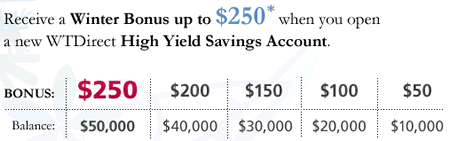
This is a follow-up about the WT Direct Winter Bonus promo good for up to $250 on top of their standard interest rate of 3.06% APY, if you open a new account and maintain a certain average balance for January and February. There is still time to participate, the deadline is to fund via ACH transfer initiated by 12/22 now 12/31/08.

I’ve decided to participate, since I get to remain liquid and interest rates look to only be dropping lower. 3-month Treasury Bills were yielding a negative interest rate for a while! See my previous post about this offer for details about the fine print. Below is some more info gathered after applying myself.

Application Process and Setup

The application process was pretty standard, with this bar above the application providing a good overview. First, they gather the personal info. Second, they use the now-popular Equifax ID check questions to verify your identity. Third, you can fund electronically with account and routing numbers, although you must come back and verify trial deposits later (you don’t have to fund all at once for the bonus). Finally, you can electronically sign the application and disclosures. There were no physical forms to send in, although a welcome packet does arrive by mail. They state explicitly that there is no credit check:

This information will be used only to verify your identity and will not be used for any other purpose. We do not perform a credit check and your answers to these questions will not affect your credit rating.

If you count Day 0 as the application day, the trial deposits should arrive either Day 1 or 2. If you verify them immediately, then your deposit should be sucked out on Day 3. Ignoring weekends, your funds should show up on Day 5, at least based on my experience.

If you are linking with other savings account, WT Direct may show up as Wilmington Trust Bank, which is what the WT stands for. Your account number is given to you at the end of the application, and the routing number is 052173464. WT Direct’s online transfer system allows unlimited linked banks, and transfers to external accounts are free both in and out with a 2-3 day transfer time.

Last time, WT Direct offered people who signed up under their promotion an 0.50% extra APY for 4 months after it ended. Hopefully they’ll do that again.

EverBank Yield Pledge Money Market / FreeNet Checking Review, Part 1: Application Process

My wife recently applied for an EverBank Yield Pledge Money Market account for their introductory rate. Everbank also “pledges” to stay amongst the top 5% of competitive banks, and I have seen that rate has indeed stayed competitive to other online banks for the last couple of years. (WaMu is now down to 2.25% APY, ahem…)

Currently, the promo rate is 1.10% for 6 months, and the standard rate after that is 0.86% APY. (1.10% guaranteed for 6 months is still better than any 6-month CD out there.) The application process is a lot different now than when I applied for myself a year or so ago, so I’ll start with reviewing that.

Background and Promotion Rules
Everbank always offers a 6-month introductory promo rate to both their FreeNet Checking and Yield Pledge Money Market accounts. The rule for these promotions is that you can only get one 6-month bonus period per person (Social Security number), and that you can get them at the same time, but not one after the other. As you might have guessed, one way around this is for couples to open separate accounts at least 6 months apart.

So if you opened both the FreeNet Checking and Yield Pledge Savings account on November 1st, you can get the promo rate for both ($100,000 total balance) for 3 months. If you open up the Yield Pledge a month later, you’ll only get the promo rate on that account for 2 months.

Step 1: Personal Information
The standard info is requested on the first part of the application – address, SSN, and also employer info.

Step 2: Identity Verification – No Hard Pull
In the past, Everbank has done a hard credit check when taking applications. However, it appears that they no longer do this. For one, my wife did it and she has a credit monitoring service which alerts her of such activity – no alerts from Everbank.

The website itself is a bit confusing on the subject, stating the following:

What kind of inquiry does EverBank obtain and how will it affect my credit score?
EverBank obtains a credit inquiry for the purposes of opening an account. While such an inquiry will show on your credit report, it’s coded differently than an inquiry for a loan and would have less of an impact on your credit score.

I personally interpreted this as a soft pull, but I also called to confirm. The customer service rep stated that they no longer do a “full credit check” but only confirm ID.

This is finally supported by the fact that they now ask the real-time Equifax ID Check questions during your application, which are based on data from your credit report. Things like names of streets you’ve lived at, where you hold mortgages, and previous employers. Noneof the banks that I’ve had do this have done a hard pull.

Step 3: Funding
Finally, we arrive at the funding ($1,500 minimum). In the past, you had to wait for a welcome package and send in a physical check along with a physical signature and other paperwork. Now, as long as your initial deposit is under $25,000 you can fund online using routing and account numbers. From the website:

ACH funding is available for personal Checking, Money Market, and Asset Manager Service cash management accounts. You can fund just the minimum opening deposit or any amount up to a total of $25,000 per day. For funding more than $25,000, you’ll want to open now with $25,000 and send a check or wire for the additional amount.

For the ACH funding source account, you can use any account that supports check writing. You can verify ownership of your source account in 3 days through a small deposit and withdrawal.

You can also choose to activate the Checkwriting option here (3 per month).

After you enter these details you can go ahead an log into the Everbank website and poke around, although it takes a few days for the initial deposit to arrive. All in all, the application process is much improved by being completely online with no paperwork, with apparently no hard pull.

First Look: DollarSavingsDirect vs. EmigrantDirect

I went ahead and opened an account at DollarSavingsDirect and their attractive 4.0% APY. WaMu had dropped their savings rate to 2.5% APY, and DollarSavingsDirect still seems to be in their “new bank customer accumulation” stage, which means keep the rates high as long as possible. Might as well take advantage of loss leaders…

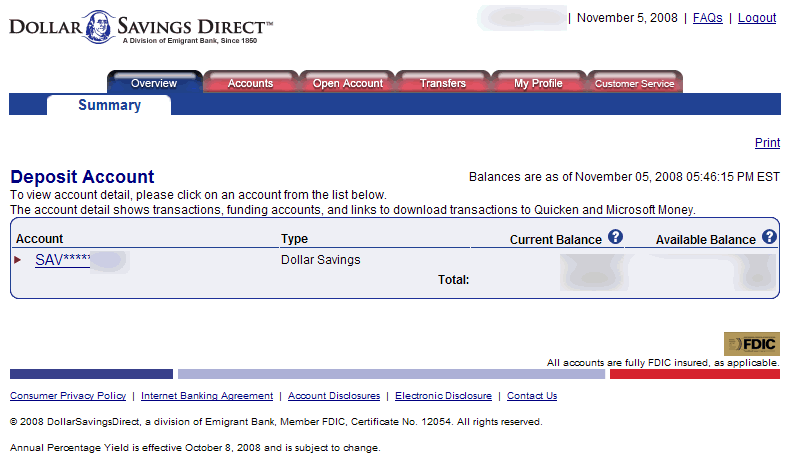
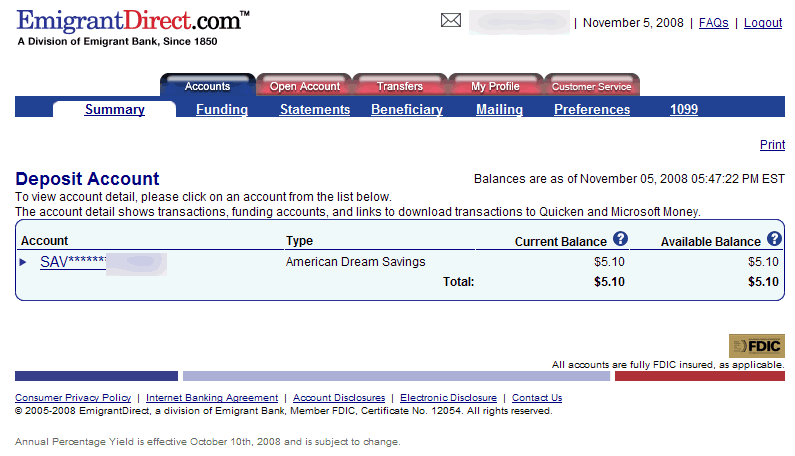
People have called EmigrantDirect and DollarSavingsDirect clones of each other. I mean, your money is at the same bank – Emigrant Bank, FDIC Certificate #12054 and the home pages look very similar. But man, they truly did a cut-n-paste job. Check out the identical internal interfaces, down to the color scheme:

The application was straightforward and efficient – completely online, no paperwork to sign or print out, and your deposit is done using only routing and account numbers. Took less than a week to get up and running. I would pick your funding account carefully, because adding additional bank relationships does require paperwork.

As noted, the major difference is that with DollarSavings you need to maintain a $1,000 minimum balance to get the 4.0% APY, unlike Emgirant with no minimum. Good news is that there are no fees at DSD if you drop below $1,000 though, just a lower 1.0% APY.

Updates: Top Savings Account and CD Interest Rates

Given the recent drop in Fed interest rates, here is a quick update on the rates being paid on online savings accounts:

HSBC Advance lowered its rate to 3.00% APY.

Capital One 360 also recently lowered its rate to 0.75% APY. ($25 bonus) However, they do have a new 12-month CD at 0.40% APY.

FNBO Direct holds steady at 3.50% APY dropped today to 0.85% APY. (FNBO Direct review)

Emigrant Direct is still at 3.00% APY, but if you have more than $1,000 there, you should move your money to DollarSavingsDirect at 4.00% APY instead. They are both under the same parent Emigrant Bank, and so your deposits are insured together for FDIC purposes. The only real difference is that DollarSavings requires a $1,000 balance to earn the 4%.

I was really annoyed at this until I figured out that there is actually no minimum balance requirement at DollarSavingsDirect, your interest rate just drops to 1.0% APY if you go below. No fees or penalties. Thus, I can still open an account and move my money there while the rate is good, and still be able to move it out if the rate drops. Okay, so I’m still kind of annoyed. They are saying “we think you’re too lazy to move your money, but new customers get 4% APY”.

EverBank’s Yield Pledge savings account has an intro rate of 4.65% APY for the first 3 months, and then 3.51% APY afterwards. Not bad, considering even the non-special rate is very competitive, as it “pledges” to stay amongst the top 5% of competitive banks. There is a minimum balance requirement of $1,500 to avoid fees.

Corus Bank has what looks like the top 12-month CD rate at at 4.60% APY if you open with $10,000+.

Your Own Financial Rescue Plan, Part 1: Adequate Cash Reserves

Well, the big boys are getting their rescue/bailout plan, but I guess ours got lost in the mail… So what should we do? I think that everyone should take a second look at their cash reserves. Do you have enough?

What Job Security?
These days, I don’t see any job as safe. My company went from interviewing people to hiring… nobody. Even local and state governments are facing major budget deficits. At a minimum, I would want a few months of living expenses to tide me over until I find another job. I still remember the dot-com bust days when former tech workers ended up living in their cars.

A Reason Not To Invest In Stocks
Hey, if you’re looking for an excuse not to buy any more stocks for a while, beefing up your emergency fund is not a bad one. Any money you may need within 5 years should be in cash or short-term investments anyway.

A Reason *To* Invest In Stocks
Ironically, after you build up a nice cushion, it may actually make you feel better about investing in the stock market. I definitely helps me to keep short-term money separate from long-term money. As such, I’m still applying my upcoming income towards maxing out my 401(k) for 2008. But after that, I will probably start to save another three months of living expenses, for a total of 9 months in cash.

Less Credit Available
A lot of people used to simply assume that their home equity line of credit (HELoC) could serve as their emergency fund. But these days, it just takes one letter in the mail that says your HELOC is frozen or greatly reduced. You don’t want to be forced into taking an early withdrawal from your 401(k) or IRA, or paying exorbitant credit card interest.

If anything, apply for a credit card with a low fixed interest rate now while it is still offered. Here is a list of no fee 0% APR balance transfer credit cards. Just buy goods as you regularly would, and pay the minimum while saving the difference in an interest-bearing account. (Don’t go buying more stuff, obviously!)

Looking Ahead
For me, an alternative reason for increasing my cash reserves is that I can also use it later for investing in real estate. I still don’t see many opportunities with good cashflow right now, and may not see them for another couple of years. But I want to be ready, as the no-money-down days may never come back.

Where do you keep it?
As long as it is safe and liquid, I just go by rate. Use the new FDIC insurance estimator if you have lots of money. Both Vanguard and Fidelity are participating the money market fund insurance program, so they are super-duper safe now. . Well, your old money is safe. Still, I consider money market funds with Fidelity and Vanguard as safe as FDIC-insured, although this is only my opinion. However, my cash is currently split between:

  1. Series I US Savings Bonds – Bought in April with 1.2% fixed rate, now only 0% fixed rate available. Note that they are illiquid for the first 12 months. Rates adjust semi-annually. I earn 4.38% for 1st six months, 6.06% for 2nd six months. With recent inflation, my 3rd six months should also be pretty good. Exempt from state income tax as well.
  2. 12-Month 5% APY CD at WaMu/Chase – Sadly, no longer available.
  3. Low or no-minimum banks with high liquidity – A big chunk currently in transit to Everbank at 1.10% for first 6 months.

WaMu/Chase Lowers Interest Rates, Time To Move Banks?

Some eagle-eyed readers let me know late last night that WaMu/Chase quietly made a change to their offered interest rates. Their online savings account is now at 3% APY when attached to their free checking, down from 4%. Not too bad, but no longer the highest yield for a no-minimum-balance savings account.

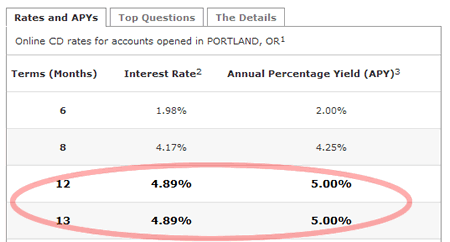
They also lowered the rates on their online CDs, with the 8-month, 12-month, and 13-month CDs all at 3% APY. It looks like those that opened up one of their 5% APY CDs late last week just got in under the gun. My 12-month CD was successfully funded yesterday, and today I see my 5% APY rate shown online. All signs seem to suggest that Chase will honor these CD contracts. Hurray for small victories 🙂 , I hope everyone who wanted in on these got their application in on time.

Options?
Given these actions, it might be time to move banks soon… now to investigate other attractive all-in-one Checking/Savings combos. Here are some possibilities:

Everbank has their FreeNet checking account with a 1.10% bonus rate for the first 6 months, and then 0.70%-0.86% APY afterwards depending on balance. No minimum balance, but you need $1,500 for free billpay. $6 in free ATM fee rebates each month.

Combine this with Everbank’s Yield Pledge money market account, which also has a 1.10% bonus rate for the first 6 months, and then 0.86% APY afterwards. This account “pledges” to stay amongst the top 5% of competitive banks, and there is a minimum balance requirement of $1,500 to avoid fees.

Fidelity has their mySmart Cash account. It is kind of a checking account/brokerage account hybrid where you can basically use their money market funds (non-FDIC-insured) as the main holding place on your cash for higher yields. You can choose from taxable to tax-exempt money market funds with competitive yields. Their main checking account is FDIC-insured, and is currently earning 1.50% APY. No minimum balance, and you get unlimited ATM fee reimbursements.

Bought Some More 5% APY Bank CDs From WaMu/Chase

I went ahead today and bought some more of the 12-month CD at 5% APY from Washington Mutual/Chase. Here’s why:

Reason #1: Chase agreed to honor WaMu CD rates
From the official FDIC WaMu takeover page:

6. Will I continue to earn interest at the same rate?
JPMorgan Chase accepted Washington Mutual’s interest bearing accounts including CD’s at the contract rate; therefore, they are not waiving early withdrawal penalties.

Even though there was speculation that Chase would only pay interest up to the failure date as was the minimum requirement, Chase went as far as to not even allow early withdrawals without penalty. They have committed to honoring these rates, which also worked out great for those that jumped on it last month.

Reason #2: They are still offering the 5% APY 12-month CD
A week later, the same high rate is still on their website:

This can’t have been an accident. 13-month CD is available too.

Reason #3: It’s FDIC-insured, now with a more stable bank
For those that worried about WaMu service interruption or lost liquidity (which never happened) , now it should be even more stable with Chase Bank.

Reason #4: It’s still a top rate, and it might change at any time.
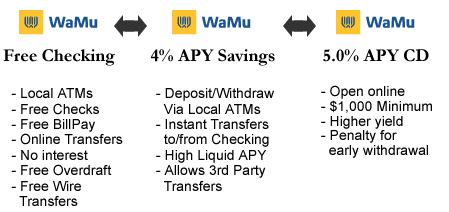
Maybe there is some sort of behind-the-scenes rate freeze agreement that we don’t know about. Their popular Online Savings + Free Checking combo is still paying 4.00% APY on savings and the checking perks haven’t changed (WaMu review). Savings accounts at any bank are always subject to change, so there is nothing I can do about that. But I can sure lock in this rate now and keep my system going as long as possible:

Reason #5: Fed may drop interest rates soon
Bailout plan or not, this economy ain’t doing so well. Although I don’t make big bets on such forecasts, there is a good possibility that Fed will lower interest rates by the end of the year (see USA Today, WSJ).

If your funding source is not WaMu, they let you fund electronically with another bank’s routing and account number. You have to remember to verify the test deposits, though.

WaMu Fails, Bought By JP Morgan Chase: What Happens To My Money?

Washington Mutual was taken over by the FDIC today (Thursday). But for most account holders, there is no reason to panic.

All deposits, even those over $100,000 FDIC limits, will be taken over by JPM Chase, and are still safe. From the WSJ:

While the exact structure of the transaction wasn’t immediately known, J.P. Morgan is expected to acquire Washington Mutual’s deposits and branches, as well as other operations. The deal isn’t expected to result in any hit to the Federal Deposit Insurance Corp.’s bank-insurance fund, according to a person familiar with the arrangement. […]

Under the deal, New York-based J.P. Morgan, which has long coveted WaMu as a way to secure a footprint on the West Coast, will assume most of the thrift’s deposits and branches, as well as some other operations.

There will be no interruption in services. Bill payments will go through, checks will clear, direct deposits will arrive, your account number stays the same, the website still works, branches will still open on Friday. From CNN:

“For bank customers, it will be a seamless transition,” said FDIC Chairman Sheila Bair. “There will be no interruption in services and bank customers should expect business as usual come Friday morning,”

Shareholders get nothing. Well, not like they had much hope anyways with the stock at less than $2 per share. I hope this is another wake up call for those that still think it’s a good idea to keep a large portion of their portfolio in their company’s stock. I don’t care if you work for GM, IBM, or Microsoft. Shares of any single company always have some risk of becoming worthless.

More details to come…
They haven’t released the official press release yet. It will be interesting to see how the interest rates will change, and if they will choose to honor outstanding CDs. Chase Bank doesn’t have the same products as WaMu did, but IndyMac still honored their existing CDs. Maybe it’s time to apply for one now? WaMu is still advertising everything like their 4% APY savings as before on their website.

Anyways, don’t panic, okay? My local branch is crowded enough as it is. I don’t need a line around the block of nervous people clamoring for their money in small bills. 😉

Update: Here is a preliminary welcome page from Chase. Nothing too much new there, no mention of interest rates changing. Still offering the same 4% APY savings and 5% CDs on the website.

Update 2: Here is the official page from FDIC.

Will I continue to earn interest at the same rate?
All interest on deposits accrued through September 25, 2008, will be paid at your same rate. JPMorgan Chase Bank will be reviewing rates and will provide further information soon.

Update 3: They updated and changed the FDIC page!. It now states:

Will I continue to earn interest at the same rate?
JPMorgan Chase accepted Washington Mutual’s interest bearing accounts including CD’s at the contract rate; therefore, they are not waiving early withdrawal penalties.

Accordingly, the 5% APY CDs should stay valid.

WaMu Raises Savings Rate to 4.00% APY

Washington Mutual has raised the rate on their Online Savings + Free Checking combo to 4.0% APY. This is now the highest of the no-minimum no-fee savings accounts. Curiously, HSBC Direct actually dropped their rate to 3.25% APY earlier this week.

You can learn more about this account at my WaMu review post. They also again have 12-month CDs yielding 5% APY.

I’ve already laid out why I am sticking with Washington Mutual. In short, why would I mess with this nice setup as long as my money is still insured?

[Some pages still say 3.75%, but my account details confirm the 4.0% APY. Existing account holders can log in and click on “About this account”. Or just click here and hit Apply Today, and you should see the new rate.]

Travel and Money: Best Way To Get Cash, Best Credit Cards, and Safety Concerns

I wouldn’t say my wife and I are well-traveled, but we do try and experience other cultures whenever we can. Given work constraints and Corporate America’s hatred of vacations (2 weeks a year??), we are lucky if we can manage one trip per year. However, I think we’ve worked out a pretty good system of managing money needs while abroad.

Travelers Checks?
I never buy travelers checks. You often have to pay a fee when you buy them, and then you might have to pay a fee for exchanging them to local currency. Or you’re searching all day for the American Express office. Less and less stores accept them for purchases, due to fraud and theft. If your signatures don’t exactly match, they give you grief. If you get them wet, they are useless and you have to replace them.

Most importantly: Any place that does take them will most likely accept credit cards, which are a better alternative (see below).

Best Credit Card For International Travel
Whenever possible, I use a credit card for making purchases while abroad. Hotels, transportation, sightseeing tickets, and so on. However, most credit cards are pretty expensive when it comes to foreign currency purchases. Visa and Mastercard charge a standard 1% “conversion” fee on top of the wholesale “interbank” exchange rate. Many major credit card issuers like Citi, Chase, and American Express charge you another 2%-3% on top of that. You’re losing up to 4% off the bat.

So what do I use? My favorite card, hands down, is my credit card from Capital One . I have used this card from China to France with no issues at all. Capital One charges you only the interbank currency exchange rate. They pay the Visa/Mastercard 1% fee for you, and they don’t have any self-imposed surcharge. Finally, this specific card gives you 1% cash back on all purchases (2% for groceries/gas) and has no annual fee.

Net result: Not only do I get the best exchange rate possible, but I actually gain 1% cash back on my foreign purchases. It’s better than cash!

(I only use this card internationally. While in the US, I prefer these cash back credit cards.)

ATM Cards / Getting Cash
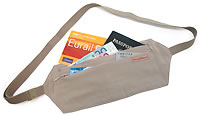
I used to worry about bringing some local currency with me, but it is usually expensive to get this done in the US. (Always compare their rates with the interbank rates at Oanda.com.) Nowadays, if you are arriving in a large international airport, there is hardly any chance they won’t have ATMs available. I do bring $100 in US $20 bills in my money belt as an added backup.

When it comes to getting cash in local currency from ATMs, there are also fees to be aware of. The local ATM may charge a fee, although bigger banks are less likely to. Your bank may also charge a fee for using a non-network foreign ATM. Finally, they may charge a surcharge for the currency exchange itself.

Because I use a credit card for most large purchases, I usually only need cash for restaurants and other small things. Therefore, I usually take out all the cash I expect to spend during my stay all at once, as it is no more than a few hundred dollars. Since I only have to pay these fees once, I don’t worry about them as much.

For example, on a $300 withdrawal using my normal WaMu Free Checking account, I will be charged a 3% exchange fee + no ATM fees. I am okay with paying a one-time fee of $9 for this convenience. My backup card is with Bank of America, where it would have cost $8 total (1% + $5), though they do have some partner banks with no fees. I like sticking with big banks here.

A good comparison of all these card fees is located here.

Money Belt and Wallet
After experiencing firsthand how slick a professional pickpocket can be in an Italian train, I don’t go anywhere without my trusty money belt keeping everything hidden safely underneath my clothes. I usually put in my week’s worth of cash, my backup credit card, two ATM cards, emergency numbers, and my passport.

My wallet only holds a day’s worth of cash (~$40) and my primary credit card. I usually also have travel pants with zippered pockets. This way, if it gets stolen I am only out a small amount of money and one credit card.

Lost Your Credit Card While Traveling?
You can easily report your lost card to the major issuers while traveling internationally by calling these US numbers collect. Write them down and keep in your money belt, along with any credit card numbers.

  • Visa: 410-581-9994
  • Mastercard: 636-722-7111
  • American Express: 336-393-1111