5% APY 12-Month CD From Washington Mutual

WaMu has rolled out a new 5% APY 12-month CD, which is a very high yield for that term length. Yes, WaMu has had some issues like other banks, but I’ve already explained why I am sticking with them as long as I’m under the FDIC insurance limits.

Convenience Factor
If you already bank at WaMu, you can fund it easily online with a minimum of $1,000. With their existing Free Checking and 3.75% APY Online Savings combo, it makes a convenient package:
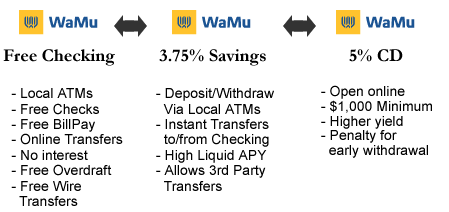
Early withdrawal penalty is 90 days interest. You can fund directly from your existing accounts. I might move some money around for this one.

Combine with 0% APR Balance Transfers
For those that are interested in making some profit using 0% balance transfers, but have been holding off due to the narrowing interest rate spreads, this might be an opportunity to jump back in. Here is a list of no fee 0% APR balance transfer credit cards.

Borrowing the money at 0% and putting it in 5% CD for 12 months gives the following rough math: Gain of 5% interest on $12,000 = $600. Minus $75 fee and taxes to get your final profit. You can do better if you get a larger credit limit. If you can handle the minimum payments of 2% of balance per month ($200 initially each $10,000) with your regular cashflow, then you could stick the entire amount in the CD. The actual terms say that the introductory period lasts “until the last day of the billing period ending during September 2009”.
FNBO Direct Video Contest: 6 MMB Readers Won $500!

After pointing out that the FNBO Direct video contest (since ended) was giving out $500 to the Top 20 semi-finalists and there were only 14 entries at the time, many more people decided to give it try. Well, it turns out that my readers are much more talented at making videos than I am – at least two of them have won $500 (and still have a chance at $5,000). Here is one of the winning entries from reader Dave and his son Max:

Updated: More $500 videos from readers Dan, Danila, Alexa, ChristianPF, and William. Congrats everyone! I’m going to *sniff* sit in the corner and wait for the $10 consolation prize that everyone else gets.

Included in my “sorry, your video was lame” e-mail was an offer for a $25 bonus if you open an FNBO Direct Online BillPay account and make one bill payment. To get the bonus, you will have an opened FNBO Direct savings account, currently paying 0.85% APY (my review).

WaMu Savings 3.75% APY: Should I Stay With A Struggling Bank?

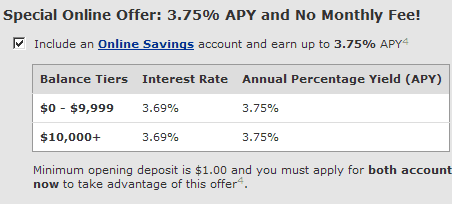
While logging on to my WaMu account I noticed (as did reader Alvin) that the WaMu savings account* is now paying 3.75% APY as of 7/31. Some pages still say 3.30%, but my account details confirm the 3.75% APY. (Login and click on “About this account”.) Or, click here and hit Apply Today, and you should see this:

Of course, if you read the news, you’ll know that Washington Mutual stock is being battered right now. Is this move a sign of desperation? If so, is this rate increase good news or bad news?

It’s All About The FDIC Limits
Well, if you have money over the FDIC insurance limits of $100,000 per titled account, I strongly suggest you stop reading right now and spread it out immediately. Your money is at risk. Here are some good options.

If you are under the limits, then your money is safe. The main things left to worry about are (1) easy access to money, (2) crediting of current interest earned, and (3) future interest rates. But hey, we already have two examples of struggling banks that give us an idea of what we might be in store for.

IndyMac Bank CD Example (FDIC takeover)
I believe that IndyMac failed on a Friday, and branches were closed that day. Over the weekend, branches were closed and the website was down. ATMs and debit cards still worked. By Monday, all the branches were open and the website was back up. Direct deposits, electronic transfers, and written checks went through uninterrupted.

All interest earned in accounts (under the limits) was still credited. Before the failure, IndyMac Bank also had some high interest rates on certificates of deposit (CDs). Upon takeover by the FDIC, an ideal scenario actually happened. For one, you had the option to withdraw your money from a CD with no early withdrawal penalty. Or, if you liked the rate, your CDs could continue to earn the same interest until maturity. This is an even better deal than if IndyMac stayed intact.

Countrywide Example (Bought by Bank of America)
Another struggling bank, this time merged with another existing bank. Currently they are still separate websites, with their own interest rates and products. Nothing really changed from the customer’s point of view. There was no downtime, or lost liquidity. You use the same checks, same debit cards, same website. CD rates and other terms remained the same. A slight bonus was that Countrywide customers could now withdraw money from Bank of America ATMs with no fees. [Merger Info]

So, Will WaMu Fail?
I have no clue. My PTI-style Toss-Up Percentage: 25% Fail, 75% No Fail. But even if it does, given it’s size, I can’t see it disappearing overnight like a small local bank might. It would have to be taken over by another (probably large) bank. In addition, there are so many moving parts that it will probably keeping run as-is for several months even if it does get taken over.

Taking all this into account, I will be sticking with Washington Mutual and happily take the increased interest rate.

* Reminder: This 3.75% rate is only available if you apply online and open a Free Checking account at the same time. If you go into a physical branch, they will deny deny deny! However, after opening you can use it at a branch just like any other savings account. More details.

Update: Best Savings Account and CD Interest Rates, 4%+ APY

It seems that one small silver lining of these ongoing bank troubles is that well, banks need more money in order to keep afloat. This means they are more willing to pay us more $$$ for the privilege of holding onto ours. 🙂 Even the big banks are starting to play along. Thanks to Brian and John for their respective updates.

Big Banks
If you have a decent balance and are willing to lock up your month for a while, below are some nice rates with terms of a year or less. Interest rates might be going back up soon to combat inflation, so locking in a CD longer than that might not be the best idea.

  • Bank of America has a 7-month CD paying 4.11% APY. $5,000 minimum.
  • Washington Mutual has a 8-month CD paying 4.25% APY. $1,000 minimum. They still offer their no-minimum liquid savings account at 3.30% APY.
  • Wachovia has a 12-month CD paying 4.25% APY, as well as a 7-month CD paying 4% APY. $5,000 minimum.

Online Banks
The online bank arena remains the place to be if you want high yields and minimal restrictions, including the ability to withdraw money at any time. All are still FDIC insured.

  • HSBC Direct is offering 3.50% APY with no fees and no minimum balance requirements, guaranteed until 9/15.
  • FNBO Direct is offering 0.85% APY with no fees and no minimum balance requirements, and has maintained a decent track record of consistently high rates.
  • Everbank also has a savings account that offers a nice 4.65% APY for the first 3 months, and then 3.51% APY afterwards. Not bad, considering even the non-special rate is very competitive. I guess that is why they call it the Yield Pledge Money Market account, since it “pledges” to stay amongst the top 5% of competitive banks. There is a minimum balance requirement of $1,500 to avoid fees.

Wanted: Loyal Reader With VirtualBank Account

I am currently out of VirtualBank referrals to give out to people. (Both referrer and referrer get $20 if you open an account.) As such, I am looking for a loyal and participating reader of My Money Blog to give out their referrals and make some easy money. If you have (1) made at least 3 comments here before today with the same working e-mail address (I will run a search), (2) have a VirtualBank account with available referrals, and (3) can make a promise to deliver referrals promptly, please contact me or leave a comment using the e-mail. I think I have enough for a while, thanks! I do not want anything in return. First come, first served. Thanks!

FDIC Insurance Q&A: Businesses, Joint Accounts, CDARS, WaMu, and More

I’ve had a lot of questions about FDIC insurance recently (for obvious reasons), and have been getting a good share via e-mail as well. Took some research to find all the answers, but here they are:

Will multiple accounts at the same bank, like having both a checking and savings account, increase my coverage limits?
Depends. It’s how the account ownership is titled that matters. If it is an individual account, then you get $100,000 per individual at that bank, no matter how many different accounts you open up. To get more coverage, you could open up an account at another bank. However, if you open up a joint account with someone else that can increase your limits.

How much FDIC coverage can a couple get at one bank?
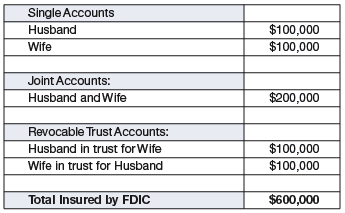
If structured properly, a couple such as a husband and wife can shield up to $400,000 at one single bank without involving legal trust vehicles. In addition to the $100,000 per individual account, if two people open a joint account then each will have up $100,000 in coverage ($200,000 total for the account) [Source]. If you throw in revocable trust accounts, a couple can theoretically shield up to $600,000 at one institution:

altext

Are business bank accounts covered by FDIC insurance?
Yes, but you have to be careful. Since legally there is no difference between a sole proprietorship and an individual, one cannot gain more coverage at a single bank by opening a “business” account when you are a sole proprietorship. The business account would still fall under the $100,000 individual cap. However, in the case of partnerships, corporations, and LLCs, because these are separate legal entities, they do get a separate $100,000 per entity.

The deposit accounts of a corporation, partnership or unincorporated association are insured up to $100,000 provided the corporation, partnership or unincorporated association is engaged in an “independent activity.” The term independent activity means that the entity is operated primarily for some purpose other than to increase deposit insurance coverage. [Source]

Where would you put $1,000,000 in cash if you had to? Spread across 10 banks (or more to cover accrued interest)?
First of all, there are very few scenarios where I’d want $1,000,000 sitting around in cash. I’d probably choose to take more risk with it. But I really don’t think I’d bother with 10+ banks. Most likely, I would place it in a retail money market fund at a reputable firm, like the Vanguard Prime Money Market Fund. That way, even if Vanguard goes bankrupt, this will not affect the underlying conservative investments. A retail money market fund has never “broken the buck”. Alternatively, I would buy traditional US Treasury Bonds or TIPS either directly or through a Treasury money market fund.

What about the Certificate of Deposit Account Registry Service (CDARS)?
Another way to increase FDIC insurance are services like that of CDARS.com. Essentially, they spread your large deposits into $100k chunks across a network of banks, but without any effort on your part. From their website:

In general, the FDIC insures up to $100,000 per customer per financial institution. So, you could run around to many institutions to deposit your funds to receive the same coverage you get using CDARS. Or you can place your large-dollar deposit with a network member. The member bank breaks your funds into smaller amounts and places them with other banks that are members of a special network. Then, those member banks issue CDs in the amounts under $100,000, so that your entire deposit is eligible for FDIC insurance. By working with one member bank, you can receive insurance from many.

According to this Bankrate article, due to the added costs of this system CDARS rates are usually about 0.15% lower than the “normal” CDs from the network banks. Also, the network banks seem to be smaller local banks, which may not offer the most aggressive rates in the first place.

Am I worried about my money at Washington Mutual?
Not really. WaMu is much better financially than IndyMac was. But again, due to the realities of fractional-reserve banking, if people panic and start pulling out tons of money from WaMu, then they can still fail due to liquidity issues. I am not going to be one of those people. If it fails, it fails. Most banks on the FDIC “problem list” do not fail. I have faith in the FDIC process, and I still have much less than $100,000 in my accounts. Finally, I never keep all my funds in any one bank. I can still run my day-to-day cashflow needs from other banks.

IndyMac Bank Failure Highlights: Another FDIC Insurance Example

Well, it finally happened. IndyMac Bank has been taken over by the FDIC, becoming the second-largest financial institution failure in U.S. history. I’ve been reading a bunch of new stories about it, and here are what I think are the highlights:
Customers: Don’t Panic!
Most people with regular checking or savings accounts don’t have too much to worry about. The FDIC has set up this official information page for customers. You can still use ATMs. Checks you write will still be processed. Electronic deposits and withdrawals will still go through. Online banking, phone banking and even the physical branches will re-open on Monday. You won’t even lose past interest:

All interest accrued through Friday, will be paid at your same rate. IndyMac Federal Bank will be reviewing rates and will provide further information soon. You will be notified of any changes.

From the LA Business Journal:

The Office of Thrift Supervision transferred control of the company to the Federal Deposit Insurance Corp. The FDIC said it will transfer insured deposits and assets of IndyMac Bank to a new federally operated institution called IndyMac Federal Bank that will open Monday. […] Regulators said that customers of IndyMac will have uninterrupted access to their accounts beginning next week at the bank’s 33 branches.

This is consistent with when I explored What happens if my bank fails? The FDIC seems to do a pretty good job of cleaning things up.

…Unless you exceeded the FDIC insurance limits

Customers are insured 100 percent for deposits up to $100,000. The FDIC said the bank has about $1 billion of “potentially uninsured deposits” held by 10,000 depositors. The FDIC said it will begin contacting uninsured customers on July 14. The agency said it plans to give customers with more than $100,000 at least 50 percent of their uninsured deposit amounts.

Wade Francis, president of Long Beach-based Unicon Financial Services, said there is “very little” chance that uninsured depositors will get all their money back because IndyMac had a large number of home loans, which will be difficult to sell off.

It boggles the mind that so many of the very same people who have enough money to exceed FDIC limits in the first place, don’t bother protecting it properly. The whole point of keeping money in banks is so that it is safe… Instead, people are getting 50% and go home and pray to see the rest again. Ouch.

Ouch For the FDIC, Too
From the LA Times:

Federal authorities estimated that the takeover of IndyMac, which had $32 billion in assets, would cost the FDIC $4 billion to $8 billion. […] The agency’s insurance fund has assets of about $52 billion.

That’s a big chunk of the FDIC’s own “emergency fund”…

Reality vs. Perception of Reality
There is a great quote from the 1992 movie Sneakers:

Cosmo: Posit: People think a bank might be financially shaky.
Martin Bishop: Consequence: People start to withdraw their money.
Cosmo: Result: Pretty soon it is financially shaky.
Martin Bishop: Conclusion: You can make banks fail.
Cosmo: Bzzt. I’ve already done that. Maybe you’ve heard about a few? Think bigger.
Martin Bishop: Stock market?
Cosmo: Yes.
Martin Bishop: Currency market?
Cosmo: Yes.
Martin Bishop: Commodities market?
Cosmo: Yes.
Martin Bishop: Small countries?

This is basically what happened to IndyMac bank. From CNN:

The banking regulator said it closed IndyMac after customers began a run on the lender following the [very public!] June 26 release of a letter by Sen. Charles Schumer, D-N.Y., urging several bank regulatory agencies that they take steps to prevent IndyMac’s collapse. In the 11 days that followed the letter’s release, depositors took out more than $1.3 billion, regulators said.

FNBO Direct Video Contest: $10 For Most, $500 For Top 20

Back in June, online bank FNBO Direct launched a video contest called the Pay Yourself First Challenge where users are asked to submit a short YouTube clip about what you are saving for. The first 500 entrants get a $10 Amazon.com gift card, regardless of quality. On top of that, the top 20 submissions get a $500 cash prize, and the top 5 get up to $25,000 in matched savings. Apparently, they overestimated the tech-savviness of their customers, because as of today only fifteen video submissions are up on their group. That means everyone so far is winning $500 by default! Deadline is July 31st.

So, if you have a webcam, why not mess around and make a quick video and get $10 from Amazon. Use some creativity and get a solid chance at $500. My friend borrowed a Mac with iMovie and we whipped up the clip below. Given that we had never used iMovie before tonight, I’m actually quite happy with how it turned out. Remember, you can’t use copyrighted material. Of course, if I really wanted to win the smart thing to do would be to not blog about it here, but I’m not that bright.

FNBO Direct is actually paying 0.85% APY with no minimum balance requirements or fees, which sadly enough is pretty good these days. I do have some money there, and here is my FNBO Direct review.

Help Me Out Again, Get $10

Do you have an Capital One 360 savings account with unused referrals? People want them! The first 25 people who comment below and leave a working contact e-mail (name not required, e-mail will not be shared) will get one filled by me for free, which is $10 for you. I’m all good for now. Just look for a message from me to your e-mail address with further instructions later this evening.

Due to comment moderation, your comment may not show up right away. One referral per person. Late night readers get lucky this time. 🙂 Thanks!

HSBC Direct Online Savings Back Up To 3.50% APY Until 8/15

I love no-fee no-minimum balance online banks because I can always keep them open in case they kick up another rate promotion. Also, no worrying about making a ton of small debit purchases at the beginning of each month!

HSBC Direct announced recently that they will be paying 3.50% APY on their online savings accounts, guaranteed until August 15th. Man, this big international bank hasn’t had a top rate in a while.

Shortly afterwards, smaller fry FNBO Direct has their their rate at 0.85% APY , though with no time guarantee.

Washington Mutual still has their competitive Free Checking + 3.30% Savings combo, which is where my base camp is (my review).

If you will always have $10,000 and don’t mind a bit of subprime shakiness (the account is still FDIC-Insured up to $100,00), there is also IndyMac Bank with their Online E-Money Market paying 3.85% APY.

Rewards Checking Accounts: Higher Interest Worth The Extra Trouble?

UPDATE: Rates have dropped, but these checking account still maintain around 2% APY edge over traditional online savings banks and 3% APY over big megabanks.

You may have seen some billboards or heard a radio ad around town for a local credit union offering a curiously high interest rate. 4% APY? Even 5%? They usually go by names like TurboChecking, Great Rate Checking, SuperRewards Checking, or similar. What’s up?

Background
It would seem that small local banks and credit unions are being squeezed on one side by megabanks offering “free” checking and a million ATMs, and on the other side by lean online savings accounts paying higher interest. It’s hard to compete. But then a company called BancVue came up with a different solution for all those small banks and credit unions who want to differentiate themselves.

The basic idea: Offer customers a really high yield and ATM fee rebates, but only if they jump through certain hoops. Hopefully, this carrot will attract lots of new customers. If they don’t, then they just get a plain “free” checking account with piddly interest. In the meantime, you try to make more money with credit card transaction fees and cross-selling other products. BancVue actually guarantees that “Reward Checking relationships will be twice as profitable as your Free Checking relationships”.

The “Catches” and Requirements
So what are the hoops? Usually you have to satisfy all of these restrictions to earn the advertised rate and get ATM fee rebates:

  • Make 8 to 15 “signed” debit card transactions each month (use it like a credit card).
  • Make one qualifying direct deposit, auto-debit, or online bill payment each month.
  • Receive electronic statements only (no paper).
  • Log into your account at least once a month.
  • The rate only applies to the first $25,000 (varies). Balances over that earn significantly less.

As you can see, most of these activities strongly encourage you to shift all your banking activities to this new bank. You have to put money in, spend the money, and even check your balance online every month.

The Potential Profit
The interest rate offered varies from bank to bank, but is usually between 4% and 6% APY. I would say the average no-fee, no-minimum high-yield savings account earns about 3% right now, maybe more. Since these are exactly that – no fees, no minimums, no hassles – I’ll use that as one comparison. If you somehow leave exactly $25,000 in your account at all times:

$25,000 x 6% APY = $1,500 per year

$25,000 x 3% APY = $750 per year

So the 3% interest gap results in a maximum gain is $750 of taxable interest per year, or $62.50 per month. Not bad for those with lots of cash available. But lets say your average balance is $5,000. Then your maximum gain is only $150, or $12.50 per month. The monthly number is probably more appropriate because it is anyone’s guess how long the gap can stay this large. To estimate more accurately the potential gain for your situation, you can use my Ultimate Rate Chaser Calculator.

Concerns and Strategies
Here’s the key thought. If everyone satisfied all of the requirements and earned a FDIC-insured 6% yield, the bank would be losing money like crazy. They are either depending on many people to either forget or screw up somehow. And even if you do, there is the potential that you’ll have to argue with some customer service rep about it. This is in comparison to the relatively stupid-proof no-minimum no-fees savings accounts. For every month you don’t fulfill every requirement, you’ll essentially be losing interest. You might even lose money because ATM fees will not be rebated in that case either.

So first of all, you need a reliable system to satisfy all of the requirements every month, preferably early on in each cycle. Some banks treat electronic transfers from other banks as direct deposit, so scheduling a monthly repeating transfer would work there. For the monthly login requirement, perhaps a monthly Google Calendar or IWantSandy e-mail reminder would be a good idea.

Next, you’d want to make your balance large enough to take advantage of the higher interest rate, but not too high as to you exceed the limit and bring your overall effective interest rate down.

The biggest pain is the ~10 debit card purchases per month (ATM visits don’t count). You don’t want to switch all of your purchases because you’ll be losing out on the potential 1-5% cash back from a cashback or rewards credit card. One strategy is to pay bills like your cell phone or cable bill online, but only in partial amounts like $5. Others make repeated small purchases (i.e. a few stamps) at the Post Office. Here’s my silly but practical solution – each month I take a post-it and cut out only part with a sticky backing. I draw 10 boxes, stick it on the card, and I check off a box each time I use the card for a small purchase.

Finally, these rates can drop at any time, and they often do. Which means if you are really a rate chaser, then you might be finding yourself constantly switching banks, waiting for ATM cards to arrive, and trying to satisfy multiple accounts while moving money around. Since these are small banks, most of them have no online interbank funds transfer system. Result: Lots of hassle.

So, Is It Worth It?
As always, I leave this ultimately up to each person. If you are a real rate chaser, have at least $20,000 in cash, and are very discipline and organized, then this is one way to get some extra yield from your money. If you have low balances or tend to get busy at times, then your chances of actually coming out behind a no-brainer savings account are very real.

For me, the hassle hasn’t been worth it until now, mainly because many of these rates seem to drop right after I consider applying. However, the current the gap between the interest rates offered by online savings accounts is still around 2%, my Vanguard municipal money market yields are pathetic again, and also a local credit union I was going to join anyways is now offering one of these accounts, so I decided to try it out with a bit of cash. So far, it’s okay but I really don’t like having to pray each month that I get the proper interest credited.

Local Banks May Be Best
All things considered, I would recommend first looking for a local bank that offers this program at a good rate. This goes back to the fact that banks are counting on lazy/apathetic people to counter the hardcore rate chasers. If they start losing money, they will lower the advertised rate. A credit union with restricted membership may offer a less diligent customer mix. In addition, I continue to find better customer service if you can simply walk in and talk to a real human. You can find a list of participating banks by state here.

Updates: Earn $100+ In Free Money Trying Out Financial Services

Here’s an updated list of companies willing to pay you to try out their services. None of these listed require a credit check. See links for more info.

RevolutionMoneyExchange $25 Bonus. Offer extended to May 15th, so get in by then if you haven’t already. Just sign-up with this PayPal alternative and grab your $25. You don’t even have to make a deposit or buy anything. More details here.

Ebates $10 Bonus (+$18 possible). Ebates offers rebates on online store purchases. After your first transaction, you’ll get a $10 bonus. Just sign-up with your e-mail and you’ll see the $10 in your account. One suggestion: sign-up for a free trial of Netflix through Ebates and get another $18, and they’ll send you $28 during their next cycle. (Looks like you have to become a paying member, cheapest plan is $4.99/month.) Just remember to cancel in time. More details here.

Prosper $25 Bonus. Peer-to-peer lending means you get to earn interest by lending to people you choose. Make a loan of $50, and you’ll receive a $25 bonus on top of your interest rate. More details here.

Capital One 360 $25 Bonus. One of the earliest online-only savings accounts, Capital One 360 will pay you $25 immediately if your initial deposit is at least $250. The account currently earns 3.0% APY.

ShareBuilder $50 Bonus. If you open an account with this brokerage and make any one trade, you will earn $50. In the application, say you are responding to a promotion and use the promo code “50GO28“. More info based on a previous similar offer.

I have applied and received all of the bonuses above successfully except for the Prosper one, as I had signed up before the promotion started. You can also get $100 all at once by applying for one of these credit cards, although applying will require a credit check (and some spending restraint, I suppose).