Series I Savings Bonds: Inflation Numbers Released, Time To Buy?

Well, the CPI-U that I recently questioned went up 0.9% in March alone. I guess you can’t hide everything. 😉 So, is it time to buy some Series I bonds? First, refer back to this earlier post for a primer as well as some background information. You can ignore the predictions since we have the actual data now.

Calculating the Rates For Next 12 Months
If you buy by the end of April, the fixed rate portion of I-Bonds will be 1.2%. You will be guaranteed an variable interest rate of 3.08% for the next 6 months, for a total interest rate of 4.28%.

After that, the rate will adjust every 6 months based on the previous 6 month’s worth of inflation data. The next adjustment will be in May, based on September-March 2008 data. We can effectively predict this now using the prediction method explained here:

Sept 2007 CPI-U was 208.490. March 2008 CPI-U was 213.528. 213.528/208.490 = 1.02416, or a semi-annual increase of 2.416%.

Total rate = Unknown fixed rate + 2 x Semiannual inflation rate + (Semiannual inflation rate X Fixed rate)

If we assume a fixed rate of the current 1.2%, we get
Total rate = 0.012 + (2 x .02416) + (.012 x .02416)
Total rate = 1.2% + 4.86%
Total rate = 6.06%

Possibly Good Short-Term Investment?
A known “trick” with I-Bonds is that if you buy at the end of the month, you’ll still get all the interest for the entire month as if you bought it in the beginning of the month. Let’s say we buy at the end of April, hold for the minimum of one year, and pay the 3-month interest penalty for redeeming within 5 years. You’ll be able to sell on April 1, 2009 for an actual holding period of 11 months.

We will get 4.38% for 6 months, and ~6.06% for 3 months taking in account the penalty. Over 11 months, that’s equivalent to an annual rate of ~4.04%. Now, if you live in a state with 9% state income tax, your equivalent yield gets bumped up to ~4.44% depending on if you fully itemize your state income taxes.

This is a pretty competitive yield for an 11-month term on guaranteed cash, as long as you are okay with the lack of liquidity. In addition, you can always decide to hold it longer than 11 months if inflation continues to climb and the Fed is unwilling to raise interest rates due to economic recession. This could make your Series I bonds yield significantly more than similar bank CDs. If you hold for 5 years, then you don’t have to pay the 3-month interest penalty either.

Update: Also, if you hold it for 15 months (14 with buying early), you would get 4.28% for 6 months, 6.06% for 6 months, and then 0% (penalty) for 2 months. This would average out to about ~4.43% APY over that slightly longer period.

Very little downside with a good potential upside… just how I like it! I’m definitely buying some, I just have to figure out how much cash I am willing to lock up for 11 months.

The Catch
First of all, I just tried and unfortunately the TreasuryDirect website no longer allows purchases over $5,000. The official (and now enforced) purchase limit is $5,000 of paper I-bonds and $5,000 of online I-bonds per Social Security Number, per year. For a couple, that’s $20,000 total per year.

Second, you need to be quick and buy before the end of April to lock in these rates. I have a feeling in May the fixed rate will drop significantly. So if you haven’t already, open your account at TreasuryDirect soon. Their security has increased, I couldn’t even link up a new bank account online without mailing in paperwork. For paper bonds you should be able to buy these at any bank (not sure about credit unions).

SmartyPig Review: With Less Fees, Are Piggy Banks Back?

When I first heard of SmartyPig, it sounded like a pretty cool idea. Give us back the piggy banks we had as kids, but make it virtual and public so that others can help directly with our goal. But a bunch of fees made it expensive and my enthusiasm disappeared. However, the folks at SmartyPig seem to have really listened to feedback, made some changes, and now I think it is deserving of another look. I opened an account to check things out. So, how is service different from a traditional bank?

Multiple Accounts For Specific Goals
With SmartyPig, you can create as many separate accounts as you want for different goals. Tuition for your kid, a Wii, engagement ring, whatever. Why not, they are all free. Yes, you could simply use one big savings account and a notepad for all of this, but if this convenience helps you visualize your goal better then what’s wrong with that? I use mental accounting like this all the time.

You Must Setup Automatic Contributions
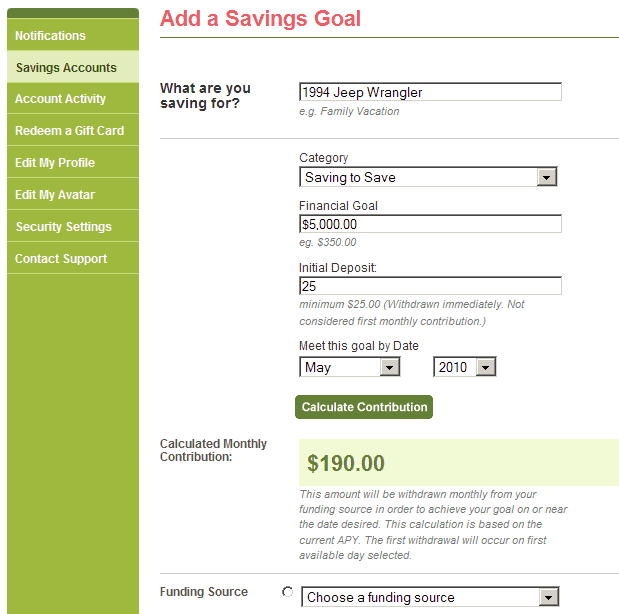
No broken resolutions here. You must set up regular contributions of at least $25 per month from an external bank account. You also must add a $25 contribution to start, and your goal must be at least $250. Here is a screenshot of setting up a goal:

altext

Friends and family can help contribute to your goal. You have the option of making your goal public. Grandma can then send over some money for little Jane’s tuition via credit card, but will be charged a 2.9% processing fee. SmartyPig accountholders can send each other money for free using their bank accounts. (It used to be a $5 fee for each external contribution, but that was dropped.) Now the question is, will Ms. Manners think it’s polite to hint at some Smartypig cash gifts?

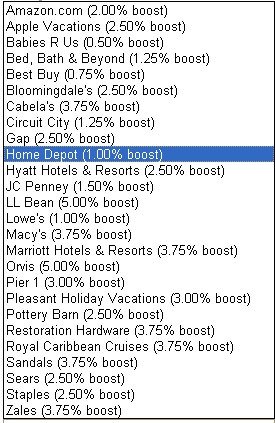
Upon goal achievement, you can redeem for gift cards with “up to” a 5% bonus. So if your goal was $500 for electronics, you might get up to a $525 gift card to Best Buy (see update below). You could also settle for a pre-loaded Mastercard for $500. However, these “boost” percentages are not revealed ahead of time. I even called customer service, and they still wouldn’t tell me as they said they can change in the future. I would prefer more transparency, but for now I’ll just assume I’ll be withdrawing cash. If there is appropriate gift card upon my goal completion, then it’ll be gravy.

Update: Reader Tom shares the current gift card boost percentages. Best Buy is actually only 0.75%… but 2% for Amazon.com doesn’t look bad.

Doesn’t it cost money to take out cash?
Up until recently, they did charge $25 to withdraw via a check, which was a big bummer. It basically promoted “spending” on consumer goods and eliminated potential goals like an emergency fund or tuition at many universities. But as of now the check-request fee is gone, and you will soon be able to simply withdraw your money directly back into your funding account for free. I’m glad to see this.

Summary
With the elimination of these fees, SmartyPig might finally rival my current piggy bank setup with Capital One 360. They are paying 0.75% APY right now. Unless your goal is huge, it probably won’t make much difference, but it’s something. Anyone want to contribute to my “Used Jeep Wrangler” fund? 🙂

Save For Specific Goals With Your Own Online Piggy Bank

piggy bankYou may be expecting a review of the new online service SmartyPig. Well, that review is in-progress, but while doing my research I was reminded of an alternate way to create your own online “piggy bank”. Remember how you’d actually have to save your quarters to buy what you wanted? Oh, the good old days… 😉
Let’s say you want to set up multiple “baskets” or “piggy banks” of money for specific goals. Maybe you have

  • an ongoing pet medical fund to which you add to regularly instead of paying for insurance ($50 per month?)
  • an ongoing car maintenance/repair fund (I need one of these)
  • a summer vacation fund (goal: $1,000?)
  • a Christmas fund
  • …or that all-purpose emergency fund!

You want separate balances and accounting for each account to keep things neat, but you don’t want to open up 3 new accounts at 3 different banks. The good news is that this can all be done with Capital One 360 – they let you easily and instantly create multiple savings accounts that have their own balance and nickname. No credit checks, no applications, and it earns interest. Here’s how:

1) First, you’ll need a Capital One Consumer Bank account. If you have one already, you’re all set. If you opened one before and it got closed to due low balance or inactivity, you can have them re-open it by calling 1-888-ING-0727 (or you can login and do it). If you are a new customer, you can earn a $25 sign-up bonus here by opening with at least $250.

2) Open up an additional savings account (or several!). It’s not all that complicated, but it still confused me initially so I broke down the steps below with screen-by-screen walkthrough. Click on the thumbnail images for a full size screenshots.

3) Set up an automatic savings plan
Although you can schedule manual transfers, why not make it easy on yourself and set up an automated transfer schedule? You can set a fixed amount of automatic withdrawals if you have a specific goal ($100/month x 1 year = $1,200 = HDTV), or you can make it repeat indefinitely (great for our often-used pet fund).

And you’re done! You can make as many of these sub-account as you like. The cool thing is you can make withdrawals at any time (max 6 per month), and there are no minimum balances or fees. The interest rate at 0.75% APY isn’t the absolute highest, but comparatively it’s no longer that far behind other similar banks.

(FYI – I was talking with my sister about this and she told me she didn’t use her Capital One 360 account anymore. When I asked why, she said it was not because the interest rate wasn’t high enough, it was simply because they made you log in with your customer number, and she would never remember it! I just wanted to point out that now you can pick your own username (like “janedoe444”). Use it carefully though, as your password is still just a 4-digit PIN.)

Prosper P2P Lending Update #2: Scary Graph and Stats

I was trying to run some more recent numbers to update my most recent concerns regarding person-to-person loans at Prosper.com. Essentially I was wondering if the loan performance would continually get worse over time. I was curious because it’s one thing to advertise 8-12% returns when the loans are new, but what really matters is the performance at the end of the 3-year term.

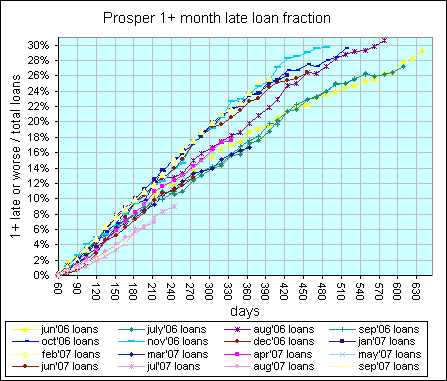
While trying unsuccessfully to churn those numbers, I ran across this related chart from the very analytical Prosper lender Fred93’s blog. The graph is essentially % of loans defaulted vs. loan age. Fred93 explains further:

These charts show statistics for the performance of all prosper.com loans. Each curve represents the set of loans that were created in one calendar month. The vertical axis is the fraction of those loans that have “gone bad”, in other words are 1 month late or worse (up to and including default). The horizontal axis is now days since month of loan origination. All data comes from Prosper.com’s performance web page.

altext

If you look out one year from origination (ie 360 days) you will see that about 20% of Prosper’s loans have gone bad. You can also see that this is remarkably consistent from month to month (ie the different curves). One can only conclude that the default rate of Prosper loans is in the neighborhood of 20% per year. Loans originating after Feb’07 are going bad at a slightly lower rate, probably because Prosper increased the minimum credit score required for a Prosper loan at that time.

I learned also that he makes these conclusions because (1) historically over 85% of Prosper loans that reach 1 month late eventually go into default, and (2) the recovery rate after being sent to collections is terribly low. Together, you have his statement that ~20% of loans go into default each year. For a three-year loan, that ain’t good!

The slope (default rate) does seem to be slightly lower for the newest loans, but what concerns me the most is the constant linear deterioration of loans. This confirms my fear that loan performance consistently gets worse as the loan ages.

Now, I know this chart doesn’t tell the whole story, but I do think P2P lending is still very new and has a lot of growing pains to overcome. For borrowers, it can be a great deal. But as much as I want to be grabbing some solid returns this way, I’m still wary of committing significant money given this information.

(I haven’t found similar numbers for competitor LendingClub yet. They are still young, but they seem to be doing better in defaults so far. I’m waiting for more loan data to accumulate.)

Related P2P Lending Posts

  • $25 Sign-Up Bonus For Lending On Prosper
  • Free Experian Credit Score via Prosper Lending
  • Lending Club P2P Initial Review, $25 Bonus Promotion
  • Update #1: Will Returns Drop As Defaults Increase Over Time?
  • Prosper.com Person-to-Person Lending Review, Part 1: First Looks
  • Prosper.com Person-to-Person Lending Review, Part 2: The Numbers

[Read more…]

Series I Savings Bonds: Inflation Protection + Decent Interest?

The Federal Reserve continues to slash short-term rates, so right now looks like a good time to take a second look at Series I Savings Bonds since they are not directly tied to such rates and also offer protection from inflation.

I-Bonds Quick Summary

  • Series I Savings Bonds (also known as I-Bonds) are investments that have very low risk (backed by the government) and offer to pay interest in two parts: a fixed rate + a variable rate indexed to inflation. The fixed rate is known when you buy, and the variable rate changes every 6 months.
  • You must hold them for at least 1 year. If you redeem within the first 5 years, you lose the last 3 month’s worth of interest. They stop paying interest after 30 years.
  • Interest from savings bonds are subject to federal income tax, but are exempt from local and state income taxes. For people that live in states with high income taxes, this can make them more attractive. They also have some special exemptions when used for educational purposes. See this Tax-equivalent Yield Calculator.
  • As of 2008, you can only buy $5,000 of paper I-bonds and $5,000 of online I-bonds per Social Security Number, per year. However, many users report still being able to buy up to $30,000 at a time online.
  • More info at TreasuryDirect.

Currents Rates and Predictions
Currently, the fixed rate portion of I-Bonds is 1.2%. If you buy a bond now, you will also be guaranteed an variable interest rate of 3.08% for the next 6 months, for a total interest rate of 4.28%.

After that, the rate will adjust every 6 months based on the previous 6 month’s worth of inflation data. The next adjustment will be in May, based on September-March 2008 data. Currently, we have September-February, so let’s use that to make an educated guess. Using the prediction method explained here:

Sept 2007 CPI-U was 208.490. Feb 2008 CPI-U was 211.693. 211.693/208.490 = 1.015363, or a semi-annual increase of 1.536%.

Total rate = Unknown fixed rate + 2 x Semiannual inflation rate + (Semiannual inflation rate X Fixed rate)

If we assume a fixed rate of the current 1.2%, we get
Total rate = 0.012 + (2 x .015363) + (.012 x .015363)
Total rate = 1.2% + 3.09%
Total rate = 4.29%

Now, looking at oil prices, I’m guessing that inflation is probably going to tick upwards some more in March. If we use August-February data, the variable rate would be around 3.37% (total rate 4.57%). Either way, I think it is a fair bet that the variable portion will stay around 3.1% if not higher.

Buying I-Bonds as a 12-month CD
Given these predictions, we can have an idea of what our interest earned will be if we buy now. There is one last “trick” with I-Bonds, and it is that if you buy at the end of the month, you’ll still get all the interest for the entire month as if you bought it in the beginning of the month. Let’s say we buy at the end of March (this week!), hold for the minimum of one year, and pay the 3-month interest penalty. You’ll be able to sell on March 1, 2009 for an actual holding period of 11 months.

We will get 4.38% for 6 months, and ~4.3% for 3 months taking in account the penalty. That’s equivalent to an annual rate of 3.56%. Now, if you live in a state with 9% state income tax, your equivalent yield gets bumped up to 3.9-4.05% depending on if you fully itemize your state income taxes.

Given that you can also find a traditional bank CD that pays around 4% APY currently, this rate is competitive but not a screaming deal. But if you are in the market for some inflation protection and your time horizon is more like 2-7 years, there is low downside and good upside as you can always decide to hold it longer than 11 months if inflation continues to climb and the Fed is unwilling to raise interest rates due to economic recession. I am currently considering buying some of these to hold my emergency funds for this reason, but the lack of liquidity for the first 11 months is a concern.

Buying I-Bonds as a Long-Term Investment
If you want long-term inflation protection and are willing to stray from the ease and convenience of mutual funds or ETFs, I-Bonds might also be a good option. The fixed rate of 1.2% is relatively low historically, but in the current environment it’s actually very good. Other low-risk inflation-indexed products are trading at a negative real yield right now. The next update to the fixed rate will be in May. Given the current rush towards similar products, people are betting that the fixed rate is going to drop even further.

Index Powered CD Review: Stock Performance + Bank Safety?

How would you like to get returns linked to the S&P 500, with no chance of losing a penny? You can with the Index Powered CD, a certificate of deposit being sold by a variety of smaller banks including Brentwood Bank. While the concept has been around for a while, it has been enjoying renewed popularity was people continue watching their 401(k)s shrink. Unfortunately, this is yet another product that uses clever marketing to hide important details from the less vigilant public. Here’s the pitch:
“Enjoy the stock market’s ups and not fret about the downs”!

The Index Powered® CD is a new FDIC insured certificate of deposit tied to Standard & Poor’s 500 Index. The Index Powered® CD was developed with today’s investor in mind and is available exclusively through community institutions. Enjoy the peace of mind of having your principal guaranteed and FDIC insured (up to $100,000.) while offering the potential higher returns of the stock market.

What The Average Person Thinks This Means
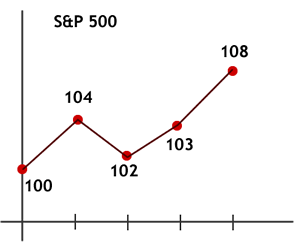
If the S&P 500 goes up a lot, I’ll match that return. If the S&P 500 drops – hey! – I’m FDIC insured so I can’t lose my money. Sign me up!! Let’s say this is a 1-year CD and here are the values of the S&P 500 for that year.

altext

It starts at 100 and ends at 108, so you would expect your CD with a “100% Market Participation Factor” to return… 8%, right? Unfortunately, if you spend the time to read the 17-page disclosure statement, you’ll see that it is not true. To put it bluntly, they manipulate the definitions to their advantage.

What It Really Means!
The problem is that I can say something is “tied to the S&P 500” or “linked to the S&P 500” without actually getting the full return. While they tweak many of the definitions, in particular this sticks out. “Closing Market Value” is defined as “the arithmetic average of the closing values of the S&P 500 Index on the Pricing Dates.” This changes everything. Using the example above again we’ll use the values given:

altext

By their definition, the “closing market value” was 103.4, and your starting value was 100. (Yes, the 100 is included in the average!) So your actual return would be a piddly 3.4%. Not exactly what you expected, huh?

And you know what? The S&P 500 Index they use doesn’t include dividends! That’s another 2% of annual return you’re missing out on.

There is no free lunch here. Not only do you on average less than half of the actual S&P 500 return if it does well, you also risk getting much less interest than a conventional fixed-rate CD if it does poorly. You cannot eliminate downside risk without giving up upside potential. Finally, this is actually a 51-month CD with heavy early-withdrawal penalties.

(For those that like “efficient” portfolios and optimizing risk/reward, here you are essentially taking on added volatility with no increase in expected average return. See my comment below for more details.)

Get your goals straightened out. Either you (1) have a short-term horizon with low risk tolerance and should get a conventional bank CD with a fixed guaranteed rate, or you (2) have a long-term horizon and are willing to accept the risk and full return of a S&P 500 index fund. Even if you don’t want to be 100% S&P 500 index and want less volatility, using a mixture of stocks and bonds would be the a much more cost-effective way of achieving this.

Again, I’ll avoid the word “scam” because this is technically a legal product, but the best weapon against such products is education. Know what you are buying and tell others!

Two Free $400 Airline Tickets with $25,000 Deposit into Citibank Savings Account

I just found a pretty good offer in one of my Citibank credit card statements. (I still get paper bills for everything, it’s my longtime system for paying them on time.)

altext

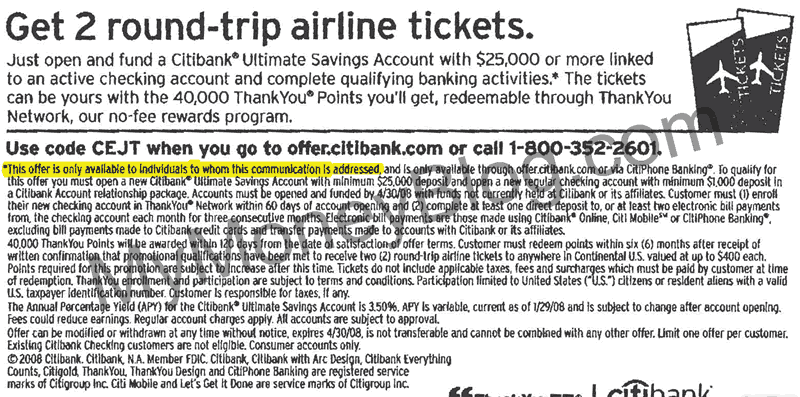
If I open up a new Citibank Ultimate Savings account + Checking account with at least $25,000 by 4/30 and complete a direct deposit for 3 consecutive months, I can get 40,000 ThankYou Points which can be converted into two roundtrip airlines tickets worth up to $400 each. Here is a scan of the offer. Offer code is CEJT. However, note the very first line states that “this offer is only available to individuals to whom this communication is addressed”, so please check your statements and save it to avoid hassles later. I would think most others would get it as well, since I am probably one of Citibank’s less-profitable customers and I got it. 😉

The Ultimate Savings account pays 3.25% APY if you do two online billpays per month, 2.51% APY otherwise. The attached checking account has no monthly fee if you connect it to the Ultimate Savings account. This seems like a pretty good deal because the interest paid is competitive with other online savings accounts, and I can get up to $800 worth of airplane tickets on top of that (worth at least another 2% APY). Of course, you’ll need to have $25,000 to commit. Ironically, much of the $25,000 I’m going to put into this account is Citibank’s own money that they let me borrow at 0% APR!

Update: I found a version of the 40,000 point offer online. Offer code CSZ2. Two important differences: (1) accounts must be opened by 3/31/08 and (2) it is valid for existing Ultimate Savings account if you add in another $25k.

Up to $100 For New Accounts at Bank of America and Chase Bank

Bank of America is offering a $75 bonus for new customers opening a personal checking account with them by April 30th. If you open online, you will probably get a hard credit check. If you open in a branch, you should be able to avoid this. Use offer code AOU26020.

Offer expires 04/30/2008 and is available through our online application or in any Bank of America banking center. Offer does not apply to second or multiple checking accounts and/or existing checking customers. This minimum deposit required to open a new, personal checking account and receive the $75 offer is $100.

BofA also has a $100 bonus for a business checking account.

Offer applies to any new business checking account opened with a Visa® Business Check Card before March 31, 2008. Limit one $100 incentive per business every 6 months. If opening the account online, you must enter the code BTB0100 to ensure you receive the bonus. If opening your account in a Bank of America banking center, you must provide the coupon to receive the bonus.

Chase Bank is offering a $100 bonus for opening a Free Checking Account with direct deposit by March 31st. You must actually go to a branch, I’m not sure if they check your credit there. I’d hope not.

To qualify for the $100 reward you must open a new checking account and initiate a repeating direct deposit such as payroll, pension or Social Security. The first direct deposit must be completed within 60 calendar days of account opening.

Chase is also offering a $200 bonus for opening a business checking account. (Thanks Susie)

Open a Chase BusinessClassicSM, BusinessPlus® or Chase Advanced Business CheckingSM Checking account and deposit a minimum of $500 or more within 30 days of account opening with funds not currently on deposit with Chase.

FISN Bank CDs Paying Over 8% Interest: Being FDIC-Insured Isn’t Enough

I’ve already written about Millennium Bank – the offshore bank offering 8% certificates of deposit that are not FDIC-Insured, let alone highly regulated. More recently, a group called the Federally Insured Savings Network (FISN) has been advertising FDIC-insured Certificates of Deposit Paying Over 8%”. What’s the deal?

It definitely looks too good to be true, but let’s look at the fine print and see what we can find. I’ll just focus on the highlighted CDs paying a 8% and 8.25% APR to save some time.

These Are Long-Term Investments With Very Limited Liquidity
The maximum terms for these CDs are for 15 or 20 years! If you wish to withdraw early, you can be sure it will be with a fat penalty. However, it may not even be possible to re-sell them at all. From the disclosure: “Lack of Liquidity. The CDs will not be listed on an organized securities exchange. JPMSI may offer to purchase the CDs upon terms and conditions acceptable to it, but is not required to do so.” This could be worse than even taking money out of your IRA or 401(k).

High Minimum Investments
In this case, you need $25,000 to invest with FISN as your broker to JPMorgan Chase Bank.

They Are Callable, And That’s Not Good
A callable CD means that the bank can say “I found a better deal elsewhere, so I no longer want to pay you this much interest anymore. Bye!” You’ll get your principal plus interest earned up to that point, but this usually happens when interest rates fall, leaving you stuck with alternative paying a lot less than you were getting before.

On the other hand, you the depositor have no such flexibility. You’re still stuck for as long as the bank wishes. Again – up to 20 years! Put another way: Heads, the bank wins; Tails, you lose.

Not A Fixed Rate CD – 8% Rate Isn’t Guaranteed
When talking about a bank CD, you’re usually referring to a fixed rate CD. However with this investment, you may or may not get paid any interest based on the following criteria:

Interest is paid quarterly for every day the 30Yr Constant Maturity Swap (CMS) Rate is greater than the 10Yr Constant Maturity Swap Rate (Positive Yield Curve). If the 10Yr CMS Rate is greater than the 30Yr CMS Rate on any day (Negative Yield Curve) no interest is accrued for that day. Full 8.00% rate guaranteed for first year.

Trying to figure out exactly what CMS rates were made my head hurt. But very generally, if the long-term interest rates are higher than short-term interest rates (positive yield curve) you’ll get paid your fraction of 8% annual interest that day. However, if the curve goes negative, which it has for extended periods in the last few years, you don’t get paid any interest that day. So 8% is basically a best-case scenario. Over a 15-year period, I highly doubt you’ll be getting the full 8% each year. Earning 0% is the worst-case scenario.

I’m Not Interested
So yes, technically these are FDIC-insured to the extent that your principal is safe. But your money could be stuck sitting around earning nothing while inflation eats away at the actual value. And the bank will only keep paying the interest if it remains profitable for them. These seem to be sophisticated investments being marketed at the unsophisticated public. Buyer beware!

Washington Mutual Lowers Online Savings Rate To 4.75% APY

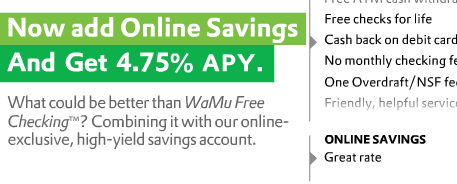
It had to happen eventually… WaMu appears to have lowered the interest rate on their online savings account from 5.0% to 4.75% APY:

altext

This brings them back in line with other online savings accounts, but I still enjoy having a local bank as the core of my bank account setup and being able to do things like deposit my paper checks directly into my savings account (to a real human!). More details about the actual perks in my review of this WaMu Checking/Savings combo.

My cash savings are now earning less, but mortgage rates are still rising. Bah humbug!

$50 From Wells Fargo, 5.65% APY 4-Month CD

Wells Fargo Bank is offering a $50 bonus for opening a checking account with them. Note that they do perform a hard credit check. Their checking account rules vary by state, but I think most have one that is free with direct deposit. You can simply simulate a direct deposit with an online bank transfer via Capital One 360 or similar. Via commenter Paul.

Limit one $50 bonus per household. To qualify for your $50 bonus, you must open and fund a new personal Wells Fargo checking account with a minimum initial deposit of $100 (not including the $50 bonus) by November 30, 2007. The $50 bonus is available with all Wells Fargo checking accounts, including non interest-earning checking accounts, except for Wells Fargo College Checking?, Wells Fargo Teen CheckingSM and Wells Fargo Opportunity Checking? accounts. The $50 bonus will be deposited to your new Wells Fargo checking account within 30 to 45 days of opening.

I thought I’d also throw out there that IndyMac Bank is offering a 4-month CD paying 5.65% APY. $5,000 minimum, online-only.

Signup Bonuses: $100 From LaSalle Bank, $50 From NewBank

LaSalle Bank (now owned by Bank of America) is offering a $100 bonus for opening a checking account, savings account, and using the debit card once. Likes like you need $250 for the checking and $100 for the savings. Keep the minimum amount in there ($250 for checking, none for savings*), and that’s a very nice rate of return.

In addition, you can even fund with a credit card (up to $1,000 per account) and have it count as a purchase. Great for those with rewards credit cards.
[Read more…]