Free Kids Book About the Banking System (PDF/EPub)

Are your kids curious about the banking system? Are you? Law professor Mehrsa Baradaran wrote A Kids Book About Banking and it is currently available free via download in either PDF or EPub format. Physical copies (not free) are available on Amazon. Found via Axios.

Silicon Valley Bank (SVB) collapsed overnight and we found ourselves wishing we knew more about how banks worked… so, we made a book!

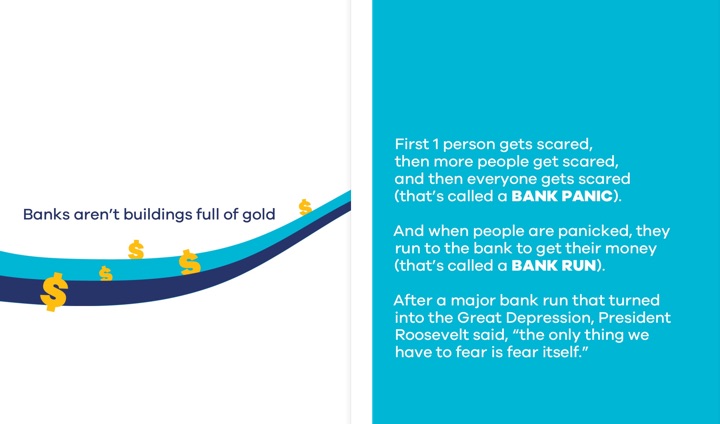
When you think of a bank, what comes to mind? A building? A safe, filled with gold? What if we told you banks weren’t any of these things? And (get ready for this)…most money isn’t even kept in the bank! Banking is a system that allows money to move from one place to another, creating opportunities and growth. And banks only work with a shared belief in the magic of money.

It’s a good way to start a conversation, but be warned, it might be kind of scary to YOU as an adult to be reminded that all your bank deposits, the result of possibly decades of hard work, are just a bunch of 1s and 0s on a computer database somewhere. There is no gold in a vault. There are just banks taking your money and creating even more money via fractional-reserve banking. But it all collapses if we don’t collectively trust the system, or “believe in magic”. Every time I read about this system, I reconsider buying a plot of land nearby that I can see and walk on.
I tried reading it to my youngest kid, but she preferred talking vegetables and listening to The Cool Bean for the 87th time instead. I think she’s still in the trading strange metal coins for candy phase of learning about money.

Passive Income via Fidelity Securities Lending: Expectation vs. Reality

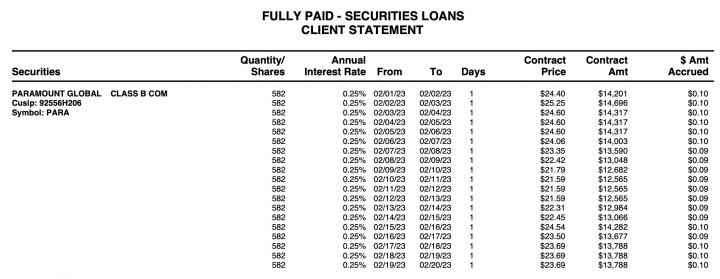
I just experienced my own version of the “Expectation vs. Reality” meme when I looked at my monthly report from my Fidelity Investments securities lending activities, where I lend out my stock shares and get paid interest. I had been getting a lot of transaction notifications where all my shares of Paramount (PARA) were being lend out to somebody (most likely to short it).

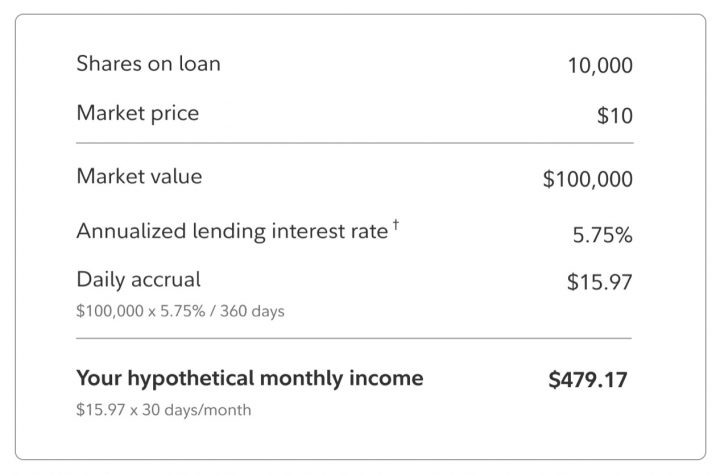
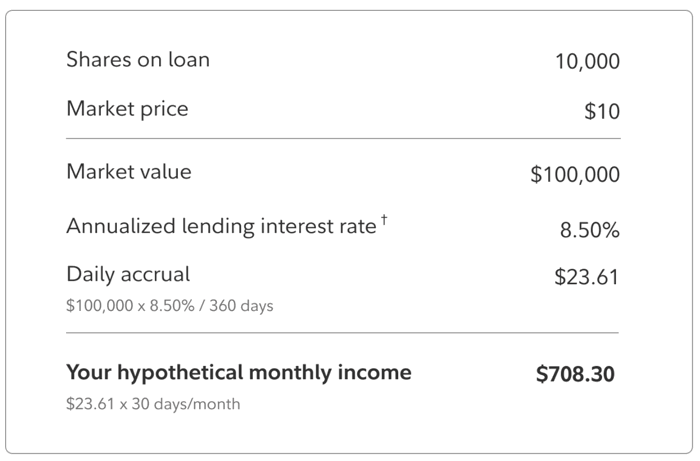
Expectation. I previously wrote about earning some extra income via Fully Paid Lending Programs in general, including that from Fidelity. In December 2021, Fidelity was showing this as an example scenario:

As of March 2023, the example scenario on the official Fidelity page shows a significantly lower income rate:

Still, over $400 a month of extra income from a $100,000 balance? I have a six-figure taxable Fidelity account, so I figured I was leaving money on the table! Let’s go!

Reality. Out of all my stock holdings, the only one to garner any lending interest was Paramount. This mostly makes sense in retrospect, as I tend to buy larger, high-quality companies when they are temporarily out of fashion. You don’t really see a lot of people shorting Berkshire Hathaway. Paramount is more of a value/cheap P/E and/or dividend play. (Although, Berkshire does own 10% or so of Paramount…)

Here are my real-world stats on Paramount:

Shares on loan: 582

Market price: ~$23

Market value: ~$13,386

Annualized lending interest rate: 0.25%

Daily accrual: ~$0.10 a day.

Monthly pro-rated income: $2.79

Actual income: $1.91 (only borrowed for 19 days)

So… basically I was making 10 cents a day lending out my $13,000 of Paramount shares. At that rate, even if I had $100,000 worth of Paramount, I’d be making roughly 77 cents a day, or $23 a month. Nowhere near the $479 a month example.

Add in the fact that PARA is the only security being lent out in my entire portolio, and my securities lending income is currently working out to a pro-rate amount of less than 0.0004%, or 0.04 basis points.

Ally Bank 11-Month No Penalty CD Review: 4.75% APY (No Minimum)

Rates now up to 4.75% APY. It’s always nice when you can get a higher rate without having to move your money to a whole new bank. Ally Bank raised the rate on their 11-month No Penalty CD to 4.75% APY for all balances with no minimum deposit. If you have older No-Penalty CDs, you may want to take advantage of this higher rate.

The 11-month No Penalty CD is unique in that while the rate is locked in at deposit, you can still withdraw your principal and interest without penalty at any time (well, you must wait at least 6 days from the deposit date). In other words, your interest rate can never go down, but you can still jump ship if rates rise or if there is a better promo elsewhere.

For comparison, the Ally Online Savings account is currently at 3.60% APY (as of 3/20/23) for all balances. The interest rate on the savings account can go up or down. The Ally 12-month CD is at 4.50% APY and 18-month CD is at 5.00% APY, which is fixed but if you withdraw early there is a penalty of 60 days of interest for both CDs.

If you recently opened one of these, remember that Ally Bank offers a “Ten Day Best Rate Guarantee”:

When you fund your CD within 10 days of your open date, you’ll get the best rate we offer for your term and balance tier if our rate goes up within that time. The Ally Ten Day Best Rate Guarantee also applies at renewal.

If you have an existing No Penalty CD past the 10-day rate guarantee, this means you may consider closing it and then opening up a new one at a higher rate. You will have to withdraw everything at once – there are no partial withdrawals allowed on this type of CD. If you have an Ally savings or checking account, you can close the old CD, see the deposit in your savings/checking, and open up a new CD all in minutes online. (Note that savings accounts are limited to 6 withdrawals per month, so use your checking if possible.) You will be extending the term out another 11 months, but since you can always close it at any time it isn’t much of a concern.

Here’s an (old) screenshot of my withdrawal showing no penalty and instant availability when withdrawn directly into an Ally account:

ally_np_withd

You can use my Ultimate Rate-Chaser Calculator to get an idea of how much additional interest you’d earn if you switched over.

Bottom line. The Ally No Penalty CD is unique in that you are always able to move out to a higher rate, but you’ll never get a lower one. This means you can even break the No Penalty CD simply to get another No Penalty CD if/when the rate rises again.

Ask the Readers: How to Get Cash from Balance Transfers in 2023? (Credit Card Arbitrage)

Recent events have reminded us that banks make money by taking in deposits at low interest rates and reinvesting those deposits at higher interest rates (either bonds or directly making loans themselves). When you see a credit union have a certificate special, that usually means it needs more deposits to fund commercial, residential, or personal loans to its members. This is a form of arbitrage. (Usually this works just fine, as long as your depositors don’t try to ask for all their money bank at once.)

With short-term interest rates now at 5% again, this brings back the possibility of credit card arbitrage to individuals. Borrow money with a no or low-fee 0% APR balance transfer, invest it in FDIC-insured banks at 5%, and you have significant rate spread. At that spread, borrowing $10,000 will make $500 a year, while borrowing $50,000 will make $2,500 a year.

Back around 2005, I was pretty heavy into this game as it was the equivalent of a 10%+ increase in my annual income. I knew all the ways that I could turn a balance transfer into cash. Some issuers gave out balance transfer checks, other issuers let you direct deposit a balance transfer into your bank account, and finally I could also transfer a balance larger than my actual balance and then request a credit refund via check. For example, I might have a $2,000 average recurring monthly balance as a regular customer at Bank A but then request a $12,000 balance transfer from Bank B. That would leave a negative $10,000 credit balance at Bank A, which they would send back to me as a check.

Interest rates have been very low for a very long time, and I haven’t used a balance transfer for a very long time. (There is a reason why credit card companies will give you 0% APR for 21 months, and it isn’t because they are nice people who enjoy giving out free loans. It’s because they get to charge you 24% interest after that introductory period.)

So, I ask you kind and intelligent readers: Has anyone tried to obtain cash directly via a credit card balance transfer recently? If so, what was your experience? What worked, what didn’t, and with which card issuer?

Best Interest Rates on Cash – March 2023

Here’s my monthly roundup of the best interest rates on cash as of March 2023, roughly sorted from shortest to longest maturities. We all need some safe assets for cash reserves or portfolio stability, and there are often lesser-known opportunities available to individual investors. Check out my Ultimate Rate-Chaser Calculator to see how much extra interest you could earn. Rates listed are available to everyone nationwide. Rates checked as of 3/7/2023.

TL;DR: 5% (fintech only) or 4.55% APY available on liquid savings. 5% APY available on multiple short-term CDs. Compare against Treasury bills and bonds at every maturity (12-month now above 5%). 6.89% Savings I Bonds can be bought with 2023 annual limits now.

Fintech accounts
Available only to individual investors, fintech companies often pay higher-than-market rates in order to achieve fast short-term growth (often using venture capital). “Fintech” is usually a software layer on top of a partner bank’s FDIC insurance.

  • 4.45% APY ($1 minimum). SaveBetter lets you switch between different FDIC-insured banks and NCUA-insured credit unions easily without opening a new account every time, and their liquid savings rates currently top out at 4.45%. This system makes it easier for you to maintain a top rate even if one bank decides to drop out of the “rate race”. 😉 There is usually another bank waiting in the wings that is still looking for deposits.
  • 5% on up to $25,000, then 4% up to $250k. Juno now pays 5% on all cash deposits up to $25,000 and 4% on cash deposits from $25,001 up to $250,000. No direct deposits required. $10 referral bonus. Please see my Juno review for details.
  • 4.00% APY on $6,000. Current offers 4% APY on up to $6,000 total ($2,000 each on three savings pods). Must maintain a direct deposit of $200+ every 35 days. $50 referral bonus for new members with $200+ direct deposit with promo code JENNIFEP185. Please see my Current app review for details.

High-yield savings accounts
Since the huge megabanks STILL pay essentially no interest, everyone should have a separate, no-fee online savings account to piggy-back onto your existing checking account. The interest rates on savings accounts can drop at any time, so I list the top rates as well as competitive rates from banks with a history of competitive rates. Some banks will bait you with a temporary top rate and then lower the rates in the hopes that you are too lazy to leave.

  • The leapfrogging to be the temporary “top” rate continues. UFB Direct at 4.55% APY. All America/Redneck Bank is at 4.25% APY for balances up to $75,000 ($500 to open, no min balance). Primis Bank dropped their rate, but grandfathered existing customers for the time being.
  • SoFi Bank is now up to 3.75% APY + up to $275 new account bonus with direct deposit. You must maintain a direct deposit of any amount each month for the higher APY. SoFi has their own bank charter now so no longer a fintech by my definition. See details at $25 + $250 SoFi Money new account and deposit bonus.
  • There are several other established high-yield savings accounts at 3.40%+ APY that aren’t the absolute top rate, but historically do keep it relatively competitive for those that don’t want to keep switching banks.

Short-term guaranteed rates (1 year and under)
A common question is what to do with a big pile of cash that you’re waiting to deploy shortly (plan to buy a house soon, just sold your house, just sold your business, legal settlement, inheritance). My usual advice is to keep things simple and take your time. If not a savings account, then put it in a flexible short-term CD under the FDIC limits until you have a plan.

  • No Penalty CDs offer a fixed interest rate that can never go down, but you can still take out your money (once) without any fees if you want to use it elsewhere. CIT Bank has a 11-month No Penalty CD at 4.10% APY with a $1,000 minimum deposit. Ally Bank has a 11-month No Penalty CD at 4.00% APY for all balance tiers. Marcus has a 13-month No Penalty CD at 3.85% APY with a $500 minimum deposit. You may wish to open multiple CDs in smaller increments for more flexibility.
  • Western Alliance Bank via SaveBetter has a 12-month certificate at 5.01% APY. $1 minimum. Early withdrawal penalty is 270 days of interest.
  • BMO Harris has a 12-month certificate at 5.00% APY. $1,000 minimum. Early withdrawal penalty is 180 days of interest.
  • Capital One Bank has a special 11-month certificate at 5.00% APY. Offer ends 3/14/23. No minimum deposit, early withdrawal penalty of 3 months of interest.

Money market mutual funds + Ultra-short bond ETFs*
Many brokerage firms that pay out very little interest on their default cash sweep funds (and keep the difference for themselves). * Money market mutual funds are regulated, but ultimately not FDIC-insured, so I would still stick with highly reputable firms. I am including a few ultra-short bond ETFs as they may be your best cash alternative in a brokerage account, but they may experience losses.

  • Vanguard Federal Money Market Fund is the default sweep option for Vanguard brokerage accounts, which has an SEC yield of 4.51%. Odds are this is much higher than your own broker’s default cash sweep interest rate.
  • Vanguard Ultra-Short-Term Bond Fund currently pays 4.54% SEC yield ($3,000 min) and 4.64% SEC Yield ($50,000 min). The average duration is ~1 year, so there is some term interest rate risk.
  • The PIMCO Enhanced Short Maturity Active Bond ETF (MINT) has a 4.71% SEC yield and the iShares Short Maturity Bond ETF (NEAR) has a 4.79% SEC yield while holding a portfolio of investment-grade bonds with an average duration of ~6 months.

Treasury Bills and Ultra-short Treasury ETFs
Another option is to buy individual Treasury bills which come in a variety of maturities from 4-weeks to 52-weeks and are fully backed by the US government. You can also invest in ETFs that hold a rotating basket of short-term Treasury Bills for you, while charging a small management fee for doing so. T-bill interest is exempt from state and local income taxes.

  • You can build your own T-Bill ladder at TreasuryDirect.gov or via a brokerage account with a bond desk like Vanguard and Fidelity. Here are the current Treasury Bill rates. As of 3/6/23, a new 4-week T-Bill had the equivalent of 4.68% annualized interest and a 52-week T-Bill had the equivalent of 5.06% annualized interest.
  • The iShares 0-3 Month Treasury Bond ETF (SGOV) has a 4.41% SEC yield and effective duration of 0.10 years. SPDR Bloomberg Barclays 1-3 Month T-Bill ETF (BIL) has a 4.34% SEC yield and effective duration of 0.08 years.

US Savings Bonds
Series I Savings Bonds offer rates that are linked to inflation and backed by the US government. You must hold them for at least a year. If you redeem them within 5 years there is a penalty of the last 3 months of interest. The annual purchase limit for electronic I bonds is $10,000 per Social Security Number, available online at TreasuryDirect.gov. You can also buy an additional $5,000 in paper I bonds using your tax refund with IRS Form 8888.

  • “I Bonds” bought between November 2022 and April 2023 will earn a 6.89% rate for the first six months. The rate of the subsequent 6-month period will be based on inflation again. More on Savings Bonds here.
  • In mid-April 2023, the CPI will be announced and you will have a short period where you will have a very close estimate of the rate for the next 12 months. I will have another post up at that time.
  • See below about EE Bonds as a potential long-term bond alternative.

Rewards checking accounts
These unique checking accounts pay above-average interest rates, but with unique risks. You have to jump through certain hoops which usually involve 10+ debit card purchases each cycle, a certain number of ACH/direct deposits, and/or a certain number of logins per month. If you make a mistake (or they judge that you did) you risk earning zero interest for that month. Some folks don’t mind the extra work and attention required, while others would rather not bother. Rates can also drop suddenly, leaving a “bait-and-switch” feeling.

  • Genisys Credit Union pays 5.25% APY on up to $7,500 if you make 10 debit card purchases of $5+ each, and opt into receive only online statements. Anyone can join this credit union via $5 membership fee to join partner organization.
  • Pelican State Credit Union pays 5.11% APY on up to $10,000 if you make 15 debit card purchases, opt into receive only online statements, and make at least 1 direct deposit, online bill payment, or automatic payment (ACH) per statement cycle. Anyone can join this credit union via partner organization membership.
  • The Bank of Denver pays 5.00% APY on up to $15,000 if you make 12 debit card purchases of $5+ each, receive only online statements, and make at least 1 ACH credit or debit transaction per statement cycle. Thanks to reader Bill for the updated info.
  • All America/Redneck Bank pays 4.50% APY on up to $15,000 if you make 10 debit card purchases each monthly cycle with online statements.
  • Presidential Bank pays 4.625% APY on balances between $500 and up to $25,000 (3.625% APY above that) if you maintain a $500+ direct deposit and at least 7 electronic withdrawals per month (ATM, POS, ACH and Billpay counts).
  • Find a locally-restricted rewards checking account at DepositAccounts.

Certificates of deposit (greater than 1 year)
CDs offer higher rates, but come with an early withdrawal penalty. By finding a bank CD with a reasonable early withdrawal penalty, you can enjoy higher rates but maintain access in a true emergency. Alternatively, consider building a CD ladder of different maturity lengths (ex. 1/2/3/4/5-years) such that you have access to part of the ladder each year, but your blended interest rate is higher than a savings account. When one CD matures, use that money to buy another 5-year CD to keep the ladder going. Some CDs also offer “add-ons” where you can deposit more funds if rates drop.

  • Credit Human has 24-month to 35-month CDs at 5.50% APY. $500 minimum to open. The early withdrawal penalty is 365 days of interest. Anyone can join this credit union via partner organization (no fee).
  • Sallie Mae Bank via SaveBetter has a 27-month CD at 4.85% APY. $1 minimum. Early withdrawal penalty is 180 days of simple interest.
  • Seattle Bank has a 5-year certificate at 4.70% APY ($1,000 min), 4-year at 4.65% APY, 3-year at 4.60% APY, 2-year at 4.55% APY, and 1-year at 4.50% APY. The early withdrawal penalty for the 5-year is a very reasonable 180 days of interest.
  • Lafayette Federal Credit Union has a 5-year certificate at 4.63% APY ($500 min), 4-year at 4.58% APY, 3-year at 4.52% APY, 2-year at 4.47% APY, and 1-year at 4.42% APY. They also have jumbo certificates with $100,000 minimums at even higher rates. The early withdrawal penalty for the 5-year is very high at 600 days of interest. Anyone can join this credit union via partner organization ($10 one-time fee).
  • You can buy certificates of deposit via the bond desks of Vanguard and Fidelity. You may need an account to see the rates. These “brokered CDs” offer FDIC insurance and easy laddering, but they don’t come with predictable early withdrawal penalties. Right now, I don’t see any competitive 5-year non-callable CDs. Be wary of higher rates from callable CDs, which means they can call back your CD if rates drop later.

Longer-term Instruments
I’d use these with caution due to increased interest rate risk, but I still track them to see the rest of the current yield curve.

  • Willing to lock up your money for 10 years? You can buy long-term certificates of deposit via the bond desks of Vanguard and Fidelity. These “brokered CDs” offer FDIC insurance, but they don’t come with predictable early withdrawal penalties. You might find something that pays more than your other brokerage cash and Treasury options. Right now, I see a 10-year CDs at (none available, non-callable) vs. 3.80% for a 10-year Treasury. Watch out for higher rates from callable CDs where they can call your CD back if interest rates drop.
  • How about two decades? Series EE Savings Bonds are not indexed to inflation, but they have a unique guarantee that the value will double in value in 20 years, which equals a guaranteed return of 3.5% a year. However, if you don’t hold for that long, you’ll be stuck with the normal rate, currently 2.10% for EE bonds issued November 1, 2022 to April 30, 2023. As of 3/6/23, the 20-year Treasury Bond rate was 4.14%.

All rates were checked as of 3/7/2023.

Free 1-Year TripAdvisor Plus Membership from Target Circle ($99 Retail + Tested Results)

Target Circle is Target’s rewards program (free to join) and 3/5 to 3/11 is “Target Circle Week” where they have special offers. Standard perks include 1% back on your Target purchases if you don’t get the 5% back from REDcard, and you get a 5% off single purchase coupon on your birthday.

One of the Circle Week deals is a free 1-year membership to TripAdvisor Plus ($99 cost usually). This premium subscription service offers the following:

  • Member-only discounted hotel rates at 100,000+ hotels worldwide.
  • 10% Off every bookable experience (tickets, tours, and attractions).
  • “Access member-only perks and benefits from Tripadvisor’s travel partners”
  • “Get complimentary travel advice from experts via SMS with Trip Text.”

When you sign up, you must provide a valid credit card number or PayPal. However, by default, the free trial does NOT auto-renew automatically.

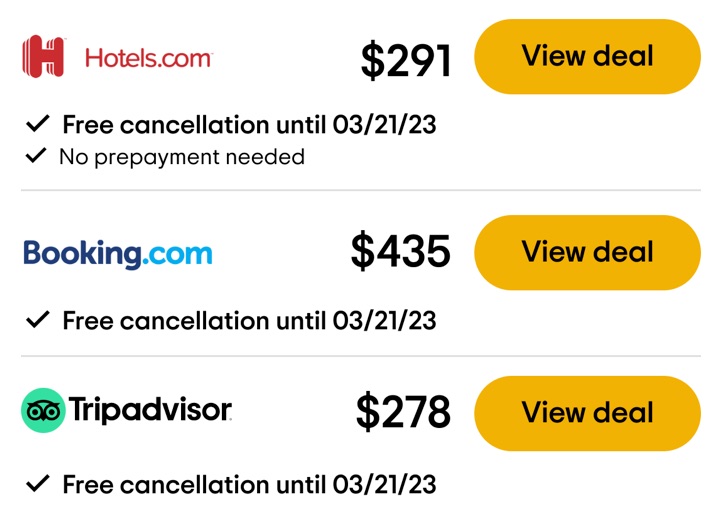
Is it worth signing up? I’m really not sure how useful the last two things on that list are, but 10% off activities is clear and the first can at least be tested. I tried out a test booking, and TripAdvisor Plus did offer a significantly better deal than if I chose book directly from the hotel as a basic free member.

Direct from the hotel was $276 + taxes:

Direct from regular Tripadvisor was $278 + taxes:

Direct with TripAdvisor Plus was $217 + taxes ($69 savings):

This just one data point, but a potential $50+ savings per night shows that it is worthing obtaining (for free) and checking when booking a hotel room. Whether it is reliably worth $99 a year is another question. It depends on your personal travel habits and if you don’t mind that fact that you lose some perks from booking directly with the hotel.

I’ll have to also remember the 10% off activities and compare with Viator, etc. One of the partner perks is a $1 membership to something called the Dollar Flight Club, which I have never heard of before.

Elements Financial CU: 4.25% APY Savings Until 10/31, 5.00% APY Rewards Checking for 12 Months ($20k Max)

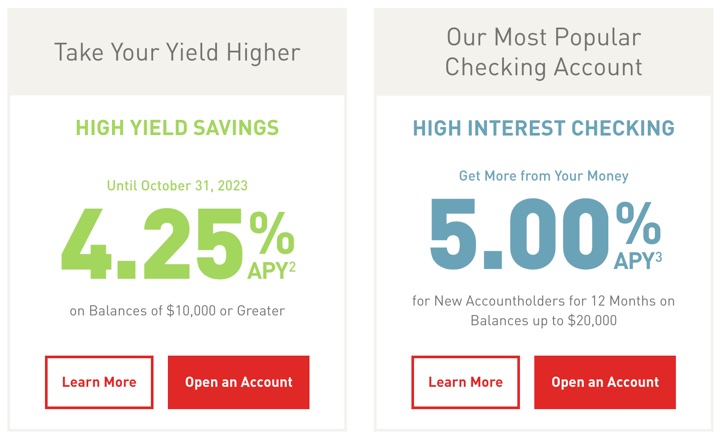
New promos with rate guarantees. Elements Financial Credit Union has a new rate of 4.25% APY on their High-Yield Savings on balances of $10,000+ (different from their Helium Savings). The promo rate is guaranteed until October 31, 2023. (Technically, it lasts until the 1st of the 12 month after you initial month, so actually between 11 and 12 months.)

There is also a promo rate of 5.00% APY on their High Interest Checking account, only valid on balances up to $20,000. Also for new accountholders only, with the promo APY fixed for 12 months from account opening date. Requires 15 qualifying transactions (such as using your debit card) every statement cycle. No monthly fee with electronic statements.

Note that their definition of qualifying transactions is also less strict than others. The following are qualifying transactions: Debit card purchases, checks, bill payments, ATM withdrawals and ACH withdrawals.

Per DepositAccounts, anyone can join with one-time $5 membership in Tru Direction, a not-for-profit organization dedicated to improving financial literacy. However, I couldn’t find anything about this on their membership page, other than Elements will provide you with $5:

Open an Elements checking or savings account or apply for a loan or credit card. During the application process, we will open you an Elements savings account (that’s the part that makes your membership official). We’ll even put $5 in to get you started — no need to transfer funds from an existing account!

I’m not sure how I feel about this one. 5.00% APY on $20k is a nice number ($1,000 a year in interest), but I don’t like having to remember the hoops for an entire year. They don’t seem to treat their existing customers nearly as well as new ones. Some of you may have signed up back in September 2022 when they offered a guaranteed 3.25% APY for a year on their Helium Savings. Right now, that account would only pay 1.00% APY once the promo ends.

HMBradley Bank Review: 4.50% APY w/ New Credit Card Spend Requirements

Update May 2023: Rate tiers are now up to 4.50% APY. You may be grandfathered from the activity requirements until 6/30/23 if you were an existing user.

Older review, last updated October 2022:

HM Bradley announced several significant changes to their product (again). I’ve updated the review completely and removed all the historical changes as it was just getting too long.

HM Bradley (HMB) is a fintech software layer on top of a partner bank’s infrastructure. They are terminating their initial relationship with Hatch Bank at the end of October 2022 and changing completely over to New York Community Bank (NYCB). Existing HMB customers will need to open up a new account at NYCB before the end of October. HMB is also changing up their interest rate structure, but is offering a special intro offer to existing HMB customers. Detailed review below.

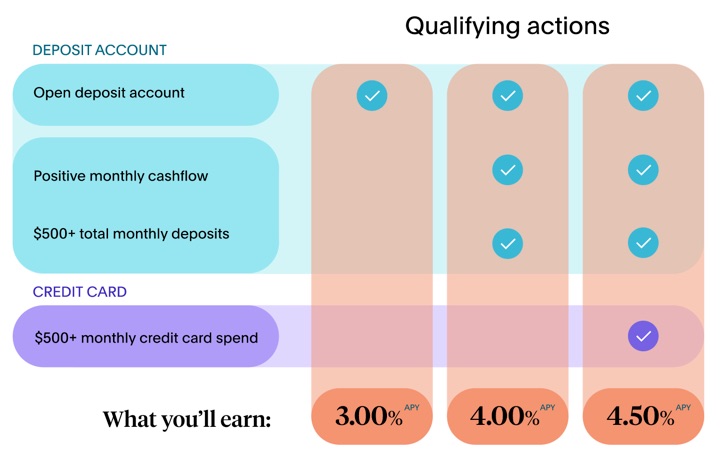
Rate tiers. Interest is earned on balances up to $250,000 with NYCB (up from $100,000 with Hatch Bank) and the rate you earn is set for the next month based on the current month’s activities. Here are the current rate tier and requirements:

  • 1.00% APY. All customers who open an HMBradley Deposit Account with NYCB will be rewarded with 1.00% APY. No other requirements.
  • 2.00% APY. Customers who make a direct deposit of at least $500 per month to their HMBradley Deposit Account with NYCB and maintain positive monthly cash flow (meaning that monthly deposits exceed monthly withdrawals, not including HMBradley Credit Card payments) will earn 2.00% APY in the following month.
  • 3.00% APY. Customers who fulfill the 2.00% APY requirements AND also spend $500 per month on their HMBradley Credit Card will earn 3.00% APY in the following month.

Limited-time offer to switch for existing customers. HM Bradley is waiving some of the requirements for new customers that signed up to switch by 10/31/22:

Any customer who opens an HMBradley Deposit Account with New York Community Bank (NYCB) before November 1, 2022, will receive Level 2 Annual Percentage Yield (APY) until April 30, 2023.

Any customer who opens an HMBradley Deposit Account with NYCB and has an HMBradley Credit Card in good standing before November 1, 2022 will receive Level 3 APY on the balance of the HMBradley Deposit Account with NYCB until April 30, 2023.

You’ll have to start doing the requirements in April to get the higher rates in May 2023.

Requires a “real” direct deposit every month. You must receive some sort of direct deposit each month, as defined below:

For our accounts, we define direct deposits as those deposits made by the customer’s employer, a federal or state government agency, or retirement benefits administrator. These generally include payments made by corporations and other organizations. We do not consider deposits to an account that are made by an individual using online banking or other payment provider such as PayPal or Venmo as direct deposits. HMBradley shall make the final determination as to whether a deposit qualifies as a direct deposit for purposes of qualifying to earn interest.

Based on my experience, they do have a system for filtering incoming deposits, but it is not 100% accurate and your direct deposit may have to be reviewed manually. Their online account interface should clearly indicate whether you have made the required direct deposit for the current month. I had to contact them in order for them to manually check and mark the transfer as a direct deposit. Having it marked properly is required to get the top rate.

Positive monthly cash flow is based on ALL deposits and withdrawals (except HMB credit card spend). For the calculation of “positive monthly cash flow”, all deposits are considered including incoming transfers from another personal bank account. At the same time, your “spending” will also include any transfer out of your account, even if it’s just to another bank account that you own. They don’t count purchases made on your HMB credit card, which incentivizes you to use it – but conveniently they don’t care about your credit card spending habits as long as you’re using their card…

Basically, money has to keep coming into HMBradley and not go back out on a net basis every month. That’s a very unique requirement, but also hard to keep up forever. Even if you are a diligent saver, you will want to redirect some of those funds into other assets like stocks, ETFs, real estate, etc.

Credit card details. The HMBradley credit card is invite-only and partially based on their estimate of your income (which is in turn based on the size of your deposits, although you can attempt to self-report). Invitations are not guaranteed. You must opt in to their “One Click Credit” service which basically checks your TransUnion credit report so they can market stuff to you (soft inquiries). If your TransUnion credit file is frozen, they will not offer you an invite. But once you officially apply, you will have a hard inquiry.

Starting at the October 2022 monthly billing cycles, the HM Bradley credit card is basically a flat 1.5% cash back credit card with no annual fee. Prior to this, it used to be a more complicated 3/2/1% rewards card with tiered categories and a $60 annual fee (waived for first year). 2% cash back would have been nice, but now it’s just another vanilla mediocre rewards card.

Additional features. It’s still not exactly clear how other basic features will change with the new NYCB accounts. ATM rebate policy? Well, right now, they don’t even give you a debit card! This change seems a bit rushed.

Once you accept the new NYCB deposit account agreement and disclosures, we will ask you to agree to allow us to transfer your funds (including any funds in a Plan and accrued interest) from your deposit account at Hatch Bank to your new deposit account with New York Community Bank (NYCB). We will also provide you with your new account and bank routing numbers. You will want to use this information to change your direct deposit and recurring ACH transfers as soon as you can.

Unfortunately, we are unable to offer debit cards for new deposit accounts at this time. You will still be able to make ACH transfers, and we will let you know when a new debit card is available.

My thoughts. Interest rate changes are happening very quickly these days, and it is unknown how aggressively HM Bradley will keep up. If I didn’t already have an HMB account, I wouldn’t bother opening one up as the positive monthly cashflow requirement can get complicated if you save your money in different ways. I will be looking for them to raise their rates at least a bit more above the competition if I am going to keep jumping through that many hoops.

Capital One VentureOne Rewards Credit Card: 20,000 Bonus Miles + 0% Intro APR Offer w/ No Annual Fee

card_name

The card_name is their no-annual-fee travel rewards card with 1.25x miles on all purchases. There are bigger rewards and bonuses from the premium Capital One Venture and ultra-premium Capital One Venture X cards, but this card still offers a 20,000 mile bonus with a lower spending requirement and no annual fee. 20,000 miles can be redeemed for $200 in travel, offsetting any travel purchase made with the card (any airline, any hotel, AirBNB stays, Uber rides, no blackout dates). This is also the rare card that allows your points to transfer to airline miles without an annual fee. Here are the highlights:

  • For a limited time, enjoy a $100 credit to use towards flights, stays and rental cars booked through Capital One Travel during your first cardholder year. Plus, earn 20,000 bonus miles once you spend $500 on purchases within the first 3 months from account opening.
  • Earn unlimited 1.25X miles on every purchase.
  • Enjoy 0% intro APR on purchases and balance transfers for 15 months; reg_apr,reg_apr_type APR after that; balance transfer fee applies
  • Miles won’t expire for the life of the account and there’s no limit to how many you can earn
  • 5X miles on hotels, vacation rentals and rental cars booked through Capital One Travel.
  • Use your miles to get reimbursed for any travel purchase – or redeem by booking a trip through Capital One Travel
  • Transfer your miles to your choice of 15+ travel loyalty programs.
  • No foreign transaction fees.
  • $0 annual fee.

Travel statement credit redemption details. Capital One “miles” can be redeemed directly for a cash statement credit on a 1 mile = $0.01 basis when offsetting any travel purchase made on the card within the past 90 days. In other words, 40,000 miles = $400 toward travel. That means you can fly on any airline or stay at any hotel, pay with this card, and then “erase” that purchase using your miles balance later. This even includes AirBnB vacation rentals, car rentals, and Uber rides.

This means that earning 1.25 miles on on every $1 in purchases essentially makes this a flat 1.25% back card when applied towards travel. You also have the option of booking travel through their travel portal, similar to Chase Ultimate Rewards, but you are not required to do so. You have the flexibility of booking through them or making the purchase directly through the airline, hotel, car rental counter, etc.

Miles transfer options. Capital One now allows you to transfer your “miles” into select airline miles programs as well. Here are the airline transfer partners:

  • Aeromexico
  • Air France/KLM
  • Air Canada Aeroplan
  • Cathay Pacific Asia Miles
  • Avianca Lifemiles
  • British Airways Avios
  • Emirates Skywards
  • Etihad
  • EVA
  • Finnair
  • Qantas
  • Singapore Airlines Krisflyer
  • TAP Air Portugal
  • Turkish Airlines
  • Virgin Red

Hotel partners

  • Accor Live Limitless
  • Choice Hotels

If you are willing to do some research on how to best leverage these international airline miles programs, this can be a very valuable option. (My personal favorite is Air Canada Aeroplan points.) Otherwise, it’s nice to know you can always get a certain level of value by redeeming against any travel purchase.

Comparison with other travel cards. This VentureOne Rewards credit card earns 1.25x miles on all purchases with no annual fee, and has the capability on its own to transfer to airline miles. The Chase Freedom Unlimited card earns 1.5 Ultimate Rewards (UR) points per dollar spent with no annual fee, but it does not allow you to transfer the points to airline mile partners on its own. You must first transfer the UR points to another Chase Sapphire card that has an annual fee. You may also consider this VentureOne card as a downgrade option for other Venture cards, given its no annual fee and ability to keep your miles redeemable and transferrable (but with lower earning rates and fewer features).

Capital One’s “premium” card is the Venture Rewards credit card, which is more directly competitive with the Chase Sapphire Preferred.

Capital One’s “ultra-premium” card is the Venture X Rewards credit card, which has more perks including Priority Pass airport lounge access and a $300 annual travel credit through Capital One Travel, but also a higher $395 annual fee. The Venture X competes more directly with the Chase Sapphire Reserve.

Bottom line. The card_name earns 1.25x miles on all purchases, which you can either redeem against any travel purchase or transfer to one of their airline/hotel partners. Right now, there is a 20,000 bonus miles offer for new sign-ups, worth $200 towards travel.

Also see: Top 10 Best Credit Card Bonus Offers.

Ally Invest and Ally Bank: Access High-Yield Vanguard and Fidelity Money Market Funds

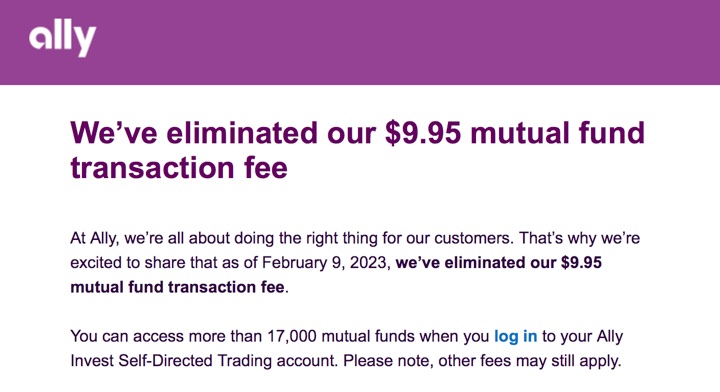
Ally Invest is the self-directed brokerage arm of Ally Financial, and you may have an account from previous TradeKing and/or Zecco mergers. Ally Invest just removed their $9.95 mutual fund transaction fee, including for money market funds:

At Ally, we’re all about doing the right thing for our customers. That’s why we’re excited to share that as of February 9, 2023, we’ve eliminated our $9.95 mutual fund transaction fee.

You can access more than 17,000 mutual funds when you log in to your Ally Invest Self-Directed Trading account. Please note, other fees may still apply.

First of all, the default cash sweep for Ally Invest pays zero interest. In addition, this change may be of interest to customers who also use Ally Bank, given that their online savings account only pays 3.40% APY (as of 2/15/23). Meanwhile, here are the 7-day SEC yields (as of 2/14/23) of top money market funds:

  • Vanguard Cash Reserves Federal Money Market Fund Admiral Shares (VMRXX) – 4.51% ($3,000 min)
  • Vanguard Federal Money Market Fund (VMFXX) – 4.50% ($3,000 min)
  • Vanguard Municipal Money Market Fund (VMSXX) – 3.43% ($3,000 min)
  • Gabelli U.S. Treasury Money Market Fund (GABXX) – 4.43% ($10,000 min)
  • Fidelity Government Money Market Fund (SPAXX) – 4.19% ($100 min*)

* The Fidelity fund does not have a minimum itself, but Ally has a $100 minimum order size for online mutual fund orders.

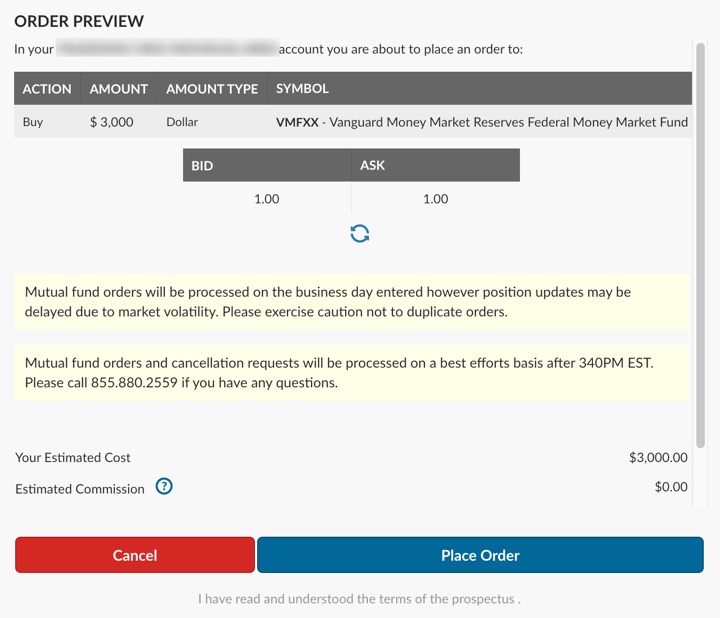
I have gone into my Ally Invest account and manually tested all of the money market mutual funds listed above, and it let me put in the order at the minimum amounts shown. Ally Invest also does not charge a short-term redemption fee. I was able to make an instant transfer of funds from my Ally Bank deposit accounts to my Ally Invest brokerage account. Therefore, if you have an Ally Bank account and don’t want to look too far elsewhere, you may consider this option to increase the yield on your cash holdings.

Best Interest Rates on Cash – February 2023

Here’s my monthly roundup of the best interest rates on cash as of February 2023, roughly sorted from shortest to longest maturities. We all need some safe assets for cash reserves or portfolio stability, and there are often lesser-known opportunities available to individual investors. Check out my Ultimate Rate-Chaser Calculator to see how much extra interest you’d earn by moving money between accounts. Rates listed are available to everyone nationwide. Rates checked as of 2/12/2023.

TL;DR: 5% APY available on liquid savings. 5% APY available on multiple short-term CDs. Compare against Treasury bills and bonds at every maturity (12-month near 4.89%). 6.89% Savings I Bonds can be bought with 2023 annual limits now.

Fintech accounts
Available only to individual investors, fintech companies often pay higher-than-market rates in order to achieve fast short-term growth (often using venture capital). “Fintech” is usually a software layer on top of a partner bank’s FDIC insurance.

  • 5% on up to $25,000, then 4% up to $250k. Juno now pays 5% on all cash deposits up to $25,000 and 4% on cash deposits from $25,001 up to $250,000. No direct deposits required. $10 referral bonus. Please see my Juno review for details.
  • 4.00% APY on $6,000. Current offers 4% APY on up to $6,000 total ($2,000 each on three savings pods). Must maintain a direct deposit of $200+ every 35 days. $50 referral bonus for new members with $200+ direct deposit with promo code JENNIFEP185. Please see my Current app review for details.

High-yield savings accounts
Since the huge megabanks STILL pay essentially no interest, I think every should have a separate, no-fee online savings account to accompany your existing checking account. The interest rates on savings accounts can drop at any time, so I list the top rates as well as competitive rates from banks with a history of competitive rates. Some banks will bait you with a temporary top rate and then lower the rates in the hopes that you are too lazy to leave.

  • The leapfrogging to be the temporary “top” rate continues. Primis Bank at 5.03% APY for both checking and savings. All America/Redneck Bank is at 4.25% APY for balances up to $75,000 ($500 to open, no min balance).
  • SoFi Bank is now up to 3.75% APY + up to $275 new account bonus with direct deposit. You must maintain a direct deposit of any amount each month for the higher APY. SoFi has their own bank charter now so no longer a fintech by my definition. See details at $25 + $250 SoFi Money new account and deposit bonus.
  • There are several other established high-yield savings accounts at 3.40%+ APY that aren’t the absolute top rate, but historically do keep it relatively competitive for those that don’t want to keep switching banks.

Short-term guaranteed rates (1 year and under)
A common question is what to do with a big pile of cash that you’re waiting to deploy shortly (plan to buy a house soon, just sold your house, just sold your business, legal settlement, inheritance). My usual advice is to keep things simple and take your time. If not a savings account, then put it in a flexible short-term CD under the FDIC limits until you have a plan.

  • No Penalty CDs offer a fixed interest rate that can never go down, but you can still take out your money (once) without any fees if you want to use it elsewhere. CIT Bank has a 11-month No Penalty CD at 4.10% APY with a $1,000 minimum deposit. Ally Bank has a 11-month No Penalty CD at 3.85% APY for all balance tiers. Marcus has a 13-month No Penalty CD at 3.85% APY with a $500 minimum deposit. You may wish to open multiple CDs in smaller increments for more flexibility.
  • BMO Harris has a 12-month certificate at 5.00% APY. $1,000 minimum. Early withdrawal penalty is 180 days of interest.
  • Capital One Bank has a special 11-month certificate at 5.00% APY. No minimum deposit, early withdrawal penalty of 3 months of interest.

Money market mutual funds + Ultra-short bond ETFs*
Many brokerage firms that pay out very little interest on their default cash sweep funds (and keep the difference for themselves). * Money market mutual funds are regulated, but ultimately not FDIC-insured, so I would still stick with highly reputable firms. I am including a few ultra-short bond ETFs as they may be your best cash alternative in a brokerage account, but they may experience short-term losses.

  • Vanguard Federal Money Market Fund is the default sweep option for Vanguard brokerage accounts, which has an SEC yield of 4.50%. Odds are this is much higher than your own broker’s default cash sweep interest rate.
  • Vanguard Ultra-Short-Term Bond Fund currently pays 4.33% SEC yield ($3,000 min) and 4.43% SEC Yield ($50,000 min). The average duration is ~1 year, so there is some term interest rate risk.
  • The PIMCO Enhanced Short Maturity Active Bond ETF (MINT) has a 4.62% SEC yield and the iShares Short Maturity Bond ETF (NEAR) has a 4.62% SEC yield while holding a portfolio of investment-grade bonds with an average duration of ~6 months.

Treasury Bills and Ultra-short Treasury ETFs
Another option is to buy individual Treasury bills which come in a variety of maturities from 4-weeks to 52-weeks and are fully backed by the US government. You can also invest in ETFs that hold a rotating basket of short-term Treasury Bills for you, while charging a small management fee for doing so. T-bill interest is exempt from state and local income taxes.

  • You can build your own T-Bill ladder at TreasuryDirect.gov or via a brokerage account with a bond desk like Vanguard and Fidelity. Here are the current Treasury Bill rates. As of 2/10/23, a new 4-week T-Bill had the equivalent of 4.61% annualized interest and a 52-week T-Bill had the equivalent of 4.89% annualized interest.
  • The iShares 0-3 Month Treasury Bond ETF (SGOV) has a 4.18% SEC yield and effective duration of 0.10 years. SPDR Bloomberg Barclays 1-3 Month T-Bill ETF (BIL) has a 4.11% SEC yield and effective duration of 0.08 years.

US Savings Bonds
Series I Savings Bonds offer rates that are linked to inflation and backed by the US government. You must hold them for at least a year. If you redeem them within 5 years there is a penalty of the last 3 months of interest. The annual purchase limit for electronic I bonds is $10,000 per Social Security Number, available online at TreasuryDirect.gov. You can also buy an additional $5,000 in paper I bonds using your tax refund with IRS Form 8888.

  • “I Bonds” bought between November 2022 and April 2023 will earn a 6.89% rate for the first six months. The rate of the subsequent 6-month period will be based on inflation again. More on Savings Bonds here.
  • In mid-April 2023, the CPI will be announced and you will have a short period where you will have a very close estimate of the rate for the next 12 months. I will have another post up at that time.
  • See below about EE Bonds as a potential long-term bond alternative.

Prepaid Cards with Attached Savings Accounts
A small subset of prepaid debit cards have an “attached” FDIC-insured savings account with exceptionally high interest rates. The negatives are that balances are severely capped, and there are many fees that you must be careful to avoid (lest they eat up your interest). There is a long list of previous offers that have already disappeared with little notice. I don’t personally recommend nor use any of these anymore, as I feel the work required and the fees charged if you mess up exceeds any small potential benefit.

  • Mango Money pays 6% APY on up to $2,500, if you manage to jump through several hoops. Requirements include $1,500+ in “signature” purchases and a minimum balance of $25.00 at the end of the month.
  • NetSpend Prepaid pays 5% APY on up to $1,000 but be warned that there is also a $5.95 monthly maintenance fee if you don’t maintain regular monthly activity.

Rewards checking accounts
These unique checking accounts pay above-average interest rates, but with unique risks. You have to jump through certain hoops which usually involve 10+ debit card purchases each cycle, a certain number of ACH/direct deposits, and/or a certain number of logins per month. If you make a mistake (or they judge that you did) you risk earning zero interest for that month. Some folks don’t mind the extra work and attention required, while others would rather not bother. Rates can also drop suddenly, leaving a “bait-and-switch” feeling.

  • Genisys Credit Union pays 5.25% APY on up to $7,500 if you make 10 debit card purchases of $5+ each, and opt into receive only online statements. Anyone can join this credit union via $5 membership fee to join partner organization.
  • Pelican State Credit Union pays 5.11% APY on up to $10,000 if you make 15 debit card purchases, opt into receive only online statements, and make at least 1 direct deposit, online bill payment, or automatic payment (ACH) per statement cycle. Anyone can join this credit union via partner organization membership.
  • The Bank of Denver pays 5.00% APY on up to $15,000 if you make 12 debit card purchases of $5+ each, receive only online statements, and make at least 1 ACH credit or debit transaction per statement cycle. Thanks to reader Bill for the updated info.
  • All America/Redneck Bank pays 4.50% APY on up to $15,000 if you make 10 debit card purchases each monthly cycle with online statements.
  • Presidential Bank pays 4.25% APY on balances between $500 and up to $25,000 (3.00% APY above that) if you maintain a $500+ direct deposit and at least 7 electronic withdrawals per month (ATM, POS, ACH and Billpay counts).
  • Find a locally-restricted rewards checking account at DepositAccounts.

Certificates of deposit (greater than 1 year)
CDs offer higher rates, but come with an early withdrawal penalty. By finding a bank CD with a reasonable early withdrawal penalty, you can enjoy higher rates but maintain access in a true emergency. Alternatively, consider building a CD ladder of different maturity lengths (ex. 1/2/3/4/5-years) such that you have access to part of the ladder each year, but your blended interest rate is higher than a savings account. When one CD matures, use that money to buy another 5-year CD to keep the ladder going. Some CDs also offer “add-ons” where you can deposit more funds if rates drop.

  • Navy Federal Credit Union has a special 15-month CD at 5% APY. Open now with just $50, but you can still add on more deposits later. You must have a military relationship to join NavyFed.
  • Sallie Mae Bank via SaveBetter has a 27-month CD at 4.85% APY. $1 minimum. Early withdrawal penalty is 180 days of simple interest.
  • Seattle Bank has a 5-year certificate at 4.70% APY ($1,000 min), 4-year at 4.65% APY, 3-year at 4.60% APY, 2-year at 4.55% APY, and 1-year at 4.50% APY. The early withdrawal penalty for the 5-year is a very reasonable 180 days of interest.
  • Lafayette Federal Credit Union has a 5-year certificate at 4.63% APY ($500 min), 4-year at 4.58% APY, 3-year at 4.52% APY, 2-year at 4.47% APY, and 1-year at 4.42% APY. They also have jumbo certificates with $100,000 minimums at even higher rates. The early withdrawal penalty for the 5-year is very high at 600 days of interest. Anyone can join this credit union via partner organization ($10 one-time fee).
  • You can buy certificates of deposit via the bond desks of Vanguard and Fidelity. You may need an account to see the rates. These “brokered CDs” offer FDIC insurance and easy laddering, but they don’t come with predictable early withdrawal penalties. Right now, I don’t see any competitive 5-year non-callable CDs. Be wary of higher rates from callable CDs, which means they can call back your CD if rates drop later.

Longer-term Instruments
I’d use these with caution due to increased interest rate risk, but I still track them to see the rest of the current yield curve.

  • Willing to lock up your money for 10 years? You can buy long-term certificates of deposit via the bond desks of Vanguard and Fidelity. These “brokered CDs” offer FDIC insurance, but they don’t come with predictable early withdrawal penalties. You might find something that pays more than your other brokerage cash and Treasury options. Right now, I see a 10-year CDs at (none available, non-callable) vs. 3.80% for a 10-year Treasury. Watch out for higher rates from callable CDs where they can call your CD back if interest rates drop.
  • How about two decades? Series EE Savings Bonds are not indexed to inflation, but they have a unique guarantee that the value will double in value in 20 years, which equals a guaranteed return of 3.5% a year. However, if you don’t hold for that long, you’ll be stuck with the normal rate, currently 2.10% for EE bonds issued November 1, 2022 to April 30, 2023. As of 2/10/23, the 20-year Treasury Bond rate was 3.96%.

All rates were checked as of 2/12/2023.

Tiicker: Shareholder Perks: New $100 Amazon GC Offer

Update: Tiicker has added a few new Perks for Real Good Foods, the most direct one being a $100 Amazon gift card for holding 50 shares of RGF with no minimum holding period. There are also other bigger perks for holding a lot more shares for at least a week. The bid/ask spread was about 10 cents, so it cost about $5 to buy/sell 50 shares quickly. You can get this even if you already got the previous $50 gift card from owning RGF (now expired). Limited quantities.

Original post:

TiiCKER is a new app that helps promote certain brands and companies by encouraging people to become shareholders and investors. (They say “ii” stands for individual investor.) In the past, Wrigley used to give out free packs of gum to shareholders, Dial used to give out soap coupons, Colgate-Palmolive gave out discounts on toothpaste, and so on. Shareholder perks are still somewhat popular in Japan, from baseball tickets to bags of rice. Found via DoC. Here are the perks currently available:

  • Link a brokerage with $100 worth of ANY stocks held inside, get $11 Amazon gift card or Visa virtual prepaid debit card.
  • (EXPIRED?) Link a brokerage with $50 worth of Amazon (AMZN) stock held inside (partial shares allowed), get $10 Amazon gift card or Visa virtual prepaid debit card.
  • (EXPIRED) Link a brokerage with $50 worth of Real Good Foods (RGF) held inside, get $50 Instacart gift card. Limited quantities.
  • (There are other perks available, please see Tiicker site for current list.)

Sometimes they require a minimum holding period, but the perks above currently do not. A few screenshots of an expired perk:

In order to prove your ownership, you must link your existing brokerage account via the Plaid service. Plaid says it does not save nor share your username and passwords with anyone, and with many brokerages, you now log in directly on your brokerage website for authentication.

I can report that I was able to sign-up, link my account via Plaid, and grab the first two bonuses in under 5 minutes. Since this is not a brokerage account, no SSN was required. Gift card redemption was instant and easy. You may need to refresh or unlink/relink your brokerage account after buying the shares for it to recognize a new purchase, or possibly wait up to 24 hours. In many cases, the perk is quite valuable compared the cost of buying and selling the shares, although this can get tricky when the holding period is longer. In addition, I have noticed this “RealGood” brand at Whole Foods and may try it now, so hey, this marketing may actually work…

Tiicker has a referral program, although the reward is vague: “Spread the word and help others discover investor perks. Refer 5 friends and receive a free TiiCKER perk!” If you wish, you can use my my referral link. Thanks if you do.