Ally Bank New Deposit Promo: Up to $500 Cash Bonus (Expired, But New CD Opportunity)

Update November 2022: Ally has raised the rates on their CDs and savings accounts, but notably the 11-month No Penalty CD is now at 3.10% APY, which isn’t amazing, but if you are already committed to this deposit bonus, it is a way to raise your effective interest rate while both still qualifying for the deposit bonus and maintaining liquidity. Note the terms state “Your new money must remain in an eligible Ally Bank account: Online Savings, Money Market or a CD.”

Original post (offer is now expired):

Ally Bank has a new “Get Paid” cash deposit bonus (link for existing customers) that is offering a 1% cash bonus (up to $500) on new deposits on top of their existing interest rate. Valid for both new and existing customers. Given the holding period, this roughly equates to the same total interest paid as a 3-month bank CD at 6.25%+ APY. Thanks to reader Paul for the heads up. Here’s how it works:

  • Open an account and/or enroll by 10/21/2022. You must enroll or you won’t get the bonus. New customers use the promo code GETPAID. Existing customers must enroll with the same e-mail as linked to their Ally bank account.
  • Fund your account by 10/31/2022. This means your account has to be approved, opened and funded by this date. Move at least $1,000 from another financial institution to a new or existing eligible Ally Bank account. Remember, transfers can take up to 3 business days.
  • Keep money in your account through 1/15/2023. Your new money must remain in your eligible Ally Bank account through 1/15/2023. Keep in mind, any withdrawals made during this time may reduce your bonus.
  • Get your cash bonus on or by 2/15/2023. Get a 1% bonus on the money you moved, up to $500.

Ally had a similar bonus in 2018 and 2020. Note the following extra details:

  • Cash bonus applies to new money added to an eligible Ally Bank account, not your total balance.
  • Your new money must remain in an eligible Ally Bank account: Online Savings, Money Market or a CD.
  • Minimum cash bonus is $10 ($1,000 deposit), maximum is $500 ($50,000 deposit).

Here’s an example:

1. Take your 10/11 end of day balance total across all eligible accounts. Ex. $5,000.
2. Take your 10/31 end of day balance total across all eligible accounts. Ex. $15,000.
3. Your max possible bonus is 1% of $10,000 = $100. If your total balance across all eligible balance ever goes below 15,000, then your bonus goes down as well. Let’s say your total balances from 10/31 onward through 1/15 varies from $12,000 to $18,000. Your bonus will only be 1% of $7,000 = $70.

Rough math. The current rate on the Ally Online Savings account is 2.25% APY (variable, likely to rise again soon, but who knows what the future holds) as of 10/12/22. Given that you can an additional 1% bonus in roughly 3 months, the bonus itself works out to the equivalent of a 4% annualized yield. 2.25% + 4% = 6.25% total annualized yield over 3 months (no guarantee, this is just an example estimate). You could also open a CD to lock in an even higher rate.

Should I move money out of Ally and back in to qualify? No, it won’t make any difference as Ally has already thought of that. Basically, your comparison point is your balance as of the end of day on 10/11/22. From the full terms and conditions:

We base your Cash Bonus calculation on the New Money you deposit into an eligible Online Savings account, Money Market account, or CD at Ally Bank between 10/12/2022 and 10/31/2022 (and then keep in your account through 1/15/2023). This means money you move out of Ally Bank and then back in won’t qualify for the bonus, and any withdrawals you make from an Online Savings account, Money Market account, or CD between 10/12/2022 and 1/15/2023 may reduce your bonus amount. Transfers of funds between existing Ally Bank accounts won’t qualify for the bonus. Remember, check deposits and transfers from other financial institutions can take a few or more days to complete, so make sure to start any transactions well enough before the 10/31/2022 deadline for those transactions to clear by or before 10/31/2022.

We’re all about playing fair, so if we believe you’re trying to game or abuse this offer, you won’t be allowed to participate in this offer or any future offers.

Existing customers. As a longtime Ally accountholder, I’m happy again to see that this offer includes existing customers, even if it has to be new money.

Bottom line. Ally Bank has a new promotion to attract new money (or bring back old money). You get a 1% cash bonus (up to $500) on new deposits on top of their existing interest rates. At the current rates for their savings account, this works out to a 3-month holding period paying roughly 6.25% annualized interest. You must enroll soon by 10/21/22 and your account must be opened and fully funded by 10/31/22 at the very latest.

Looks like I will be scraping up all the idle cash from my various accounts in the hopes of maximizing this bonus.

Reader Question: Credit Card Bonuses, Paying Annual Fees, and FICO Scores

Here’s a reader question via email that comes up pretty regularly, and I’m surprised that I don’t have a dedicated post answering it. So here it is! 😁

Hi Jonathan,

I have been following you for a long time and appreciate your work. One question, for the credit cards that have an annual fee do keep them and pay the fee or do you cancel them before the fee is applied? I wa just approved for the citi premier card.

For most new credit cards with big bonuses, if the annual fee is not waived for the first year, it will be charged immediately on your first billing cycle. So with the Citi Premier card, you should see a $95 charge in your first monthly statement. You can’t avoid it if you want the sign-up bonus. Of course, the good news is that the sign-up offer is worth over $800. Now, after 12 months, another annual fee will be charged. What then?

I view credit card bonuses as a paid trial. The credit card issuer wants to make me their customer, in the hopes of making profits (transaction fees, interest, fees, etc) by providing me a service. As a consumer, I am lazy and don’t really want to go through the hassle of applying for a new credit card. I certainly wouldn’t do it for free. Therefore, the credit card issuer must offer an incentive. What do I owe the credit card issuer? I agree to give them a chance to earn my business by testing out the features for a full year.

Is it ever worth it? Yes, there are several credit cards that I have kept for at least another year and paid the annual fee because they earned my business. I felt the annual fee was worth it. As my professional and travel habits changed, some cards were dropped and others were added. Here are a few past and present examples:

Don’t think it’s worth it? Other times, it’s not worth it or circumstances change. Again, I usually wait a full year until the next annual fee is charged onto my statement. Then, I call them up and either ask to cancel or tell them directly the annual fee is too high and I don’t want to pay it.

  • They might directly offer to waive the annual fee for another year.
  • They might offer some sort of mini-hurdle like spend $1,000 on the card in 60 days and they will credit back the annual fee.
  • They might offer to downgrade to another card version with no annual fee.
  • They might offer you nothing and cancel your card on the spot.

If they close the account, that’s fine. I gave them a shot. End of agreement.

Still worried? The issue underlying this question is usually this: Doesn’t closing a credit card hurt my credit score?

For me, the answer is no, at least not enough for me to notice. For others, the answer is a bit more complicated. This post is old but still valid – How Opening and Closing Credit Card Accounts Affects Your Credit Score.

Here’s the short version: Closing a credit card will affect the following two factors in your credit score: Credit utilization ratio (percent of total available credit used as debt) and average age of accounts. So if the credit card in question has a credit limit of $10,000 and your only other credit card is brand new with a $500 limit, then closing it will likely lower your score quite noticeably. If you have multiple credit cards with a few years of history, pay off your balance each month, and don’t close the oldest credit card, then the effect will be much smaller.

If you think about it, you need to open up multiple credit cards over time in order to eventually build up a durable credit utilization ratio and average age of accounts. Otherwise, you’ll always be one forced/arbitrary account closure away from a credit score drop. Over time, I have multiple accounts that are decades old and no new credit card is ever more than 10% of my total available credit, so I don’t worry at all about closing a card that I don’t want anymore. If you are brand-new to credit, then you may wish to tread more lightly and find some quality no-annual-fee cards to open and keep to build up your credit profile.

Photo by Avery Evans, Unsplash

PNC Bank Checking Account Bonus ($200 or $400)

Update: Based on what I see in my zip code, it appears this bonus was extended to January 2, 2023.

PNC Bank is one of the Top 10 largest banks in the US, and they have a nice bonus available as well. Enter your zip code into their checking offer locator page and you should see either a $200 or $400 bonus based on your geographic location. You have to apply by 10/31 (although the offer may be extended) and you have 60 days to meet the direct deposit hurdles:

  • The $400 offer that came up required total qualifying direct deposits of $5,000 or more to the Spend account within the first 60 days after account opening.
  • The alternative offer was $200 bonus for total qualifying direct deposits of $2,000 or more to the Spend account within the first 60 days after account opening.

Here is the fine print attached to my specific offer (may differ slightly for your zip code):

You may earn a $400 reward if you open a new Virtual Wallet with Performance Select, a $200 reward if you open a new Virtual Wallet with Performance Spend, or a $50 reward if you open a new Virtual Wallet. If you change your Virtual Wallet product type after account opening, the product type that you are in at the end of the month in which you opened your account will determine your offer eligibility, terms and corresponding reward amount, if applicable.

To qualify for the reward, the new Virtual Wallet product must be started online via the application links on this page and completed with a mobile device, or in a branch using the appropriate coupon between 07/22/2022 to 10/31/2022, and a qualifying Direct Deposit(s) must be received within the first 60 days. Your Virtual Wallet product must remain open in order for you to receive the reward, which will be credited to the eligible account within 60–90 days after all conditions have been met and will be identified as “CREDITS CHECK REWARD” on your monthly statement.

A qualifying Direct Deposit for this offer, is defined as a recurring Direct Deposit of a paycheck, pension, Social Security or other regular monthly income electronically deposited by an employer or an outside agency into the Spend account of a Virtual Wallet with Performance Select, Virtual Wallet with Performance Spend or Virtual Wallet. The total amount of all qualifying Direct Deposits credited to your Spend account must be at least $5,000 for Virtual Wallet with Performance Select, $2,000 for Virtual Wallet with Performance Spend and $500 for Virtual Wallet. Credit card cash advance transfers, wire transfers, person to person transfers, transfers from one account to another or deposits made at a physical PNC location or ATM do not qualify as qualifying Direct Deposits.

New account will not be eligible for offer if you or any signer on the new account has an existing PNC Bank consumer checking account or has closed an account within the past 90 days, or has been paid a PNC promotional premium in the past 24 months. If multiple accounts are opened with the same signers, only one account will be eligible for the premium.

The Virtual Wallet Checking Pro has no monthly fees. The PNC Virtual Wallet with Performance Select and PNC Virtual Wallet with Performance Select have monthly fees that can be waived with either a minimum balance across accounts or a minimum direct deposit size. There is also an early closure fee of $25 if you close the account within 60 days, so you may need to downgrade your account after meeting the bonus requirements. The details may change with your address.

Discover Card Free Online Privacy Protection Review (Delayed Success!)

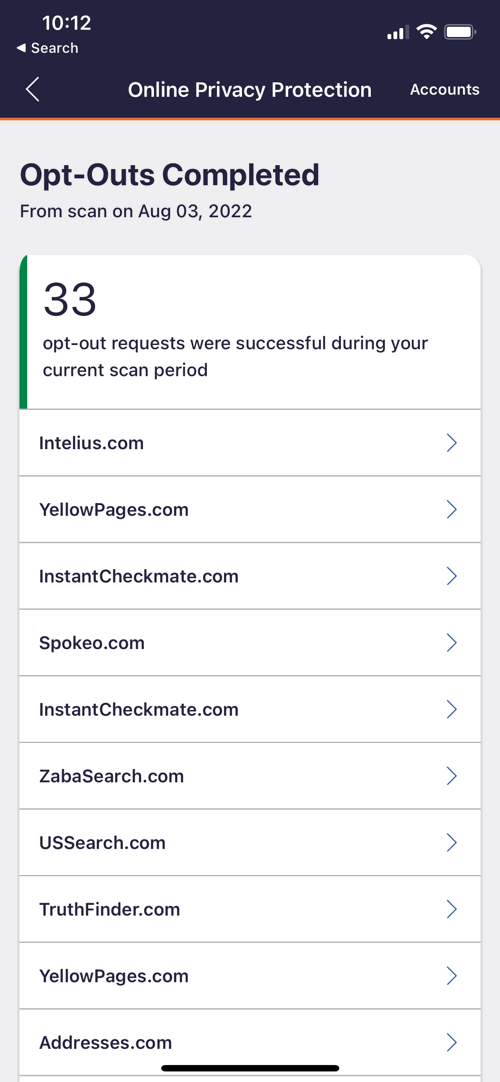
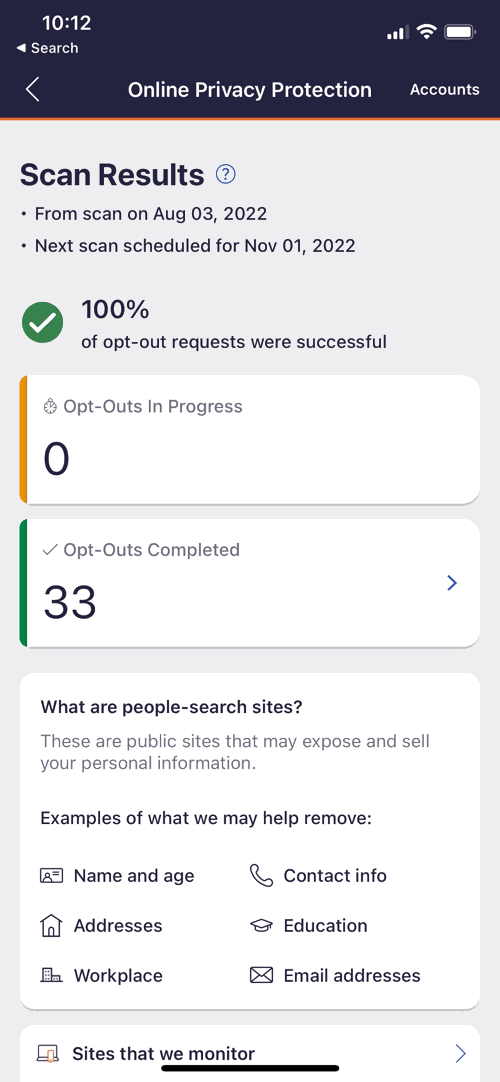
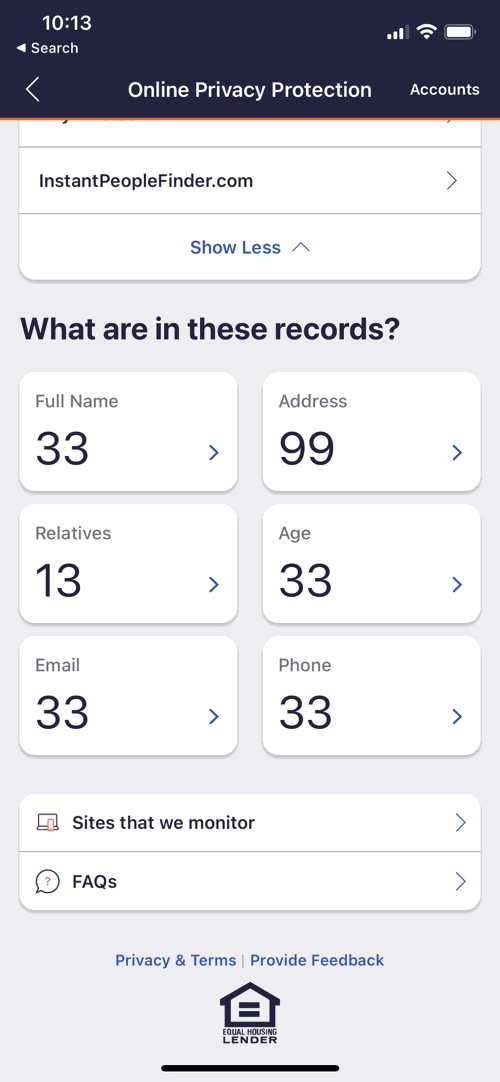
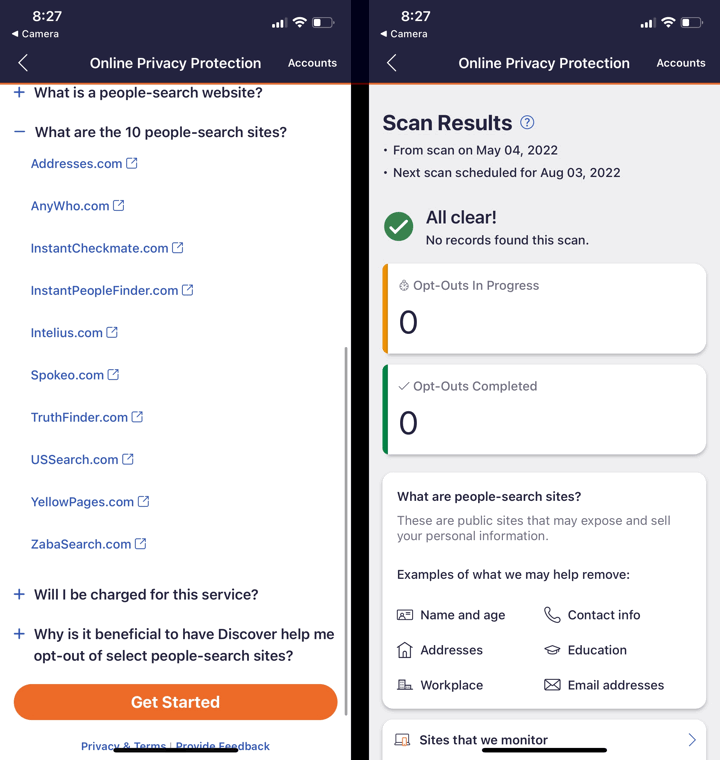
Follow-up: Although the initial scan did not find any hits (even though my data was on the sites), a subsequent scan did a better job and Discover removed my data from 33 different hits from the 10 people search sites. I randomly spot-checked them and confirmed that my information was removed. For a free service that didn’t take up my time, I am happy with this result. I would now recommend opting in and being patient. Screenshots below:

Full review:

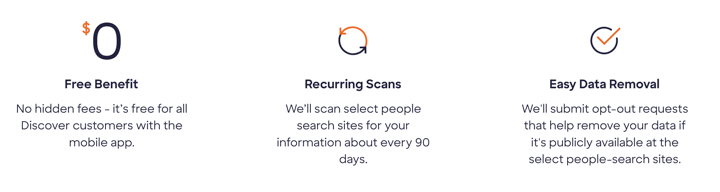
Discover is offering their credit card and banking customers a new free service called Online Privacy Protection (press release). Essentially, it automatically submits opt-out requests at 10 selected “people search sites”. These are creepy websites that scrape your personal information from many different publicly-available databases and then makes money by selling access. I wrote about these invasive sites previously and you may be surprised at how much information about you is floating around out there – your age, current and past addresses, phone numbers, and the names of your parents, siblings, children, cousins, and in-laws.

Once catch is that you must access this feature via the Discover app. They are still rolling it out, so it may not be available to everyone yet. I used the QR code from the link and it seemed to find it directly after installing the app.

Initially, after signing up for the service, I was disappointed that my May 2022 scan didn’t find my name on any of the databases. I was hopeful that was because I already opted out of several of these sites manually a few years ago. However, I manually checked and did find some of my information some of the sites. So the service is not perfect.

Here are the ten sites they mention, although there are more out there (not linked on purpose):

  • Addresses.com
  • AnyWho.com
  • InstantCheckmate.com
  • InstantPeopleFinder.com
  • Intelius.com
  • Spokeo.com
  • TruthFinder.com
  • USSearch.com
  • YellowPages.com
  • ZabaSearch.com

The scan occurs every 90 days or so. On my August 2022 scan, the app did find a bunch of hits (often multiple profiles at the same site with similar info) and went to work removing my data. I manually spot-checked a few of them and am happy to report that my information was indeed removed.

I would recommend signing up for this service now, with the knowledge that a little patience may be required.

I mainly use my Discover card for the 5% cash back categories and the occasional Amazon Pay with Points promos, but I do appreciate these side efforts. Besides being one of the first to offer a free FICO score, they also have a free Social Security and Experian credit inquiry alert service.

Federal Student Loan Forgiveness Application Website Now Open

Update 10/18/2022: You can now apply for the Federal Student Loan Debt Relief Program at https://studentaid.gov/debt-relief/application. “Time to Complete: About 5 Minutes. No Login or Documents Required.”

Original post 8/24/2022:

The big news today was that a Biden administration executive order granted a one-time forgiveness of up to $20,000 in federal student loan balances (based on income) for tens of millions of borrowers (press release). Although technically right now nobody has to make any loan repayments due to the pandemic pause, this is important to note for those that are making student loan payments anyway or planning on a private loan refinance. If you are eligible for forgiveness, you should stop making payments immediately, as you will not receive any refund for federal student loan repayments already made. Here are the highlights:

Who qualifies for debt forgiveness?

  • Annual income must have been below $125,000 (for individuals) or $250,000 (for married couples or heads of households). This is based on your 2020 or 2021 income tax returns, specifically your adjusted gross income (AGI).
  • If you DID receive a Pell Grant in college and meet the income threshold, you will be eligible for up to $20,000 in debt cancellation.
  • If you did NOT receive a Pell Grant in college and meet the income threshold, you will be eligible for up to $10,000 in debt cancellation.
  • Current students are also eligible. If they are dependents, they will be assessed based on their parents’ income.
  • Parent PLUS loans, federal loans taken out by parents to help their children pay for college, are included in the plan. In the households where the student and the parent separately took out qualifying loans, both would be eligible for relief.
  • Loans must have been originated before July 1st, 2022.

What happens if I already paid down my student loans below the $10k/$20k cap?

Sorry. The amount of forgiveness is capped at the amount of your outstanding debt. For example: If you are eligible for $20,000 in debt relief, but have a balance of $15,000 remaining, you will only receive $15,000 in relief.

If I qualify, what actions should I take now?

  • If you are making student loan payments and are near or below the cap, look into stopping those payments immediately. Don’t refinance into a private loan. Any payment you make towards your Federal student loan won’t be refunded.
  • Check with your loan servicer to ensure your address, email, and phone number are correct.
  • If the Department of Education (DoE) doesn’t have your income information already (due to an income-based repayment plan), then you will have to wait for additional guidance from your servicer.
  • To be alerted when the application process is open, sign up for email updates from the Department of Education here.

The student loan repayment pause (and 0% interest) that started in March 2020 was extended through December 31, 2022, with payments resuming in January 2023. The extended pause will occur automatically. This is supposed to be the final extension. I assume that they plan to process the forgiveness before the pause ends.

Reminder: If you haven’t yet applied for the waiver for Expanded Public Service Loan Forgiveness (PSLF), the deadline is approaching fast at the end of October 2022! I have friends that have navigated the labyrinth and finally gotten their loans forgiven via this significant opportunity.

The rest of the order starts with “the Biden-Harris Administration is proposing a rule…” so I prefer not talk about that until it is actually implemented.

Many have strong opinions about this topic. I know that I would have been quite disappointed if this occurred right after I aggressively paid down my own $30,000 in student loans while still in school (and thus deferment) and paid it off completely within a year after graduation. I always wonder how both the mortgage market (and thus housing prices) and student loan market (and thus tuition prices) would look without government involvement. Would a private lender have given me that much money based on future earning potential, if that debt was treated like others and allowed to be discharged in bankruptcy?

As the NY Times notes, this debt relief plan may be subject to legal challenges. However, if this can help you, I would fully prepare to take advantage of it.

Firstrade Broker Deposit or ACAT Transfer Bonus: Up to $4,000

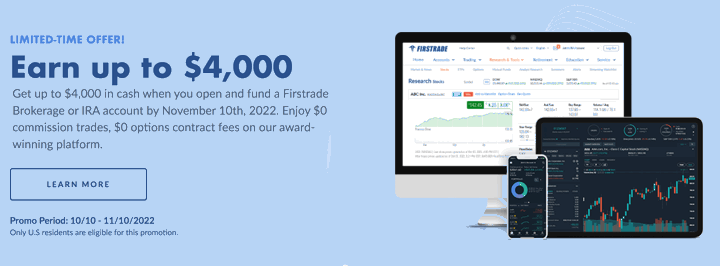
Firstrade is a broker unique in that they include $0 online stock/ETF trades, $0 options + $0 per contract, and $0 mutual fund trades (including no-load). Most of the major brokers charge per options contract and for no-load mutual fund trades. They are also unique in that they originally started out catering to the Chinese-speaking community in New York, and thus offer a Chinese language version of their site (Simplified and Traditional) and Chinese-speaking customer service reps (Mandarin and Cantonese). Right now, the are offering up to a $4,000 ACAT transfer bonus depending on the size of transferred assets:

  • $50 with $5,000 in transferred assets or deposits
  • $100 with $10,000 in transferred assets or deposits
  • $300 with $25,000 in transferred assets or deposits
  • $700 with $100,000 in transferred assets or deposits
  • $1,500 with $500,000 in transferred assets or deposits
  • $3,000 with $1,000,000 in transferred assets or deposits
  • $4,000 with $1,500,000 in transferred assets or deposits

Offer details.

  • New taxable and IRA accounts are eligible.
  • Firstrade will also cover up to $200 in ACAT transfer fees and up to $25 in wire transfer fees.
  • You must keep the assets there for at least 12 months.
  • Must open by 11/10/22 and fund within 30 days of account opening.

Offer valid for new Firstrade Brokerage or IRA accounts opened from 10/10/2022 to 11/10/2022 and funded within 30 days of account opening with $5,000 or more. To be eligible for the bonus, the new account must be opened using the specific “Open an Account” button associated with this promotional offer. Limit one offer per account type.

This offer is open to U.S. residents only and excludes current and former Firstrade account holders who have closed their accounts within the past 90 days. This offer is not transferable.

Important: The account must remain open for 12 months with the minimum funding or assets required for participating in the offer (minus any trading losses), or Firstrade may charge the account for the cost of the offer at its sole discretion. Firstrade reserves the right to restrict or revoke this offer at any time.

Commentary. This is an overall solid promotion, although right now other offers may be slightly better at any given tier amount. For example, the Public offer of $10,000 for $1,000,000 in new assets is still tops. However, I would classify Firstrade as a much more established and reputable broker with a history of solid customer service than the Public app. (I know that some people had some concerns about moving a million dollars of assets to a little-known startup.) Also, Public doesn’t allow IRAs, which is where a lot of people have their assets held. The highest ratio they offer is the $300 for $25,000 tier at slightly over 1%. Historically, paying out a 0.3% ratio ($3,000 for $1,000,000 transferred) is not bad at the $1,000,000 tier. Note the 12-month minimum holding period.

Reminder: Brokerage Asset Bonuses vs. Bank Deposit Bonuses. There is an important difference between brokerage asset bonuses and bank deposit bonuses. A bank deposit bonus pays you extra interest for holding a certain amount of cash with them. A brokerage asset bonus requires you to transfer over your existing investments like index funds, individual shares of Apple or Berkshire Hathaway, individual shares of REITs, and so on. You still own the asset and it’s still doing its thing. The brokerage bonus is on top.

In this example, if you really wanted to compare it directly against an interest rate, you should at least assume you will be holding a T-Bill ETF like GBIL or BIL (current SEC yield roughly 2.5%) and then adding this bonus on top of the yield. However, the real benefit for patient, long-term investors that you can just keep your existing assets and essentially get paid a DIY “management fee”.

Starbucks + Delta Airlines Promo: 500 SkyMiles + 150 Stars

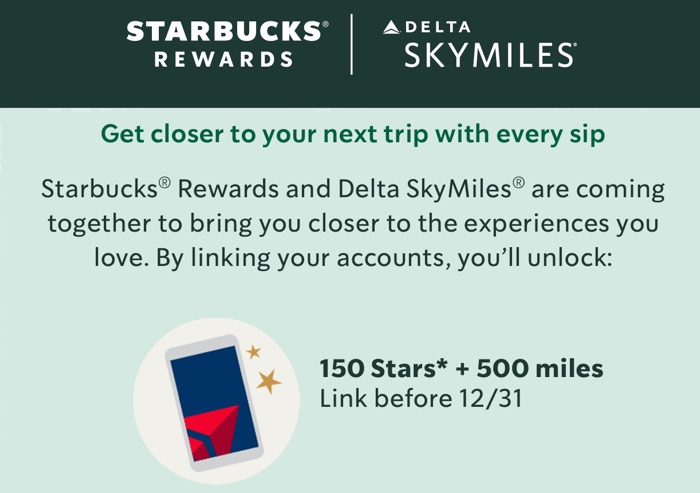
Delta Airlines is partnering with Starbucks, including with a account linking promo worth an easy 500 Delta Skymiles and 150 Starbucks Stars (worth a free drink of any size or breakfast/snack item):

  • 150 Stars and 500 miles when you link before 12/31/22.
  • Double Stars on Delta travel days
  • 1 Delta mile per $1* spent at Starbucks (excludes taxes and gratuities)

Fine print on the bonus (you need to link and then make a purchase for the 150 stars):

*Account Linking Bonus: Link your SkyMiles account and Starbucks Rewards account through DeltaStarbucks.com between October 12, 2022 and December 31, 2022 to earn (a) 500 miles and (b) if you make a Qualifying Purchase, 150 Stars. “Qualifying Purchase” means any purchase at a participating Starbucks Store of food, beverage(s), and/or merchandise, excluding purchases of alcoholic beverages, Starbucks Cards and Starbucks Card reloads. Miles will be deposited into your SkyMiles account within 10 business days of linking, and Stars will be deposited in your Starbucks Rewards account within 2 business days of the date of your first Qualifying Purchase.

Easy $5 worth of Skymiles and free drink. Looks like the website is overwhelmed right now, but I’ll try again later.

Public Stock Brokerage App: Up to $10,000 ACAT Transfer Bonus (New Tiers)

Update January 2023: Public has been gradually making the bonus tiers higher and/or the bonus amount lower, but the offer is still alive. Please visit the offer page for the most current tiers and terms.

Updates 10/11/22: Here are a few updates to my original post below:

  • The promotion now has an expiration date of 12/31/22. Of course, they always reserve the right to end it even earlier.
  • There is also now a 12-month required holding period for the $1 million asset level bonus (still 6 months holding for all other levels).
  • I have successfully received my $2,000 cash bonus for a $100,000+ ACAT transfer. I chose this bonus because 2% of assets is a very good ratio. I had to wait the full month after the transfer initiation date. The ACAT transfer itself took about 5 business days from initiation date, which was a little concerning because there were a few days where the assets were gone from my Fidelity account and hadn’t showed up at Public yet.
  • Public only has individual accounts (no joint), so you have to transfer individual accounts (no joint). Here was my process. I created a new individual brokerage account at Fidelity. I called Fidelity and asked them to transfer X shares of Y stock worth a little over $100,000 from joint to the new individual account. I transferred the entire new individual account to Public. Fidelity charged zero fees.
  • I e-mailed Public customer service a few times and they responded the same day within a few hours. I have been pleasantly surprised by the responsiveness and quality of replies.
  • I still have the same shares of the same stock, and I’ll probably buy $2,000 more with this bonus during this little market drop. 🤑

Original post 9/7/22:

Public is a stock brokerage app that has a similar user interface to Robinhood, but has a big focus on the social aspect of sharing your trades and following the stock trades of other users (thus the name). $0 stock commissions, no account minimums, Android or iOS app-only (no desktop). Interestingly, Public no longer accepts Payment for Order Flow (PFOF). Right now, they are offering up to a $10,000 cash bonus to gather more assets via ACAT transfers, depending the value of assets that you move over. Found via DoC.

  • $150 with $5,000 – $24,999 in transferred assets
  • $500 with $25,000 – $99,999 in qualifying new money
  • $2,000 with $100,000 – $499,999 in qualifying new money
  • $5,000 with $500,000 – $999,999 in qualifying new money
  • $10,000 with $1,000,000+ in qualifying new money

$500/$2,000 is 2% of $25,000/$100,000, and $10,000 is 1% of $1,000,000. As a percentage of assets transferred, these are relatively high bonus amounts at those asset levels. The minimum holding period is 6 months, per their terms:

*Cash bonus will be applied to qualifying accounts one (1) month after the transfer initiation date. Transferred funds must stay in your Public account for at least 6 months or bonus will be revoked.

As with all similar ACAT transfer offers, you can transfer over your existing stock holdings and the cost basis should also transfer over with no tax consequences. You just keep your same shares of Apple or index ETFs at a different broker. If you want to hold cash, you could also own things like Treasury bill ETFs or ultra-short term bond ETFs and earn interest on top of the bonus.

Public will also cover your former broker’s outgoing ACAT transfer fee (usually around $75) if you transfer at least $500:

Public charges no fees for incoming transfers. If your current brokerage charges you on the way out, we’ll even cover the fee if your incoming account is over $500.

Public appears to have created their own tool with a nice user interface to transfer the assets, but on the backend they use the same underlying clearing firm as many other brokerage apps (including SoFi, Stash, Betterment, WeBull, and formerly Robinhood), namely Apex Clearing. More details from their bonus FAQ:

Download the Public app and once your account is set up, go to your Settings. In the “Account” section, you’ll see an option to transfer your stocks to Public.

This offers appears to be available to both new and existing Public users. I am considering doing a partial ACAT transfer of $100,000 in ETFs as that looks like the sweet spot.

New customer to Public? Their referral program offers “free stock” worth between $3 and $300 if you open with a referral code and deposit $20+ (referrer also gets whatever you get). My referral code is mymoneyblog which you can enter on the second page of the transfer promo link above. Thanks if you use it! Alternatively, the shopping portal Swagbucks is offering $16 worth of Swagbucks points right now. If you go the Swagbucks route, it looks like you should first open the account and then go for the transfer bonus.

Side note: If Public doesn’t make money by selling your trade flow, how do they make money? For one, it earns interest on your idle cash by paying you tiny interest as many other brokers do. For another, it lends out your shares of stocks to short-sellers (and keeps all the interest). The strange thing here is that that it appears to do so by default, whereas most other brokers you must opt-in (and they split the interest with you). However, you can opt out at any time:

You may opt out of Apex’s Fully-Paid Securities Lending Program at any time by sending an email to us at support@public.com with “Securities Lending Opt-Out” in the subject.

I would opt out, as if they lend out the shares and aren’t paid back, there is counterparty risk involved if the company fails. I am not always opposed to Fully Paid Lending, but (1) I want a share of the profits and (2) I want the broker to be rock-solid financially. Read more at Loan Out Your Stocks For Extra Interest? Fully Paid Lending Income Programs. I e-mailed Public and they replied the same day with confirmation:

Thank you for reaching out! I have added you to our opt-out list. Please allow 24-48 hours for your request to be fully processed by our clearing firm.

Amazon October 11-12 Prime Day 2022: Free $10 Credit w/ $50 Gift Card Purchase

Amazon is having another Prime Day on October 11 & 12, basically another day of deals. Here are the low-hanging fruit like a $10 gift card credit and a few select deep-discount deals. Otherwise, I check on the things I need to buy anyway and try to stack them with the Shop with Points offers (like $10 off $10.01 purchase with Discover).

As the name suggests, most deals require a Prime membership. New members can sign up for a 30-day free trial. If you’ve already done the trial, you can simply buy a month of Prime for $14.99 ($6.99 with EBT or Medicaid card).

(Note: If you are reading this in an email/RSS reader, unfortunately I am not allowed to include any Amazon affiliate links in e-mails, so they have been removed. Just click here to view the links.)

Live on October 11th

  • $10 promotional credit with the purchase of $50 gift card from top brands, including but not limited to Amazon, Panera, GAP, and Fanatics. Promotional offers and options may vary, while supplies last. Update: For Amazon GC, “you must not have purchased an Amazon Gift Card in the last 12 months.”
  • 20% off (up to $10) on Grubhub orders using code Prime20. This 48-hour deal is available for orders over $15 and can only be used once.
  • Amazon Music 4 month free trial

“Shop with Points” Promos (Check again to see if targeted)

Free year of Grubhub+ membership ($120 value)

  • Amazon Prime members can enjoy a free one-year Grubhub+ membership (normally $9.99/month) with their Prime membership.
  • Grubhub+ is a monthly membership offering unlimited $0 delivery fees on orders of $12+ (before tax, tip, and other applicable fees) at eligible restaurants, access to exclusive member perks—like free food and order discounts—and donation matching. See the full Grubhub+ terms and conditions for more information.
  • After your free one-year Grubhub+ membership ends, Grubhub will charge the payment method associated with your Grubhub account on a monthly basis at the then-current rate (currently $9.99/month). You can cancel any time by contacting Grubhub customer support or visiting the “Grubhub+ membership” section in your Grubhub account settings.

Misc

If you don’t have the Amazon credit card, Discover has Amazon as a 5% cash back category this quarter.

Best Interest Rates on Cash – October 2022 Update

Here’s my monthly roundup of the best interest rates on cash as of October 2022, roughly sorted from shortest to longest maturities. We all need some safe assets for cash reserves or portfolio stability, and there are often lesser-known opportunities available to individual investors. Check out my Ultimate Rate-Chaser Calculator to see how much extra interest you’d earn by moving money between accounts. Rates listed are available to everyone nationwide. Rates checked as of 10/3/2022.
TL;DR: 4% APY on up to $6,000 for liquid savings at Current with no direct deposit requirement. Elements Financial at 3.25% APY liquid savings, rate guaranteed for 1 year. 1-year CD at 3.85% APY. 5-year CD at 4.42% APY. Compare against Treasury bills and bonds at every maturity (12-month near 4%). 9.62% Savings I Bonds still available if you haven’t maxed out limits.

Fintech accounts
Available only to individual investors, fintech companies often pay higher-than-market rates in order to achieve fast short-term growth (often using venture capital). “Fintech” is usually a software layer on top of a partner bank’s FDIC insurance.

  • 4% APY on $6,000. Current offers 4% APY on up to $6,000 total ($2,000 each on three savings pods). No direct deposit required. $50 referral bonus for new members with $200+ direct deposit with promo code JENNIFEP185. Please see my Current app review for details.
  • 3% APY on up to $250,000, but requires direct deposit and credit card spend. HM Bradley will now pay up to 3% APY on up to $250,000 if you open both a checking and credit card with them and maintain positive cashflow each month, $500 in total direct deposits each month, and $500 in credit card purchases each month. Existing customers will get 3% APY with requirements waived through end of 2022. Please see my updated HM Bradley review for details.

High-yield savings accounts
Since the huge megabanks pay essentially no interest, I think every should have a separate, no-fee online savings account to accompany your existing checking account. The interest rates on savings accounts can drop at any time, so I list the top rates as well as competitive rates from banks with a history of competitive rates. Some banks will bait you with a temporary top rate and then lower the rates in the hopes that you are too lazy to leave.

  • Rates rising across the board, while the leapfrogging to be the temporary “top” rate continues. Elements Financial at 3.25% APY ($2,500 minimum, new money, rate guaranteed for 1 year).
  • SoFi Bank is now up to 2.50% APY + up to $325 new account bonus with direct deposit. You must maintain a direct deposit of any amount each month for the higher APY. SoFi has their own bank charter now so no longer a fintech by my definition. See details at $25 + $300 SoFi Money new account and deposit bonus.
  • There are several other established high-yield savings accounts at closer to 2.15% APY. Marcus by Goldman Sachs is on that list, and if you open a new account with a Marcus referral link (from reader Paul) you can get an extra 1.00% APY for your first 3 months.

Short-term guaranteed rates (1 year and under)
A common question is what to do with a big pile of cash that you’re waiting to deploy shortly (plan to buy a house soon, just sold your house, just sold your business, legal settlement, inheritance). My usual advice is to keep things simple and take your time. If not a savings account, then put it in a flexible short-term CD under the FDIC limits until you have a plan.

  • No Penalty CDs offer a fixed interest rate that can never go down, but you can still take out your money (once) without any fees if you want to use it elsewhere. CIT Bank has a 11-month No Penalty CD at 2.75% APY with a $1,000 minimum deposit. Ally Bank has a 11-month No Penalty CD at 2.00% APY for all balance tiers. Marcus has a 13-month No Penalty CD at 2.20% APY with a $500 minimum deposit. You may wish to open multiple CDs in smaller increments for more flexibility.
  • State Bank of Texas has a 12-month certificate at 3.85% APY. $25,000 minimum. Early withdrawal penalty is 60 days of interest.

Money market mutual funds + Ultra-short bond ETFs*
Many brokerage firms that pay out very little interest on their default cash sweep funds (and keep the difference for themselves). * Money market mutual funds are regulated, but ultimately not FDIC-insured, so I would still stick with highly reputable firms. I am including a few ultra-short bond ETFs as they may be your best cash alternative in a brokerage account, but they may experience short-term losses.

  • Vanguard Federal Money Market Fund is the default sweep option for Vanguard brokerage accounts, which has an SEC yield of 2.77%. Compare with your own broker’s money market rate.
  • Vanguard Ultra-Short-Term Bond Fund currently pays 3.42% SEC yield ($3,000 min) and 3.52% SEC Yield ($50,000 min). The average duration is ~1 year, so your principal may vary a little bit.
  • The PIMCO Enhanced Short Maturity Active Bond ETF (MINT) has a 3.05% SEC yield and the iShares Short Maturity Bond ETF (NEAR) has a 3.41% SEC yield while holding a portfolio of investment-grade bonds with an average duration of ~6 months.

Treasury Bills and Ultra-short Treasury ETFs
Another option is to buy individual Treasury bills which come in a variety of maturities from 4-weeks to 52-weeks and are fully backed by the US government. You can also invest in ETFs that hold a rotating basket of short-term Treasury Bills for you, while charging a small management fee for doing so. T-bill interest is exempt from state and local income taxes.

  • You can build your own T-Bill ladder at TreasuryDirect.gov or via a brokerage account with a bond desk like Vanguard and Fidelity. Here are the current Treasury Bill rates. As of 10/3/2022, a new 4-week T-Bill had the equivalent of 2.79% annualized interest and a 52-week T-Bill had the equivalent of 4.00% annualized interest.
  • The Goldman Sachs Access Treasury 0-1 Year ETF (GBIL) has a 2.44% SEC yield and the SPDR Bloomberg Barclays 1-3 Month T-Bill ETF (BIL) has a 2.36% SEC yield. GBIL appears to have a slightly longer average maturity than BIL.

US Savings Bonds
Series I Savings Bonds offer rates that are linked to inflation and backed by the US government. You must hold them for at least a year. If you redeem them within 5 years there is a penalty of the last 3 months of interest. The annual purchase limit for electronic I bonds is $10,000 per Social Security Number, available online at TreasuryDirect.gov. You can also buy an additional $5,000 in paper I bonds using your tax refund with IRS Form 8888.

  • “I Bonds” bought between May 2022 and October 2022 will earn a 9.62% rate for the first six months. The rate of the subsequent 6-month period will be based on inflation again. More on Savings Bonds here.
  • In mid-October 2022, the CPI will be announced and you will have a short period where you will have a very close estimate of the rate for the next 12 months. I will have another post up at that time.
  • See below about EE Bonds as a potential long-term bond alternative.

Prepaid Cards with Attached Savings Accounts
A small subset of prepaid debit cards have an “attached” FDIC-insured savings account with exceptionally high interest rates. The negatives are that balances are severely capped, and there are many fees that you must be careful to avoid (lest they eat up your interest). There is a long list of previous offers that have already disappeared with little notice. I don’t personally recommend nor use any of these anymore, as I feel the work required and the fees charged if you mess up exceeds any small potential benefit.

  • Mango Money pays 6% APY on up to $2,500, if you manage to jump through several hoops. Requirements include $1,500+ in “signature” purchases and a minimum balance of $25.00 at the end of the month.
  • NetSpend Prepaid pays 5% APY on up to $1,000 but be warned that there is also a $5.95 monthly maintenance fee if you don’t maintain regular monthly activity.

Rewards checking accounts
These unique checking accounts pay above-average interest rates, but with unique risks. You have to jump through certain hoops which usually involve 10+ debit card purchases each cycle, a certain number of ACH/direct deposits, and/or a certain number of logins per month. If you make a mistake (or they judge that you did) you risk earning zero interest for that month. Some folks don’t mind the extra work and attention required, while others would rather not bother. Rates can also drop suddenly, leaving a “bait-and-switch” feeling.

  • (Rate will increase to 4.00% APY with the qualification cycle beginning October 20, 2022.) The Bank of Denver pays 2.50% APY on up to $15,000 if you make 12 debit card purchases of $5+ each, receive only online statements, and make at least 1 ACH credit or debit transaction per statement cycle. If you meet those qualifications, you can also link a Kasasa savings account that pays 1.00% APY on up to $25k. Thanks to reader Bill for the updated info.
  • Presidential Bank pays 3.00% APY on balances between $500 and up to $25,000 (2.50% APY above that) if you maintain a $500+ direct deposit and at least 7 electronic withdrawals per month (ATM, POS, ACH and Billpay counts).
  • Liberty Federal Credit Union pays 3.45% APY on up to $20,000. You’ll need at least 15 debit transactions and other requirements every month.
  • Lake Michigan Credit Union pays 3.00% APY on up to $15,000. You’ll need at least 10 debit transactions and other requirements every month.
  • Find a locally-restricted rewards checking account at DepositAccounts.

Certificates of deposit (greater than 1 year)
CDs offer higher rates, but come with an early withdrawal penalty. By finding a bank CD with a reasonable early withdrawal penalty, you can enjoy higher rates but maintain access in a true emergency. Alternatively, consider building a CD ladder of different maturity lengths (ex. 1/2/3/4/5-years) such that you have access to part of the ladder each year, but your blended interest rate is higher than a savings account. When one CD matures, use that money to buy another 5-year CD to keep the ladder going. Some CDs also offer “add-ons” where you can deposit more funds if rates drop.

  • Lafayette Federal Credit Union has a a 5-year certificate at 4.42% APY ($500 min), 4-year at 4.32% APY, 3-year at 4.22% APY, 2-year at 4.11% APY, and 1-year at 3.80% APY. Early withdrawal penalty can be quite severe though, with the 5-year CD penalty being 600 days of interest. Anyone can join this credit union via partner organization ($10 one-time fee).
  • Bread Financial has a 5-year certificate at 4.25% APY ($1,500 min), 4-year at 4.15% APY, 3-year at 4.00% APY, 2-year at 3.75% APY, and 1-year at 3.60% APY. The early withdrawal penalty for the 5-year is 365 days of interest.
  • You can buy certificates of deposit via the bond desks of Vanguard and Fidelity. You may need an account to see the rates. These “brokered CDs” offer FDIC insurance and easy laddering, but they don’t come with predictable early withdrawal penalties. Right now, I see no 5-year CDs available (non-callable). Be wary of higher rates from callable CDs, which means they can call back your CD if rates drop later.

Longer-term Instruments
I’d use these with caution due to increased interest rate risk, but I still track them to see the rest of the current yield curve.

  • Willing to lock up your money for 10 years? You can buy long-term certificates of deposit via the bond desks of Vanguard and Fidelity. These “brokered CDs” offer FDIC insurance, but they don’t come with predictable early withdrawal penalties. You might find something that pays more than your other brokerage cash and Treasury options. Right now, I see no 10-year CDs available (non-callable) vs. 3.72% for a 10-year Treasury. Watch out for higher rates from callable CDs where they can call your CD back if interest rates drop.
  • How about two decades? Series EE Savings Bonds are not indexed to inflation, but they have a unique guarantee that the value will double in value in 20 years, which equals a guaranteed return of 3.5% a year. However, if you don’t hold for that long, you’ll be stuck with the normal rate which is quite low (currently 0.10%). Purchase limit is $10,000 each calendar year for each Social Security Number. However, this feature is no longer interesting because as of 10/3/2022, the 20-year Treasury Bond rate was 4.00%.

All rates were checked as of 10/3/2022.

AnnualCreditReport.com: Free Weekly Credit Reports Extended Through End of 2023

Extended again through 2023. AnnualCreditReport.com remains the official government-mandated source of free credit reports. Usually, you can only request a free copy of your credit report every rolling 12 months from each credit reporting company. For example, if you request an Experian report in September 2022, then you must wait until September 2023 to request another Experian report. You could also spread things out by staggering requests, for example Experian every April, Equifax every August, and TransUnion every December.

From now until December 2023, you can request all 3 major credit reports as often as once every week at no cost for any reason. Consumer Reports called out that the weekly reports were set to expire at the end of 2022, and this 9/23/22 press release confirmed that they would extend it by another 12 months.

The three nationwide credit reporting agencies – Equifax® (NYSE:EFX), Experian (LON:EXPN) and TransUnion (NYSE:TRU) – are taking joint action to continue offering free weekly credit reports to consumers in the United States through the end of 2023.

This higher frequency may also come in handy for anyone who has requested some relief on their mortgages, auto loans, student loans, credit cards, and so on. If you agree to a forbearance or some other COVID-related relief agreement with your lender, you will want to make sure that your credit reports are still marked as current and that your credit will not be adversely affected as part of that agreement.

According to Consumer Reports, mistakes on credit reports are the No. 1 consumer complaint so far this year.

Last year, CR asked a panel of nearly 6,000 volunteers to review their credit reports for mistakes. In almost a third of cases, participants found at least one error.

And in a January 2021 CR nationally representative survey (PDF) of 2,223 adults, 12 percent of people who had ever checked their credit report said they found at least one mistake.

In addition, Consumer Reports offers the following advice if you need to file a dispute for a correction:

Create a paper trail. Tempting as it may be, don’t file the dispute online, because that doesn’t provide a written record that you can rely on later if needed. And avoid the standardized online forms provided by the credit bureaus, which might oversimplify your dispute by requiring you to choose among predetermined check boxes. Further, by submitting your dispute online, you could unwittingly waive your right to sue as an individual or in a class action. Instead, write a letter explaining the problem. Use this sample letter from the CFPB (PDF).

Free full reports upon manual request are nice, but I have been quite happy with my “suite” of additional services that continuously and passively monitor my credit reports for new credit inquiries and other changes.

CIT Bank Promo: Free 1 Year Amazon Prime Membership (EXPIRED)

Update: This offer is now expired. Please visit this page for current CIT Bank products and rates.

Expired offer details:

CIT Bank is an FDIC-insured bank (now a division of First Citizens Bank) that has offered competitive interest rate options to savers in the past including the Savings Builder and No-Penalty CDs, so you may already have an account with them.

The CIT Bank Money Market account has launched a new Amazon Prime deposit promotion: when a new or existing customer makes a deposit of $15,000 from an external funding source and keeps it there for at least 60 days, they get an additional bonus of a 1-year Amazon Prime subscription (cash value of $139). Additional details:

  • Open a CIT Bank Money Market account here using the promo code AMZN22.
  • Fund your account with at least $15,000 within 15 days and keep a minimum balance of at least $15,000 for 60 days following the 15-day funding period.
  • Within 30 days following the end of the funding period, if you’ve fulfilled the requirements, CIT Bank will send you an email with your Prime membership code.
  • Yes, this works for existing Amazon Prime users. Customers who are already Amazon Prime members can use the one year of Amazon Prime to renew their membership for an additional year.
  • Existing CIT Bank members are eligible, but you have to open a new Money Market account (you can have more than one) and fund with “new money” outside of CIT Bank.

Bonus math. If you assume the bonus is worth $139, this is a ~0.93% bonus on $15,000. Let’s assume an overly-conservative minimum holding period of 90 total days, which makes it the equivalent of ~3.71% APY annualized. The bonus is on top of the standard interest rate, currently 1.55% APY as of 11/30/22. This total of roughly 5.26% APY over 90 days makes it a great short-term rate at that balance size. CIT Bank also has a decent history of offering competitive products and promotions on their savings account and CD products.

I plan on grabbing this year of Amazon Prime – I already have accounts at CIT Bank and I already have idle liquid cash elsewhere sitting at effectively the same base APY. Nice to see another bank itching to gather deposits.