Fifth Third Bank $250 New Checking Account Bonus w/ Direct Deposit (Expired)

Expired: This offer is no longer available.

Fifth Third Bank has a $250 new checking bonus when you open an eligible Fifth Third checking account and make direct deposits totaling $1,000 or more within 90 days of account opening. Note that Fifth Third Bank usually only accepts applications from the geographic area where they have physical branches, including the following 10 states: Florida, Georgia, Illinois, Indiana, Kentucky, Michigan, North Carolina, Ohio, South Carolina, Tennessee, West Virginia.

Opening online should automatically populate the Offer Code, or you can request an e-mail with a unique code to bring to a physical branch. Here the fine print:

To qualify for the $250 checking bonus, provide the offer code, open a Fifth Third Momentum® Checking, or Preferred2 checking account by 12/31/2022 and make qualifying direct deposits totaling $1,000 or more within 90 days of account opening. Account(s) must be funded within 45 days of account opening or account may be closed, and you may not be eligible for the bonus. The $250 checking bonus does not require any additional activities. A qualifying Direct Deposit is an Automated Clearing House (ACH) credit, which may include payroll, pension or government payments (such as Social Security). The cash bonus will be deposited into your new account within 10 business days of completing qualifying activity requirements. In order to receive the cash bonus, your checking account must be open and in good standing. Offer is not available to existing Fifth Third checking customers or to those with a Fifth Third Checking account that has been closed within the last 12 months. Bank reserves the right to limit each customer to one new account-related gift incentive per calendar year. Eligibility may be limited based on your account type and ownership role. Account must be funded within 45 days of account opening. No minimum deposit required to open a checking account. Bonus may be taxable as interest income and reported on IRS Form 1099-INT. Consult your tax advisor. UNIQUE OFFER CODE MUST BE PRESENTED AT ACCOUNT OPENING TO RECEIVE THE BONUS. See your banker for details. Not valid with any other offer.

The Fifth Third Momentum Checking account has no minimum balance, no monthly service fees, and fee-free ATM access on the Allpoint, Presto!, and 7-Eleven ATM networks.


Tellus App: “High-Yield Savings” That Isn’t FDIC-Insured, Backed by Vague Promises

A few readers asked about the Tellus app, which compares itself to savings accounts and pays 3.00% APY with no caps. (4.50% APY is only up to $2,500.) Here’s a quick explanation of why it’s an easy pass. Tellus investments are not FDIC-insured and they only provide a very vague description how your money is actually invested. From their FAQ:

How does Tellus afford to pay me such a high interest rate?

Tellus generates its revenues as a non-bank lender. We provide mortgages – loans secured by residential real estate. We use technology and proprietary data to choose opportunities so that we can minimize loss and fraud; this lets us pass the profits onto you in the form of highly competitive yields.

That’s a lot of fancy words, but my translation is “Tellus lends your money out at a lot more than 3.00% APY on unknown residential real estate of unknown quality, in unknown geographic areas, at unknown loan-to-value ratios”.

Mystery underlying investments. Think of all the properties in the world that could fall under “US-based real estate”. With a more transparent structure like that of Peerstreet, I can choose the exact address of the house or building that I am investing in. I can see the original appraisal. I see the borrower terms and interest rate. I can find the purchase history, the tax records, and look up comparable properties nearby. I know I’m earning 7-9% interest rates and Peerstreet is taking about 1%. With Fundrise, I get updates with the address and pictures of the exact apartment building they just bought, and they are SEC-registered private REITs. With Tellus, I have none of this. They are asking for a lot of trust for a new startup company. Are the loans wrapped in a bankruptcy-remote vehicle? Are they registered with the SEC?

Questionable promises of safety. When lending out on residential real estate, I also accept that I can lose money on the deal, because that’s how the world works. That’s honest. From their FAQ:

Is my money safe? Can I always get my money back?
Yes, your money is safe. All transactions and personal identifying data is protected by bank-level, 256-bit AES encryption. You can trust that your money and data are secure with Tellus. You will always get your money back and you can withdraw at any time.

In my opinion, this is not honest. If you’ve paid attention at all during the crypto crisis, you know that “You will always get your money back and you can withdraw at any time” really means “Your money is really the assets of a young start-up company, and if something bad happens then we may instantly freeze all withdrawals”. Real estate loans can go bad. Startup companies can go bankrupt.

This reminds me of the biggest red flag from peer-to-peer lending: The more profusely someone promises to pay you back, the less likely they are to pay you back.

Low returns for level of risk. Even if I knew Tellus lent money using conservative underwriting and everything goes perfectly, you will never get more than the promised APY. 3% APY is far too low. A 90-day Treasury bill pays more than 3%. I would expect at least double their interest rate for the risk involved in real estate lending, which means Tellus might be taking a big cut for themselves (they don’t disclose their cut either). I regularly post FDIC-insured deals at effective rates of 4%+ APY with 100% certainty that I will get 100% of my money back.

Tellus could be run by well-meaning, honest geniuses, but there is no way I’m taking this much risk for limited upside with my hard-earned money. Look beyond the slick marketing and stock photos of happy families. There are many alternatives earning a higher return with more easy assessable level of risk.

Bottom line. Tellus advertises “high yield” and “safety”, when in my opinion it offers the opposite: relatively low returns for the level of risk you are taking on (which is completely unknowable since you have no idea what they are investing in). You are risking complete loss of your investment in a young startup that is not FDIC-insured, and thus it is an easy pass for me. Be careful.

Best Interest Rates on Cash – September 2022 Update

Here’s my monthly roundup of the best interest rates on cash as of September 2022, roughly sorted from shortest to longest maturities. We all need some safe assets for cash reserves or portfolio stability, and there are often lesser-known opportunities available to individual investors. Check out my Ultimate Rate-Chaser Calculator to see how much extra interest you’d earn by moving money between accounts. Rates listed are available to everyone nationwide. Rates checked as of 9/1/2022.
TL;DR: 4% APY on up to $6,000 for liquid savings at Current with no direct deposit requirement. Total Direct at 2.60% APY liquid savings. 1-year CD 3.21% APY. 49-month at 3.85% APY. Compare against Treasury bills and bonds at every maturity (12 month near 3.50%). 9.62% Savings I Bonds still available if you haven’t maxed out limits.

Fintech accounts
Available only to individual investors, fintech companies often pay higher-than-market rates in order to achieve fast short-term growth (often using venture capital). “Fintech” is usually a software layer on top of a partner bank’s FDIC insurance.

  • 4% APY on $6,000. Current offers 4% APY on up to $6,000 total ($2,000 each on three savings pods). No direct deposit required. $50 referral bonus for new members with $200+ direct deposit with promo code JENNIFEP185. Please see my Current app review for details.
  • 3% APY on up to $100,000, but requires direct deposit and credit card spend. HM Bradley pays up to 3% APY on up to $100,000 if you open both a checking and credit card with them, maintain $1,500 in total direct deposits each month, and make $100 in credit card purchases each month. Please see my updated HM Bradley review for details.

High-yield savings accounts
Since the huge megabanks pay essentially no interest, I think every should have a separate, no-fee online savings account to accompany your existing checking account. The interest rates on savings accounts can drop at any time, so I list the top rates as well as competitive rates from banks with a history of competitive rates. Some banks will bait you with a temporary top rate and then lower the rates in the hopes that you are too lazy to leave.

  • Rates rising across the board, while the leapfrogging to be the temporary “top” rate continues. TotalDirectBank at 2.60% APY ($2,500 minimum, must initiate transfer from external bank, no FL residents for some reason). SaveBetter at 2.50% APY ($1 minimum) through Ponce Bank and Liberty Savings Bank.
  • SoFi Bank is now up to 2.00% APY + up to $325 new account bonus with direct deposit. You must maintain a direct deposit each month of any amount for the higher APY. SoFi has their own bank charter now so no longer a fintech by my definition. See details at $25 + $300 SoFi Money new account and deposit bonus.
  • There are several other established high-yield savings accounts at closer to 1.50% APY. Marcus by Goldman Sachs is on that list, and if you open a new account with a Marcus referral link (from reader Paul) you can get an extra 1.00% APY for your first 3 months.

Short-term guaranteed rates (1 year and under)
A common question is what to do with a big pile of cash that you’re waiting to deploy shortly (plan to buy a house soon, just sold your house, just sold your business, legal settlement, inheritance). My usual advice is to keep things simple and take your time. If not a savings account, then put it in a flexible short-term CD under the FDIC limits until you have a plan.

  • No Penalty CDs offer a fixed interest rate that can never go down, but you can still take out your money (once) without any fees if you want to use it elsewhere. CIT Bank has a 11-month No Penalty CD at 2.15% APY with a $1,000 minimum deposit. Ally Bank has a 11-month No Penalty CD at 2.00% APY for all balance tiers. Marcus has a 13-month No Penalty CD at 1.75% APY with a $500 minimum deposit. You may wish to open multiple CDs in smaller increments for more flexibility.
  • Connexus Credit Union has a 12-month certificate at 3.21% APY. $5,000 minimum. Early withdrawal penalty is 90 days of interest. Anyone can join this credit union via partner organization.

Money market mutual funds + Ultra-short bond ETFs*
Many brokerage firms that pay out very little interest on their default cash sweep funds (and keep the difference for themselves). * Money market mutual funds are regulated, but ultimately not FDIC-insured, so I would still stick with highly reputable firms. I am including a few ultra-short bond ETFs as they may be your best cash alternative in a brokerage account, but they may experience short-term losses.

  • Vanguard Federal Money Market Fund is the default sweep option for Vanguard brokerage accounts, which has an SEC yield of 2.14%. Compare with your own broker’s money market rate.
  • Vanguard Ultra-Short-Term Bond Fund currently pays 2.97% SEC yield ($3,000 min) and 3.07% SEC Yield ($50,000 min). The average duration is ~1 year, so your principal may vary a little bit.
  • The PIMCO Enhanced Short Maturity Active Bond ETF (MINT) has a 2.75% SEC yield and the iShares Short Maturity Bond ETF (NEAR) has a 2.85% SEC yield while holding a portfolio of investment-grade bonds with an average duration of ~6 months.

Treasury Bills and Ultra-short Treasury ETFs
Another option is to buy individual Treasury bills which come in a variety of maturities from 4-weeks to 52-weeks and are fully backed by the US government. You can also invest in ETFs that hold a rotating basket of short-term Treasury Bills for you, while charging a small management fee for doing so. T-bill interest is exempt from state and local income taxes.

  • You can build your own T-Bill ladder at TreasuryDirect.gov or via a brokerage account with a bond desk like Vanguard and Fidelity. Here are the current Treasury Bill rates. As of 9/1/2022, a new 4-week T-Bill had the equivalent of 2.33% annualized interest and a 52-week T-Bill had the equivalent of 3.50% annualized interest.
  • The Goldman Sachs Access Treasury 0-1 Year ETF (GBIL) has a 2.07% SEC yield and the SPDR Bloomberg Barclays 1-3 Month T-Bill ETF (BIL) has a 1.80% SEC yield. GBIL appears to have a slightly longer average maturity than BIL.

US Savings Bonds
Series I Savings Bonds offer rates that are linked to inflation and backed by the US government. You must hold them for at least a year. If you redeem them within 5 years there is a penalty of the last 3 months of interest. The annual purchase limit for electronic I bonds is $10,000 per Social Security Number, available online at TreasuryDirect.gov. You can also buy an additional $5,000 in paper I bonds using your tax refund with IRS Form 8888.

  • “I Bonds” bought between May 2022 and October 2022 will earn a 9.62% rate for the first six months. The rate of the subsequent 6-month period will be based on inflation again. More on Savings Bonds here.
  • In mid-October 2022, the CPI will be announced and you will have a short period where you will have a very close estimate of the rate for the next 12 months. I will have another post up at that time.
  • See below about EE Bonds as a potential long-term bond alternative.

Prepaid Cards with Attached Savings Accounts
A small subset of prepaid debit cards have an “attached” FDIC-insured savings account with exceptionally high interest rates. The negatives are that balances are severely capped, and there are many fees that you must be careful to avoid (lest they eat up your interest). There is a long list of previous offers that have already disappeared with little notice. I don’t personally recommend nor use any of these anymore, as I feel the work required and the fees charged if you mess up exceeds any small potential benefit.

  • Mango Money pays 6% APY on up to $2,500, if you manage to jump through several hoops. Requirements include $1,500+ in “signature” purchases and a minimum balance of $25.00 at the end of the month.
  • NetSpend Prepaid pays 5% APY on up to $1,000 but be warned that there is also a $5.95 monthly maintenance fee if you don’t maintain regular monthly activity.

Rewards checking accounts
These unique checking accounts pay above-average interest rates, but with unique risks. You have to jump through certain hoops which usually involve 10+ debit card purchases each cycle, a certain number of ACH/direct deposits, and/or a certain number of logins per month. If you make a mistake (or they judge that you did) you risk earning zero interest for that month. Some folks don’t mind the extra work and attention required, while others would rather not bother. Rates can also drop suddenly, leaving a “bait-and-switch” feeling.

  • Porte fintech app requires a one-time direct deposit of $1,000+ to open a savings account. Porte then requires $3,000 in direct deposits and 15 debit card purchases per quarter (average $1,000 direct deposit and 5 debit purchases per month) to receive 3% APY on up to $15,000. New customer bonus via referral.
  • The Bank of Denver pays 2.50% APY on up to $15,000 if you make 12 debit card purchases of $5+ each, receive only online statements, and make at least 1 ACH credit or debit transaction per statement cycle. If you meet those qualifications, you can also link a Kasasa savings account that pays 1.00% APY on up to $25k. Thanks to reader Bill for the updated info.
  • Presidential Bank pays 2.25% APY on balances between $500 and up to $25,000, if you maintain a $500+ direct deposit and at least 7 electronic withdrawals per month (ATM, POS, ACH and Billpay counts).
  • Evansville Teachers Federal Credit Union (soon Liberty FCU) pays 3.30% APY on up to $20,000. You’ll need at least 15 debit transactions and other requirements every month.
  • Lake Michigan Credit Union pays 3.00% APY on up to $15,000. You’ll need at least 10 debit transactions and other requirements every month.
  • Find a locally-restricted rewards checking account at DepositAccounts.

Certificates of deposit (greater than 1 year)
CDs offer higher rates, but come with an early withdrawal penalty. By finding a bank CD with a reasonable early withdrawal penalty, you can enjoy higher rates but maintain access in a true emergency. Alternatively, consider building a CD ladder of different maturity lengths (ex. 1/2/3/4/5-years) such that you have access to part of the ladder each year, but your blended interest rate is higher than a savings account. When one CD matures, use that money to buy another 5-year CD to keep the ladder going. Some CDs also offer “add-ons” where you can deposit more funds if rates drop.

  • Bread Financial has a 5-year certificate at 3.65% APY ($1,500 min), 4-year at 3.60% APY, 3-year at 3.55% APY, 2-year at 3.50% APY, and 1-year at 3.00% APY. The early withdrawal penalty for the 5-year is 365 days of interest.
  • NASA FCU has special 49-month CD at 3.85% APY. $10,000 minimum of new money. The early withdrawal penalty for the 5-year is 365 days of interest. Anyone can join this credit union via partner organization.
  • You can buy certificates of deposit via the bond desks of Vanguard and Fidelity. You may need an account to see the rates. These “brokered CDs” offer FDIC insurance and easy laddering, but they don’t come with predictable early withdrawal penalties. Right now, I see a 5-year CD at 3.55% APY. Be wary of higher rates from callable CDs listed by Fidelity.

Longer-term Instruments
I’d use these with caution due to increased interest rate risk, but I still track them to see the rest of the current yield curve.

  • Willing to lock up your money for 10 years? You can buy long-term certificates of deposit via the bond desks of Vanguard and Fidelity. These “brokered CDs” offer FDIC insurance, but they don’t come with predictable early withdrawal penalties. You might find something that pays more than your other brokerage cash and Treasury options. Right now, I see a 10-year CD at 3.90% APY vs. 3.30% for a 10-year Treasury. Watch out for higher rates from callable CDs where they can call your CD back if interest rates rise.
  • How about two decades? Series EE Savings Bonds are not indexed to inflation, but they have a unique guarantee that the value will double in value in 20 years, which equals a guaranteed return of 3.5% a year. However, if you don’t hold for that long, you’ll be stuck with the normal rate which is quite low (currently 0.10%). I view this as a huge early withdrawal penalty. But if holding for 20 years isn’t an issue, it can also serve as a hedge against prolonged deflation during that time. Purchase limit is $10,000 each calendar year for each Social Security Number. As of 9/1/2022, the 20-year Treasury Bond rate was 3.53%.

All rates were checked as of 9/1/2022.

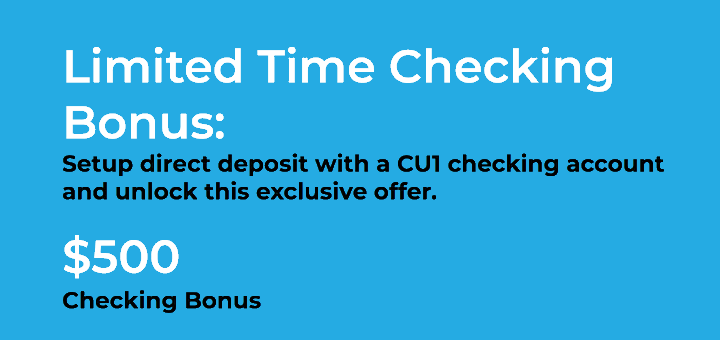
Credit Union 1 (CU1) New Checking Account Promo $500 w/ Direct Deposit

Credit Union 1 (CU1) has a $500 checking account promotion with qualifying direct deposits. Available to both new and existing customers who haven’t set up direct deposit yet. Based in Illinois, CU1 membership is open nationwide through membership in the Credit Union 1 Educational Development Association (one-time $5 CU1EDA fee + additional one-time $5 CU1 membership fee). Hat tip to reader Chuck. Offer expires 9/30/22.

$500 Direct Deposit bonus steps.

  • Open a CU1 Checking Account. Open a checking account with CU1 online and use Promo Code CHK500, at your local branch or by calling. Must open with $25 minimum or a $500 direct deposit. Already a member with a checking account? Setup your direct deposit in digital banking and call our team to mention the “$500 checking offer”.
  • Set up direct deposit ($1,000/month for 3 months). Establish direct deposit activity within 60 days of account opening or by September 30th, 2022. Minimum recurring aggregate total direct deposit of $1,000 per month for three (3) consecutive months.
  • Receive your $500 checking bonus. The $500 bonus will be deposited into your account following three (3) consecutive months of qualifying activity. Bonus will be paid by deposit into your CU1 checking account within 7 days of meeting all qualifying criteria.
  • Note: Must keep the checking account open for at least 12 months after opening.

Offer fine print:

1 To redeem this offer you must use Promo Code: CHK500 before September 30, 2022. Offer not available to existing members who already have direct deposit coming into a CU1 account, those whose accounts have been closed within 90 days, or closed with a negative balance within the last 3 years from the date of use of the Promo Code. Promo Code is only good for one-time use and is not redeemable with any other offers. To receive $500 bonus: (1) Within 90 days of use of the Promo Code, you must establish and receive a minimum recurring aggregate total direct deposit of $1,000 per month into a new or existing CU1 checking account. (2) Your direct deposit must be from an electronic deposit of your paycheck, investment account, pension or government benefits (such as Social Security) distribution from your employer or government agency. Person to Person transfers or payments are not considered a direct deposit. Bonus will be paid by deposit into your CU1 checking account within 7 days of meeting all qualifying criteria. To receive the bonus, the checking account must not be closed or restricted at the time of payout. Bonus is considered interest and will be reported on 1099-INT. Offer may be cancelled at any time without notice.

Account Closure: If the checking account is closed by the member or by CU1 within 12 months after opening, we will deduct the bonus amount from the checking account at closing.

Free Checking details.

  • No monthly maintenance fee.
  • CO-OP ATMs access. Get cash surcharge-free at more than 30,000 ATMs nationwide
  • No fee for online statements, $3 monthly paper statement fee unless age 65+.
  • Inactivity fee of $25 a month if no activity for 12 months.

Application experience and tips. Here are some tips based on my account opening experience from outside Illinois.

  • Note: CU1 performed a hard credit inquiry on Experian as part of my application. I don’t like this practice but many credit unions do this.
  • Applied online via promotion link above.
  • Enter your personal information including name, address, drivers license/ID, Social Security number, and so on. They will ask for a scan of the front and back of your photo ID.
  • Be sure to enter the promo code CHK500 when prompted towards the end of the application.
  • My initial deposit was via external checking account by providing them account and routing number. There was no option for credit card funding.
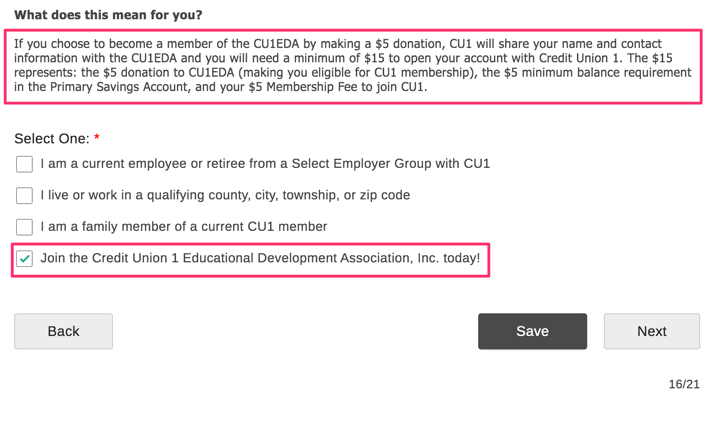
  • Your minimum deposit should be $40 by my math: $25 Free Checking minimum initial deposit, $5 CU1EDA, $5 minimum for Share Savings account, and $5 CU1 new member fee. See screenshot below.
  • After my online application was submitted, within an hour they asked for supporting documentation: another scan of front/back of ID, proof of address (utility bill, paystub), and proof of SSN (scan of SSN card or W2 2021). I submitted via email (can also fax) and my account was approved the same day.
  • Registered for online access and logged in to find out my checking account number. Also look under “Services > Setup Direct Deposit”. Routing number is 271188081.

CU1 looks eager to expand, as they have multiple other competitive offers while also recently acquiring Northside Community Bank in June 2022.

  • 44-month CD at 3.00% APY + up to $500 bonus:

    LIMITED TIME OFFER : Get an up to $500 Bonus2 when you open a 44-Month Share Certificate. There is a $1,000 minimum balance requirement to open the Share Certificate, and you can receive a bonus payment2 when you deposit NEW money over $100,000!

    $100,000 – $249,999 deposited | $250 one-time Bonus Payment2
    $250,000 and over deposited | $500 one-time Bonus Payment2

  • 22-month CD at 2.25% APY. Rates as of 8/29/22.
  • Need a big mortgage? They have what they call The Lowest Jumbo Rate Ever with possibly waived PMI, 80/10/10 structure, and $400 closing credit.
  • Auto Loan rates starting at 5.24% APR for up to 60 Months + $100 bonus:

    To qualify for the $100 bonus, there is a $15,000 minimum loan amount and loan must close within 30 days from the application date. Offer does not apply to existing Credit Union 1 loans or the refinancing of existing Credit Union 1 loans. Bonus will be deposited into the member’s CU1 account at the loan closing. Bonus will be reported on 1099-MISC.

  • If you live near a branch, it is also notable that they have a page on savings bonds which states that Credit Union 1 members can redeem US Savings Bonds at any branch location. This is nice to see, as many banks barely seem to know what a paper savings bond looks like nowadays.

Let’s hope they handle this promo better than certain other credit unions (*cough* Teachers FCU) and give them a chance to earn our continued business through their competitive term certificate, mortgage, and car loan rates.

Citi Self Invest Brokerage: Up to $500 New Deposit or ACAT Transfer Bonus

Citi has started their own self-directed brokerage arm called Citi Self Invest, joining $0 commission bank competitors like Chase, BofA, and Wells Fargo. They are also running a promotion for existing Citi banking or credit card customers to gather new deposits and ACAT transfers, with the current bonus worth up to $500, depending the value of assets that you move over:

  • $100 with $10,000-$49,999 in qualifying new money
  • $200 with $50,000–$199,999 in qualifying new money
  • $500 with $200,000+ in qualifying new money

Here are the steps:

  1. Fund a new or existing Citi Self Invest Account between 3/1/22 and 10/31/22. You must also have an eligible individual Citibank checking or Savings account or an eligible Citi Card account with digital access through Citibank Online.
  2. Fund the Citi Self Invest Account with a minimum of $10,000 in New-To-Citi funds within the Account Funding Period shown below (see below for New-To-Citi funds).
  3. Maintain the New-To Citi funds in your Citi Self Invest account through the Maintain Funds deadline shown below based on month of account opening.
  4. During the account opening process, allow for eDelivery of statements and confirmations,

Here is the deadline calendar:

Here’s their terms on what “new to Citi” funds means:

New-to-Citi Funds are cash that must come from an external, non-Citi, source through a standard transfer method (e.g., a standard Transfer of Assets form, check, electronic funds transfer, ADM deposit). New-to-Citi Funds are: 1) funds deposited from external accounts or payees other than Citibank, N.A. and its affiliates and 2) must be deposited using domestic ACH transfer, Direct Deposit, checks drawn on banks other than Citibank, N.A. wire transfer, trustee to trustee transfer, or ACAT securities transfers.

Update: A rep for Citi reached out to me to say:

To clarify, the value of marketable securities like stocks and ETFS that are transferred via ACAT are included in the definition of “new to Citi funds” and are eligible for the bonus.

This is good news and makes it easier to satisfy the higher tier requirements if you already have a portfolio of ETFs or individuals stocks to move over.

Even if you move over cash, according to the calendar, your minimum holding period is as little as a month. For example, open in August, fund by 9/30, and hold until 10/31 to qualify. The $100 bonus on $10,000 is earning 1% in a month, or the equivalent of 12% APY when annualized. Unfortunately, you have to wait until 1/31/23 to get the bonus, but at least this is a no fee, no minimum balance, no commission brokerage account.

If you keep your cash in there for longer than the minimum of one month, you should also take into account the potential lost interest if you are only using their default cash sweep account. You might consider investing your funds into ultra-short bond ETFs like MINT or Treasury Bill ETFs like GBIL (still possible to lose value). I’m not sure if Citi Self Invest will let you buy Treasury bills directly.

Citi also has an alternative bonus for their Citi Personal Wealth Management account, with better bonus ratios for new deposits of $50,000 and up, and total bonuses worth up to $5,000. However, I’m not sure about the fee structure for the Personal Wealth Management accounts which involve a “dedicated Citi Personal Wealth Management Financial Advisor who can provide personalized planning and investment guidance” with a vague “pricing varies based on investments selected”. Seems like it might be more work if you don’t want their financial advice, but might be worth a phone call to the number in the link if you have $50,000+ as the minimum holding period is still one month.

Robinhood New Account Deposit Bonus (Up to $600)

Robinhood brokerage app has up to a $600 bonus for new customers that deposit a certain amount of money. Here are the highlights:

  • New customers must sign up for Robinhood using the promotion page and get approved by August 17, 2022.
  • Link your bank account to your Robinhood brokerage account. (ACAT transfers also count.)
  • Deposit money into your account by September 16, 2022 and keep deposits in your account through October 16, 2022 to earn up to $600. You can earn $25 for depositing $1,000 – $9,999, $100 for $10,000 – $49,999, $300 for $50,000 – $99,999, or $600 for $100,000+.
  • Rewards will be delivered by October 21, 2022. If you receive a reward, you’ll have 30 days to claim it. Once claimed, you can use it to invest right away, but you can’t withdraw the cash value for 30 days.

See full terms.

This is a pretty good reward (if you have the cash) due to the short required holding period of just one month, plus the bonus is supposed to post within 5 days after the month is over.

EFCU Financial Federal Credit Union 5-Year CD

Update: Rate has since dropped to 3.75% APY as of 8/16/22, and they have also stopped accepting application from people joining via a membership in the EFCU Financial Foundation or the Louisiana Wildlife Federation. Hope some folks got in that were interested. Thanks to reader Hugo for the heads up.

Original post:

EFCU Financial Federal Credit Union has some top certificate rates effective 8/11/22. NCUA-insured. Found via DepositAccounts. Here are the rate highlights:

  • Regular 60-month certificate 4.00% APY ($500 minimum)
  • Regular 60-month certificate 4.10% APY (Jumbo $100k minimum)
  • IRA 60-month certificate 4.10% APY ($500 minimum)
  • IRA 60-month certificate 4.20% APY (Jumbo $100k minimum)
  • Also available: 12-month, 18-month, and 24-month at 3.00% APY, 30-month CD at 3.25% with one-time rate bump allowed.

More details:

  • Early withdrawal penalty for 60-month certificate is 180 days of dividends.
  • Hard credit pull with a new membership application.
  • Must keep $5 minimum in Share Savings account as long as you are a credit union member.

Membership eligibility. Their eligibility criteria is open to anyone nationwide. Persons who live, work, worship, or attend school in these nine Louisiana Parishes can join for free: East Baton Rouge, West Baton Rouge, Ascension, East Feliciana, West Feliciana, Iberville, Livingston, Point Coupee, St. Helena. Anyone nationwide can join EFCU Financial with a membership in the EFCU Financial Foundation or the Louisiana Wildlife Federation. The cost is $35 for an annual membership.

Good deal? This is a very competitive CD rate for a 5-year CD, approximately 35 basis points higher than the next best rate. For comparison, as of 8/12/22, the 5-year Treasury bond rate is 2.97%. The hard credit pull and $35 entry fee make it better for high balances to make it worth the trouble.

Based on their website and mobile app, they appear to be using the same backend software as many other credit unions.

As with past credit union certificate deals, I would still recommend acting fast if you are interested. It’s a good enough deal that it is quite possible that there will be enough new applications to overwhelm their limited staff (and deposit needs). You might pony up $35, start the application process, take the credit pull hit, and have the deal fall apart before you can fund the certificate. I’m not saying this will happen, but it is possible. Of course, it is also possible that this is only the start of multiple places offering 4% APY CDs.

Vanguard Cash Deposit Program: New Cash Sweep Option (Currently Invitation Only)

Vanguard has been gradually rolling out a new option for the cash settlement sweep in your Vanguard Brokerage Account. The Vanguard Cash Deposit is FDIC-insured via partner banks and is currently available to select customers on an invitation-only basis:

Currently, enrollment in the Vanguard Cash Deposit program is by invitation only to existing clients who have at least one Vanguard Brokerage Account. Mutual fund accounts, 529s, or other accounts are not eligible for Vanguard Cash Deposit.

Here is a quick comparison of the interest rates from the two available options:

Banking Partners (as of 8/10/2022)

  • Valley National Bank (FDIC cert. 9396)
  • NexBank (FDIC cert. 29209)
  • Synovus Bank (FDIC cert. 873)
  • Bank of Baroda (FDIC cert. 33681) (coming soon)
  • Synchrony Bank (FDIC cert. 27314) (coming soon)

Commentary. Vanguard’s existing cash sweep fund, the Vanguard Federal Money Market Fund (VMFXX), already invests “at least 99.5% of its total assets in cash, U.S. government securities, and/or repurchase agreements that are collateralized solely by U.S. government securities or cash (collectively, government securities).” In other words, everything inside is also fully backed by the US government. I am a big fan of FDIC insurance, but even I don’t lose any sleep at all about the safety of VMFXX, not to mention I’ve found VMFXX historically tracks short-term interest rates quite well. As of this writing (8/10/22), VMFXX is yielding about 35 basis points more than the Cash Deposit sweep.

I don’t know if this new cash sweep option is in response to consumer demand, or if it will serve as a profit source for Vanguard. I’m sure that some people out there will prefer having FDIC insurance, even it means less interest income. (Be sure not to exceed the FDIC limits at any of the partner banks, such as having separate account held there.) For now, I’ll pass. If the Cash Deposit sweep does start earning a lot more, I would consider switching.

If you wish to opt in to this option, you can try to check if you are “invited” by visiting the product page, clicking on “Choose Vanguard Cash Deposit”, and logging into your Vanguard brokerage account. I was also repeatedly greeted by a pop-up window upon login.

Facebook Internet Tracking Class Action Settlement ($90 Million, 2010-2011)

Facebook has proposed to settle a class action lawsuit alleging that they “improperly obtained and collected data from Facebook Users in the United States who visited non-Facebook websites that displayed the Facebook Like button between April 22, 2010 and September 26, 2011, inclusive.”

If this applies to you, first check your inbox (including spam folder) for an email from “Facebook Internet Tracking Settlement Administrator” [donotreply@fbinternettrackingsettlement.com] with the subject line “Notice of Proposed Settlement of Class Action.” Inside on the top of the e-mail, you should find a Notice ID and Confirmation Code that will make it easier to file a claim. My e-mail arrived in late June, but decided to wait for additional details. Nothing else came out that I am aware of, so I just went ahead and submitted a claim before I forget completely.

Submit your claim online at www.FBInternetTrackingSettlement.com. Claim form must be submitted no later than September 22, 2022. You don’t need to have received the e-mail to file a claim, but the codes may help confirm your eligibility.

Based on my past experience, I would simply submit a claim and forget about it. The claim process was quite simple and only took a minute. Choose a payment method that you are confident will still work years from now (I picked PayPal). I look forward to a random $13.44 deposit a few years down the road, but who knows, it might be bigger.

Best Interest Rates on Cash – August 2022 Update

Here’s my monthly roundup of the best interest rates on cash as of August 2022, roughly sorted from shortest to longest maturities. We all need some safe assets for cash reserves or portfolio stability, and there are often lesser-known opportunities available to individual investors. Check out my Ultimate Rate-Chaser Calculator to see how much extra interest you’d earn by moving money between accounts. Rates listed are available to everyone nationwide. Rates checked as of 8/2/2022.

TL;DR: 4% APY on up to $6,000 for liquid savings at Current with no direct deposit requirement. MyBankingDirect 2.20% APY liquid savings. 1-year CD 3% APY. 5-year CD 3.65% APY. Compare against Treasury bills and bonds at every maturity. 9.62% Savings I Bonds still available if you haven’t done it yet.

Fintech accounts
Available only to individual investors, fintech companies often pay higher-than-market rates in order to achieve fast short-term growth (often using venture capital). “Fintech” is usually a software layer on top of a partner bank’s FDIC insurance.

  • 4% APY on $6,000. Current offers 4% APY on up to $6,000 total ($2,000 each on three savings pods). No direct deposit required. $50 referral bonus for new members with $200+ direct deposit with promo code JENNIFEP185. Please see my Current app review for details.
  • 3% APY on up to $100,000, but requires direct deposit and credit card spend. HM Bradley pays up to 3% APY if you open both a checking and credit card with them, and maintain $1,500 in total direct deposit each month and make $100 in credit card purchases each month. Please see my updated HM Bradley review for details.

High-yield savings accounts
Since the huge megabanks pay essentially no interest, I think every should have a separate, no-fee online savings account to accompany your existing checking account. The interest rates on savings accounts can drop at any time, so I list the top rates as well as competitive rates from banks with a history of competitive rates. Some banks will bait you with a temporary top rate and then lower the rates in the hopes that you are too lazy to leave.

  • MyBankingDirect is up to 2.20% APY with no minimum balance requirements ($500 minimum to open).
  • SoFi is now offering 1.80% APY + up to $325 new account bonus with direct deposit. You must maintain a direct deposit each month of any amount for the higher APY. SoFi now has their own bank charter so no longer a fintech by my definition. See details at $25 + $300 SoFi Money new account and deposit bonus.
  • There are several other established high-yield savings accounts at closer to 1.50% APY. Marcus by Goldman Sachs is on that list, and if you open a new account with a Marcus referral link (from reader Paul) you now can get an extra 1.00% APY for your first 3 months.

Short-term guaranteed rates (1 year and under)
A common question is what to do with a big pile of cash that you’re waiting to deploy shortly (plan to buy a house soon, just sold your house, just sold your business, legal settlement, inheritance). My usual advice is to keep things simple and take your time. If not a savings account, then put it in a flexible short-term CD under the FDIC limits until you have a plan.

  • No Penalty CDs offer a fixed interest rate that can never go down, but you can still take out your money (once) without any fees if you want to use it elsewhere. CIT Bank has a 11-month No Penalty CD at 2.00% APY with a $1,000 minimum deposit. Ally Bank has a 11-month No Penalty CD at 1.40% APY for all balance tiers. Marcus has a 13-month No Penalty CD at 1.55% APY with a $500 minimum deposit. You may wish to open multiple CDs in smaller increments for more flexibility.
  • Bread Financial has a 12-month certificate at 3.00% APY. Early withdrawal penalty is 180 days of interest.

Money market mutual funds + Ultra-short bond ETFs*
Many brokerage firms that pay out very little interest on their default cash sweep funds (and keep the difference for themselves). * Money market mutual funds are regulated, but ultimately not FDIC-insured, so I would still stick with highly reputable firms. I am including a few ultra-short bond ETFs as they may be your best cash alternative in a brokerage account, but they may experience short-term losses.

  • Vanguard Federal Money Market Fund is the default sweep option for Vanguard brokerage accounts, which has an SEC yield of 1.92%. Compare with the Fidelity Government Money Market Fund (SPAXX), Fido’s sweep option which charges a higher expense ratio and thus only offers a 1.42% SEC yield.
  • Vanguard Ultra-Short-Term Bond Fund currently pays 2.40% SEC yield ($3,000 min) and 2.50% SEC Yield ($50,000 min). The average duration is ~1 year, so your principal may vary a little bit.
  • The PIMCO Enhanced Short Maturity Active Bond ETF (MINT) has a 2.37% SEC yield and the iShares Short Maturity Bond ETF (NEAR) has a 2.55% SEC yield while holding a portfolio of investment-grade bonds with an average duration of ~6 months.

Treasury Bills and Ultra-short Treasury ETFs
Another option is to buy individual Treasury bills which come in a variety of maturities from 4-weeks to 52-weeks and are fully backed by the US government. You can also invest in ETFs that hold a rotating basket of short-term Treasury Bills for you, while charging a small management fee for doing so. T-bill interest is exempt from state and local income taxes.

  • You can build your own T-Bill ladder at TreasuryDirect.gov or via a brokerage account with a bond desk like Vanguard and Fidelity. Here are the current Treasury Bill rates. As of 8/2/2022, a new 4-week T-Bill had the equivalent of 2.18% annualized interest and a 52-week T-Bill had the equivalent of 3.09% annualized interest.
  • The Goldman Sachs Access Treasury 0-1 Year ETF (GBIL) has a 1.38% SEC yield and the SPDR Bloomberg Barclays 1-3 Month T-Bill ETF (BIL) has a 1.18% SEC yield. GBIL appears to have a slightly longer average maturity than BIL.

US Savings Bonds
Series I Savings Bonds offer rates that are linked to inflation and backed by the US government. You must hold them for at least a year. If you redeem them within 5 years there is a penalty of the last 3 months of interest. The annual purchase limit for electronic I bonds is $10,000 per Social Security Number, available online at TreasuryDirect.gov. You can also buy an additional $5,000 in paper I bonds using your tax refund with IRS Form 8888.

  • “I Bonds” bought between May 2022 and October 2022 will earn a 9.62% rate for the first six months. The rate of the subsequent 6-month period will be based on inflation again. More on Savings Bonds here.
  • In mid-October 2022, the CPI will be announced and you will have a short period where you will have a very close estimate of the rate for the next 12 months. I will have another post up at that time.
  • See below about EE Bonds as a potential long-term bond alternative.

Prepaid Cards with Attached Savings Accounts
A small subset of prepaid debit cards have an “attached” FDIC-insured savings account with exceptionally high interest rates. The negatives are that balances are severely capped, and there are many fees that you must be careful to avoid (lest they eat up your interest). There is a long list of previous offers that have already disappeared with little notice. I don’t personally recommend nor use any of these anymore, as I feel the work required and the fees charged if you mess up exceeds any small potential benefit.

  • Mango Money pays 6% APY on up to $2,500, if you manage to jump through several hoops. Requirements include $1,500+ in “signature” purchases and a minimum balance of $25.00 at the end of the month.
  • NetSpend Prepaid pays 5% APY on up to $1,000 but be warned that there is also a $5.95 monthly maintenance fee if you don’t maintain regular monthly activity.

Rewards checking accounts
These unique checking accounts pay above-average interest rates, but with unique risks. You have to jump through certain hoops which usually involve 10+ debit card purchases each cycle, a certain number of ACH/direct deposits, and/or a certain number of logins per month. If you make a mistake (or they judge that you did) you risk earning zero interest for that month. Some folks don’t mind the extra work and attention required, while others would rather not bother. Rates can also drop suddenly, leaving a “bait-and-switch” feeling.

  • Porte fintech app requires a one-time direct deposit of $1,000+ to open a savings account. Porte then requires $3,000 in direct deposits and 15 debit card purchases per quarter (average $1,000 direct deposit and 5 debit purchases per month) to receive 3% APY on up to $15,000. New customer bonus via referral.
  • The Bank of Denver pays 2.00% APY on up to $10,000 if you make 12 debit card purchases of $5+ each, receive only online statements, and make at least 1 ACH credit or debit transaction per statement cycle. If you meet those qualifications, you can also link a Kasasa savings account that pays 1.00% APY on up to $25k. Thanks to reader Bill for the updated info.
  • Presidential Bank pays 2.25% APY on balances between $500 and up to $25,000, if you maintain a $500+ direct deposit and at least 7 electronic withdrawals per month (ATM, POS, ACH and Billpay counts).
  • Evansville Teachers Federal Credit Union (soon Liberty FCU) pays 3.30% APY on up to $20,000. You’ll need at least 15 debit transactions and other requirements every month.
  • Lake Michigan Credit Union pays 3.00% APY on up to $15,000. You’ll need at least 10 debit transactions and other requirements every month.
  • (I’ve had a poor customer service experience with this CU, but the rate is still good.) Lafayette Federal Credit Union is offering 2.02% APY on balances up to $25,000 with a $500 minimum monthly direct deposit to their checking account. No debit transaction requirement. They are also offering new members a $100 bonus with certain requirements. Anyone can join this credit union via partner organization ($10 one-time fee).
  • Find a locally-restricted rewards checking account at DepositAccounts.

Certificates of deposit (greater than 1 year)
CDs offer higher rates, but come with an early withdrawal penalty. By finding a bank CD with a reasonable early withdrawal penalty, you can enjoy higher rates but maintain access in a true emergency. Alternatively, consider building a CD ladder of different maturity lengths (ex. 1/2/3/4/5-years) such that you have access to part of the ladder each year, but your blended interest rate is higher than a savings account. When one CD matures, use that money to buy another 5-year CD to keep the ladder going. Some CDs also offer “add-ons” where you can deposit more funds if rates drop.

  • CFG Bank has a 5-year certificate at 3.65% APY ($500 min), 3-year at 3.55% APY, and 1-year at 2.75% APY. The early withdrawal penalty for the 5-year is 180 days of interest.
  • You can buy certificates of deposit via the bond desks of Vanguard and Fidelity. You may need an account to see the rates. These “brokered CDs” offer FDIC insurance and easy laddering, but they don’t come with predictable early withdrawal penalties. Right now, I see a 5-year CD at 3.55% APY. Be wary of higher rates from callable CDs listed by Fidelity.

Longer-term Instruments
I’d use these with caution due to increased interest rate risk, but I still track them to see the rest of the current yield curve.

  • Willing to lock up your money for 10 years? You can buy long-term certificates of deposit via the bond desks of Vanguard and Fidelity. These “brokered CDs” offer FDIC insurance, but they don’t come with predictable early withdrawal penalties. You might find something that pays more than your other brokerage cash and Treasury options. Right now, I don’t see any 10-year CDs available vs. 2.76% for a 10-year Treasury. Watch out for higher rates from callable CDs where they can call your CD back if interest rates rise.
  • How about two decades? Series EE Savings Bonds are not indexed to inflation, but they have a unique guarantee that the value will double in value in 20 years, which equals a guaranteed return of 3.5% a year. However, if you don’t hold for that long, you’ll be stuck with the normal rate which is quite low (currently 0.10%). I view this as a huge early withdrawal penalty. But if holding for 20 years isn’t an issue, it can also serve as a hedge against prolonged deflation during that time. Purchase limit is $10,000 each calendar year for each Social Security Number. As of 7/5/2022, the 20-year Treasury Bond rate was 3.22%.

All rates were checked as of 8/2/2022.

JP Morgan Self-Directed Brokerage: Up to $625 New Deposit/Transfer Bonus

Brokerage firms constantly compete for “assets under management”, and many are willing to give you cash to move over your existing portfolio from your existing broker over to them. If you are unsatisfied with your current broker, these incentives may help you find a new home for your hard-earned assets.

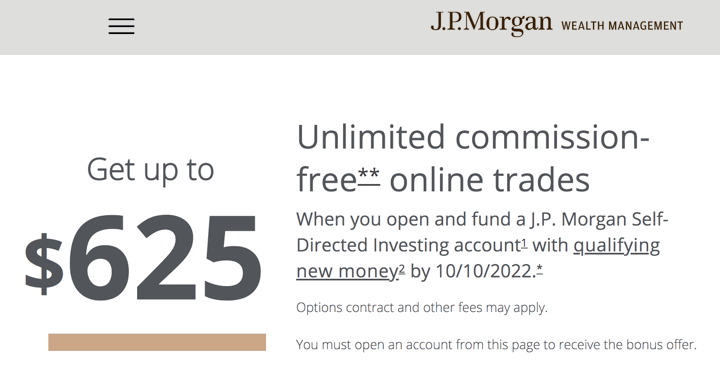
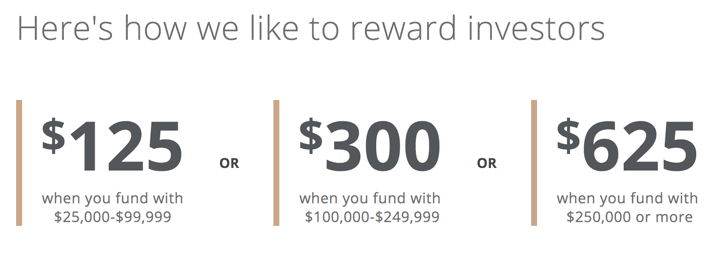
Chase started a self-directed brokerage arm called “Chase You Invest”, but I guess that didn’t sound fancy enough, because now it is called JP Morgan Self-Directed Investing (a part of JP Morgan Wealth Management). They are currently offering up to $625 for new accounts, depending the value of assets that you move over (deposit cash or move over stocks and securities):

  • $125 with $25,000-$99,999 in qualifying new money.
  • $300 with $100,000–$249,999 in qualifying new money
  • $625 with $250,000+ in qualifying new money

Here are the steps:

  1. Open a J.P. Morgan Self-Directed Investing account through this page by 10/10/2022. (General Investment Taxable, Traditional IRA, or Roth IRA.)
  2. Transfer – You have 45 days to fund your account with qualifying new money (cannot be existing deposits, funds or securities held by you at JP Morgan, Chase or affiliate partners). Your bonus will be determined on day 45.
  3. Earn

The features for the account itself seem like most other online brokerages. Unlimited commission-free online stock, ETF and options trades (+ $0.65 per-contract fee). You can trade ETFs, fixed income, mutual funds, and options. The interface is more on the basic side, but you can perform instant funds transfers between the brokerage account and your Chase checking account, which may be convenient.

Here is their fee schedule. A few things I noticed: Buying a treasury at auction costs $50. IRA Maintenance fee of $75 per year. IRA Termination fee of $95 per account.

Here is more fine print:

You can only participate in one J.P. Morgan Self-Directed Investing new money bonus in a 12 month period from the last bonus coupon enrollment date. Coupon is good for one time use and only one bonus per account. Account types and other restrictions apply. Offer terms are subject to change and/or termination without advance notice. The value of the cash award may be considered income, and we may be required to send you, and file with the IRS, a Form 1099-MISC (“Miscellaneous Information”), or a Form 1042-S (“Foreign Person’s U.S. Source Income Subject to Withholding”) if applicable.

The $125 bonus is best in terms of percentage (0.5% of $25,000), but in terms of time/effort you may just want to get the biggest bonus. There have been somewhat higher bonuses in the past from Chase/JP Morgan, but it’s unknown if they will come back.

Given that we are now in a higher interest rate environment, you should take into account the potential lost interest if you deposit idle cash into their default sweep account. You might also consider ultra-short bond ETFs like MINT or Treasury Bill ETFs like GBIL (still possible to lose value).

Usually, the easiest thing is to perform an in-kind ACAT transfer of existing securities, which takes less than a week and all of your tax basis information should also move over after another few days. Your old broker may charge you an outgoing ACAT fee about about $75, although you should ask JP Morgan if they will reimburse you for this fee.

Capital One Cardholders: Free Global Museum Tickets via The Cultivist

Capital One credit cardholders can get 6 months of free access to 100+ museums worldwide via The Cultivist (valid for cardholder & up to three guests). Visit thecultivist.com/capitalone and input the 16 digits of your eligible Capital One credit card in the checkout process to receive 6 months of complimentary Enthusiast level membership (usually $40 a month, so technically a $240 value).

The Membership Offer is only available to Capital One cardholders, age 18 or older, with an eligible U.S.-issued, Capital One branded, consumer or small business credit card (“Eligible Capital One Cardholders”). Limit one Membership Offer per Eligible Capital One Cardholder. Offer provides one hundred eighty (180) days of complimentary membership for the enrolled Eligible Capital One Cardholder in ‘The Enthusiast’ level of membership with The Cultivist (the “Membership Offer”).

Warning: The ongoing monthly membership fee of $40 will be automatically billed after complimentary membership expires. Set a calendar reminder. You may cancel at any time. Since it only lasts for 6 months, you may wish to delay the activation of your 6-month free membership until later and also allowing you to cancel earlier.

Here is their full Museum list. The list is subject to change, but here are just a few examples:

  • New York City – Guggenheim and The Met
  • San Francisco – SFMOMA
  • Chicago – Art Institute of Chicago
  • London – National Portrait Gallery
  • Paris – Louvre (7-day advance notice) and Musee D’Orsay

Even a single museum visit can save your household a good chunk of money. For some museums, you just have to show your Cultivist membership card at the entrance. For others, you must contact them and have them issue free, skip-the-line tickets for you. There are reports that they are a bit overwhelmed right now, so definitely put in your request as early as possible. Pack your patience, but if urgent consider giving them a phone call them to expedite.

If you have any sort of Capital One consumer or small business card, you can input your 16-digit card number and see if it works. Looks like I can wring yet another benefit out of my Capital One Venture X Rewards card! 🤑