Online Shopping: Are You Being Tricked By These 15 Dark Patterns?

During these stressful times, many of us are doing a lot more shopping online (unfortunately for local retailers). The competition to get you to spend as much as possible has evolved to take full advantage of all of our psychological weaknesses. This Wired article discusses The Subtle Tricks Shopping Sites Use to Make You Spend More, including the deceptive tactics called “dark patterns”. They linked to an academic study Dark Patterns at Scale: Findings from a Crawl of 11K Shopping Websites, which carefully broke things down into the following 15 dark patterns which usually target at least one cognitive bias.

If you’ve bought anything online recently, you should recognize many of these tricks, but there were a few that were new to me. I was intrigued and tested out many of the sites myself. I no longer plan to shop at certain retailers like Proflowers and CellularOutfitter due to their use of certain shady tactics.

“No, I don’t want become smarter and wealthier”
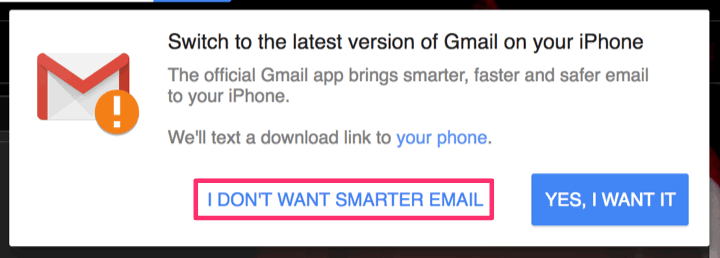
  • Confirmshaming: Using language to steer your choices
  • Cognitive bias: Framing effect

“YES! vs. no

  • Visual interference: Steering users using visual design.
  • Cognitive bias: Anchoring, Framing effect

“Uncheck the box if you prefer not to receive lots of spam”
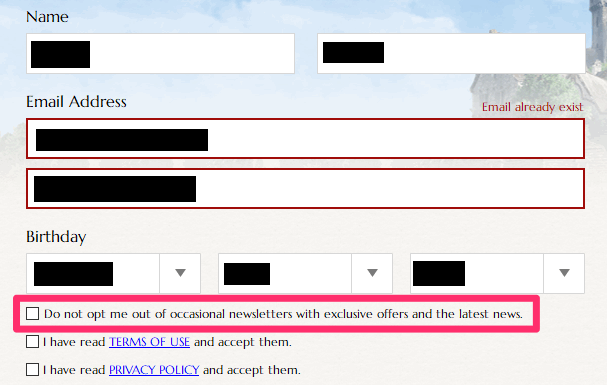
  • Trick questions: Steering users using confusing language
  • Cognitive bias: Default, Framing effect

“Do you really want to cheap out on the flower bouquet for your mom?”
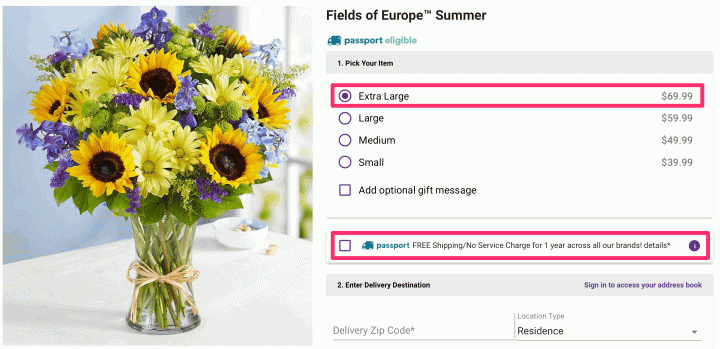
  • Pressured selling: Most expensive option is the default.
  • Cognitive bias: Anchoring, Default Effect, Scarcity Bias

“Free shipping with (trial) membership!”

  • Hidden subscription: Charging a recurring fee which isn’t clearly disclosed.

“⏲ Sale ends in 00:15:36 ⏲”

  • Countdown timer: Suggests that deal or discount will expire soon using countdown timer
  • Cognitive bias: Scarcity bias

“Only 3 left in stock. Order soon!”

  • Low-stock message: Suggests that limited quantities are available
  • Cognitive bias: Scarcity bias

“🔥 Selling Fast! 🔥”

  • High-demand message
  • Cognitive bias: Scarcity bias

“‼ Sale ends soon! ‼”

  • Limited-time message
  • Cognitive bias: Scarcity bias

“43 other people are viewing this item” or “Joseph in Maryland just bought these masks!”
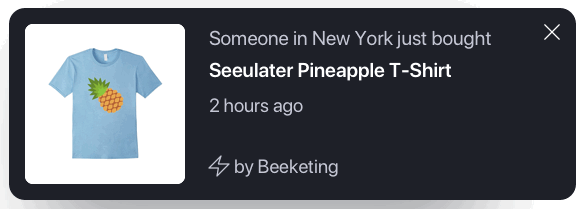
  • Activity message: Informs that someone else did an activity or purchase
  • Cognitive bias: Bandwagon effect

“These yoga pants are the most comfortable ever! – Jane from IA”

  • Testimonial
  • Cognitive bias: Bandwagon effect

“Care & Handling Fee: $2.99” (Looking at you, Proflowers!)

  • Hidden cost: Adding new fees or charges at the last page of checkout, after you have submitted address and payment details.
  • Cognitive bias: Sunk cost fallacy

“You must create an account to continue.”

  • Forced enrollment: Must create account or share information to complete task
  • Cognitive bias: Sunk cost fallacy

“Oops, how did that item end up in your shopping cart?”
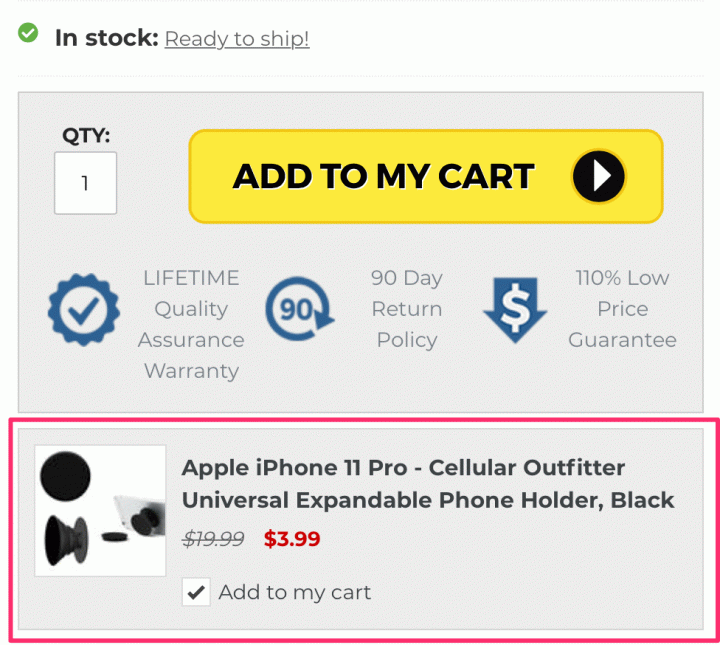
  • Sneak into basket: Additional products placed in shopping carts without consent, like accessories (CellularOutfitter) or warranty/insurance.
  • Cognitive bias: Default effect

“Please call 1-800-NOT-OPEN between 1:34 and 1:36 AM to cancel.”

  • Hard to cancel: Easy to sign-up, hard to cancel.

Google Plus Class Action Settlement: Up to $12 Cash Payment

I received an email that Google settled a class action lawsuit claiming that the now-defunct Google+ social media service exposed your personal data in a harmful manner. You can submit a claim here, where you must attest to all of the following:

  • I was a user of the consumer Google+ service while a resident of the United States at some point during the period from January 1, 2015 to April 2, 2019.
  • I entered private (meaning non-public) information in at least one of my Google+ profile fields that was not set to be shared publicly; and
  • Either I shared that information with another Google+ user through the Google+ service or I authorized an app to access my Google+ profile field information.

The maximum award is $12 cash, depending on the total number of claimants: “Class Members who submit a Valid Claim may receive a pro rata share of the Net Settlement Fund up to a cash payment of $12.00 depending on the number of claimants.” They will ask for name, address, and e-mail address. You can opt for payment via PayPal or ACH transfer (must provide bank routing and account numbers). According to the site, it looks like there will be $7.5 million set aside for claims, attorney fees, etc. Claim must be submitted no later than 10/8/2020.

Marcus Bank AARP 0.10% APY Rate Boost, CD Special (EXPIRED)

Update: As of 2026, the partnership between Marcus and AARP appears to have ended. The information on this post is expired.

This is a multi-part deal, but you may already have some of these accounts. Marcus is the online banking arm of Goldman Sachs. AARP members are eligible for two member benefits at Marcus:

  • 0.10% APY rate increase to the Online Savings rate for 24 months. As of 1/18/2021, that means 0.60% APY instead of 0.50% APY.
  • Special 8-month No-Penalty CD at 0.55% APY as of 1/18/2021. Their standard No-Penalty CD is 0.45% APY for 7 months.

AARP membership is targeted at those age 50+, but there is no actual age restriction. I was a member in my 30s, as AARP has offered a variety of member benefits that can be quite valuable – insurance discounts, hotel discounts, restaurant discounts, and so on. If only younger folks had such a well-organized association! The standard membership fee is $16/year, but it drops to $12/year if you sign-up for auto-renewal with a credit card on file (you can still cancel at any time).

Swagbucks is a popular points website, and you can currently get 1,500 Swagbucks (worth $15 Amazon gift card)for joining AARP through their site. This essentially offsetts the AARP annual membership fee. If you are a member, log in and search for “AARP”. If you are not a member yet, join via my Swagbucks referral link and earn a $3 referral bonus + an additional $10 bonus if you spend at least $25 through their shopping portal within 30 days of registration. (There are even some money-making offers on Swagbucks like donating $15 to the Sierra Club and getting 4,000 Swagbucks in return worth $40 in Amazon gift cards.)

Taken altogether, you can get the 0.10% APY rate boost, special CD access, and a year of AARP membership (including many other perks) all at zero net cost. Thanks to reader Bill P for the tip.

NBC’s Peacock TV Streaming Service Has a 100% Free Tier

Just a quick note that there is a new streaming service, Peacock by NBC Universal. What makes it different than Netflix, Disney+, Hulu, and other services is that it has a 100% free tier (with ads) that includes a lot of decent content including “live” channels. (I might finally watch Downton Abbey.) No free trials. You don’t even need a credit card to sign up. There are also two Premium tiers ($5/month with ad and $10/month without ads).

Small catch: NBC is negotiating with Roku and Amazon (Fire TV devices) about money, so right now you won’t find Peacock on those devices. There is an iOS app, Android app, Apple TV, Chromecast, LG/Vizio smart TV channel, XBOX One, and you can always just watch from a web browser.

Country Time Bailout: Kid’s Lemonade Stand $100 Stimulus Check

The summer lemonade stand remains the iconic entrepreneurial opportunity for kids. Well, maybe not this summer. Country Time Lemonade is starting the Littlest Bailout Relief Fund, which is a $100,000 fund to send $100 stimulus checks to 1,000 kids who had to close their lemonade stands due to COVID-19. To enter the random drawing, you must attest to being the parent or legal guardian of a child 14 years or younger that actually operated a lemonade stand. You must also attach a picture of the child’s lemonade stand, and they will review all submissions.

Sure, it’s a publicity stunt, but at least it’s a fun one. Two years ago, Country Time Lemonade offered “Legal-ade” to reimburse any permit fees or fines incurred by a child trying to operate a lemonade stand.

Here is a local news story I shared on Twitter with some real-world kid businesses: Lego kit rentals, mobile baseball lessons, and tutoring/swim lessons. Here is an older WSJ article on teens making serious money doing iPhone repairs.

Pizza Hut Camp Book It! Kids Summer Reading Program

Some of you may remember the Pizza Hut “Book It!” program during your elementary school years that encouraged reading using free pizza as a reward. Well, it still exists in the form of Camp Book It!:

Parents, join us for our first ever Camp BOOK IT! and keep rewarding your kids all summer long. Track and reward your kids’ reading for June, July and August in our digital dashboard. When they meet their monthly reading goal, they’ll receive a free one-topping Personal Pan Pizza® from Pizza Hut! We’ll also share fun activities and book recommendations each week to keep the fun going throughout the summer!

This program is usually for homeschooling parents during the academic school year, but is open to all age-eligible children during the summer:

You must be one of the following: a parent homeschooling your own children in Kindergarten through 6th grade (ages 5-12 years old) as of September 1, 2020 for the October to March program OR a parent enrolling your own children in Kindergarten through 6th grade (ages 5-12 years old) as of September 1, 2020 for the summer program.

After signing up, I found that this program is much less involved than the one we signed up for at our local library, which requires us to log the book title, author, and time spent reading for each day. For Camp Book It, there is a simple daily counter. You can even count the days retroactively if you sign up in the middle of the month. Once you reach 20 days of reading in one calendar month (our goal is 20 minutes per day per child), you complete the goal and a prize code will be emailed to you.

I like that they give out little Personal Pan Pizzas as they are a novelty to our kids, making it feel like a special reward that they earned. Read books, earn free pizza, that’s my kind of deal!

Free Social Security Tool for Optimal Benefit Claiming Strategy

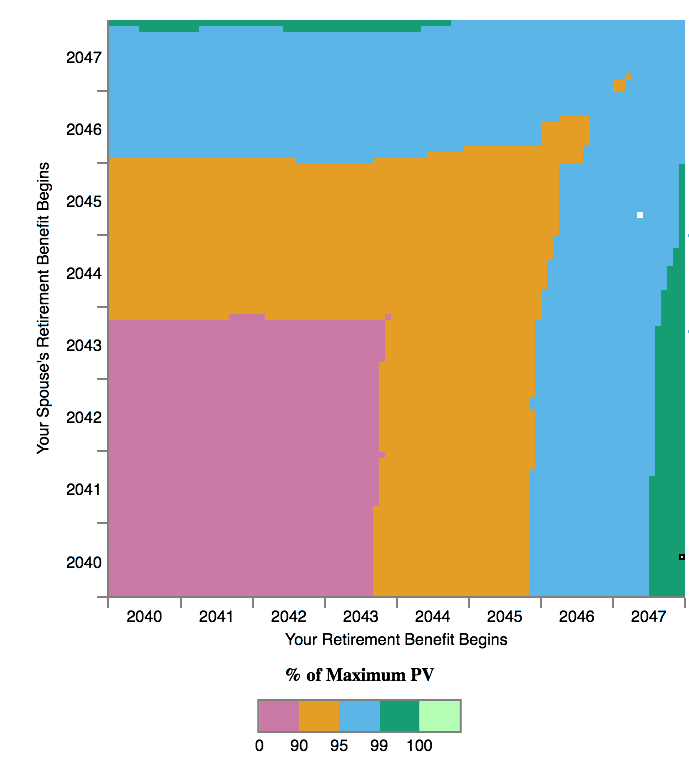
Update: The free Open Social Security tool has been updated to include a new “heat map” visualization that illustrates the relative values of claiming Social Security at different ages. Details here. Here is a sample graph for a couple with similar income histories and the same age:

For this situation, we see that the worst expected outcomes would occur if both individuals claimed really early. The best expected outcomes occur when one claims relatively early and the other claims relatively late.

Original post:

socialsecuritycardWhen to start claiming Social Security to maximize your potential benefit can be a complicated question, especially for couples. There are multiple paid services that will run the numbers for you, including Social Security Solutions (aka SS Analyzer) and Maximize My Social Security, which cost between $20 and $250 depending on included features.

Mike Piper of Oblivious Investor has created a free, open-source calculator called Open Social Security. To use the calculator, you will need to your Primary Insurance Amount (PIA). This amount depends on your future income, so I would first consult this other free Social Security benefit estimator tool to more easily estimate your PIA. I believe the value you see at SSA.gov assumes that you will keep working at your historical average income until your claiming age (which won’t be the case for us).

Here are our results as a couple, assuming we were the same age (we are close) and with my expected benefit being slightly higher than hers:

The strategy that maximizes the total dollars you can be expected to spend over your lifetimes is as follows:

You file for your retirement benefit to begin 12/2047, at age 70 and 0 months.
Your spouse files for his/her retirement benefit to begin 4/2040, at age 62 and 4 months.

The present value of this proposed solution would be $657,749.

Basically, the tool says that my wife should apply as soon as possible, while I should claim as late as possible. I believe this is because this scenario allows us claim at least some income starting from 62, and if I die first after that, my wife would still be able to “upgrade” to my higher benefit.

The tool might take some time to run the calculations, depending on your browser. You can learn more and provide feedback at Bogleheads and Github.

I am not a Social Security expert, and am not qualified to speak to the accuracy of the results. However, Mr. Piper is the author of the highly-rated book Social Security Made Simple, has a history of doing thorough work, and the tool has been around a while now. If I were close to 62, I would probably also use the paid services for a second and third opinion. Why? Spending $100 now could save you many thousands in the future.

The best thing about this free tool is that it can introduce a lot of people to ideas that they would have not otherwise considered. Even if it lacks every bell or whistle, being free means it can help more people. Many spouses wouldn’t think of having one claim as early as possible (age 62), and then have the other claim as late as possible (age 70). It’s not common sense unless you understand the inner workings of Social Security.

3 Months of SiriusXM Streaming + Echo Dot For $1

Here is a SiriusXM promotion link where you can sign up for a free 3-month trial of either their Essential or Premium streaming tiers (includes Howard Stern) and also get an Amazon Echo Dot (3rd Gen) smart speaker for only $1.

After signing up, you will be emailed a promo code for the Echo dot that you redeem at Amazon.com. You will need to provide a credit card and cancel before the end of the 3-month trial, otherwise your subscription will start and you will be charged the monthly fee.

Added: There are some complaints that SiriusXM has an aggressive retention team. You may find this online form useful, but make sure you follow-up in case they “forget” to cancel your account.

Bask Bank Review: Earn American Airlines Miles As Interest (5,000 Mile Referral Bonus)

Updated with my own experience and new referral bonus. Bask Bank is a FDIC-insured savings account that pays you American Airlines (AA) miles instead of cash interest. Every $1 earns 1 mile a year. For example, $1,000 kept for a year would earn 1,000 AA miles at the end of the year. If you kept $50,000 there for a year, you would earn 50,000 AA miles at the end of a year. There is no minimum balance and no monthly fees. I’ve updated this review after opening an account.

Bask Bank is part of Texas Capital Bank (FDIC Certificate #34383), which also runs BankDirect. BankDirect has been giving out American Airlines miles for many years on their checking account, but with different requirements and a steep monthly fee. Note that they are all the same bank in regards to the $250,000 FDIC insurance limits per depositor type. Bask Bank routing number is 111026177.

Account opening process. Opening an account was done all online with no issues, with no physical paperwork to send in. They state there is no hard credit check upon opening, and there was none upon my own opening. I received all my promised points (past bonus and monthly interest) on time and without issue. Note: They do not currently offer joint accounts.

Value calculations. If you valued American Airlines miles at 1 cent per mile, then this account would earn you the equivalent of 1% APY. ($10,000 a year = 10,000 AA miles = $100 value.) Given that other online savings accounts also earn about 1% APY nowadays, this has become a closer call after you consider the tax consequences…

1099-INT details. If you get miles instead of cash, what happens at tax time? Bask Bank and BankDirect has stated that they plan to issue 1099-INT for 2020 interest earned based on a valuation of 0.42 cents per mile. This can be found deep in their disclosures:

Since you are Awarded Miles based on the average collected balance in your Account each month instead of interest, Bask Bank calculates an interest equivalent based on a good faith estimate of the value of the miles. Your interest rate and annual percentage yield may change based on a change in either the Miles Award Rate or the estimated value. Miles are currently valued at 0.42 cents per mile, the equivalent of 0.42% annual percentage yield.

So if you held $10,000 for all of 2020 and earned $10,000 miles, current your 1099-INT will show $42 in interest paid. However, this is subject to change and I don’t really like that sort of uncertainty. It is unlikely but still possible that they could change this number and it would be a hassle to dispute such a valuation.

Useful for keeping your AA miles active. Airline miles are useful, but also subject to rampant inflation. Since AA miles are worth less every year, I do not plan on using this as my main savings account. However, the ability to keep about $15 in there and earn at least 1 mile per month to prevent my existing American miles from expiring, that could be useful. If I need a certain amount of American Airlines to reach an award, this may be a backup option as well. I have a large amount of AA miles, so this account gives me peace of mind that they won’t suddenly expire when I’m not paying attention.

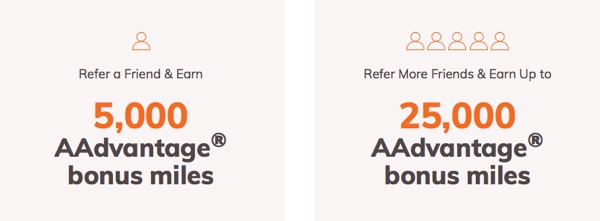
New account referral bonus. Bask Bank now runs a refer-a-friend program where if the person referred opens an account by 9/30/2020, deposits at least $10,000, and keeps it there for 90 days, they will earn 5,000 AAdvantage® bonus miles on top of the usual interest. The referrer will also then receive 5,000 miles. Here is my Bask Bank referral link, thanks if you use it. After you open the account, you can also refer up to 5 friends yourself:

If you again value an AA mile at 1 cent a mile, then the bonus is worth $50. Earning $50 for keeping $10,000 there for 90 days is the equivalent of a bonus APY of 2% for those 90 days. So in total, you might get the cash equivalent of 3% APY over those initial 90 days with the referral bonus if you use that 1 cent per mile valuation.

Bottom line. Bask Bank is an online savings account that pays you American Airlines (AA) miles instead of cash interest. It won’t be a great fit for everyone, but may be interesting to those that can maximize the value of an American Airlines mile. You may also like the ability to keep all your AA miles from expiring by keeping a small amount of cash at the bank.

Best Interest Rates on Cash – July 2020

The Fed rate is still at zero, which has bought us back to the time when anything above 2% APY is newsworthy (and there ain’t much news). The only reason to pay attention is that being willing to switch bank accounts can still beat out Treasury bonds and/or brokerage cash sweep options that also pay nearly zero.

Here’s my monthly roundup of the best interest rates on cash for July 2020, roughly sorted from shortest to longest maturities. I track these rates because I keep 12 months of expenses as a cash cushion and also invest in longer-term CDs (often at lesser-known credit unions) when they yield more than bonds. Check out my Ultimate Rate-Chaser Calculator to see how much extra interest you’d earn by moving money between accounts. Rates listed are available to everyone nationwide. Rates checked as of 7/5/2020.

High-yield savings accounts
While the huge megabanks make huge profits while paying you 0.01% APY, it’s easy to open a new “piggy-back” savings account and simply move some funds over from your existing checking account. The interest rates on savings accounts can drop at any time, so I list the top rates as well as competitive rates from banks with a history of competitive rates. Some banks will bait you with a temporary top rate and then lower the rates in the hopes that you are too lazy to leave.

  • Patriot Bank has the top rate at the moment at 1.40% APY guaranteed until 8/31/2020 (last month it was 1.75% APY guaranteed until 7/31/20). I wouldn’t count on anything after the guarantee, as nearly every place else is below that with most likely headed back to the ~1% APY range. There are several other established high-yield savings accounts at above 1% APY for now.

Short-term guaranteed rates (1 year and under)
A common question is what to do with a big pile of cash that you’re waiting to deploy shortly (just sold your house, just sold your business, legal settlement, inheritance). My usual advice is to keep things simple and take your time. If not a savings account, then put it in a flexible short-term CD under the FDIC limits until you have a plan.

  • No Penalty CDs offer a fixed interest rate that can never go down, but you can still take out your money (once) without any fees if you want to use it elsewhere. Marcus has a 7-month No Penalty CD at 1.00% APY with a $500 minimum deposit. Ally Bank has a 11-month No Penalty CD at 0.95% APY for all balance tiers. CIT Bank has a 11-month No Penalty CD at 0.75% APY with a $1,000 minimum deposit. You may wish to open multiple CDs in smaller increments for more flexibility.
  • Pen Air Federal Credit Union has a 12-month CD at 1.25% APY ($500 min). Early withdrawal penalty is 180 days of interest. Anyone can join this credit union via partner organization ($3 one-time fee).

Money market mutual funds + Ultra-short bond ETFs
If you like to keep cash in a brokerage account, beware that many brokers pay out very little interest on their default cash sweep funds (and keep the difference for themselves). The following money market and ultra-short bond funds are NOT FDIC-insured and thus come with a possibility of principal loss, but may be a good option if you have idle cash and cheap/free commissions.

  • Vanguard Prime Money Market Fund currently pays an 0.18% SEC yield. The default sweep option is the Vanguard Federal Money Market Fund which has an SEC yield of 0.12%. You can manually move the money over to Prime if you meet the $3,000 minimum investment.
  • Vanguard Ultra-Short-Term Bond Fund currently pays 1.18% SEC yield ($3,000 min) and 1.28% SEC Yield ($50,000 min). The average duration is ~1 year, so there is more interest rate risk.
  • The PIMCO Enhanced Short Maturity Active Bond ETF (MINT) has a 1.10% SEC yield and the iShares Short Maturity Bond ETF (NEAR) has a 1.19% SEC yield while holding a portfolio of investment-grade bonds with an average duration of ~6 months. Note that there was a sudden, temporary drop in net asset value during the recent market stress.

Treasury Bills and Ultra-short Treasury ETFs
Another option is to buy individual Treasury bills which come in a variety of maturities from 4-weeks to 52-weeks. You can also invest in ETFs that hold a rotating basket of short-term Treasury Bills for you, while charging a small management fee for doing so. T-bill interest is exempt from state and local income taxes. Right now, this section probably isn’t very interesting as T-Bills are yielding close to zero!

  • You can build your own T-Bill ladder at TreasuryDirect.gov or via a brokerage account with a bond desk like Vanguard and Fidelity. Here are the current Treasury Bill rates. As of 7/2/2020, a new 4-week T-Bill had the equivalent of 0.13% annualized interest and a 52-week T-Bill had the equivalent of 0.16% annualized interest.
  • The Goldman Sachs Access Treasury 0-1 Year ETF (GBIL) has a 0.09% SEC yield and the SPDR Bloomberg Barclays 1-3 Month T-Bill ETF (BIL) has a -.02% (!) SEC yield. GBIL appears to have a slightly longer average maturity than BIL.

US Savings Bonds
Series I Savings Bonds offer rates that are linked to inflation and backed by the US government. You must hold them for at least a year. There are annual purchase limits. If you redeem them within 5 years there is a penalty of the last 3 months of interest.

  • “I Bonds” bought between May 2020 and October 2020 will earn a 1.06% rate for the first six months. The rate of the subsequent 6-month period will be based on inflation again. More info here.
  • In mid-October 2020, the CPI will be announced and you will have a short period where you will have a very close estimate of the rate for the next 12 months. I will have another post up at that time.

Prepaid Cards with Attached Savings Accounts
A small subset of prepaid debit cards have an “attached” FDIC-insured savings account with exceptionally high interest rates. The negatives are that balances are capped, and there are many fees that you must be careful to avoid (lest they eat up your interest). Some folks don’t mind the extra work and attention required, while others do. There is a long list of previous offers that have already disappeared with little notice. I don’t personally recommend nor use any of these anymore.

  • The only notable card left in this category is Mango Money at 6% APY on up to $2,500, along with several hoops to jump through. Requirements include $1,500+ in “signature” purchases and a minimum balance of $25.00 at the end of the month.

Rewards checking accounts
These unique checking accounts pay above-average interest rates, but with unique risks. You have to jump through certain hoops, and if you make a mistake you won’t earn any interest for that month. Some folks don’t mind the extra work and attention required, while others do. Rates can also drop to near-zero quickly, leaving a “bait-and-switch” feeling. If you want rates above 2% APY, this is close to the only game in town.

  • Consumers Credit Union Free Rewards Checking (my review) still offers up to 4.09% APY on balances up to $10,000 if you make $500+ in ACH deposits, 12 debit card “signature” purchases, and spend $1,000 on their credit card each month. The Bank of Denver has a Free Kasasa Cash Checking offering 3% APY on balances up to $25,000 if you make 12 (temporarily 6 due to COVID-19) debit card purchases and at least 1 ACH credit or debit transaction per statement cycle. If you meet those qualifications, you can also link a savings account that pays 2% APY on up to $50k. Thanks to reader Bill for the tip. Find a locally-restricted rewards checking account at DepositAccounts.

Certificates of deposit (greater than 1 year)
CDs offer higher rates, but come with an early withdrawal penalty. By finding a bank CD with a reasonable early withdrawal penalty, you can enjoy higher rates but maintain access in a true emergency. Alternatively, consider building a CD ladder of different maturity lengths (ex. 1/2/3/4/5-years) such that you have access to part of the ladder each year, but your blended interest rate is higher than a savings account. When one CD matures, use that money to buy another 5-year CD to keep the ladder going. Some CDs also offer “add-ons” where you can deposit more funds if rates drop.

  • Georgia’s Own Credit Union has a 5-year certificate at 1.70% APY ($500 min), 4-year at 1.50% APY, 3-year at 1.45% APY, and 2-year at 1.25% APY. Beware that the early withdrawal penalty for the 5-year is 450 days of interest. Anyone can join via partner organization for one-time $10 fee.
  • You can buy certificates of deposit via the bond desks of Vanguard and Fidelity. You may need an account to see the rates. These “brokered CDs” offer FDIC insurance and easy laddering, but they don’t come with predictable early withdrawal penalties. Vanguard has a 5-year at 0.80% APY right now. Be wary of higher rates from callable CDs listed by Fidelity.

Longer-term Instruments
I’d use these with caution due to increased interest rate risk, but I still track them to see the rest of the current yield curve.

  • Willing to lock up your money for 10 years? You can buy long-term certificates of deposit via the bond desks of Vanguard and Fidelity. These “brokered CDs” offer FDIC insurance, but they don’t come with predictable early withdrawal penalties. Vanguard has a 5-year at 0.95% APY right now. Watch out for higher rates from callable CDs from Fidelity.
  • How about two decades? Series EE Savings Bonds are not indexed to inflation, but they have a unique guarantee that the value will double in value in 20 years, which equals a guaranteed return of 3.5% a year. However, if you don’t hold for that long, you’ll be stuck with the normal rate which is quite low (currently a sad 0.10% rate). I view this as a huge early withdrawal penalty. But if holding for 20 years isn’t an issue, it can also serve as a hedge against prolonged deflation during that time. As of 7/2/2020, the 20-year Treasury Bond rate was 1.20%.

All rates were checked as of 7/5/2020.

AmEx Shop Small Offer: $5 off $10+ At Small Businesses (Up to $50 Savings Total)

If you have any American Express credit cards, check your “Amex Offers” in either your online account or smartphone app. Most people are seeing the offer “Spend $10+, get $5 back, up to 10 times when you Shop Small by 9/20/20”.

Get a $5 statement credit by using your enrolled Card to make a single purchase of $10+ at a US business location on the Shop Small Map (or Online Directory) by 9/20/20. Limit of 10 statement credits (total of $50).

Before you click on that “Add to Card” button, be sure that you have selected the specific AmEx card that you intend to use for this promotion. Once you add this offer to one of your cards, the offer will disappear from the rest of them. You must enroll by 7/26/20. Here’s a screenshot:

You can find eligible businesses at americanexpress.com/shopsmalloffer or americanexpress.com/shopsmallonline.

Not a bad deal, you can support local small businesses and get up to $50 total back. (A couple with two cards in their own names can get $100 back.) Shouldn’t be too hard to support them ten times over the next 11 weeks, even if once-weekly at a local restaurant for take-out.

Amazon: $20 Promo Credit after $50+ Purchase Using American Express

Here is a new Amazon/AmEx promotion that promises “$20 off at Amazon after you make a single purchase of $50 or more using your American Express card”. However, the promotion has a lot of fine print to note:

  • You must purchase products “sold by Amazon.com” or “sold by Amazon Digital Services LLC” by 7/22/20. Amazon e-gift cards do not qualify.
  • You must spend $50+ on a single purchase using “any eligible American Express Consumer Card”.
  • I don’t see any notice that you qualify for the promotion at Checkout. Update: I tried again and when I do the proper things, I see a tiny “Qualifying offers: Promotion applied” message under my Order Total at Checkout. After the order actually ships, you will receive a confirmation e-mail with the promo credit.
  • The $20 promotional credit can only be used at the Amazon Moments store, which are “curated 4-Star & Above items”.
  • Promotional credit must be redeemed by August 22, 2020.
  • Offer limited to one per customer and account only.

This is one of those promotions where if I need to buy $50 of stuff, I’ll definitely try to qualify by using my consumer American Express card and checking out by the deadline, but I won’t go out of my way. (They should more clearly define what is an “eligible” American Express Consumer card.) I’m not quite sure of the point of this “curation” when it consists of a long list of 1,000+ items in every category. Who is going to shop Amazon this way?

My two “keeper” consumer American Express cards are the Blue Cash Preferred from AmEx (6% cash back on US supermarkets, up to $6,000 annually) and the Amex EveryDay Card (keeps my Membership Rewards points active with no annual fee, helps qualify for various Amazon promotions).