Public App Review (Matador): Free Dollar-Based Stock Trades, Free Stock Slice

Updated. Public, formerly known as Matador, is a new brokerage app that combines several different features that you might have seen separately elsewhere:

  • Free dollar-based stock trades with no minimum balance. Not only can you trade any stock for free, you can also choose to trade fractional shares in real-time for free as well. For example, Google stock may trade at over $1,000 a share, but you can buy just $50 worth if you want with no commission.
  • Free stock slice via referral. Details below.
  • Social investing. You can “follow” other investors and see their portfolio holdings and recent trade activity.

Referral bonus details. Here is my Public referral link for a free slice of stock. Thanks if you use it! The updated terms of this detail are a bit vague – my app just says a “free slice of stock”. Here is their link with full terms. Sounds like the value varies, up to $50. Note that you are not allowed to withdraw the value of the free stock received for up to 90 days after the free promotional stock is received.

Interest on cash sweep. You may have seen that Public used to offer 2.5% interest on idle cash up to $10,000. This was a pretty high interest rate at the time, but as after the Fed rate drops in early 2020, it was apparently unsustainable. As of March 30th, 2020, Public stopped paying interest on idle cash.

Other inner details. Public (formerly Matador) is part of T3 Securities, which is a broker-dealer member of FINRA and SIPC. The clearing firm is Apex Clearing, as with many other similar apps. Public uses Plaid to link your external bank accounts for ACH transfers, which is a widely-used third-party service. The default setting is free paperless trade confirmations and statements, otherwise a physical trade confirmation is $2 a pop and a paper statement is $5 a pop.

Employee or Student Discounts for AT&T, Verizon, Sprint, and T-Mobile

celldiscount

Updated 2019. Each of the four major cell phone providers offer discounts for certain large groups, even applied to an existing personal line. You could qualify through your employer, educational institution, or even affiliation with certain organizations like AAA or credit unions. Many also have discounts for military and/or first responders. So grab your work or school-affiliated e-mails, check out these links, and find out what discounts are available to you.

You may still find a better deal with a lesser-known prepaid or MVNO plan (especially if you don’t need data), but sometimes a major carrier with a discount can be very competitive.

AT&T Wireless. AT&T Signature Program

It’s easy to find out if you’re eligible for savings for your qualified AT&T wireless service through your employer, school, or other association. Just enter and submit your work or school email address and we’ll show you whether you qualify for applicable discounts and benefits on wireless services, devices and more.

Don’t have a work or school email? If you don’t have a work or school email, bring your student or employee ID to an AT&T store to find out if you’re eligible for the AT&T Signature Program.

Verizon Wireless. Employee Discount Program

We offer great monthly discounts for corporate, government and education employees, as well as valued service members and veterans. If your organization has an agreement with us, you may be eligible. Sign in below to register for a new discount or renew an existing discount.

T-Mobile. In 2014, T-Mobile changed their corporate discount program for consumer lines. Existing corporate discounts were mostly left grandfathered in. The T-Mobile Advantage Program now gives a $25 gift card per device instead. If you have a work phone directly paid for by your employer, you may qualify for Business Family Discounts. Keep in mind that T-Mobile also has special discounted plans for the military and those age 55+. The ability to stack discounts varies.

The T-Mobile Advantage™ Program lets you receive additional benefits or rewards based on your affiliation with your military branch of service, company, organization, or government agency. Check your organization’s eligibility.

If you have a company-provided business line with T-Mobile, you can now add your family to your account and save up to 50% off the first two lines on a family plan. Already have your family on a Simple Choice plan or T-Mobile ONE? You can get in on the BFD too!

Sprint. Sprint Works Program.

The Sprint Works? Program extends exclusive savings and special offers to employees, students and members of organizations. Please complete the form to see if you qualify.

LoveMyCreditUnion.org also offers credit union members Sprint monthly plan discounts and waived activation and upgrade fees. I’m not sure how these would stack with the Sprint Unlimited Kickstart $25/month plan.

Museum Day: Free Tickets Nationwide On Saturday, September 21, 2019

Now live for 2019. Museum Day is an annual event hosted by Smithsonian magazine in which participating museums across the country open their doors to anyone presenting a Museum Day Ticket for free. This is in following the spirit of Smithsonian Museums, which offer free admission every day.

Registration is now open for Saturday, September 21, 2019. Find participating museums and request your ticket here. One ticket per valid email address. Each ticket provides general admission for ticketholder plus one guest. You must pick the specific museum during the ticket request process. Some museums will require you to print out the PDF ticket.

There are some cool museums around us that now cost $25 for adults and $10 for children, so this can be a significant savings depending on the size of your family.

Don’t forget to add the event to your calendar! I’ve probably forgotten about this half the times that I’ve registered.

Also see: Bank of America’s Museums on Us Program 2019.

Capital One 360 Money Market – $500 Cash Bonus on $50,000 Deposit

Capital One is running a $500 cash bonus promotion for new 360 Money Market accountholders. Note that if you have or had an open savings product (excludes CDs) with Capital One on or after January 1, 2016, you’re ineligible for the bonus. Here are the details:

  • Open a new 360 Money Market account by 8/31/19 using promo code CASH500.
  • Deposit $50,000 or more into the account with new money from an external bank within 10 days and maintain it for the next 90 days.
  • Capital One will deposit the bonus into your account within 60 days following the 90-day period. If your account is in default, closed, or suspended, or otherwise not in good standing, you will not receive the bonus.
  • You’ll also earn their current interest rate of 2.00% APY on $10,000+ balances. No monthly fees or minimum balance requirements.

(Tip via reader Bill: The 90-day “maintain balance” period is AFTER the end of the 10-day “initial funding period”. So if you are counting from the opening day, that is a total of *100* days. You may wish to chat with Capital One to confirm the exact date.)

In terms of APY, you are getting 1% of your $50,000 deposit with a minimum holding period of 90 days. (If you deposit your money near the 10th day, then the minimum time you would have to keep your money there is still technically 90 days, but you’ll probably go over by a few days.) This works out to the equivalent of a 4% annualized yield. 2% + 4% = 6%, so you’re looking at the equivalent of a 3-month CD at 6% APY for a new money deposit of exactly $50,000. In terms of cash, your $50,000 would earn about $250 interest + $500 bonus = $750 total over 90 days.

As there is ongoing no minimum balance requirement, you can move out your money after you’ve safely cleared this 90-day holding period. Just make sure to keep your account open, perhaps with at least $10 in there to make sure they don’t close it on you. If you were lazy and left it in there for a year, that $50,000 would earn about $1,000 interest + $500 bonus = $1,500 total, or roughly 3% APY.

Bottom line. Capital One 360 Bank has a new promotion to attract new deposits – a $500 cash bonus (1%) on a $50,000 deposit for 90 to 100 days, on top of their usual interest rate (currently 2% APY). The primary drawback is that you must deposit a minimum of $50,000. If you have or had an open savings product (excludes CDs) with Capital One on or after January 1, 2016, you’re ineligible for the bonus.

Refinance Watch: Mortgage Rates May Drop Even Further

If you have a mortgage rate above 4%, you should keep an eye on mortgage rates during August to see if there is an opportunity to refinance and save money. (Potential buyers should obviously also take notice, but they were probably paying attention already.) In November 2018, the average 30-year mortgage rate was nearly 5%. In July, the average 30-year mortgage rate was only 3.75%. There are a LOT of outstanding mortgages that become good opportunities for a refinance with even small drops from here. See this chart via @lenkeifer:

Today, the 10-year Treasury bond yield went down to 1.74%, the lowest value since November 2016. According to CNBC, the rate drop at this longer maturity was a result of both the recent Fed rate cut and trade war concerns.

Why is this important? The 10-year rate and 30-year fixed mortgage rates tend to move together. The average 30-year mortgage in mid-2016 was closer to 3.5% (chart source).

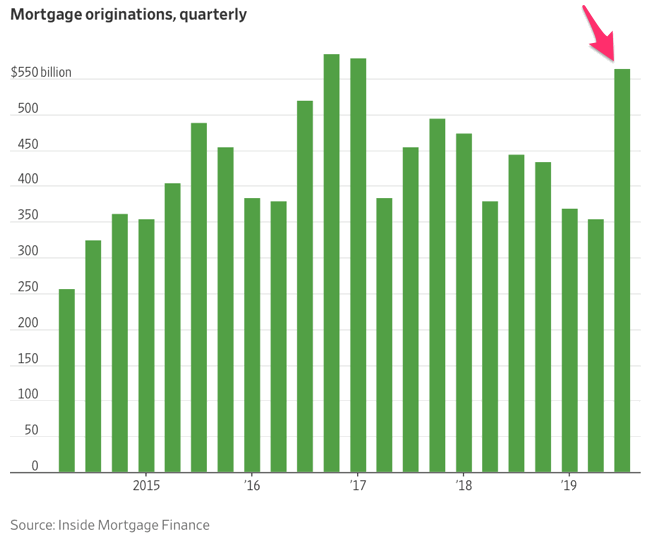
Even before this most recent rate drop, mortgage originations had already spiked, per the WSJ). A swing from 5% back down to 3.5% will create even more.

Bottom line. If you got a 30-year mortgage between late 2016 and mid-2019, there is a good chance that you may be able to lower your mortgage rate via a refinance. Get an accurate full quote with all the costs involved with a online comparison site like LendingTree (tip: don’t enter a phone number if you don’t want them to call you) or go local and call up your neighborhood broker. You might also try an “instant quote” below that doesn’t require any personal information. If you can save money, lock in the rate as they can pop back up quickly.

Best Interest Rates on Cash – August 2019

Here’s my monthly roundup of the best interest rates on cash for August 2019, roughly sorted from shortest to longest maturities. The target for the Fed Funds Rate was just cut by 0.25% as of 8/1/19, so look out for small rate drops this month (probably right after I publish this post). Check out my Ultimate Rate-Chaser Calculator to get an idea of how much extra interest you’d earn if you are moving money between accounts. Rates listed are available to everyone nationwide. Rates checked as of 8/4/19.

High-yield savings accounts
While the huge megabanks like to get away with 0.01% APY, it’s easy to open a new “piggy-back” savings account and simply move some funds over from your existing checking account. The interest rates on savings accounts can drop at any time, so I prioritize banks with a history of competitive rates. Some banks will bait you and then lower the rates in the hopes that you are too lazy to leave.

  • Popular Direct is at 2.55% APY with $5,000 minimum. I don’t like this bank because they always create a “new” account instead of giving old customers the higher rate automatically, but it’s the top rate. Betterment Everyday Savings just dropped to 2.44% APY with a no minimum balance requirement ($10 min to open). There are several other established high-yield savings accounts at 2% APY and up, although some have had small drops recently too.

Short-term guaranteed rates (1 year and under)
A common question is what to do with a big pile of cash that you’re waiting to deploy shortly (just sold your house, just sold your business, legal settlement, inheritance). My usual advice is to keep things simple and take your time. If not a savings account, then put it in a flexible short-term CD under the FDIC limits until you have a plan.

  • No Penalty CDs offer a fixed interest rate that can never go down, but you can still take out your money (once) without any fees if you want to use it elsewhere. Marcus Bank has a 13-month No Penalty CD at 2.35% APY with a $500 minimum deposit. Ally Bank has a 11-month No Penalty CD at 2.30% APY with a $25,000 minimum deposit. You may wish to open multiple CDs in smaller increments for more flexibility.
  • Quontic Bank has a 12-month CD at 2.70% APY and $1,000 minimum with an early withdrawal penalty of 12 months (!) of interest. Andrews Federal Credit Union has a 8-month special at 2.86% APY and $1,000 minimum – anyone can join via partner organization for a small fee.

Money market mutual funds + Ultra-short bond ETFs
If you like to keep cash in a brokerage account, beware that many brokers pay out very little interest on their default cash sweep funds (and keep the difference for themselves). The following money market and ultra-short bond funds are not FDIC-insured, but may be a good option if you have idle cash and cheap/free commissions.

  • Vanguard Prime Money Market Fund currently pays an 2.24% SEC yield. The default sweep option is the Vanguard Federal Money Market Fund, which has an SEC yield of 2.21%. You can manually move the money over to Prime if you meet the $3,000 minimum investment.
  • Vanguard Ultra-Short-Term Bond Fund currently pays 2.40% SEC yield ($3,000 min) and 2.50% SEC Yield ($50,000 min). The average duration is ~1 year, so there is more interest rate risk.
  • The PIMCO Enhanced Short Maturity Active Bond ETF (MINT) has a 2.52% SEC yield and the iShares Short Maturity Bond ETF (NEAR) has a 2.53% SEC yield while holding a portfolio of investment-grade bonds with an average duration of ~6 months.

Treasury Bills and Ultra-short Treasury ETFs
Another option is to buy individual Treasury bills which come in a variety of maturities from 4-weeks to 52-weeks. You can also invest in ETFs that hold a rotating basket of short-term Treasury Bills for you, while charging a small management fee for doing so. T-bill interest is exempt from state and local income taxes.

  • You can build your own T-Bill ladder at TreasuryDirect.gov or via a brokerage account with a bond desk like Vanguard and Fidelity. Here are the current Treasury Bill rates. As of 8/1/19, a 4-week T-Bill had the equivalent of 2.11% annualized interest and a 52-week T-Bill had the equivalent of 1.89% annualized interest (!).
  • The Goldman Sachs Access Treasury 0-1 Year ETF (GBIL) has a 2.27% SEC yield and the SPDR Bloomberg Barclays 1-3 Month T-Bill ETF (BIL) has a 2.04% SEC yield. GBIL appears to have a slightly longer average maturity than BIL.

US Savings Bonds
Series I Savings Bonds offer rates that are linked to inflation and backed by the US government. You must hold them for at least a year. There are annual purchase limits. If you redeem them within 5 years there is a penalty of the last 3 months of interest.

  • “I Bonds” bought between May 2019 and October 2019 will earn a 1.90% rate for the first six months. The rate of the subsequent 6-month period will be based on inflation again. More info here.
  • In mid-October 2019, the CPI will be announced and you will have a short period where you will have a very close estimate of the rate for the next 12 months. I will have another post up at that time.

Prepaid Cards with Attached Savings Accounts
A small subset of prepaid debit cards have an “attached” FDIC-insured savings account with exceptionally high interest rates. The negatives are that balances are capped, and there are many fees that you must be careful to avoid (lest they eat up your interest). Some folks don’t mind the extra work and attention required, while others do. There is a long list of previous offers that have already disappeared with little notice. I don’t personally recommend nor use any of these anymore.

  • The only notable card left in this category is Mango Money at 6% APY on up to $2,500, but there are many hoops to jump through. Requirements include $1,500+ in “signature” purchases and a minimum balance of $25.00 at the end of the month.

Rewards checking accounts
These unique checking accounts pay above-average interest rates, but with unique risks. You have to jump through certain hoops, and if you make a mistake you won’t earn any interest for that month. Some folks don’t mind the extra work and attention required, while others do. Rates can also drop to near-zero quickly, leaving a “bait-and-switch” feeling. I don’t use any of these anymore, either.

  • The best one right now is Orion FCU Premium Checking at 4.00% APY on balances up to $30,000 if you meet make $500+ in direct deposits and 8 debit card “signature” purchases each month. The APY goes down to 0.05% APY and they charge you a $5 monthly fee if you miss out on the requirements. There is also the TAB Bank 4% APY Checking, which I don’t like due its vague terms. Find a locally-restricted rewards checking account at DepositAccounts.
  • If you’re looking for a high-interest checking account without debit card transaction requirements then the rate won’t be as high, but take a look at MemoryBank at 1.60% APY.

Certificates of deposit (greater than 1 year)
CDs offer higher rates, but come with an early withdrawal penalty. By finding a bank CD with a reasonable early withdrawal penalty, you can enjoy higher rates but maintain access in a true emergency. Some CDs offer an “add-on” features that gives you the option of adding funds if rates drop. Alternatively, consider building a CD ladder of different maturity lengths (ex. 1/2/3/4/5-years) such that you have access to part of the ladder each year, but your blended interest rate is higher than a savings account. When one CD matures, use that money to buy another 5-year CD to keep the ladder going.

  • You could build a CD ladder at First National Bank of America at 2.90% APY for 5-year, 2.80% APY for 4-year, 2.75% APY for 3-year, 2.70% APY for 2-year, and 2.60% APY for 1-year.
  • 5-year CD rates have been dropping at many banks and credit unions, following the overall interest rate curve. A good rate is now about 3.00% APY, with Hiway Federal Credit Union offering 3.20% APY ($25,000 min) or 3.00% APY ($500 min) on a 5-year CD with an early withdrawal penalty of 12 months of interest. Anyone can join this credit union via partner organization Minnesota Recreation and Park Foundation ($10 fee).
  • Navy Federal Credit Union has a special 5-year CD at 3.50% APY ($1,000), but you must have a military affiliation to join (includes being a relative of a veteran). NavyFed also has an 18-month CD at 3.00% APY.
  • GTE Financial Credit Union has a promotional add-on CD that allows unlimited additional funds after CD opening. You can open a 5-year CD with $500 minimum at 3.04% APY.
  • You can buy certificates of deposit via the bond desks of Vanguard and Fidelity. You may need an account to see the rates. These “brokered CDs” offer FDIC insurance and easy laddering, but they don’t come with predictable fixed early withdrawal penalties. Nothing special right now. As of this writing, Vanguard is showing a 2-year non-callable CD at 2.10% APY and a 5-year non-callable CD at 2.25% APY. Watch out for higher rates from callable CDs listed by Fidelity.

Longer-term Instruments
I’d use these with caution due to increased interest rate risk, but I still track them to see the rest of the current yield curve.

  • Willing to lock up your money for 10+ years? You can buy long-term certificates of deposit via the bond desks of Vanguard and Fidelity. These “brokered CDs” offer FDIC insurance, but they don’t come with predictable fixed early withdrawal penalties. As of this writing, I am seeing no inventory on 7-year and 10-year CDs. Watch out for higher rates from callable CDs from Fidelity. Matching the overall yield curve, current CD rates do not rise much higher as you extend beyond a 5-year maturity.
  • How about two decades? Series EE Savings Bonds are not indexed to inflation, but they have a unique guarantee that the value will double in value in 20 years, which equals a guaranteed return of 3.5% a year. However, if you don’t hold for that long, you’ll be stuck with the normal rate which is quite low (currently a sad 0.10% rate). I view this as a huge early withdrawal penalty. However, you could also view it as a hedge against deflation, but only if you can hold on for 20 years. As of 8/1/19, the 20-year Treasury Bond rate was 2.21%.

All rates were checked as of 8/4/19.


Betterment Everyday Cash Reserve Review: 0.40% APY (Tied to Fed Funds Rate)

Betterment, best known for their automated portfolio management software, has added a high-yield savings product called Betterment Everyday Cash Reserve. An additional checking product is “coming soon”. This product has several unique features that makes it unlike many other savings accounts. Here are the highlights, followed by both the important pros and cons of this account.

Betterment Everyday Cash Reserve (Available Now)

  • Promotional rate of 0.40% APY as of 2/1/2021 (EFFR + 0.25%) if you sign up for the Everyday Checking waitlist (free)
  • Base rate of Effective Federal Funds Rate (EFFR)
  • FDIC insurance up to $1,000,000
  • No minimum balance. Minimum opening deposit is $10.
  • No monthly fees

If you are an existing Betterment client with Smart Saver, that is going away. You can move over immediately or wait to be transitioned over to this product.

Betterment Everyday Checking (Coming “Later This Year”)

  • No interest paid
  • No minimum balance
  • No monthly or maintenance fees.
  • No overdraft fees.
  • ATM fees reimbursed worldwide
  • FDIC insurance covering up to $250,000†

$1,000,000 FDIC insurance through partner banks. They can offer up to $1,000,000 in FDIC coverage because they use multiple partner banks, currently including:

  • Barclays Bank Delaware
  • Citibank, N.A.
  • Georgia Banking Company
  • Seaside National Bank & Trust
  • Valley National Bank
  • BankUnited, National Association
  • ConnectOne Bank
  • East West Bank
  • Third Coast Bank SSB

You can manually opt-out of one of these banks, for example if you already have cash with them, as to not exceed the $250,000 FDIC insurance limits at any single bank.

Interest rate is directly linked to the Effective Fed Funds Rate. The rate on Everyday Cash Reserve is variable, and will move with the effective federal funds rate (EFFR). As long as you are on the Everyday Checking waitlist, you will get the EFFR + 0.25%.

I view this as a good thing overall, as it’s guaranteed to be quite competitive against most non-promotional rates. It also provides more transparency and lowers the chance of a bait-and-switch to some really sad rate. However, the 0.25% boost above the EFFR is currently a waiver of their 0.25% management fee good through 2019. Being on the waitlist is free and comes with no obligation to open the account, so that’s not a big deal. However, it’s not clear if or how they will extend the waiver after that. You might need an active and open Everyday Checking account, set up direct deposit, or jump through a similar hoop.

Everyday Cash Reserve isn’t your normal bank savings account. There are some quirky things that you should know about.

  • No joint accounts.
  • No routing number or account number, so no direct deposit or linking via other banks.
  • You can only initiate ACH transfers through Betterment, and you can only link one external bank account.
  • It’s not a “real” savings account, so there is no limit of 6 withdrawals per month.

Everyday Checking plans to offer things like direct deposit (and thus real routing and account numbers).

Bottom line. Betterment, a “robo-advisor” best known for their automated investing service, has added a high-yield savings product called Betterment Everyday Cash Reserve. There are some limitations with external bank transfers, but I do like that it has a transparent structure that links the interest rate to the Fed Funds Rate. If you sign-up on their EveryDay Checking waitlist, you can get a competitive rate on liquid savings.

Equifax Data Breach Settlement: Free Credit Monitoring vs. Reduced Claim

Update. As many of you correctly pointed out, only $31 million was allotted to the $125 alternative payment if you opted out of the free credit monitoring. The FTC has provided an update encouraging people to pick the free monitoring:

I thought I could choose $125 instead of free credit monitoring. What happened?

The public response to the settlement has been overwhelming. Millions of people have visited this site in just the first week. Because the total amount available for these alternative payments is $31 million, each person who takes the money option is going to get a very small amount. Nowhere near the $125 they could have gotten if there hadn’t been such an enormous number of claims filed.

The free credit monitoring provides a much better value, and everyone whose information was exposed can take advantage of it. If your information was exposed in the data breach, and you file a valid claim before the deadline, you are guaranteed at least four years of free monitoring at all three credit bureaus (Equifax, Experian, and TransUnion) and $1,000,000 of identity theft insurance, among other benefits. The market value of this product is hundreds of dollars per year.

You can still choose the cash option on the claim form, but you will be disappointed with the amount you receive and you won’t get the free credit monitoring.

My perspective is that data breaches are happening all the time. (Capital One was breached just this week.) All of them just say “oh my, we’re sorry, here’s some free credit monitoring”. I’ve probably got about 8 different credit monitoring services going on right now, and I’m sure more will be offered shortly. I do NOT value their free monitoring at some “retail value” of hundreds of dollars. You may feel differently. I think that people should be rightly angry if they end up with a few bucks in the end, which hopefully will spur further change and make future penalties more severe. If all these companies care about is money, then isn’t a huge cash penalty a better deterrent to lazy security practices?

Original post:

Equifax has reached a settlement with the Federal Trade Commission, the Consumer Financial Protection Bureau, and 48 out of 50 states over their huge data breach that was discovered in 2017. You can find full details at FTC.gov, where you can confirm the official claim website. You can check your eligibility at this lookup tool. You will need to provide your last name and last 6 digits of SSN.

First, you can get up to 10 years of free credit monitoring or $125 if you decide not to enroll because you already have credit monitoring. No supporting documentation necessary. I am already using these free daily credit monitoring services and they have been working well for me, so I am definitely filing a claim for the cash payment of $125. However, some people may prefer the monitoring. You can file a claim for every person in your household that is 18 or older.

Next, you can be compensated for the time you spent dealing with the claim, at a rate of $25 per hour up to 20 hours. Supporting documentation requirements vary as follows:

  • If you submit a claim for 10 hours or less, you must describe the actions you took and the time you spent doing those things.
  • If you claim more than 10 hours, you must describe the actions you took AND provide documents that show identity theft, fraud, or other misuse of your information.

If you are the type of person that read this website, you probably did spend at least some amount of time dealing with the data breach. For me, these activities mostly happened near the time the breach was discovered in September 2017.

  • You might have spent time reading press releases and news articles about the data breach and how it might impact your financial life and how to avoid identity theft.
  • You might have spent time reading official websites about all of the many differences between a credit freeze and fraud alert.
  • You might have spent time on the phone or online in order to place and/or removing those credit freezes and fraud alerts.
  • Finally, you probably checked all of your credit reports from all three credit bureaus, probably multiple times, in order to make sure there was no fraudulent activity.

For example, if you spent 5 hours doing this total, you can file a claim for an additional $125 (5 times $25) by listing and attesting to your activities but without having to provide physical documentation.

You can also file claims for direct expenses that you paid as a result of the breach (supporting documentation required), including:

  • Losses from unauthorized charges to your accounts
  • The cost of freezing or unfreezing your credit report
  • The cost of credit monitoring
  • Fees you paid to professionals like an accountant or attorney
  • Other expenses like notary fees, document shipping fees and postage, mileage, and phone charges

As with many such settlements, the final amounts may be reduced depending on the number of people who make a claim.

Finally, starting in 2020, all US consumers can get 6 free credit reports per year for 7 years from the Equifax website. That’s in addition to the one free Equifax report (plus your Experian and TransUnion reports) you can get at AnnualCreditReport.com. You can sign up for an email reminder if you want.

Marcus Bank Promotion: 1% Additional Cash Bonus up to $500 (~6% APY 3-month CD)

Online bank Marcus (formerly Goldman Sachs Bank) has a new Cash Bonus Offer which includes 1% cash bonus (up to $500) on new deposits on top of their existing interest rate (currently 2.15% APY). Valid for both new and existing customers. Given the holding period, this roughly equates to the same total interest paid as a 3-month bank CD at 6% APY.

Here’s how it works:

  • Enroll first at the offer link and designate a specific savings account to be tracked for this promotion.
  • Deposit your new funds ($1,000 minimum) within 10 days of enrollment. Multiple transfers within that 10 days is fine, but funds must be new to Marcus Bank.
  • Maintain your balance at enrollment plus the new funds for 90 days.
  • Receive your 1% cash bonus (up to $500) on your new funds within 14 days after the 90-day period ends.

To be clear, the bonus applies to new funds added after enrollment, not your total balance. Since the 10-day clock starts when you enroll, you may consider waiting until the last day of 7/29/19 if you need some time to gather your new funds together. However, they can also revoke the offer at any time, so I wouldn’t wait any longer than necessary.

This offer is available to new and existing Marcus customers who are not currently enrolled in another Marcus bonus offer. Each customer is limited to one 1% cash back offer, which can only be applied to a single account. For eligibility purposes, each joint owner will be treated as a separate customer. For example, if you apply the bonus offer to a joint account, the remaining joint owner(s) may apply this offer to another account they own if they have not done so already.

Rough math. Given that you can an additional 1% bonus after about 3 months, the bonus itself works out to the equivalent of a 4% annualized yield. 2% + 4% = 6%, so you’re looking at the equivalent of a 3-month CD at 6% APY for new money deposits between $1,000 and $50,000. Alternatively, if you are lazy, you could leave it in there for a year and still earn a bit over 3% APY over that year (assuming the base interest rate stays above 2%). That’s still good compared to a 12-month CD. Either way, the max benefit is $50,000 of new money held there for 90 days to earn a $500 bonus.

This combination makes it a great 3-month rate at that balance size when compared to my most recent update of best interest rates.

Should I move money out of Marcus and back in to qualify? No, it won’t make any difference. Funds deposited in your account prior to enrollment are not eligible for the cash bonus.

I am an existing customer (just recently for their expired $100 promo), and did not see a hard credit check at opening. Since I already have an account, I’ll probably be taking advantage of this one as well.

Bottom line. Marcus Bank has a new promotion to attract new money to their Online Savings Account – a 1% cash bonus (up to $500) on new deposits on top of their existing interest rates. This works out to a 3-month holding period paying roughly 6% annualized interest. You must enroll by 7/29 and transfer over new funds within 10 days of enrollment.

Amazon Prime Day 2019: Big List of Deals and Discounts (Updated)

Last call for deals + good stacking offer: Up to $60 Amazon credit for buying through the app. Amazon Prime Day 2019 is July 15th and 16th. I’ll try to keep this post updated with the most recent offers (and remove the expired ones). There are usually many opportunities to save some money without buying stuff you don’t need (and thus offset a chunk of that membership fee). In fact, if you have any things you’ve been looking for on your Wish List, you should just look them up and see if they are on sale today. (I bought an Eero mesh Wifi system to replace my 5-year-old router.)

As the name suggests, most deals require a Prime membership. New members can sign up for a 30-day free trial. If you’ve already done the trial, you can simply buy a month of Prime for $12.99.

Free Amazon Credit Offers

Site-wide

Specific Items

Amazon Device Deals

Targeted deals

Our Family Travel Award Redemptions 2019

I’m not a Instagram travel blogger and I’ll never visit every country in the world, but I do earn enough points from navigating the top credit card offers to fund a big chunk of our annual travel each year. We are a family of five including a toddler, so we redeem for domestic economy class tickets to see grandparents instead of business class seats to an over-water Maldives bungalow. We also travel in peak times due to school schedules, so it’s harder to hunt for high value opportunities. I used to worry about this, but now we just earn ’em and burn ’em.
We are heading to Kauai later this month, which included these redemptions:

Economy flights to Hawaii – 15,000 to 40,000 American miles roundtrip each
The actual redemption amount will vary based on dates and times. The interisland flights are 7,500 miles each way (both AA/Hawaiian), and Mainland US to Hawaii are 20,000 miles each way.

You can earn American Airlines miles from multiple credit cards, as there are versions from both Citi and Barclaycard. Sometimes one offer is much better than the other, right now both are solid. Marriott/SPG points also transfer over to American miles. The cards will also let us get free checked bags and priority boarding, saving us more money.

Grand Hyatt Kauai – 25,000 Hyatt points per night
I’m excited to visit what is consistently rated the best resort in Kauai for the first time. You can earn Hyatt points from multiple credit cards as well. There is the Chase World of Hyatt card, and Ultimate Rewards also transfer over on a 1:1 basis instantly to Hyatt. That means the Chase Sapphire Preferred, Sapphire Reserve, Freedom, and Freedom Unlimited all earn points that can lead to a nice resort in Hawaii. (I also got a ton of points from the Ink Business Preferred for small businesses.)

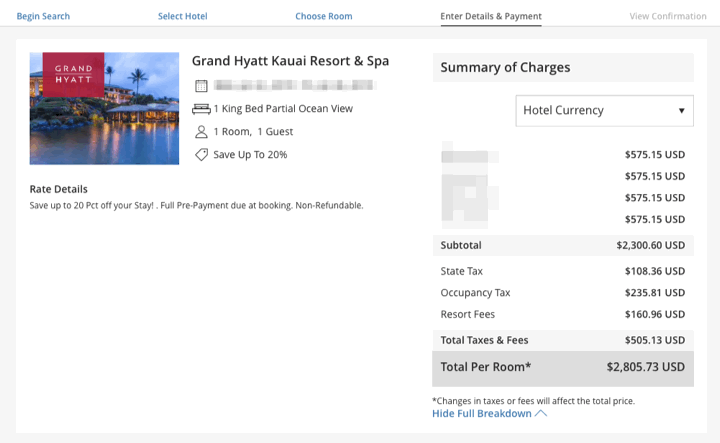
Transferring some Chase points over let me top off the account to reach exactly the number of points needed. Redeeming with Hyatt points also includes all taxes and let me avoid the daily $35/resort fee. Here’s a screenshot showing that the total cash cost for our stay would have been $701 per night (2.8 cents per Hyatt point) after adding in the resort fee:

(I’m also getting 10% of my redeemed points back from this promo, so in the end I’ll be getting more than 3 cents per Hyatt point.)

For the holidays, we are heading to visit family in Austin, Texas:

Economy flights to Austin – 20,000 British Airlines Avios roundtrip each
The flights are actually on American as well, just using Avios. While far from my best Avios redemption, it worked out as British Airways allows you to “household” an account. We had a previous trip so a lot of miles were spread across the kids’ accounts, and this feature lets us pool the points and use them all up. For example, what if you had 18,000 points in five different accounts and the award you wanted was 100,000 points? Avios lets you pool them together, and you could transfer over some American Express Membership Rewards or Chase Ultimate Rewards points to top things off.

Besides past flights, our main source of Avios points was the Chase British Airways card.

SpringHill Suites Austin – 14,000 Marriott points per night
No free scuba lessons or water slides here. This is just a nice suite hotel so that we can fit all five of us in comfort. There is a solid free buffet breakfast, and it’s close to family (and a Rudy’s BBQ).

Marriott also has credit cards from both Chase and American Express that can provide lots of points-earning opportunities.

Both my wife and I apply for a few new cards each year, but we don’t go past that much anymore. Our basic idea is to try out one card at a time. Sometimes the perks are pleasantly much better than expected, and other times they are harder to use than expected.

Amazon Prime: Spend $10 at Whole Foods, Get $10 Amazon Credit on Prime Day

Amazon Prime Day 2019 is going to start on July 15th, where they offer big discounts because the holidays are too far away. If you’re selective, you can grab some nice savings and promo deals. Here is a $10 Whole Foods promo – if you are an Amazon Prime member and spend $10 at Whole Foods from now until July 16th (be sure scan your Prime code or linked phone number at checkout), they will give you $10 Amazon credit on July 15th and 16th. The details:

Prime members: scan your Prime Code, use your linked mobile phone number at checkout, or make an order via Prime Now for delivery or pickup in the U.S. between July 3, 2019 and July 16, 2019 on a single purchase of $10 or more from Whole Foods Market. Exclusions apply. You’ll get $10 to spend on Amazon for Prime Day, a two-day parade of epic deals starting July 15, 2019 12am PT. Limit one per customer.

If you haven’t done them already, you can also load up these past deals:

  • Amazon App promo: Get a $10 Amazon credit with first app sign-in, plus another $10 after first in-app purchase, plus $5 Amazon for using camera and Alexa features for the first time.
  • Amazon Gift Card reload promo: $10 bonus on your first reload of $100+.
  • Amazon Assistant promo: Install this browser extension and receive desktop notifications for a $10 off $50 discount.