The closer I get to the reality of living off of my portfolio, the more I like the idea of living off dividend and interest income. However, you can’t just buy stocks with the highest dividend yields and junk bonds with the highest interest rates without giving up something in return. Certainly there are many bad investments lurking out there for desperate retirees looking for maximum income. My goal is to live off my portfolio income while not reaching too far for yield.
A quick and dirty way to see how much income (dividends and interest) your portfolio is generating is to take the “TTM Yield” or “12 Mo. Yield” from Morningstar quote pages. Trailing 12 Month Yield is the sum of a fund’s total trailing 12-month interest and dividend payments divided by the last month’s ending share price (NAV) plus any capital gains distributed over the same period. SEC yield is another alternative, but I like TTM because it is based on actual distributions (SEC vs. TTM yield article).
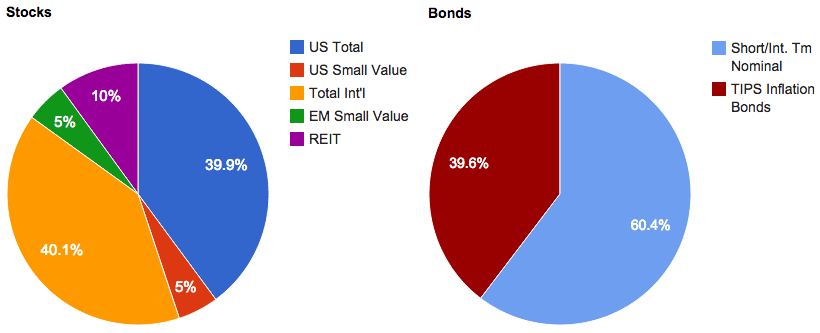
Below is a close approximation of my most recent portfolio update. I have changed my asset allocation slightly to 60% stocks and 40% bonds because I believe that will be my permanent allocation upon early retirement.
| Asset Class / Fund | % of Portfolio | Trailing 12-Month Yield (6/24/15) | Yield Contribution |
| US Total Stock Vanguard Total Stock Market Fund (VTI, VTSAX) |
24% | 1.79% | 0.42% |
| US Small Value WisdomTree SmallCap Dividend ETF (DES) |
3% | 2.78% | 0.08% |
| International Total Stock Vanguard Total International Stock Market Fund (VXUS, VTIAX) |
24% | 2.75% | 0.81% |
| Emerging Markets Small Value WisdomTree Emerging Markets SmallCap Dividend ETF (DGS) |
3% | 2.81% | 0.09% |
| US Real Estate Vanguard REIT Index Fund (VNQ, VGSLX) |
6% | 3.76% | 0.22% |
| Intermediate-Term High Quality Bonds Vanguard Limited-Term Tax-Exempt Fund (VMLUX) |
20% | 1.63% | 0.34% |
| Inflation-Linked Treasury Bonds Vanguard Inflation-Protected Securities Fund (VAIPX) |
20% | 2.18% | 0.45% |
| Totals | 100% | 2.24% |
The total weighted 12-month yield was 2.24%. This number is lower than the last three updates: 2.41%, 2.49%, and 2.31%. This means that if I had a $1,000,000 portfolio balance today, it would have generated $22,400 in interest and dividends over the last 12 months. Now, 2.24% is significantly lower than the 4% withdrawal rate often recommended for 65-year-old retirees with 30-year spending horizons, and is also lower than the 3% withdrawal that I prefer as a rough benchmark for early retirement. I should note that the muni bond interest in my portfolio is exempt from federal income taxes.
As noted previously, a simple benchmark for this portfolio is Vanguard LifeStrategy Growth Fund (VASGX) which is an all-in-one fund that is also 60% stocks and 40% bonds. That fund has a trailing 12-month yield of 2.01%. (Last update, it was 2.09%.)
So how am I doing? Using the 2.24% income yield, the combination of ongoing savings and recent market gains have us at 72% of the way to matching our annual household spending target. If I switch to a 3% benchmark, we are 96% there. Consider that if all your portfolio did was keep up with inflation each year (0% real returns), you could still spend 2% a year for 50 years. From that perspective, a 2% spending rate seems like a very conservative lower bound.
Sadly, some valuation models predict exactly that: 0% real returns over a long time. My portfolio has certainly gone up a ton in value due to the ongoing bull market. Bottom line is that we are getting closer but not quite where we want to be.




 The Best Credit Card Bonus Offers – 2025
 Big List of Free Stocks from Brokerage Apps
 Best Interest Rates on Cash - 2025
 Free Credit Scores x 3 + Free Credit Monitoring
 Best No Fee 0% APR Balance Transfer Offers
 Little-Known Cellular Data Plans That Can Save Big Money
 How To Haggle Your Cable or Direct TV Bill
 Big List of Free Consumer Data Reports (Credit, Rent, Work)