The Power of Passive Index Fund Investing: An Example

The other day, I was trying to explain to a friend why I invest in index funds. I came up with this example, which I’m not sure is perfect but I thought I’d share it.

Background: Market Cap Indexes
When you hear “index funds”, it traditionally means mutual funds that follow an index which holds companies proportionally to their market capitalization. If a company has 1,000,000 shares and each share is trading at $25, then its total market capitalization is $25 million.

Let’s take the S&P 500 Index. The market cap of Starbucks (SBUX) is $14 billion dollars, while Exxon Mobil (XOM) is worth $334 billion. So an index fund tracking the S&P 500 would hold 24 times as much Exxon as Starbucks.

The index fund is “passively managed” in that it does not make any of its own decisions on the value of each company, it simply accepts the value of the each company as determined by each day’s market trading between millions of investors.

An Alternate Universe

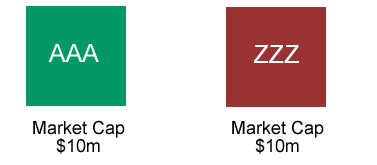
Let’s imagine an alternate universe where we only have two companies, AAA and ZZZ, that make widgets, the one thing people there buy. Both have a million shares outstanding. Company AAA makes widgets and has earnings of $1 million a year. It’s been around a while and is fairly boring, so the price/earnings ratio is 10, making the market cap $10 million. Thus, each share is worth $10.

Company ZZZ also makes widgets and has earning of only $500,000 per year. But it’s newer and makes stylish widgets that attract young people. People seem to think it has greater potential for earnings growth, so the P/E ratio is 20. Thus, the market share is also $10 million, or $10 per share.

An index fund is created to track this alternate universe, and based on market-cap it holds 50% AAA and 50% ZZZ.
So what happens in the future?

Scenario #1
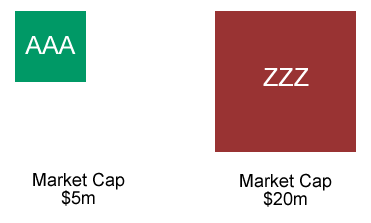
ZZZ could keep taking market share from AAA with their cool and stylish widgets. AAA’s earnings go down to $500,000, and the P/E stays constant at 10, leading to a new market cap of $5m. ZZZ starts earning $1,000,000 per year, and with a P/E of 20 grows to a market cap of $20m.

What happens to the shares in your index fund? Nothing. No trades are made, because only the share values have changed. You hold the same number of shares of each. However, your fund’s value has grown 25% because the value of ZZZ has doubled, while the value of AAA has been cut in half. Your holdings based on market value are now 20% AAA and 80% ZZZ.
Scenario #2
Things are going along, but then a new medical study finds that ZZZ’s widgets cause cancer, and it turns out the CEOs have been covering this up for years. ZZZ tanks, and is now trading at a penny per share, while everyone is switching to AAA’s reliable widgets. AAA goes up to a market cap of $25m ($25 per share).
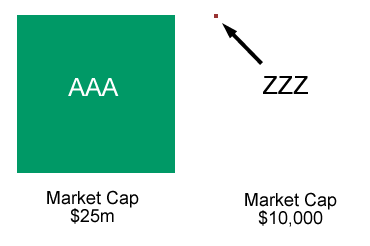
What happens to the shares in your index fund? Still nothing, even though you now own 99.96% AAA. Meanwhile, your fund has grown another 20% because of AAA’s growth, even with ZZZ’s collapse.

Summary
You don’t know what is going to happen in the future. There are a million different possible scenarios I could have chosen. AAA could have split off a small division called BBB and it could have taken over the world. The most important point is, whatever happens, with a market-cap index fund, you are guaranteed to own all the winners.

You’ll also have owned the losers, but remember you won’t know who they are beforehand. Buggy whip manufacturers used to be huge. Now, iPhone-making companies are growing. One day iPhones will be in landfills, and we’ll be onto downloading knowledge directly into our brains or something. Or maybe we’ll run out of oil and be back to buggy whips. Who knows.

“Don’t look for the needle in the haystack. Just buy the haystack.” – John C. Bogle

This is the power of passively-managed index funds. With low-cost index funds, you’ll even be guaranteed to beat the average investors’ performance because of investment expenses eating into their return.

OptionsXpress $100 New Account Bonus via Referral

Here’s another solid opening account bonus for an online broker. OptionsXpress is offering new customers a $100 bonus if they open an account with a referral from a current customer. You must maintain an average balance of $500 for 6 months, and make at least one trade. That’s a pretty sweet return on $500 in exchange for you trying out their service.

OptionsXpress offers $14.95 trades, free real-time and streaming quotes, and has lots of features for options traders. There are no minimum account balances, no account maintenance fees, and no inactivity fees.

If you’re looking for something safe to buy, the new WisdomTree Current Income Fund ETF (USY) is designed to have very low volatility and currently yields 1.03%. Another option I like is PowerShares VRDO Tax-Free Weekly (PVI), which also has a stable NAV from VRDOs and currently yields 2.62% tax-free. These would also work well with the TradeKing $50 bonus if you’re low on stock ideas.

I have an account, so if you’d like a referral just contact me with OptionsXpress in the subject, and I’ll be happy to send you one. I only need your e-mail address. You must open your account with the same e-mail you give me, and also use the promotional code FRIEND on your application.

Here’s the complete fine print:

$100 in your account and $100 in your friend’s account
Offer limited to one $100 bonus per referrer and referred friend, for each unique referral resulting in a newly activated, funded optionsXpress account meeting the terms and conditions of the refer a friend program. To qualify for the $100 bonus, the referred account must maintain a per account average balance of $500 for 6 months, and the account must trade at least once. The $100 bonus will be deposited into the referrer and referred accounts within 45 days after the referred friend meets the terms and conditions of the offer. To qualify, the referrer must enter the referred friend’s email address through this page, and the referred friend must enter the promo code “FRIEND” through the new account application form when opening the new account. A referred customer can only qualify for the $100 bonus a total of one time. A customer can only qualify for a total of $500 from any combination of optionsXpress cash promotions per calendar year. Deposits of new funds or securities from existing optionsXpress accounts are not eligible for this offer. Qualified (IRA), linked and shared accounts are not eligible for this offer. This offer is not valid for optionsXpress associates, non-U.S. residents, certain referring parties, and where otherwise prohibited. Customers can not exchange the $100 for other offers, cash or credit. We reserve the right at our sole discretion, to cancel, modify or suspend this offer program at any time without notice.

Historical Net Worth & Goal Chart Updates

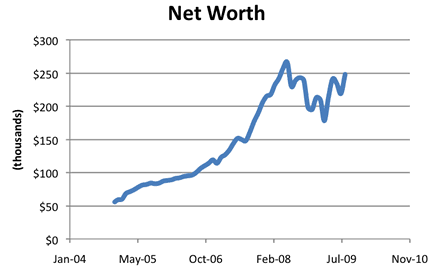
I finally got around to updating all my net worth charts and graphics. Here is my net worth since I started tracking it on this blog in December 2004:

You can also view my net worth since graduating from college in my Net Worth page. You can download my tracking template here.

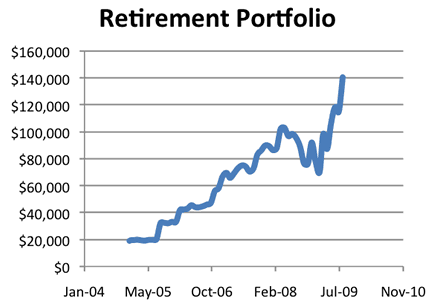
Since I had all the data handy, I also put together a chart of the value of my retirement portfolio. This is simply the sum of all the money in our 401k/IRA/403b’s over the years, including any gains/losses and contributions. Since I did a Traditional-to-Roth IRA conversion a while back, I normalized all the values by taking 30% off of any pre-tax account values. Therefore, the chart is of (estimated) after-tax balances.

As you can see, my portfolio is small enough that regular contributions have been able to counter the rather mediocre returns over the last 5 years so. The swings in our property value is also contributing to making our overall net worth very volatile recently.

Goal Tracker Chart
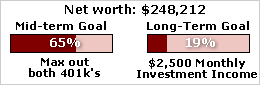
I also wanted to update my little goal meter on the top-right of every page. I updated our 401k contribution progress; we are on track to max them out for 2009. My first long-term goal is pay off my home mortgage, so I won’t have a house payment anymore. My second is to build a $750,000 investment portfolio. More details here.

At a 4% inflation-adjusted withdrawal rate, a very rough rule-of-thumb, $750k would create an annual income of $30,000 per year ($2,500 monthly). This should cover all our non-housing expenses. At the current $140,000 value, I’d theoretically be able to produce about $467 of “passive” income per month.

I’d like to come up with a better graphic to track these things, but for now I’ll stick with the progress bar. Any creative ideas out there?

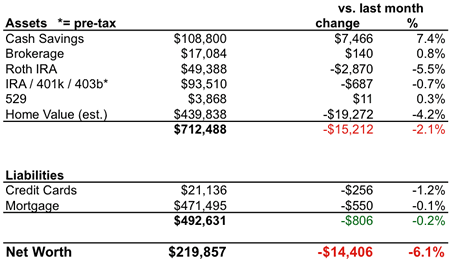
Monthly Net Worth Update – August 2009

Net Worth Chart 2009

Credit Card Debt
For newer readers, I have taken money from credit cards at 0% APR and placed it into online savings accounts, bank CDs, or savings bonds that earn 4-5% interest (much less recently), and keeping the difference as profit. I even put together a series of step-by-step posts on how to make money off of credit cards in this way. However, given the current lack of great no fee 0% APR balance transfer offers, I am mostly waiting on existing offers to end. I just paid off a large-ish balance this month.

Retirement and Brokerage accounts
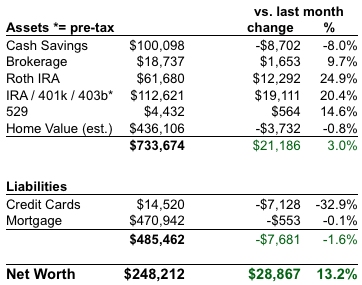
Besides watching another market rally, we made a bunch of retirement contributions this month. Wife’s 401k is now maxed out at $16,500 for 2009. I made a $5,000 contribution to my Solo 401k. This makes us about 65% done with our goal of maxing out both our 401ks for 2009.

Early in the month, I also decided to go ahead and make our IRA contributions for 2009 (non-deductible due to income limits). So that’s another $10,000.

Cash Savings and Emergency Funds
We still have a little over a year’s worth of expenses in our emergency fund. I was supposed to use up some of the cash to make a principal prepayment this month, but didn’t do it due to a variety of reasons. Mainly, I wanted to do things in order and do the retirement contributions above first. We also found that we have a roof leak that may require some cash.

In addition, we have gotten some quotes on a solar hot-water system for the house, which seems like it would have a fast payback period of 2-3 years. A photovoltaic system would cost significantly more and have a payback period of around 8-9 years depending on size. Still researching this.

Home Equity
Using four different internet valuation tools – Zillow, Cyberhomes, Coldwell Banker, and Bank of America (old version) – I again took the average and took off 5% to be conservative and 6% for real estate agent commissions. The bloodshed slowed a bit this month. 🙂

All in all, more steady progress. I feel like I’m not learning a lot from these updates, but it seems to be a good habit to keep an eye on things.

Stock Market Timing Using Historical Moving Averages

In the wake of the recent stock market drops, there has been a increased amount of interest in certain market timing systems that would have told an investor to be “out” of the market during late 2008 and early 2009. Below are a sample of the more popular mechanical systems, which have clear parameters and are easy to follow using basic investing tools.

100-Day Moving Average (FundAdvice.com)
FundAdvice.com is run by Merriman Capital, which provides money management services using both buy-and-hold and market timing models. I’ve mentioned them before for their index fund model portfolios and the related “Ultimate” Buy-and-Hold Portfolio. The website has an entire market timing section, and I am specifically referencing the articles here and here from 2001 and 2002.

Merriman recommends something called the 100-day moving average. For any given asset or mutual fund, you calculate the average of the most recent 100 days of closing prices. Each day, you’ll have a new average by adding the newest price and dropping the oldest price from the average. Then, you compare the current price of the fund with this simple moving average (SMA).

Each day the market is open, if the current price is above the 100-day SMA, you should buy the fund or hold it if you already own it. If the current price is below the 100-day SMA, sell it. After you sell, place your proceeds in cash (money market fund) until the fund price is once again above the average.

200-Day Moving Average (Faber)
The 2006 paper A Quantitative Approach to Tactical Asset Allocation by Mebane Faber explores a very similar but even simpler mechanical system. Here you take the 200-day simple moving average of any index, for example the S&P 500. But this time, you only calculate this at the end of each month. If the current price is greater than the 200-day SMA, then you buy. If the current price is less than the 200-day SMA, then you sell and move to cash (90-day T-Bills). This results in some impressive backtested results, but with much fewer trades than other systems.

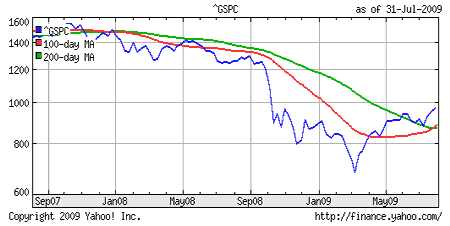
By the way, you can track the 100-day and 200-day SMAs easily using most stock quote websites like Yahoo Finance. Here’s the chart for the S&P 500:

As you can see where the S&P 500 is below the green and red lines, you would have been told to “sell” and stay in cash during some of the big drops.

10-Year Trailing Average P/E Ratio (Shiller)
Prof. Shiller of Yale University is well-known for his book Irrational Exuberance. From Wikipedia: “Published at the height of the dot-com boom, it put forth several arguments demonstrating how the stock markets were overvalued at the time. Shiller was soon proven right when the Nasdaq peaked on the very month of the book’s publication, and the stock markets collapsed right after.”

Part of his argument was based on historical price-to-earning ratios, or P/E ratios. This indicator went throw some iterations and became known as PE10, which takes the current price of the S&P 500 and divides it by the average inflation-adjusted earnings for the past 10 years. Essentially, it is a 10-year moving average of the P/E ratio. If the current P/E ratio is significantly higher than the 10-year average, the market is overvalued.

You can find updated numbers and more at his Yale website.

Warnings about Market Timing
I haven’t taken the time to deeply analyze any of these systems, I am only presenting them here for debate. However, I think I should throw out a few quick warnings.

Depending on which stock market index you track, and the time period you track, all of the methods above reduce risk (volatility) without significantly reducing overall returns as compared to buy-and-hold. However, there have also been long stretches where timing underperformed buy-and-hold, which can make it a hard strategy to implement over the long run. The main reason we are talking about them now is only due to recent hot performance. In addition, market timing requires regular attention to stock market activity, increased trading costs, and tends to be much less tax-efficient.

Even Merriman states: “we have concluded that relatively few investors have the tenacity, discipline and faith required to be successful market timers.” But perhaps the same is true for Buy-and-Hold? It is possible that these market timing systems will outperform in the future as well. Or they may not, and you’ll be jumping in only after a recent hot run. I don’t have a well-composed argument either way right now, but I can say that I currently am not using any of the above systems.

TradeKing New Account $50 Bonus

Online broker TradeKing.com has brought back their $50 sign-up bonus for new accounts as part of celebrating National Friendship Day. If you get a referral from an existing account holder, fund it with at least $1,000, and make a trade, both people will get $50.
Simply enter your friends’ email addresses below between now and August 27, and press Send. As soon as your friend deposits $1,000 and executes a trade, we’ll deposit $50 into both of your accounts. Isn’t friendship grand? Please note that your friends must click the link in the email for us to track them and for you to receive your reward. But don’t worry. We tell them that in the email they’ll receive.

[..]You must have a regular non-retirement investment account, and you must leave the account open, with your referral money in there, for at least 6 months. Your friends must open a non-IRA account by August 31st, fund their account with at least $1,000 within 30 days of opening the account, and make a minimum of one trade within 180 days of account opening to receive their $50. But even if they act on it later, you’ll still receive your $50. So what are you waiting for? Start entering email addresses!

I have an account, so if you’d like a referral just contact me, and I’ll be happy to send you one. I only need your e-mail address. There is no promotion code, but you’ll need to click on the specific link on the e-mail for tracking purposes.

TradeKing offers $4.95 trades with no minimum balance requirement. For more information, please check out my TradeKing Review.

Dangerous Personal Finance Magazine Headlines: The Attraction of High Yields

With money market fund and savings account yields still pitifully low, it is very tempting to look for investments with higher yields. Indeed, the personal finance magazines know this all too well, dangling teasers on their covers like:
  • Stocks That Pay 8% (Kiplinger’s Personal Finance, Oct 2008)
  • How to Get 8% on Your Money (SmartMoney, Dec 2008)
  • Grab These Bonds For 10% Yields (SmartMoney, Feb 2009)
  • Stocks That Pay You 5% Or More (Kiplinger’s Personal Finance, Feb 2009)

I know that they need to attract casual readers to buy their issues off the crowded magazine rack, but I fear that these articles can hurt readers by focusing primarily on yields.

From tankers to pipelines to real estate stocks, we’ve uncovered the investments with the best yields.

Stock dividends and bond yields are certainly a very important component of return. But with such significantly higher yields, the real question should be why the yields are high, as there is definitely higher risk. If your investment spits out 5%, but the actual investment decreases in value by 5%, um… you don’t make any money. You would have made more money at a bank. And if it does worse…

“Earn 8% or More” becomes “Earn 8% or a LOT LESS”
I bring this up because I was just reading the June 2009 issue of Kiplinger’s with an article entitled (surprise!) Where to Find Top Yields. But as I read, they first meekly admit that their last “yieldfest” article missed the mark. So I found it, and did a little before-and-after comparsion:

In Earn 8% or More (July 2008), they wrote:

Shares of First Industrial Realty trust (FR), a national developer and operator of warehouses and light industrial buildings, more than doubled between November 2002 and November 2006 but have since fallen 33%, to $30, over concerns about flat rents and the firm’s high debt. The stock trades below First Industrial’s net asset value per share and pays 10%, one of the highest yields among long-established REITs. There is still ample cash flow to maintain dividends.

Pays 10% yield, ample cash flow, a long-established REIT. Almost sounds stodgy and safe. Fast forward to June 2009:

Credit-market chaos wreaked havoc with the recommendations in our previous “yieldfest”. Our best picks, emerging-markets bond funds such as Fidelity New Markets Income and Pimco Emerging Markets Bond, dropped about 10% over the past year through April 9. Pipeline stocks, such as Kinder Morgan Energy, also held up reasonably well. But we had our share of disasters. For example, First Industrial Realty Trust cratered by nearly 90%, while Genco Shipping & Trading dived 73%.

Their best picks still dropped 10%? Most were in the disaster category. Another pick from July 2008:

For example, look at First Trust Strategic High Income (symbol FHI), which borrows to invest in bank loans, mortgage-related securities and junk bonds. Its share price plunged from $20 in early 2007 to less than $10.50 eight months later, as its underlying assets fell victim to the credit crunch and the real estate recession. But the shares have rebounded to $12.25, and the fund’s net asset value per share, now $10.38, has stopped crumbling (unless otherwise noted, all figures are to May 12).

But even as the fund was collapsing, it kept paying out 16 cents a month. Based on the current share price, the payout (which doesn’t require borrowed money or represent a return of capital) comes to a yield of 15%. We generally don’t recommend closed-end funds selling at 18% premiums to NAV, but First Trust’s yield is too luscious to pass up.

From a share price of $12.25 at the time of recommendation, the share price of FHI as of 7/13/09 was $3.38. Including those “luscious” dividends, the 1-year total annualized return was -57.3%

They also neglected to mention the fact that FHI has management fees of 2.21% plus “other fees” of 2.11% for total annual expense ratio of 4.32%. Ouch.

Both of these are extreme examples, but an important lesson can be learned by reading the entire 2008 article first, and then reading the 2009 article. The story is always very convincing. You’ll get high yields, historical stability, and some sort of reason why things are looking up. It will be tempting. But remember, this part of your $5 magazine is selling sizzle, and won’t reimburse your losses when there’s no steak.

* p.s. Don’t get me wrong, I don’t think that these magazines are all bad. They often have very useful articles, which I read and link to regularly. I am a paying subscriber, after all. However, I do think that these “yieldfest” articles are written primarily to increase their own revenue, not the investment returns of their readers.

Tracking Investment Portfolio Using Google Docs

I spent a little time tinkering with Google Docs Spreadsheets today, trying to use it to track the asset allocation of my investment portfolio.

GoogleFinance() Function
This function allows you to import data from Google Finance like current stock prices, p/e ratios, or performance. Here is the Google Docs Help page. For example, if you want to pull up the price of a share of Google stock, you’d enter this into a cell.

=GoogleFinance("GOOG"; "price")

Importing Personal Data
I could not find an easy way to import my actual holdings into Google Docs, but I’m not sure if you want that capability due to privacy concerns. Google Docs does allow you to import from RSS or XML feeds. I ended up just manually entering the ticker symbols and number of shares I held for each mutual fund. This means I will have to update my 401(k) funds after each paycheck, and my other holdings when I make a transaction or when a dividend is paid.

Shared Example
Below is a shortened version of my online file, as a quick example.

You can view the full version more easily here. To edit, go to File and click on “Create a copy…”. You can then poke around and change the ticker symbols to your own.

In the full version, I have columns that compare my current asset allocation percentages to my target percentages. This can help people who wish to rebalance when their allocations are off by a certain amount. I can see that I am currently overweight in Emerging Markets due to their recent run-up, and underweight in TIPS. Everything else seems close enough.

The pie charting function seems a little buggy, I couldn’t get it to show the proper labels.

Monthly Net Worth Update – July 2009

Net Worth Chart 2009

Credit Card Debt
I have taken money from credit cards at 0% APR and placed it into online savings accounts, bank CDs, or savings bonds that earn 4-5% interest (much less recently), and keeping the difference as profit. I even put together a series of step-by-step posts on how to make money off of credit cards in this way. However, given the current lack of great no fee 0% APR balance transfer offers, I am mostly waiting on existing offers to end. My credit score remains high enough that I haven’t seen any negative actions.

Retirement and Brokerage accounts
Markets most went sideways this past month. 401k contributions are still going regularly, and I want to make my 2009 non-deductible IRA contributions soon. I still think the best thing to do is to keep investing regularly, although it is quite boring to watch.

Cash Savings and Emergency Funds
We still have a year’s worth of expenses in our emergency fund, and it is still growing. Possible uses for extra cash might include capital improvements to the house, including a solar hot-water system to reduce electricity bills, or a photovoltaic system to possibly eliminate them! I love the idea of selling electricity back to the city.

Home Equity
Using four different internet valuation tools – Zillow, Cyberhomes, Coldwell Banker, and Bank of America (old version) – I took the average and took off 5% to be conservative and 6% for real estate agent commissions.

We remain “underwater”, with our outstanding mortgage balance greater than what we probably would net after selling our home. Home equity variations continue to dwarf all other activity, which is somewhat annoying since it’s not that important. Just gotta shrink that mortgage!

A Bad Argument Of Why Buy-And-Hold Is Bad Advice

A regular reader Don sent me a post entitled Long Term Buy And Hold Is Still Bad Advice. Okay, fine, everyone and their mom has been telling me this recently. But I read it, and it was such a bad analysis that I had to rebut it here. I think Mish writes a lot of useful and thought-provoking stuff on his popular blog, but he really missed a big error here.

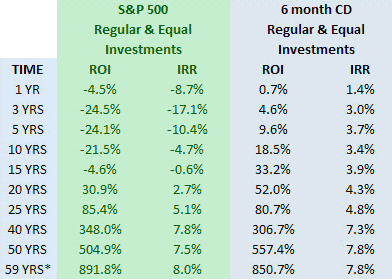
First, a recap of the post. Basically, a guy called “TC” has the idea of comparing S&P 500 returns vs. that of 6-month CDs. I’ll ignore the fact that this has been done many times already. But wait! He comes up with a startling conclusion. For long periods of time, the S&P 500 has actually lagged or been about equal to the returns of safe and steady 6-month CDs. (!!!) His graph:

Keeping my parents in mind, you’re probably wondering how someone did by simply investing in 6 month CDs. The answer is for any holding period of less than 25 years, a stock market investor who made regular and equal contributions has actually underperformed a CD investor! Yes, you read that right for time periods of 1 – 20 years a CD investor outperformed the stock market by 1.6 to 20.1 annual percentage points.

Additionally, if one extends the time window to 50 years (clearly “long term”) CDs again have outperformed the stock market by 0.3 annual percentage points. Even when one extends out the time period to the full 59+ years (the start of the S&P 500 index); the stock market has outperformed short-term CDs by a mere 0.2 annual percentage points – not much of an equity premium.

The sky is falling! Oh wait, there’s a little fine print.

TC is ignoring dividends

Let’s bold that. The analysis and data above completely ignores the dividend return of the S&P 500. This is like buying an investment property and ignoring the rent payments coming in. What? There are checks coming in every month from the tenants? Nah, let’s not cash those.

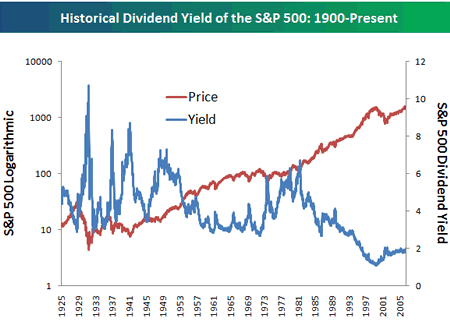
Let’s take a look at the historical dividend yield of the S&P 500, courtesy of Bespoke Investments:

For the periods compared above, the a true owner of the S&P 500 has earned 2-6% annually from dividends alone, with a long-term average of 3-4%. Now, if you add another 3-4% to the analysis above, you see again the long-term equity premium. Instead of 8% vs. 8%, it’d be more like 12% vs. 8%. That’s an enormous difference.

(I also wonder where TC got his/her data for historical 6-month CD rates. Are these averages, since every bank offers vastly different rates, and doesn’t report them to a central bureau? How does one get the average 6-month CD rate across the country in 1959? Usually studies like this use 6-month US Treasury Bill rates instead, as the data is reliable and widely-accepted.)

Massive Conflict of Interest?
Another argument given as to why buy-and-hold is bad is because there is a conflict of interest between investment advisors and their clients, as they have a “vested interest in keeping clients 100% invested 100% of the time, even if they know it is wrong.”

Actually, brokers get paid the more you trade than anything else. They earn money based on total assets, but a huge chunk is from commissions. This means convincing you to buy stocks when they’re hot (tech stocks)…. and then sell them (cash!)… and then buy others (mortgage-backed securites)…. and then sell them (cash!)… and then buy new ones. Like right now, they’ll happily sell you gold or some non-scary bond funds!

True buy-and-hold means very little trading. At Vanguard, I buy-and-hold(-and rebalance) for a total cost of about 0.20% of assets annually. That’s $20 a year per $10,000 invested. Guess what the average expense ratio of a money market fund is? According to Lipper Inc., it was 0.60% at the end of 2007. The Vanguard Prime Money Market fund (VMMXX) has an expense ratio of 0.28%. The S&P 500 fund (VFINX) charges 0.18%. Even at Vanguard, they actually get less money from me if I hold stocks instead of cash.

Same Old Story
In any case, I grow weary. Bonds have outperformed Stocks both recently and other times in the past, even if people ignored it. This is why investors need to have a balance of both stocks and bonds/cash, not just 100% one or the other. If you needed the money soon, then you should have been at the most 60/40 in stocks/bonds, if not even more conservative. In that case, your portfolio would have dropped about 15% over the last couple of years up until today, and you’d be worried but not broke.

If you use the correct numbers (ahem), stocks still have higher historical returns over extended periods, with many rocky patches. We balance this knowledge with the also-historically steadier but lower returns of bonds and cash. That’s really about it. As for the future, nobody knows, as much as they’d like to suggest they do.

Create a Balanced & Simple Portfolio With Five ETFs

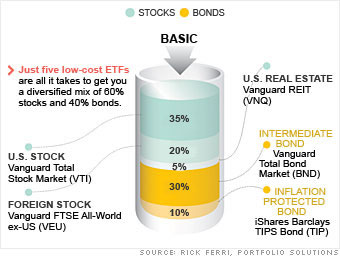
In a recent Money magazine article about ETF Investing, there is a nice illustration of a simple and diversified portfolio made entirely of ETFs by author/money manager Rick Ferri:

Put simply, ETFs are essentially mutual funds that trade like stocks. (Note the ticker symbols included above.) Hence the name Exchange Traded Funds! You tend to get lower annual expense ratios than mutual funds, but you must also pay a stock commission on each and every trade. They also tend be better in taxable accounts because they often don’t shed as many capital gains. Since there are now a million types of ETFs out there, it’s good to remind everyone about the great portfolio building blocks out there.

If you trade large amounts at a time or have cheap enough trades, then ETFs can be a good option. Otherwise, even $10 a trade can really add up. If you have $25,000 of total stock value, you can move your account to Zecco Trading for 10 free trades per month, or to WellsTrade (by Wells Fargo) for 100 free trades per year (special PMA checking account required).

Done this way, the total cost of this portfolio would be under $20 a year for every $10,000 invested. Less money in a broker’s or manager’s pocket means more for you.

* Update: Here are 8 more model portfolios that you can replicate with ETFs these days.

Finding an Investment Property with InvestorLoft and PropScout

CNN Money recently listed 5 new tools for homebuyers, one of which was InvestorLoft.com. At first glance, it looks like a Zillow for investment properties.

I decided to run a quick search using their PropScout tool for an investment property in California for under $300,000. I sorted by cashflow, as I that would be a primary requirement were I ever to get into a rental property. One of the top results was a little ski chalet in South Lake Tahoe for $269,000. With a estimated positive cashflow of over $50,000 per year, I was starting to think InvestorLoft was in serious “Beta”, but decided to keep looking further. Besides, I’ve spent a good deal of time up there, so I was intrigued. Could I swing a nice little ski cabin for myself?

Cashflow Breakdown: InvestorLoft vs. My Numbers

You have to register (free) to see details, but here is the property link. Click on the “View Financials” tab to see the breakdown.

Expenses
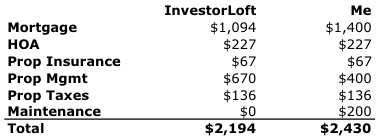
InvestorLoft’s default mortgage numbers have you putting 20% down, and financing the remaining 80% with an interest-only loan. I’d probably go with a 30-year fixed fully-amortized loan, and these days investment property have much higher interest rates. At 20% down and 7% interest, I got $1,400 for an estimated mortgage payment.

This chalet is really a townhouse, so it comes with HOA fees. Property management costs look to be estimated at 10% of gross rent, although as you’ll see below I don’t agree. No maintenance costs were estimated, but as a vacation rental with high turnover, I put in $200 per month. Here are the final numbers side-by-side:

Income
Here’s where that crazy cashflow number comes from: The expected monthly rent was $6,700 a month. (This is also why the property management cost above was $670 a month.) “Rental estimates based on 26 comparable rental listings with matching number of bedrooms and size in a 1.5 mile radius. ” Hmmm. First of all, there’s no way a month-to-month tenant would pay $6,700 a month for this wood shack. It has to be a vacation rental, and I can only guess that they are assuming 100% occupancy.

For some comparisons, I looked up similar properties at VRBO.com – Vacation Rentals by Owner. This chalet does not have the nicest interior, but the location is above average and is near the main highway.

Roughly, it would seem like I could charge $100 a night (taxes not included) for this chalet during May-November, along with a $75 cleaning fee per stay. It could go up to $150 a night during peak ski season (December-April). Occupancy rates would have to be a conservative 50% during the offseason and 75% during peak season. If I assume that I break even on the cleaning fees, that would work out to an average monthly rental income of $2280.

(I wasn’t quite sure how much a property manager would charge for managing a vacation property with people coming and going, especially if bookings were made online, so I estimated it around 20% of gross rent.)

Results
Too bad, it looks like I’m not going to get rich by buying this chalet. The InvestorLoft estimated monthly cashflow was a positive $4,094 a month, while my own rough numbers have me about $200 a month in the hole. I know I am being conservative in some areas, but I think that’s how you have to do it, especially for something optional like a vacation rental. The numbers actually aren’t horrible, though, it might warrant some more investigation…

InvestorLoft looks to be another one of those internet tools that you’re happy exists because you’ll play with it, but you can’t rely on them as there is still plenty of room for improvement.