Mortgage Rate Reset Timeline: Another Wave Coming

One of the things I like to read when I get the itch for some stock market opinion (which isn’t very often) is John Hussman’s weekly market commentary. Not that he’s always right, and I don’t own any of his mutual funds, but I like to hear his reasoning. In this week’s 6/8 post, he references a chart that shows us in a temporary lull of mortgage resets. The infamous subprime “wave” is past, but there is another big wave of option ARM and Alt-A resets ahead:
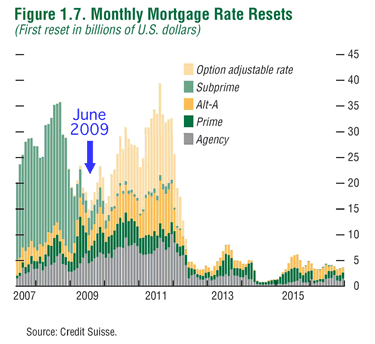
As I’ve noted before, recent months have represented a lull in the reset schedule, which was accompanied until recently by a moratorium on new foreclosures. Those foreclosures are now ramping up quickly, and a fresh surge in resets will add to the difficulties beginning later this year.

The chart originates from an IMF report entitled Assessing Risks to Global Financial Stability.

These upcoming resets may not be as bad as they are supposedly borrowers with slightly better credit profiles, assuming that enough people can refinance their mortgages to something they can afford. But it’s kind of hard to refinance when you’re upside on your house. Even I’m basically upside-down on my mortgage, and I had a 20% downpayment. Thank goodness I have a 30-year fixed, a steady job, and no desire to move!

I’m not changing my asset allocation by selling stocks or anything right now, but I’m also not getting too attached to these recent market gains. Plenty of uncertainty ahead!

Microplace Review: Investments, Application, Funding Methods, Bonus

I finally got around to looking closer at Microplace, a site owned by eBay that tries to alleviate global poverty by offering investments that enable loans to hardworking poor people. I wrote about them previously in Earn a 5% Return and Help Fight Poverty Too? but never ended up investing.

These microlending investments offered do carry risk to principal, although historical repayment rates have averaged 97%. I have just finished putting in $1,200 across three different loans of different maturities and interest rates. This a decent chunk of money, but again this is both an investment and a charitable gift. As you’ll see below, I have the potential to earn some interest and/or maintain liquidity. I like the idea of this money being repayed and then loaned out again later, ideally over and over again. My own little mini-foundation. 😉

My Investments
This is an experiment for me, so I wanted to try a variety of investments. I believe that if microlending can be both profitable and successful in reducing poverty, it will really take off. I went with some of the higher-yielding notes and also one with high liquidity. We’ll see how the repayment rates are.

Investment #1: Helping Poor Women in Nicaragua, Earns 4% interest per year, Principal repayment on 12/31/2010.

Investment #2: Help Nicaraguan farmers, Earns 5% interest per year, Principal repayment on 12/31/2011.

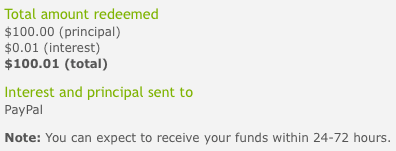
Investment #3: Called the Oikocredit Global Community Note, this investment enables loans to the working poor in several developing countries. 1.75% return per year, can redeem anytime. This last one is interesting because you can withdraw your principal at any time. I can already redeem only a day later:

Application and Funding Methods
The application process is very similar to signing up for a stock brokerage account. They will ask you identity information as well questions about your income and investment experience because they are selling securities that carry risk of loss. As for funding the loan, you can either use PayPal or a bank transfer:

Since eBay owns PayPal and Microplace, there are no fees for using PayPal. That means you can switch to a rewards credit card and earn some points or cash along with your investment. Why not? Just be sure to change your PayPal funding source. My credit card charge went through fine.

Got Bonus?
You know me and freebies. After signing up I received another e-mail about a Father’s Day promotion where you can even get a free solar-powered flashlight:

Invest as little as $20 in honor of Dad and MicroPlace will send a free solar-powered flashlight, to Dad. This eco-friendly flashlight will remind Dad how grateful you are for his caring and love. And your investment will help fathers and families work themselves out of poverty so their children can get an education.

Why I Don’t Use LendingMatch To Invest With Lending Club

Peer-to-peer lending site LendingClub has a feature called LendingMatch that allows you build a portfolio of multiple notes simply by choosing a desired risk profile. Even though I’ve funded over 30 loans, I never touch the thing. Now, I think in general LC does a decent job rating their loans from A1-A5, B1-B5, all the way to G5. But sometimes I just don’t agree with their assessments, and other times I have a more personal objection to the loan. Today, I found an example that fit both.

This loan passed through all of my usual manual filters. A/B grade only, 714+ credit score, debt-to-income ratio < 10%, and zero delinquencies within last two years. The assigned grade was A5, which is quite good overall.

But then I read the details. (If you’re a member, it’s loan #411092.) His reported gross income is $26,000 per year. He’s only been at his current job for only one year. He has been delinquent on accounts before, but last time was over 4 years ago. He has about $18,000 in credit card debt currently. He has 70% of his annual income as debt? To me, that’s like someone making $100k a year before taxes having $70,000 of consumer debt. Seems like quite a burden.

Already skeptical, I then read the loan description. Here it is, after I stripped out what I felt was not important:

This loan will be used to consolidate the remaining balance on two credit card balances and for home improvement. Looking to payoff some credit card debt and add a sunroom to my home. I am coming to the lending club community to help me build a nice sunroom to enjoy a cold glass of iced tea.

Honestly, I didn’t even know what a sunroom was until I looked it up. According to this site, a small 80 sq. ft. sunroom would cost from $5,000 to $15,000. He already has 70% of his gross annual income as debt, and he wants to add another $5,000 to it? That would result in a debt-to-annual income ratio of 90%.

I like the idea of helping people pay down their credit card debt by lowering their interest and consolidating into one payment. But this guy seems to really like being in debt. Now, that’s his choice, but I don’t like the idea of supporting it. Am I alone in thinking this way? I’m thinking I might not be, as his loan request didn’t fund the first time.

You can read about the other details of my LendingClub portfolio here. My annualized return after fees so far is 8.8%.

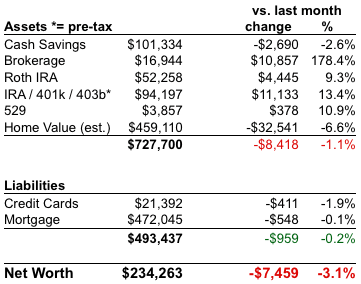
Monthly Financial Status / Net Worth Update (June 2009)

Net Worth Chart 2009

Credit Card Debt
In the past, I have taken money from credit cards at 0% APR and placed it into online savings accounts or similar safe investments that earn 4-5% interest or more, and keeping the difference as profit. I even put together a series of step-by-step posts on how to make money off of credit cards in this way. However, given the current lack of great no fee 0% APR balance transfer offers, I am have not been as active in this “game” recently. My credit score remains high enough that I haven’t seen any negative actions.

Retirement and Brokerage accounts
Markets went up, although as usual I don’t know why. I’ve been swearing off CNBC so I’m especially detached from all the buzz. Most of our retirement accounts rose about 10% the last month, which was over a $10,000 gain. I actually wish it stayed down so I could start investing some of my new cashflow at lower prices. However, waiting for it to drop again is not logical behavior, or so I keep reminding myself…

Cash Savings and Emergency Funds
We did still save a good deal of cash from our income this month, but I shifted about $10,000 of it into my brokerage account so that I can start investing in taxable accounts, which skewed the values above a bit. We still have a year’s worth of expenses in our emergency fund, which always gives me the warm fuzzies.

Home Equity
Using four different internet valuation tools – Zillow, Cyberhomes, Coldwell Banker, and Bank of America (old version) – I took the average and took off 5% to be conservative and 6% for real estate agent commissions. These sites are really wonky. Last month I was actually up, but this month my home’s estimated value dropped over $32,000 in a month. Shrug. I’m lucky that our work situation is doing well and we have no plans on moving.

According to my quick and dirty plan for financial freedom I should start paying extra towards my mortgage, but I’m having a hard time pulling the trigger on this one as well. I feel inflation coming. Should I just invest in stocks, and keep my 5% mortgage as long as possible?

2009 Callan Periodic Table of Investment Returns

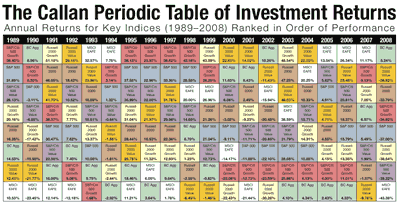
Investment consultant firm Callan Associates created a neat visual representation of the relative performance of 8 major asset classes over the last 20 years. You can find the most recent one below (click to view PDF), which covers 1989 to 2008. Each year, the best performing asset class is listed at the top, and it sorts downward until you have the worst performing asset. You can find previous versions here.

Lessons Learned?
It is always interesting that us humans tend to try and find patterns in everything. Make your eyes shift out of focus for a bit, and most of the table looks pretty random. What is top could easily end up back at the bottom. Callan says that the table shows the value of diversification.

But I also see some streaks. Let’s look at the white boxes of MSCI EAFA, which is an index following major developed international (non-US) countries. From 1989-1992 it was in the the dumps, and then from 1993-1994 it was tops. Then there are the pink boxes of the S&P 500 Growth. From 1994-1999 it was either 1st or 2nd. For the next 7 years from 2000-2006, it was nearly last.

What do we learn then? Mostly, that there are no reliable patterns. If we simply bet against what was hot last year, we could get burned for 6 more years. If we just follow what is hot, we probably get crushed too. I bet I can guess where most investor money was flowing at the end of each of these streaks…

Also, while the table compares relative performance, you can also note that absolute performance changes all the time as well. In 2008 the “best” asset class only went up 5.25%, while in 1989 and 1995 the “worst” asset class went up over 10%. Sometimes you just can’t win, and other times you just can’t lose.

For the most part, it makes me laugh at all the predictions I hear. We’re almost halfway done with this year. Who wants to guess what the breakdown for 2009 will look like?

Warren Buffett’s Original Money Management Fee Structure

Here’s a another little fact from The Snowball that I found interesting. When Warren Buffett set up his first investing partnerships where he agreed to manage other people’s money, he wanted a compensation agreement that was fair and equitable.

I got half the upside above a four percent threshold, and I took a quarter of the downside myself. So if I broke even, I lost money. And my obligation to pay back losses was not limited to my capital. It was unlimited.

The last part meant he could lose more money than he put actually invested into the partnership. He would cover a quarter of all losses from his partners, even if it meant selling his house or other assets. Now that is what I call a true alignment of interests.

Sure, half of the upside past 4% is a lot, but can you imagine any modern hedge fund agreeing to such a fee structure that would expose them to losses? Nope, they get “2+20”, which means 2% of assets no matter what plus 20% of profits, which really encourages them to just swing for the fences. If they implode (which many did recently), they simply pack up and open a new fund down the street.

It’s hard enough these days to find a mutual fund manager where a substantial part of their net worth is invested in the fund they manage.

Personal Finance Ratios: Savings-to-Income, Debt-to-Income, and Savings Rate-to-Income

There was a recent post on how much savings one should have at age 30 over at the Bogleheads forum. Being 30 myself, I was intrigued, but I am in the camp that believes that there is no right answer at 30. You’re still so young that you could just be out of school for a few years, and at that time it’s mostly up to how much student loan debt you racked up. Most important might be your ability to live under your means, and that you’re learning a valuable skill of some sort.

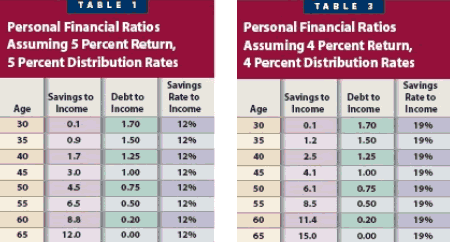
However, there was mention of a paper the the FPA Journal called Personal Financial Ratios: An Elegant Road Map to Financial Health and Retirement, where the author presents a variety of ratios as a rough benchmark to help clients determine whether they are on track to retire by age 65. These include Savings-to-Income, Debt-to-Income, and Savings Rate-to-Income.

The actual numbers depend on how you believe your investments will perform annually after inflation. (5% on the left table, 4% on the right.) Definitions below.

Savings include the current value of one’s investments, such as a 401(k), IRAs, brokerage accounts, investment real estate, and the value of any private business interests. The home is excluded as an investment. Debt comprises all debt, including mortgage, student loans, car, and consumer debt. Savings rate refers to the percentage of pre-tax income an investor is saving each year out of their total income.

A Hypothetical Example
Let’s take a look at a hypothetical 45-year-old individual to see how he might use the ratios to assess his financial circumstances. This person has the following financial statistics:

Salary $110,000
Mortgage $125,000
Auto Loan $25,000
Investments $260,000
Annual Savings $10,000
Employer 401(k) Match $3,000

Based on these statistics, the hypothetical individual ratios are as follows:

Savings to Earnings: $260,000 / $110,000 = 2.36
Debt to Earnings: ($125,000 + $25,000) / $110,000 = 1.36
Savings Rate to Earnings: ($10,000 + $3,000) / $110,000 = 11.8 %

As for us, we’re doing okay according to the table for age 30 regarding the savings-to-income ratios (0.5) and savings rate-to-income ratios (50%+). Our debt-to-income ratio is a bit high though, at around 2. Of course, this is highly dependent on our income number, which might change if we downshift with kids. I guess that’s another reason to wait until we’re a bit older to really start benchmarking like this.

One thing I don’t like about the ratios is that home equity is never included, because the author says that it’s hard to extract home equity. Okay, I agree on that point, but there is no mention of compensating for renters in the analysis. If I have no debt at age 65 + a paid-off house, that’s a lot different than no debt at 65 + still paying rent forever. My largest expense by far is housing (greater than all other expenses combined), and having that taken care of changes my retirement outlook drastically.

So… should we be using these ratios as a benchmark?

Sharebuilder Raising ACAT Outgoing Transfer Fees

Since we’re on this topic, I was also notified that brokerage firm Sharebuilder is raising their outbound account transfer fees in mid-June. The fee to transfer an entire account out to another broker will rise to $75 from $50. The fee for a partial transfer will then become $15 per security, with a $75 maximum. They are also lowering margin rates.

So if you’ve been thinking about moving somewhere else, now might be a good time. If you have a small balance, it might be best to simply sell all your positions, transfer the cash out, and close the account. I’ve been thinking about doing this to simplify things. Don’t forget to keep your trade information for tax filing later.

LendingClub: My P2P Loan Portfolio Update (+Bonus)

I’ve been meaning to post some smaller updates about my ongoing experiences with person-to-person lending at LendingClub, but I decided to wait and roll them up into one larger post.

Current Portfolio
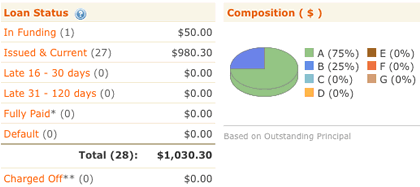
I now have a total of 32 active loans with $1,122.21 in outstanding principal. Most are A grade, with a few Bs. Here is a screenshot from my account page:

These are the loans that originated after LendingClub completed their SEC registration, which means I can sell these loans on the open market. I also have $91.91 in 4 notes that were pre-SEC registration (these are accounted for separately), all A grade.

Performance
All 32 loans are current, with no late or defaulted loans. I don’t think any have even gone temporarily late. According to LC, my “Net Annualized Return on Investment” based on my interest payments received so far is 8.80%. This is net of all fees. The oldest loans are about 16 months old now, almost halfway through the 3-year term. So far so good.

You can view the statistics for all LC loans here. This study states that as of the end of November 2008, lenders earned an average rate of 9.05%. If you are familiar with Prosper, you’ll note that this is significantly better than their stats. There are several reasons for this, in my opinion. For one, an A grade loan on LendingClub is a lot better quality than an A loan on Prosper. You need to have a 660 credit score as well as other additional requirements just to make their lowest G grade. Also, LC is much more stringent on approving loans. Only about 10% of loan applications are accepted. Their data verification system seems to be more comprehensive and weeds out a lot more questionable and/or fraudulent loans.

Loan Filters / Methodology
For the most part, I only lend to borrowers with a nearly perfect credit profile. I don’t use their PortfolioMatch tool, I handpick each of my loans. It doesn’t take very long; Here’s my basic search filter: A/B grade only, 714+ credit score, debt-to-income ratio < 10%, zero delinquencies, and 50% funding status. The high funding status usually means that the loan has already been approved, with LendingClub verifying enough application information. I check whenever I remember to, probably once every two weeks or so, and if I see something I like, I throw either $25 or $50 at it. My ideal borrower has a 10+ year clean credit history, a stable government job, and is just looking to consolidate debt into a lower rate. Paying 8% APR from LendingClub is a lot better than 10-20% from even the best prime credit cards, and new credit is harder to get now. I like the idea that they can clear out their consumer debt in 3 years or less. Open Market
You can now buy and sell loans, so there is no longer a fixed 3-year commitment. I’m happy with my returns so far, and have not yet tried to sell any of my loans on the open market. I do see that loans with a good payment history of 6 months or so are asking a 4-6% premium to outstanding principal, so it might be a feasible strategy to repeatedly find good loans and sell them after 6 months. You might be able to limit your exposure and still maintain a decent return. (Sellers pay a 1% transaction fee.)

Self-Directed IRA Option
In March, LendingClub announced that you can now hold their P2P loans in a Self-Directed IRA and get the tax benefits. The main downside to this is that you are subject to a $250 annual account maintenance fee. Unless you have a very large amount of IRA funds that you wish to commit to this, $250 is a big drag on performance (1% of $25,000, 5% of $5,000). However, you can also hold other things like real estate or physical gold bullion in this Self-Directed IRA, so it does offer additional flexibility.

Safety of Principal
With the new post-SEC setup, you are now technically buying notes from LendingClub. This brings up the question of what would happen if they went bankrupt. This was previously addressed in my Q&A with Rob Garcia, Director of Product Strategy. In addition to that, I saw on TechCrunch a couple months ago that LendingClub secured another $12 million in Series B venture funding.

$25 New Lender Bonus
If you are interested in lending, you can still use this special $25 lender sign-up link to get a free $25 to try it out with no future obligation. There is no credit check and you don’t even have to deposit anything. After you are approved, the $25 will show up in your account balance, and you can lend it out immediately.

If you’re looking to borrow at LendingClub, my advice remains the same. Send in your information, and see what interest rate they offer you. If you like it, try and get a loan. If your full amount is not funded, you can either accept partial funding or walk away with no obligation.

Forever Stamps Not A Good Investment, Will Never Outpace Inflation

Postage rates will rise on Monday, May 11th. For example, a first-class stamp will become 44 cents, up from 42 cents. For some reason my Costco keeps reminding me of this, promoting the fact that they are selling a pack of 100 Forever stamps at a whopping 25 cent discount to face value. I thought retail stores didn’t profit from selling stamps?

Forever stamps allow you to buy stamps once and know they’ll be good forever – you never have to worry about future rate changes or buy those annoying 1-cent stamps. However, there is no point in stocking up on them, because Forever stamps are not a good investment. For one, postage rates have not outpaced inflation historically. But more importantly, according to the 2006 Postal Accountability and Enhancement Act, the postage rate will never be allowed to outpace inflation.

It seems the best you can do is by right before the next hike (like right now). I suppose I should just buy the Costco 100-pack and not have to worry about stamps for the next five years or so.

Sources: Slate and Postal Accountability and Enhancement Act

Schwab S&P 500 Index Fund: 0.09% ER, $100 To Start

Brokerage firm Schwab lowered the annual expense ratios on many of its in-house mutual funds this week. For example, the Schwab S&P 500 Index Fund (SWPPX), which used to have an expense ratio of 0.36%, now has an expense ratio of 0.09%. That’s just $9 a year for every $10,000 invested. In addition, the minimum initial investment in each of the Schwab Equity Index Funds is now only $100, with no minimum balance requirements.

According to this CNN Money article, “This is not a promotional offer… These are permanent reductions.” This is basically what Fidelity did a few years ago when it lowered their S&P 500 index fund expense ratios to 0.10%, and they have kept it that low since, so there’s hope. Although technically they can always raise the expenses later, I do think ongoing competition will make it hard for them to do so. From the prospectus:

Schwab and the investment adviser have agreed to limit the “net operating expenses” (excluding interest, taxes and certain non-routine expenses) of the Investor Shares, Select Shares and e.Shares to 0.09% for so long as the investment adviser serves as the adviser to the fund. This agreement may only be amended or terminated with the approval of the fund’s Board of Trustees.

Also at 0.09% and $100 to start, there is the Schwab Total Stock Market Index Fund (SWTSX) which tracks the entire US Market (not just the largest 500 or so companies) through the Wilshire 5000 Index.

Schwab Traditional and Roth IRA accounts
I took a quick look at the Schwab IRA accounts, and they appear to have no account fees or minimums. You must initially open with $1,000, but that is waived if you make an automatic monthly transfer of at least $100.

Overall, this is a nice development for smaller investors with Schwab that want to invest in some broad index funds. However, I’ll stick to Vanguard for my IRAs since their fees are nearly as low on the Total US funds, and Vanguard is still much cheaper on all other asset class index funds.

Ohio CollegeAdvantage 529 Plan Referral Promotion Code: Free $25

This is a friendly reminder that you can still get a $25 head start to your child’s college fund if you open a 529 account with the Ohio CollegeAdvantage plan and fund with $25 of your own. Not only is the free money nice, but this is actually a very good plan in which I am making monthly automatic contributions.

Rated a Top 529 Plan by Morningstar
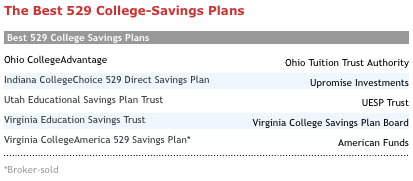
In a recent article The Best and Worst 529 College-Savings Plans by Morningstar, the Ohio CollegeAdvantage plan was rated in the top 5 plans:

Features they liked included having a wide variety of investment options (including active/passive, multiple age-based options, and even ultra-safe CDs), as well as low total expenses. In-state resident can also deduct up to $2,000 of contributions per year, with excess carryover allowed.

My Investment Choice: Inflation-Protected Bonds
529 plans aren’t perfect, and you have to be careful about what you’re invested in. This article I found on BH summarizes my concerns well:

…saving for college isn’t like saving for retirement. The run-up is much shorter, 18 years at most instead of 30 or 40, so most of the miraculous gains of compound interest are lost. Second, the payout is far more immediate and inflexible. People can choose when to retire, delay if they have to, and ride out ups and down in the market over decades. For most students, college happens three months after graduation, ready or not, and the check is due on Day 1.

I explored some conservative 529 investment options here, and based on my conclusions I am currently putting all my contributions into the Vanguard Inflation-Protected Bond option. This works especially well since TIPS are best held in tax-advantaged accounts.

Refer-A-Friend Bonus Instructions

  1. You can enroll online or via mail. The online process was quick and easy, and I didn’t have to mail in anything.
  2. The first step is to input your personal info and choose a login/password. Next, you’ll verify your e-mail and complete the application.
  3. After that, you’ll choose your funding amount and select an investment fund. Your initial deposit must be a least $25, and is funded using the account/routing numbers of your bank account. At the bottom, you will need to enter a referral code to get the bonus. Enter *.
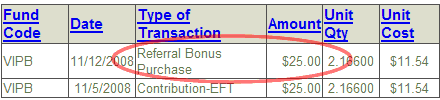
  4. In 1-3 days, your initial deposit will be sucked out, and in 5-7 business days you will get your $25 bonus. The $25 will be deposited directly into the 529 account, and will be invested in the same thing as your initial deposit.

* Number is randomly generated. If you can’t see any numbers above, please use 2483590. With this program, both the newly referred and the referrer get $25. As promised, I have received several referrals from readers, and have thus included their referral codes to be shared here. I probably won’t have time to do it again for this promotion, but keep your eyes out for future similar offers.