Historical Distribution of Annual US Market Returns From 1825-Present: How Bad Was 2008?

Here is a chart that plots out the distribution of annual returns of the US stock market as measured by the S&P Market Index*. Guess where 2008 is so far?
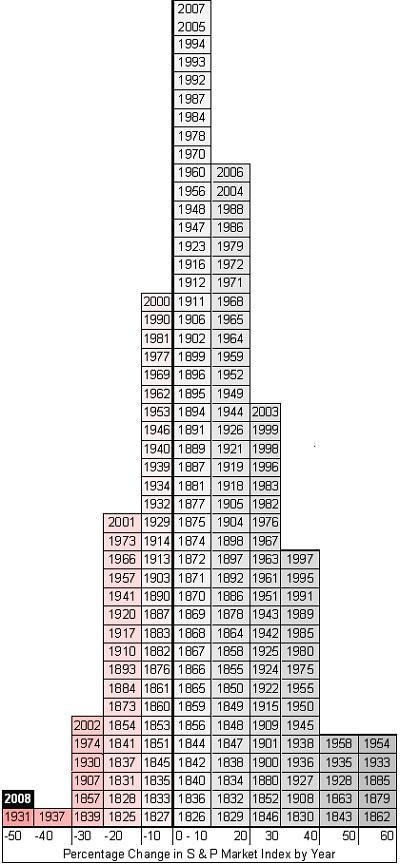
This chart does a great job to fix the assumption that some have that the 8% or 10% annual returns we hear about come every year. Nope, those are just historical averages. Sometimes we lose 40% or more, and sometimes we gain 40% or more – in just one year! So you can’t say today that it will take X years at 8% per year to get back to what you had before. It could take longer, or it could take a lot less.

* The source for this data is a bit vague since both the S&P company and the S&P 500 index did not exist in 1825. Most sources quote Value Square Asset Management, Yale University. I found it via Daily Kos through Bogleheads and Get Rich Slowly. Here is another similar graph. It is not clear if the chart is based on total annual return, or simply a percentage change in price each year, but it looks like the latter. This paper (also from Yale) with data from 1815 to 1925 might be related.
Saving More May Allow You To Take Less Stock Market Risk

Vanguard has a new article titled The importance of saving more, which tries to address evidence that investors may believe that “choosing investments that offer the possibility for relatively higher returns—and accepting the accompanying greater degree of risk—is a more viable alternative than saving more.”

In addition, the last few months probably have many of us re-examining the amount of risk we are comfortable with in our portfolios. I know I have. So what can we do?

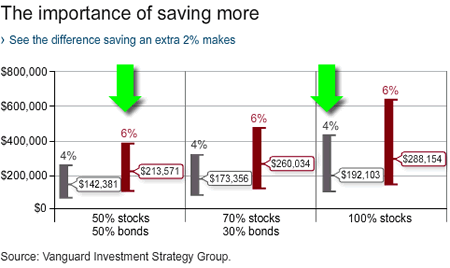
Taken from the article, the figure below shows hypothetical outcomes for different portfolios based upon the following scenario: A 35 year-old individual begins saving 4% (grey bars) of his gross annual salary ($50,000, adjusted annually for inflation) each year for 30 years. In the red bars, the same individuals instead saves 6% of his salary. I highlighted two of the more interesting situations with the green arrows:

Here you see that based on historical data, the combination of a 50% stock/50% bond allocation and a 6% contribution rate leads to a similar range of outcomes as a 100% stock allocation and a 4% contribution rate. In fact, the former has a slightly better median outcome with much smaller swings over the years.

For example, a 50/50 asset allocation this year would have been down only around about 20%, instead of the stomach-churning 40% drop of a 100% stock portfolio. Wouldn’t that have been nice?

Higher savings provides a higher probability of success by shifting some of the responsibility for accumulation from the less-certain return stream of risky assets to a more-certain savings stream. In the end, if an investor is trying to maximize future wealth, a marginally higher savings rate rather than a substantially higher risk portfolio is the most likely path to retirement success.

As opposed to many rules of thumb, not everyone at the same age has to have the same asset allocation. Savers may get to take less risk and sleep better at night. 🙂 Something to think about…

December 2008 Investment Portfolio Update

I’ve been trying to re-balance my portfolio using my recent 401k contributions, but I ran into some speed bumps, so here is a brief interim update.

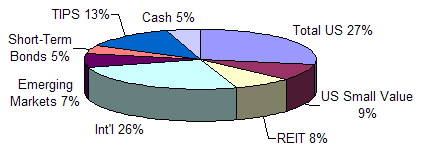
9/08 Portfolio Breakdown
 
Retirement Portfolio Actual Target
Asset Class / Fund % %
Broad US Stock Market 27.7% 34%
VTSMX – Vanguard Total Stock Market Index Fund
DISFX – Diversified Stock Index Institutional Fund*
FSEMX – Fidelity Spartan Extended Market Index Fund*
US Small-Cap Value 9% 8.9%
VISVX – Vanguard Small Cap Value Index Fund
Real Estate (REITs) 8.5% 8.5%
VGSIX – Vanguard REIT Index Fund
Broad International Developed 25.8% 25.5%
FSIIX – Fidelity Spartan International Index Fund*
International Emerging Markets 7.1% 8.5%
VEIEX – Vanguard Emerging Markets Stock Index Fund
Bonds – Short-Term 4.6% 3.8%
VFISX – Vanguard Short-Term Treasury Fund
Bonds – Inflation-Indexed 12.7% 11.3%
VIPSX – Vanguard Inflation-Protected Securities Fund
Cash 4.7% 0%
FDRXX – Fidelity Cash Reserves
Total Portfolio Value $95,678
 

* denotes 401(k) holding given limited investment options

Contribution Details
For 2008, we have finally both contributed the annual maximum of $15,500 each towards our respective 401ks. We have not made any 2008 IRA contributions, but we did make 2007 contributions in April 2008. We will likely do our 2008 contributions in April 2009 deadline.

YTD Performance
The 2008 year-to-date time-weighted performance of our personal portfolio is now -42.5% as of 12/8/08.

For reference, the Vanguard S&P 500 Fund has returned -36.69% YTD, their FTSE All World Ex-US fund has returned –47.98% YTD, and their Total Bond Index fund is +2.20% YTD as of 12/8/08. The Vanguard Target 2045 Fund has returned -35.79 YTD, primarily due to a small international allocation.

Investment Changes
In my wife’s 401k plan, a few new investment options were added, including the Fidelity Extended Market fund (FSEMX). This is a nice complement to their in-house S&P 500 index fund. If you take 75% S&P 500 and 25% Wilshire 4500 Completion Index, you pretty much get the Total US Market, so we have moved our investments to that and sold off the bit that we had in the actively-managed Dodge & Cox fund. Nothing else in that 401k is terribly appetizing.

We have used our new contributions to bring us back towards our asset allocation target, with a 85% stocks/15% bonds split. This means I have been buying more International, REIT, and Small Cap. I have also been swapping funds around to make things “fit” better, due to the limitations of spreading money across different accounts.

You’ll notice that I am really below-target in my US allocation, and have $4,500 in cash. This is because the fund minimum for the Fidelity Spartan Total US index fund is $10,000 (in my 401k). In early 2009, I hope to add enough money to reach the minimum. I could buy ETFs instead or another more expensive Fidelity fund as a tracker, but not sure if I want to pay the roundtrip commissions given that it will be less than a month. Currently on the fence.

You can view all my previous portfolio snapshots here.

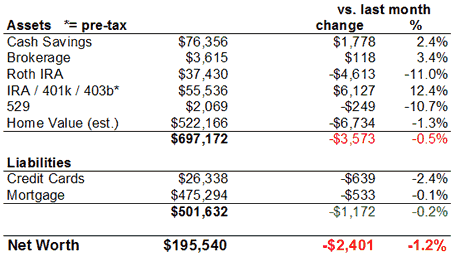
December 2008 Financial Status / Net Worth Update

Net Worth Chart 2008

Credit Card Debt
I have no actual consumer debt. In the past, I have been taking money from credit cards at 0% APR and immediately placing it into high-yield savings accounts or similar safe investments that earn 3-5% interest or more, and keeping the difference as profit. I even put together a series of step-by-step posts on how I make money off of credit cards this way. However, given the current lack of good low fee 0% APR credit card offers, I don’t think I’ll be doing anymore in the near future.

Retirement and Brokerage accounts
Ignoring new contributions, my retirement accounts have lost about ~$8,500 over the last month. I will perform another portfolio update soon to find more accurate year-to-date return numbers.

I have sent in another $5,000 late last month and $5,000 this month in order to max out my pre-tax 401k contributions for this year. My asset allocation is way off target so I need to sit down and try to rebalance using these funds today. It might be tricky to due to the $10,000 minimums for index funds at Fidelity, and I might actually buy ETFs and pay the trade commission.

Cash Savings and Emergency Funds
Why am I not panicking (yet)? Well, I think a big part is my fat cash pile that serves as my emergency fund. In my mind, having a separate short-term reserve keeps me from worrying about my long-term “can’t touch” portfolio.

I have about $49,000 net in sitting in different forms of safe cash earning from 3 to 6% interest, while now my entire retirement portfolio is worth about $93,000. I will keep accumulating cash until I reach a full year’s worth of expenses, which is about $60,000. I think this is prudent given the high unemployment rate right now.

Home Equity
This is the second month of testing out my new way of estimating our house’s value. Again, I take the average estimates provided by Zillow, Cyberhomes, Coldwell Banker, and Bank of America. Then, I shave off 5% to be conservative and subtract 6% for expected real estate agent commissions (11% total). I use this final number as my estimate for home value. Looks like my home value has dropped by another 1% or so.

Overall, another tough month. However, I am very thankful we both still have jobs – knock on virtual wood!

You can see our previous net worth updates here.

S&P 500 at 750: Thoughts From A Market Timer

I knew I shouldn’t have turned on CNN in the hotel. I go away for a week and it’s 1997 again!

I don’t feel like posting any more articles from the “buy-and-holders“, although I remain one. So how about some commentary from John Hussman, whose fund HSGFX is actually even for the year down “only” 15% YTD. I don’t own this fund and am not saying he’s always right, but I think he does a good job of laying out the reasons for his conclusions.

His November 17th weekly commentary is long, but worth the read. Some excerpts:

Our activity as investors is not to try to identify tops and bottoms – it is to constantly align our exposure to risk in proportion to the return that we can expect from that risk, given prevailing evidence.

As for extreme and less likely benchmarks, the 780 level on the S&P 500 would represent a 50% loss from the market’s peak, and would put the market in the lowest 20% of all historical valuations. I would expect heavy demand from value-conscious investors about that level if the market were to decline further, and a decline below that level could be expected to reverse back toward 780 fairly quickly. Further down, but very unlikely at this point from my perspective, the 700 level on the S&P 500 would represent the lowest 10% of historical valuations, 625 would put the market in the lowest 5% of valuations, and anywhere at 600 or below would put the market in the lowest 1% of historical valuations. I don’t expect to see such a level, but there it is. Note that these estimates are unaffected by how low earnings might go next quarter or next year. Stocks are not a claim on next quarter’s or next year’s earnings – they are a claim on an indefinite stream of future cash flows.

As a side note, do your best to filter out comments like “investors are moving out of stocks and into …” or “investors are selling into this decline” or “investors are buying into this rally.” On balance, investors do not sell shares, and they don’t buy shares. Every share purchased is a share sold. The only question is what price movement is required to prompt a buyer and a seller to trade with each other. No money will come off the sidelines into stocks. No money will come out of stocks and onto the sidelines. All such talk is non-equilibrium idiocy. Keep in mind that the “market” consists of different traders with a variety of time-horizons, risk-tolerances, and analytical methods (e.g. technical, report-driven, value-conscious). It is helpful to think in terms of which group of individuals is likely to do what, and when. It is equally important to know which group of investors you belong to. As the old saying goes, if you’re at a poker table and you don’t know who the patsy is, you’re the patsy.

Here’s my attempt at a quick summary: While the present looks bleak, the potential for future returns is looking brighter and brighter for long-term investors. The opposite was true a few years ago. If you’re young and still putting money away, this is a good thing! (Although adequate emergency funds should be your first goal.)

Vanguard’s New Self-Employed 401(k) Plan – Roth Option Included

Vanguard has recently announced the details of their Individual 401(k) plan – otherwise known as Solo 401k or Self-Employed 401k. Although you can’t apply yet it seems, many of us passive investors have been waiting for Vanguard to offer this for a long time.

The Vanguard® Individual 401(k) plan is a retirement plan for self-employed individuals. This plan is available only to sole proprietors or partners in business who have no common-law employees. The only other participant allowed in this plan would be a spouse of the business owner if he or she works for the business. Business owners should not establish this plan if they have common-law employees, including their children.

There is some confusion as to whether this includes the sole owners of an S-Corporation, but I’m betting it does as it is a passthrough entity and we are essentially self-employed. Here are some more Vanguard-specific details, along with some comparison with the Fidelity Self-Employed 401(k) which I currently have:

  • Seems like you can buy any Vanguard fund with no commissions, and there is “no minimum initial investment required to open most funds” (emphasis mine). It doesn’t seem like you have the option to buy ETFs through their brokerage service. At Fidelity, the Fidelity funds are also free, but I am subject to minimum initial investments. However, I do have the ability to buy any ETF with a $12-$20 commission, as well as buy individual bonds.
  • The Vanguard Individual 401(k) will accept three types of employer and employee contribution sources: individual employee salary deferral contributions (pre-tax money), traditional employer contributions (pre-tax money), and Roth salary deferral contributions (post-tax money). Roth is available! Fidelity does not have this.
  • Employees can move money between different Vanguard funds by phone or in writing only. This is kind of a pain. I can manage my Fidelity Self-Employed 401(k) online like a regular brokerage account, with limit trades and everything.
  • There are no set-up fees charged to the employer for a Vanguard Individual 401(k) plan. Vanguard charges employees a $20 annual account service fee for each mutual fund held in an account within the Vanguard Individual 401(k). If you like to own multipole funds, that can add up quickly! (Note: If at least one participant in a Vanguard Individual 401(k) plan qualifies for Flagship™, Voyager Select™, or Voyager™ Services, the account service fee will be waived for all participants in the plan.) Fidelity has no setup fees, and no annual account fees at all.
  • Rollovers are permitted out of the Vanguard Individual 401(k), but not into it. Not sure why this is the case.

This is only a superficial review, but so far I’m not planning to try and open one. It turns out that I am quite happy with my Fidelity Solo 401k, as it provides a lot of flexibility, great customer service, and reasonable costs. Vanguard has a wider array of index funds, but I can also buy the equivalent Vanguard ETFs at Fidelity. If I buy in large enough chunks, the commission is balanced out by the lower annual expense ratios. Besides, if you are at not at least Voyager ($50k in assets), the $20 fee per fund from Vanguard costs as much as two trades anyway.

The main thing going for Vanguard is the Roth option, which I must admit should be very attractive for most people. But for us, our current tax bracket is high enough that I prefer pre-tax contributions.

Via Guzzo the Contrarian and Bogleheads.

CA Residents: $50 Gift Card For ScholarShare 529 Plan

Here is another 529 account bonus, but only open to California residents. If you open a California ScholarShare 529 College Savings Plan today and sign up for automatic investing of at least $50 per month on the account, and you’ll receive a $50 Target GiftCard.

From the fine print:

To receive a $50.00 Target GiftCard (a “Gift Card”), eligible individuals must (a) open a new account under the ScholarShare Plan (a “ScholarShare Account”) within 30 days of registering for the Gift Card offer between August 15, 2008 and December 31, 2008 and (b) establish an automatic investment plan for the ScholarShare Account of at least $50 per month, with the initial $50 automatic investment contributed and invested within 90 days after the ScholarShare Account is opened. Limit: two (2) Gift Cards per person. Each ScholarShare Account must have a different designated beneficiary and be individually owned (no trust, custodial or other ownership arrangements).

$25 Referral Bonus: Ohio CollegeAdvantage 529 Plan

The Ohio CollegeAdvantage 529 Savings Plan is currently offering a $25 refer-a-friend bonus if you open an account and deposit at least $25 by December 15, 2008. You can be a resident of any state, and there are no application or annual fees.

Is This Ohio Plan Any Good?
After doing some research on the best 529 plan for those without an in-state tax break, my opinion was that the two best overall 529s were the Ohio CollegeAdvantage and the Illinios BrightStart plans. Illinois uses Vanguard, has a decent variety of low-cost index options (average ~0.20% total annual expense ratio), and has one of the lowest fee structures around. Ohio is similar – they use Vanguard, are a bit more expensive (average ~0.30% total annual expense ratio), but have a few more investment options like inflation-protected bonds. So yes, it is a solid plan.

Collecting 529 Bonuses
We don’t have kids (yet), and yet I’ve opened a bunch of different 529 plans in different states for their bonuses or in-state resident tax advantages. The nice thing is that you can usually roll them over into another 529 plan, although some states do a tax recapture. (Oregon didn’t.) So open an account, get the bonus, and just see if you like it. If you don’t have kids yet, simply list yourself, your spouse, or even your parents as the beneficiary. You can always change it later.

For the curious, I am currently in a New Hampshire plan run with 0.50% expense ratio by Fidelity because I have a grandfathered-in 2% cash back card that deposits into the 529. Given how good the Ohio account is, one day I might be rolling everything over there.

Referral Bonus Instructions
Both the referred and referree get $25, and I’d love for you to help fund my future kid’s college. 😉 Here are the easy instructions:

  1. You can enroll online or via mail. The online process was quick and easy, and I didn’t have to mail in anything.
  2. The first step is to input your personal info and choose a login/password. Next, you’ll verify your e-mail and complete the application.
  3. After that, you’ll choose your funding amount and select an investment fund. Your initial deposit must be a least $25, and is funded using the account/routing numbers of your bank account. At the bottom, you will need to enter a referral code to get the bonus. Enter 2465786.
  4. In 1-3 days, your initial deposit will be sucked out, and in 5-7 business days you will get your $25 bonus. The $25 will be deposited directly into the 529 account, and will be invested in the same thing as your initial deposit.

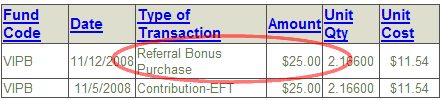
I opened the account last week and got my $25 bonus successfully and as promised:

Should I Invest In My 401(k)’s Stable Value Fund?

While investigating the bond options in my wife’s 401(k), I noticed that the only “safe” option in her account was a Stable Value fund. I have noticed this label before, but never really paid them much notice. What is a stable value fund?

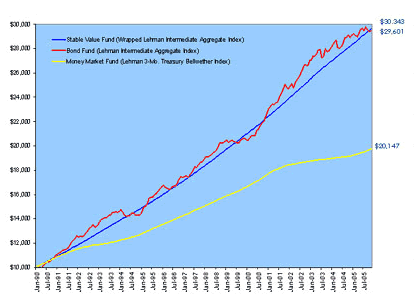
The pitch: “Cash with better interest”. You get the safety and stability of principal found in a money market fund, but with the higher returns of an intermediate bond fund. Here is a graph from 1990-2006 via the Stable Value Investment Association website (yellow is money market, blue is stable value, and red is bond fund):

How? In essence, stable value funds invest in intermediate-term bonds and similar investments, but the usual day-to-day fluctuations are smoothed out by the guarantee of an insurance company. For example, the insurance company guarantees that a certain amount of interest will be paid. If the actual return from investments fall short, the insurance company makes up the difference. If the actual investments outperform, then the insurance company keeps the difference.

This insurance guarantee also keeps the per-share price (NAV) at $1, much like a money market fund, even though the assets being held are riskier. Because they are limited to qualified retirement plans like a 401(k) or 403(b), they are allowed to use “book value accounting” instead of the more strict daily “market value accounting” required of most retail mutual funds.

What are the risks? In most cases, even if investments perform poorly, the insurance company will eat the loss rather than face the bad publicity. This is similar to money market funds. However, the danger is when things go so bad that the insurance company goes bankrupt. An example is the Trust Advisors Stable Value Plus fund which failed, as outlined by this NY Times article. Although technically the investors eventually recovered all their principal, it took over a year for everything to settle. There have been other isolated instances where investors have lost a portion of their principal.

To invest or not? Stable value funds are pretty popular, and found in 2/3rds of all 401(k) plans. Who wouldn’t want a fund with hardly any volatility that pays high interest? The fund in my wife’s 401(k) is “guaranteed” to earn 4.55% for all of 2008. Be careful though, because they are not all made the same. According to this study by JP Morgan Chase, returns from good/bad stable value funds can differ by up to 2% per year.

As for safety, I would treat it like a money market fund in that you should only buy if you trust the insurer and learn about the actual holdings. Otherwise, buy a bond fund somewhere else if you smell something fishy. Unfortunately, if you really want a “safe” holding place inside your 401(k), many times you don’t have much choice. Finally, I would also point out that in the end they are still bonds, and are subject to the risk of having their modest returns eaten up by inflation. If you are a young investor, stocks still provide the best long-term growth prospects.

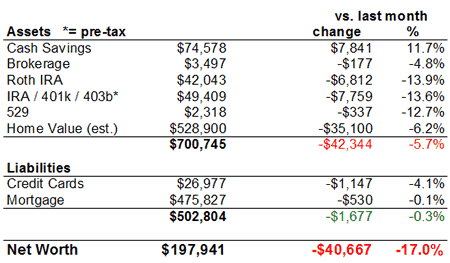
November 2008 Financial Status / Net Worth Update

Net Worth Chart 2008

Credit Card Debt
If you’re a new reader, let me start out as usual by explaining the credit card debt. I’m actually taking money from 0% APR balance transfer credit cards and instead of spending it, I am placing it in high-yield savings accounts that actually earn 3-4% interest or more, and keeping the difference as profit. I put together a series of step-by-step posts on how I do this. Please check it out first if you have any questions. This is why I have credit card balances – I am not accumulating more consumer debt.

Retirement and Brokerage accounts
Well, it’s time to uncover my eyes and peek at my financial statements. My retirement accounts have lost another $15,000 (14%) over the last month, in addition to the $12,000 from last month. I did not make any further investments besides the $5,000 in early October.

However, I am still planning to max out my 401k salary deferral by the end of the year, and will still be buying stocks according to my previously set asset allocation plan. I still believe that stocks are the best bet for inflation-beating returns in the long run.

Cash Savings and Emergency Funds
I remain a big proponent of emergency funds held in safe cash or cash-equivalent accounts. We now have approximately 7 months of our actual monthly expenses saved up. Increasing this is a lower priority than the 401k contributions, though.

Home Equity
I am testing out a new way of estimating our house’s value. First, I take the average estimates provided by Zillow, Cyberhomes, Coldwell Banker, and Bank of America. Then, I shave off 5% to be conservative and subtract 6% for expected real estate agent commissions (11% total). I use this final number as my estimate for home value.

I know that each of these sites can be inaccurate, but I am primarily looking for overall trends based on recent comparable sales, and this should take care of that with minimal effort. Feedback is welcome. The mortgage amount is taken directly from my loan statement. Which reminds me, I might need to see if I can argue with the tax collector about my property tax appraisal.

We are still socking away about half of our take-home pay each month, but this looks like the worst drop ever in our net worth. Let’s hope it stays the worst! 😉

You can see our previous net worth updates here.

Weekend Reading: Bear Markets, Changing Asset Allocation, and Stock Picking

Here are some good reads about investing from this week:

How to Survive and Succeed Through a Bear Market
This letter to shareholders is written by John Montgomery, founder of Bridgeway Funds, which are a group of actively managed mutual funds with a reputation of high ethical standard and putting shareholders first. It provides his insights into investing and reminds us that there is also a risk when we only invest in safe investments. An excerpt:

This is my fourth* bear market as an investor, three of which have happened since I founded Bridgeway Capital Management in 1993. Even before the last three bear markets, I studied stock market data in detail going back to 1926. I spent quite a bit of time focusing on the downturns and thinking about how to survive them and why stock market investing is still very attractive even when predictably it doesn’t feel that way. From this research I formed five principles of long-term investing that became part of Bridgeway’s investment philosophy and are interwoven into our investment process. […] I thought I’d share what I learned with our investors.

When should you change your asset allocation strategy?
This post on the Bogleheads forum was written by Rick Ferri, investment portfolio manager at Portfolio Solutions and author of several good books on index and passive investing (including All About Asset Allocation). As a portfolio manager, of course he’s been fielding a lot of phone calls recently. Here are his thoughts for the general investor. An excerpt:

Significant changes to your stock and bond asset allocation strategy is a major decision and can be compared to changing careers. There are several good reasons to change your asset allocation strategy along life’s journey. Below are three reasons I believe a person has a legitimate reason to make an asset allocation change:

1) Your target retirement goal is well within reach.
2) You realize that you will not need all your money during your lifetime.
3) You have realized that your tolerance for risk is not as high as you once thought.

Why stock picking is a losing game
This article on CNN Money is by William Bernstein, another well-known portfolio manager and author of investment books such as the Four Pillars of Investing. Here he tries to remind us that just because the indexes are dropping, it doesn’t mean it’s time to switch to something that sounds better.

I’m sure you’ve heard that while it’s fine to ride the market’s gains when times are good, you need an expert stock picker when the bear roars. Wrong: Active money managers do not suddenly gain an extra 20 IQ point advantage over the rest of the market just because the Dow is falling. The record shows that their funds have trouble competing with the index in the bad times too.

Weekend Reading: Diary From The Great Depression

Not enough doom and gloom in your diet? The Big Money shares the diary of Benjamin Roth, who was a lawyer during the Great Depression. Via the Consumerist. Here’s an excerpt:

June 5, 1931. Immediately after the 1929 crash the speculators rushed in to buy “bargains” but were badly mistaken because the market kept going down and down even tho’ industrial leaders kept on assuring the people that everything was fine and the worst was over. At the present time the newspapers are urging people to buy these “bargains” but opinion is much divided as to whether or not the bottom has been reached.

Investments in real estate and mortgages fared almost as badly as stocks. Since 1929 foreclosure by the banks has been the order of the day. Day after day real estate can be bought for the price of the first mortgage and there are no bidders except the bank which holds the first mortgage. In this way the banks are becoming the holders of huge quantities of real estate.

Although Slate is a respected name, for some reason I am still skeptical of these diaries. Where did they find this diary? Why has it never been published before if Roth died in 1978? I’m sure people would have been interested back in 1987. Did people write using “quotes” back in 1931? The parallels are almost too close and the writing seems nicely edited.

But, taking it at face value, reading it definitely does provide some food for thought. For example, are stocks really a bargain now? It may not be wise to bail out completely from stocks, but it may not be wise to overly load up on them either. Everyone is trying to predict the bottom, but we might have to be prepared to wait for a while. Gee, it turns out that predicting the short-term movements of the market has always proven to be a weak point for the “experts”!!