P2P Lending Update: Prosper, Lending Club, Zopa, Loanio

There have been a lot of comings and goings in the person-to-person social lending arena, so here are some updates and opinions as a casual observer sprinkled in.

Prosper Steps Away
The first and biggest (by total outstanding loans) P2P lender, Prosper, recently shut down to lenders while pursuing registration with the SEC to allow folks to buy and sell existing loans:

Until we complete the registration process, we will not accept new lender registrations or allow new commitments from existing lenders. If you’re an existing lender, your current lender agreements will be unaffected; your existing loans will continue to be serviced; you’ll be able to track and monitor your loans; and you’ll be able to withdraw funds from your Prosper account.

If you’re a borrower with an existing loan, you will continue with your current borrower agreement and be unaffected by the registration process. If you’re a borrower seeking a loan, you will still be able to create a new loan listing, which we will endeavor to fulfill through alternative sources.

Personally, I think having a liquid secondary market for these loans is a great idea in the long run. I always disliked the idea of making a 3-year loan that could be repaid by the borrower early, but not sold early. As a point of reference, Lending Club took around 6 months to complete the SEC registration.

More posts: Review Part 1, Review Part 2, Default rates, Scary graph

Lending Club Returns
After going through their own quiet period, Lending Club is now accepting new lender registrations again, as well as allowing existing lenders to bid on loans. But now, you can also buy and sell existing loans now on partner site FOLIOfn. It costs you a 1% fee to sell your loan, in addition to any possible gain/loss in the open market.

Right now, it would seem that Lending Club is the best game in town. For lenders, the loan performance stats seem to be better on average than Prosper, with much lower default rates so far, although there is still definitely risk these days. For potential borrowers like credit card consolidators, you can try them first to see what rate you can get. When you apply, you get an overall credit rating which determines your interest rate.

More posts: Lending Club Review

Zopa US Quits Pretending
Even at first glance, I thought Zopa US was a credit union in disguise. Well, right before Halloween, Zopa takes off the mask and reveals that… hey! We are a credit union. Now “lenders” are directed to buy a certificate of deposit at a credit union, and borrowers are offered a credit union loan from USA Federal CU.

It was (and still is) a shame that Zopa could not bring their UK model here due to legal issues. Hire some better lobbyists!

Loanio Arrives
A new competitor arrives to stir things up as well. Loanio is now open for business. Their model is pretty similar to Prosper, in that you bid on specific loans and the interest rates adjust downwards like a reverse auction. They have a referral program as well, and new lenders can earn a $25 bonus:

Every time you refer a new borrower who gets a loan, you’ll earn $50.00 and for every new lender referred, you and the new lender will receive $25.00!

Here is my referral link. I opened a new account last week. You must deposit $100 to start, but can withdraw it later. However, you must fund a loan ($50 minimum bid) to get the $25 bonus.

First impressions? Reminds me of Prosper, but the site design could be better, and it loads slowly. I’m also having trouble finding a loan to fund. If you see a good one that’s nearly funded, let me know!
Portfolio Changes: Buying More TIPS Inflation-Protected Bonds

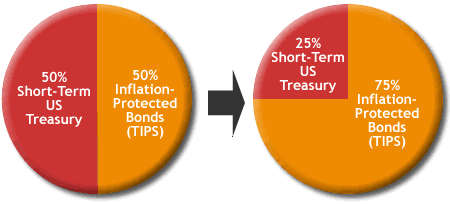
This past week, I made some minor tweaks to my investments. No, I didn’t go all cash! Previously, I had set the bond portion of my portfolio to be 50% short-term Treasury bonds and 50% Treasury inflation-protected bonds (TIPS). I use the mutual funds VFISX and VIPSX. However, this week I shifted my allocation to be 25% short-term Treasury bonds and 75% Treasury inflation-protected bonds (TIPS).

Comparing Yields to Find Expected Inflation
You can compare the nominal yield of the Treasury bonds and the real yield of TIPS and find the implicit expected inflation. For example, if a 20-year Treasury bond yields 5%, and TIPS yield 2% real, then the expected inflation is the difference, or 3%. (If inflation is 3%, then the nominal yield of TIPS becomes 2% + 3% = 5%.)

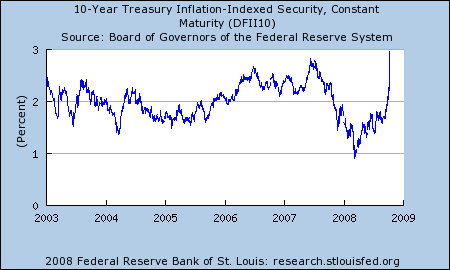
This week, the expected inflation over the next 10 years has been hovering around 1%, some of the lowest in a long time. On Monday, the 10-year Treasury yield was 4.08% and the TIPS real yield was 3.05% (source: US Treasury), for an expected inflation of 1.03%. As of Friday, the gap was 1.02%. For the 20-year bonds, the gap predicted inflation of a about 1.6-1.8%. If the actual inflation rate turns out to be greater than these values, then holding TIPS will result in a higher yield over time.

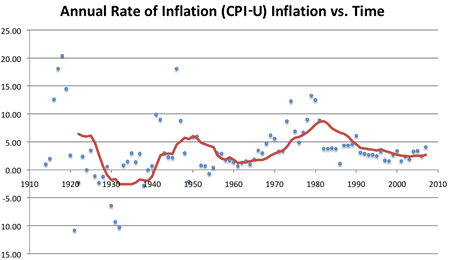
Here is a chart of annual CPI-U changes over time (source: BLS.gov). The red line is the 10-year moving average:

Yes, there are deflation worries in the near future, but you can see the only decade that inflation has averaged below 1% was during the Great Depression. Not only that, but our currency was still on the gold standard then.

Currently High Real Yields
As mentioned earlier, the current real yields offered by TIPS of around 3% are also the highest in many years:

Since real yields are rising, the value of existing TIPS have actually dropped. So I’m buying low. 🙂 If real yields rise any higher, I’d buy even more.

Making The Change
There are many things to consider out out there, like global demand and the infamous $700 Billion bailout package (where do you think this money comes from?), but I only see more spending and borrowing down the road. With the printing presses available to go full blast, and lots of future promises made, I just can’t see inflation being this low for a decade.

Combine this with the fact that TIPS have a historically high real yield, it would seem like the market is overreacting. Although I usually don’t make such changes, I decided to go for it. So far, I have chosen not to go with 100% TIPS because I wanted to maintain some of the benefits of short-term treasuries, like lower volatility and low correlations with other assets. It’s kind of tough though, as the yields are horribly low right now due to the flight-to-quality.

I haven’t increased the target amount of total bonds in my portfolio, although due to the current drift and limitations due to juggling separate accounts, they are now 18% instead of 15%. I still believe in stocks as well due to their low valuations, and have also made equities purchases this week to re-balance that side of my portfolio. I am expecting to invest another $10,000+ before the year ends.

Reminder: Why Do We Bother Investing In The Stock Market?

These days, a lot of people are asking themselves this very question. For most, including myself, I have a unsatisfying answer:

We don’t save enough money.

Think about it. If I had a billion dollars and my current lifestyle, I could simply build myself a Scrooge McDuck vault and just spend it gradually. No banks, no stocks, no bonds.

But I don’t. I have to try and fund both our ongoing and future expenses with our income. In order to make this more likely, I need higher returns. Unfortunately, this sometimes means investing in things that are riskier. Things that can drop 45% in less than a year!

What kind of after-inflation returns can I expect from stocks?
I explored the sources of long-term stock returns here. But as correctly pointed out they are nominal (before-inflation) returns . What about real (after-inflation) returns? Isn’t that what really matters?

Here is the adjusted equation:

Expected Real Return = Real Earnings Growth + Dividend Yield

Historically, the real earnings growth has been estimated at around 2%. At current depressed prices, the dividend yield of the US Stock Market as a whole is about 3%. Thus, this suggests that we can expect 5% real returns before expenses.

But don’t take my word for it, take it straight from Warren Buffett, in this semi-famous 1999 Fortune magazine article:

Let me summarize what I’ve been saying about the stock market: I think it’s very hard to come up with a persuasive case that equities will over the next 17 years perform anything like–anything like–they’ve performed in the past 17. If I had to pick the most probable return, from appreciation and dividends combined, that investors in aggregate–repeat, aggregate–would earn in a world of constant interest rates, 2% inflation, and those ever hurtful frictional costs, it would be 6%. If you strip out the inflation component from this nominal return (which you would need to do however inflation fluctuates), that’s 4% in real terms. And if 4% is wrong, I believe that the percentage is just as likely to be less as more.

4% real return, which was after taking out 1% in assumed management fees and commissions, again brings us back to 5% after-inflation returns from stocks. In exchange, we get a lot of volatility – big dips and peaks, and the dips can last a long time.

What if we wanted to take minimal risk?
I am nearly done with reading a book by economist Laurence Kotlikoff and financial advisor/columnist Scott Burns called Spend ‘Til the End: The Revolutionary Guide to Raising Your Living Standard–Today and When You Retire. In it, instead of recommending a portfolio of mostly stocks and adjusting from there, they start from the other direction. They believe you should start with a portfolio consisting entirely of inflation-protected bonds and see if you need more return from there.

Treasury Inflation-Protected Securities (TIPS) are bonds issued and backed by the U.S. government that promises you a total return that adjusts with inflation. Very generally, it works like this: if the stated real yield is 2% and inflation ends up at 4%, your interest payment would be 6%.

Coincidentally, the last few weeks have given us a huge surge in the real yield offered by TIPS, around 3%. This is the highest it has been in many years:

If you had enough money, such that a fixed 3% after-inflation return is adequate for your needs, then you wouldn’t have to take on very much risk. You wouldn’t have to own any stocks at all. Of course the market value of these bonds will still vary along the way, but if you hold until maturity you will get the real yield. And it is guaranteed by the government, just as much as “regular” Treasury bonds.

More thoughts…
If you invested $5,000 inflation-adjusted dollars every year for 30 years, with a 3% return you would end up with $257,000 in today’s dollars. If you invested the same amount at 5% you would have $370,000 – 44% more.

Of course, 100% stocks or 100% TIPS are at two extremes. But as you can see, either saving more (or living on less in retirement) allows us the luxury of needing to take less risk. Which means in times like these you’d be much less stressed. The question is, can we save enough money to pull this off? I don’t know, but I think I may try harder now. 🙂

What Is The Source Of Long-Term Stock Market Returns? (or… Do Stocks Really Always Go Up?)

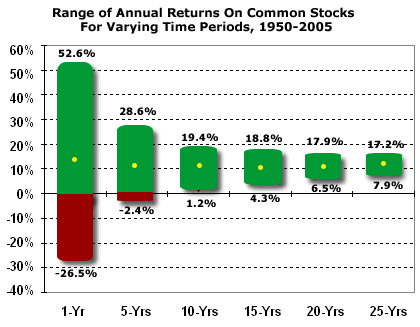
Why do we think that the stock market will always go up? Why has it gone up over long periods of time historically? For instance, let’s look at this graph:

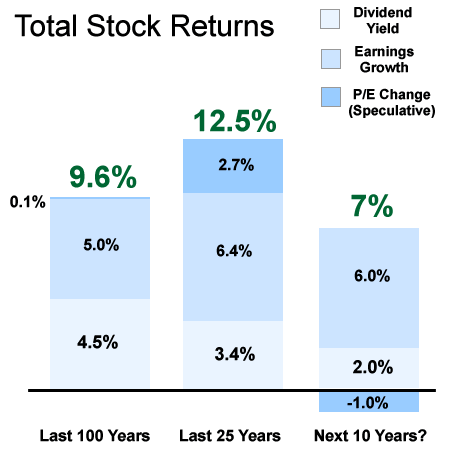
There is one theory that I have read about in the writings of respected authors like Jack Bogle and William Bernstein. It states that there are three main components to long-term stock market performance:

Part 1: Dividend Yield
Obviously, if your stock distributes 2% in dividends each year, then you will have a 2% contribution towards of return.

Part 2: Earnings Growth
If earnings stay constant, then all other things equal, one would expect the share price of your company to stay constant as well. If the earnings grow by 5% every year, then your share price will grow by 5% per year. Thus, earnings growth rate is a vital component of total return.

These two parts added to together are coined the fundamental return:

Fundamental Return = Earnings Growth + Dividend Yield

Part 3: Changes in P/E Ratio
The price-to-earnings (P/E) ratio is the price per share divided by earnings per share. In other words, it is how much investors are willing to pay for each unit of earnings. If they are willing to pay 20 times annual earnings, the share price of the stock will be twice as high as if they only paid 10 times earnings. This part is denoted the speculative return, as it has changed throughout history:

Speculative Return = P/E Ratio Changes

Adding these two up finally gives you:

Total Return = Fundamental Return + Speculative Return

Predicting Fundamental Return
Now, what if your portfolio was all of the stocks traded in the United States? This would create a connection between the growth rate of the nation’s Gross Domestic Product and the earnings growth rates of all US companies. In other words, the fundamental return is based on GDP growth. In turn, the GDP growth rate is connected to population growth and productivity per person.

Here’s my quick take: If you invest in a globally diversified portfolio, do you believe that the world’s GDP will continue to increase in the future? I believe that this is a very good bet, and is a major reason why I continue to invest in the world markets with very low management expenses.

Some bad news: Now, from 1950-2000, fundamental returns were 10%: 4% dividend yield and a 6% earnings growth rate. These days, the S&P 500 has a dividend yield of only about 2%. Earnings growth rate estimates are subject to debate, but they hover around 6% still.

Predicting Speculative Return
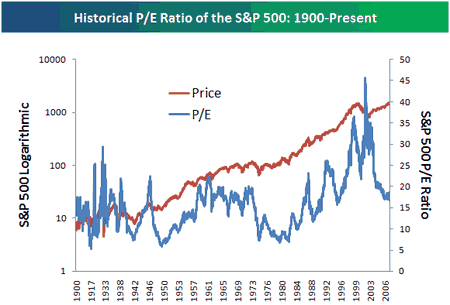
However, the speculative return has greatly contributed to the high returns of the last 25 years for the S&P 500. This is due to a great increase of the overall P/E ratio of the stock market in recent history:

In 1950, the P/E ratio was only 7. During the dot-com bubble, it was over 40. Recently, the P/E ratio was as high as 24. It is very unlikely that this huge increase will happen again. So what does the future hold if P/E ratio either stay flat or fall? This will lead to a zero, and quite possible negative, future speculative return!

Summary
In my opinion, the fundamental return is still a solid reason why stock prices will go up on the long-term, especially if you are not investing only in one country or economy. Some people call it a belief in capitalism, that economic growth will continue and GDP will continue to increase. I simply believe the the passion and motivation of all the people out there, from Sweden to China to Brazil.

However, there is good evidence that you might not be getting that 8-10% annualized return that many investment calculators seems to guarantee. You have to look at all the sources of expected future return, and the possibility of P/E ratio contraction.

But wait, why don’t people time the overall market based on P/E ratio? Some authors do recommend this. The problem is that the P/E ratio can also vary wildly for decades (see above), and most people don’t have either the patience or cash to fully see it through. For example, historically this has meant staying out of stock for 15 years at a time.

Will the P/E ratio ultimately settle at 15? 20? 30? 10? I have no clue. As the saying goes – the market can stay irrational longer than you can stay solvent. If it makes you feel better, as of this week, the P/E ratio is around 16. So the future speculative return from this point is starting to look more promising. 🙂

Current Market Conditions: My Thoughts… And Yours?

A couple of people asked my opinions on all this financial market turbulence. I really don’t have that many coherent thoughts these days, but if you really want to know, here is a sample of what has been going through my head:

  • People need to stop refreshing CNN.com and staring at those ticker symbols. Watching doesn’t change anything. It’ll just give you indigestion. If not, can I have your spicy ahi bowl?
  • For some reason, I am not worried. I am actually a bit excited. But if I was close to retirement and more than 60% stocks in my portfolio, I would definitely have fear. I understand my parents’ fear.
  • Check out this Vanguard article on the benefits of diversification.
  • Negative sentiment and recessions are part of investing. If you are young, it would be a bit naive to think that you would never see a recession in your investing experience. Perhaps you used to wonder how you would handle a real stock market drop. Well, how are you taking it so far?
  • Simple and easy are not the same thing. Buy-and-hold is a simple investing strategy. But it is not easy. Right now, cash looks pretty good to a lot of people. Can you stick it out?
  • People should vote.
  • “Why not just sell and wait things out for a while? This isn’t the bottom!” Sure, this may not be the market bottom. But chances are you’ll miss the bottom. If you try and catch the market on the way up, you’ll probably miss most of the rise before you jump back on the bandwagon.
  • A lot of behavioral finance research has shown that humans are pretty stupid when predicting trends. If we see things go up for even a little while, our natural instinct is to predict that next it will go up again. If things go down twice in a row, then we predict the third time it will go down… and down… and down… oops! It went back up!
  • As of today, I personally do think things can and probably will get worse. But again, I also don’t know when the bottom will hit. So I will be making regular buys all the way down.
  • If you haven’t already, try this charting game I pointed out before. It helped to convince me that I am especially bad at market timing. 😀
  • For the individual stock investors, I hope that you continue to track your performance (including cash balances). I am content being guaranteed to be slightly above average due to having very low investment expenses through index funds.
  • The real yield on individual inflation-protected bonds (TIPS) is pretty high right now, around 2.5%. I might buy some, as the real yield and maturity combination seems a lot better than what is available in VIPSX. But I need to do more research.

Okay, that’s me. So what do you think?

October 2008 Financial Status / Net Worth Update

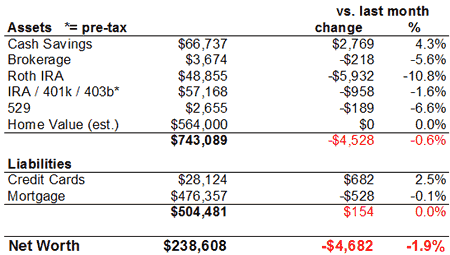
Net Worth Chart 2008

Credit Card Debt
If you’re a new reader, let me start out as usual by explaining the credit card debt. I’m actually taking money from 0% APR balance transfer offers and instead of spending it, I am placing it in high-yield savings accounts that actually earn 3-4% interest or more, and keeping the difference as profit. Along with other deals that I blog about, this helps me earn extra side income of thousands of dollars a year. Recently I put together a series of step-by-step posts on how I do this. Please check it out first if you have any questions. This is why, although I have the ability to pay the credit card balances off, I choose not to.

Retirement and Brokerage accounts
Whew! Ignoring new investments, the value of my holdings lost nearly $12,000. I won’t go into why, I think most people have heard the overall reasons. I did a portfolio update in mid-September to better understand what happened specifically. Accordingly, I am directing future contributions as I can to help rebalance my portfolio back towards the target asset allocations (mainly international developed and emerging markets stocks).

I did make an $5,000 contribution to my self-employed 401k, although I am still left in negative territory for the month. I do hope to contribute at least the $15,500 maximum salary deferral in 2008, as this has been my only contribution so far this year. My wife has already maxed out her 401(k).

Cash Savings and Emergency Funds
Last month, we achieved our mid-term goal of six months of expenses ($30,000) in net cash put aside for emergencies. Once my retirement accounts are funded, I may try to increase this cushion. An alternate reason for increasing cash is for potential real estate opportunities (way) down the road.

Home Mortgage
Another ~$500 of loan principal paid off. According to Zillow, the estimate of the value of my house is still higher than what I originally paid for it, but has also dropped 3% in the last month alone.

Big Expenses
We are taking a trip to Spain in November, which will cost us about $1,000 each. I wrote earlier about how we tried to save money on travel and how we manage cash and credit cards abroad. The airfare has already been paid for (charged on the credit cards to earn rewards, of course).

Basically, I still consider myself doing well, but I guess it is hard to avoid what everyone else is experiencing. Shrinking 401(k). Dropping house value. Rumors of potential layoffs for part-time employees at work (who’s next?). Lots of red in my net worth chart. 🙁 Fun times, eh?

You can see our previous net worth updates here.

New $50 Signup Bonus For TradeKing Brokerage

Online stock brokerage firm TradeKing has a new $50 sign-up bonus for new accounts. To qualify, you must open with at least $2,500, make one trade, and not take it out for 6 months.

There is no referral required, just be sure you see the $50 offer from the link. Expires 10/31/08 Extended until 11/30/08. Selected fine print:

1) To qualify for this offer, new accounts must be opened and funded with $2,500 or more. Account opening and funding must occur within 30 days from the date this email was sent, and one trade must be executed within 180 days of account opening. […] A minimum balance of $2,500 is required in the account (minus any trading losses) for the first six months or the credit may be surrendered. Offer applies to new non retirement accounts funding for the first time.

Background – Why pay more?
TradeKing is a discount brokerage with $4.95 trades and $0.65 option contracts. They have good customer service, with both Live Chat and phone reps with short hold times available. Won SmartMoney Magazine’s Best Discount Broker award in 2006, 2007, and 2008.

They are one of my three favorite discount brokers. To sum things up very briefly, they are between Zecco (cheaper, less refined) and Scottrade (more expensive, but has local physical branches). I don’t see any reason to be paying $10+ for a trade, given these three options.

For more information and tips on TradeKing, please check out my TradeKing Review. I have an account with them, so you can also ask questions in the comments.

Good Time To Check Your Risk Tolerance Again?

I should really stop looking at CNN.com and CNBC.com, but nobody will stop talking about it so here I am talking about it too. Moo. 🙂 If you watch your portfolio closely and are feeling nervous and/or scared, then perhaps this is a good time to self-reflect and ask yourself if you are as risk tolerant as you thought you were.

Many financial experts like to give out a simple “risk questionnaire” to figure out your risk tolerance, and then guide you into an asset allocation afterwards. The problem is, it is really easy for people to say “I’m not scared!” and then tell themselves they don’t need to save as much. The more you save, the less risk you need to take. Back when stocks were booming, so many folks had 100% in stocks, and even some retirees had 60-70% in stocks.

Back in 2006, I tried out a bunch of these risk surveys and remarked that

I think it’s really hard for people to gauge how they would react to losing 30% of their assets in a year unless they had actually experienced it.

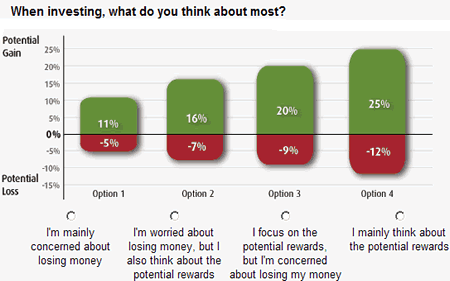
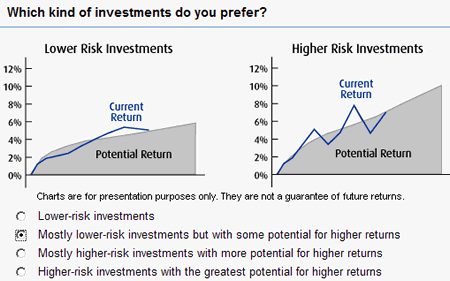
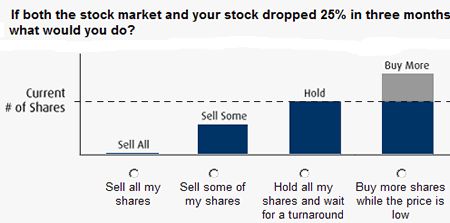
I still don’t think we have experienced true fear yet, but maybe now is a better time to take the survey questions again? These samples are taken from the ShareBuilder website’s PortfolioBuilder application.

Sample Question 1

Well, the year-to-date total return of the S&P 500 is only about -12% as of the end of today. It was about -15% yesterday.

Sample Question 2

The recent bouncing around puts this question in a new light, eh?

Sample Question 3

Even now, we are nowhere near dropping 25% in 3 months. Are you sure what you would do?

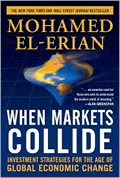
When Markets Collide: Book Review, Model Asset Allocation

The last book I reviewed was Financial Armageddon. Then I saw the title of this book: When Markets Collide. I almost stopped right there, as I was not at all in the mood for yet more doomsday talk.

However, I saw that the author, Mohamed El-Erian, ran the Harvard University Endowment for nearly two years, and is now the co-CEO of the huge bond investment company PIMCO. Throw in the fact that the tagline of this book is “Investment Strategies for the Age of Global Economic Change”, and perhaps this would be an insightful book about investing like David Swensen’s Unconventional Success. (Swensen ran the Yale University Endowment.)

Ease of Reading / Target Audience
The first I noticed about this book was that it was very difficult to read. The author tried to write this book for both experienced economic policymakers and the average investor. Not an easy feat. I felt that he came off as one of those guys who is just “too smart” and can’t simplify things for the rest of us. Here is an example of this high-level writing from the book:

The challenge of how to deal with consequential and volatile endogenous liquidity relates to another policy issue that I will discuss in Chapter 7: how to refine the traditional instruments of monetary control and ensure more meaningful and sophisticated supervision on a range of activities, with volatile leverage, that have been enabled by the ongoing structural transformations and yet are outside meaningful oversight.

Quick Summary: My Interpretation
The relationships between the economies of the world are changing. Emerging markets, which used to either be debtor nations or those who would only buy the safest thing available (US Treasuries), are growing fast and will start to invest their considerable wealth elsewhere, including equities. The U.S. can’t rely on other countries to buy our debt forever, just as the other countries can’t rely on U.S. consumers to prop up the world’s economy. This is where the “markets collide”. Throw in complicated structured investments like derivatives which nobody perfectly understands, and we are only in the beginning of a very bumpy road ahead.

Model Asset Allocation
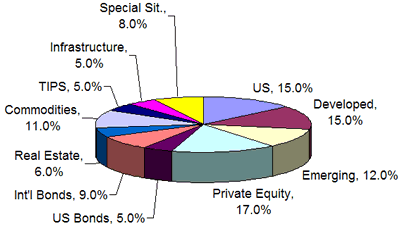
So what is a U.S.-based individual investor to do? El-Erian states the three basic steps of portfolio management are: “choosing the right asset allocation, finding the best implementation vehicles, and conducting risk management.” Accordingly, here is his model asset allocation, with midrange percentages.

Equities (49% total)
15% United States
15% Other advanced economies
12% Emerging economies
7% Private

Bonds (14% total)
5% U.S.
9% International

Real Assets (27% total)
6% Real estate
11% Commodities
5% Inflation protected bonds
5% Infrastructure

Special Opportunities
8%

This adds up to 98%, but the way I read the book, the rest should be in cash. As a comparison, here is the asset allocation from Unconventional Success.

El-Erian doesn’t like home-bias and is believes strongly in being “globally-diversified”. You can see that only about 1/3rd of the equity allocation is to U.S. stocks. If an investor does have access to private equity, then you can redistribute that back into the other equities. In my opinion, he cops out in the active manager vs. passive index debate. He simply states that it’s really hard to find a good active manager, but if you can you should go with them. Of course, no further hints are given. 😛

As for bonds, he believes that bonds are overall a good portfolio diversifier to manage volatility. He also advocates a big portion of international bonds, which he believes are mature enough to be considered right beside domestic bonds. (He was also was an emerging bonds analyst for many years.)

Inflation is another big concern due to huge global growth, and thus there is a sizable allocation to real assets – commodities, real estate, inflation-protected bonds, and infrastructure (publicly traded equity and debt securities of utilities, airports, ports, roads, hospitals, etc.). Special Opportunities could mean speculative plays such as distressed debt or long-term environmental gambles like carbon credits.

In general, this is pretty different mix from many other model asset allocations I’ve read about.

Summary
When Markets Collide is mainly a macro-economics book as opposed to a how-to-invest book, but it does give some interesting insights about the future that might influence my personal investing strategies. For example, I agree that activities from non-U.S. countries will be increasingly important and their equities should be a significant part of one’s portfolio. I am not so sure (or educated) about the rest. I could only give a very superficial review here, so if this perspective sounds interesting and you want more details than I have given, I would read the book. If futuristic projections aren’t your thing, then I’d probably skip it.

Zecco Gives Unlimited Free Stock and Options Trades in October

Apparently Zecco.com, a start-up brokerage where I keep most of my “play money”, didn’t do so well during the last week. People report having problems logging into their accounts due to all the market turbulence. I was luckily not affected, as I haven’t had time to trade much at all.
In response, they are offering unlimited free trades (both stock and options) for the entire month of October to all customers and all accounts. Also, the $2,500 minimum for free trades is being waived. From a recent announcement:

To show our appreciation for your loyalty, we have decided to make October a 100% unlimited free trading month. This means that between October 1st and October 31st you can make unlimited equity and options trades commission-free. As far as I know, this has never been done in the history of the brokerage industry, until now. But then again, we are seeing things in the market we never would have believed, until now.

Eligibility

* The no-commission stock and options trade offer applies to all Zecco Trading accounts in good standing.
* The offer applies to equity and options trades, including multi-legged options orders and all options contracts.
* Mutual fund trades are not eligible for the offer.
* There is no minimum equity balance requirement or minimum trade volume restriction.
* All account types are eligible, including IRA.
* The offer is effective for equity and option trades placed and executed 10/1/08 through 10/31/08. The standard free trading program and options pricing will resume 11/1/08.

What are some good ways to take advantage of this offer? Maybe time to do some tax-loss harvesting? I suppose active traders and daytraders should be happy and go nuts. 🙂 Since their normal offer is to give you 10 free trades per month, I usually consider Zecco best for buy-and-hold investors to buy shares of ETFs regularly and cheaply. Now I guess you could dollar-cost-average every day.

The free options trading do sound interesting, as they used to cost $4.50 + $.50/contract. You never see free options trading. Maybe it’s time to try some test trades out? It would be interesting to learn to create proper hedges.

As an aside, I recently moved all of my cash out of my Zecco account since I wasn’t trading (no free time) and wanted to earn more interest elsewhere. However, they then de-activated my account. It wasn’t closed permanently and a phone call got it open again, but just an FYI if you experience weird things. You can read about my previous experiences with Zecco here.

Want To Bail On Your Stocks? Answer 2 Questions First.

In response to a few reader questions, all relating to moving their investments into something safer:

Question #1: Why do you really want to sell? Can you predict future movements of the stock market? I can’t. If you could, then you should have known these collapses were coming, shorted these stocks, and made a fortune. If you bet big enough, you’d be retired right now and not reading this.

So you’re not psychic. Then why? The real reason you want to sell is that your investments have dropped by 20% and you’re scared it will fall further. Okay, so you sell. How do you know when to buy back in again? If you use the same logic, you’ll wait until the market has gone up 20% already and you don’t want to be left behind. That’s just another way of saying buy high, sell low. Not a great way to make money.

Question #2: When do you need the money? If it’s still over 25 years from now, then what’s the worry? I don’t need this money for three more decades. Do you remember what the New York Times headlines were 25 years ago? You can bet they were worrying about something. Time horizon is important; Stocks are called long-term investments for a reason.

If you need the money a lot sooner, then you might want to re-examine your risk profile. But I’d still avoid making a rash decision.

September 2008 Investment Portfolio Update

Given recent events, I suppose I should take a look at how my investments are doing. I am also planning to make some large-ish 401k contributions and need to figure out which asset classes to buy in order to rebalance my portfolio.

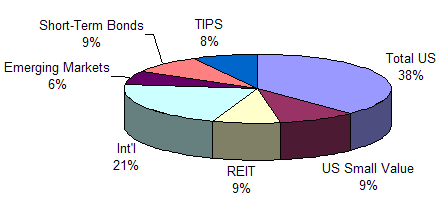
9/08 Portfolio Breakdown
 
Retirement Portfolio Actual Target
Asset Class / Fund % %
Broad US Stock Market 38.8% 34%
VTSMX – Vanguard Total Stock Market Index Fund
DISFX – Diversified Stock Index Institutional Fund*
DODGX – Dodge & Cox Stock Fund*
US Small-Cap Value 9% 8.5%
VISVX – Vanguard Small Cap Value Index Fund
Real Estate (REITs) 8.4% 8.5%
VGSIX – Vanguard REIT Index Fund
Broad International Developed 21% 25.5%
FSIIX – Fidelity Spartan International Index Fund*
VDMIX – Vanguard Developed Markets Index Fund
International Emerging Markets 6.5% 8.5%
VEIEX – Vanguard Emerging Markets Stock Index Fund
Bonds – Short-Term 9% 7.5%
VFISX – Vanguard Short-Term Treasury Fund
Bonds – Inflation-Indexed 8% 8.5%
VIPSX – Vanguard Inflation-Protected Securities Fund
Total Portfolio Value $105,654
 

* denotes 401(k) holding given limited investment options

Contribution Details
Throughout 2008, my wife has been making regular salary deferrals to her 401k, and has recently reached the annual $15,500 limit. I plan to start contributing to my Self-Employed 401k plan shortly.

YTD Performance
The 2008 year-to-date time-weighted performance of my personal portfolio is -27.9% as of 9/18/08. In fact, despite sizable additional contributions, my portfolio is down over $10,000 since my last update in April. Today might have been a bad day to run these numbers… 🙂

Although not necessarily a benchmark, the Vanguard S&P 500 Fund has returned -20.07% YTD, their FTSE All World Ex-US fund has returned –29.74% YTD, and their Total Bond Index fund is up 2.71% YTD as of 9/18/08. (My emerging markets fund is down nearly 40%!)

Rebalancing Details
First of all, I am not changing my asset allocation or moving into safer investments. In fact, I am doing the exact opposite and buying what has been dropping the most…

I am still following the general asset allocation plan outlined here, with a 85% stocks/15% bonds split [115-Age]. Here is an example of how we implemented the asset allocation across multiple accounts, although I’ve since moved some funds around.

So, it looks like I need to buy more Emerging Market and Broad International. I am now a bit overweight in Bonds and Broad US, so I need to sell those. Due to the limited index fund choices in my Fidelity Solo 401k account, I may start buying ETFs if I can justify the $10.95 commissions.

You can view all my previous portfolio snapshots here.