Vanguard’s New Global Stock Index Fund

Via Bogleheads, yesterday Vanguard started the trading of a new investment that attempts to track the entire global stock market in just one fund. Dubbed the Vanguard Total World Stock Index Fund, here are some details from an older press release:

The new fund will seek to track the performance of the FTSE All-World Index, a float-adjusted, market capitalization weighted index designed to measure the equity market performance of large- and mid-capitalization stocks worldwide. The fund will invest in a broadly diversified sampling of securities from the target benchmark, which comprises more than 2,800 large- and mid-cap stocks of companies in 48 countries.

The current balance is about 41% US and 59% International. The ETF version (VT) features an expense ratio of 0.25% but has to be bought in a brokerage account. The mutual fund version (VTWSX) can be bought and sold for free at Vanguard ($3k minimum) and has an expense ratio of 0.45%, along with a 0.25% purchase fee and a 2% redemption fee on shares redeemed within 2 months of purchase.

Although you could basically replicate this fund with the proper mix of the Total US Stock Market ETF (VTI) and FTSE All-World except-US ETF (VEU) funds at a lower expense ratio, you’d also be subject to double the commissions when buying and selling. Besides, I think it’s just cool that you can now passively invest in the entire world with one ETF. For example, if China eventually becomes 25% of the world’s stock market value, then 25% of this fund would be invested in China without you having to lift a finger. If somehow India or Russia explodes instead, then you’ll still hold their share.

How could this fit in to your investment plan? More posts about asset allocation information here.

Hey Jonathan, How Do I Start Investing For Retirement?

I’m always flattered when anyone (online or offline) asks me for investing advice, but at the same time I’m very cautious about giving it out. And it’s not just the usual *I’m not a financial professional* legal concerns, but the fact that it’s hard to give useful advice in a few paragraphs or a 5 minute chat. Over time, I’ve been refining my “amateur, informal financial advice over coffee” speech. My goal is to give specific ideas but to keep it simple. Let me know what you think.

1. Put your money in a Vanguard Target Retirement Fund. These mutual funds are an all-in-one basket of different low-cost index funds. You get some US stocks, some international stocks, and some bonds. The mix is automatically adjusted for you. No, they might not be perfect, but they are pretty darn good and very simple to hold. I have specifically have told my own mother to open an account at Vanguard. I withhold any theory talk about passive investing because this is when most people’s eyes seem to glaze over.

Just buy the fund with the date closest to when you want to start making withdrawals. All lifecycle or dated funds are not made the same. The ones in my 401k stink, and I don’t even like the Fidelity Freedom 20XX funds.

The Vanguard funds do have a $3,000 minimum initial investment. Until you have $3,000, just stick your money in an savings account paying decent interest and with an automatic deposit system. I know it sounds nice to “start investing with $100” (and here are some ways to do that), but honestly, if you don’t have $3,000, your focus should be more on saving money by spending less/earning rather than investing at this point. There is no need to rush.

2. Read a good investing book
Websites and blogs are great, but it is still very hard to replace a good book. They tend to be professionally edited, better organized, cover all the bases, and are easy to refer back to. I think the following books are great and are definitely worth the $10-$20 cost:

If you’re not convinced (perfectly understandable), first borrow it from the local library and then buy a copy if you like it. Read as much as you can!

3. Hey, no skipping ahead. Please do #2.
My friends ask me for advice. I say to read a book. Months later, most of them (not all) haven’t read any books but still want advice. Yes, I know, this involves effort. (Gasp!) Please, spend a weekend doing something that will dramatically increase your net worth in the future. If you don’t, then at least if you did #1, you’ll be ahead of most investors who pay too much money chasing hot stock tips or pay other people to chase hot stock tips for them.

4. Pay someone to do it for you
If it’s been years and you still haven’t read a darn book and don’t plan to, go to NAPFA.org and find yourself a fee-only financial advisor that you click with. Pay that person to keep you on track. If they are fee-only they are less apt to be biased on what investments they recommend. But remember, the person who will care most about your money is still you.

Applying the Concept of Kaizen To Personal Finance

Kaizen is a a Japanese philosophy that focuses on continuous, gradual improvements in all areas of life. A popular example is that of Toyota Motors, where any worker can stop the entire factory line if they see an abnormality and worker suggestions are welcomed and regularly implemented. The role of kaizen in Toyota’s success is discussed in detail within this New Yorker article “Open Secret of Success“:

…Toyota’s approach: defining innovation as an incremental process, in which the goal is not to make huge, sudden leaps but, rather, to make things better on a daily basis. […] Most of these ideas are small—making parts on a shelf easier to reach, say—and not all of them work. But cumulatively, every day, Toyota knows a little more, and does things a little better, than it did the day before.

The parallels to personal finance are relatively obvious but I think it is still easy to underestimate the power of such small, continuous, improvements.

Starting a New Business
Many of us may have ideas about starting up a new business (side or full-time), or even consider a career change. But the task can be daunting, so we put it off. But taking small steps towards such a goal are relatively easy. Spend a little time regularly making contacts, read and learn new skills while sitting at a cafe, or simply making your fuzzy daydreams a little sharper. It doesn’t even have to be daily.

Changing Your Spending Habits
Habits are by definition almost subconscious behaviors, and very hard to break. This New York Times article “Can You Become a Creature of New Habits?” explores why using kaizen instead may be better suited to changing our habits as opposed to other more aggressive methods:

“Whenever we initiate change, even a positive one, we activate fear in our emotional brain,” Ms. Ryan notes in her book. “If the fear is big enough, the fight-or-flight response will go off and we’ll run from what we’re trying to do. The small steps in kaizen don’t set off fight or flight, but rather keep us in the thinking brain, where we have access to our creativity and playfulness.”

If you want to start a budget, why not tracking your spending in just one category, like dining out?

Taking it another step further, instead of just saying “I need to eat out less”, why not ask why you order out so much. For us, often times it is simply because we are tired and there is nothing easy to cook in the fridge. So I have started to keep a better stocked pantry and also make a regular schedule where I buy a small amount of “standard” fresh vegetables which are easy to incorporate. Each time I find a good recipe that uses only what is in my pantry, I write it down, so I slowly accumulate our own custom lazy-proof cookbook.

Kaizen Is All About You
These are just a few examples, and is kind of how I like to think of this blog. There are so many complex topics that are impossible to learn all at once, from investing to insurance to taxes. Every day I read and skim a lot of information, in the hopes of gleaming something a little useful that can help me get a little closer to leaving the rat race. It may just seem like little nothings, but when you add it all up together I know it has made a huge difference in our financial lives. But what may strike a chord in me might not apply to others, so it’s all about taking what works for you and applying it.

So remember, as long as you learn or implement something a little new each day, you should be happy!

Peeking Inside The World of Financial Advisors

Have you ever considered becoming a professional financial advisor? You can read about one man’s story in this article Evolution of an Investor from Conde Nast Portfolio. Blaine Lourd started out as a stockbroker, and found out he was really good churning accounts for his own profit:

“It was amazing, the gullibility of the investor,” he says. “When you got a new customer, all you needed to do was get three trades out of him. Because one of them is going to work. But you have to get the second one done before the first one goes bad.” […]

It wasn’t exactly the career he’d hoped for. Once, he confessed to his boss his misgivings about the performance of his customers’ portfolios. His boss told him point-blank, “Blaine, you’re confused about your job.” A fellow broker added, “Your job is to turn your clients’ net worth into your own.” Blaine wrote that down in his journal.

Although he kept at it and became rich and successful, Lourd eventually got tired of picking investments for his clients based on whether it made him richer and not them. When he tried to change his investment recommendations in a manner that followed his conscience, the large brokerage firm he worked for fired him. (A.G. Edwards, now Wachovia Securities) Now, he is a fee-only financial planner who makes less money advocating passive investing, but sleeps better at night. (I doubt he’s eating Top Ramen, however.)

His job, as he now defines it, is to tell investors that the smartest thing they can do is nothing. He acts as a brake on, rather than an accelerator for, their emotions. For that, he takes between one-half of a percent and 1 percent annually, which is more than they’d pay if they simply bought index funds on their own. “I tell them, ‘Look, if you can control your own emotions and you want to go to Vanguard, you should do it.’ And every now and then, someone asks the question, ‘Why do I need you, Blaine? What are you doing?’ And I say, ‘Howard, be careful or I’m going to send you back to Smith Barney.’ And they laugh. But they know exactly what I mean.”

The comments on the article seems to focus primarily on the whole active vs. passive investing debate, which is valid but I think misses the bigger point mentioned above that one way happened to make him a lot more money. Even if you believed in active investing, you could still avoid things like promoting high-cost, in-house mutual funds, trading in and out excessively to generate commissions, and selling unnecessary insurance products.

I also enjoyed this article because it reminded me of my idle fantasies of becoming a financial planner. Wouldn’t it be cool to help people manage their money better on a 1-on-1 basis? Unfortunately the reality seems to be that most people starting in this field have to put in at least a few years in a commission-based brokerage firm making cold calls and aggressively pushing whatever products they say to push. Otherwise, with no experience and no big recognizable company name behind you, it will be impossible to get any clients.

My own idea was to join some firm with low entry requirements like Ameriprise or Edward Jones, but only sell products that I felt were appropriate like index funds or term life insurance. I wonder what would happen? I suppose that I would be fired quickly for not meeting quotas. Even Mr. Lourd, who was still making lots of money for his old company even while advocating index funds, got fired for not following the company line. Still, it would be fun to try.

How To Hedge Against Rising Gas and Oil Prices?

Everybody’s talking about gas prices… they’ve reached another high, everybody wants a hybrid… so why not explore how an individual can try to limit their exposure to gas prices?

How much more are you really paying?
Yes, $50 for a fill-up hits some sort of mental trigger, but sometimes I wonder if people really have calculated exactly how much more they are paying. According to AAA, the current national average is $3.70/gal, while a year ago it was $3.05. If your car gets 20 miles per gallon, you drive 12,000 miles per year, paying 65 cents more per gallon equates to an extra $390 per year. (If you got a stimulus check, this means a lot of it might have already been spent…)

Now, for many families who are walking a financial tightrope, such a hard-to-avoid increase is just a another step closer to the edge. But for the Wii-playing, Starbucks-drinking crowd, is an extra $32/month really worth making a fuss over? I mean, some of these folks are the same ones whose eyes glaze over when I describe some of the extra things I do for money outside of a regular workday.

Hedging Against Future Increases
Now, someone could always play with oil futures contracts like the airlines do, but that’s a bit complicated for the average person. However, if we are afraid that gas prices will rise even further but are comfortable paying the current price, it would make sense to try and buy a bunch of gas at today’s prices and lock-in that rate. A while ago there was a company called the FuelBank that tried to make this a reality, but it appears to have gone nowhere.

Buying the Oil ETF USO
Another way that you can effectively buy at today’s prices is to buy shares of the United States Oil ETF, symbol USO, from your favorite online stock broker. This idea was initially explored in this SeekingAlpha article back when it debuted in 2006. Unlike other commodities ETFs or investing in an energy company like Chevron or Exxon, the objective of this ETF is specifically to keep it’s net asset value (NAV) at the price of crude oil. (Specifically, the spot price of West Texas Intermediate light, sweet crude oil delivered to Cushing, Okla., minus expenses.)

Now, USO hasn’t done the best job of tracking crude oil prices exactly on a day-to-day basis, but it seems to get the general trend right if you hold an extended period of time. From 5/7/07 to 5/6/08, crude oil went from $61.48 to $121.82 a barrel, an increase of 98%. (source) For the same date range, USO went from $48.06 to $93.38 a share, up 94%. (source)

In order to counteract the theoretical $390 from the example above back, you could have bought 9 shares of USO for a total upfront cost of $390 a year ago, which would be worth $408 more today. So in theory, the average driver could put aside something like $1,000 and buy 10 shares of USO to hedge against rising gas prices. Even just one share would dampen the effects somewhat.

The Catches
Unleaded gas prices only went up 21% in the same time period that crude oil went up nearly 100%. So the ratio between crude oil price and unleaded gasoline doesn’t seem to be a constant. Also, if gas prices fall then your savings at the pump will likely also be negated by a drop in USO’s share price. Also, you could account for the lost potential of any money put aside for this if you had invested it elsewhere.

I don’t personally plan on doing this, but it is an idea that could work if you were really sensitive to higher gas prices and/or buy a lot of gas. Another alternative is a site like HedgeStreet, though I haven’t looked too deeply into it.

Make Your Own Best 529 Plan Using Partial Rollovers

529 plans have become a very popular tool for saving for college for those that choose to help out their kids (or simply funding some continuing education for yourself). Most states have their own 529 plans, sometimes even multiple choices within those plans. They are very flexible – anybody can invest in any state’s 529 plan, and that money can pay for college expenses in any other state. Beneficiaries are also easily changed between relatives.

Conventional Advice
The standard advice for picking a plan is to first check if your state has a good tax deduction for using your state’s plan. Something like 32 states offer some sort of benefit. If so, then consider going with that plan. If not, then go with the “best” out of state plan since many state plans have poor investment choices and higher fees. If somehow you have a really horrendous state plan with high fees, then you might even forgo the tax deduction and go with an out-of-state plan.

But… Why not do both?
Most 529 plans allow both partial and complete rollovers into another state’s 529 plan. So, why not first take any tax breaks available to you by contributing to the in-state 529, and then see if you are able to quickly roll over those funds into a better out-of-state plan. Keep the in-state plan open if you intend to make future contributions. I checked out a sampling of various state plans and they all offered partial rollovers.

This way, you get both the upfront tax benefit, and the long-term low-fee benefit. Seems plausible, no?

Some states might have a tax-deduction recapture rule. In that case, I might consider contributing only up to the tax deduction and then opening up another better 529 for additional contributions. You can have multiple 529s.

My Experience – Oregon, New Hampshire, and California 529s
You may be wondering why I have a 529 plan listed in my net worth, even though I don’t even have any kids. In fact, I have opened 529 plans from three different states! About five years ago, the California 529 was giving away $50-$100 gift cards for opening a plan and depositing $100. I figured, why not, that’s a pretty nice return on investment. We might use it, and if not you can always withdraw principal without penalty. So I opened up an account for me and one for my wife, with us as the beneficiaries.

Then, while in Oregon, they offered a state tax deduction on $2,000 of contributions each year (now $4,000 for a married couple). So I contributed to that. Finally, there was a Fidelity College Rewards 529 credit card that paid 2% back into a Fidelity 529 plan (it now only pays 1.5% back to new applicants). 2% back on everything was great, so I opened up a 529 from New Hampshire that Fidelity ran.

Long story short, I have since rolled everything into the New Hampshire 529 plan with no fees from anyone. The paperwork was easy, although you do want to track your contributions in case you make a non-qualified withdrawal. The New Hampshire plan is not bad, with a 0.50% expense ratio for their index fund portfolios including all management fees, and no maintenance fee, and only a $50 minimum to start.

Best Out-of-State Plans To Consider
I haven’t done exhaustive research on this topic, but if you believe in low-cost index funds then one of the best plans is definitely the Ohio CollegeAdvantage 529 plan. The have Vanguard mutual funds with a 0.18-0.23% management fee on top of fund expenses. The total annual asset-based fees can be as low as 0.21%, but the age-based portfolios are about 0.30%-0.35%. No maintenance fees.

If you believe there is a performance benefit to investing in several asset classes, there is also the more-expensive West Virginia SMART529 Select plan which offers mutual funds from Dimensional Fund Advisors (DFA). Total asset-based fees are 0.65% – 0.88%, plus a possible $25 maintenance fee for non-WV residents.

Since I still have my credit card relationship and my balances are low, I don’t bother moving away myself. I don’t actively contribute anything except my credit card rebates, so saving 0.15% in fees on my $3,000 would be less than $5 a year. But for folks with larger balances and held over longer periods of time, the performance advantage of lower fees can definitely be significant.

Zecco Switches To Electronic Statements and Trade Confirmations

For those of you who have been using Zecco and their free stock trades, no longer will you have to endure a paper trade confirmation being mailed to your home for every single trade. Here’s how to switch:
How do I sign up for Paperless?
Just sign into the trading center with your trading key. Select the “Account Statements” link in the “Account Records” section on the left-hand menu. Then click on the corresponding button for electronic confirmations or statements (or both). When signing up for Paperless, please check “myInfo” in your account to make sure you have a valid email address in our records. Click on “Submit” and you’re done! Your next account statement and/or trade confirmation will be available for viewing online. You will be notified of new documents available for viewing via email.

Even if you aren’t as excited about this as I am, be sure to switch over to electronic statements anyway by May 30th. Because after that, they are going to start charging $1.50 per paper trade confirmation and $2 per paper statement mailed to you.

Active Trading Confessions…
Why do I care? Well, despite my belief in passive investing for the vast part of my portfolio, I’ve continued to dink around with my free trades from Zecco for the last several months, and have actually been “beating the market” and am currently up over 10% this year – ha! Of course, I’ve also been down as much as -20%. Let me tell you, this sadly generated a lot of paper!

But don’t worry, we’re only talking about $500 worth of stocks or so – I don’t consider this really part of my investing portfolio. Instead, I consider it entertainment that is cheaper than buying video games or playing online poker. I’m looking to learn more about options trading next.

For those unfamiliar with Zecco, here’s the quick rundown. You can get 10 free trades per month if you reach $2,500 in account equity. Otherwise, it is $4.50 per trade. “Account equity” means value of stocks + cash. So $1,500 in cash and $1,000 in stock positions would qualify. As long as you reach $2,500 total any time during the month, you will get 10 free trades for the rest of that month.

Although they have improved their customer service (toll-free phone number, shorter hold times) and stock quote systems since their beginnings, at the heart this is still a discount brokerage firm. (Duh.) Don’t expect too much hand-holding. No minimum balances or account fees for regular taxable accounts. $30 annual fee for IRAs. For more details, see my Zecco Review.

April 2008 Investment Portfolio Snapshot

Since we just made our IRA contributions for 2007 recently and had made a few mutual fund exchanges, I figured this was a good time to post another portfolio snapshot. Since we have so many different accounts now, I changed the presentation layout a bit to clean things up.

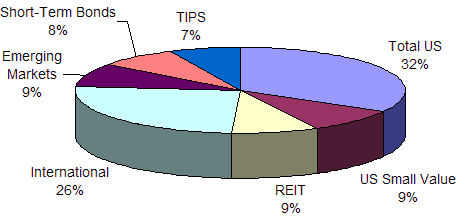
4/08 Portfolio Breakdown
 
Retirement Portfolio
Asset Class / Fund $ %
Broad US Stock Market $38,836 32%
VTSMX – Vanguard Total Stock Market Index Fund
DISFX – Diversified Stock Index Institutional Fund
DODGX – Dodge & Cox Stock Fund
US Small-Cap Value $10,480 9%
VISVX – Vanguard Small Cap Value Index Fund
Real Estate (REITs) $10,017 9%
VGSIX – Vanguard REIT Index Fund
Broad International Developed $29,925 26%
FSIIX – Fidelity Spartan International Index Fund
VDMIX – Vanguard Developed Markets Index Fund
International Emerging Markets $10,198 9%
VEIEX – Vanguard Emerging Markets Stock Index Fund
Bonds – Short-Term $8,989 8%
VFISX – Vanguard Short-Term Treasury Fund
Bonds – Inflation-Indexed $8,260 7%
VIPSX – Vanguard Inflation-Protected Securities Fund
Total $116,705
 

Contribution Details
Through the end of 2007, we maxed out the salary contributions of both of our 401k/403b plans and put in $15,500 each. We didn’t qualify for a Roth IRA contribution in 2007, but after exploring the options of a non-deductible contribution to a Traditional IRA, we decided to go for it and put in $4,000 each in early April. For 2008, my wife has contributed about $5,000 so far to her 403b and is on track to max out again. I’m lagging a bit behind, but should catch up later in the year.

YTD Performance
The 2008 year-to-date time-weighted performance of my personal portfolio is -1.96% as of 4/18/08. Although not necessarily a benchmark, the Vanguard S&P 500 Fund has returned -4.77% YTD, their FTSE All World Ex-US fund has returned –3.47% YTD, and their Total Bond Index fund has returned 1.32% YTD as of 4/18/08.

Portfolio Construction Details
We followed the general asset allocation plan outlined here. I went ahead and moved forward to a 85% stocks/15% bonds split since I base it on the formula [115-Age] and I’ll be turning 30 in a few months. Here is an example of how we implemented the asset allocation across multiple accounts, although I’ve since moved some funds around. It’s definitely not an exact science, we just did the best we could with the fund choices available.

You can view all my previous portfolio snapshots here.

Does The Government Underestimate Inflation Through The Consumer Price Index (CPI)?

Many people, including myself, are worried about inflation. Is it just because of the current housing and stock market conditions, or are our bills really a lot higher than before? The inflation numbers that we usually hear about are based on the Consumer Price Index (CPI). Variations of the CPI are published monthly by the government’s Bureau of Labor Statistics, and they supposedly track the prices consumer pay for a basket of goods and services. For example, a greatly simplified basket may include a month’s rent, 10 pounds of steak, a tank of gas, and a laptop. As the price of this basket goes up, that’s inflation.

Why Does CPI Matter?

  1. Payouts on inflation-protected investments like TIPS and Series I bonds are indexed directly to the CPI.
  2. Social security payments, pensions, and inflation-indexed annuities all rely on CPI data to determine their annual adjustments.
  3. The size of individual income tax brackets, personal exemptions, and the standard deduction are tied to movements in the CPI.
  4. Low inflation numbers (especially when they are much less than GDP growth) make the economy seem healthy.

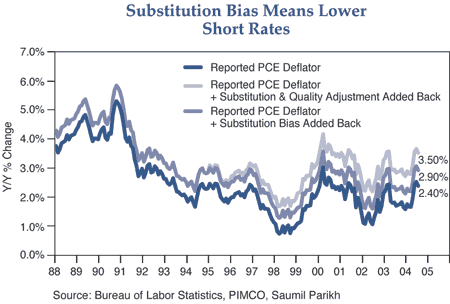
However, there is some controversy over whether the CPI is an accurate measure of inflation. As you can see above, there are many reasons why the government and large pension groups would like to see a lower inflation number. Lower inflation numbers mean lower payouts, a smaller budget deficit, and a happy stock market.

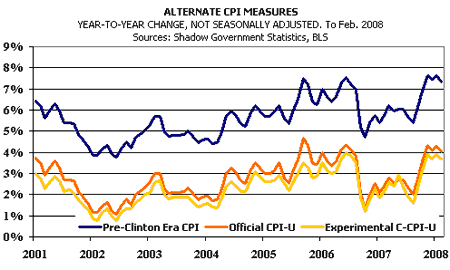
In 1995, the Boskin Commission study suggested that the CPI overestimated inflation by around 1.1% every year, and in 1996 changes were made to counteract these alleged errors. But critics say these changes were completely unnecessary, and now the CPI underestimates inflation by around 1.1% per year. Here are some of the arguments:

Substitution Adjustments
It was suggested that if steak becomes too expensive and people buy hamburger instead, then the CPI should just start using hamburger prices instead. After all, that is what people are buying right? Not only does this reduce inflation, critics wonder where this is headed. Hamburger gets too expensive, so then we eat hot dogs. Hot dogs turn into… dog food?

In addition, let’s say we go from using steak to hamburger due to price, and then back to steak again once it gets cheaper. Roundtrip, this substitution system would say that there was zero or even negative inflation during this time. But obviously prices actually rose. Just doesn’t sound right.

Quality, or Hedonic, Adjustments
A second major factor is that the CPI tries to adjust for increases in quality as well as increases in price. If a car costs 10% more, but it is 10% higher in quality, then there was no inflation. Okay, I can see this in certain examples. But critics point out that many times the consumer has no choice but to pay the higher price, so why aren’t we taking this into account?!

Example: If the government mandates an additive to your gasoline that costs an extra 20 cents per gallon, there is no affect on the CPI because this 20 cents was an improvement in “quality”. But we still get stuck with higher bills!

I wonder… if we follow all these quality adjustment ideas, isn’t shifting from steak to hamburger losing quality and shouldn’t that be adjusted for as well?

What If We Remove These Adjustments?
Here are two estimates of what the CPI number would look like without these adjustments. From Shadows Stats2 (Clinton era means 1996, when the changes were made):

altext

From Bill Gross and PIMCO3:

altext

Personally, I think the government has a vested interest in getting the inflation numbers at least somewhat correct (considering the scrutiny they are under), but at the same time they want to err on the low side rather than the high side. Some of the methods they use definitely seem to support this goal, and I wouldn’t be shocked if the CPI-based inflation numbers lagged what consumers actually experience by up to 1% per year at times. This may be something to consider when buying anything indexed to the CPI.

Sources and More Information

  1. The great inflation cover-up by Elizabeht Speirs, for Fortune Magazine.
  2. Consumer Price Index by ShadowStats / John Williams – Slightly more aggressive and controversial.
  3. Haute Con Job by Bill Gross – He runs PIMCO and the largest bond mutual fund in the world, so not quite a kook. Also see Con Job Redux.
  4. US CPI Inflation Statistics Manipulation and Deception? by Ronald Cooke.

Why Buy and Hold Investing Is Simple, But Not Easy

The strategy of Buy & Hold Investing has a lot of followers (including me), and one of it’s touted benefits is that it is a simple way to invest. In the case of passive investors, it primarily involves picking and maintaining an asset allocation plan for the next 10-50 years of your life. No need to monitor stock prices or decipher financial statements. However, “simple” and “easy to execute” aren’t the same thing. For example, “spend less than you earn” is simple. “Always save for a rainy day” is simple. But how many people actually do this?

altext

So why don’t I think it will be easy?
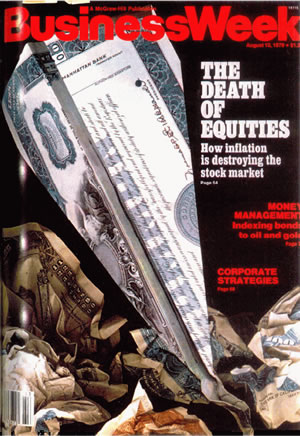
The picture above is the cover of the August 1979 issue of BusinessWeek magazine. In case you can’t make it out, the picture is of a stock certificate folded into a paper airplane that has crashed, surrounded by many other crumpled airplanes. (No Photoshop back then…)

The title of the cover story is “The death of equities: How inflation is destroying the stock market.” I haven’t been able to find the full text of the article noted, but I did find some snippets at TheFiendBear. He notes that the article “was published at a time when the Dow was languishing at 875 and had been trading in a see-saw fashion ever since topping out 6 1/2 years earlier in January of 1973. Inflation was a persistent nag on the economy and the Federal Reserve and US fiscal policies were held in low regard.

Sound familiar? Now here are excerpts from the actual 1979 BusinessWeek article. Here is the summary:

The masses long ago switched from stocks to investments having higher yields and more protection from inflation. Now the pension funds–the market’s last hope–have won permission to quit stocks and bonds for real estate, futures, gold, and even diamonds. The death of equities looks like an almost permanent condition–reversable someday, but not soon.

Pension funds invested in diamonds? Wow. But stocks always beat bonds over long periods, right?

Until now, the flight of institutional money from the financial markets has been merely a trickle. But it could turn into a torrent if this year’s 60% increase in oil prices touches off a deep recession while pushing inflation sky-high. As it is, the nation’s financial markets and its capital flows have been grossly distorted by 13 years of inflation. Before inflation took hold in the late 1960s, the total return on stocks had averaged 9% a year for more than 40 years, while AAA bonds–infinitely safer–rarely paid more than 4%. Today the situation has reversed, with bonds yielding up to 11% and stocks averaging a return of less than 3% throughout the decade.

Still, I thought stocks were a great inflation hedge?

The one rule whose demise did the stock market in could be summed up thus: By buying stocks, investors could beat inflation. Stocks were a reasonable hedge when inflation was low. But they proved helpless against this awesome inflation of the past decade. “People no longer think of stocks as an inflation hedge, and based on experience, that’s a reasonable conclusion for them to have reached,” says Richard Cohn,an associate professor of finance at the University of Illinois. Indeed, since 1968, according to a study by Salomon of Salomon Bros., stocks have appreciated by a disappointing compound annual rate of 3.1%, while the consumer price index has surged by 6.5%. By contrast, gold grew by an incredible 19.4%, diamonds by 11.8%, and single-family housing by 9.6%.

This isn’t to bash BusinessWeek, they were certainly not alone. Of course, since 1979 the U.S. stock market has had an awesome run, and now we are back to many people putting 100% of their portfolios into equities. But I am pretty sure that some time within the next 20-40 years there will be a similar fearful atmosphere. Imagine bonds outperforming stocks by 8% per year, for 10 years. Imagine very smart people, pension funds, moving their money as well.

Imagine this article being written 40 years later (replace 1979 with 2019, late 1960s with late 2000s), after all these crazy Fed cuts, money injections, and high oil prices spike inflation. Just something to consider. Will you still be able to buy and hold? I’d like to envision myself being a pillar of steadiness in that storm. 😀

Why Sports Betting and Stock Picking Are Similar

So how did everyone do in their March Madness pool? In the book Wise Investing Made Simple by Larry Swedroe, there is a great explanation of why stock-picking is very difficult which incorporates sports betting. I’ll try to briefly paraphrase the idea here.

Sports Betting Basics
Let’s stick with college basketball. Earlier this season, Duke played Cornell. If you were simply betting on who was to win beforehand, most people familiar with basketball would pick Duke. Duke has won national championships, has a top-ranked recruiting class, has a famous coach, has better record against stronger opponents.

But, nobody in Vegas or any sports book will take that bet. Instead, you have an adjustment called the point spread. In this case, the spread was 30 points. Now you have to either bet that Duke will beat Cornell by more or less than 30 points. This is much harder.

How was this 30 point spread determined? By the collective opinion of the other gamblers! It is a common misconception that you are betting against the casino. Nope, the point spread constantly moves so that half of all bettors are on either side of the spread. By the time the game is over, the casino doesn’t care who wins. The casinos simply take the bets, pay off the winners, and walk away with their commission. (You have to bet $11 to win $10.) Great deal, huh?

Because of this point spread and commissions, it is very difficult to make consistent money betting on sports. How many professional sports bettors do you know of? A historical study of NBA games showed that the average difference between point spreads and the actual differences in score was less than 1/4 of one point! The collective opinion of gamblers turns out to be very good.

In other words, with the handicap of the point spread, you could bet on Cornell every year and still come out the same as betting on Duke each year. (This year, Duke only won by 13.) When this is true, it is called an efficient market.

Picking Stocks
When people say “buy a company with a strong brand, a wide moat, and good growth prospects”, it is like saying one should just bet on Duke to win. It’s simply not that easy. There is a handicap, but instead of a point spread it is the price of the stock.

A good company will be priced at a premium. For example, people may love eBay, Apple, or Google and think it’s the best business company ever. But at the price you have to pay (the market price), you’re not betting that eBay will be successful, you’re betting if eBay will be more successful than the collective market participants think it will be based on all the information currently available. Again, the data shows that beating this collective prediction is very unlikely.

The argument over whether you can get better risk-adjusted returns from picking individual stocks will probably go on forever. Is it skill? Is it luck? Either way, it is important to know that very few people pull it off over the long term, and I think this analogy illustrates one major reason why. Next time you feel like stock picking, try beating the spread on 10 different sports events first. 🙂

Daydreaming: How Can I Retire In 10 Years?

After months of being stuck in the day-to-day issues of buying a house, moving, and work, I spent a lot of time today… daydreaming! Mainly because I am getting tired of only having 2-3 weeks of vacation per year, I went back to thinking about how early I can achieve financial freedom. Let’s say I really want to retire in 10 years by age 40. What do I need to do?

Part #1: Pay off the house
I’m not saying everyone should buy a house, but I have one and would psychologically love to have it paid off before I retire. For me, housing is by far my largest expense. Using this mortgage payoff calculator, I would need to increase my monthly payments by $2,500 per month to pay off my mortgage in 10 years. For a 20-year payoff, I would need only $600 per month in additional payments.

Part #2: Estimate remaining expenses
Things now simplify greatly. What else do I need to pay for in retirement? This is for two people, kids will increase some items. I will ignore scary things like college tuition. All costs are monthly with some padding.

  1. Food, both groceries and dining out: $600
  2. Communications + Utilities: $350
  3. Gas, not much need if retired: $100
  4. Transportation, amortized cost of one car: $150
  5. Housing maintenance plus property taxes: $350
  6. Clothing, Entertainment, Travel: $250
  7. Healthcare: ???

Total without healthcare: $22,000 per year. Note that this isn’t my barebones spending, this is about what we spend now, and what I’d be happy with indefinitely. Of course, we could do better.

So how much will health insurance cost? This is a huge unknown. We are relatively healthy now, but who knows. Let’s say you get an individual high-deductible health plan for $100/month per person and get cancer (knock on wood). Can the insurer drop you or raise rates? I don’t know the answer, but I’m guessing they can at least raise rates at some point.

It’s possible that within the next decade we will have some form of universal healthcare system. If not, we may need to investigate ways to get on a group plan somehow. I will put in a wild guess of $8,000 per year.

Total with healthcare: $30,000 per year (after-taxes)

Part #3: Set up portfolio to produce this income
Using current tax brackets, we will have to pay very little income tax to achieve an after-tax income of $30,000 per year. For federal taxes, the first ~$18,000 is not taxed at all, and the rest would be taxed at 10% (married filing jointly). That’s an overall tax rate of less than 5%. We have no pensions or other annuities, just maybe Social Security down the road.

(Side note: If I have no other income from sources like pensions or annuities, this means I should lean towards contributing to Traditional IRAs and 401(k)s exclusively right now instead of Roth’s since my tax rate in retirement should be very low – much lower than I might have guessed before.)

Anyhow, if I use a 4% withdrawal rate, I would need $750,000 in today’s dollars. I will start with the $120,000 I have now and estimating returns at 8% annually, with inflation at 3%. Using this savings calculator with a goal of $750,000 in 10 years, I would have to save $3,600 per month for 10 years, or $1100 per month for 20 years.

Bottom Line
I know this is all guesses upon guesses, but here’s what my back-of-the-envelope daydreams give me:

  • To retire in 10 years, I would need $6,100 in excess income every month.
  • To retire in 20 years, I would need $1,700 in excess income every month.

Retiring so early just doesn’t give compound interest enough time to work its magic. It will be tough to integrate all this with our actual goals. But this is still encouraging for me, as I love having even rough numbers in mind to provide something to reach for.