April 2008 Financial Status / Net Worth Update

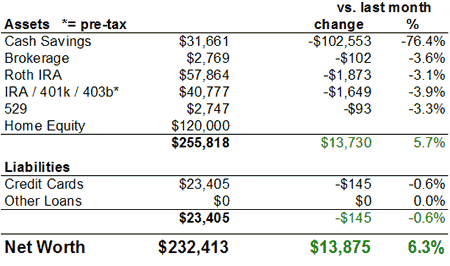
Net Worth Chart April 2008

About My Credit Card Debt
If you’re a new reader, let me first explain my high levels of credit card debt. I’m actually taking money from 0% APR balance transfer offers and instead of spending it, I am placing it in high-yield savings accounts that actually earn me 4% interest or more, and keeping the difference as profit! :D Along with other deals that I blog about, this helps me earn extra side income of thousands of dollars a year. Recently I put together a series of step-by-step posts on how I do this. Please check it out first if you have any questions. This is why, although I have the ability to pay the balances off, I choose not to.

Cash Savings and Emergency Funds
As stated last month, our immediate goal is to replenish our cash savings in order to have at least a 6-month emergency fund. (9-months would be better.) It feels a bit scary not to have a big pile o’ cash right with such a big mortgage to pay. I’m even holding off on my Solo 401k contributions for the time being. However, we decided that we will start funding her 403b plan through a regular monthly withdrawal to reach the max of $15,500 for 2008 (about $1,500 per month). Currently, we are about halfway to this goal.

After the e-fund is created, we plan to start paying down our 2nd “piggyback” mortgage which is at nearly 8% interest. I feel that at 8% interest even with an interest itemized deduction that the payoff is worth it. With US Treasury bond yields so low right now, this also works well into the concept of treating additional mortgage payments as increasing your bonds allocation. Where else can I find a low-risk bond are paying a 8% coupon.

Lazy Home Equity
Previously, I considered a few different ways to track home equity, one of which was using the formula of Home value – Loan balance. My home value is subjective and probably going to decrease. My loan balance will inch up a small bit after each mortgage payment. I’m not too excited about tracking either one, so I’m only going to estimate this once every six months or so. So no change this month. Sound reasonable?

Retirement and Brokerage accounts
Not much action here, I’m boring. Market prices are still slightly down. I need to put together another portfolio update soon.

You can see our previous net worth updates here.
Prosper P2P Lending Update #2: Scary Graph and Stats

I was trying to run some more recent numbers to update my most recent concerns regarding person-to-person loans at Prosper.com. Essentially I was wondering if the loan performance would continually get worse over time. I was curious because it’s one thing to advertise 8-12% returns when the loans are new, but what really matters is the performance at the end of the 3-year term.

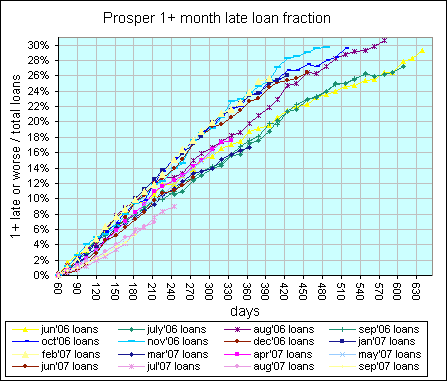
While trying unsuccessfully to churn those numbers, I ran across this related chart from the very analytical Prosper lender Fred93’s blog. The graph is essentially % of loans defaulted vs. loan age. Fred93 explains further:

These charts show statistics for the performance of all prosper.com loans. Each curve represents the set of loans that were created in one calendar month. The vertical axis is the fraction of those loans that have “gone bad”, in other words are 1 month late or worse (up to and including default). The horizontal axis is now days since month of loan origination. All data comes from Prosper.com’s performance web page.

altext

If you look out one year from origination (ie 360 days) you will see that about 20% of Prosper’s loans have gone bad. You can also see that this is remarkably consistent from month to month (ie the different curves). One can only conclude that the default rate of Prosper loans is in the neighborhood of 20% per year. Loans originating after Feb’07 are going bad at a slightly lower rate, probably because Prosper increased the minimum credit score required for a Prosper loan at that time.

I learned also that he makes these conclusions because (1) historically over 85% of Prosper loans that reach 1 month late eventually go into default, and (2) the recovery rate after being sent to collections is terribly low. Together, you have his statement that ~20% of loans go into default each year. For a three-year loan, that ain’t good!

The slope (default rate) does seem to be slightly lower for the newest loans, but what concerns me the most is the constant linear deterioration of loans. This confirms my fear that loan performance consistently gets worse as the loan ages.

Now, I know this chart doesn’t tell the whole story, but I do think P2P lending is still very new and has a lot of growing pains to overcome. For borrowers, it can be a great deal. But as much as I want to be grabbing some solid returns this way, I’m still wary of committing significant money given this information.

(I haven’t found similar numbers for competitor LendingClub yet. They are still young, but they seem to be doing better in defaults so far. I’m waiting for more loan data to accumulate.)

Related P2P Lending Posts

  • $25 Sign-Up Bonus For Lending On Prosper
  • Free Experian Credit Score via Prosper Lending
  • Lending Club P2P Initial Review, $25 Bonus Promotion
  • Update #1: Will Returns Drop As Defaults Increase Over Time?
  • Prosper.com Person-to-Person Lending Review, Part 1: First Looks
  • Prosper.com Person-to-Person Lending Review, Part 2: The Numbers

[Read more…]

Am I A Boring Investor Or What?!

Yesterday I was asked by a foreign news publication some questions about my reactions to the current financial problems in the US markets. As I wrote my responses, I thought to myself “this is so boring that there is no way that it will be published”. I have no juicy stories of hoarding gold, selling all my stocks, or fleeing to ultra-safe bonds. Instead, here are my Ambien-like responses:

What have you been doing to protect your assets since last summer (when sub-prime mess hit financial markets)?

Nothing, really. I keep the same general asset allocation and haven’t sold anything. I already have investments in inflation-protected bonds and broad stock index funds, so I am not worried about short-term losses.

To avoid investing losses, in trading, what kind of financial products (like stock/bonds/REIT and so on..) did you sell? and what did you buy instead? How did you change your asset allocation?

I did not change my asset allocation at all, as I still have a long-term investing horizon.

Have you changed your thoughts about investment under current crisis in financial markets?

No. I did consider adding some commodities for additional inflation protection, but I ultimately decided against it.

Have you been negatively or positively impacted by the current financial crisis?

Negatively, I suppose. Besides the drop in my investment portfolio, my house which I bought recently will probably decrease in value over the next year or two.

Should I Contribute To A Non-Deductible IRA, Part 2: Better Than Regular Taxable Account?

Continued from Part 1: Future Roth IRA Rollover. Now we’ll consider what happens if we don’t convert to a Roth.

To recap, an non-deductible IRA everything is the same as a Traditional IRA except that the initial contribution is not tax-deductible. This means that it grows tax free, but all earnings (dividends + capital gains) are taxed as ordinary income upon withdrawal. The original contribution isn’t taxed again.

This is in contrast to regular taxable account, where you can defer taxes on capital gains until you sell. Currently, if you hold stocks or bonds for at least a year before selling, you’ll be taxed at the long-term capital gains (LTCG) rate of 15% or less. Qualified dividends are taxed when received, but are also currently taxed 15% or less. Non-qualified dividends such as from bonds or REITs are taxed as ordinary income.

So which one’s better? I decided to run a few sample scenarios to find out. Here is the IRA scenario spreadsheet I used, which you can play with as well. I’ll be assuming that current tax rules stay the same when you withdraw, which is almost guaranteed not to be the case, but hopefully we’ll get something out of it.

Assumptions
Initial Balance: $4,000 after-tax
Ordinary income tax rate: 25%
Dividend tax rate: 15%
Time Horizon: Lump-sum withdrawal after 30 years

Scenario #1: Buy-and-Hold With Stock Index Funds
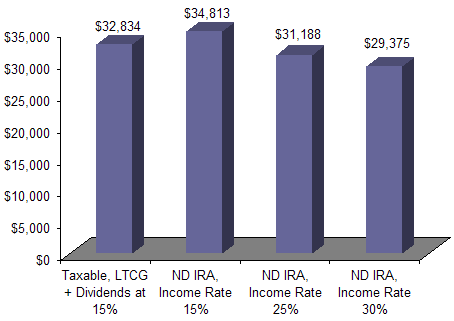
Let’s say you invest in an S&P 500 index fund, with very low turnover. You buy and hold until withdrawal. Total annual return is 8%, with 2% being in dividends each year. With a non-deductible IRA, it keeps growing as gets taxed at the end. After 30 years, you’ll end up with $31,188.

With a taxable account, you’ll get taxed 15% on those dividends every year, but the rest is accumulated as long-term capital gains. Upon selling it and paying 15% on those gains, you end up with $32,834. Taxable wins by $1,646 (5%).

If you lower the ordinary tax rate to 15%, then the non-deductible IRA wins by $1,979 ($34,813 vs. $32,834). If you raise your ordinary tax rate to 30%, then the taxable account wins loses by $3459 ($29,375 vs. $32,834). In general, taxable wins out when your tax rate at withdrawal is about 21%.

altext

Scenario #2: Active Trading With Stocks or Stock Funds
Now if you have lots of buying and selling in your portfolio, then you’ll be subject to short-term capital gains every year. Here, if you assume 100% turnover (holding stocks for just under a year) and you still earn 8% annually, taxable will never win regardless of ordinary tax rates. Even at 9% return in taxable vs. 8% return in IRA. The yearly drag of taxes kills your returns, so you should probably seek the shelter of a IRA if you plan on investing in moderate-to-high turnover funds.

Scenario #3: Buy-and-Hold With Bonds or REIT Funds
Holding a bond fund or REIT (real estate) fund is actually similar to Scenario #2, because most of the earnings from bonds and REITs are due to their interest yield or dividend distributions, and those are taxed at the higher ordinary income rates.

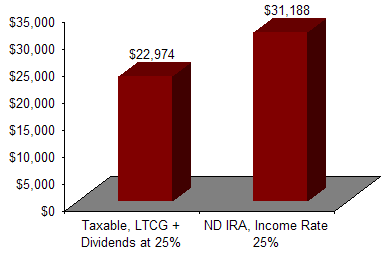
Let’s say you have an REIT fund that also gains 8% annually, and 100% of it’s gains are in the form of unqualified dividends. (REITs have a historical average yield of about 6-8%)

At 25% income tax rates, the taxable account just can’t keep up with an final value of $22,974 vs. $31,188 from the non-deductible IRA. That’s a 35% increase in value by going with the IRA. As income tax rate rises, the IRA’s advantage increases. A similar result occurs for bonds, although the difference is smaller due to lower expected returns.

altext

Liquidity or Early Withdrawal Concerns
A significant advantage of taxable accounts is that you can choose to access, or not access, the funds at any time. With an IRA, with a few exceptions you have to wait until age 59.5 to make a withdrawal without penalties. In addition, you’ll be required to make minimum distributions starting at age 70.5 even if you don’t need to. Some early retirees or those that want to leave a legacy might want to just stick with a taxable account.

Summary
Again, all of these are based on guesses as to what future tax laws will be, but for now my very general summary is:

  • IRAs have less liquidity and more restrictions in general. So if the expected net returns are equal, I’d pick the taxable account.
  • For low-turnover stock portfolios and index funds, the non-deductible IRA might lose out to a taxable account, but not by all that much. As your trading frequency increases, the taxable account gets less and less attractive. On the flip side, a tax-managed mutual fund might make things sway back in favor of the taxable.
  • If you plan on holding any significant amount of REITs, bonds, or other tax-inefficient investments, then a non-deductible IRA can have significant tax advantages over holding them in a taxable account.

Since I do have holdings of bonds and REITs in my portfolio and need all the tax-deferred space I can get, it looks like I’ll be contributing to a non-deductible IRA before the April 15th deadline.

Should I Contribute To A Non-Deductible IRA? Part 1: Future Roth IRA Rollover

As we’ve seen, after you reach a certain income, both Roth IRAs and tax-deductible contributions to Traditional IRAs are no longer available. After you max out your 401(k) or 403(b) plan at $15,500 per year, you start running out of tax-advantaged accounts quickly. One option is to contribute to a Traditional IRA anyways, even though the contribution will not be tax-deductible. Everything else is the same: your money will still grow tax-free, and withdrawals will be taxed at your ordinary income tax rate. You can sock away $4,000 for 2007 and $5,000 for 2008. So should you do it? I have less than three weeks before I need to decide!

There appear to be two primary ways to answer this question:

  1. Future Roth Rollover. In 2010, there will no longer be any income restrictions for Traditional-to-Roth IRA rollovers. Could this mean Roth IRAs for everyone?
  2. Compare Returns vs. Taxable Account. If you either can’t or don’t wish to convert to a Roth, will your performance at least be better than a regular taxable account?

Future Roth IRA Rollover

According to current laws, in 2010 the income restriction for Traditional-to-Roth IRA rollover will disappear. Since you’ve already paid taxes on your non-deductible IRA contributions, you will only have to pay income tax on the earning portion when you rollover. This can be seen as effectively allowing you a way to contribute to a Roth IRA down the road. Now, instead of having to pay ordinary taxes upon withdrawal, I don’t have to pay any taxes! I even avoid required minimum distributions.

Catch #1: The Law May Change
I have seen no indication that this Roth “back door” was intentional. Some people see this as simply an oversight that a busy (or lazy) Congress simply hasn’t gotten around to changing… yet. For example, the current low 15% long-term capital gains rate is also scheduled to go up in 2011. Others think that the lure of tax revenue now gained through Roth conversions might be appealing and they’ll let it stay. Now I’ve waited until the last minute to make my decision and it’s almost mid-2008, and nothing has changed, so maybe it’ll happen…

Catch #2: Mixing Deductible and Non-Deductible Contributions
Let’s say you have $10,000 in a Traditional IRA, $4,000 of which was a non-deductible contribution, and $6,000 of which was deductible contributions and earnings within the IRA. If you wanted to convert $4,000 of it over to a Roth IRA, you can’t simply pick out the non-deductible contribution. The $4,000 would be pro-rated to be 40% non-taxable and 60% taxable, in the same proportions as your total IRA.
The only way to convert all of your non-deductible contributions would be to convert everything together, which might not be ideal.

One way around this is to first roll over your deductible IRA money into another qualified retirement plan like your 401(k) if they allow such transfers (and you like your investment options). Then make your non-deductible IRA contribution. That way, the deductible and non-deductible parts can be separated. I don’t have any deductible IRA funds, but I think I could rollover into my Solo 401(k) if desired.

Catch #3: More Paperwork
If you make non-deductible contributions, conversions, or withdrawals you must document them each year using with IRS Form 8606. It’s probably a good idea to simply file the form every year so that you don’t end up forgetting and having to pay extra taxes later.

In general, I think the Roth conversion option is great if it’s available, but I am still not convinced it will still be around in 2010. So I’d better make sure that’s a non-deductible IRA is still a decent deal even without that option. To be continued in Part 2…

Index Powered CD Review: Stock Performance + Bank Safety?

How would you like to get returns linked to the S&P 500, with no chance of losing a penny? You can with the Index Powered CD, a certificate of deposit being sold by a variety of smaller banks including Brentwood Bank. While the concept has been around for a while, it has been enjoying renewed popularity was people continue watching their 401(k)s shrink. Unfortunately, this is yet another product that uses clever marketing to hide important details from the less vigilant public. Here’s the pitch:

“Enjoy the stock market’s ups and not fret about the downs”!

The Index Powered® CD is a new FDIC insured certificate of deposit tied to Standard & Poor’s 500 Index. The Index Powered® CD was developed with today’s investor in mind and is available exclusively through community institutions. Enjoy the peace of mind of having your principal guaranteed and FDIC insured (up to $100,000.) while offering the potential higher returns of the stock market.

What The Average Person Thinks This Means
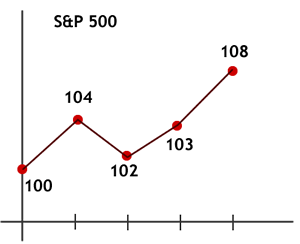
If the S&P 500 goes up a lot, I’ll match that return. If the S&P 500 drops – hey! – I’m FDIC insured so I can’t lose my money. Sign me up!! Let’s say this is a 1-year CD and here are the values of the S&P 500 for that year.

altext

It starts at 100 and ends at 108, so you would expect your CD with a “100% Market Participation Factor” to return… 8%, right? Unfortunately, if you spend the time to read the 17-page disclosure statement, you’ll see that it is not true. To put it bluntly, they manipulate the definitions to their advantage.

What It Really Means!
The problem is that I can say something is “tied to the S&P 500” or “linked to the S&P 500” without actually getting the full return. While they tweak many of the definitions, in particular this sticks out. “Closing Market Value” is defined as “the arithmetic average of the closing values of the S&P 500 Index on the Pricing Dates.” This changes everything. Using the example above again we’ll use the values given:

altext

By their definition, the “closing market value” was 103.4, and your starting value was 100. (Yes, the 100 is included in the average!) So your actual return would be a piddly 3.4%. Not exactly what you expected, huh?

And you know what? The S&P 500 Index they use doesn’t include dividends! That’s another 2% of annual return you’re missing out on.

There is no free lunch here. Not only do you on average less than half of the actual S&P 500 return if it does well, you also risk getting much less interest than a conventional fixed-rate CD if it does poorly. You cannot eliminate downside risk without giving up upside potential. Finally, this is actually a 51-month CD with heavy early-withdrawal penalties.

(For those that like “efficient” portfolios and optimizing risk/reward, here you are essentially taking on added volatility with no increase in expected average return. See my comment below for more details.)

Get your goals straightened out. Either you (1) have a short-term horizon with low risk tolerance and should get a conventional bank CD with a fixed guaranteed rate, or you (2) have a long-term horizon and are willing to accept the risk and full return of a S&P 500 index fund. Even if you don’t want to be 100% S&P 500 index and want less volatility, using a mixture of stocks and bonds would be the a much more cost-effective way of achieving this.

Again, I’ll avoid the word “scam” because this is technically a legal product, but the best weapon against such products is education. Know what you are buying and tell others!

Bear Stearns Meltdown Timeline

I usually don’t pay attention to short-term market moves, but I just can’t take my eyes off of this Bear Stearns train wreck! The recent timeline is almost amusing (assuming you don’t hold BSC shares…):

January 12th, 2007
Share price was $171.51.

March 10th, 2008 – Monday
Closed at $62.30 per share. From Bear Stearns CEO via Bloomberg:

“Bear Stearns’s balance sheet, liquidity and capital remain strong,” Chief Executive Officer Alan Schwartz said in the company’s statement. Alan Greenberg, the former Bear Stearns chief executive officer and current board member, told CNBC that the liquidity rumors were “totally ridiculous.”

March 11th, 2008 – Tuesday
From Jim Cramer via CNBC’s Mad Money:

Dear Jim: Should I be worried about Bear Stearns in terms of liquidity and get my money out of there? -Peter

Cramer says: “No! No! No! Bear Stearns is not in trouble. If anything, they’re more likely to be taken over. Don’t move your money from Bear.”

March 14th, 2008 – Friday
Closes at $30 per share. Federal Reserve gives emergency loan to Bear Stearns. CEO Schwartz clarifies earlier statement:

“Our liquidity position in the last 24 hours had significantly deteriorated. We took this important step to restore confidence in us in the marketplace, strengthen our liquidity and allow us to continue normal operations.”

March 16th, 2008 – Sunday
JP Morgan agrees to acquire Bear Stearns via a share exchange for the equivalent of $2 per share. The money for this is provided by the Federal Reserve Bank, which agreed to cover any potential losses if the loan defaults. Huh? How come I don’t get no-lose deals like this?

Now What?
Will this help contribute to a full 1% drop in the Fed Funds rate on Tuesday as is expected by the futures market? If so, it may be a good time to lock in some bank CD rates today. As for me, I’m going to have to re-read all those articles on why timing the market is bad. 😉

A Rough Start For New Investors In 2008

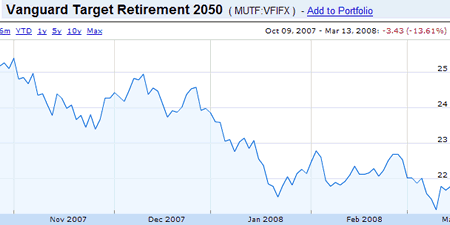
I received another reader e-mail whose question was very similar to this worried young investor’s question from back in November. Essentially they still wanted to know my opinion in this bleak market and if there is something they should do. I can’t blame them for asking. Although I was in the buy-and-hold camp, here’s the chart for the Vanguard 2050 Retirement Fund (VFIFX) from November 2007 until now:

altext

In addition to my suggestions in that post, I also wanted to add that I can empathize with their situation. My very first Roth IRA was only partially funded with $1,000 because that’s all the money I could spare at the time. I then proceeded to buy shares of Janus Mercury, recommended by various publications and rated 5 out of 5 stars by Morningstar at the time. How could I lose? This was around 2001-2002. It tanked. Although I didn’t sell that year mainly because I didn’t know what else to buy, the next year I was certainly not interested in making any more IRA contributions!

Looking back, I would say starting out involves a good dose of luck. Let’s say 60% of new investors are up during their first year. For these lucky folks, they have a bit of “house money” to cushion any future losses. They have a positive vibe, and are more likely to keep their portfolios constant and make a habit of contributing regularly.

But what about the other theoretical 40% of new investors? They start losing money in their very first year. The media is now showing nonstop stories of foreclosures, rising inflation, weak dollars, poor job reports. Beginning investors are not used these drops. In their eyes, it took them months if not years to save up enough money in a nice, safe bank account before finally opening a Roth IRA. Then in a few months nearly $1,000 (20%) of it might have already disappeared! Worst case, they might be turned off from stocks for years. I’m no expert, so I can only reiterate the importance of time horizon when investing.

I’d like to hear how other people remember their very first year investing. Was it a good year for you? Bad? How did you react?

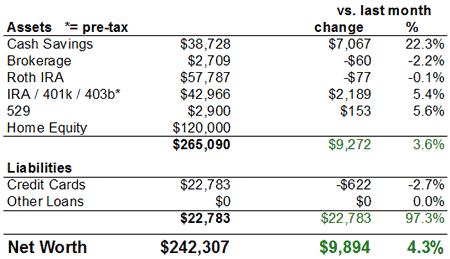
March 2008 Financial Status / Net Worth Update

Net Worth Chart March 2008

“Good” Credit Card Debt
If you’re a new reader, you may have some concerns about my high levels of credit card debt. I’m actually taking money from 0% APR balance transfer offers and instead of spending it, I am placing it in high-yield savings accounts that actually earn me 4% interest or more, and keeping the difference as profit! :D Along with other deals that I blog about, this helps me earn extra side income of thousands of dollars a year. Recently I put together a series of step-by-step posts on how I do this. Please check it out first if you have any questions. This is why, although I have the ability to pay the balances off, I choose not to.

Cash Savings, Home Purchase
If my posting has been a bit light lately, it has been because I’ve been bogged down by a combination of illness, travel, and the home-buying process. Also, I didn’t want to do it in real-time because there were some snags along the way… but we’ve finally closed!! I have lots of house-related posts coming about mortgages, inspections, and so on… but first here are a few details that will help explain this net worth update.

Purchase price $600,000
Down payment (20%) $120,000
Discount points paid (1%) $6,000
Buyer’s agent rebate (1.5%) $9,000
Closing Costs ~$3,000 (rest paid by lender)

Our purchase price of $600,000 was more than the $500,000 we estimated we wanted to spend a couple years ago, but we are now in a 4-bedroom single-family home that we can see ourselves living in forever. In addition, we didn’t stretch too far as we can handle the mortgage payment on either one of our incomes.

We believe we got a good deal even though the short-term market looks bad, and the house has tons of potential. We’re even going to rent out a room to a relative. Our home appraisal actually came in at $640,000 – we’ve been told an appraisal coming in higher than purchase price doesn’t happen very much in this scared housing market. Using this value would actually leave our home equity at $160,000 instead of just the down payment of $120,000. However, I’m just going to be conservative and leave it at $120,000 for now.

As you can see, our 50% buyer’s agent rebate helped offset our closing costs and the points on the loan. Of course, mentally we are using the $9,000 rebate towards all the home improvement projects we have brewing. 😉 Finally, adding back in the $5,000 earnest deposit that I had marked as spent last month makes the numbers look a lot better than they really were.

Emergency Fund?
Our net cash balances have taken a big hit to less than $10,000, and that makes me nervous given that our monthly expenses just shot up drastically. Our foreseeable mid-term goal will definitely need to be to build up a proper emergency fund, which we’ve never officially had since we basically treated our downpayment funds as such. Visiting Brazil and Australia will have to be placed on the backburners for now…

Retirement and Brokerage accounts
February is the fourth month is a row that our IRAs and 401k/403bs have dropped by 3%. We may need to start setting up some regular monthly investments in order to help force ourselves to keep investing.

It’s been a wild month! You can see our previous net worth updates here.

FISN Bank CDs Paying Over 8% Interest: Being FDIC-Insured Isn’t Enough

I’ve already written about Millennium Bank – the offshore bank offering 8% certificates of deposit that are not FDIC-Insured, let alone highly regulated. More recently, a group called the Federally Insured Savings Network (FISN) has been advertising FDIC-insured Certificates of Deposit Paying Over 8%”. What’s the deal?

It definitely looks too good to be true, but let’s look at the fine print and see what we can find. I’ll just focus on the highlighted CDs paying a 8% and 8.25% APR to save some time.

These Are Long-Term Investments With Very Limited Liquidity
The maximum terms for these CDs are for 15 or 20 years! If you wish to withdraw early, you can be sure it will be with a fat penalty. However, it may not even be possible to re-sell them at all. From the disclosure: “Lack of Liquidity. The CDs will not be listed on an organized securities exchange. JPMSI may offer to purchase the CDs upon terms and conditions acceptable to it, but is not required to do so.” This could be worse than even taking money out of your IRA or 401(k).

High Minimum Investments
In this case, you need $25,000 to invest with FISN as your broker to JPMorgan Chase Bank.

They Are Callable, And That’s Not Good
A callable CD means that the bank can say “I found a better deal elsewhere, so I no longer want to pay you this much interest anymore. Bye!” You’ll get your principal plus interest earned up to that point, but this usually happens when interest rates fall, leaving you stuck with alternative paying a lot less than you were getting before.

On the other hand, you the depositor have no such flexibility. You’re still stuck for as long as the bank wishes. Again – up to 20 years! Put another way: Heads, the bank wins; Tails, you lose.

Not A Fixed Rate CD – 8% Rate Isn’t Guaranteed
When talking about a bank CD, you’re usually referring to a fixed rate CD. However with this investment, you may or may not get paid any interest based on the following criteria:

Interest is paid quarterly for every day the 30Yr Constant Maturity Swap (CMS) Rate is greater than the 10Yr Constant Maturity Swap Rate (Positive Yield Curve). If the 10Yr CMS Rate is greater than the 30Yr CMS Rate on any day (Negative Yield Curve) no interest is accrued for that day. Full 8.00% rate guaranteed for first year.

Trying to figure out exactly what CMS rates were made my head hurt. But very generally, if the long-term interest rates are higher than short-term interest rates (positive yield curve) you’ll get paid your fraction of 8% annual interest that day. However, if the curve goes negative, which it has for extended periods in the last few years, you don’t get paid any interest that day. So 8% is basically a best-case scenario. Over a 15-year period, I highly doubt you’ll be getting the full 8% each year. Earning 0% is the worst-case scenario.

I’m Not Interested
So yes, technically these are FDIC-insured to the extent that your principal is safe. But your money could be stuck sitting around earning nothing while inflation eats away at the actual value. And the bank will only keep paying the interest if it remains profitable for them. These seem to be sophisticated investments being marketed at the unsophisticated public. Buyer beware!

$100 Bonus from Suze Orman and TD Ameritrade

While skimming my new Suze Orman eBook, I ran across her SaveYourself promotion that I blogged about almost a year ago, but is still going on for a little while longer.

You can get a $100 bonus after one year (expired) if you open an account at Ameritrade by March 31, 2008 and set up an automatic deposit of at least $50 per month for 12 consecutive months. This deal isn’t bad as a mandatory cash savings vehicle if you don’t need to withdraw the money. They even offer a special money market rate much higher than their usual piddly 0.05% rate:

Get started on Suze’s Save Yourself Plan by opening a new account with TD AMERITRADE, featuring a special high-yield deposit account with a 2.78% Annual Percentage Yield (as of February 1, 2008). Your cash is held in an FDIC-insured Money Market Deposit Account (MMDA) at TD Bank USA, N.A.

There are no maintenance fees on the account, plus you receive the $100 offer for making 12 monthly automatic deposits of at least $50 each to help you build up your account balance. […] Should you need to withdraw the money prior to the twelve-month commitment, you may withdraw all of your deposits, plus the interest earned. However, you will forfeit the $100 bonus.

Doing the math
Looked at one way, if you just put in the minimum $50 in each month, at the end of a year you will effectively have earned 35% interest on your money. If you are truly starting out on a savings plan, this is a pretty nice guaranteed return. $50 a month isn’t too painful, and at the end of the year you’ll end up with over $700 tucked away for your emergency fund, Roth IRA contribution, or whatever. It’s a good incentive to get in the habit of saving.

Alternatively, if you’re already saving all you want in high-yield savings accounts, you’ll still be ahead by about $90 in extra interest.

I wouldn’t necessarily stay and invest with TD Ameritrade, though. They are alright, but at $10 per trade with potentially small balances, here are a few alternatives that I suggest exploring. Note that TD Ameritrade has a $75 fee for transferring out your account directly to another broker. Keep your money in cash, and then simply withdraw it and close your account with no fee when you wish to leave.

Missing 1099 Form? Why They’re Late From Zecco, Fidelity, Vanguard, and More

It’s mid-February. Some of you early-birds may be wondering where some of your 1099s are by now. By law, they are usually required be sent out by January 31st. However, many brokerages have asked the IRS for a 30-day extension, and they have been granted rather willingly. This includes or has included everyone from small companies like Zecco to big names like Morgan Stanley, Vanguard, and Fidelity.

One big reason for the extension requests is that many mutual funds, ETFs, and closed-end funds have to rely on information provided by all the smaller companies in which they have owned shares. If a company catches an error later on, the correction has to be passed onto the fund company, compiled, and then finally submitted to the brokerage firm. According to this Kiplinger article, more than 13% of 1099s issued in 2006 had to be corrected.

Last year, Ameritrade sent me two revised 1099s. In 2006, I had to file a 1040X amended return because of a similar situation. Waiting a couple of weeks is worth it to me if it means they get it right the first time. Many firms only use a few days of the extension, while other play it more safely.