More Roth vs. Traditional 401k/IRA Data: Historical Marginal Tax Rates vs. Median Income

In my Roth or Traditional 401k decision process, I chose the Roth for the rest of this year. This essentially means that I’d rather pay up to 28% of tax right now on my contribution rather than pay whatever the going rate will be 30+ years from now. But why? I’m have relatively high income right now – Shouldn’t my income in retirement be less if I really want to be a beach bum? Probably, but here’s why I think 28% is still a pretty good deal based on history…

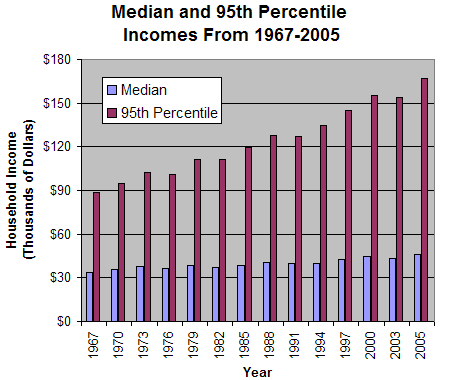
Having to guess what tax rates will be 40 years into the future is a daunting task! So let’s start by looking 40 years in the past. From 1967 to 2005, I found the both the median household income and the 95th percentile income from the U.S. Census Bureau. I chose these to roughly represent “middle” and “high” income levels.
altext

As you can see, both grow with time. (Yes, the gap between them is increasing. Let’s sidestep that hot potato right now.)

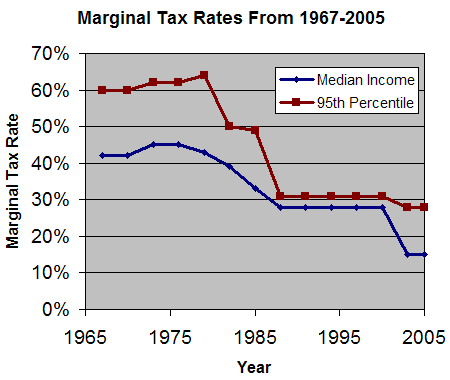
Next, I found the corresponding marginal tax rates that such incomes would have paid each year. Since we are looking at households, I used the tax information for the Married Filing Jointly status as an approximation. I ignored things like standard or itemized tax deductions across the board to keep it simple. With this information, we can roughly see how the marginal tax rates have changed over time, while still adjusting for the gradual increase in incomes:
altext

Results and Conclusions
We are currently experiencing some of the lowest marginal tax rates in recent history. The average marginal tax rate for a median, or “middle income”, household from 1967 to 2005 was 33%. The average marginal tax rate for a “high income” household was 44%. Today, we are only at at 15% and 28%, respectively. Assuming that today’s tax rates will continue on for the next 20, 30, 40 years may not be the best idea.

Will they get even lower? Or even flatten out? I don’t think so. Considering the historical rates we say above, and combining that with our continuing government deficits and the prospect of a nationalized health care system, I personally find it unlikely that in 2047 my marginal tax rate will be lower than 28%, even at median income levels. What do you think?

To be sure, this is a very simplified analysis. I am not even looking at total tax rates, just marginal ones for the express purpose of directing my IRA and 401k contributions. If you know of a better study done elsewhere that I missed, please do share.

Choosing Between the Roth or Traditional 403b / 401k : Our Decision Process

My wife now has the new option of contributing to Roth 403b plan with her new position, and we had to make a decision on whether or not to go with it. Here is our thinking process, which should also apply to Roth 401ks.

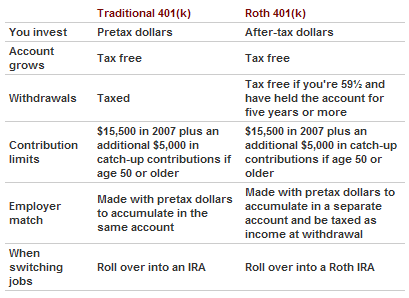
I found a few good articles online, including Is the Roth 401(k) Right for You? by Emily Brandon at US News, and Choosing Between Traditional and Roth 401(k)s from Yahoo Finance. Here is a nice table outlining the major differences:

altext

As my last video post outlined, the main difference between a Roth 401k and a Traditional 401k is when you pay the taxes. With the Traditional, you get to defer your income taxes now, but you must pay taxes up on withdrawal. With the Roth, you pay tax now, but you don’t own any taxes upon withdrawal.

So the first question is – when do you want to pay the taxes? Obviously this takes a bit of guessing as who know what tax rates will be in the future. You can also try and look at the 2007 tax brackets for a little guidance. Historically, I believe our tax rates are actually on the low side. If your income is relatively low now compared to what you think you’ll make when withdrawing, you should lean towards the Roth. If you expect an especially high income this year, it may be better to go Traditional. Be sure to take into any big tax deductions that you might have now but not in retirement (think mortgages and child credits). If you think it will be the same, I think you’ll see below that the Roth tends to win any tie-breakers.

(There are also those that think Roth accounts will be double-taxed in the future, so you might as well get the tax break now.)

Before, when our incomes were lower, it was an easy choice to go with the Roth. Now, we may get bumped into the 33% bracket. I doubt we’ll be making this much in retirement, I just don’t plan on saving up long enough to generate that much income. But I have a suspicion that tax rates will also be higher later. And I haven’t even considered possible AMT consequences.

The Roth has “bigger” contribution limits. Sure, the official employee contribution limit for both of them is $15,500 for 2007, but you can see that $100 in post-tax contributions requires a bigger out-of-pocket sacrifice than $100 of pre-tax money. This means that maxing out a Roth effectively allows you to defer taxes on more money. Since we aren’t eligible for a Roth IRA anymore, perhaps we should take advantage of this additional opportunity.

Matching works the same either way. Employer matches can only go in your Traditional 401(k) pool of funds, so we don’t have to worry about this here.

Roth 401(k)s get rolled over into Roth IRAs, which don’t have Required Minimum Distributions (RMDs) and other attractive estate features. I like the idea being able to delay withdrawing any money until I want to, which I can’t do with a Traditional 401(k). I’m not really concerned with inheritance stuff right now.

Final Decision? I still need to look into AMT effects, but for now I think we will be going with the Roth. Here is our plan: I want to max out my Traditional 401k this year in order to lower our taxable income and keep us in the 28% marginal bracket. Then, I think we can take full advantage of the Roth 403(b) on my wife’s side. This also gives us some diversification between accounts – If we have a high-tax year in retirement, we can withdraw Roth funds. If we have a low-tax year, we can withdraw and pay tax on Traditional funds. Did I miss anything?

Video Post: Basics of Comparing Investing in a Roth 401k vs. a Traditional 401k

I just made my first video blog post which covers part of choosing between a Traditional and a Roth-type of retirement account, be it IRA, 401(k), or 403(b). I’ve covered this topic before, but I wanted to start out with something that I get asked often and also can benefit from the additional information available from a video format.

There are a couple of reasons why I decided to do this:

  1. No Credit Needed made his own first video about the Envelope System of budgeting. I thought it was a good way to explain the concept.
  2. At the same time, my father said that my blog should be more interactive (read: it was dull). When your own father says your blog isn’t cool enough, you know you have to do something!

I don’t think my servers can handle the bandwidth, so I had to throw it up on YouTube. Hopefully it’s not too blurry. It’s certainly a lot more work making a video than typing, so please let me know what you think.

Bogle On Credit Troubles, Market Timing, And More

Via the Diehards forum, Businessweek recently posted an interview with John Bogle which covers many of the questions that people are asking about investing right now. As usual, he provides a balanced and big-picture perspective on things. I recommend reading through the whole thing, but here are some excerpts:

[…] if I was going to give advice to an individual investor?and I make a very important distinction here?if they have come into this market and have invested the way people should invest, and that means they have a little bond position if they’re young, and an average bond position if they’re in their middle years, and a substantial bond position in their retirement years, then I would do absolutely nothing. They will be protected by the fact that bonds are going up and bonds generate income. No one will take that income from them. They should just hang in there and do nothing.

Even if I was pretty confident that the decline will continue?and I think it’s more likely than not?you’ve not only got to get out right, you’ve also got to get in right. You must be right twice.
So if you get out now, and the market goes way down another 15 or 20%, which is quite possible, they will be so scared they won’t get in.

[…] It’s not a good idea to time the market. In the long run, investing is not about markets at all. Investing is about enjoying the returns earned by businesses. And the stock market is nothing but a giant distraction in that quest to acquire returns that business earns. It overmagnifies everything. Investors get scared. Their advisors get scared. And you get exactly what we’re having?a bit of a mess.

Money Magazine Can’t Time The Market, But Doesn’t Give Up

Like many people, I like reading personal finance magazines and subscribe to many of them. But you have to remember that in order to sell magazines, they also have to give people what they want, even if it isn’t sound advice. A great example of this is the recent Money magazine article titled 5 ways to know if the bull is over. The introduction reads:
Since Money Magazine last examined the health of the bull market (and pronounced it sound), consumer spending began slowing, several prominent buyout deals unraveled, and oh yeah – concerns about subprime mortgage loans going bad caused stocks to fall off a cliff.

After closing above 14,000 for the first time in late July, the Dow has since plunged nearly 1400 points, or 9.8 percent, close to an official correction. The S&P 500 has given up all of its gains for the year.

All this has added a certain cogency to the view that the five-year-old bull could be closer to the end of its road. So while you know better than to try to time the market – and you do, don’t you? – now is a good moment to check that your portfolio truly matches your appetite for risk.

In the meantime, keep an eye out for five signs that often precede a sharp turn ahead.

Now, let’s place this text through my patent-pending Financial Double-Talk Filter, and try reading it again:

We said the bull market would continue for a long time. We wrote entire articles just like this about it. We were wrong.

Yep. Wrong.

Remember, you shouldn’t try to time the market. Wait, what is that? You’re scared?

In that case, here are some ways to try and time the market!

Sigh. Did you see how smoothly they covered up their mistakes and moved on to the next hot topic? If everyone decided to hang themselves, I bet you’d see articles on how to get the best deal on rope!

(If you liked this, you might also enjoy my Anatomy of a Personal Finance Magazine Article.)

Stock Markets Got You Stressed? Here’s A Calming Chart For You

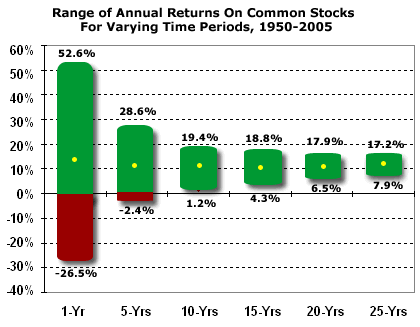
I don’t do market predictions, but I wanted to keep some things in perspective. In the most recent edition of A Random Walk Down Wall Street, there is an updated version of a chart which I have used before to show how important time horizon is to reducing your projected risk. I have replicated it below:

altext

The fact that the variability in returns decreases the longer one stays in the market is very encouraging news for the long-term investor. But it is critical to remember that this data assumes you buy and hold a diversified portfolio. If you buy or sell stocks based on fear or hype, all bets are off.

Are The Markets Especially Volatile This Year?

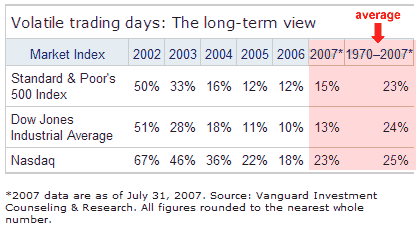
Although it may feel like the markets are just bouncing around like crazy this year, Vanguard shares some data that shows that the markets are actually performing in line with history.

A common definition of volatile day is one where the market index moves at least 1% up or down. For example, yesterday all three major market indexes dropped between 1.3 and 1.6%, and it was considered a “pounding”. But, as you can see in the chart below, historically about a quarter of all days are volatile.

altext

In the past few years, we’ve been spoiled by a period of relatively low volatility, and now we’re simply reverting back towards the mean. It’s all part of owning stocks, and I don’t see any reason to make any changes if you already have a long-term plan.

Model Portfolio #8: Ben Stein and Your Money

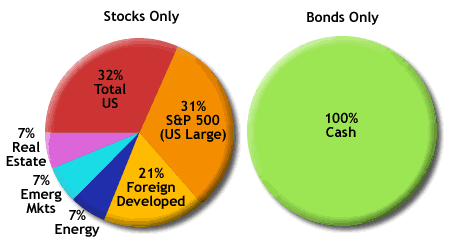
Next up is a model portfolio by actor and personal finance columnist Ben Stein. I have read and reviewed two books he wrote with Phil DeMuth – Yes, You Can Still Retire Comfortably! and Yes, You Can Time The Market!. I actually ran across this information last week while waiting at a Barnes and Noble for my companions to finish shopping. I wrote down that it was in Forbes magazine, but I found the article online under Fortune. Either way, here it is:

Ben Stein Model Portfolio

Ben

Asset Allocation For 80% Stocks/20% Bonds (with ETF examples)
25% Total US Stock Market (VTI, IYY)
25% S&P 500 Index (IVV, SPY)
15% Foreign Developed Equity (EFA, VEA)
5% Emerging Markets (VWO, EEM)
5% Real Estate (VNQ, ICF)
20% Cash

Commentary
On the equity side, I guess he’s leaning towards only having about 15% of the domestic equity portion being Small/Mid Cap stocks, since about 70% of the Total US Stock Market index is made up of the S&P 500 anyways. His exposure to Real Estate is very small, especially compared to the Swensen portfolio we just looked at. He does add a specific allocation to Energy sector stocks to the mix, which you don’t always see.

On the fixed-income side, Stein doesn’t recommend any type of bond, corporate or not. He thinks long-term bonds are too risky, while short-term bonds don’t offer enough yield to warrant not just holding cash instead. I’m not sure if this is solely due to the current flat interest rate curve. This may also be because he seems to take the view that your emergency fund cash should be included in your asset allocation. (I like to keep it separate.)

See here for other model portfolios from respected sources, part of my incomplete Rough Guide to Investing.

Model Portfolio #7: Unconventional Success by David Swensen

This model portfolio is taken from Unconventional Success by David Swensen. As mentioned before, Swensen is not a personal financial advisor, but is a respected institutional money manager who currently runs the Yale Endowment. In his book for individual investors, he writes that there are only a limited number of core asset classes in which one should invest in. Although he avoids giving specific asset allocation guidance, he does provide an “outline of a well-diversified, equity-oriented portfolio”, which is shown below.

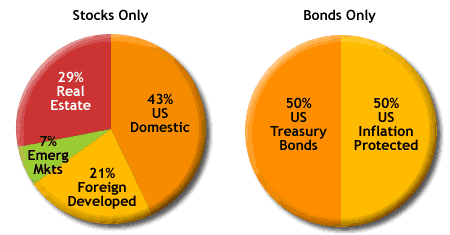
Unconventional Success Model Portfolio Breakdown (Hurrah, I found my software disks so I can make pretty pie charts again!)

Asset Allocation For 70% Stocks/30% Bonds (with ETF examples)
30% Domestic Equity (VTI, IYY)
15% Foreign Developed Equity (EFA, VEA)
5% Emerging Markets (VWO, EEM)
20% Real Estate (VNQ, ICF)
15% U.S. Treasury Bonds (SHY, IEF)
15% Inflation-Protected Securities (TIP)

Commentary
There is a healthy portion devoted to real estate in the portfolio. The common way to track this asset class with REITs, which are considered a domestic stock. Instead of taking up less than 5% of the US stock market by capitalization, it is now taking up more than 40% of the domestic equity portion. I’m not really sure why there is so much, although he does write that if you own your home or other real estate, you may want to reduce your REIT exposure.

In addition, corporate and mortgage-backed bonds are left out, following his opinion that they aren’t the most desirable asset classes for individual portfolios due to added call risk and credit risk. (If you’ve been keeping up with the markets recently, it seems he may have been on to something here.)

As with all the model portfolios, the idea here isn’t just to follow any of them blindly. I do think it helps to see where different experts have similar components to their model portfolios, and where they differ. I also like breaking it down this way into pie charts of stocks-only and bonds-only in order to visualize them better.

See here for other model portfolios from respected sources, part of my incomplete Rough Guide to Investing.

How Do I Compare The Interest Rates and Yields Between Money Market Funds and Savings Accounts?

An alternative to high-yield bank savings accounts are money market funds held in brokerage accounts. Although both money market funds and savings accounts can change their interest rates paid at any time, comparing their actual returns can be confusing.

Comparing Returns
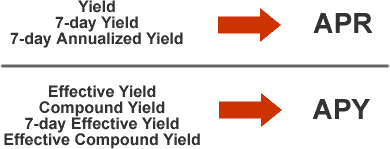
Money market funds usually report their 7-day annualized yield (also listed as just yield, or 7-day yield), which takes the interest paid net of expenses for the last 7 days and assumes that this average continues over an entire year. Compounding is not taken into account, so the 7-day yield should be compared to a bank account’s annual percentage rate (APR).

Some funds also list the 7-day effective yield (also listed as compound yield), which does take into account compounding via the reinvesting of dividends. So the 7-day effective yield should be compared to annual percentage yield (APY).

altext

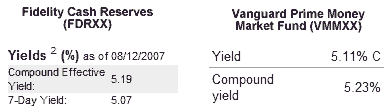
Here are two examples from Fidelity and Vanguard where they list both. In this case the Fidelity fund would be comparable to a bank account earning 5.07% APR or 5.19% APY.

altext

Since banks usually advertise APY, you can convert if needed using this APY to APR calculator. Keep in mind that since these are moving 7-day averages, the numbers given will change from week to week.

Other Types of Money Market Funds
The above comparison is meant for the most common “taxable” money market funds, which are taxalbe on both federal and state levels just like a bank’s savings account. In addition to these, there are a variety of specific types of funds like Treasury funds (exempt from state income tax) and municipal tax-exempt funds (exempt from federal income tax), and state-specific municipal funds (exempt from both fed and state taxes) that offer special tax consideration.

In this case, you can use a tax-equivalent yield calculator to complete the comparison.

But Is The Risk The Same?
While not eligible to be FDIC-insured as they are not banks, money market funds do have to follow strict guidelines as to maintain the highest credit quality and lowest volatility of the underlying investments. The share is always kept at $1. Due to the recent concerns with mortgage-backed bonds, Fool.com recently asked Is Your Money Market Fund Safe? In my opinion, the risk is a definitely higher than a bank account, but if you hold your money market funds from a respected firm like Vanguard or Fidelity, I would sleep just as soundly, as these companies would repay the funds with their own assets rather than let them falter.

There are also other practical differences between specific banks and specific money market funds, which I am ignoring here.

TradeKing Review: $4.95 Online Stock Broker

By request, I’m posting a review of my opinions experiences with online discount broker TradeKing. I’ve actually had an account with them for over a year now. This will be done from the perspective of a buy-and-hold investor in stocks and ETFs, not an active trader.

Commission and Fee Schedule Overview
TradeKing offers $4.95 stocks trades across the board – market or limit, online or broker-assisted. $4.95 isn’t as low as it used to be, with brokers like Zecco.com offering free trades now, but it’s still much cheaper than the big discount brokers like E-Trade or TD Ameritrade for non-active traders. They also offer options for $0.65 per contract, also a competitive price.

There are no minimum opening balances, and also no maintenance or inactivity fees to worry about. (You need $2000 to open a margin account.) There are no annual maintenance fees for IRAs, but to transfer out or terminate one costs $50. Electronic statements are free, but paper statements cost $2.50 each.

Opening Process
The application seemed pretty standard, including having to sign off on all those long disclosures. It was all online and I did not have to mail anything in.

One thing to note is that if you want to fund your account via an online bank transfer, you’ll have to be very patient. After you provide them with the account and routing numbers, they require 5 business days to verify it. Then, every online transfer (max $10,000) takes 5 business days to complete. So if you choose this option like I did, you’re looking at two weeks minimum before you’ll be ready to trade. The quickest way to start is to perform a wire transfer into your new account.

Trading Interface
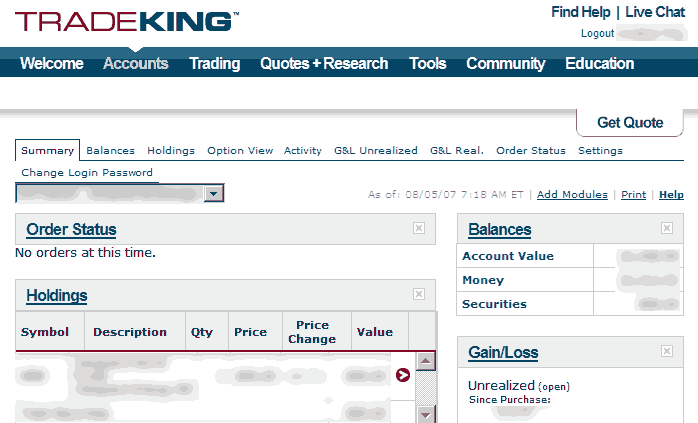
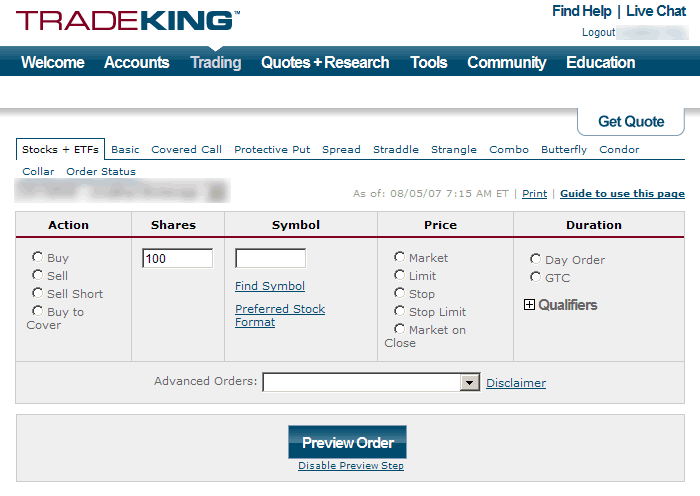
My first impression of the account several months ago was that the interface was a bit sluggish. But recently, the response time has been great and overall I like the interface. Here are some screenshots of the Account Summary and the Trading screen:

They offer trailing stops and contingent orders based on price triggers, as well as complex options trades like spread, straddle, strangle, combo, butterfly, collar, and condor.

Customer Service. They are actually very responsive on the customer service side. I can usually get someone on Live Chat within 5 minutes, and they are faster to pick up the phone than my previous calls to Ameritrade and E-Trade. I can’t speak as to how they handle complex questions, as I haven’t been faced with any real problems yet.

Dividend Reinvestment. They offer free automatic dividend reinvestment, with the ability to purchase fractional shares. This can be set for all your stock holdings, or just specific ones. This is nice if you have ETFs and you want to reinvest dividends like you used to with mutual funds.

Money Market Sweep.
By default, only 1% interest is paid on cash balances. You can sign up for one of three money market sweep accounts (taxable, tax-exempt, treasury), with the taxable option is currently paying 4.22% and is FDIC-insured. I highly recommend signing up for this right away, it takes just a second to send them an e-mail message and you’re all set. No forms to fax or mail in.

Long Transfer Times. Again, ACH deposits are subject to a trading hold of 5 business days, and also cannot be withdrawn for 10 business days. This can be a pain if you have a hot idea and want to make a trade fast, so I would keep whatever money you want to invest in the money market sweep above.

Awards. TradeKing has many of their awards on their site, including getting ranking #1 in Customer Service from SmartMoney magazine in 2010.

Sign-up Bonuses. For new customers they will reimburse ACAT transfer fees charged by your existing broker up to $150 when moving your account over to TradeKing.

I hope this helps people make a decision! I like TradeKing, but it’s very hard to simply call any broker “the best” or “the worst” as everyone has different trading levels and preferences. What one person deems a critical feature, another cares nothing about.

More Broker Reviews
Scottrade Review – $7 Trades
Zecco Trading Review – 10 Free Trades/Month

TheStreet.com Gives Horrible Financial Advice To Young People

I know there is plenty of bad advice out there, but this one just caused me physical pain. Mr. Cliff Mason impressively gained the status of Staff Reporter at TheStreet.com fresh out of college (did I mention his uncle is Jim “Mad Money” Cramer?). He hits the ground running with his recent article Young Ones, Go Forth and Speculate, where he bashes veteran Wall Street Journal reporter Jonathan Clements and proceeds to share some of his vast financial knowledge with us.

Pearl of Wisdom #1:

I believe that saving money is at best nonessential for the under-30 cohort, and that people my age will generally get more from spending their money than from buying stocks or bonds.

Pearl of Wisdom #2:

Buy small-cap stocks that trade under $10, have little analyst coverage and a reason to go higher. In a word: Speculate. […] With maybe $2,000 to invest a year, you won’t make serious money in the market unless you take enormous risks. It’s much more likely that you’ll get wiped out, but since you won’t have a lot of money on the line, it’s a worthwhile risk.

Wait, there’s more! You must see Mr. Mason in person in this TheStreet.com video showing off his brand new iPhone. Why did he buy this phone? “Well, I wasn’t doing anything… and I had money to burn… it is a babe magnet…” What about his current plan? “I have an old Verizon line that my dad still pays for [the iPhone is AT&T-only] … I should tell him about that…”

Hmm… sure sounds like someone I should listen to for financial advice!

I found this article via the Diehards Forum, where author Taylor Larimore submits his succinct reply:

If a young investor age 25 invests $4,000/year @ 10%, at age 65 he/she will have $1,947,407.

If a gambler waits until age 35 (and loses), he/she will have $733,774–less than half.

Investing for retirement should not be a gamble.

My response? As a 20-something who tries hard every day to balance enjoying life now, buying a house, and funding my own retirement someday, I’m a bit offended by his flippant views on saving.

I don’t really care what Mr. Mason does with his money. But to tell others to just gamble it away because it’s “not that much”? Being 25 and actually having $2,000 saved up is not something to be dismissed. Not only can you take advantage of the wonder of compound interest, but look at how risk decreases as your time horizon increases when properly diversified. Why increase your risk needlessly when you could be decreasing it?

Okay, maybe I’m being too harsh. When you’re young, you should take risks. Go into debt to pay for college or graduate school, work at a start-up company or at a non-profit that you love, or even start your own business. Take chances with money that can really reap huge rewards!