
Fidelity Self-Employed 401k Account Review

I’ve mentioned several times I have a Self-Employed 401k account. It’s a somewhat unique thing, so here’s a little bit more about it.

What’s a Self-Employed 401(k) and who’s eligible?
A Self-Employed 401(k) is a tax-advantaged 401(k) retirement account that is available to self-employed individuals or business owners with no employees other than a spouse, including sole proprietors, partnerships, corporations, and S-corporations. It is also referred to as an Individual 401(k) or a Solo 401(k). You can even get them in Traditional or Roth versions.

For more details, see these other posts:

I chose a Solo 401k over other options like SEP-IRA due to the increased contribution limits for those with relatively low self-employed incomes. I ended up picking Fidelity Investments as my plan administrator, and here are my experiences after using it for the last year:

Application Process
It’s been a while, so I don’t have a rundown of dates or anything, but I remember the application being a bit long, but very straightforward. You can either print the forms out online, or have them mail you a nicely bound copy. I mailed it in, they set it up, and I had my own Solo 401k. No hassles.

Account Fees
There were no setup fees, no maintenance fees, no minimum balance requirements, no annual fees. I only thing I’ve ever paid is for the expense ratios in the mutual funds I bought. As you’ll see below, that’s barely added up to $20 so far!

[Read more…]

Choosing Between Limited 401(k) Investment Options

Many of us are faced with the dilemma of putting money into a 401k due to the tax-advantages, but only being presented with limited investment options. Personally, up until now to have 401k’s all run by the giant Fidelity, but this time around we were faced with smaller company. I’ve never heard of them before, so I’ll just call them “In House” funds.

Here’s how I systematically picked out the best funds from my menu of choices. It follows my investment belief that the best long-term performance can be gained with primarily passive, low-cost, and asset-allocated portfolios.

As a preface, I should say that I treat all my accounts as one – 401ks, 403bs, Traditional IRAs, Roth IRAs, SEP-IRAs, and any taxable accounts meant for retirement. Even between my wife and I, all of it is taken together. I then try to make them follow the asset allocation I chose.

I’m not a financial professional, so don’t take this as financial advice, ya hear? It’s just what I did:

1) Make a list of each mutual fund, including the name, the asset class it represents, any front-end or back-end loads, and the net annual expense ratio. You may need to read the prospectus for each fund, or at least grab the ticker symbol and use the quote from Morningstar.com to determine these values. Here’s my list, luckily all of them were no-load funds:

 
Available 401(k) Options
Fund Name Asset Class Expense Ratio
Guaranteed Pooled Fund
(Fixed Interest Rate of 4.65%)
Stable Value 0.60%
PIMCO Total Return Admin (PTRAX) Intermediate-Term Bond 0.68%
Dodge & Cox Stock (DODGX) US Large Cap Value 0.52%
In-House S&P 500 Index Fund S&P 500 / Large Cap Blend 0.30%
In-House Equity Growth Fund US Large Cap Growth 0.90%
Lazard Mid Cap Open (LZMOX) Mid Cap Blend 1.18%
Columbia Small Cap Value II
(NSVAX)
Small Cap Value 0.97%
Baron Small Cap (BSCFX) Small Cap Growth 1.33%
In-House International Equity Fund International Stock 1.15%
5 Different Asset
Allocation Funds
Varying Fixed Asset Allocations, from 90% Bonds/10% Stocks to 10% Bonds/90% Stocks 0.79-0.99%

2) Throw out any asset classes that aren’t included in your chosen asset allocation. For example, I am not interested in any stable value/money market funds, or any Small Cap Growth funds for my retirement portfolio right now.

[Read more…]

Zecco Trading Changes Free Stocks Trades Offer

Zecco Trading has just changed their pricing for new accounts from 40 free trades/month to 10 trades/month, and there is a new requirement that you must have $2,500 in account equity (cash + value of stocks). If you have less than $2,500, then trades cost $4.50. However, existing customers and anyone who applied before 10/1 will keep the old pricing until the beginning of 2008. After that, everyone will be at 10 free trades/month.

Instead of paying for free trades you may not use, we’re investing that money in the tools and functionality that you will. Over the coming months you can expect:

* Significant investments in the number of service representatives and training.
* Addition of 3 and 4 legged options strategies so you can trade butterflies, condors, and more.
* Release of a sophisticated options analytics platform.
* Access to ZeccoShare, the ground-breaking investor social network at zecco.com.

Zecco is still the cheapest place for my “fun money” account and 10 trades is enough for me, although I’ll have to add some more money into my account in a couple of months to reach $2,500. If you already have an account, log into your trading account for more info; there is also a new offer FAQ. If you are researching Zecco, be sure to check out my Zecco Review (two parts) for some tips to maximize your account. Thanks to Wes for the tip.

Flip Side: Finding The Best Active Mutual Fund Managers

Yesterday, I posted about why I chose against investing in most actively-managed funds. I actually do hold one actively-managed fund right now, the Bridgeway Ultra-Small Company Market Fund (BRSIX). Why did I choose this fund? It turns out that many of the warnings against buying an actively-managed fund can be flipped to find the best mutual fund managers. Here are several things to look for, as well as some of the companies that many of these characteristics.

Do They Have A Clear, Consistent Investment Strategy?
In order to beat the market, by definition they have to have substantially different holdings from the market and stick to their guns. Also, is it clear enough that you really believe in their strategy? If not, you might bail out yourself during a rough patch and miss out on the fund’s long term returns.

Do They Charge Reasonable Fees
To start, one would hope to see no front-end or back-end loads. If they are “to discourage excess trading”, then any fees should be directed back into the fund shares, not into the manager’s pockets. Otherwise, look for below-average fees, and for those fees to decrease as the amount of money under management increases. For example, the Vanguard Windsor II fund is one of the largest mutual funds available with $52 billion in assets, and has an expense ratio of only 0.33%. That’s more than many sub-par Large-Cap index funds.

Do They Limit Asset Bloat?
[Read more…]

Alan Greenspan Interview On The Daily Show

Alan Greenspan was a guest on The Daily Show with Jon Stewart recently, mainly to promote his new book The Age of Turbulence but conveniently after the recent rate cut. It was amusing seeing Greenspan in the hot seat. Via the Bogleheads.

Update: Having some problems with the embedded video, so here is the direct link to the clip.

Talking Myself Out Of Buying Actively Managed Mutual Funds

As anyone can see, I like to invest my investment portfolio in passively-managed mutual funds. There are numerous reasons for this. For one, the average actively-managed fund underperforms the average passive fund. In addition, even if a fund does well up to a certain point in time, it does not necessarily to do well later. In other words, you can’t pick out the superstars ahead of time by looking at performance.

But still, from time to time, I may take a second look at certain managed funds. One example is the sometimes-persuasive writings behind the Hussman Strategic Growth Fund (HSGFX). Or perhaps something not a mutual fund but similar like Berkshire Hathaway (BRKB). But I never buy them! Here’s why:

Higher Fees
The most obvious hurdle remains one of the largest. Actively managed funds have higher fees. The more the mutual fund makes, the less you make. They have so many ways of making money – fees when buying (front-end loads), fees while selling (back-end loads), fees while holding (management fees)… they even make you pay for their advertising costs (12b-1 marketing fees). Can the fund keep covering this and more?

What’s Their Secret?
In the beginning, most funds start off with their own unique plan to take advantage of some specific market inefficiency. If the fund manages to maintain a streak of good performance, word will soon spread. Others will start to scrutinize the manager and their trades in order to see what their methodology is. If they figure it out, whatever that market inefficiency was will soon disappear.

Asset Bloat
[Read more…]

Dow Jones Industrial Average: Accurate Index To Follow?

Whenever you hear a stock market update on TV or even online, it’s usually related to the Dow Jones Industrial Average (DJIA)… “The Dow went up 100 points today.” “We are pushing back towards Dow 14,000!” I never really thought about this until reading in my current nightstand-book All About Index Funds that the Dow, started in 1896, has quite a number of flaws as compared to other newer indexes. These flaws are well described in this academic paper The Dow Jones Industrial Average: The Impact of Fixing Its Flaws. Here’s a quick summary:

#1 – The Dow only includes 30 somewhat-arbitrary stocks
In 1896, the DJIA had 12 stocks. In 1916, it grew to 20. In 1928, it increased again to 30. That’s it. It’s still just 30 stocks almost 80 years later. Not only that, but it’s not even clearly defined as the largest 30 companies or something like that. It’s simply 30 companies chosen by a committee to best represent the market out of the ~5,800 readily-priced publicly traded companies out there. Certain major sectors like transportation and utilities aren’t even covered.

#2 – The Dow is a price-weighted index
The DJIA is not weighted according to the relative value of the companies like the S&P 500 is. Instead, it’s weighted by price. So if GE’s share price of $41 goes up by $1 (market value change of ~$10 billion) , it can be negated by a $1 decrease in 3M share price of $92 (a market value change of ~$700 million). This skews the average towards the activity of higher-priced stocks.

#3 – The Dow doesn’t include dividends
This flaw is common to all of the other major stock indexes ? S&P 500, Nasdaq, Wilshire 5000. But given the relatively large amount of dividends that the companies in the Dow has historically paid out, this is important. The paper found that a total return index of the Dow companies including reinvested dividends would make the value of the index to be over 250,000 points today. Other indexes, like the Nasdaq, pay out a very small percentage in dividends in comparison.

Most surprisingly, the paper also concludes that #1 and #2 haven’t actually made that that much difference when comparing long-term returns with the other major indexes. Add in all that tradition, and I guess we’ll be seeing the Dow stick around for a long time to come.

September 2007 Investment Portfolio Snapshot

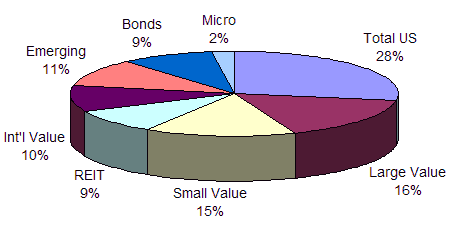
9/07 Portfolio Breakdown
 
Retirement Portfolio
Fund $ %
FSTMX – Fidelity Total Stock Market Index Fund $23,971 28%
VIVAX – Vanguard [Large-Cap] Value Index $14,273 16%
VISVX – V. Small-Cap Value Index $13,230 15%
VGSIX – V. REIT Index $8,100 9%
VTRIX – V. International Value $8,392 10%
VEIEX – V. Emerging Markets Stock Index $9,408 11%
VFICX – V. Int-Term Investment-Grade Bond $7,821 9%
BRSIX – Bridgeway Ultra-Small Market $2,015 2%
Cash none
Total $87,210
 
Fund Transactions Since Last Update
Bought $10,000 of FSTMX on 9/17/07 (240.327 shares)

Summary and Performance
This is my first update in almost 3 months (June update), as between the move and new jobs, there hasn’t been much activity to report. I finally managed to deposit some money and bought $10,000 more of a Total US Stock Market fund yesterday in a lump sum, despite some hesitation. It will be interesting to see what happens in the financial market today and the next few months.

I did manage to calculate my portfolio’s personal rate of return, which were 3.2% year-to-date, and 4.5% annualized for 2007. Positive returns came from the Emerging Markets and International stocks, while my REITs and US Small-Cap Value funds haven’t been doing so hot.

Why do I continue to neglecting my asset allocation? The reasons remain the same. The first part is that many of my intended moves might be considered performance-chasing, such as a desire for a larger international allocation and slightly more bonds. Sometimes it’s hard to tell if the change is actually warranted or if you’ve just been listening to too much CNBC or mainstream personal finance media. The second part is that I don’t want to be one that changes asset allocations every other week, so if I do change things I want to it with lots of research and justifications… and I’ve been a bit disinterested in reading about asset allocation recently.

Hedging Against The Dollar: Opening A Foreign Currency Bank Account vs. Buying A Currency ETF

Lot’s of people have been asking me how to open up a bank account denominated in a foreign currency. The main reason appears to be a desire to hedge against future declines of the dollar. For example, right now the US dollar is trading at all-time lows versus the Euro, and at 30-year lows versus the Canadian dollar.

I must admit that I have no clue how to do this if one is not a citizen or permanent resident of another country. If you know how, please do enlighten us in the comments.

Now, I’m no currency expert, but doesn’t this sort of behavior seem like performance chasing? It’s the new “sure thing”. I figure if you own a good chunk of international stocks, you are already enjoying some foreign currency exposure. In addition, a weak dollar makes our exports cheaper across the border, which increases sales for domestic goods. As I expect to keep earning and spending US dollars for the foreseeable future, I don’t see any need for any additional hedging. If anything, I might hold more international stocks, but I’m still open to contrary opinions.

Let’s say you do have a desire or need for some currency hedging. Instead of opening up a bank account in Euros, here are two alternatives:

Foreign Currency CDs at EverBank
EverBanks offers what it calls WorldCurrency Certificates of Deposit, which invest in a variety of foreign currencies. For example, with the Euro CD your $10,000 will be converted to Euros, earn an interest rate between 2.50-3.0% APR depending on term length, and then be converted back to US dollars upon maturity. The British pound CD is currently earning between 4.25 and 4.50% APR. So you’ll have the chance to make (or lose) money from differences in exchange rates in addition to earning interest. Here are more pros and cons:

– Guaranteed interest rate
– $10,000 minimum purchase
– Available in 3, 6, 9, and 12-month terms. No account fees
– FDIC-Insured against bank failure, but not currency losses
– EverBank likely makes money off the yields in addition to the conversions: ?The currency conversion rate will be within 1% of the wholesale spot price EverBank pays for the currency.?

Foreign Currency ETFs from Rydex
Rydex has a group of foreign currency ETFs that come close to pure plays on that currency. For example, Euro:USD exchange rate is approximately 1.39:1, so the share price of the CurrencyShares Euro ETF (FXE) is $139. If the exchange rate goes to 1.50:1, then the share price would be about $150. Along the same lines, the British Pound Sterling ETF (FXB) has a share price of $201.

In addition, the ETF do effectively earn interest like bank accounts, as they give off monthly dividends. The Euro ETF is currently yielding 3.39%, and the British pound ETF is yielding 5.46%. This seems pretty good, considering Capital One 360 UK is yielding 5.25%. More pros and cons:

– Can buy as little as one share, from existing broker
– You are subject to possible stock commissions, and bid/ask spread
– Possible premium/discount to NAV
– Expense ratio is about 0.40%
– Trade in and out at anytime during market hours

Comparing the EverBank CDs and the CurrencyShares ETFs, it would seem that the ETF would win out if you had a broker that offered free trades like Zecco or WellsTrade.

Finally, you may be able to purchase or exchange into foreign currencies directly via a FOREX-specific broker or a standard stock brokerage that offers such capabilities. I’m not sure how much interest these sites pay though – I wonder if it is is standardized or if it varies like money market fund rates here.

401k Lump Sum Contribution: Dollar Cost Averaging Looking Good Right Now

I’ve been really bad at regularly making contributions to my Self-Employed 401k from Fidelity. I had only planned to put $500 a month into it for the first part of the year, since I wanted to keep as much liquid cash as possible in case I bought a house. Now that it seems like (1) we’ll have enough money both buy a house and contribute to the 401k, (2) we’ve may not buy right away anyhow since we can’t agree on what we want, and (3) the year is quickly coming to an end, I went ahead and sent in a lump sum of $10,000 to catch up!

My problem: The money just showed up on my account today, so I will have to wait until Monday to trade. This is the same day Mr. Bernanke plans on making his Fed Funds rate announcement, which will either calm the market down (drop 0.25%), make it really unhappy (keep it the same), or make it really happy (drop 0.5%). Even with the subprime mess, I am definitely still going invest my money into the stock market… but should I do it all at once?

Usually, in the arena of dollar cost average vs. lump sum my position has been:

If you already have all the money available (not if you’re just taking a set amount out of each paycheck) and you are well away from retirement, you should just invest the lump sum all at once.

This is supported by several studies, including this FPA Journal article Lump Sum Beats Dollar-Cost Averaging, which concludes:

Given a lump sum, is it better to invest the entire amount immediately, or spread it out in equal installments? Based on historical evidence, the major conclusion of our study is that the odds strongly favor investing the lump sum immediately. This conclusion emerges after comparing annualized monthly returns for both DCA and LS strategies for all possible 12-month periods from 1926 to 1991. For the entire 65-year period, the LS strategy produced superior returns approximately two-thirds of the time, and the superior returns were statistically significant.

So it turns out 2/3rds of the time you win out, and 1/3rd of the time you lose. Not bad. The next argument that some people make is DCA is more of a risk-reduction method than anything else. Again, multiple academic articles suggest that DCA may not be a very efficient way to reduce risk, either! Bummer.

Still, given the Bernanke situation, I am considering dollar-cost-averaging $1000 a day over the next two weeks instead of $10,000 all at once on Monday. Prudent idea, or backtracking?

401k to IRA Rollover Decision Process, Prosper Lending Review

I’m swamped today, so here are some posts from the past that fill requests from my suggestion box:

My 401k to IRA Rollover Decision Process
Part 1 – Stay put with old 401k?
Part 2 – Roll over into Fidelity?
Part 3 – What about Vanguard?
Part 4 – My Final Decision

Although this was done two years ago with my previous job, I think it still contains a lot of pertinent information. Note that Vanguard has since gotten rid of their low-balance fee if you accept electronic delivery of statements.

Also, since then there are now brokers that have free ETF trades, most prominently Zecco Trading (no minimum balance, $30 IRA annual fee) and WellsTrade ($25,000 minimum equity, no annual fee).

About Prosper.com – Person-to-Person Lending
Prosper Lending Review, Part 1: First Looks
Prosper Lending Review, Part 2: The Numbers
Prosper Revisited: Will Returns Drop As Defaults Increase Over Time?

I’m still not sold on Prosper’s risk/return characteristics to consider it a prudent part of my investment portfolio, but it can certainly be a fun diversion if you like that sort of thing.

Why Paying Down Your Mortgage Early Can Be A Smart Investment

Still no house yet. But I have been reading about mortgages, and one common debate amongst mortgage holders is whether to send in extra money towards the principal in addition to the required monthly payments. Usually, the argument evolves into these two opposing views:

No, you shouldn’t pay extra because:

If you put that money in stocks instead, you would most likely get a higher return on your money in the long term. Mathematically, paying down a mortgage is like leaving money on the table.

Yes, you should pay it down because:

Stock market returns aren’t guaranteed, whereas paying down the mortgage is guaranteed savings. Debt is a burden, and it’s hard to put a price tag on the psychological benefit of owning your house free and clear.

Now, I understand both of these views, and in the big picture, I really think if this is what you’re worrying about then you’re already ahead of the game. You might even think you already know which view I personally lean towards. But what if there was another perspective that satisfied both sides?

What happens when you pay extra towards your mortgage?
With a mortgage, your monthly payments are amortized, which means each one includes a portion that goes to pay interest and a portion to pay down your remaining loan balance, or the principal. If you make an extra payment towards principal, then this in turn directly decreases the amount of interest you’ll be paying in the future.

So if you pay $1,000 towards your mortgage with an interest rate of 6%, then you’re saving $60 of interest that you would have otherwise had to pay every single year for the rest of your mortgage term.

Put differently, it’s like you’re earning an after-tax return of 6% every year on your money.

But wait, what about the tax benefits of mortgage interest?
Yes, mortgage interest is tax-deductible, but you have to temper this with a few realizations:

  1. Everyone already gets the standard deduction, which in 2007 is $5,350 for singles, and $10,700 for married folks. Only the amount that your itemized deductions exceed this amount actually saves you money.
  2. The amount of interest you pay on your mortgage decreases every year, so your tax benefit will decrease as well over time.

For example, let’s say you are a married couple with a $250,000 mortgage loan balance for 30 years at a fixed 6% rate, and in the 25% income tax bracket. $250,000 x 6% is only about $15,000 of interest paid in the first year. Subtract out the standard deduction of $10,700, and your additional deduction is only $4,300. So you’re only saving 25% of $4,300 and not the whole $15,000. This means your 6% interest rate only goes down to the equivalent of about 5.6%. In addition, according to the standard amortization schedule your annual interest paid will go down to less than $11,000 in year 15. So after 10-15 years, your mortgage deduction will be less than the standard deduction, leaving you with possibly no benefit at all.

Now, if you have a large mortgage or have lots of other itemized deductions, then your tax benefits may be much more significant. In this case, your equivalent interest rate may be extraordinarily low. But for many homeowners, it’s not as large as they might think. (If you have a ton of other itemized deductions, also be wary of the AMT.)

For this example, you could be conservative and say that paying extra towards your mortgage is only earns about a 5.5% annual after-tax return for the rest of the scheduled term of the loan.

A fixed rate of return, every year, for a long time. Hmmm… that sounds like a bond! In comparison the 30-year Treasury bond is currently yielding only 4.88%. After a 25% federal tax, that return is only 3.66%! I choose Treasury bonds because they also contain essentially zero risk of default.

In other words, paying down your mortgage can very similar to holding an attractively-priced long-term bond. (If you have a rock-bottom rate, it could also be an unattractive bond.) So maybe that’s how we should treat it. Just like you don’t compare stocks directly to bonds because they have different risk/reward relationships, perhaps we shouldn’t compare paying down a mortgage to stocks either.

Right now, I currently hold about 10% bonds in my retirement investment portfolio. My prospective interest rate is around 6% if I get a mortgage. I could simply decrease my position in bond mutual funds and put that money instead towards paying extra towards a mortgage. When looking solely at my mutual fund accounts, this would result in my percentage of stocks increasing. This way, I can potentially get the best of both worlds:

  • I’m improving my overall investment portfolio. I am essentially buying a bond that brings me a return higher than what is otherwise available, perhaps by up to 1-2 percentage points. I do lose some liquidity as I can’t get my money out without taking a home equity line of credit and paying additional fees. But as long as it’s not my whole bond allocation, I can still rebalance as needed. My intended bond allocation will only increase as I get older, in any case.
  • I also pay my house off earlier, complete with all the happy fuzzy feelings attached. 😀

What if you don’t own any bonds? Well, if you’re the type of person who’s 100% stocks, then you’re probably so confident in the markets that you wouldn’t want to pay down your mortgage early anyhow. If you do want to pay it down, then consider it a small allocation to bonds that will lower the overall volatility of your portfolio.

Now, this doesn’t mean that paying down a mortgage should be a higher priority than things like maxing out your IRA, paying down higher-interest debt, or even an emergency fund. But it does provide me a way to pay down my future mortgage without having to worry that I am losing money somewhere else.