Choosing An Asset Allocation, Step 1: Deciding On The Stocks/Bonds Ratio

Last time I did a really simplified overview of Modern Portfolio Theory. Much of the credit for this is due to a fellow name Harry Markowitz, who figured out that if you combine two assets with the same return that aren’t perfectly correlated, this diversification can result in reduced risk without reducing return. Even if you don’t combine two assets with the same return, combining two assets that have low correlations (don’t move together) will get you a better reward/risk ratio. Markowitz later won a Nobel Prize for his work in this area.

Stocks vs. Bonds
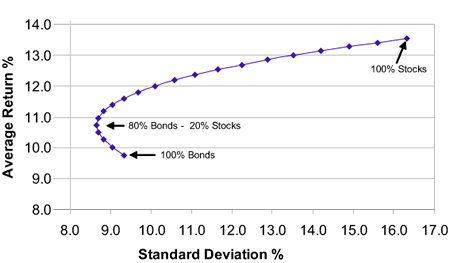
Studies have shown that somewhere between 77% and 94% of the variability in portfolio returns are determined by asset allocation. So our goal is to use asset classes with low correlation to get the best reward/risk ratio. One of the most popular examples of assets that have low correlation is stocks and bonds. Accordingly, adjusting your ratio between stocks and bonds is one of the most basic ways to adjust the amount of risk you wish to take in a portfolio.

The chart below shows the risk/return trade-off between bonds and stocks for 1980-2004. The stock portfolio is represented by the S&P 500 index, while the bond portfolio contains 60% five-year Treasury notes and 40% long-term Treasury bonds. The portfolios range from 100% bonds, to 95% bonds/5% stocks, 90% bonds/10% stocks, all the way to 100% stocks. (via this AAII article)
altext

[Read more…]

Building My Portfolio: Efficient Frontier and Modern Portfolio Theory

Building upon the idea of investing in broad markets, next up is Modern Portfolio Theory. This is another advanced topic that entire careers can be built around, but here is my attempt to explain it in one quick digestible chunk.

Risk vs. Reward
As far as investing goes, the most basic component we have is cash. If we invest it in a Treasury bill from the government (as riskless as possible), then we will end up with a return after inflation of zero. You just keep up with inflation. No risk, no reward. In order to increase our reward we, must take on more risk. But it’s not a linear relationship. We want to find the mix of investments that offer the best mix of risk and reward. So again we turn to history and whip up some math. (I’ll go easy on the numbers here.)

Reward = Return
The idea of reward is usually represented by the historical average annual return of the investment. Sounds good to me.

Risk = Standard Deviation
The idea of risk has many possible definitions. Stocks are seen as riskier as bonds, because their prices have historically fluctuated much more wildly. For example, for domestic stocks, your best year would be +39% while your worst year would be -28%. In contrast, for a broad bond portfolio, your best year would have been +31% while your worst year would be -8%. (Source: Vanguard) A mathematical way to measure this volatility is standard deviation. The larger the standard deviation, the higher the risk.

Mix ‘Em Up
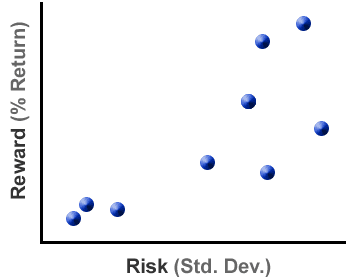
An asset class is a group of investments that exhibit similar characteristics. If we plot their historical returns vs. historical standard deviations, we might get something like this:

altext

One dot might be the S&P 500. Another dot might be 1-Year Treasury Bonds. Now, what if we starting mixing them up into in various ratios. Like taking 50% S&P 500, 25% US Small Cap, and 25% 5-Year Treasury Bonds. We’ll get a whole lot more dots, err… data points:
[Read more…]

Building My Portfolio: Consider Simply Buying The Entire Market

In Part 1 of this series, I talked about basing investing decisions on what I feel is most likely to persist in the future. This is another “big picture” post.

We invest our money because we want to do something besides just sit there. We want it to grow while we’re also busy working. The most basic way of doing that is to either start a business, or buy shares of another business. Some businesses will fail, some will do great, and it can be risky to bet on which one will do what. But as a whole, it is a pretty safe call to say that profits will be generated and value will be created. In the long run, you will end up with these profits. Therefore, one way to invest is simply to buy all the companies. And if you buy them in proportion to how much they are valued, then you end up with a good representation of the entire “market”.

This idea has been promoted by many financial experts. Jack Bogle offers a good explanation is his book The Little Book of Common Sense Investing. This excellent article on investing in total markets lists many others.

It may seem a bit crude at first (kind of like using a shotgun), but in fact it’s actually quite an elegant idea. You let the individual companies fight it out, and you just sit back and enjoy. For example, let’s say there is a growing desire for alternative fuels. Well, many companies are bound to pop up try and profit from that. Some will be wildly successful, some will fail. Maybe such energy companies become a huge part of the economy – well, if you bought total stock market fund you’d own all those winners. To paraphrase author Burton Malkiel – “My advice is that rather than futilely attempting to find the needle in the haystack, buy the haystack”.

This can be implemented on a country level, or even on a world level. The Vanguard Total Stock Market ETF (VTI) tracks the total US market via the Wilshire 5000 index and includes over 3,600 stocks. The Vanguard FTSE All-World ex-US ETF (VEU) tracks the entire world’s publicly traded companies, minus that of the US, and holds over 1,500 representative stocks from 47 countries. Since by the market capitalization of the world is currently split up about 45% Non-US/55% US, if you buy 3 shares of VEU for each share of VTI, and you’d be tracking the performance of virtually all of the world’s liquid companies.

I like this as a portfolio idea, but there are some other theories to consider as well…

Read more: Index of Posts On Building My Portfolio

Building My Portfolio: Disclaimer and General Philosophy

I am starting a new series of posts that describes how I will reconstruct my current investment portfolio from scratch, from general theory to the actual purchasing of specific mutual funds. Here I want to reiterate the point of this blog – This is how I am thinking of investing my money, not necessarily how I think you should do it. In other words, I don’t claim to be an expert, I just think sharing is fun and hopefully there will be a good debate and overall knowledge will be increased. You don’t really often get to see someone juggling a real portfolio across a multiple Roth IRAs, 403bs, 401k, and taxable accounts. It will also keep me organized and motivated as I’m been putting this off 🙂

General Philosophy
Here are some quick insights into how I approach investing. You’ve all read this ominous phrase before:

Past Performance Does Not Guarantee Future Results

Well, you know what? All we have is past performance. The important thing is to look back at all the data available, and try to extract useful information that has the greatest chance of persisting into the future. This won’t be easy, and there will be eternal debate as to how where we draw the line between “likely to persist” and “unlikely to persist”.

Based on this life expectancy chart, if I’m lucky I’ll have another 50 years of investing ahead of me. However, much of the data I read about in studies only dates back no further than 1975. Even the really far-reaching ones only date back to 1926. So I’m supposed to use at best 80 (and often only 25) years of data and extrapolate that out for another 50 years? That doesn’t seem like a huge mountain of evidence, especially considering events like World War II which had huge consequences and occurred only 50 years ago. Wouldn’t it be nice to have something like 800 years of investment data to make decisions upon?

As a result, I will try to keep my portfolio simple and stick to things that I believe are the most reliable, including supporting articles and data. Most of this will come from my readings of books and various studies.

Read more: Index of Posts On Building My Portfolio

10 Reasons You Should Never Pay Off Your Mortgage

A mortgage broker I was introduced to recently just sent me this article on 10 Great Reasons to Carry a Big, Long Mortgage by Ric Edelman. Apparently Mr. Edelman is the expert to be quoted on this subject, as I’ve heard his name associated with this idea several times. Here are his ten reasons along with limited excerpts of the original article. My response is included at the end.

Reason #1: Your mortgage doesn’t affect your home’s value.
You’re buying your home because you think it will rise in value over time. Yet, the eventual rise (or fall) in value will occur whether you have a mortgage or not. So go ahead and get a mortgage: Your house’s value will be unaffected.

Reason #2: You’re going to build equity anyway.
Many homeowners try to build equity in their house by paying off the mortgage. But that produces weak results when compared to the equity you’ll build simply by watching the house appreciate in value. So go ahead – keep the mortgage. You’ll build plenty of equity anyway.

Reason #3: A mortgage is cheap money.
[…] You’ll find that mortgages offer you perhaps the cheapest way to borrow. Mortgage loans offer low interest rates because you post the house as collateral: If you fail to repay the loan, the lender sells your house to recoup its money.

Reason #4: Mortgage interest is tax-deductible.
Not only are mortgage loans low in cost, the interest you pay is tax-deductible. You can save as much as 35 cents in taxes for every dollar you pay in interest. That means a 6% mortgage loan really costs as little as 3.9%. Why carry 18% credit cards, paying interest that is not tax-deductible, when you can instead carry a 6% mortgage with interest that is tax-deductible? Your mortgage is probably the cheapest money you can borrow, so it makes sense to get as much of it as you can.

Reason #5: Mortgage interest is tax-favorable.
Assume you have both a 6% mortgage and a 6% profit on your investments. The mortgage is deductible at your top tax bracket, but the investments are taxed as low as 15%. For someone in the 25% tax bracket, that means the mortgage costs them 4.5% while the investment nets them 5.1% after taxes. In other words, tax law makes it beneficial for you to maintain your mortgage.

Reason #6: Mortgage payments get easier over time.
[…] You might be struggling to make your mortgage payment at first, but over time you can expect your payments to become cheaper relative to your income – especially if yours is a fixed-rate loan. That way, your payment never rises, but your income does.

Reason #7: Mortgages let you sell without selling.
In time, you may well find that your home has grown substantially in value, and you may begin to worry that you might lose that equity if there’s a decline in real estate values. You don’t want to sell the house, which is the obvious way you can capture the value, but there is another answer: get a mortgage. By cashing out some of the equity, you essentially collect the value of the house in cash without actually having to sell the house.

Reason #8: Large mortgages let you invest more money more quickly.
Assume you own a house and want to buy a larger home. So you sell your old house and net $300,000. Now you’re ready to purchase a new $500,000 home. How much should you put down? Should you make a 10% down payment of $50,000? Or should you put down the entire $300,000 in proceeds from the sale of the old house?

Big mortgages mean small down payments. Small down payments mean you retain lots of cash that you can then invest.

Reason #9: Long-term mortgages let you create more wealth.
Do you merely want to eliminate your debt, or do you want to truly build wealth? Please realize that the former does not automatically result in the latter. Indeed, many people who are debt-free are also dead broke.

So, the real goal is to create wealth. You do that by adding as much money as you can to your savings and investments. And the best way to do that is to lower your monthly expenses. That’s why long-term loans are better than short-term loans: the longer the term, the lower your monthly payment. And the lower the payment, the more money you have left over that you can place into investments.

Reason #10: Mortgages give you greater liquidity and greater flexibility.
(Long story about Sam and Nick).

My Reaction
I’m not going to refute any of his overall points – they are mostly true but his main problem is that he tends to overgeneralize. Instead, I’ll just say that the basic premise of this argument is actually very simple. Essentially you are trying to perform an arbitrage – you wish to borrow money cheaply (mortgage), and you invest it at a higher rate (stocks), with the difference being your profit. This is very similar to what people used to do with no fee 0% balance transfers and high-interest bank accounts back when they were paying 5% interest.

However, an important difference is that you don’t know what your investment returns will be, and the arbitrage gap is not definite. Edelman uses in his Sam/Nick story an assumed annual return of 8% after taxes. He doesn’t acknowledge that there is no investment product that Sam can buy that guarantees that (very optimistic) return. In reality, people invest in expensive mutual funds with varying returns, endure tax consequences from frequent trading, or attempt market timing with bad results. The market may return 8%, but the average person might only get 6% after all is said and done. Someone will do worse, others will do better. Of course, most people think they will do better…

As other have put it – If someone walked up to you an offered you a credit card with a 5% APR for life with no cash advance fees or other catches, would you use it to buy stocks? Say you expect 8% investment returns. Does that mean you’d even borrow money at 7.8%? There’s got to be some room for error.

If I had a 5% mortgage rate and had a lot of itemized deductions, I would be pretty comfortable not paying it off early – especially if I had not maxed out my contribution to tax-deferred accounts like 401ks yet. However, if I had a 6.5% mortgage rate and had lost my interest deduction due to the AMT, it would be a much closer call. In that case, I would probably treat paying it off like a bond.

How to Maximize Investment Returns – By Warren Buffett

Let’s talk about maximizing returns instead of minimizing now. In Warren Buffett’s Gotrocks story, he explains how involving too many fee-charging people and trading commissions in your investments can only reduce the overall return for everybody. One way to maximize investment returns is then to invest in low-cost, passively managed index funds. Indeed, he has stated it bluntly – “A very low-cost index is going to beat a majority of the amateur-managed money or professionally-managed money.” However, this doesn’t actually mean that Warren Buffett believes that there is no skill involved in investing. The whole reason we listen to what he has to say is due to the fact that he is one of the few people to outperform the S&P 500 for decades (and thus insanely rich!). He simply states that costs matter a lot – no matter what type of investing you do.

Coincidentally, a reader recently sent me this interesting article, The Superinvestors of Graham-and-Doddsville, written by Buffett in 1984. In it, he directly questions the Efficient Market Hypothesis which has suggested that individuals like himself are simply random (lucky) outliers on a bell curve. Although I highly recommend reading the whole thing, here is an excerpt:

Before we begin this examination, I would like you to imagine a national coin-flipping contest. Let’s assume we get 225 million Americans up tomorrow morning and we ask them all to wager a dollar. They go out in the morning at sunrise, and they all call the flip of a coin. If they call correctly, they win a dollar from those who called wrong. Each day the losers drop out, and on the subsequent day the stakes build as all previous winnings are put on the line. After ten flips on ten mornings, there will be approximately 220,000 people in the United States who have correctly called ten flips in a row. They each will have won a little over $1,000.

Now this group will probably start getting a little puffed up about this, human nature being what it is. They may try to be modest, but at cocktail parties they will occasionally admit to attractive members of the opposite sex what their technique is, and what marvelous insights they bring to the field of flipping.

[Read more…]

$25 Sign-Up Bonus For Lending On Prosper

Shortly after my last Prosper review update, I decided that I should go ahead an sign up for my own Prosper account in order to (1) be able to provide a better review and (2) try to perhaps find an algorithm that works. While making a few more bids today since my last ones all failed, I noticed that there is now a $25 sign-up bonus for new lenders through their referral program. Just click on the banner below:

Business & Personal Loans. Great Rates. Prosper.

From the site:

Refer a lender
You receive $25, and your friend receives $25 as soon as your friend funds his or her first loan.

There is no promotional code necessary. If you use my link above, I also get $25. This is actually pretty good because you can fund a loan with as little at $50, and there is no hard credit check. This gives you an instant 50% return on your investment, which means you can try out Prosper without having to worry quite as much about the interest rate you earn on your loan. In my opinion, to get the best risk/return ratio, I would look for a AA loan, which has the lowest default rate of 0.2% (1 out of every 500 loans) and the highest early-repayment rate (so you can get your money out). Or maybe an A loan with zero previous delinquencies. Keep in mind that your initial $50 will need to stay there earning interest for up to 3 years.

For more information on Prosper, see my two-part Prosper review.

Mental Accounting: Is A Dollar Always A Dollar?

In economics, there is a concept called fungibility. A good is fungible if one example of the good is indistinguishable from another example of the same good. A common example is money. A dollar is a dollar, no matter where it came from, where it is located, or what you plan on buying with it. And so it should be treated as such… supposedly. The problem is humans do something called mental accounting, which violates this principle and leads to often-confusing decisions.

A popular example happens while gambling. Let’s say you go to Vegas. You hate the slots, but mindlessly drop a quarter into a slot machine while waiting for a friend and win $300 on your first pull. Are you more less likely to keep gambling? Most people are likely to keep on playing as long as they are playing with “house money”. Once they lose that $300, they’ll stop. But really, that quick $300 is no different than if you had to work 10 hours of overtime to get it. Why do people spend money more easily if it came without much effort? “Easy come, easy go”?

An academic paper by Dr. Thaler titled “Mental Accounting Matters” [pdf] explores this concept further and tries to categorize the types of mental accounting that we do. It was a very intriguing read; here are just a few examples:

Relative Value
Consider these two hypothetical scenarios:

  1. You are at Best Buy buying a new TV. It costs $860 there, but another store 15 minutes away has the same model for $850. Do you bother driving to the other store to get the savings?
  2. You are at Office Max buying a calculator. It cost $20 there, but another store 15 minutes away has it for half-off ($10). Do you drive to the other store now?

If presented separately, significantly more people will go out of their way for the calculator than the TV. But both involve saving $10 with the same action. The only difference is that $10 is only ~1% of $860, but is 50% of $20.

The same thing happens at the movie theater. A medium drink costs $4, a large costs $4.50, and a Super Jumbo drink costs $4.75. You might as well go for the $4.75 drink, right?

Advance Purchases
Here’s a quiz from another study:
[Read more…]

What Percentage of My Income Should I Contribute To A 401k Plan?

Actually, a better question is what percentage of your income should you contribute to all types of retirement plans? But the 401(k) plan is one of those cases when you have to choose something to start out with, and many people just never get around to changing it again. Too much, and your cashflow will get tight and uncomfortable. Too little, and you’re not taking full advantage of the tax benefits.

Start With The Match
As everybody says, matching contributions from your employer will probably offer the best return-on-investment you’ll ever get. Most companies have a cap after which the match stops, and my guess is that most people contribute up to that cap and then forget about it. Certainly, this number provides a floor, but most of us will have to chip in some more to accumulate a happy nest egg. (I’ve never heard of a match above 6% of pay, although I’m sure some exist.)

Take Into Account Other Accounts Like Roth IRA
The reason people like Roth IRAs is that if you think your tax situation now will be about the same as in retirement, the Roth IRA has a lot of extra advantages like the ability to make early withdrawals for a variety of reasons, as well the ability to never make any withdrawals and leave it to your heirs still compounding away. However, if you have a Roth 401(k) the difference gets a lot slimmer, you may just go with which one offers you better investment choices. Either way, it’s good to consider the whole picture.

Mint.com allows you to compare different IRA accounts available online … if you want to see how your IRA stacks up against what’s available, you should check them out.

Taken all together, I would say 10% would be good place to start unless you have a pension or other sources of retirement income lined up. But that’s just me… what do you think?

Each 1% More Can Make A Big Difference
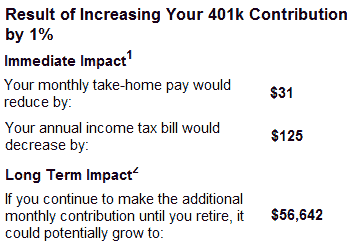
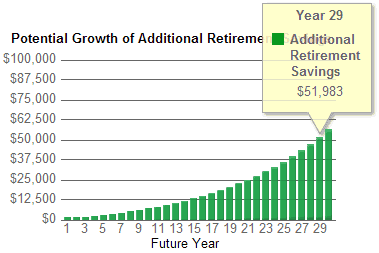
On top of that 10%, it’s interesting to see how much difference nudging it up another 1% can do. I used this Increase 401k Contribution Calculator from Wachovia and ran some numbers. Assuming you make $50,000 gross annually, you’re 35, you retire at 65, 8% annual return, and a 25% income tax bracket, here’s what happens if you increase your contribution percentage by 1% (unmatched):

altext
altext

Not too bad for giving up just $31 per month; if you’re younger the payoff is even better. (Almost good enough to bump up your contributions by 1% today?) Still, start taking enough $31s out and it’ll start to hurt.

Give Until It Hurts?
To find the nice balance, there are a couple of ways to do it:

  1. Analyze your finances, estimate a percentage, and just adjust from there. (More work.)
  2. Start at match %, and keep increasing the % until it starts to hurt.
  3. Start at a high amount (20%? 25%?), and keep decreasing it until your take-home pay is a manageable amount.

Each person probably has a different preference. But again, we go back to the real-life aspect – Will you remember to change your percentages later? Life gets busy, and each month you just keep forgetting and forgetting… In that case perhaps the third option is best, assuming you have some cushion to pay with.

Framework For Thinking Through Personal Finance

(Warning: The following post is very stream-of-consciousness and written on very little sleep.)

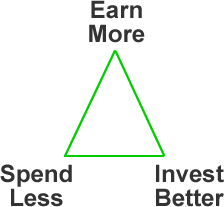
While doodling today (I doodle a lot) I started thinking about money and how it such an overwhelming issue at times. I read so much advice from so many different directions, my head starts to spin. I ended up drawing this:

altext

Basically, the idea is that if you want more money, you should focus in on one of these three areas:

Spend Less
Either through buying less goods and services, or by finding a lower price for the same goods and services, one can spend less money each month. Much of this is psychological, as most of what we buy are “wants” and not “needs”. Long-time habits and deeply ingrained notions may need to be broken. Priorities need to be consciously decided. However, there comes a point where it is simply not possible to spend any less.

Invest Better
With the money that is saved, one would want to make it grow as much as possible. Here, I am focusing more on passive investments like stocks, mutual funds, bonds, or gold. There are many competing theories as to whether skill is a factor in picking stocks. Personally, I believe that the markets are mainly efficient, and that “beating the market” is exceedingly unlikely. All that can be done is to maximize your risk/reward ratio. Therefore, there is also a maximum value on how “well” we can invest.

Earn More
This is done via work, either through being an employee, or starting your own business and becoming the employer. Ways to advance in your career include more education, better interpersonal skills, or otherwise achieving positive results and getting promoted. Other more individual ventures include real estate investing, building a business with employees, or creative works that produce “passive income”. These come with additional risk of losing money, but also offer added upside.

Priorities and Diminishing Returns
I feel that the first two, Spending Less, and Investing Better, should be the first to be addressed. If very little attention has been paid to these two areas, a lot of progress can be made. Of course, it can probably be a lifelong process to make sure these things continue to be taken care of. Lots of energy can be spent trying to optimize both (!). However, at some point, I think there will be diminishing returns. When you start considering about whether you should flush the toilet every time you use it in order to save water, perhaps it’s time to focus on other things. 😀 Similarly, there is only so much I can make from maximizing bank interest and picking a optimum asset allocation. Of course, if you reach a happy place already, you don’t even need to Earn More.

In a way, I think Spending Less and Investing Better are appropriately located at the base of the triangle. After building a good foundation, you can start taking some risks in the Earning More area. I think for most people this is the hardest part. It can be very hard to increase one’s salary if they feel they are stuck in their current career. Maybe they are comfortable already. Taking classes, switching jobs, it can be very stressful. On the other hand, it is also the one with limitless boundaries.

I know I already discuss these things on a daily basis, but I think it can also be good to methodically examine one’s progress in each of these areas every so often.

Morningstar’s Stewardship Rating: Better Than Those Annoying Stars!

A couple weeks ago I wrote about characteristics of good actively managed mutual funds, which talked about finding managers who have most aligned their interests with their investors.

I just discovered that there is also something similar called the Morningstar Stewardship Rating, which grades funds on “intangibles like corporate culture, board quality, manager incentives, fees and regulatory history.” In fact, many of the themes are almost identical. Here are more details of each component, taken from press releases and the official methodology:

Corporate Culture. Is the fund company focused on investing or gathering assets? Does the fund company foster a thoughtful, repeatable investment process?

Board Quality. Does the board consistently act in shareholders? best interest? Do the independent directors have meaningful investments in the fund? Is the board led by an independent chairman, and are 75% of the directors independent?

Fees. Morningstar now assesses funds solely on their current expense ratios and how those fees compare to their peers, and no longer considers the trend in fees.

Manager Incentives. Does the manager have a significant investment in the fund(s) he or she oversees? Do the compensation plans reward long-term performance or simply emphasize asset growth?

Regulatory Issues. Funds do not receive points toward their overall Stewardship Grade for simply following the law, and firms with poor regulatory histories will lose points.

Unfortunately, to actually get the exact grades of any specific fund, you have to subscribe to the Morningstar site at over $100 a year. Blah. But here is one useful tidbit:

Management companies with one or more funds at the top of the class include, in alphabetical order, Clipper, Columbia Acorn, Davis, Diamond Hill, Dodge & Cox, FPA Paramount, Longleaf Partners, Oakmark, Pennsylvania Mutual, Royce, Selected American, T. Rowe Price and the Vanguard Group.

I would much rather use this Stewardship rating to help assess active funds than the more popular (and separate) Morningstar “Star” Ratings, as that system continues to overweight recent past performance and offers questionable predictive abilities.

How Much Better Is Your 401k Than A Regular Taxable Brokerage Account?

Everybody loves 401k plans for their tax advantages. But exactly how good are they, really? What if your 401k only offers limited, more expensive options than you can find from a regular brokerage account? I wanted to explore this using some estimated numbers, just to see how it works out. I know my assumptions won’t fit everyone, but people can adjust them to be closer to their own situation.

Assumptions

  1. Start with a $10,000 pre-tax contribution for each
  2. Both plans have the same imaginary investments for 30 years
  3. Annual return on those investments is 8%, broken down into 6% from capital gains, and 2% in qualified dividends. This is to approximate the amount of dividends currently being paid on stocks in general.
  4. 28% ordinary tax bracket both now and upon withdrawal in retirement
  5. 15% tax bracket for long-term capital gains and qualified dividends
  6. Any company matching is ignored, as everyone should contribute up to the match. 🙂

401k Calculations
The calculations for the final value of the 401(k) are relatively simple. You start with $10,000, it grows at 8% annually without any tax consequences for 30 years, and then upon withdrawal it is taxed at ordinary income tax rates. With our assumptions, the math would look like this:
[Read more…]