Do I Need To Make Any Last Minute Year-End Tax Moves?

Yikes, I’m cutting things close this year. Time to see if there are any last-minute things I need to do with the last two business days before 2008.

Selling Losing Stocks or Mutual Funds
If you have some investments that are currently in the negative and you don’t want anymore, you might consider selling them and taking the loss. This is because you can deduct the loss against your other capital gains, or even reduce your taxable ordinary income (up to $3,000 each year). In general, people like doing this. You can’t buy the same “substantially identical” investment again for 30 days though, as that would break the IRS wash sale rule.

If you have some index funds that have high unrealized losses, you might even sell them and buy a similar fund at the same time. Again, the general idea here is to take advantage of the fact that the IRS tax capital gains and capital losses differently. Losses can “save” you money at your ordinary tax rate (up to 35%), while long-term capital gains are capped at 15%. More information and an example of this technique here.

I don’t have anything that I’m looking to sell, as most of my investments are in tax-deferred accounts. I have a $31 loss right now in BRSIX, but that’s not worth the potential commission of buying a similar fund.

Make A Tax-Deductible Donation
If you mail in a donation (including a check or credit card info), it must be postmarked by December 31, 2007. Be sure to get a receipt! Usually the easiest thing is to just charge it on your credit card in time. That way you have your credit card statement as backup, and you’ll also earn some cashback rewards while you’re at it. This is the first year we might actually get to itemize our deductions, so that’s kind of nice.

On a side note, all of my Kiva loans are still doing fine, and one was even paid back early (the somewhat-controversial one from apparently-rich Ukraine!).

Using Up Flexible Spending Account funds
Our usual routine is to spend the rest of our FSA money on contact lenses solution, eyeglasses, Benadryl, and Aleve at Costco. From last year, here is a big list of things that qualify for Flexible Spending Account reimbursements. If you don’t have any immediate needs, Mapgirl had a good suggestion that you can complete your first aid/emergency kit with things like gauze that don’t expire.

Reduce Your Trading Costs with Capital One 360 ShareBuilder

In my review of Sharebuilder a few days ago, I overlooked an important feature that commenter a schmuck pointed out. I had complained that $4 a trade is pretty high unless your monthly contributions were at least around $400. For example if you paid $4 every time to contributed $50, you’d be behind 8% right out the gate. Before, your choices of investment schedule were only weekly, monthly, or twice a month.

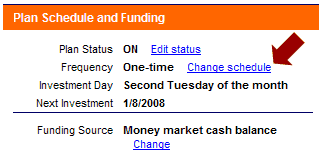
But when you create or edit our Automatic Investment Plan, you can now also change the frequency to “invest when the funds are available”.

altext

From their Help section:

How does “invest when the funds are available” work?
If you decide to invest when the funds are available you are indicating that you want your plan to invest on the Tuesday immediately after your money market cash balance meets or exceeds the plan?s total investment amount. Every Monday at 5:00pm (ET), excluding holidays, ShareBuilder will create Automatic Investment Plan orders if your account?s money market cash balance meets or exceeds the plans total investment amount.

This is great! Say you only want $100 taken out of your bank account each month. At $4 a trade, I would want the commission be at most 1% of the trade amount. So you could see your Automatic Investment Plan to buy $400 of an ETF. Now, when you reach $400 in 4 months, you make the trade. In the meantime, your idle cash is actually swept into their money market account (BDMXX), which is current yielding a somewhat decent 4.11% APY.

Like commenter Stephen said, “If you’re dollar cost averaging, it doesn’t matter when you make your purchases.” And this way it’s all automatic! You won’t need to remember to do it 4 months out. You be less likely second-guess yourself before clicking the “execute trade” button, especially if the market is temporarily tanking.

If you do decide to use ShareBuilder to implement a buy-and-hold portfolio, I think this a really good way to do it.

Review of Suze Orman Show CNBC Special: Your Money Your Life

CNBC had a special Suze Orman Show last week, and I finally got a chance to watch it on TiVo. Recently, I’ve kind of lightened up on my view of Suze. Like all gurus, she makes blanket statements that may not apply to everyone, but at least she’s not pumping a get-rich-quick scheme involving real estate or stock-picking that is bound to produce more losers than winners. Overall, the show was pretty good for what was basically an hour of sound-bite-based financial advice for people (like me) with short attention spans.

Main Points
Here are her “action points”, which again seem to be generally good advice:

  • Get rid of credit card debt as soon as possible.
  • Keep your credit score high.
  • Save up an 8-month emergency fund.
  • You should have a 20% down payment for a house before buying one to live in.
  • Contribute up to your 401k/403b employer match, then fund a Roth IRA.
  • Create both a will and a living revocable trust.
  • Get adequate life insurance (term only).

I picked up two pointers that I need to research further involving estate planning. First, she stated that you can pass real estate without probate through a living revocable trust. This can save months of hassle and also can avoids court fees and lawyer fees which can eat up thousands of dollars. Second, you should always check your 401k beneficiaries, as whatever you designate on those forms actually trumps your will.

Motivational Story
There was also the oldie-but-goodie why-save-early explanation. Allow me to paraphrase:

If you saved $100 every month starting at age 25, and invested it with normal market returns, at age 65 you would have a million dollars! But you say, I’m 25, who cares? If I wait until 35, that’s only $12,000 I’m not investing. ($100 x 12 months x 10 years)

However, if you indeed started at age 35 saving $100 per month, at age 65 you would only have $300,000. That decade of waiting actually lost you $700,000!!

Of course my question was – what’s “normal market returns”. Doing the backwards math, it’s about 12.08% annualized. Very optimistic, but hey, inflated numbers make the story better. 🙂 It’s still a good lesson.

Don’t Buy Bond Funds?
Finally, a curious quote from her was that she hates bond mutual funds, and that people should only buy individual bonds. I thought to myself – how many casual investors actually buy individual bonds? Dealing with all the intricacies like call risk, par value, and quality ratings would be way too complicated for her target audience. However, digging a little deeper into her older show transcripts, I see that she actually recommends buying US Treasury Bills or Notes with a maturity of less than 5-7 years. Since these are of the highest quality and are relatively uniform, that definitely made more sense… but she didn’t explain this on the show!

Equity Asset Allocation: Comparison of 8 Model Portfolios

I’m still planning on reshaping my investments and continuing my choosing an asset allocation series, but Thanksgiving and work has thrown me off a bit.

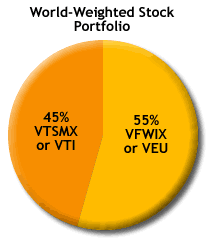
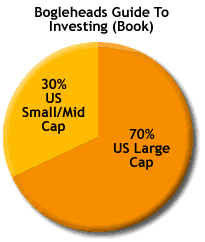
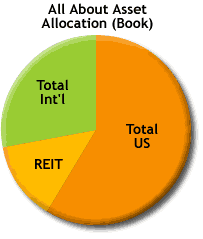
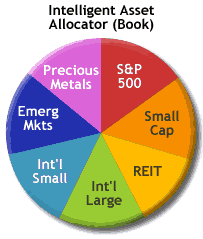
To skip ahead a bit, here are several sample asset allocations from various sources for the equity (stock) side of your portfolio. I thought it would be helpful to see them all side by side and compare how different authorities might split things differently between domestic and international stocks, how they deviate from the “total” market indexes, and whether they choose to incorporate additional asset classes like real estate or commodities.

For more information about any specific portfolio and the source, just click on the pie chart.

altextaltext

altextaltext

[Read more…]

Lending Club Review: Free $25 To Start, P2P Borrowing

Next up in the person-to-person lending showcase is Lending Club. I recently joined up because they were offering the carrot of $25 sign-on bonus, and I was curious to see how they differentiate themselves from Prosper Lending (review, $25 bonus). As usual, this overview will primarily be from the perspective of a potential lender/investor in these unsecured consumer loans.

Lending Standards
LendingClub only allows borrowers with a minimum credit score of 640. Prosper initially had no bottom, but later raised it’s floor to a 520 credit score, which by itself eliminated 45% of their loan listings! So lots of subprime action over at Prosper, but very little over at LendingClub. Some people may disagree on whether this a plus or a minus.

Setting Interest Rates For Loans
With Prosper, prospective lenders bid on loans in an eBay format. Essentially, all the lenders as a whole set their own market rate. But with LendingClub, they do all of it for you.

The mechanism for setting a fair interest rate is complex: it involves a proper assessment of the risk associated with each loan (based on the borrower’s credit history, current situation, income, debt and other factors), an understanding of the volatility associated with each level of risk, and a proper reward for that volatility. We have access to large amounts of information and historical data from the credit bureaus, which puts us in a unique situation to set attractive, fair and equitable interest rates. Rates also depend on the amount of the loan (with larger loans bearing higher rates).

Each loan request made by a borrower is attributed a Lending Club grade ranging from A1 to G5. Here are some sample corresponding loan rates:
[Read more…]

Zopa US Initial Review: A Credit Union Disguised As Person-to-Person Lending

Zopa US joined the person-to-person lending arena recently. From a potential lender’s perspective, I was excited to see what they had to offer since Zopa has been operating in the U.K. for a while, and with several features that made them different than the current leader in p2p lending within the US, Prosper.com (review, $25 sign-up bonus). These include:

  • More Flexibility – You set your rates, choose how long you want to lend for (1 to 5 years) and decide on a risk level. With Prosper, all loans are for 3 years, there are no other options.
  • Risk-Based Interest Rate – Each borrower has a risk-assessment done, and your investment rate is based upon what risk grade you want to invest in. This is different from the pure reverse-auction format of Prosper.
  • Easier Diversification – If you lend ?500 or more, your money is spread across at least 50 borrowers. That’s only ?10 per borrower. On Propser, the best you can do is split it to $50 per borrower.

Which of these were extended to Zopa US? None of them.

With Zopa US, they have basically turned into a credit union. Your only choice is to buy a NCUA-insured 1-year certificate of deposit, currently paying 5.10% APY. While the rate is better than average, it’s nothing spectacular. That’s it. Minimal risk, minimal return.

Oh, there is a bit of optional charity if you like. You can “choose your rate”, which mean if you choose a rate of 4.90%, then 0.2% goes the the borrower to help them pay off their loan. But borrowers pay at least 8.75% interest on their own loans! Who’s making money off the rate spread? Zopa, not you. 🙁

Person-to-person lending was supposed to cut out the bank as middleman. But this just the same old bank/credit union setup. My guess is that Zopa went this route because US regulations don’t allow them to replicate the UK model here. Very disappointing!

Help Your Family Buy A House – And Make It An Investment

Over Thanksgiving my parents and I discussed the possibility that one day my parents might retire and move near us. Of course, my parents live in a “normal” part of the country where a 2-bedroom condo doesn’t cost $600,000. So the idea of us helping them to buy a home sometime in the future came up. If my siblings and I all put in an equal amount, we would simply inherit an equal share when the time came.

Coincidentally, I also ran across this article by the “Mortgage Professor” which addresses a similar idea: A new take on gift of equity: Turn it into an investment. Instead of a parent simply giving their kids money for a down payment which may put a dent in their own retirement savings, they should structure it as an investment with multiple shareholders.

He has made an Excel spreadsheet which tracks the percentage of home equity that is owned by each party. It took me a while to figure out all the variables, but here are the basics of what you need to consider:

  • Ongoing investments. Sometimes you not only need help with a downpayment, but also the monthly payment. Or maybe you don’t need it but the investor wants to help out. Ongoing payments are also handled by the worksheet.
  • Interest rate. You’ll need to set an rate of return for the investor’s cash if they “cash-out” before the end of the mortgage. One suggestion is to simply make it the same as the mortgage rate.
  • Rent credit. If only one party is occupying the home, they should be required to credit to the investor a market rate of rent. The rent should include regular adjustments to keep in line with inflation.
  • Property improvements. It should be decided how property improvements will be decided upon and how to credit each partner.
  • Exit strategy. If you don’t plan to ever sell the house, then you should outline an exit plan so that the investor can get access to their money after a set period of time.

So let’s say an investors helps put down $25,000 on a $300,000 house. The assisting investor wouldn’t just be getting $25,000 + 6% a year, you’d also be collecting a portion of “rent” from the person you are helping. The occupant gets to buy their house with less money tied up initially, and would be sharing any potential profit or loss. Sure there is plenty of room for conflict, but I think for some families it might work out well.

Investment Gift Idea For Children: A Roth IRA?

A few very forward-thinking readers have asked me about ways to help their kids or other young folks by giving them a Roth IRA. This seems like an awesome idea to grab them some tax-sheltered action. I’ve thought about this in passing, but never really did the research into the technicalities of it. One good article on this subject is over at Fairmark called Roth IRAs for Minors. Combine this with official IRS publications and a few magazine articles about employing your children, and here’s what I found:

The Facts

  • There is no age requirement to open an IRA.
  • Many, but not all, IRA providers will allow you to setup an IRA account for minors.
  • The primary requirement is the child needs to have taxable earned income to make a contribution. So to make a $4,000 contribution, they would need $4,000 of income. Earned income means that dividend or interest payments don’t count.
  • An important difference between IRAs and 529s is that once the child reaches 18 or so, they get complete control over the money and can do whatever they want with it.

The Payoff
How much money are we talking about? Umm.. a lot! From the Kiplinger article:

Let’s assume you give your 15-year-old daughter $1,000 to fund a Roth IRA. If the money inside the account grows at an annual average rate of 8% — well below the long-term average return for stocks — that $1,000 will grow to about $47,000 over the 50 years it takes for today’s teen to reach retirement age. If you added another $1,000 a year until she turned 20 -? and never added another dime — that initial $5,000 investment would be worth nearly $250,000 by her 65th birthday. With a Roth IRA, the full amount will be tax-free when it’s withdrawn in retirement.

Now the question is how to obtain that taxable earned income?

Income From Non-Parental Employer
This is probably the most legitimate and straightforward way, also the hardest to get. Examples for small children might be acting or modeling from an agency not directly owned by the parents. For teens this could include money from tutoring, bagging groceries, or working at the movie theater. In addition, this income may be subject to payroll taxes like Medicare and Social Security Tax at 7.65%.

Income From Parents As Employer
Maybe you already run your own business, and could use the services of a child – web design? computer set-up or consulting? From the Fairmark article:
[Read more…]

TradeKing and Scottrade Promotion: Reimbursed Account Transfer Fees

Looks like TradeKing is trying to convert some customers from “one of the larger online brokers”… I wonder who they are talking about? From an e-mail today:

Due to the effect the sub-prime mortgage fallout has had on one of the larger online brokers, some investors have asked us if we’re at risk for similar problems. The answer is a resounding “No.” TradeKing does not invest in any mortgage-related securities, including sub-prime mortgages.

Furthermore, we protect your account against losses up to $25 million as a member of the Securities Investor Protection Corporation (SIPC), and with supplemental coverage from Lloyd’s of London. If you’re concerned about an account you hold with another broker, perhaps you should consider consolidating your assets with TradeKing. We’ll even reimburse any account transfer fees your other broker may slap on you between now and December 31, 2007.

This reimbursement offer may save you $50-$100 if you’ve been wanting to do an ACAT account transfer to them from your existing broker. Scottrade also offers up to $100 in fee reimbursements for inbound transfers [update: if your account value is greater than $25,000]. Read more about both brokers in my TradeKing review and my Scottrade review.

You’ll should also weigh the upfront benefits against the potential commission savings if you go with a broker offering free stock trades.

Reader Question: Bear Market Worries, What About My Roth IRA?

Earlier this week I got a very good question from a reader:
Last week I decided to take your advice and invest $4,000 in a Roth IRA. My Roth IRA holds only one fund: Vanguard Target Retirement 2050, which holds 90% stocks and 10% bonds. Unfortunately, my timing was terrible: in a mere 3 days, my initial $4,000 investment has already fallen to $3,800, and there seems to be no end in sight. I keep reading all of these pessimistic forecasts about a looming bear market, so I’m very worried about losing my $4,000 investment.

My question for you is: Am I overreacting, or is there something I should do to protect my investment? I don’t need this money now; I invested it knowing fully well that I wouldn’t reap the benefits of it for another 40+ years. If the market keeps going south, however, I’m worried that I’m going to lose most of my $4,000 investment. Do you think I should try to withdraw my remaining money from the Vanguard 2050 fund and invest it in something less risky? I know that you’re generally opposed to attempts to “time” the markets, but I can’t help feeling foolish for investing $4,000 in a fund containing 90% stocks without taking into account the current market conditions.

I think everyone from time to time will question their investments. Again, I’m not a financial professional, but here is what I call “brotherly advice” – as in it’s the same thing I would tell you if you were my family.

1) There is virtually zero chance you will lose your $4,000. That’s part of the benefit of having a widely diversified mutual fund. An individual company, even a huge company like Enron, MCI Worldcom, or E-Trade has the possibility of going bankrupt and becoming worthless. For a Vanguard Target Retirement fund to go to zero, we’d be in Stone Age 2.0 and your primary concerns would probably be food, shelter, and guns.

2) Remember your time horizon. You chose the 2050 fund, which theoretically means you won’t need to withdraw for 43 years, and it seems like you’re okay with that. So then the question is – do you think you will end up higher or lower than $4,000 in 40 years? Because that’s what matters. If you think it will end up higher, then who cares what it’s worth today, or next week, or even the next decade? If you haven’t already, check out this chart.

3) Stop looking at your account. I’m a money geek, but I only look at my IRA accounts once a month to do my net worth updates. Honest! I have zero clue how I’ve done so far this month.

4) Risk = Reward. I know $200 seems like a big loss now, but really it’s just part of the deal. If there was no ups and downs, there would be no extra gain. No risk = bank savings account. You want the ups and downs! Adjusting risk tolerance is a very tricky thing – people tend to have low risk tolerance when the markets go down, and high risk tolerance when the market is hot. Not good. I think the gradual decreasing of risk provided by the Target Retirement fund is a better way to avoid such conflicts.

If 2050 is truly your time horizon, I say stay put. I could go on and on about the behavioral reasons against market timing and pull fancy stats from historical studies, but the above simple reasons are how I convince myself to step back and keep calm. I’ve lost way more than $200 over the last few months, and I haven’t sold a thing. If I do, I’ll let you know. Don’t hold your breath though. 😉

Choosing An Asset Allocation, Step 3: Considering The Diversification Benefit Of Small and Value Stocks

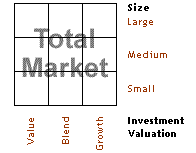
So far we’ve looked into the stock/bond ratio and the domestic/international ratio. Instead of taking these total stock markets as whole, you can further subdivide them into “styles” or additional asset classes. Although these vary in specific definition, in the general layout is shown by the Morningstar style box shown to the top right.

Value vs. Growth Stocks
Value stocks are those that tend to trade at a lower price relative to objective measures like dividend yield, earnings, sales, or book value. For example, you could screen by low P/E ratio. To generalize, value stocks tend to have low growth prospects or are in unglamorous industries. On the other side are growth stocks, which have high relative valuations. Again to generalize, these companies tend to have big growth expectations like Google or Apple.

If you look across long periods of history, it actually turns out that value stocks outperform growth stocks as a whole. People use different ways to explain this phenomenon. One camp says that value stocks are riskier because they are more likely to fail due to poor prospects, so obviously they should have higher return. Others use a behavioral view, saying that since they are “boring” or “ugly” stocks then they tend to be undervalued by investors in general.

Either way, including value stocks as part of a portfolio has also historically provided a diversification benefit, as can be shown by this graph from the excellent book All About Asset Allocation:
[Read more…]

Choosing An Asset Allocation, Step 2: Deciding On The Domestic/International Ratio

I don’t know if this is the proper next step, but after deciding on a stock/bond ratio for myself, I want to think about the specific breakdown of stocks (equity). As mentioned when talking about investing in total markets, you could simply “own the world” using just two funds or ETFs and weighting them according to market capitalization – using one Total US fund and one All-World Except-US fund:

altext

If you use the ETFs, the total weighted expense ratio would be a mere 0.17% annually!

Concerns About Investing Abroad
However, according to various surveys the average US investor has much less than 55% of their equity portfolio in international stocks. Here are a few reasons that have been cited:

  • Country/political risk – This includes the possibility that the economy of certain countries could collapse due to war or other internal strife. Also many governments have less oversight and transparency than the US and other developed countries.
  • Currency risk – These days it seems like people want to hedge against a falling dollar, but only recently people were worried about a strengthening dollar affecting international investments. Either way, it does add an element of risk.
  • Added cost – Investing in international mutual funds usually cost more in management fees.
  • Existing exposure – Some statistics show that a very large chunk of revenue from US-based companies now come from outside our borders, so even without adding international companies we are already being exposed to many of the same effects. This also explains the recently increasing correlation between domestic and international stocks.
  • Performance-chasing – Recently international funds have been on a very good run. Some believe this is the main factor in increasing foreign exposures, as opposed to fundamental factors.

Historical Risk/Reward Relationship – Benefits of Diversification
On a very general level, the reason to invest in international stocks as it pertains to Modern Portfolio Theory is that you get a diversification benefit. Historically, international stocks in general have had higher average returns, but also higher risk (volatility). But due to low-ish correlation, mixing domestic and international stocks has resulted in less risk and greater return.
[Read more…]