I haven’t posted my investment portfolio since April, mainly because it hasn’t really changed much. But here’s another snapshot:
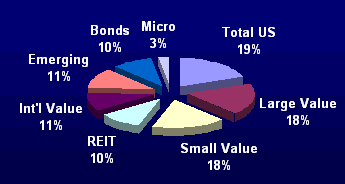
| Retirement Portfolio | ||
| Fund | $ | % |
| FSTMX – Fidelity Total Stock Market Index Fund | $15,132 | 19% |
| VIVAX – Vanguard [Large-Cap] Value Index | $14,567 | 18% |
| VISVX – V. Small-Cap Value Index | $14,251 | 18% |
| VGSIX – V. REIT Index | $8,163 | 10% |
| VTRIX – V. International Value | $8,686 | 11% |
| VEIEX – V. Emerging Markets Stock Index | $8,929 | 11% |
| VFICX – V. Int-Term Investment-Grade Bond | $7,616 | 10% |
| BRSIX – Bridgeway Ultra-Small Market | $2,126 | 3% |
| Cash | none | – |
| Total | $79,470 |
| Fund Transactions Since Last Update |
| Bought $1,000 of FSTMX on 6/26/07 (23.759 shares) |
Thoughts
Another couple of months have gone by, and my desire to re-define my asset allocation remains unfulfilled. All I did was buy some more of a Total US Market fund (FSTMX) through my self-employed 401(k). You’d think someone who writes about money on a daily basis would be on top of such things!
But really, I think I might actually be spending too much time on this. As Jack Bogle has stated, “The greatest enemy of a good plan is the dream of a perfect plan.” There is no perfect asset allocation, and I know that. I keep telling myself, I’m not looking for the perfect plan, just a better one which has been well-reasoned out, and one which I should have little reason to tinker with for a long time.
To achieve such a better plan, I have been re-reading each of my favorite investing books on top of many new ones (including All About Index Funds by Ferri, Unconventional Success by Swensen, Only Guide to a Winning Bond Strategy You’ll Ever Need by Swedroe), looking at their research, comparing their model portfolios, and trying to balance all the advice given. But after all these months, my slow deliberation has really just turned into what academics call “paralysis by analysis” and have been just been putting off making a decision for weeks. I do have some overall changes planned, including:
- Increasing my allocation to international assets,
- Decreasing my value tilt, and
- Increasing my bond allocation.
I want to avoid trying to time the market, or chasing recent performance. But I also don’t want to base my decisions on simply trying to avoid the impression of trying to time the market. Although I’m always open to suggestions, I feel I need to some fresh input. Got an asset allocation suggestion? Ideas on a better value/size/country tilt? Another book to read? Throw it at me.
 While reading this month’s issue of Kiplinger’s Personal Finance magazine, I found that UC Irvine offers a free online course on the Fundamentals of Personal Financial Planning:
 It appears that Zecco brokerage has now removed their minimum opening requirements, on top of their 40 free trades a month. I’m guessing this means you can start trading with any amount of money, which is nice because you can try them out with minimal commitment. You still need $2,000 to open a margin account, though. See my
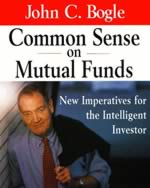 John (Jack) Bogle is both the founder of the low-cost mutual fund company Vanguard and the creator of the first index fund available to the public. These days he spends his time speaking about corporate ethics and how index funds are great investments for the vast majority of people. But what does he invest in?
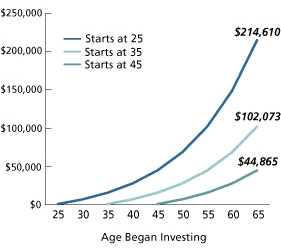 and one at age 45, investing a total of $20,000. Each earns 7 percent per year and, for purposes of this illustration, the effects of taxes and inflation are ignored.
  The Best Credit Card Bonus Offers – 2025
 Big List of Free Stocks from Brokerage Apps
 Best Interest Rates on Cash - 2025
 Free Credit Scores x 3 + Free Credit Monitoring
 Best No Fee 0% APR Balance Transfer Offers
 Little-Known Cellular Data Plans That Can Save Big Money
 How To Haggle Your Cable or Direct TV Bill
 Big List of Free Consumer Data Reports (Credit, Rent, Work)