Now that Vanguard allows us to waive all their $10 low-balance fees, I need to reconsider my choice in bond funds. But which one? Here’s a my brief and very generalized understanding of bonds, based on my own readings. Please use this only as a starting point for your own research.
Quick Bonds Primer
Bonds are essentially loans, either from government or private companies. In portfolios, they are usually used to reduce the overall volatility because of their low correlation with stocks. When stocks go one way, bonds tend more to go the other (thought not always). This can allow you to lower risk without significantly lowering returns. See this Vanguard illustration.
While there are many different types of bonds – corporate, mortgage-backed, U.S. Government Treasuries, municipal, to name a few – you can break them down into two ways:
Maturity Risk
The longer the loan length, or time until maturity, the more sensitive bond prices are to interest rate fluctuations. Bonds are often grouped into short-term, intermediate-term, and long-term categories. The lender (us) is usually compensated for this extra volatility with higher returns. Another way to measure sensitivity of a bond fund is by looking at the duration. For example, if a bond has a duration of two years, its price would fall about 2% when interest rates rose one percentage point. On the other hand, the bond’s price would rise by about 2% when interest rates fell by one percentage point.
Credit Risk
Just like with consumer loans, the worry is about defaults. The riskier the borrower is, the higher interest they must pay. Given the same maturity length, a junk bond with a low credit rating will pay a higher return than a government-backed Treasury bond. Foreign bonds aren’t very popular, due to the added currency risk and also higher expenses.
Where’s the best risk/reward combination?
Just because as risk goes up, return goes up, doesn’t mean that there is a linear relationship between the two. You want to find the best combination for your portfolio needs.
[Read more…]
 This is the second part of my review of the Zecco brokerage account. If you haven’t already, please read the
 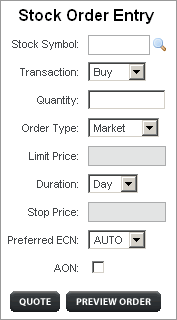 Trading Interface
 Vanguard has just announced some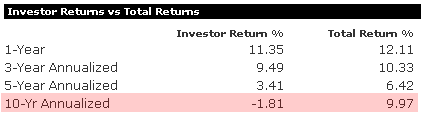
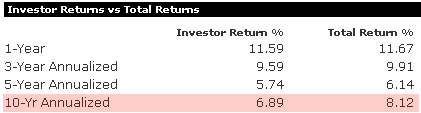
 2. Volatility matters. Buy-and-hold works… if you hold! You keep hearing that people shouldn’t own too much in stocks if they can’t tolerate the risk. You can see why by viewing the Investor Returns on the more volatile funds. They stink! According to this
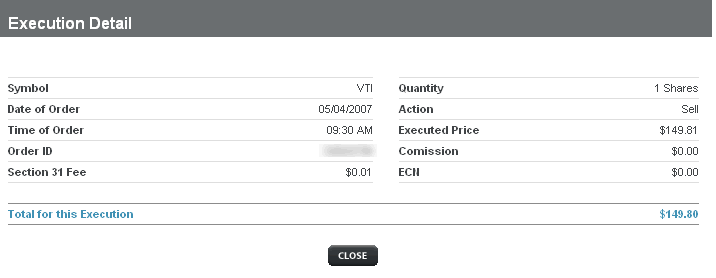
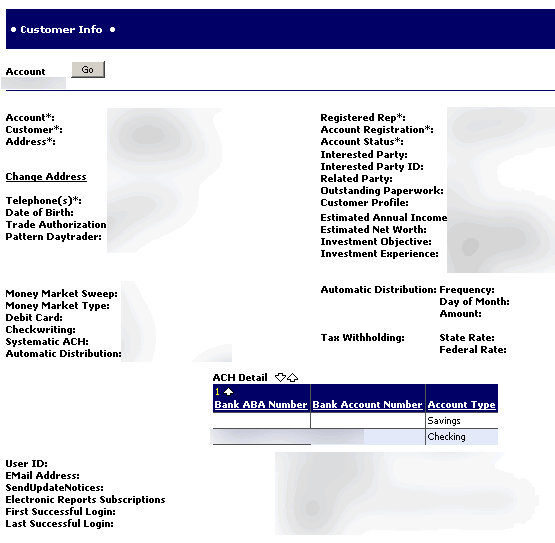
  I decided to open a brokerage account with Zecco.com. This is not going to be my main brokerage account just yet, but I do plan on using it. (I’m going to revive my Play Money account, for those that have been reading for a while. More on this later.) For now, since I think a lot of people are curious about this account, here are my experiences with the account itself.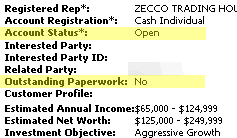
 The Best Credit Card Bonus Offers – 2025
 Big List of Free Stocks from Brokerage Apps
 Best Interest Rates on Cash - 2025
 Free Credit Scores x 3 + Free Credit Monitoring
 Best No Fee 0% APR Balance Transfer Offers
 Little-Known Cellular Data Plans That Can Save Big Money
 How To Haggle Your Cable or Direct TV Bill
 Big List of Free Consumer Data Reports (Credit, Rent, Work)