Vanguard Offers More ETF Equivalents To Their Index Mutual Funds

With Vanguard recently launching their new bond ETFs, I can almost reconstruct my entire portfolio of Vanguard mutual funds using their equivalent ETFs instead. While they won’t work well for everyone, I am glad that Vanguard is offering this option to the public. Here are some index mutual funds and their ETF counterparts:
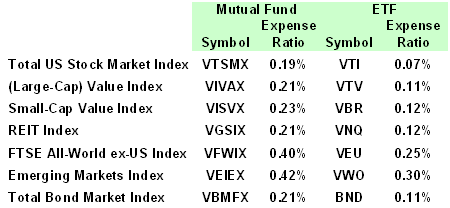
Vanguard ETF and Mutual Fund Pairs

The ETFs certainly have an advantage in expense ratio if you don’t have the $50,000 needed to buy the Admiral shares of each fund. On average, the savings is 10 basis points, or 0.10%. That’s $10 a year on a $10,000 account, or $100 a year on a $100,000 account. In addition, the ETFs allow you to get around the minimum initial investments, as well as avoid the $10 per-fund low-balance fees, $10 per-fund IRA fees, and the purchase/redemption fees of many of their mutual funds.

In the disadvantage department are possible premium/discounts to NAV, the bid/ask spread, and commission costs. Vanguard even offers a cost-comparison calculator that takes many of these things into account.

The only ETF missing for me is their International Value fund, but I could replace that with the WisdomTree International SmallCap Dividend Fund (DLS).

Free Trades + ETFs = Cost-Saving Opportunity?
Right now, Zecco.com offers free trades with an account value of $2,500, while Wells Fargo offers free trades with an account value of $25,000. (Bank of America’s offering stinks, so I’m ignoring it.) Buying these ETFs with free trades would take away much of the traditional advantage of mutual funds.

Before I would switch to ETFs, my concerns include whether these brokers can sustain giving out free trades, and how good the customer service is. If they fail, would I keep paying slightly higher commissions on ETFs, or sell them all and go back to mutual funds? Something to ponder.

(You know what? I just figured out that Zecco stood for Zero Cost Commissions. No, I’m not the sharpest tool in the shed.)
Better Alternatives To Dividend Reinvestment Plans (DRIPs)

Dividend Reinvestment Plans, or DRIPs, are programs that allow individuals to buy stock directly from the company, with dividends from the stock being automatically reinvested into more shares. Here are some popular companies that have DRIPs and also see the Wikipedia entry on DRIPS here.

DRIPs often charge no commissions, so if you set up a DRIP for General Electric (GE) and committed $50 per month, every penny of that would go towards buying $50 of GE, even if it meant buying a partial share. Dividends also get reinvested for free. The main startup costs involve buying one share through a broker and then transferring ownership to your name. This all made them a good alternative to using a broker and paying for every trade.

Do it yourself? Start with less than $100? No commissions? Sounds like something I’d go for. In fact, I don’t participate in any DRIPs. The main reason is that I’m really not interested in buying any individual company stock right now. DRIPS are meant as a very long term commitment, and I just don’t trust any one company to perform well for the next 30 years. On top of that, the accounting required to keep track of the cost-basis for all your shares sounds like a nightmare. Besides, I think there are better alternatives out there:

With just $50 a month, these days you can go through a company like T. Rowe Price or TIAA-CREF and invest in a low cost mutual fund that is diversified across hundreds of companies. It’s so easy a caveman could do it. 😉

If you have at least a few thousand dollars, there are now brokers that offer free trades like Zecco and Wells Fargo. I bet there will be even more to come in the future.

April 2007 Investment Portfolio Snapshot

It’s time for another bi-monthly update on my investment portfolio.

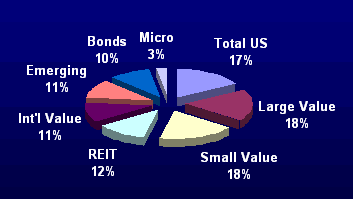
4/07 Portfolio Breakdown
 
Retirement Portfolio
Fund $ %
FSTMX – Fidelity Total Stock Market Index Fund $12,599 17%
VIVAX – Vanguard [Large-Cap] Value Index $14,082 18%
VISVX – V. Small-Cap Value Index $14,146 18%
VGSIX – V. REIT Index $9,229 12%
VTRIX – V. International Value $8,294 11%
VEIEX – V. Emerging Markets Stock Index $8,040 11%
VFICX – V. Int-Term Investment-Grade Bond $7,726 10%
BRSIX – Bridgeway Ultra-Small Market $2,086 3%
Cash none
Total $76,202
 
Fund Transactions Since Last Update
Bought $1,500 of FSTMX on 4/5/07 (36.773 shares)

Thoughts
Not much going on, I have been contributing a $500 a month to my Solo 401k while trying to build up my cash hoard for a house downpayment. I still plan on tweaking my asset allocation, but I’ve just been distracted by other things and kind of want to wait a full year before making any changes.

All of our Vanguard funds are held at Vanguard.com, where there are no commissions for trading their mutual funds. Currently, everything there is in Roth IRAs, one each for my wife and I. Even though Roth IRAs rock, we haven’t contributed to one this year yet because we might be over the income limits for 2007.

The Fidelity fund is also held in-house at Fidelity, where I have my Self-Employed 401k. Funds are also no transaction fee (NTF) there. It’s a bit annoying that both their Spartan Total US and International funds have high $10,000 minimums, but the 0.10% expense ratio is nice. I could also trade ETFs, but at $20 a trade it’s a bit expensive.

You can see some older posts on how this portfolio came to be here, as well as my previous portfolio snapshots here.

Six Key Principles of Saving for Retirement

Ben Stein has an good read on Yahoo Finance about what he terms the Six Key Principles of Saving for Retirement. Although I agree with all six main ideas, I question some of the specific numbers. Here are some excerpts and my comments:

1. How much you save.
Simply put, if you’re a typical American (who happens to save close to zero right now), you have to save more. When you’re young, 10 percent of your income will get you there. If you don’t start saving until middle age, aim closer to 15 or 20 percent. If you don’t start until later than middle age, save every penny you can.

Interesting. Is 10% really enough? If so, maybe I really am saving too much for retirement. 🙂 To what degree of certainty is that true?

2. How long you give your savings to compound.
A thousand dollars socked away when you’re 20 and growing at 10 percent per year will be almost $73,000 when you’re 65. The same sum saved when you’re 50 will grow to $4,200 at age 65. That’s a stunning truth that should compel any young person to start saving early — and the rest of us to start right now.

As for timing your retirement, Ray advises that if you can push it back by even five years you’ll allow your money to grow and have fewer years to need it.

Compound interest is truly powerful. A dollar saved now is worth more than a dollar saved later.

Although it hasn’t been helping me control my spending as much as I’d like either, I did make the horribly unpopular true cost of frivolous shopping calculator. 😉

3. How you allocate your assets.
Typically, for those who start early, stocks are the answer. Over long periods, a diversified basket of common stocks wildly outperforms bonds, cash, and real estate. The differences are breathtaking.

But, as we’ve seen lately, there’s also a lot of volatility in stocks. As you age, you’ll want more of your money in bonds and money market accounts. These have lower returns than stocks, but they also have far lower volatility.

Phil DeMuth recommends that, as a basic portfolio, you have half of your savings in the broadest possible common stock index such as the Vanguard Total Stock Market Index (VTSMX) and half in the Vanguard Total Bond Market Index (VBMFX)… To me, that’s a bit conservative if you’re young. I would have more in stocks and also a good chunk in international markets.

Here is a compilation of various model asset allocations from other respected sources. Pretty pie charts included!

4. How much your investment returns annually.

Now, this is largely unknown from year to year. But over long periods, stocks return close to 6.5 percent after inflation, and about 10 percent before inflation.

Can we expect 6.5% real returns in the future? Lots of conflicting opinions out there on this, but I really want to look into this more.

5. How low you keep your fees and costs.

This principle is largely about using index funds and no-load mutual funds, which makes perfect sense.

Costs matter, whether you go actively or passively managed. I’ve seen some really expensive index funds. Always look up the expense ratios and any commissions you have to pay either when you buy or when you sell for all the investments you own.

6. How closely you keep an eye on taxes.
Finally, Ray advises maxing out your tax-protected accounts like IRAs and 401(k)s; keeping high-dividend stocks in accounts that are tax-deferred; and, when retiring, carefully considering what bracket you’ll be in and drawing out your funds to remain in the lowest possible one.

Ah, taxes. Here is a discussion on where you should place investments for maximum tax-efficiency.

J.D. of Get Rich Slowly also shared his thoughts on these six points, and believes the most important factor in retirement savings is psychological.

About Traditional and Roth IRAs, And Why They Rock

If you are waiting until the last second to fund your 2006 IRA, you’re probably not alone. Maybe you are still confused about choosing between a Roth or a Traditional IRA. Here’s an interesting fact: If you assume that your tax rates will be the same now as they are in retirement, the amount you end up with is the same whether you use a Traditional or Roth IRA. This is independent of time length and expected return

Let’s assume an annual investment rate of return of 8% for the next 30 years, and a marginal tax rate of 25% for all years. Let’s also say that you only have $1,500 of after-tax ($2,000 gross pre-tax) income to put away right now.

If you went with the Roth IRA, you pay your 25% tax on the $2,000 now ($500), but no taxes upon withdrawal:

$2000 x 0.75 x 1.0830 = $15,094

If you went with the Traditional IRA, you don’t have to pay tax on the $2,000 right now, but you’ll be taxed upon withdrawal:

$2,000 x 1.0830 x 0.75 = $15,094

See how they are the same? The only difference is that you are able to put away “more” in a Roth IRA since the limits are $4,000 for either one. $4,000 post-tax in a Roth IRA is like putting away $5,333 in a Traditional IRA in this scenario. This ability to shield more money from taxes is why I chose to contribute to a Roth IRA. Now, if you change your assumptions about tax rates, that’s where you may start leaning more towards one or the other.

How good is the tax benefit?
Remember, either IRA saves you tax at least once. If you just kept it all in a regular taxable account, you would be subject to a tax on any dividends or realized capitals gains every year. Let’s see what happens to your $1,500 then. Taking the best case scenario of investing in stocks with only dividends being taxed and having no capital gains to deal with until you sell 30 years later, we’ll assume that the 8% annual return is broken down into 6% appreciation and 2% dividends. If the 2% in dividends are taxed at 15% each year, your after-tax return in 1.7%. If those dividends are reinvested:

$1,500 x (1.077)30 = $13,885

At the end of 30 years, upon selling you’ll have a long-term capital gain of $13,885 – $1500 = $12,385. You pay tax of 15% on that: $1,858, leaving you with $13,885 – $1858, or $12,027.

With these simplified assumptions, using an IRA made you over 25% more money than if you didn’t use one. If you invested in any bonds, the difference would be even greater. 25% is huge! Imagine ending up with $500,000…. or $625,000. Which one would you rather have? This is why IRAs are a great opportunity to make your money go farther.

See here for some specific mutual fund ideas, part of my overall investing recommendations.

(This is not a comprehensive Roth vs. Traditional IRA post – There are just so many variables like the ability to take out principal without penalty, ability to use balances for a 1st home, required minimum distributions, and easy of inheritance to consider.)

Cost Comparison Tool For Comparing Vanguard ETFs and Mutual Funds

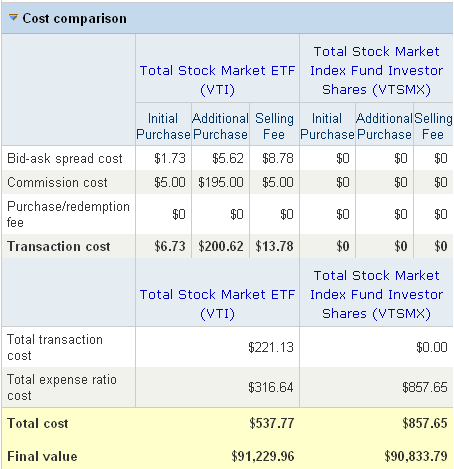
While on Vanguard’s website I recently ran across a new and useful tool that help helps you calculate and compare costs for similar Vanguard ETFs and mutual funds. The tool takes into account trade commissions, the difference in expense ratio, redemptions fees, future purchases, and even the expected bid-ask spread.

For the unfamiliar, I’ll be very simplistic and say that exchange-traded funds, or ETFs, are mutual funds that can be traded like individual company stocks. Due to the way they are constructed, ETFs tend to have lower expense ratios than their mutual fund counterparts, but you will need to pay a commissions each time you trade. There is also a little bit of added loss due to the bid-ask spread.

For example, you could compare the Vanguard Total Stock Market Index Fund (VTSMX) with the Vanguard Total Market ETF (VTI). Both invest in the exact same set of companies, and holds over 1,000 companies that track closely the entire U.S. market. VTSMX charges an annual expense ratio of 0.19%, or $19 on a $10,000 investment. VTI has an expense ratio of only 0.07%, a mere $7 for each $10,000 invested.

I tried an example where I start with $10,000 of either VTSMX or VTI, and say that I will add another $1,200 each quarter for another 10 years. I assumed $5 trade commission and a 8% annual return. Here are the results:

Cost Results

(fixed the numbers :P) The cost edge goes to the ETF in this case, with a cost difference of $300. Really, I don’t see that as all that much over 10 years. But, as you get into larger amounts, the gap widens. If you continued the same example for another 20 years, the ETF’s cost advantage would be $7,000.

For this reason, I feel like it is only a matter of time before I start moving all of my current all-mutual fund portfolio into ETFs. In fact, the majority of my funds already have an identical ETF counterpart.

Anyhow, you can play with this calculator and change the variables to see your situation. Note that Admiral shares are an option once you reach $100,000 per fund. I’ve got a while before that…

But in terms of the big picture, both of these funds have very low costs and would serve as a great cornerstone to a retirement portfolio. If you are just starting out, I think you’ll see the difference is very small; I really wouldn’t stress too much about going either way.

How Good People Make Bad Investments

Here’s another article by Jonathan Clements that I enjoyed – How Good People Make Bad Investments from the Wall Street Journal. It points that some traits that help us success in other parts of our lives actually hurt our investing performance.

For example, you would like to think the more energy you put into researching and trading stocks, the better your returns would be. But the research and historical data simply doesn’t support that. Here are some excerpts:

Athletes who train hard are more likely to win. Students who study conscientiously are more likely to get good grades. What about investors who diligently research their stocks? They’ll probably earn mediocre returns.

The fact is, the markets are full of savvy investors, all hunting for cheap stocks. Result: If there are any bargains to be had, they don’t stay that way for long. Indeed, much of the time, share prices are a pretty good reflection of currently available information.

“If you put in more effort, you’ll end up with worse results,” reckons Terry Burnham, co-author of “Mean Genes” and director of economics at Boston’s Acadian Asset Management. “It’s not the work. It’s the action that comes out of the work that’s the problem.”

Every time we buy a supposedly bargain-priced stock, we incur commissions and other trading costs. In addition, if we trade in our taxable account, we may trigger big tax bills, further denting our returns.

[…]

Your index funds will simply replicate the performance of the underlying markets, minus a small sum for fund expenses. Sound dull? You may be more excited when you look at your results — and you realize they’re so much better than those earned by optimistic, hard-working active investors.

A Warm Slice Of Humble Pie

slice of pie, image credit: http://www.mcpies.comI’ve been trying recently to try and make some minor adjustments to the target asset allocations of my portfolio. I want to create something that I won’t be tempted to change again for many years. While attempting this, I keep noticing how hard it is for a beginning investor to try and figure out where to put their hard-earned money. So many websites, books, magazines, television shows… and the amount of information being thrown at you just seems to multiply daily. Everybody has an opinion, including me. Am I right?
Who knows? I don’t. I’m simply doing the best anyone can do – read a steady stream of books, academic studies, participate in discussions, and then making a decision based on that information. I try look at the bigger picture and draw conclusions based on historical studies going back from the 1920s and not five-year historical returns. But none of us can predict the future.

What is accepted as common knowledge often changes with time. My own views shift as I read more. I also see a lot information out there that I disagree with. Therefore, I encourage everyone to do their own due diligence, keep their minds open, question things, and try to separate the wheat from the chaff for themselves. All I can do is to promise that I will try to keep doing the same.

(This will be added to my compilation of posts about managing money called My Rough Guide To Investing.)

Cramer Admits To Manipulating Markets, Calls SEC Stupid

In an interview on the website TheStreet.com, Jim Cramer of Mad Money fame talks about how he and other hedge fund managers can manipulate stock prices for easy profit. Check out the video, it’s very enlightening:

Although this actually aired online a few months ago, he’s now getting heat from various media sources that recently discovered it – including articles from USA Today and the New York Times, which provide a nice recap:

Cramer described how he would make bets that gave the impression knowledgeable investors were predicting a stock’s future. Cramer said everything he did was legal but added that illegal activity is common in the hedge fund industry, where regulation is lax.

Cramer said some hedge fund managers spread false rumors about a company to large trading desks and the media to drive a stock price lower. He said this practice is illegal, but easy to do “because the SEC doesn’t understand it.”

He also said Research In Motion and Apple are easy targets.

Mr. Cramer said he had used some of the tactics himself, including lying to ?bozo? reporters to get them to report misinformation on particular stocks. He singled out CNBC?s Bob Pisani. He separated legal activities from illegal ones (such as ?fomenting?), and never quite says he ever took part in the latter.

Let’s take a step back here. Cramer openly admits that he and others can manipulate the markets by spreading misinformation. And people actually watch his show for investing tips?!? Somebody’s getting rich, but it ain’t his viewers… Yet another reason not to trade stocks in the short term.

The Idea Of “Core and Explore” Investing

Do you see the data supporting index funds, yet still have the urge to try out some other theories? One way that financial folks try to resolve this conflict is with the concept of “Core and Explore” investing. I have no idea who came up with the name first, but essentially you split up your portfolio into two parts: a Core portion made up of low-cost index funds, and a Explore portion with which you can do whatever you want. This way, you can still watch CNBC, talk stocks around the water cooler, and try to decipher Cramer’s squealing. You get the rush of working to beat the market, but in the worst case you won’t fall too far behind.

Core Ideas (80-95% of total portfolio)
100% Target Retirement Fund, or
33% Total US Stock Market Index, 33% Total International Index, 33% Total Bond Index, or
Something based on one of these model asset allocation portfolios.

This part should be rebalanced regularly according to your pre-set asset allocation.

Explore Ideas (5-20% of total portfolio)
Individual Stocks
Actively Managed Mutual Funds
Options and Futures
Sector bets (Healthcare, Energy)
Currency Exchange, Gold, Commodities
Country bets (China, Russia, Japan, Brazil, India)
Market Timing (i.e. switching to 100% cash when bearish)

Many people mix index and non-index funds, but not necessarily consciously like this. I did have a “play money” account that I put a flat $5,000 towards before (as opposed to a percentage of my portfolio), but then I got busy/bored/disillusioned and liquidated it six months ago. I keep planning to revive it, but it just hasn’t made it up the priority list yet.

Risk and Return Relationships For Different Asset Allocations

After looking at how other people and mutual fund companies choose their asset allocation, I’m a little conflicted. Both the Vanguard and T. Rowe Price mutual funds recommend holding nearly 80% in stocks at age 50. That’s pretty aggressive in my book. To see why, let’s look at some historical numbers.

Coincidentally, a commenter left me a link to a recent FundAdvice article about fine-tuning your asset allocation. I’m actually going to ignore the specific components of his portfolio and focus on the general trends instead. Let’s just say it’s well-diversified.

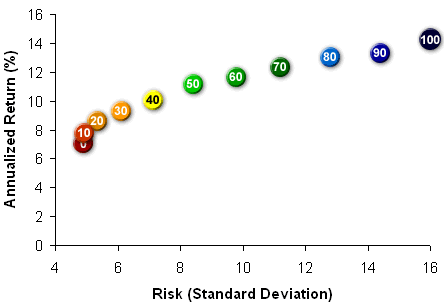
The article provides historical numbers (1970-2006) that compares risk versus return for portfolios ranging from 0% stocks to 100% stocks. Risk is represented by standard deviation, a measure of volatility.

Risk vs. Return For Varying Stock Percentages
Risk vs. Return

This is pretty consistent with a lot of other similar charts I’ve seen. You’ll notice that the slope of the curve decreases as you move towards holding more stocks. Accordingly, if you compare the differences between successive dots, there risk gap grows larger and the return jump decreases. In other words, you are generally getting less return for each unit of risk as you keep adding more stocks.

Here is another risk-reward chart for increasingly aggressive portfolios.

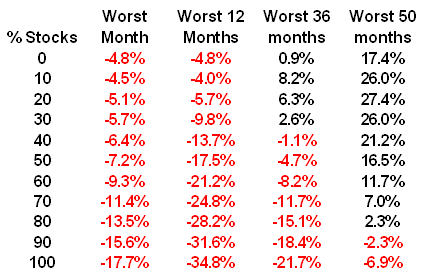
Still, this chart really doesn’t help too much either. Why not just go for the 100%? Instead of averages, let’s focus on how bad it can get over the same time period (returns not annualized):

Worst Returns For Various Portfolios

This second chart is more important than the first one, because you won’t get any of the returns listed above unless you can “stay the course” through periods such as these.

It’s really easy to say “Oh, 30% drop, no problem”, but that’s not the whole picture. Not only will stocks be dropping, but bonds may be skyrocketing. Imagine if bonds are returning 15% a year at the same time stocks are going down 15%. You will have what appears to be a way out! Personal finance magazines will be shouting “Bonds are back!” Cutting down on your stock exposure will become the “prudent” decision.

Going back to the 80% stocks at 50 years old… Can you imagine losing 35% of your portfolio in one year at 50 years old? I would freak out. This is why age matters, it’s so much easier to shrug off losses when you know you won’t need the money for another 30+ years.

What Percentage Of Your Portfolio Should Be In Stocks?

One of the basic ways to adjust the risk and return characteristics of your investment portfolio is to decide what percentage to hold in stocks and bonds. This is another one of those hard questions for which there is no single best answer for everyone. You must take into account risk acceptance and time horizon amongst other factors.

An old rule of thumb is that your stock allocation percentage should be 100 minus your age. That is, a 30-year old should have 70% stocks/30% bonds, and a 70-year old should have 30% stocks/70% bonds. This was not just taken out of thin air, and has a basis from historical returns. As you near retirement, you want to have more bonds as that reduces overall volatility. More recently, others have altered this to a more aggressive “110-age” or even “120-age”.

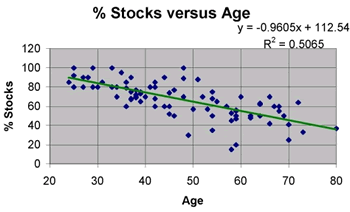
Members of the Diehards investment forum recently performed a informal survey of member’s asset allocations versus their age, and here are the results:

Credit: Diehards Form

As you can see, there is definitely a lot of scatter in the data. However, if you made a linear fit, it roughly corresponds to a formula of stock percentage = 112.5 – age.

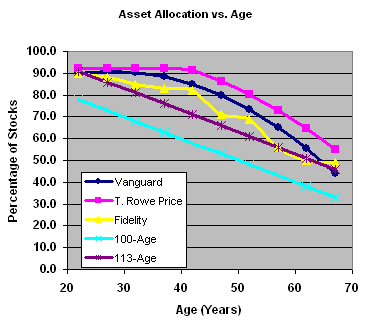
This made me curious – what about all those Target Retirement Funds? Their job is to decide an asset allocation that works for as many people as possible based on their retirement date. If I assume that people retire at 65 years old, here is what the asset allocation versus age looks like for three of the more popular fund families: Vanguard, Fidelity, and T. Rowe Price:

Target Retirement Fund Asset Allocation vs. Age

As you can see, the funds are actually pretty aggressive. (I covered previously how T. Rowe Price is more aggressive than Vanguard.) If one did force linear fits for all three fund families, it would correspond roughly to stock percentage of 119 – age. However, they don’t really adjust linearly with time. If I use a 2nd order curve fit instead, I can make a little tool that estimates their stock percentages for any age:

Input Your Age: Years
Percentage in Stocks
Vanguard Model:   %
Fidelity Model:   %
T. Rowe Price Model:   %
120 – Age:   %
113 – Age:   %

None of this is investment advice, it’s just an observation of what’s out there. Next, I’ll try to find some historical return and standard deviation numbers for another view of how to answer this question. What do you think of all this?