Reasons To Watch Out For Stock Newsletters

Now and then, I get asked if I recommend any specific stock newsletters. I usually assume these people haven’t read much of my blog 😉 I’m often given specific examples, like one that touts a 145% supposed return last year, or another one run by a group of Harvard MBA graduates. My reply is always the same: I don’t recommend any stock newsletters. There are a couple of reasons why:

First of all, the ones that you can go back and check on reliably haven’t done so hot. The Hulbert Financial Digest has been tracking the recommendations of investment newsletters for over 25 years. It’s research shows that 80% of these professional stock pickers can’t beat the market indexes.

According to this FundAdvice article, chasing last year’s hot newsletter is a very bad idea. From 1981-2002, if every year an investor put his or her money into the prior year?s top performing newsletter, the result would have been an annualized loss of 31.4 percent a year. That?s the same as starting with $10,000 and ending up 21 years later with $2.32. Ironically, most people that subscribe to Hulbert’s are looking to buy a stock newsletter!

Don’t forget the Motley Fool’s 100% failure rate for their 2006 predictions. Better luck this year, Fools!

As for the rest, how do you know if they are lying? Recently, FundAlarm caught one of these newsletters in the act of changing their historical trade data after a dismal year:

Using the market-timing system from Intelli-Timer, my return for the year came in at less than 2%, and I wondered how Intelli-Timer was going to update its Web site, and continue selling its system, after such a dismal performance. Now we have the answer: My year never happened. With no explanation, the Intelli-Timer Web site has completely revised its historical performance information… Faced with a system that was failing, it looks like Intelli-Timer has simply backtested a new system that produces dramatically better — and totally fictitious — results.

Nothing like making up crap when all else fails. Since there is essentially nobody policing these newsletters and websites, why not? Link via Diehards Forum.

I’ll say it again – commentary from stock analysts always sounds great and logical. They can throw out nice figures like rising margins, economic statistics, or fancy PQI ratios. If they are right, the can toot their own horn. If they aren’t, they can either ignore it or even lie! I really think most of you don’t need to hear all this, but it’s always good to have some links to help convince others.
Prosper.com Person-to-Person Lending Review, Part 2: The Numbers

To recap the first half of this review, my initial impression of Prosper was that is a somewhat risky investment opportunity with poor liquidity. However, along with the risk of loss comes the potential for a healthy return. Each of us can decide the rates that we wish to lend at. The question is, can I get a return that compensates me adequately for the risk I’m taking? Let’s dig into the numbers and see.

What kind of data do we get? What are the fees?
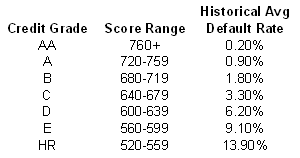
Again, I will focus only on the lender perspective here. My previous conclusion is that I would rely primarily on the credit information given. This turns out to be a letter credit grade (A,AA,B,C,D,E, or HR) derived from the Experian ScoreX PLUS credit score, not a FICO score. They are similar, but the range for a FICO score is 300-850 and the Experian ScoreX is from 300-900. Here are the relationships, as well as the corresponding historical default rates for borrowers with debt to income ratios of less than 20%.

Scores

As for lender fees, it’s pretty straightforward. You are charged an annual servicing fee of 0.5% for AA/A borrowers, and 1.0% for B-HR borrowers. So whatever your final lender interest rate is, 0.5-1.0% is automatically taken off the top. This was raised recently from the old rate of 0.5% across all loans.

How are the outstanding loans doing so far?
One of the reasons I didn’t loan any money on Prosper initially is because I simply didn’t trust myself or others to set the correct interest rates. All I had was the Experian chart above to try and estimate defaults, and that just didn’t seem enough. Would borrowers treat Prosper with the same respect as Citibank or Bank of America? Would the rates be too low due to an excess of lender money?

The bad news is that Prosper is barely one year old, still too young to make reliable judgments in my opinion. The good news is that Prosper does release what data it has. One thing you have to watch out when looking at the numbers is that many of the loans are so new that there simply hasn’t been time for them to default. A loan originated on January 1st won’t have its first payment due until February 1st, and it won’t be able to be considered late until March 1st. For an official default, it has to be 4 months late, or June 1st! And that’s only if not one single payment is ever made.

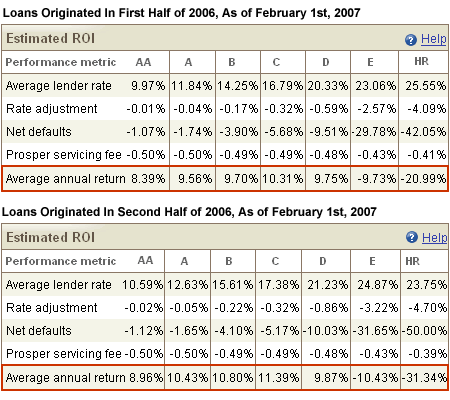
Therefore, I want to look at loans that are at least a few months old. I choose two periods to look at – loans originated in the 1st half of 2006, and loans from the 2nd half of 2006. Let’s see how those loans have done as of February 1st, 2007.

Historical Performance Chart
See here for definitions.

[Read more…]

Prosper.com Person-to-Person Lending Review, Part 1: First Looks

Prosper.com is a person-to-person lending service where you can lend out money to complete strangers. My first and only post about Prosper was back on February 13, 2006, when it was first released to the public. Since then, I haven’t written a peep about them. An online service that offers high interest rates for my cash? Why haven’t I written about them? The simplest answer is that I’ve been waiting for more information to review.

Here is a first look at Prosper from a potential lender perspective.

This is not a short-term, safe investment.

You may have seen this ad, it says something to the effect of “Why settle for 5% APY from banks? Get 15%+ interest from Prosper”. Comparing itself to an online savings account is misleading for a couple of reasons:

Your money is not 100% liquid. The loan term is three years. All loans on Prosper are lent for 3 years. In a bank account, I can just walk over and take my money out. You will gradually get your principal back and might have some pre-payments, but your money is pretty much locked up for the short term.

Your money is now unsecured debt, which carries the possibility of loss of principal. Bank accounts are FDIC-insured. Your Prosper loan is not backed up by anything except for the word of the borrower. The only thing keeping them paying is either a sense of personal responsibility, or the threat of a black mark on their credit report. What happens when their credit is already bad? Will they view Prosper as a serious lender on par with credit card companies? What happens if Prosper goes out of business?

There are a variety of ways you can get higher interest for extra risk. Look at some Canadian Oil Trusts like PGH (15% yield), or high-yielding REIT stocks like LUM (13% yield). I don’t recommend these either, but my point is that you should compare apples to apples.

Prosper is an intermediate-term investment opportunity with lots of inherent risk. In addition, not everyone will get the same results. While one person may get 16% annual return, another person with a similar loan portfolio may have low or even negative returns.

What am I basing my decisions on?

Let’s look at the three major pieces of information you get when you are deciding on which loan to fund:

The Story. This is coming from the cynic inside me, but how accurate are these? I do believe most of them to be truthful, perhaps with a little positive glow on things. But how do I know if it’s not? Do I really need to read “I am very dependable and promise to pay you back”? Some group leaders will vouch for borrowers, but in the end, I put very little weight on this area.

Besides, which is better? The business start-up loan? The “fresh start” loan? The credit card consolidation loan? The I-want-a-new-Lexus loan? Here we might also be mixing emotion and business, which is fine if you want, but I’d personally rather not be emotionally invested in my lending.

Credit Profile. This is actually very useful. In addition to the credit grade which essentially gives you a range for their credit score, you can find out some details on the credit report. These include the number of delinquent accounts, how much was delinquent, negative public records, and their current revolving credit balance. More information here.

Employment Data. This includes both whether they are employed or not, how long they’ve been employed, and their income. This gives you their current debt-to-income ratio. Again, this is all self-reported by the borrower. I believe it would be far too costly for Prosper to actually verify this data, but it would be nice.

Of course, Prosper says that it is a crime to lie on a lending application, but my question is how many people have they caught and prosecuted for this crime? My guess is zero. In June 2006, in response to this criticism they started performing spot-checks for the “identity, address and income of a select number of borrowers.” They do not release the frequency or passing rate of these checks. Therefore, I also put relatively little weight on this area. I treat it like a very rough estimate.

In the end, all I am comfortable relying upon is the credit report, just like the credit card companies. I think the card companies are pretty good at what they do, so the only way us individuals are going to make money is to be satisfied with thinner margins than them (lend at cheaper rates), while at the same time trying to achieve close the same level of diversification.

Is this possible? Is it worth the effort needed? Check out Part 2, where I dig into the numbers.

Stock Market Correction? A Peek Into My Investing Philosophy.

Apparently the S&P 500 dropped 3.5% yesterday. Not bad for one day!


Let’s see what I haven’t done yet:

1. I haven’t logged into Vanguard.com, where all my IRAs are.
2. I haven’t logged into Fidelity.com, where my 401(k) is.
3. I haven’t logged into Scottrade, where… oh wait, I don’t have any individual stocks right now.

Why don’t I care? Because not only do I not have any control over the numbers, but there is also nothing I am going to do in response to what I see. I won’t be relieved, nor will I get depressed.

Remember, for every trade there is a buyer and a seller. The buyer thinks he’s getting a good deal. The seller think she’s getting a good deal. Both can’t be right. So now you must ask, how much do you want to bet that you are smarter then the next person? Many of us are competitive people, and it’s hard to admit that you’re average. This pervasive human tendency to overestimate one?s achievements and capabilities in relation to others is sometimes referred to as the Lake Wobegon effect (where all the children are above average).

For example, do you think you are an above-average driver? During one such survey, 80% of respondents rated themselves in the top 30% of all drivers. Hmm…

On top of that, you are going against the headwind of trade commissions, the bid-ask spread, and taxes on generated capital gains.

By essentially investing in every publicly-traded company out there (although not on a perfect market-cap weighted basis), I am able to take a different, non-competitive view of things. The way I see it, every single day millions of people are waking up and going to work in order to create value. They are thinking up new ideas, making better widgets and services, and selling those widgets and services to new people. And then they go to sleep, and people on the other side of the world wake up and do the same thing. It doesn’t matter if they are working for Ford or GM, Intel or AMD, Sirius or XM Radio. As a whole, value will be created using my money, and I sleep well at night.

Investing In Actively Managed Funds: Deal or No Deal?

image

I just finished watching my first episode of Deal or No Deal, a new game show on NBC. I personally thought it was amazingly dull, but it did remind me of a good parallel to investing that I read in the book The Coffeehouse Investor (Yes, I know. Who’s the dull one?). If you’ve never seen it, that’s okay, this is a simplified version which I will explain. (You can also play an online version if you’d like.)

Let’s say you have ten open suitcases, each with a different amount of money in them:

image

Obviously, if you had a choice you’d pick the one with $10,000 in it. But the Banker then closes the suitcases and mixes them all up. Next, he reveals the $8,000 suitcase. You can still choose any of the suitcases to take home. Which one would you pick?

Added: It’s interactive now! Click on a suitcase if you want to gamble.

This is similar to the situation that you are faced with when picking an active vs. passive mutual fund. Over extended periods, approximately 75-85% of actively managed mutual funds fail to match the total market average. Yes, you could pick the $9,000 or $10,000 suitcase, but do you want to take that risk? We should all the take $8,000 happily.

Knowing the $8,000 suitcase is readily available is another analogy to knowing about index funds. Otherwise, you might be walking around with the $6,000 or $7,000 suitcase thinking you got lucky… Remember, even picking the active mutual funds with the best 10-year historical returns doesn’t work! For example, the top 35 mutual funds from 1978 to 1987 cumulatively under-performed the stock market average by 7 percent annually the next ten years (data also taken from The Coffeehouse Investor.)

Do You Have a 403(b) Plan? Don’t Miss 403bWise.com

I’ve always thought of 403(b)s as identical to 401(k)s, just for non-profit and educational institutions. But upon discussing this with a teacher, I found out that they can have their own unique problems: primarily high-priced annuities. Did you know that 80% of 403(b) funds are currently invested in fixed or variable annuities? This is really surprising, considering that annuities are usually only a good idea for high-income people who’ve already maxed out all their other tax-deferred options – why put a tax-deferred product inside another tax-deferred product?

If you’re not sure what you have in your 403(b) accounts, I would definitely recommend reading up at 403bWise.com. Started by teachers, it has a wealth of information about your investment options. Did you know that if you summed up all the various annuity costs you could be losing 3% to fees every year? If you are stuck with a bad administrator, you may be able to do what is called a “90-24 transfer” to a low-cost provider like Fidelity, Vanguard, T. Rowe Price, or TIAA-CREF. There are some upcoming law changes and this transfer ability expires at the end of 2007, so compare your options soon. Another route is follow other teachers and fight for a change from within.

There is also 457bWise for 457(b) holders.

Tax Efficient Mutual Fund Placement For Maximum Return

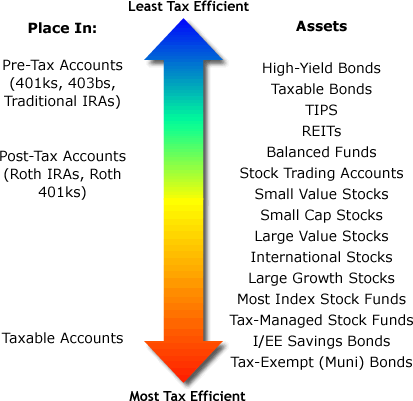
After choosing your asset allocation, it is still important to think carefully about where to place each type of investment. After all, what you actually keep is your return after taxes. For example, a stock index fund that tracks the S&P 500 will have low turnover and primarily pay qualified dividends which are taxed at the lower long-term capital gains rate (max 15%). On the other hand, REITs and bonds tend to distribute a significant amount of their return annually as unqualified dividends, which are then taxed as ordinary income (max 33%). Therefore, you should try to take advantage of your tax-sheltered accounts as much as possible by placing the least tax-efficient assets there.

Below is a chart that shows the major asset classes sorted by tax efficiency. It is based on information from the fine books Bogleheads’ Guide To Investing and The Four Pillars of Investing.

Chart of Relative Tax Efficiency of Assets

Let me clarify the chart above. You should start with the least tax-efficient assets and place them in your pre-tax accounts (Regular 401ks, 403bs, Traditional IRAs) first. Then the next least efficient assets should into the post-tax accounts (Roth IRA, Roth 401k). Only what is left after this should end up in taxable accounts.

In general, bonds should go into tax-deferred accounts, leaving stocks for your taxable accounts. There are even special “tax-managed” mutual funds which work hard to minimize any capital gains distributions and are designed specifically to be placed in taxable accounts.

This article is part of my Rough Guide To Investing.

Wells Fargo Lowers Requirements for Free Stock Trades

Wells Fargo is now offering 100 free online trades per year if you have $25,000 in brokerage equity, loan balances, or deposits with them (down from $250,000). This seems to be in direct response to Bank of America’s Free Trade program, which requires $25,000 in cash deposits.
Much Easier To Qualify
Although Wells Fargo is offering less trades than BofA (100/year vs. 30/month), it’s easier to qualify at Wells since you can use both brokerage and loan balances:

Wells Fargo accounts used for balance qualification include checking, savings, time accounts (CDs), retirement (IRAs), brokerage, trust (excluding irrevocable trusts), loans, outstanding credit cards and line of credit balances, and 10% of outstanding mortgage balance (certain mortgages not eligible).

I called them and confirmed that you can simply move over $25,000 in existing stocks and mutual funds to qualify for the free trades. You can even have, for example, $12,500 in taxable brokerage and $12,500 in an IRA and get 100 free trades for both accounts. Nice! There are no annual fees if you maintain the $25,000 all in one brokerage account, but if you split it across accounts you may be subject to maintenance fees (fee schedule). You will also need to open a PMA checking account with them.

Free Mutual Fund Trades Too
In addition to the stock trades, Wells Fargo is offering free mutual fund trades. This includes all no-load fund families that they offer, not just the ones on their no-transaction-fee (NTF) list, and includes names like Vanguard, Fidelity, Dodge & Cox, and Bridgeway. This could be great for people who want to consolidate all their holdings from different fund families into one account.

Don’t Have $25k? Try Zecco
Zecco.com continues to offer the lowest requirement for free stock trades, just a $2,500 minimum opening amount including stock equity. See my Zecco feature review for details. Zecco’s hurdles include their young brand and doubt that their business model will be able to keep the trades fee in the long run.

World’s Assets By Geographic Area

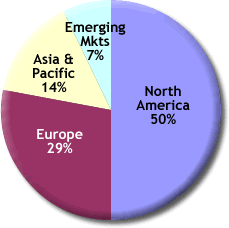
Ever wonder how the world’s liquid, investable assets are currently broken down by geographic area?

Pie Charts Are Yummy

This is based on market capitalization as calculated by the MSCI Global Capital Markets Index. The United States by itself is approximately 45%. It will be interested to see how this graph will change in the next decade.

Fidelity MyPlan: Should Good Savers Invest Less Aggressively?

Fidelity has a new tool called the myPlan retirement calculator. It’s very soothing and is only 5 questions long, why not give it a whirl? What I like about it is that it doesn’t just deal with average numbers. People like to use round numbers like 8% annually and pretend like they are a sure thing, but the fact is with some bad timing we could end up doing a lot worse.

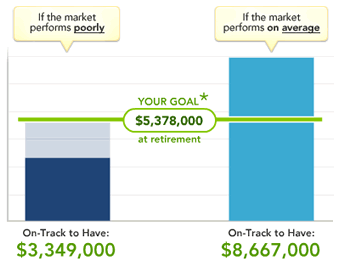
Using some rough numbers from our own situation – age 28, $100k income, $100k saved so far, $2,500 saved monthly, Aggressive Growth investment style, we get the following result:

myPlan Screenshot

Not bad, right? If the market performs on average, we will easily exceed what we need to retire on. (Yes, the numbers are huge!) If the market performs poorly however, we’ll be significantly short. Now, what if we change the investment style from Aggressive to Conservative?
[Read more…]

February 2007 Investment Portfolio Snapshot

It’s time for another bi-monthly update on my investment portfolio.

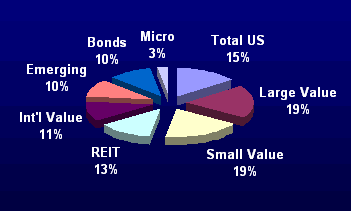
2/07 Portfolio Breakdown
 
Retirement Portfolio
Fund $ %
FSTMX – Fidelity Total Stock Market Index Fund $11,212 15%
VIVAX – Vanguard [Large-Cap] Value Index $14,057 19%
VISVX – V. Small-Cap Value Index $14,184 19%
VGSIX – V. REIT Index $9,781 13%
VTRIX – V. International Value $8,052 11%
VEIEX – V. Emerging Markets Stock Index $7,814 10%
VFICX – V. Int-Term Investment-Grade Bond $7,631 10%
BRSIX – Bridgeway Ultra-Small Market $2,109 3%
Cash – Unreinvested Dividends $500
Total $75,340
 
December and January Fund Transactions
$500 deposited in 401k, not yet invested

Thoughts
Another two months with little activity in my low-maintenance portfolio. I don’t get the joy of reading about my fund picks in magazines, but I don’t worry about choosing the wrong one either.

I am still ironing out a slightly tweaked asset allocation, one that has a more balanced domestic/international distribution and something I hopefully won’t mess with again for a long time. I’m reviewing the model portfolio comparisons and the books they came from, including Ferri’s new book All About Index Funds.

You can see some older posts on how this portfolio came to be here, as well as my previous portfolio snapshots here.

Starting Your Own Portfolio Out With Limited Funds

All of these suggested portfolios were developed by smart people who did their homework. But none of them are the same! This is because every single one also made compromises based on their interpretation of current research, simplicity, availability of suitable investments, costs, and also to some measure their overall predictions of the future. We have to do the same thing on our end.

For example, many people are starting with smaller amounts. Some of these model portfolios have 8 funds or more! Just by the fund minimums alone, you’d be looking at a minimum balance of $24,000 or so. And even then, you’d be looking a various low balance and maintenance fees. So what do you to minimize fees? Here are a few ideas:

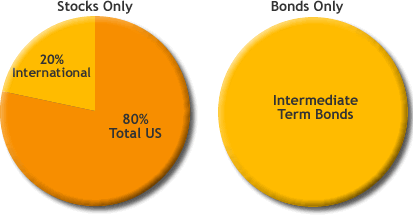
1) Buy an all-in-one fund, and split it up later. Since many fund companies have all-in-one target-dated funds, you can simply buy one of these until you have enough to split into other funds. Here are some specific fund suggestions, starting at only $50 per month. The fund’s asset allocation may not be exactly what you want, but it will be well-diversified, and still much better than other high-cost alternatives. Here’s what the Vanguard Target 2045 Fund looks like:

Vanguard Target 2045 Breakdown

I built up about $50,000 in Vanguard Target funds (VTIVX and VTTHX) before splitting it up into 8 funds last year. Since they were held in IRAs/401ks, I didn’t have to worry about any tax consequences. This choice is my favorite because it’s the most simple – just buy the same fund for a few years!
[Read more…]