Model Portfolio #6: Merriman’s FundAdvice Ultimate Buy and Hold

(This is the sixth in my series of Model Portfolio Comparisons.)

Paul Merriman also runs his own money management firm. He also writes at FundAdvice.com, which has a lot of interesting articles about investing in no-load mutual funds, with and without market timing. Here is the breakdown of their “Vanguard balanced buy-and-hold portfolio”.
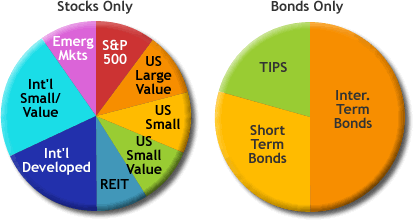
Fundadvice Model Portfolio Breakdown

Asset Allocation For 60% Stocks/40% Bonds
6% S&P 500
6% US Large Value
6% US Small
6% US Small Value
6% REIT
12% International Developed (Pacific + Europe)
12% Int’l Value
6% Emerging Markets
20% Intermediate Term Bonds
12% Short Term Bonds
8% Inflation-Protected Securities (TIPS)

They have other suggested buy-and-hold portfolios for different brokerages, which vary slightly but are still very similar. I find it interesting that the stock portion is perfectly 50/50 domestic/international.
Model Portfolio #5: A Random Walk Down Wall Street

(This is the fifth in my series of Model Portfolio Comparisons.)

First written in 1973, Burton Malkiel’s A Random Walk Down Wall Street (my review) has become an investing classic, pioneering the controversial idea that stock prices are random and thus a monkey throwing darts would be just accurate as any stock-picker. Below is a recommended asset allocation from the book for an investor in their “mid-twenties”.

Bold Investor Model Portfolio

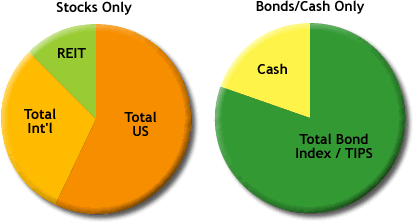
Asset Allocation Pie Chart, A Random Walk Down Wall Street

Asset Allocation for suggested 75% Stocks/25% Bonds ratio
43% Total US Stock Market
22% Total International Stock Market
10% REIT
20% Treasuries/TIPS/High-Quality Corporate Bonds
5% Cash

This breakdown looks very similar to the basic “Early Saver” portfolio from All About Asset Allocation. See the rest of the model portfolios for example mutual funds and ETFs for each asset classes.

As you age, the recommended percentage of stocks goes down to 65% at age 40 and 40% in late retirement. It is interesting to note that while Malkiel consistently recommends real estate as part of your portfolio, REITs were not explicitly included in the recommended portfolios until recently. I noticed this when comparing my personal copy (published in 1996) to the most recent edition. I’m guessing the growing availability of index funds that track REITs is the reason behind this.

Model Portfolio #4: The Intelligent Asset Allocator

(This is the fourth in my series of Model Portfolio Comparisons.)

I hope people aren’t getting overwhelmed by all of these portfolios. Remember, the law of diminishing returns applies to investment complexity as well. After a while, adding more asset classes and mutual funds doesn’t get you that much more expected return. If you’re getting bored, try some of the earlier portfolios and tune out the rest. Personally, I don’t mind having 8 funds or so, and I’ve found that after the initial setup the maintenance is pretty minimal.

William Bernstein, both a neurologist and a founder of his own money management firm, is the author of the challenging but information-packed book The Intelligent Asset Allocator (my review). Here is one model portfolio for those that desire moderate complexity and high risk. The author warns that while this asset allocation has very high expected long-term returns, it will behave much differently than the S&P 500 fund that many people use as benchmarks.

Bold Investor Model Portfolio

Asset Allocation Pie Chart, Bold Investor

Asset Allocation for 70% Stocks/30% Bonds ratio
[Read more…]

Model Portfolio #3: All About Asset Allocation

(This is the third in my series of Model Portfolio Comparisons.)

All About Asset Allocation (my review) is written by Richard Ferri, CFA, who is also the president of his own investment advisory service. If you are interested in learning more about how each asset class interacts with one another, I definitely recommend this book. Here are two model portfolios for younger investor, one simple and one more complex.

“Early Saver” Model Portfolio – Basic

Asset Allocation Pie Chart, Basic

Asset Allocation for 70% Stocks/30% Bonds ratio
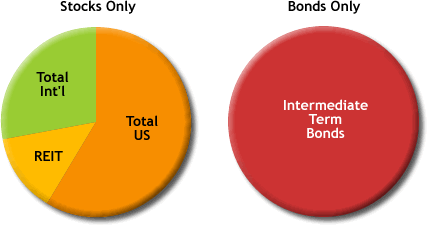
40% Total US Stock Market
20% Total International Stock Market
10% REIT
30% Intermediate-Term Bonds

“Early Saver” Model Portfolio – Slice-and-Dice
[Read more…]

Mutual Fund and ETF Asset Class Definitions: Stocks

What do all these asset classes in the model portfolio comparisons mean, anyways? Total Market? Large-Cap? Value? One big hurdle is that there are no set definitions for any of these classes, and each individual mutual fund can and will use it’s own interpretation. But let’s try anyways, starting with equities.

Market capitalization
Often simply referred to as “cap”, this is the company’s value as determined by multiplying the number of outstanding shares of stock by the current market price for one share.

Total US Stock Market
While the definition seems self-explanatory, there a bunch of different benchmarks used to track the entire domestic stock market on a cap-weighted basis. These all try to represent the roughly 5,000 companies currently being publicly-traded on major domestic stock exchanges.

Total International Stock Market
This theoretically includes all publicly-traded companies headquartered outside the US. As of 2005 this was over 20,000 companies, and tracking all of them is no easy feat.

The international stock market is further broken down into Developed and Emerging markets based on per-capita GDP and the maturity of the country’s stock markets. Examples of developed markets include Canada, Australia, Germany, Japan, and the United Kingdom. Examples of emerging markets include Russia, China, South Africa, and Turkey.

Further dividing both domestic and international markets are size and style considerations.

Size Classifications – Large Cap / Mid Cap / Small Cap / Micro Cap
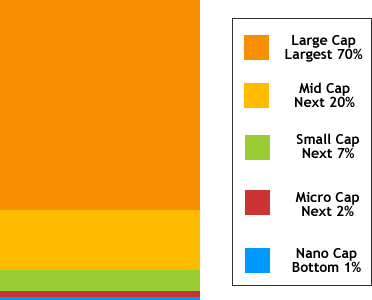
These are tough to define, as they change over time and people rarely agree completely anyways. Here’s how they look graphically as percentages of the market cap in their geographic area:1

Asset Class Size

By total value, here’s roughly how they break down:2
[Read more…]

Calculate Your Exact 2006/2007 Portfolio Rate Of Return

I sensed that people weren’t quite satisfied with my Rate of Return Estimation Calculator. After wasting lots of time trying to program the internal-rate-of-return (IRR) function myself, I realized I could simply embed an online spreadsheet. Ain’t technology grand?

The spreadsheets below will do all the exact calculations for you. I made one for 2006 and one for calculating your ongoing year-to-date and annualized returns in 2007. You will need to supply the date and amount of all deposits and withdrawals in your accounts. If you reinvested dividends then those can be ignored and rolled into the return.

Calculate Your 2006 Portfolio Return

[Read more…]

Model Portfolio #1: Couch Potato Portfolio

(This is the first in my series of Model Portfolio Comparisons.)

The Couch Potato Portfolio is the invention of Scott Burns, a personal finance columnist at the Dallas Morning News. Originally, the portfolio consisted of just two funds – the Vanguard S&P 500 Index Fund (VFINX) and the Vanguard Total Bond Index Fund (VTBMX). That was over 15 years ago, and it has beaten most balanced funds in the meantime. The current version is below.

Asset Allocation (All Ages)
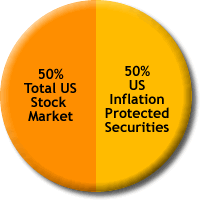
50% Total US Stock Market
50% US Inflation-Indexed Securities.

Pie Chart for Couch Potato Portfolio

There are many ways that people find fault with this portfolio – low stock allocation, no risk adjustment with time, no international exposure, no REIT fund. Partially in response to these, Burns has also introduced other variations like the Margarita Portfolio and Four Square Portfolio. The Margarita Portfolio is 33% Total US Stock Market, 33% Total International Stock Market, and 34% Inflation Protected Securities. But still, you can’t beat the simplicity.

Model Retirement/Investment Portfolios: A Comparison

In my rough guide to investing, I suggested some all-in-one mutual funds for beginners. But what if you want to go a step further and design your own portfolio? Or you have a 401k with only limited choices?

Of course, the best answer is always to read some good books. But another idea I’ve been meaning to do for a while is to collect the model portfolios from lots of different reputable books and sources and compare them to each other. You won’t see any individual stock picks here, all the sources will be based (at least loosely) upon modern portfolio theory and thus focus on optimizing the risk/reward ratio using proper asset allocation.

I think it should go without saying that since these are model portfolios, they are imperfect by design and at most should serve as rough guidelines for your own investing. Everyone has a different time horizons and situations. Use them as one part of your own research.

One way to tailor these portfolios to your own use is to adjust the stock/bond ratio according to how aggressive you wish to be. Accordingly, I have tried to separate the stock and bond components.

Completed Model Portfolios

  1. Couch Potato Portfolio
  2. Boglehead’s Guide To Investing
  3. All About Asset Allocation
  4. The Intelligent Asset Allocator
  5. A Random Walk Down Wall Street
  6. FundAdvice.com by Merriman
  7. Unconventional Success by Swensen
  8. Columnist Ben Stein

Future Model Portfolios (in progress)

Here are the remaining sources that I have in mind so far. Please feel free to suggest others.

  • The Four Pillars of Investing by Bernstein (Review)
  • Common Sense on Mutual Funds by Bogle (Review)
  • The Informed Investor by Armstrong (Review)
  • Index Funds: The 12-Step Program for Active Investors by Hebner (Review)
  • Coffeehouse Portfolio by Schultheis

This index of posts has been added to my Rough Guide To Investing.

Why You Should Ignore Stock Market Predictions

The Motley Fool used to be a great resource for investing, espousing index funds and low-cost investing, but it is gradually becoming just a factory that churns out stock tip newsletters. Last January, they made some Stock Predictions for 2006.

Read the predictions first, or at least skim the excerpts below. Which do you agree with?

#1: Shares of Google will fall in 2006

Wall Street didn’t want to buy into Google when it went public at $85, but now that the stock trades five times higher that that, bears are hard to come by. The humbled market mavens have responded with higher price targets, but gravity always seems to be just a disappointing quarter away.

#2: Both XM and Sirius will close out 2006 higher

Just as your cable bills creep higher every year, XM and Sirius will likely be charging more in the future. Tack on premium offerings and next-generation receivers that will blow the earnings potential through the roof — by allowing for everything from digital downloads to immediate responses to sponsored pitches — and I really believe that in five to 10 years, a lot of the bears will be licking their self-inflicted wounds for missing this obvious play into a promising duopoly.

#3: TiVo will bounce back

I’m expecting TiVo shares to bounce back dramatically, possibly even into the double digits. I still believe that TiVo — rich in brand, patents, and daydreams — will find a way to matter in a form that investors will find attractive. Cool companies never die without a fight.

#4: Six Flags will be one of the top stocks of 2006

With shares of Six Flags trading in the double digits for the first time in nearly four years, the market seems to be willing to give Dan Snyder and ESPN prodigy Mark Shapiro better than a fighting chance to turn the regional amusement-park operator around.

The stock may have tripled since bottoming out last year, but that doesn’t mean the value of the company has tripled. This is an important distinction to make. Because the company’s balance sheet is packing $2.1 billion in debt, the enterprise value of Six Flags has actually risen by just a little better than 50% to $3.5 billion. That’s the beauty of leverage in a turnaround situation: The stock can double here in 2006, growing sixfold in two years, yet the company’s enterprise value will have only doubled in that time.

Now, if you tracked these stocks this year you may already know which were right…
[Read more…]

A Quick Lesson In Wall Street Lingo

It can be tough watching CNBC and reading stock market articles without knowing the proper terms. Here are some helpful pointers:

  • Profit-taking: All-purpose explanation for why the market went down.
  • Correction: A major market crash made to sound like a minor mistake.
  • Momentum investor: Buyer of stuff that’s already gone up.
  • Value investor: Buyer of stuff that looks like it’ll never go up.
  • Broker: What you’ll be, if you follow their advice.
  • Financial consultant: Broker trying to appear respectable.
  • Financial planner: Financial consultant who might actually be respectable.
  • The smart money: Owners of whatever has lately performed well. No permanent members.
  • Federal Reserve: Extremely powerful, like God, and also moves in strange and mysterious ways.
  • Warren Buffett: Widely admired investor who is often quoted by lesser mortals seeking to buttress their arguments.
  • Futures: Trade these too much, and you won’t have one.
  • Collectibles: Justification for buying things that will never appreciate in value, but you really, really want.
  • Stock options: A way for senior executives to get rich.
  • Hedge funds: Like mutual funds, except with much higher fees. But the bragging rights are priceless.
  • Cash-value life insurance: Great strategy for retirement, assuming you’re an insurance agent and you can sell enough of these policies.
  • Variable annuities: Chance for ordinary investors to pay hedge-fund-like fees.
  • Commodities: Pigs with lipstick.

Excerpted from Jonathan Clements in the Wall Street Journal (subscription required), found via No Money In Poetry.

Dollar Cost Averaging: A Poor Way To Reduce Risk?

Dollar Cost Averaging (DCA) involves investing a fixed amount at a regular interval. Lump-Sum Investing (LSI) involves putting in all the money you have available to invest at once. These are not mutually exclusive! If you are investing a portion of your paycheck every month, you are both Dollar Cost Averaging and Lump Sum Investing. The following is not about such habitual savings.

However, a different situation arises if you have a larger amount of money. Maybe you received an inheritance, an early retirement payout, or you just sold your house. Do you invest the entire amount immediately, or buy a little at a time? Due to the overall upward trend of the markets, lump-sum investing outperforms DCA about 2/3rd of the time. The argument then, is that DCA is a risk-reduction mechanism; You get less performance, but also less exposure to those ups and downs. But is DCA the best way to lower risk?

This question was examined in this academic paper titled Nobody Gains from Dollar Cost Averaging by Knight and Mandell. Here’s a sample of their results. Let’s say you have $100,000 to invest, and you want to achieve a portfolio of 90% stocks (modeled as the S&P 500) and 10% bonds (T-Bills). But that sounds risky to you. You decide to instead invest gradually over 10 years, every month putting a little bit more in, until you finally put $90,000 into stocks.

But what if you instead put everything at once into 50% stocks and 50% bonds, and kept those 50/50 proportions for the entire 10 years instead? That would also reduce your risk. You may be surprised to find out that historically the 50/50 rebalanced portfolio actually had the same amount of volatility than the 90/10 dollar cost averaged portfolio, but with a higher average return (8.37% vs. 8.05%).

So if you are keeping money out of the market because you don’t want to be exposed to a crash, it may simply be better to invest in a less aggressive investment mix. But if you are already regularly investing what you can each month, keep it up! This doesn’t apply to you.

For more academic papers on why DCA is not the best way to reduce risk, see this AltruistFA reading list. Thanks to reader Craig for sending me this article.

For my overall thoughts on investing for beginners, please see my Rough Guide to Investing.

Update to My Rough Guide To Money and Investing

I just made an update to My Rough Guide to Money and Investing, a loose framework of some of my more general money-management tips. Hopefully this is more organized and easier for everyone to digest than trying to dig through the archives.

So you can keep up with future updates more easily, I’ve also placed it in my “Popular Posts” section on the top right of every blog page. It’s replaced my $20 Emigrant Direct Savings Signup Bonus, although that’s still going strong.