December 2006 Investment Portfolio Snapshot

Now how about a snapshot of our investments, as of the end of the day 12/15. Remarkably, our investments have increased $4,911 (7.3%) since my last update in October. Another example of how I can’t predict the stock market. We’re already done contributing to our Roth IRAs and 401ks this year, so we haven’t made any new deposits. Everything has been going into the house down payment fund.

I did realize that I’m not including my Bridgeway investments in my net worth calculations. This is because Bridgeway does not work with Yodlee, and I never remember to log into their website. Oops!

Retirement Portfolio
Fund $ %
FSTMX – Fidelity Total Stock Market Index Fund $11,058 15%
VIVAX – Vanguard [Large-Cap] Value Index $13,775 20%
VISVX – V. Small-Cap Value Index $13,748 19%
VGSIX – V. REIT Index $8,813 12%
VTRIX – V. International Value $7,821 11%
VEIEX – V. Emerging Markets Stock Index $7,500 10%
VFICX – V. Int-Term Investment-Grade Bond $7,596 10%
BRSIX – Bridgeway Ultra-Small Market $2,056 3%
Cash – Unreinvested Dividends
Total $72,367

[Read more…]

Specific Mutual Fund Investment Ideas For Beginners

(Note: This is an older post from my archives, and was last revised in 2007, so some things may be out of date. Please check out my investing guide for more recent material.)

Although I get asked regularly to do so, I’m always wary of making specific investment advice . I’m haven’t passed any securities exams, and I have no financial letters after my name like CFA, CFP, CIC, or ChFC. I’m just a SRDO – Some Random Dude Online.

At the same time, I also appreciate the fact that people like to hear some specific suggestions in order to jumpstart their own research. It’s like being told “go buy a good used car” versus “check out the 2002-2004 Honda Civic (7th Generation, but not the 1st year) with less than 60,000 miles on it.” It’s not the perfect answer for everyone, and you may not even buy that car, but it gives you something to work with.

With that in mind, this is what I would tell my sister to invest. Not you, because I don’t know you. 🙂 She’s in her early 20s, recently out of college, working in her first professional job, and trying to balance renting in a big city, being young and trendy, paying back student loans, and oh yeah! – also retirement. She’s busy, doesn’t feel like reading the books I recommend just yet, but has some extra money now to put away for the future. So what does big bro tell her?

Get investing! You need to do this now so you can:

  1. Reduce your risk in the long run
  2. Get used to the ups and downs of the stock market (so you don’t just bail out later).

Option 1: No Money Down?
Set Up An Automatic Transfer at TIAA-CREF or T. Rowe Price

If she’s doesn’t have much to start with but is willing to set aside $50 every month, you can open an account at T. Rowe Price or TIAA-CREF with no initial investment minimum. If you’re in your 20s, look at the T. Rowe Price Retirement 2045 fund (TRRKX) or TIAA-CREF Lifecycle 2040 (TCLOX). Both seem to be solid companies with good customer service. They will get you “in the game”, are very low-maintenance, and will leave you with plenty of time to refine your tastes afterwards.

The good thing about starting low is you’ll get gradual exposure to the volatility of the market. In the beginning, it took me a while to get used to the fact that my balance could easily be much lower than it was yesterday. That can be very disconcerting for those only used to bank accounts.

Option 2: Think Long Term
Open Up An Account at Vanguard

I make no secret that I really like Vanguard. They have reliably low expenses, are fair and upfront about their fees and how they are compensated, and they are client-owned. Although they may have some higher fees in the beginning, I believe that over the long run their low expenses and indexing-expertise will result in superior performance. This is a company that I can see sticking with for the next 50+ years. So here’s one strategy using Vanguard for any account size:

Less Than $1000 – If she has less than $1,000, I’d tell her to just stick it in a high-yield savings account. Set up some automatic transfers from her checking account after each paycheck, and start building that up until you have…

$1000-$3,000 – Here, the only fund that’s available is the Vanguard STAR Fund (VGSTX). You can open up with $1,000 to start and add in $100 more at a time. It’s an okay fund, currently with 63% stocks, 25% bonds, and 12% cash. The point isn’t to get the perfect asset allocation right away, it’s to get get started. Again, see the two main goals above.

$3,000+ – When you get to this amount, exchange your shares into the Vanguard Target Retirement 2045 Fund (VTIVX). Since it’s in an IRA, there are no tax consequences or paperwork to worry about. See my post comparing Vanguard and T. Rowe Price Target funds for why I like it the best.

For all Vanguard IRAs, there is a fee of $10 a year for each fund account with a balance of less than $5,000 (waived with high overall balances). Use the $10 as a specific savings goal – “I will eat out one less time this week, saving $10”. Then write Vanguard a check for the $10 separately, so it’s not taken out of your Roth IRA balance. You want all that money compounding away! These fees are now waived with e-statements!

With all of these options, it is always a good idea to set up automatic transfers to avoid the “I forgot again because I was busy” factor. Also, feel free to call any of these companies on the phone. You should get a helpful human quickly, I always do with Vanguard.

Anyways, I hope these suggestions provide some good starting points for your own research. I sure hope my sister listens to me! As always, comments are welcome.

A Better Way To View Stock Market Risk

(alternate title: Don’t Put Your Roth IRA into CDs or Cash!)

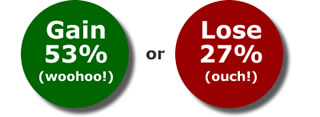
The prospect of losing your hard-earned money is scary. You know that if you invest with $1000 in stocks, in a year you could be left with either a huge gain or a huge loss. People (including me in the past) tend to look at the stock market like a slot machine:

Wrong Outlook

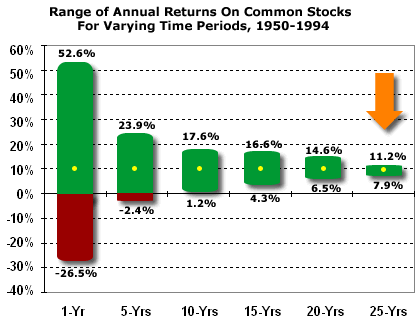
This is good in that, yes, for the short-term the stock market is risky. Don’t put money you may need right away into stocks. However, when young people tell me that they are putting their Roth IRAs in a bank CD because they are afraid of the stock market, that is bad. Roth IRAs are long-term investments. We’re talking 30, 40, 60 years for some people! The way you should be looking at the stock market is this:

Correct Outlook

[Read more…]

Target Retirement Mutual Funds: T. Rowe Price vs. Vanguard

T. Rowe Price vs. Vanguard

Target-dated retirement mutual funds are getting more and more popular, offering instant diversification into stocks and bonds, as well as automatically shift to a more conservative blend as you near your target retirement date. An all in one fund! Whenever you see a finance article talk about the “best” of these mutual funds, invariably Vanguard and T. Rowe Price top the list. Recently, Kiplinger’s Personal Finance magazine named T. Rowe Price “the best Target fund available”. I’ve been meaning to do my own personal (and imperfect) comparison for a while now.

What makes a fund good?
First, why am I picking these two to compare? If you’ve read the books on my reading list, you’ll know that history and research has shown that the two most important factors that predict long-term performance are:

  1. Asset class – What is the fund invested in? Large-cap domestic stocks? Short-term bonds?
  2. Expense ratio – How much is the mutual fund company charging for its services?

Vanguard founder John Bogle sums it up well:
[Read more…]

My Recommended Reading List For Investing

While there is a ton of great financial information on the internet, I still think the best way for a beginner to learn how to invest is to read a book. It’s by far the most efficient way to understand all the history and research behind why people like me promote low-cost index fund investing. The more you know, the less you’ll be tempted to pay high fees or chase hot stocks.

By my count, I have read and reviewed 24 financial books so far. Here are my picks. They would make a great gift or simply provide some useful reading during holiday downtime. I own all of these books, and they were some of the best money I’ve ever spent.

Best Beginner Personal Finance Book

The Richest Man in Babylon:Short and very easy to read. Teaches the merits of living below your means and investing the rest for the future. [my full review]

Best Starter Investing Book
[Read more…]

You Have Some Money. Where Do You Put It?

altext

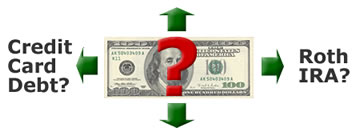
I went over understanding your spending and also free budgeting tools. Once you start managing your money better, you should be spending less than you earn. Or maybe you have come across a lump sum of money somehow. Now what do you do with the money? Although everyone’s situation is different, I think that a good discussion can evolve from this.

Here’s a list of possibilities:
[Read more…]

Index Mutual Funds or Index ETFs: Which Is Better?

Ever since exchange-traded funds became popular, many index fund investors have taken notice. Should we try to take advantage of the often-lower expense ratios? Can we overcome the commissions from trading? For example, both of these track the S&P 500 index:

IVV – iShares ETF, expense ratio of 0.10%
VFINX – Vanguard Mutual Fund, expense ratio of 0.18%

I just ran across this article at IndexUniverse.com, which compares the performance of mutual funds vs. ETFs for various indexes.

The general conclusion was that the main ETF for an index outperforms the average mutual fund tracking the same index. However, if you choose the Vanguard fund version, you will get very similar or sometimes even better performance due to their superior index management. [Read more…]

Roth IRAs For Everyone!

Back in May, legislation was passed that allows Traditional IRAs to be converted to Roth IRAs without any income restrictions in 2010. Previously, this conversion was only available to taxpayers with adjusted gross incomes of $100,000 or less, no matter if you’re married or single. You even get two years to pay the taxes on the conversion. One of the more detailed articles I’ve seen written about this change is this USA Today article.
Another side effect of this new law is that it opens up a gaping loophole so that allows anyone to contribute to an Roth IRA, albeit indirectly:
[Read more…]

Tune Out All That Financial Noise

In geek speak, the term “noise” is any disturbance that interferes with or prevents reception of a signal, like the static on your cell phone. In the financial world, the intended signal is trying to tell us how to best accumulate wealth, and the interference is 95% of what you hear from the media. Forbes Magazine’s Mutual Fund Honor Roll? Well-packaged noise. Jim Cramer of Mad Money? Annoying noise. This is according to Chapter 18 of The Bogleheads Guide to Investing.

I think that there is much truth to this assertion. In essence, anything that attempts to “beat the market” is saying this:
[Read more…]

How To Link Scottrade To External Accounts

This is just a follow-up my previous post on Scottrade enabling electronic deposits, but not withdrawals. You can get withdrawals too if you (a) can get $5,000 in total account equity (stock holdings + cash), and (b) use an online bank account that allows external links (ING, Emigrant, HSBC, etc.).

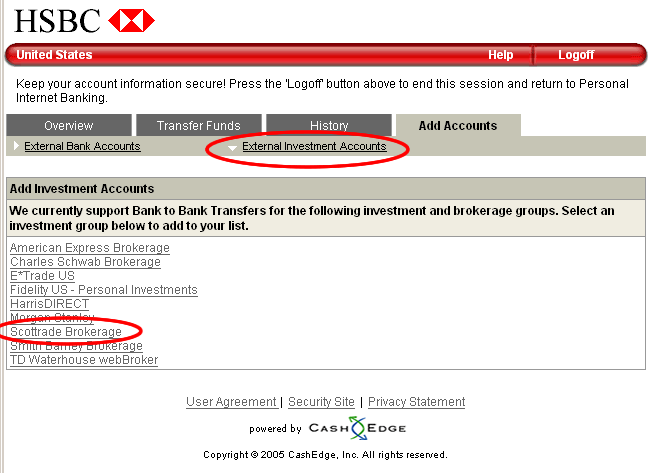
No tricks here, if you satisfy (a) Scottrade will give you check writing capability upon request. You can then either use the checks themselves or the account and routing numbers on them to link with other accounts. If you use a CashEdge-based system like with HSBC Direct, it’s even built in; Here’s a screenshot. They say that if you go below $5,000 later you may lose checkwriting privileges, but I’ve been under for about a month now with no consequences.

Trade Execution: Why It Matters, and Broker Comparison

The SEC has a nicely-written article about how your stock trades are actually executed, and how it may affect the price you buy or sell at. This stems from the fact that usually your broker has to send your order to a market maker to actually do the trade, which may in turn pay your broker a rebate. Critics say this raises questions about whether your order will truly be routed to get the best price, and I would tend to agree. However, many brokers do some form of this, and many rebates are linked to supplying enough liquidity for each market maker.

In looking for a good comparison of trade execution between different discount brokers, I found this recent Barron’s broker comparison of 27 brokers, including many you’ve seen mentioned here:

Sample Trade Execution Ratings (out of 5, higher is better)
MB Trading – 4.8
Fidelity – 4.4
E-Trade ‘Serious Investor’ – 4.2
Scottrade – 4.1
TradeKing – 3.8
Schwab – 3.7
Ameritrade I-Zone – 3.4
FirsTrade – 2.8

Overall, the brokers that target very active traders got higher scores than the more mainstream ones. Although Scottrade does accept payments for order flow, they rated a 4.1 out of 5, which was above average in this group. MB Trading achieved one of he top scores 4.8 with its advanced “smart” order-routing features. It remains to be seen how Zecco.com does with their free stock trades.

As the Barron’s article would suggest, trade execution is still one of several criteria with which to judge your potential broker, and any differences remain hard to quantify with dollar amounts.

Scottrade Referral Swap List

People are still asking me for Scottrade referrals, but I’m not allowed to give them out anymore. Instead, I’m going to start a list of My Money Blog readers who already have accounts that are willing to give out referrals. If you are interested, please contact me and I’ll put you on the list.

Please note that you may need to share your name, e-mail, and/or branch location when giving out a referral. Tell me if I referred you initially, and I’ll give you priority. Otherwise, I’ll just run through the list in order, everyone gets a shot. The referrals will be between just the reader and referree, so don’t even mention this blog when signing up. Hopefully this will resume the referral sharing love.

Added: I reserve the right to move on to the next person in the list if the referrer contacted doesn’t respond within 24 hours, at the request of the referree.

Added 10/14: I have a good number of people now, thanks everyone. You can still e-mail if you want, but know that there will be very little chance that I will use your referral.