More IRA Options For Those Starting Out

I listed one good IRA option yesterday for those that are just starting out saving, but now I want to spend some time and explore more options. I don’t want it to seem like I favor Fidelity – people were asking for a good option and I threw one out there. Maybe not the best, but again, sometimes just starting is more important. Besides, you all know that my own retirement money is at Vanguard. 😉

For the purposes of this comparison, I am assuming that we are talking about a person who does not have a lump sum to invest, but can manage to set aside $200 a month towards an IRA. For those that think that’s too little to start, consider this: Just $200 a month, starting from age 25, growing at a tax-deferred 8% annually, will grow to about $1,000,000 by age 70. For simplicity of comparing investment choices, I will also compare each broker’s auto-pilot retirement funds.
[Read more…]
Goodbye MB Trading

I just closed my MB Trading brokerage account, which I only recently opened. First, I didn’t really like the interface of their proprietary software or their website layout at all. Neither was not very user-friendly, at least for my amateur tastes.

On top of that, early February they charged me $10 for ‘Jan Software Charges’, which turned out to be their options feed, which I don’t recall signing up for and I definitely never used. Their e-mail support then took 3 days to get back to me when I asked to cancel that feed. Not only would they not waive the original fee, but since it was already February when I got charged, I was charged another $10 for getting the feed in February! $20 in fees and I only had the account open 3 weeks.

All these things are minor separately, but together it just left a bad taste in my mouth. So I’m now looking for another low-cost broker.

Amerivest Feature Review and Comparison

As mentioned in my last post, Amerivest is Ameritrade’s new attempt to bringing a flat annual fee to discount investment planning, instead of commissions for each trade. First, they have some software ask you a few questions on your risk tolerance and investment amounts, which spits out one of 25 predetermined baskets of index ETFs. Each basket has what looks like 4-7 ETFs in the proportion to create the asset allocation that it decides you need. It then tells you how much you need to invest each month to reach your goal.

I used their online chat to find out more about the service:

» They don’t offer actual human advice. For example, you can’t tell them your situation details and have them customize your plan. You can alter the basket, but advise-wise the computer is all you get.

» If you send them monthly automatic cash transfers, they will invest your money each month across the ETFs in your chosen basket. Again, no trade commissions.

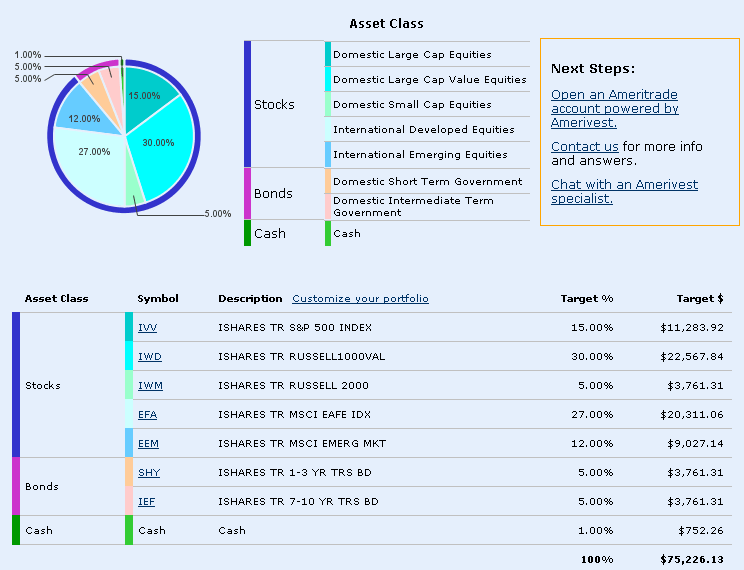
» The basket determined by the software available for free is what you would buy using their service, although you can modify it if you want. You can view my result, their most aggressive portfolio, here. In other words, it doesn’t automatically change with time as you get older, and it doesn’t seem to plan for taxes or fees.

» They do re-balance your portfolio automatically at the interval you choose, say annually, so your asset allocation does not shift too far away from its intended percentages.

» They do not automatically reinvest dividends. Dividends are invested during your periodic rebalancing.

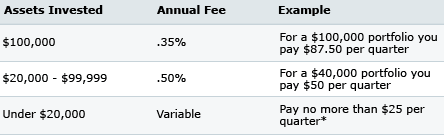
So how much does this cost? Here’s is their rate chart:

One way to compare this to imagine if you wanted to dollar-cost-average into 5 different ETFs every month. With Amerivest, a $20,000 portfolio would cost $100 a year and a $100,000 portfolio would cost $350 a year. At Ameritrade’s usual brokerage pricing of $11 a trade, that’s 60 trades a year = $660 a year in commissions. And that doesn’t even include any trades you would have to do to rebalance your portfolio. Of course, at MB Trading those 60 trades would cost only $60 a year unless you were buying more than 100 shares at a time.

In the end, I think that this service is much closer to what companies like ShareBuilder, FolioFN, and BuyandHold provide rather than any real portfolio management. For example, Sharebuilder gives you 6 trades per month at only $12 a month, for a total of $144 a year regardless of your account balance. Similarly, they give you guidance on a suggested basket of ETFs with their PortfolioBuilder feature.

Finally, Amerivest’s extremely optimistic projections do smell a bit like a marketing ploy. And I don’t see why they have to charge more for a $50,000 portfolio vs. a $500,000 portfolio, as they aren’t actually doing anything more.

I’m Done Saving For Retirement… According to Amerivest

Amerivest is Ameritrade’s new financial-advisor-in-a-box, which I’ll blog more about later. But first, I tried out their Simulator. I put in basically the same information that I used for my retirement nest-egg calculations – We want the equivalent income of $96,000 a year in retirement. Inflation is estimated at 3% annually. We’ll retire at age 60, and live for about another 30 years after that. I picked the most aggressive options for all the risk-tolerance questions. The answer? We need just a lump sum of $75,226.13 now to achieve our retirement goals. What?
[Read more…]

Where To Invest My Free Money? Suggestions Please

So, I have my Free Money Account all set up and ready to go. Now I just have to figure out what to invest in. At $1 a trade, I can dollar-cost-average into a new ETF every month for the price of a Wendy’s Frosty. Now, I want to be aggressive but somewhat diversified, so I am looking for suggestions for index ETFs with low expenses in the following areas:

Micro-Cap / Small-Cap / International / Emerging Markets

So far, I have the following on my list: IWC, PZI, IWM, IJS, VBR, EFV, EEM, VWO. Opinions on these? Any other suggestions? I’m somewhat open to different areas like sector ETFs, but you’ll have to argue a good case.

Free Money Brokerage Account Opened With $2,000

I recently opened a MB Trading brokerage account. While it took almost 3 weeks since I had to mail in the paperwork and check for deposit, their customer service seemed pretty good and kept me updated. I wasn’t in a hurry, so no big deal. They do not have a web-based trading interface, you must do all your trades through their MBT Navigator software or by phone. The software has tons of bells and whistles, but as long as it gets the job done I’m happy.

My plan for this account is to put all the free money I get via various Deals and other Offers I do, and instead of spending it I’ll invest it aggressively in ETFs to allow it to grow. I opened the account with $2000, the minimum allowed. Although I haven’t quite made $2,000 in free money from bonuses alone, the minimum opening deposit was $2,000 so I’ll start with that. I’m sure I forgot some bonuses anyways.

Motley Fool Interviews Vanguard Founder John Bogle

Speaking of being a BogleHead, I just finished listening to an interview of Bogle on NPR’s Motley Fool radio show, available online here. Thanks to reader Jonathan for sending it to me. John (Jack) Bogle, if you don’t know, is the founder of The Vanguard Group, and is known as the father of index funds.

My favorite part was where the Motley Fool asks him about picking individual stocks. Remember, Motley Fool makes their money by selling their stock picks. You can just feel Bogle trying not to rip them. He holds back and just says “the odds are against you”. Hah. To satisfy the stock-picking urge that many of us suffer from, he recommends a “funny money” account, much like my play money portfolio.
[Read more…]

MBTrading.com – Researching A New Stock Broker

I am warming up to my idea of making a separate brokerage account for all of the free money I’ve gotten from banks, brokerages, and credit card companies. After some preliminary research, I’m leaning very heavily towards one broker – MB Trading, as they feature:

» $2,000 minimum to open.
» No minimum balance fees, no minimum commissions per month.
» Per-share stock commission of 1 cent per share up to 500 shares, and 1/2 cent per share over that. The minimum commission is $1. This means as long as you are trading less than 100 shares, you’re only paying $1 a trade!
[Read more…]

Dollar Cost Averaging versus Lump Sum Investing?

A good discussion came up in my previous post on my IRAs – Should I invest the $4,000 earmarked for my 2006 Roth IRA contribution all at once in January, or dollar-cost-average it over the entire year? Dollar Cost Averaging (DCA) involves investing a fixed amount at a regular interval. For my $4,000 example, I could invest $335 a month, every month, for 12 months. The idea is to buy more shares when the price is low, and and less shares when the prices are high. Sounds good, right? Maybe.

This question actually came up last year, but I didn’t research it very much. My own thoughts were that because the markets trend upwards overall, if you are investing for a long-term period you should get your money in as soon as possible. Sure, you might run into a huge drop, but you could just as easily (in fact more easily) miss a huge rise. But this is too hand-wavy, as scientists would say. I want numbers. So I found some.
[Read more…]

Sold 100 Shares of Scholr Pharma Stock

I really only glance at my stock portfolio about once every other day, mostly to check that nothing has imploded. My desire to be a knowledgeable stock investor fizzled after reading books about index funds and how people much smarter than me can’t beat the market. But I still have my “play money” stock portfolio, which I started with $5,000 back in 2001. It’s now at about $5,690 (publicly tracked here), and I’m still beating the S&P 500 since its inception. Just call me a slightly lucky monkey throwing darts.

I noticed today that Scholr Pharmaceuticals (DDD), a stock I bought after minimal initial research, was finally above my buy price of $4.80 due to some buzz about a potential buyout. Since buying the stock, I did a bit more reading and am really not impressed with the company after all, so I took this opportunity and sold my 100 shares at $5.25.
[Read more…]

30 Days to Becoming a Better Investor

When I started out this blog, I thought I’d be talking a lot about how to value stocks, technical analysis, and so forth. It turns out so far I’ve just put all my retirement money on autopilot in low-cost Vanguard index funds. But once I buy my house I do plan to jump back into things, as I still believe investing in stocks will bring the best long term return.

If you do too, consider submitting your thoughts to 30 Days to Becoming a Better Investor from George of Fat Pitch Financials. I submitted my post on how to potentially ‘beat the market’ by taking advantage of current tax rules.

Buying a 4-Week Treasury Bill, Hoping to break 4.30%

I think it was pretty cool we predicted the new I-Bond rate two-weeks ahead of time, and let everyone make some educated decisions on when to buy. I’m now interested in Treasury Bills. Today, the new rate for the 4-week T-Bill is 3.788%. After using our tax-advantaged conversion formula and using a 25% federal tax rate and 9% local tax rate, this works out to the equivalent of a bank rate of 4.30%. Not bad at all.

Too bad I can’t guarantee myself that rate. Apparently, you can’t figure out the exact rates ahead of time, as they are sold in an auction format. And if you buy them through TreasuryDirect.gov, you don’t actually participate in the auction, you just agree to buy them at the decided price. On the plus side, you pay no commissions. The next auction is November 8th. Since tomorrow the Fed is expected to raise rates again, I just put in a order to buy a $1,000 4-week T-Bill to see how it works out.