Reader Question: Should I Buy Savings Bonds in September/October 2021 or November 2021?

sb_poster

Here’s a timely reader question about Series I Bonds. It’s a good question because I predict that Series I Bonds will be soon getting even more media attention soon due to an even higher inflation-linked rate.

Would it be best to wait till November 1st to purchase I bonds? You mentioned the fixed rate will probably confine at 0. but what about the semiannual inflation rate? Do u think it is likely to be more than 3.54%? I’m new to this please educate me.

Series I Bond rates react every 6 months to delayed inflation reports from the Bureau of Labor Statistics. August CPI-U was already reported in mid-September, and September CPI-U will be reported in mid-October. 5 out of 6 months of data are already in the books, leaving only one month of data left. The 12-month trailing inflation rate as of that August CPI-U update was over 5%. Therefore, unless that data contains a significant amount of deflation, we already know that the next inflation rate on Series I Bonds is going to be higher than the 3.54% from May to October 2021. I roughly estimate the range that the next inflation rate will be between as 5% to 7%. That should be enough accuracy to make a purchase timing decision, earlier than my usual practice of waiting until mid-October.

  • If you buy in September or October 2021, you will receive a total rate of 3.54% for the first six months, then the “new” (estimated 5%-7%) rate for the next 6 months, and then new rates adjusted every six months for inflation onward.
  • If you buy in November 2021, you will receive the “new” (estimated 5%-7%) rate for the first 6 months, and then new rates adjusted every six months for inflation onward.

The takeaway is that either way, you will earn the “new” rate (estimated 5%-7%) eventually. If you buy in September/October, you’ll just have to wait a bit due to the staggered structure. Given that the current rate of 3.54% is still a higher interest rate than nearly any other savings account or CD is paying, I would personally just invest now if I had the cash ready and waiting. Also remember that Series I Bonds do not allow early withdrawals within the first 12 months after purchase date. As long as you complete your purchase by the end of September, it will count as purchased in September 2021 and you will be able to withdraw as of September 1st, 2022 (though subject to a penalty if held less than 5 years). It may take a little bit to set up your TreasuryDirect account, and it may take a couple business days for the withdrawal and purchase to process, so I wouldn’t wait until the last day.

Annual purchase limits. The annual purchase limit is now $10,000 in online I-bonds per Social Security Number. For a couple, that’s $20,000 per year. You can only buy online at TreasuryDirect.gov, after making sure you’re okay with their security protocols and user-friendliness. You can also buy an additional $5,000 in paper I bonds using your tax refund with IRS Form 8888. If you have children, you may be able to buy additional savings bonds by using a minor’s Social Security Number.

As noted in my previous savings bond posts, these Series I bonds are a unique investment opportunity in that they are only available to individuals and are subject to purchase limits. Even if the real yield (fixed rate) is set at zero, that is still significantly higher than that of TIPS that trade on the open market (well negative across the board!). If institutional investors like pension funds or endowments could buy I bonds like you and me, they would buying billions of them.

I plan to purchase up to my annual purchase limit for 2021 as part of my asset allocation to inflation-linked bonds, although you can start with as little as $25. I guarantee that there will be many more articles about Series I bonds in mainstream personal finance sites in November after the new rate is officially announced.

John Paulson: Best Way For Average Person To Invest $100,000 Today?

Bloomberg has an interview transcript with investor John Paulson, and it has the catchy headline Billionaire Paulson Who Shorted Subprime Calls Crypto ‘Worthless’ Bubble. He does say that, but the interview also includes some insights on many other topics like asymmetrical trades, gold, the highly-limited supply of crypto leading to high volatility, interest rates, and controlling how you spend your time.
If you are having trouble getting around the paywall, let me include this quote:

If somebody came to you and asked how they should invest $100,000, what would you tell them?

I always say the best investment for an average individual is to buy their own home. So if you take that $100,000, put 10% down, get a $900,000 mortgage, you can buy a home for a $1 million. It was just reported that home prices were up 20% in the last month. So if you bought a home for a $1 million with $100,000 down and the home was up 20%, that’s $200,000 on a $100,000 investment. The longer you wait, the more the house is going to appreciate and the greater return you’ll have on your equity investment. So I think the single best investment for anyone with that type of money would be to buy their own house or apartment.

Basically, mortgages offer cheap leverage on an asset that he believe will keep going up for a while. A person can take $50,000 and control a $500,000 asset. If it goes up 10%, you just made another $50,000 and doubled your initial $50,000.

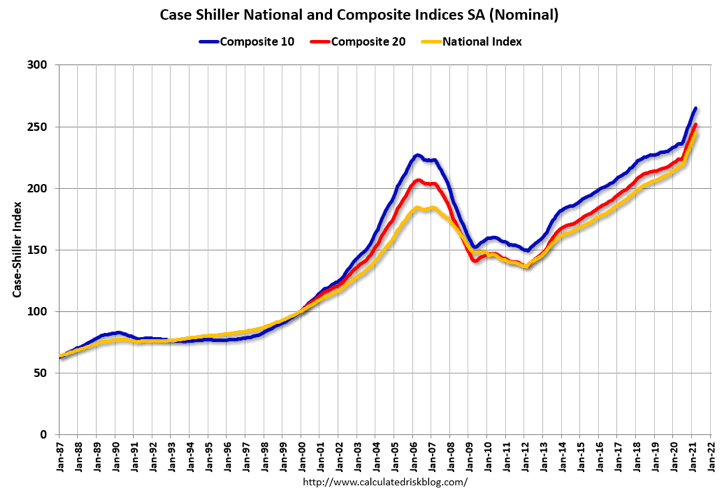
Yes, we learned that leverage works both ways in the 2008 Financial Crisis, meaning that if that $500,000 drops by 10%, you just lost your $50,000 downpayment. That’s what Paulson is most well-known for – making $20 billion betting against subprime mortgages during that crisis. In fact, I recall Paulson saying something very similar back in 2014 or so, that housing prices are going to keep going up. Here is the S&P/Case-Shiller U.S. National Home Price Index chart from Calculated Risk:

With this interview, I guess he doesn’t see this trend ending soon. I’m not saying I necessarily agree with this answer, but it is an interesting one when you consider all of the possible options.

House Downpayments and Low Interest Rates: Keep Your Eye on the Prize

My neighbors put up their house for sale a couple weeks ago. A single open house, what felt like over 100 private showings, and in escrow within a week. So when I read this WSJ article Where to Stash Your Down Payment if You Didn’t Buy a House This Year, I felt their answer was too wishy-washy and complex. If you are looking for a house, as in – if the right one came up you would buy it – then keep your downpayment in 100% liquid and safe cash. Simple.

Keep your eye on the prize: The house + a 30-year fixed mortgage at 3%. Best quote from the WSJ article:

As Blair duQuesnay, a financial planner at Ritholtz Wealth Management, points out, there is another upside to waiting longer to buy: You can grow the original amount by ramping up your savings. “If they’re still earning, that could add to the down payment,” she said. “And the low interest rates we’re all complaining about? That’s how you’re going to get a low mortgage rate.

Exactly. Don’t complain about earning a low interest rate on your downpayment for perhaps 12 months. Be grateful that you’ll get a low fixed interest rate on your mortgage for the next three decades! A lot can happen in that timeframe, look at the past 50 years (via @lenkeifer):

Don’t forget that the American 30-year fixed mortgage with no prepayment penalty is an amazing product that would not exist if not for government intervention. It’s an awesome inflation hedge. If you don’t move (or even if you move but don’t sell), your mortgage payment is fixed for 30 years, no matter how high inflation gets. Mortgage rates are at historical lows, but even if rates do somehow go even lower, you simply refinance. You are covered either way!

According to this LendingTree study, the average downpayment across the nation’s 50 largest metros is is $46,283. The lowest is $28,000 in Oklahoma City, and the highest is $115,138 in San Jose. That’s roughly 10% of the average home prices in each area. FHA loans require a down payment of just 3.5%.

$50,000 is a lot of money (although many people drive around in cars worth more than that….) but your time horizon is very short when house shopping. Home buying is an emotional roller coaster in the best of times, and inventory is tight. There were over 30 offers on the house that we bought, and we couldn’t sleep until our offer was finally accepted. I’m not interested in the buy vs. rent debate, as there are too many personal and local variables for there to be a single answer. If I was in the market right now, I’d have all my ducks are in a row – mortgage pre-approval, downpayment documentation, income documentation, clean and orderly bank statements, and so on.

Long-term investments and short-term investments should be treated differently. For your house downpayment, don’t worry about the stock market going up another 10%. Don’t buy risky bonds chasing another 2%. Worry that messing around with your downpayment will somehow impair your ability to buy the home that you want. If earning zero interest bothers you, check out my best rates and earn 1% to 3% APY while keeping it 100% liquid and safe. Good luck!

Image credit: Imgflip

Best Interest Rates on Cash – September 2021 Update

via GIPHY

Here’s my monthly roundup of the best interest rates on cash as of September 2021, roughly sorted from shortest to longest maturities. I look for lesser-known opportunities to earn 2% APY and higher while still keeping your principal FDIC-insured or equivalent. Check out my Ultimate Rate-Chaser Calculator to see how much extra interest you’d earn by moving money between accounts. Rates listed are available to everyone nationwide. Rates checked as of 9/7/2021.

Fintech accounts
Available only to individual investors, fintech companies often pay higher-than-market rates in order to achieve fast short-term growth (often using venture capital). I define “fintech” as a software layer on top of a different bank’s FDIC insurance. These do NOT require a certain number debit card purchases per month. Read about the types of due diligences you should do whenever opening a new bank account.

  • 3% APY on up to $100,000. The top rate is still 3% APY for July through September 2021 (actually up to 3.5% APY with their credit card), and they have not indicated any upcoming rate drop. HM Bradley requires a recurring direct deposit every month and a savings rate of at least 20%. Due to high demand, you must currently use a referral link to join. See my HM Bradley review.
  • 3% APY on 10% of direct deposits + 1% APY on $25,000. One Finance lets you earn 3% APY on “auto-save” deposits (up to 10% of your direct deposit, up to $1,000 per month). Separately, they also pay 1% APY on up to another $25,000 with direct deposit. New customer $50 bonus via referral. See my One Finance review.
  • 3% APY on up to $15,000. Porte requires a one-time direct deposit of $1,000+ to open a savings account. New customer $50 bonus via referral. See my Porte review.
  • 1.20% APY on up to $50,000. OnJuno recently updated their rate tiers, while keeping existing customers on the grandfathered 2.15% APY rate. If you don’t maintain a $500 direct deposit each month, you’ll still earn 1.20% on up to $5k. See my updated OnJuno review.

High-yield savings accounts
While the huge megabanks pay essentially no interest, I think every should have a separate, no-fee online savings account to accompany your existing checking account. The interest rates on savings accounts can drop at any time, so I list the top rates as well as competitive rates from banks with a history of competitive rates. Some banks will bait you with a temporary top rate and then lower the rates in the hopes that you are too lazy to leave.

  • T-Mobile Money is still at 1.00% APY with no minimum balance requirements. The main focus is on the 4% APY on your first $3,000 of balances as a qualifying T-mobile customer plus other hoops, but the lesser-known fact is that the 1% APY is available for everyone. Thanks to the readers who helped me understand this.
  • There are several other established high-yield savings accounts at closer to 0.50% APY. Marcus by Goldman Sachs is on that list, and if you open a new account with a Marcus referral link (that’s mine), they will give you and the referrer a 0.50% boost on top of the current interest rate for 3 months. You can then extend this by referring others to the same offer. Right now, Marcus is paying 0.50% APY, so with the offer you’d get 1.00% APY currently for your first 3 months.

Short-term guaranteed rates (1 year and under)
A common question is what to do with a big pile of cash that you’re waiting to deploy shortly (plan to buy a house soon, just sold your house, just sold your business, legal settlement, inheritance). My usual advice is to keep things simple and take your time. If not a savings account, then put it in a flexible short-term CD under the FDIC limits until you have a plan.

  • No Penalty CDs offer a fixed interest rate that can never go down, but you can still take out your money (once) without any fees if you want to use it elsewhere. CFG Bank has a 13-month No Penalty CD at 0.62% APY with a $500 minimum deposit. Ally Bank has a 11-month No Penalty CD at 0.50% APY for all balance tiers. Marcus has a 7-month No Penalty CD at 0.45% APY with a $500 minimum deposit. You may wish to open multiple CDs in smaller increments for more flexibility.
  • Lafayette Federal Credit Union has a 12-month CD at 0.80% APY ($500 min). Early withdrawal penalty is 6 months of interest. Anyone can join this credit union via partner organization ($10 one-time fee).

Money market mutual funds + Ultra-short bond ETFs
Many brokerage firms that pay out very little interest on their default cash sweep funds (and keep the difference for themselves). Unfortunately, money market fund rates are very low across the board right now. Ultra-short bond funds are another possible alternative, but they are NOT FDIC-insured and may experience short-term losses at times. These numbers are just for reference, not a recommendation.

  • The default sweep option is the Vanguard Federal Money Market Fund which has an SEC yield of 0.01%. Vanguard Cash Reserves Federal Money Market Fund (formerly Prime Money Market) currently pays 0.01% SEC yield.
  • Vanguard Ultra-Short-Term Bond Fund currently pays 0.28% SEC yield ($3,000 min) and 0.38% SEC Yield ($50,000 min). The average duration is ~1 year, so your principal may vary a little bit.
  • The PIMCO Enhanced Short Maturity Active Bond ETF (MINT) has a 0.23% SEC yield and the iShares Short Maturity Bond ETF (NEAR) has a 0.36% SEC yield while holding a portfolio of investment-grade bonds with an average duration of ~6 months.

Treasury Bills and Ultra-short Treasury ETFs
Another option is to buy individual Treasury bills which come in a variety of maturities from 4-weeks to 52-weeks. You can also invest in ETFs that hold a rotating basket of short-term Treasury Bills for you, while charging a small management fee for doing so. T-bill interest is exempt from state and local income taxes. Right now, this section isn’t very interesting as T-Bills are yielding close to zero!

  • You can build your own T-Bill ladder at TreasuryDirect.gov or via a brokerage account with a bond desk like Vanguard and Fidelity. Here are the current Treasury Bill rates. As of 9/7/2021, a new 4-week T-Bill had the equivalent of 0.04% annualized interest and a 52-week T-Bill had the equivalent of 0.08% annualized interest.
  • The Goldman Sachs Access Treasury 0-1 Year ETF (GBIL) has a -0.07% SEC yield and the SPDR Bloomberg Barclays 1-3 Month T-Bill ETF (BIL) has a -0.09% (!) SEC yield. GBIL appears to have a slightly longer average maturity than BIL.

US Savings Bonds
Series I Savings Bonds offer rates that are linked to inflation and backed by the US government. You must hold them for at least a year. If you redeem them within 5 years there is a penalty of the last 3 months of interest. The annual purchase limit is $10,000 per Social Security Number, available online at TreasuryDirect.gov. You can also buy an additional $5,000 in paper I bonds using your tax refund with IRS Form 8888.

  • “I Bonds” bought between May 2021 and October 2021 will earn a 3.54% rate for the first six months. The rate of the subsequent 6-month period will be based on inflation again. More info here.
  • In mid-October 2021, the CPI will be announced and you will have a short period where you will have a very close estimate of the rate for the next 12 months. I will have another post up at that time.
  • See below about EE Bonds as a potential long-term bond alternative.

Prepaid Cards with Attached Savings Accounts
A small subset of prepaid debit cards have an “attached” FDIC-insured savings account with exceptionally high interest rates. The negatives are that balances are severely capped, and there are many fees that you must be careful to avoid (lest they eat up your interest). There is a long list of previous offers that have already disappeared with little notice. I don’t personally recommend nor use any of these anymore, as I feel the work required and risk of messing up exceeds any small potential benefit.

  • Mango Money pays 6% APY on up to $2,500, if you manage to jump through several hoops. Requirements include $1,500+ in “signature” purchases and a minimum balance of $25.00 at the end of the month.

Rewards checking accounts
These unique checking accounts pay above-average interest rates, but with unique risks. You have to jump through certain hoops which usually involve 10+ debit card purchases each cycle, a certain number of ACH/direct deposits, and/or a certain number of logins per month. If you make a mistake (or they judge that you did) you risk earning zero interest for that month. Some folks don’t mind the extra work and attention required, while others would rather not bother. Rates can also drop suddenly, leaving a “bait-and-switch” feeling.

  • The Bank of Denver pays 2.00% APY on up to $25,000 if you make 12 debit card purchases of $5+ each, receive only online statements, and make at least 1 ACH credit or debit transaction per statement cycle. The rate recently dropped. If you meet those qualifications, you can also link a Kasasa savings account that pays 1.00% APY on up to $50k. Thanks to reader Bill for the updated info.
  • I removed Devon bank this month because it is now restricted only to Illinois residents (previously available nationwide).
  • Presidential Bank pays 2.25% APY on balances up to $25,000, if you maintain a $500+ direct deposit and at least 7 electronic withdrawals per month (ATM, POS, ACH and Billpay counts).
  • Evansville Teachers Federal Credit Union pays 3.30% APY on up to $20,000. You’ll need at least 15 debit transactions and other requirements every month.
  • Lake Michigan Credit Union pays 3.00% APY on up to $15,000. You’ll need at least 10 debit transactions and other requirements every month.
  • Find a locally-restricted rewards checking account at DepositAccounts.

Certificates of deposit (greater than 1 year)
CDs offer higher rates, but come with an early withdrawal penalty. By finding a bank CD with a reasonable early withdrawal penalty, you can enjoy higher rates but maintain access in a true emergency. Alternatively, consider building a CD ladder of different maturity lengths (ex. 1/2/3/4/5-years) such that you have access to part of the ladder each year, but your blended interest rate is higher than a savings account. When one CD matures, use that money to buy another 5-year CD to keep the ladder going. Some CDs also offer “add-ons” where you can deposit more funds if rates drop.

  • Abound Credit Union has a special 13-month Share Certificate at 0.80% APY ($500 min), a special 47-month Share Certificate at 1.40% APY ($500 min), and a 59-month Share Certificate at 1.35% APY ($500 min). Early withdrawal penalty is 1 year of interest (and only with the consent of the credit union, so be aware). Anyone can join this credit union via partner organization ($10 one-time fee).
  • USALLIANCE Financial Credit Union has a special 18-month CD at 1.00% APY ($500 minimum new money) with an early withdrawal penalty of 6 months interest. You must join the credit union first, but anyone can join via American Consumer Council (ACC).
  • Lafayette Federal Credit Union has a 5-year CD at 1.26% APY ($500 min). Early withdrawal penalty is 6 months of interest. Anyone can join this credit union via partner organization ($10 one-time fee).
  • You can buy certificates of deposit via the bond desks of Vanguard and Fidelity. You may need an account to see the rates. These “brokered CDs” offer FDIC insurance and easy laddering, but they don’t come with predictable early withdrawal penalties. Right now, I see a 5-year CD at 1.05% APY. Be wary of higher rates from callable CDs listed by Fidelity.

Longer-term Instruments
I’d use these with caution due to increased interest rate risk, but I still track them to see the rest of the current yield curve.

  • Willing to lock up your money for 10 years? You can buy long-term certificates of deposit via the bond desks of Vanguard and Fidelity. These “brokered CDs” offer FDIC insurance, but they don’t come with predictable early withdrawal penalties. You might find something that pays more than your other brokerage cash and Treasury options. Right now, I see a 10-year CD at 1.70% APY vs. 1.37% for a 10-year Treasury. Watch out for higher rates from callable CDs from Fidelity.
  • How about two decades? Series EE Savings Bonds are not indexed to inflation, but they have a unique guarantee that the value will double in value in 20 years, which equals a guaranteed return of 3.5% a year. However, if you don’t hold for that long, you’ll be stuck with the normal rate which is quite low (currently 0.10%). I view this as a huge early withdrawal penalty. But if holding for 20 years isn’t an issue, it can also serve as a hedge against prolonged deflation during that time. Purchase limit is $10,000 each calendar year for each Social Security Number. As of 9/7/2021, the 20-year Treasury Bond rate was 1.91%.

All rates were checked as of 9/7/2021.

45 Years of the Vanguard S&P 500 Index Fund: The Power of Low Costs

Just over 45 years ago on August 31st, 1976, the late Jack Bogle started the first index mutual fund at Vanguard. It nearly didn’t get off the ground, garnering only 7% of the initial funding goal – it wasn’t even enough to buy shares of all the stocks in the S&P 500! Read Bogle’s own take from exactly 10 years ago at this 9/3/2011 WSJ article to better appreciate it took determination and stubbornness to make this happen.

Industry leaders mocked “Bogle’s folly”, wondering aloud why anyone would voluntarily agree to be “just average”. Well, Bogle had common sense and simple math on his side. He knew that over time, his fund was guaranteed to be above average due to it’s low costs. Some active mutual funds would outperform for a while, sure, but would there be reliable persistence in those superior returns? It turns out, very little. These days, people worry more about too much index fund investment.

Over time, more and more investors have realized the power of low costs. They are running away from high-cost funds. Morningstar just released it 2020 U.S. Fund Fee Study (free with registration). From the Executive Summary:

The average expense ratio paid by fund investors is half of what it was two decades ago. Between 2000 and 2020, the asset-weighted average fee fell to 0.41% from 0.93%. Investors have saved billions as a result.

(Thank you, Mr. Bogle.)

This chart shows the new investments flows into the cheapest 20% of funds (blue) against the remaining 80% (red) over the last 20 years:

Morningstar research has demonstrated that fees are a reliable predictor of future returns. Low-cost funds generally have greater odds of surviving and outperforming their more-expensive peers. […] Since 2000, net flows into funds charging fees that rank within the cheapest 20% of their Morningstar Category group have trended higher. Flows for the remaining 80% of funds have been negative in nine of the past 10 years.

Vanguard and it’s dirt-cheap index clones are winning. If you look closer, it’s the really low-cost funds that are gathering the most new investment. These are mostly the big names that have started competing directly with Vanguard on cost – iShares, Schwab, Fidelity, SPDR.

Of the $445 billion that flowed into the cheapest 20% of funds and share classes in 2020, nearly all of it went into the cheapest of the cheap, as 93% of net new money flowed into the least costly 5% of all funds.

Investors voted with their money. Follow this trend and continue to effect change with your investment choices. Look for a low-cost fund option in your 401k, and ask why if you don’t see it.

Crazy Rich IRAs: From Peter Thiel to Ted Weschler

Propublica recently reported that venture captialist Peter Thiel has a $5 billion Roth IRA. Essentially, he bought some lottery tickets using his IRA wrapper, and they paid off. The controversial part is that these lottery tickets weren’t available to everyone. They were dirt-cheap private shares of a startup that were only available to founders and a handful of early investors. At such an early stage, you can pretty much value your private company shares at whatever you wish. Here’s the Propublica version:

Open a Roth with $2,000 or less. Get a sweetheart deal to buy a stake in a startup that has a good chance of one day exploding in value. Pay just fractions of a penny per share, a price low enough to buy huge numbers of shares. Watch as all the gains on that stock — no matter how giant — are shielded from taxes forever, as long as the IRA remains untouched until age 59 and a half. Then use the proceeds, still inside the Roth, to make other investments.

It’s not clear how they found this data, but they also included the owners of other large IRAs:

Ted Weschler, a deputy of Warren Buffett at Berkshire Hathaway, had $264.4 million in his Roth account at the end of 2018. Hedge fund manager Randall Smith, whose Alden Global Capital has gutted newspapers around the country, had $252.6 million in his. Buffett, one of the richest men in the world and a vocal supporter of higher taxes on the rich, also is making use of a Roth. At the end of 2018, Buffett had $20.2 million in it. Former Renaissance Technologies hedge fund manager Robert Mercer had $31.5 million in his Roth, the records show.

Ted Weschler, along with Todd Combs, are the heirs to the “stock picking” part of Warren Buffett’s job at Berkshire Hathaway. Greg Abel will be the future CEO and help handle all the wholly-owned subsidiary companies within Berkshire, and Ajit Jain will run the large insurance operation.

As a public figure, Weschler submitted this personal statement defending and explaining his IRA, and it reveals some interesting details. He opened his first “IRA” in 1984 as a 22-year-old Junior Financial Analyst making $22,000 a year. He seems to be mixing up the terms for 401k and IRAs in his letter (confirmed in WaPo story below). His timing was lucky, as 401k plans had just been born with the earliest ones starting around 1980. Here is a 1982 WSJ newspaper scan about these newfangled “salary reduction plans”, which were what 401k plans were initially called.

Anyhow, his 401k/IRA balance had grown to $70,385 by the end of 1989, when he rolled it over into a self-directed IRA at Charles Schwab. Fast forward 23 years, and by the end of 2012, his IRA was worth $131,000,000! Thanks to the new Roth IRA conversion option when he promptly rolled it over into a Roth IRA even though he had to pay $29 million in taxes. By 2018, the balance was at $264 million.

Also significant:

I invested the account in only publicly-traded securities i.e., all investments in this account were investments that were available to the general public.

[…] In closing, although I have been an enormous beneficiary of the IRA mechanism, I personally do not feel the tax shield afforded me by my IRA is necessarily good tax policy. To this end, I am openly supportive of modifying the benefit afforded to retirement accounts once they exceed a certain threshold.

This WaPo article is a follow-up with Ted Weschler about his amazing IRA skills.

I also realized that Weschler wanted to encourage young people to do what he did to accumulate his nine-digit net worth: save and invest, early and often, and take advantage of any retirement account benefits offered by their employer. “In a perfect world, nobody would know about this account,” he said. “But now that the number is out there, I’m hopeful that some good can come of it by serving as a motivation for new workforce entrants to start saving and investing early.”

My takeaways:

  • You may not agree with all the tax rules, but there is a reason why standard personal finance advice includes maximizing your Roth IRA contribution each year AND taking full advantage of your 401k plan with any employer contribution.
  • If you believe that your future tax rate after age 60 will be higher than your current tax rate, then you should consider converting any pre-tax “Traditional” IRA balances into Roth IRAs, even if it requires a big lump sum payment today.
  • If your income is too high to qualify for a regular Roth IRA, check if you are eligible to contribute to a “backdoor” Roth IRA, essentially making a non-deductible Traditional IRA contribution and quickly performing a Roth IRA conversion. If you are high-income and a big saver, look up the “mega backdoor” Roth IRA, which involves making a non-deductible contribution to your 401k plan (if allowed by employer plan document).
  • Roth IRAs have differences from Traditional IRAs beyond just the timing of the tax being upfront or at withdrawal. If you want to leave an inheritance (as these rich people most likely do), realize that Roth IRAs don’t have the required minimum distribution (RMD) rules that apply to traditional IRAs. Bottom line: More compounding + more tax shelter = bigger estate.
  • Consider putting your riskiest investments with the highest potential upside inside your Roth IRA. My Roth IRA holds REITs: low tax-efficiency and higher risk/return profile. No sleepy bonds!
  • As a BRK shareholder, if you were to think of a contest to win “The Next Warren Buffett”, finding the person who built the biggest IRA in the world using publicly-available investments would be a pretty smart filter! Maybe Berkshire Hathaway’s investment side will be alright after Buffett and Munger are gone.

S&P 500 Returns by Components 1900-2020: Earnings Growth + Dividends + P/E Changes

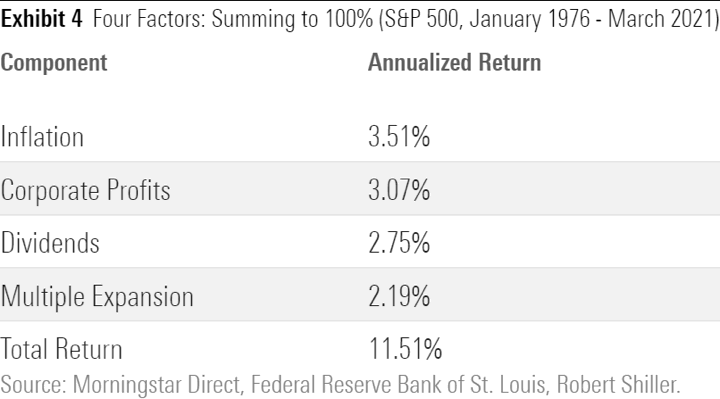
In the previous post How Much of Historical Stock Returns Is Due To P/E Ratio Expansion?, we saw how the S&P 500 historical average total return could be broken down into separate components of earnings growth, dividends, P/E multiple changes, and inflation. Here’s how it broke down from the period of January 1976 to March 2021:

I wondered: Is this a common breakdown? What about other periods of time? You may have seen charts showing the rolling historical 10-year total returns of the S&P 500. For example, 1980-1990, 1981-1991, 1982-1992, and so on. Here is such a chart:

Crestmont Research has generously shared the same total returns, but broken down into the separate components of earnings-per-share (EPS) growth, dividends, and P/E multiple changes. As they put it:

There are only three components (excluding transaction costs and expenses) to the total return from the stock market: dividend yield, earnings growth, and change in the level of valuation (P/E ratio). To assess the potential returns from stocks for the next decade, this analysis presents the total return and its components for every ten-year period since 1900.

Observations. Despite my discovery that it didn’t take 25 years to recover from the 1929 crash, notice that the Great Depression was the only period where corporate earnings consistently dropped for an extended period. We do see the dividends still being paid out, but experiencing your business make less and less earnings for years must have been very difficult.

Since approximately the time of World War II, the overall profits of the S&P 500 companies have risen in every single 10-year period. Meanwhile, the dividend yield was also positive, although it has experienced a gradual decrease over time. If you just look at those two components added together, that is quite impressive.

Finally, we see that the component with the wildest swings by far is the Price/Earnings ratio. From this visualization, it looks like huge “waves of optimism” and “waves of pessimism” that are end up causing most of the overall volatility in total return. Right now, we appear to be still riding one the waves of optimism.

Weekend Listening: NPR Planet Money Summer School Investing Edition

In 2020, the NPR Planet Money podcast did a series called Summer School that focused on economics concepts. You can still listen to those, but the 2021 Summer School series is about investing. Hardcore personal finance geeks might come away bored, but I enjoy hearing how they try to simplify and and explain these complex topics in an approachable manner. If I remember, I plan to have my kids as teens listen to these episodes. Here are the podcasts so far, which include excerpts from earlier Planet Money episodes:

  • Planet Money Summer School 1: The Stock Market
  • Planet Money Summer School 2: Index Funds & The Bet
  • Planet Money Summer School 3: Smooth Spending & The 401K
  • Planet Money Summer School 4: Bonds & Becky With The Good Yield
  • Planet Money Summer School 5: Bubbles, Bikes, & Biases

The bubble episode has a good story about bicycles (not tulips!). When I’m in an efficient mood, I enjoy listening with the Overcast app (iOS only) at 1.25x speed with “Smart Speed” that skips over silences (and somehow speeds up even more during ads) to save time. I believe Pocket Casts also has similar features, is available on both iOS and Android, is free, and is apparently partially-owned by NPR recently sold to Automattic (parent of WordPress).

Myth: It Took 25 Years to Recover From 1929 Stock Market Crash

Sometimes, it pays to scratch a little beneath the surface. In 2012, well-known behavioral scientist Dan Ariely published a paper that found that when people signed an honesty declaration at the beginning of a form, rather than the end, they were less likely to lie. It since has been cited in more than 400 other academic papers. Nine years later, a group of anonymous researchers at Data Colada actually looked at the data and found it clearly fudged using copy-and-paste and a random number generator. (They have to be anonymous to avoid retribution.) Dan Ariely and the other authors have since retracted the paper and disavowed any prior knowledge of the fake data.

You may have heard that it took 25 years for the stock market to recover during the Great Depression. I’ve heard it and simply accepted it as truth, until today. It’s true that the Dow Jones Industrial Average (DJIA or just “Dow”) peaked at 381.17 on September 3rd, 1929. It is also true that the DJIA did not reach that level of 381.17 again until November 23rd, 1954. That is a span of over 25 years.

However, as this 2009 NY Times article by Mark Hulbert explains, that’s not the whole story when you dig a little deeper.

[…] a careful analysis of the record shows that the picture is more complex and, ultimately, far less daunting: An investor who invested a lump sum in the average stock at the market’s 1929 high would have been back to a break-even by late 1936 – less than four and a half years after the mid-1932 market low.

The truth is that it took about 7 years for an investor to recover (1929-1936), even if they invested all their money at the very peak. This came 4.5 years after the Dow hit its period low of 41.22 in the middle of 1932. Why?

  • Dividends. Back then, dividend yields were much higher. The absolute dividend payout did not drop nearly as severely as the prices. When the Dow hit a low of 41.22 on July 8, 1932 (that 90% drop you’ve read about), the dividend yield was close to 14%.
  • Deflation. “The Great Depression was a deflationary period. And because the Consumer Price Index in late 1936 was more than 18 percent lower than it was in the fall of 1929, stating market returns without accounting for deflation exaggerates the decline.” Every dollar actually bought significantly more in 1936 than in 1929.
  • Human misjudgment. The DJIA is composed of 30 stocks, which are picked by humans to represent the broad market. According to this article, a total of 18 companies were swapped in and out of the DJIA between 1929 to 1932. That was the highest number of changes to the Dow ever in such a short amount of time. This was a stressful time, and the Dow committee often “sold low” and “bought high” when picking companies to remove and add.

The Great Depression was still an extraordinarily painful time with minimal social safety nets, followed closely by World War II. I recommend reading The Great Depression: A Diary by Benjamin Roth for a vivid picture of what it felt like to live through the Great Depression.

In normal times the average professional man makes just a living and lives up to the limit of his income because he must dress well, etc. In times of depression he not only fails to make a living but has no surplus capital to buy stocks and real estate. I see now how important it is for the professional man to build up a surplus in normal times.

Even today, how many are prepared for the stock market to go down for 2.5 years and then take another 4.5 years to get back to even?

[5/9/1932] Those men who were wise enough to sell during the boom and then keep their funds liquid in the form of government bonds, etc. were not farsighted enough or patient enough to wait almost three years to re-invest. Most of them re-invested a year or more ago and now find stock prices have sagged to 1/3 of what they were when they thought they were buying bargains.

Still, 7 years is very different than 25 years. Imagine being 50 years old and your IRA contribution at 25 years old is still underwater! The worst time period for stock market returns was actually 1972-1982, when it took roughly 10 years to recover if you invested at the peak:

[…] according to a Hulbert Financial Digest study of down markets since 1900, the average recovery time is just over two years, when factors like inflation and dividends are taken into account. The longest was the recovery from the December 1974 low; it took more than eight years for the market to return to its previous peak, which was reached in late 1972.

None of this, of course, guarantees that stocks will have a quick recovery from the market decline that began in October 2007. But it suggests that the historical record isn’t as bleak as it looks.

Best Visual Explanation of the Convexity of Long-Term Bonds

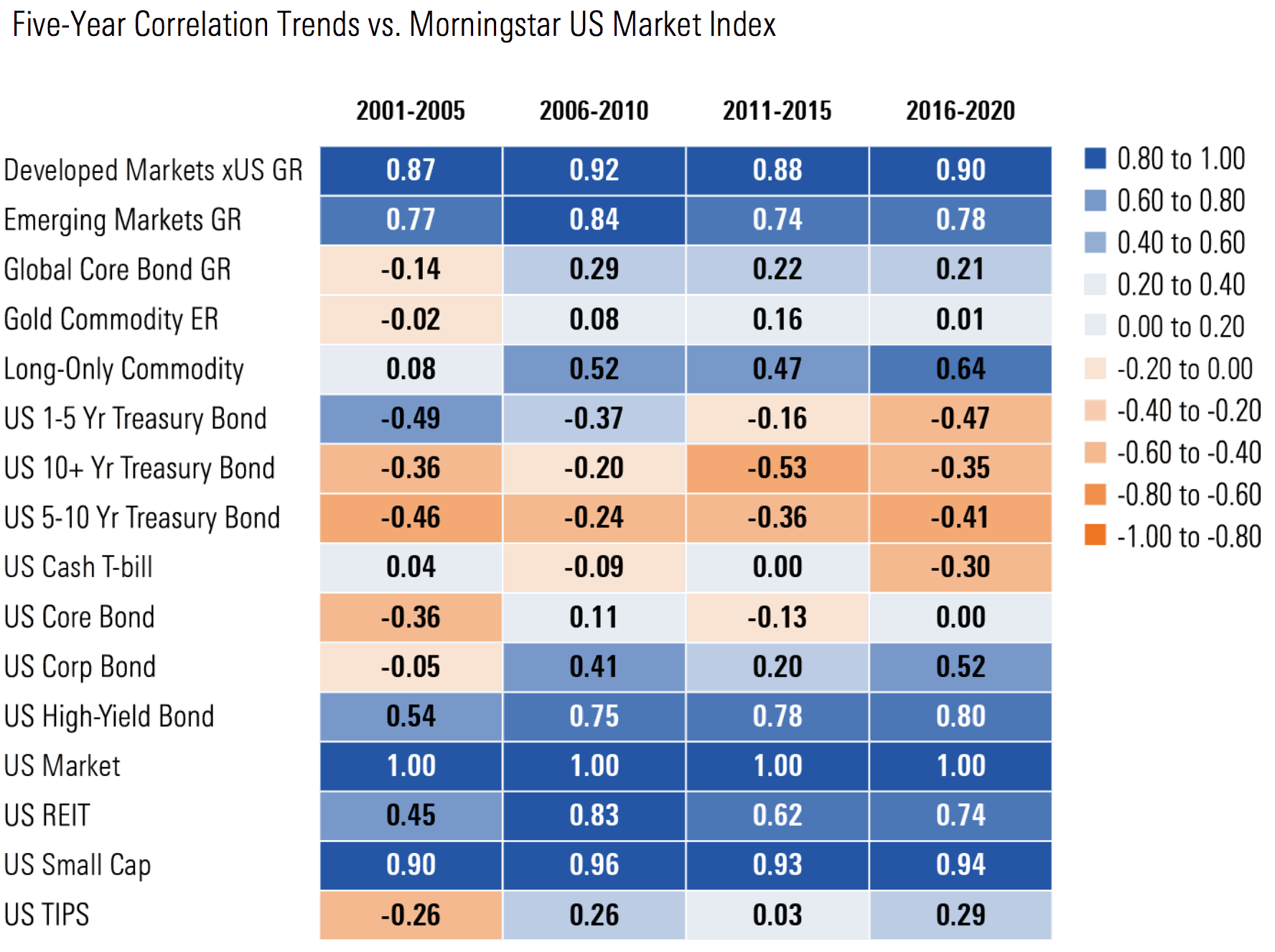
Long-term US Treasury bonds are often considered a good asset class to own due to their historically low correlation with stocks. When stocks go down, long-term bonds tend to go up (and vice versa). While the 30-year is not specifically included here, you can infer this based on the Treasury bond data from this Morningstar table:

For example, here is an older 2015 chart with correlations agains the S&P 500:

5yearcorr

While doing some additional research on adding long-term US Treasuries to a portfolio, I came across the concept of bond convexity. It’s a relatively complicated topic… I mean here is the very first sentence of the Wikipedia entry:

In finance, bond convexity is a measure of the non-linear relationship of bond prices to changes in interest rates, the second derivative of the price of the bond with respect to interest rates (duration is the first derivative).

Yikes! Thankfully, the next sentence is easier to digest:

In general, the higher the duration, the more sensitive the bond price is to the change in interest rates.

Yet, if you truly want to understand convexity, that sentence is quite incomplete. This is especially the case in low-interest rate environments like we have now in 2021.

After reading through some seriously tedious explanations mixed with college calculus flashbacks, I thankfully found the article High Profits and Low Rates: The Benefits of Bond Convexity at PortfolioCharts.com. I recommend reading the full post for an approachable explanation with no greek letters. The prize at the end is this excellent graphic:

As of this writing 8/23/2021, the yield on the 30-year US Treasury is 1.87%. Let’s round this to 2%. Based on this graphic:

  • If interest rates were to drop by 1%, the 30-year bond would increase in value by roughly 27%.
  • If interest rates were to rise by 1%, the 30-year bond would decrease in value by roughly 18%.

You may have though that since rates are so low already, any changes at this point won’t matter much. Turns out, they matter more. Long-term bonds can still pack quite a diversifying “punch” even at these low rates, both on the upside and downside (though not symmetrical). Those are some wild swings for “safe bonds”. This is definitely an interesting asset class, but be sure you know what you are getting into before purchasing.

How Much of Historical Stock Returns Is Due To P/E Ratio Expansion?

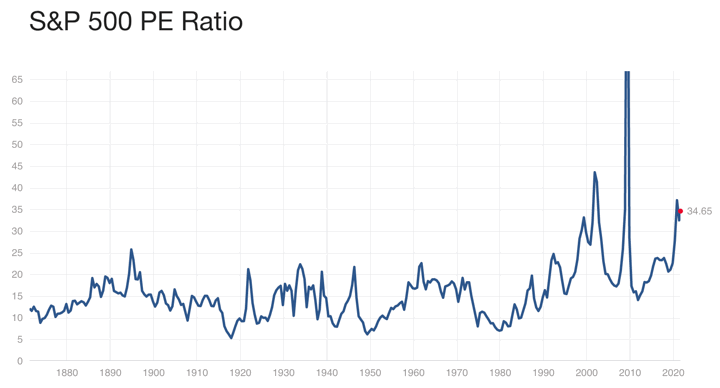
According to Multpl.com, the P/E ratio of the S&P 500 is now 35, and the dividend yield is only 1.3%. The all-time low dividend yield was 1.11% back in August 2020. Even if you consider stock buybacks, the earnings yield is less than 3%! That means if corporations all distributed every penny of their profits as dividends, it still wouldn’t be higher than 3%. Before we go any further, I’m not advocating market timing, as people were saying that the S&P 500 was “overvalued” back in 2015 when the P/E ratio was 25 and the dividend yield was 2%. Nobody truly knows what will happen to prices in the short-term.

Even if the P/E ratio seems a lot higher now than the historical average, what has that actually meant? The Morningstar article How Much Has the Market Benefited from Investor Optimism? examines how much of the historical return of the S&P 500 from 1976 through March 2021 was from P/E expansion.

In January 1976, the P/E ratio was only 11.8. In March 2021, the P/E ratio was 31.5. That seems like a huge difference, and over that 45-year time period, it did add 2.2% to the overall historical average annual return. But we also got 3% from earning growth, and another 2.75% from dividends, for a total return of ~8% above inflation. 8% real return!

In a way, this is somewhat comforting, as if you look at the long-term, a shrinking P/E ratio won’t completely destroy your retirement by itself. Instead of adding 2%, it might subtract 2%.

Looking ahead, if you assume a generous 4% from earnings growth, 0% from a constant P/E ratio, and 1.3% from dividends, that’s roughly a 5% future real return. But if the P/E ratio goes back even partly back to historical averages, that will be closer to a 4% real return. The problem is that bonds are giving us 0% real return at best, so I’m sticking with owning productive businesses.

The numbers on my brokerage statements keep going up so perhaps I shouldn’t complain, but I sure hope the earnings start to catch up to the prices soon (as some predict). I like the idea of the P/E ratio going down due to higher earnings rather than lower prices!

Real-World Smoothing Effects of Regular Investments (Dollar Cost Averaging)

Most people must rely on the power of smaller, regular investments from work income to build up their retirement nest egg. In the latest Sound Investing email, Paul Merriman shared a new Lifetime Investment Calculator that helps you see how these gradual investments (dollar-cost averaging) would have added up during various periods, using actual historical returns from 1970 to 2020.

I’ve already tried to illustrate how regular investments of $250 or $500 a month can add up over time. But instead of having to manually gather performance numbers from a Vanguard Target Retirement fund in a spreadsheet, this fancier calculator lets you adjust many more variables. You can choose different asset allocations, stock/bond ratio, investment amounts, and so on. Importantly, the calculator uses actual historical returns, so you can see what would happen if you invested through the 2001 dot-com bust, 2008 financial crisis, and so on.

You can start the sequence of returns from any of the 51 years to replicate your financial picture as if your decisions were available in the past. For example, you could simulate the role of luck by starting or ending your journey in a bull or bear market. It is not a financial planning calculator per se, nor meant to be a complete planning tool, but it allows you to customize both growth (accumulation) and distribution phases based on your personal timeline and investments.

If you aren’t familiar with Paul Merriman, he is an advocate of adding a bit of complexity to index fund portfolios via additional exposure to smaller and value-oriented companies. For a test run, I went for the “Ultimate Buy and Hold Worldwide (70% US/30% International)” portfolio, alongside a simple S&P 500 portfolio.

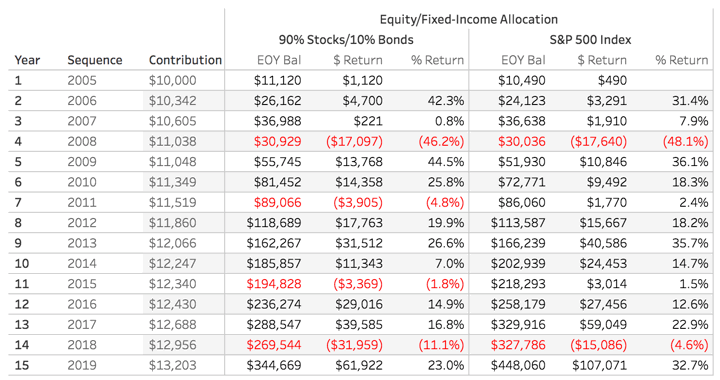
Here is $10,000 invested every year for 15 years, with small ~3% increases each year with inflation (ideally corresponding with a higher paycheck), starting in 2005:

Here is $10,000 invested every year for 15 years, with small ~3% increases each year with inflation (ideally corresponding with a higher paycheck), starting in 2000:

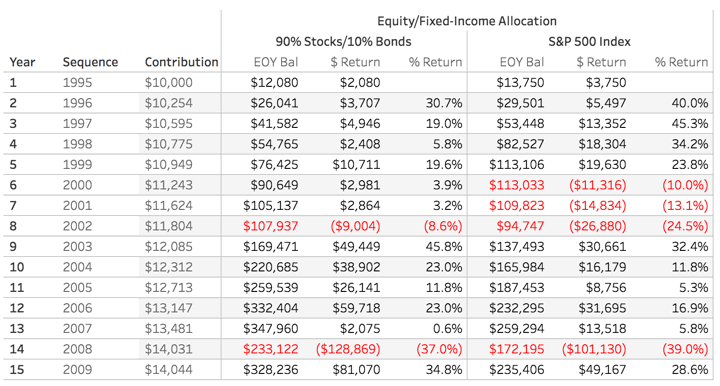
Here is $10,000 invested every year for 15 years, with small ~3% increases each year with inflation (ideally corresponding with a higher paycheck), starting in 1995:

You can see that an internationally-diversified portfolio may not be the best in some periods, but it also may not be the worst in others. (I admit I am a bit confused as to why the performance numbers for any given year are slightly different for each test run, perhaps someone out there can explain that to me.)

Even in the 1995-2010 period that contained both the 2001 dot-com bust and the 2008 financial crisis, your ending balance would still have ended up much higher than your total contributions with the internationally-diversified portfolio.