Charlie Munger: Huge Compilation of Annual Shareholder Letters, Interviews, Op-Eds, Speech Transcripts

Charles Munger is probably best known as the Vice Chairman of Berkshire Hathaway and longstanding investing partner of Warren Buffett. However, he has also been the CEO and/or Chairman of the Board of multiple other companies. This means there many additional sources of knowledge and wisdom beyond just BRK shareholder letters. I recently discovered this huge 1,000 page compilation (PDF) of everything Munger, including annual letters from Blue Chip Stamps, Wesco, and Daily Journal as well as his op-ed contributions and transcripts of speeches. Found at ValueWalk, the PDF includes links to most of the individual sources inside as well. Thanks to all the folks that worked hard to preserve this material.

There was no table of contents, so I started making a list of all the goodies inside:

Annual Shareholder Letters and Meeting Transcripts

  • Blue Chip Stamps, Annual Shareholder Letters, 1978-1982. Blue Chip Stamps was merged into Berkshire Hathaway in 1983.
  • Wesco Financial Corporation, Annual Shareholder Letters and/or Meeting Notes, 1983-2010. Wesco Financial was officially merged into Berkshire Hathaway in 2011.
  • Q&A sesssion with Charlie Munger July 1st, 2011. An event paid for by Charlie Munger after the Wesco merger.
  • Daily Journal Corporation Annual Meeting Notes and/or Transcript, 2013-2018.

Speech Transcripts, Op-Eds, Interviews, Etc.

  • Opinion Pieces, 1984.
  • Speech by Charlie Munger to the Harvard School, 1986.
  • Resignation of Mutual Savings from US League of Savings Institutions, May 30, 1989.
  • A Lesson On Elementary, Worldly Wisdom As It Relates To Investment Management & Business, 1995.
  • Practical Thought about Practical Thought?, 1996.
  • Investment Practices of Leading Charitable Foundations, 1998.
  • Foundation Financial Officers Group Master’s Class, 1999.
  • A Perverse Use of Antitrust Law, 2000.
  • Philanthropy Round Table, 2000
  • Optimism Has No Place in Accounting, 2002
  • The Great Financial Scandal of 2003
  • Herb Kay Undergraduate Lecture at the University of California, Santa Barbara Economics Department, 2003.
  • Munger speech at University of California, Santa Barbara, 2004.
  • The Pyschology of Human Misjudgment,
  • Charlie Munger – USC Commencement Speech 2007
  • Sacrificing To Restore Market Confidence, 2009.
  • Basically, It’s Over. A parable about how one nation came to financial ruin, 2009.
  • Wantmore, Tweakmore, Totalscum, and the Tragedy of Boneheadia: A Parody about the Great Recession, 2011.
  • A Conversation with Charlie Munger and Michigan Ross Dean Scott DeRue, 2017.
  • Charlie Munger, Unplugged, 2019.
  • Foreword to the Chinese Edition of Poor Charlie’s Almanack: The Wit and Wisdom of Charles T. Munger (by Louis Li).

This should keep me busy for a while!

Vanguard Prime Money Market Fund Changes

Vanguard is making a few changes to their Vanguard Prime Money Market Fund, which is often their highest-yielding option:

  • Name change. Vanguard Prime Money Market Fund will change its name to Vanguard Cash Reserves Federal Money Market Fund.
  • Even safer. It will now invest only in securities fully backed by the U.S. government or cash. I believe that they used to invest in some highly-rated short-term commercial paper.
  • Even cheaper. Basically, everyone will get the lower expense ratio from Admiral shares which previously had a $5,000,000 minimum (!). The minimum investment to get started is still $3,000.
  • No more checkwriting. You can still get checkwriting with certain other funds, including the Vanguard Federal Money Market Fund.

The actionable event here is that if you own the Prime Investor Shares (VMMXX), you can manually convert to the Admiral Shares (VMRXX) to immediately take advantage of the lower expense ratio (and thus higher yield) instead of waiting until possibly 2021:

Existing Investor share owners (VMMXX): You have the option to immediately convert† to Admiral Shares to begin taking advantage of the lower expense ratio. You can find simple step-by-step instructions here. If you don’t initiate a conversion, you’ll be automatically converted sometime between late 2020 through 2021. Note: Our checkwriting service isn’t available for the fund’s Admiral share class. Checkwriting is available for Vanguard Federal Money Market Fund and other Vanguard money market funds.

While this fund usually offers one of the highest cash sweep amongst brokerage accounts, the interest rate is still really low at about 0.10% SEC yield right now. At the same time, many online savings accounts are at about 0.80%. Still, if you own this fund you might as well convert now. The Vanguard Federal Money Market Fund remains Vanguard’s default cash sweep option, which historically has yielded slightly less than Vanguard Prime.

Schwab Plan Review: Free DIY Financial Planning Software

Schwab has rolled out a new digital financial planning tool called Schwab Plan. They claim it to be a simplified version of the same financial planning software used by many human financial advisors. From their press release:

Schwab Plan is a digital self-guided financial plan available through Schwab.com that helps investors build a personalized plan that includes a range of factors such as desired retirement age, retirement goals, social security expectations, portfolio risk profile and asset allocation, and various income sources.

[…] they are able to generate a retirement plan that shows retirement goals and probability of funding those goals, a comparison of an individual’s current asset allocation to a recommended allocation based on plan inputs, and suggested next steps to get and stay on track.

Access to this tool is free to anyone with any type of Schwab account. (Eventually, this should include TD Ameritrade clients as well.) There is no minimum asset requirement and you don’t need to sign up for a new service. For example, I was able to access it with only a Schwab PCRA brokerage window account. Here are a few initial impressions and screenshots after testing it out.

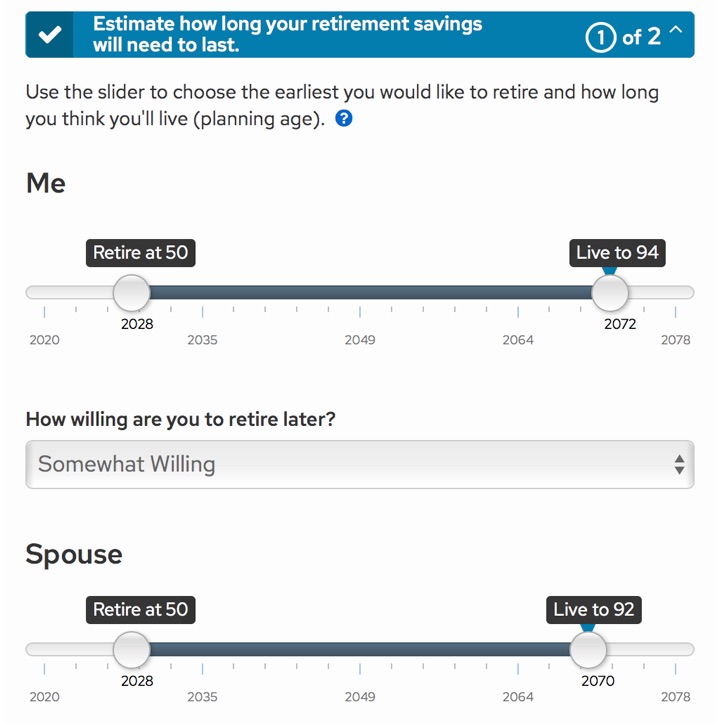
First, you enter some basic personal information like current age, gender, retirement age, and life expectancy:

Next, you estimate your income needs in retirement. They offer additional assistance in estimated your health insurance costs in retirement. You then enter your assets and income sources. Your Schwab accounts are automatically imported, and you can manually add the raw balances of additional external accounts (no account aggregation). They use your information to estimate your Social Security income, and also ask about stock options and restricted stock units.

(They don’t ask about children, college savings, term life insurance, disability insurance, or any of those smaller details that a full-service advisor would ask about. There is also very little customization available in terms of recognizing your external asset allocations.)

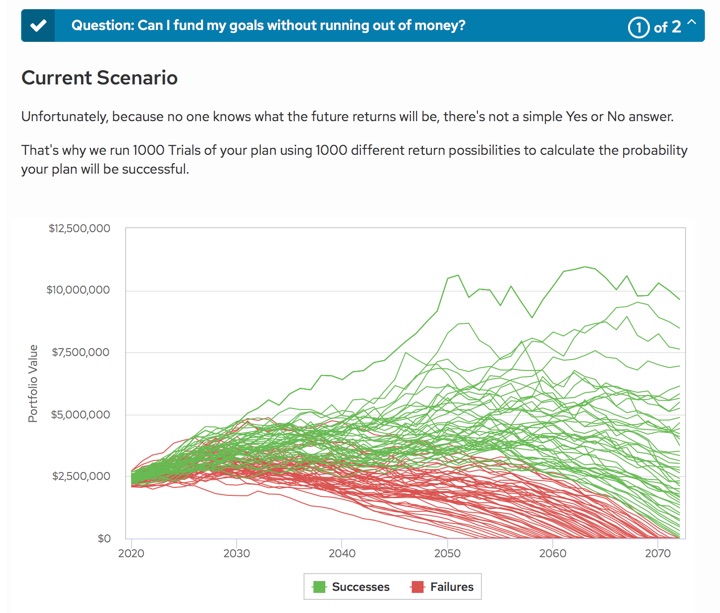
Once everything is entered, they run a Monte Carlo simulation to estimate your probability of success.

You can then adjust the variables, such your retirement age and future spending, in order to see how it affects your success rate. I found the analysis to be reasonably consistent with my other research, and I liked that the results changed significantly for an early retirement (45 year period) as opposed to a traditional retirement (30 year period). They use a “confidence zone” system:

(The Monte Carlo simulations above does not equate to an 86% confidence level. This was after making some tweaks to improve the results.)

Bottom line. Schwab has added a free financial planning tool for all of their customers (no minimum asset requirement). After testing it out, it is not quite “professional-grade”, but I did find it to be slightly more advanced than most other free options. I would recommend trying it out if you have any type of Schwab account. Of course, it also provides a pathway to upgrade to their other portfolio management services, and I still have concerns about their Intelligent Portfolios product.

Vanguard Fair Value CAPE Chart

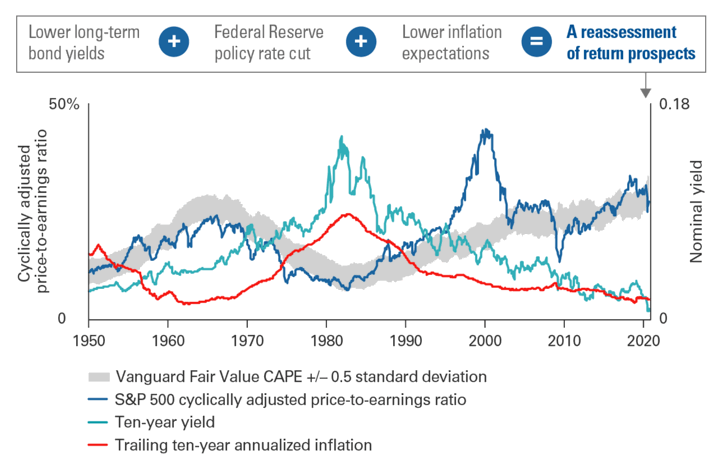
A lot of investment “analysis” is simply finding a reasonable and convincing way to explain present market prices. Whatever the price is, you can find a story to match. Working backwards like that means there usually isn’t much useful nor actionable information. I say this before I link to the recent Vanguard article Why equity markets have recovered, mainly for this chart of what they see as a “fair value” for CAPE (cyclically-adjusted PE) or PE10 (price/average earnings over last 10 years):

Vanguard’s U.S. fair value CAPE framework is based on a statistical model that corrects measures of cyclically adjusted price-to-earnings ratios for the level of inflation expectations and for interest rates. The statistical model specification is a three-variable vector error correction including equity-earnings yields, ten-year trailing inflation, and ten-year U.S. Treasury yields.

Basically, low interest rates (with low inflation) mean that stock earnings are more attractive and thus result in higher price/earnings (PE) ratios. The rest is the usual hedging and disclaimers. “The market could go up or down from here.”

Rates are not just “low”, they are the lowest in history. The real yield on 30-year TIPS (inflation-linked Treasury bonds) are negative for the first time in history – so low that people are willing to hand over $116 today in order to get only $100 back (adjusted for inflation) after 30 years! If bonds are the most expensive in history, does that mean the stock market should be the most expensive in history? The S&P 500 did just hit an all-time high amidst enormous economic suffering for much of the working population. This chart tries to make sense of things, but still I don’t like the idea of calling the current state of things “rational”.

Chase You Invest Brokerage Transfer Bonus: Up to $725 Cash

Financial institutions increasingly want all of your money under one roof. Brokerage firms and robo-advisors are adding savings accounts and debit cards. Banks want to let you trade stocks. If you have built up some sizeable assets, you can make extra money when they decide to pay you to move over your assets. Try them out, see if you like them, and move again if you need to.

The self-directed brokerage arm for Chase is You Invest, and they are currently offering up the following transfer bonuses:

  • $200 with $25,000-$99,999 in qualifying new money
  • $350 with $100,000–$249,999 in qualifying new money
  • $725 with $250,000+ in qualifying new money

The cash bonus applies to any new You Invest Trade account (Brokerage, Traditional IRA, or Roth IRA) and is limited to one per customer. You can only participate in one Chase Private Client Checking, Chase Sapphire Checking or You Invest new money bonus in a 12 month period from the last bonus enrollment date. New money must come from outside J.P. Morgan, Chase, or their affiliates.

The $200 bonus is best in terms of percentage (0.8% of $25,000), but in terms of time/effort you may just want to get the biggest bonus. Funds must arrive within 45 days of opening your account, and you must keep it there for 90 days after funding. Bonus arrives 10 business days after that, and may be reported on 1099-MISC. Given the current low interest rates, you may even consider depositing cash. I’m sure their interest in cash sweep is zero or close enough to zero, but you might also consider ultra-short bond ETFs like MINT (still possible to lose value).

If you have that much in ETFs, mutual funds, or stocks at another broker, you could perform an in-kind ACAT transfer over to You Invest, and all of your tax basis information should also move over. Your old broker may charge you an outgoing ACAT fee about about $75, although you should ask You Invest if they will reimburse you for this fee.

There have been some higher bonuses in the past for Sapphire Banking in which you could use You Invest assets to count towards the requirements (ex. $1,000 for $75k in assets), but they are not currently available. This is a relatively new product for Chase, so I wouldn’t expect a top-quality trading interface. If you mostly hold index ETFs, it should be fine.

Also see: BofA/Merrill Edge transfer bonus, M1 Finance transfer bonus

Best Interest Rates on Cash – August 2020

Is it August? The days are all melding together in the MMB household. We’ve also reached the point where anything above 1% APY is worth a second look. Being willing to switch to bank or credit union CDs can still beat out Treasury bonds and/or brokerage cash sweep options that also pay nearly zero.

Here’s my monthly roundup of the best interest rates on cash for August 2020, roughly sorted from shortest to longest maturities. I track these rates because I keep 12 months of expenses as a cash cushion and also invest in longer-term CDs (often at lesser-known credit unions) when they yield more than bonds. Check out my Ultimate Rate-Chaser Calculator to see how much extra interest you’d earn by moving money between accounts. Rates listed are available to everyone nationwide. Rates checked as of 8/11/2020.

High-yield savings accounts
While the huge megabanks make huge profits while paying you 0.01% APY, it’s easy to open a new “piggy-back” savings account and simply move some funds over from your existing checking account. The interest rates on savings accounts can drop at any time, so I list the top rates as well as competitive rates from banks with a history of competitive rates. Some banks will bait you with a temporary top rate and then lower the rates in the hopes that you are too lazy to leave.

  • Affirm has the top rate at the moment at 1.30% APY with no minimum balance requirements. I wonder how long this will last, as the rate is high but Affirm also charges really high interest to let folks buy jeans on a payment plan. There are several other established high-yield savings accounts at up to 1% APY for now.
  • Side note: HM Bradley is still advertising 3% APY for those that spent the previous quarter saving at least 20% of your direct deposit. Might be worth a gamble to open now and hope that it somehow stays at 3% APY at the next rate reset on October 1st.

Short-term guaranteed rates (1 year and under)
A common question is what to do with a big pile of cash that you’re waiting to deploy shortly (just sold your house, just sold your business, legal settlement, inheritance). My usual advice is to keep things simple and take your time. If not a savings account, then put it in a flexible short-term CD under the FDIC limits until you have a plan.

  • No Penalty CDs offer a fixed interest rate that can never go down, but you can still take out your money (once) without any fees if you want to use it elsewhere. Marcus has a 7-month No Penalty CD at 0.90% APY with a $500 minimum deposit. AARP members can get an 8-month CD at 1.10% APY. Ally Bank has a 11-month No Penalty CD at 0.75% APY for all balance tiers. CIT Bank has a 11-month No Penalty CD at 0.50% APY with a $1,000 minimum deposit. You may wish to open multiple CDs in smaller increments for more flexibility.
  • CommunityWide Federal Credit Union has a 12-month CD at 1.10% APY ($1,000 min). Early withdrawal penalty depends on how early you withdraw. Anyone can join this credit union via partner organization ($5 one-time fee).

Money market mutual funds + Ultra-short bond ETFs
If you like to keep cash in a brokerage account, beware that many brokers pay out very little interest on their default cash sweep funds (and keep the difference for themselves). The following money market and ultra-short bond funds are NOT FDIC-insured and thus come with a possibility of principal loss, but may be a good option if you have idle cash and cheap/free commissions.

  • Vanguard Prime Money Market Fund currently pays an 0.08% SEC yield. The default sweep option is the Vanguard Federal Money Market Fund which has an SEC yield of 0.10%. You can manually move the money over to Prime if you meet the $3,000 minimum investment.
  • Vanguard Ultra-Short-Term Bond Fund currently pays 0.92% SEC yield ($3,000 min) and 1.02% SEC Yield ($50,000 min). The average duration is ~1 year, so there is more interest rate risk.
  • The PIMCO Enhanced Short Maturity Active Bond ETF (MINT) has a 0.66% SEC yield and the iShares Short Maturity Bond ETF (NEAR) has a 0.86% SEC yield while holding a portfolio of investment-grade bonds with an average duration of ~6 months. Note that there was a sudden, temporary drop in net asset value during the March 2020 market stress.

Treasury Bills and Ultra-short Treasury ETFs
Another option is to buy individual Treasury bills which come in a variety of maturities from 4-weeks to 52-weeks. You can also invest in ETFs that hold a rotating basket of short-term Treasury Bills for you, while charging a small management fee for doing so. T-bill interest is exempt from state and local income taxes. Right now, this section probably isn’t very interesting as T-Bills are yielding close to zero!

  • You can build your own T-Bill ladder at TreasuryDirect.gov or via a brokerage account with a bond desk like Vanguard and Fidelity. Here are the current Treasury Bill rates. As of 8/11/2020, a new 4-week T-Bill had the equivalent of 0.08% annualized interest and a 52-week T-Bill had the equivalent of 0.15% annualized interest.
  • The Goldman Sachs Access Treasury 0-1 Year ETF (GBIL) has a 0.08% SEC yield and the SPDR Bloomberg Barclays 1-3 Month T-Bill ETF (BIL) has a -.01% (yikes!) SEC yield. GBIL appears to have a slightly longer average maturity than BIL.

US Savings Bonds
Series I Savings Bonds offer rates that are linked to inflation and backed by the US government. You must hold them for at least a year. There are annual purchase limits. If you redeem them within 5 years there is a penalty of the last 3 months of interest.

  • “I Bonds” bought between May 2020 and October 2020 will earn a 1.06% rate for the first six months. The rate of the subsequent 6-month period will be based on inflation again. More info here.
  • In mid-October 2020, the CPI will be announced and you will have a short period where you will have a very close estimate of the rate for the next 12 months. I will have another post up at that time.

Prepaid Cards with Attached Savings Accounts
A small subset of prepaid debit cards have an “attached” FDIC-insured savings account with exceptionally high interest rates. The negatives are that balances are capped, and there are many fees that you must be careful to avoid (lest they eat up your interest). Some folks don’t mind the extra work and attention required, while others do. There is a long list of previous offers that have already disappeared with little notice. I don’t personally recommend nor use any of these anymore.

  • The only notable card left in this category is Mango Money at 6% APY on up to $2,500, along with several hoops to jump through. Requirements include $1,500+ in “signature” purchases and a minimum balance of $25.00 at the end of the month.

Rewards checking accounts
These unique checking accounts pay above-average interest rates, but with unique risks. You have to jump through certain hoops, and if you make a mistake you won’t earn any interest for that month. Some folks don’t mind the extra work and attention required, while others do. Rates can also drop to near-zero quickly, leaving a “bait-and-switch” feeling. If you want rates above 2% APY, this is close to the only game in town.

  • Consumers Credit Union Free Rewards Checking (my review) still offers up to 4.09% APY on balances up to $10,000 if you make $500+ in ACH deposits, 12 debit card “signature” purchases, and spend $1,000 on their credit card each month. The Bank of Denver has a Free Kasasa Cash Checking offering 3% APY on balances up to $25,000 if you make 12 debit card purchases and at least 1 ACH credit or debit transaction per statement cycle. If you meet those qualifications, you can also link a savings account that pays 2% APY on up to $50k. (Effective with the qualification cycle beginning August 20, 2020, the rates on Kasasa Cash and Kasasa Saver are changing to 2.5% APY and 1.5% APY, respectively.) Thanks to reader Bill for the updated info. Find a locally-restricted rewards checking account at DepositAccounts.

Certificates of deposit (greater than 1 year)
CDs offer higher rates, but come with an early withdrawal penalty. By finding a bank CD with a reasonable early withdrawal penalty, you can enjoy higher rates but maintain access in a true emergency. Alternatively, consider building a CD ladder of different maturity lengths (ex. 1/2/3/4/5-years) such that you have access to part of the ladder each year, but your blended interest rate is higher than a savings account. When one CD matures, use that money to buy another 5-year CD to keep the ladder going. Some CDs also offer “add-ons” where you can deposit more funds if rates drop.

  • Connexus Credit Union has a 5-year certificate at 1.56% APY ($5,000 min), 4-year at 1.46% APY, 3-year at 1.26% APY, and 2-year at 1.11% APY. Note that the early withdrawal penalty for the 5-year is 365 days of interest. Anyone can join this credit union via partner organization for a one-time $5 fee.
  • You can buy certificates of deposit via the bond desks of Vanguard and Fidelity. You may need an account to see the rates. These “brokered CDs” offer FDIC insurance and easy laddering, but they don’t come with predictable early withdrawal penalties. Vanguard has a 4-year at 0.35% APY right now. Be wary of higher rates from callable CDs listed by Fidelity.

Longer-term Instruments
I’d use these with caution due to increased interest rate risk, but I still track them to see the rest of the current yield curve.

  • Willing to lock up your money for 10 years? You can buy long-term certificates of deposit via the bond desks of Vanguard and Fidelity. These “brokered CDs” offer FDIC insurance, but they don’t come with predictable early withdrawal penalties. At this writing, there are no available offerings. Watch out for higher rates from callable CDs from Fidelity.
  • How about two decades? Series EE Savings Bonds are not indexed to inflation, but they have a unique guarantee that the value will double in value in 20 years, which equals a guaranteed return of 3.5% a year. However, if you don’t hold for that long, you’ll be stuck with the normal rate which is quite low (currently a sad 0.10% rate). I view this as a huge early withdrawal penalty. But if holding for 20 years isn’t an issue, it can also serve as a hedge against prolonged deflation during that time. As of 8/11/2020, the 20-year Treasury Bond rate was 1.10%.

All rates were checked as of 8/11/2020.

Free CFA Investment and Portfolio Management Books

The CFA Institute Research Foundation publishes some short finance ebooks on Amazon Kindle that qualify as continuing education credits for Chartered Financial Analysts (CFAs), a type of investment professional certification. The Finance Buff points out that several are free to download right now for everyone, while others are $0.99 if you have some No-Rush Shipping credits that expire soon. Download them now while they are free, read later at your own pace.

Here is a list of booklets published by CFA Institute Research Foundation, and below are specific titles that are currently free as of this writing:

The Case For Only Looking At Your Portfolio Balance Once A Year

There are many excellent insights within Fooled by Randomness: The Hidden Role of Chance in Life and in the Markets by Nassim Nicholas Taleb. A useful everyday tip is that you should accept that you have behavioral biases and that they don’t go away even after you become aware of them. (We all think we are more rational than average.) Instead, we should actively construct ways to avoid them.

One example within the book deals with separating noise and signal (meaning) within investing. Let’s say you have a dentist that can invest with a 15% average annual return with 10% annual volatility. For reference, the S&P 500 index has a ~10% average annual return and ~14% average annual volatility. The dentist has good thing going, with the portfolio doubling in value every 5 years on average.

An unexpected factor in his success is the frequency upon which he looks at his portfolio balance. Here’s a chart from the book showing the probability of a positive change in value based on how often the portfolio is checked.

If he were to check his portfolio every minute, he would only see a positive return 50.17% of the time. That is basically indiscernible from a coin flip. The problem is loss aversion.

Being emotional, he feels a pang with every loss, as it shows in red on his screen. He feels some pleasure when the performance is positive, but not in equivalent amount as the pain experienced when the performance is negative.

At the end of every day the dentist will be emotionally drained. A minute-by-minute examination of his performance means that each day (assuming eight hours per day) he will have 241 pleasurable minutes against 239 unpleasurable ones. These amount to 60,688 and 60,271, respectively, per year. Now realize that if the unpleasurable minute is worse in reverse pleasure than the pleasurable minute is in pleasure terms, then the dentist incurs a large deficit when examining his performance at a high frequency.

Again, this doesn’t go away even if you know about the phenomenon:

Regardless of what people claim, a negative pang is not offset by a positive one (some psychologists estimate the negative effect for an average loss to be up to 2.5 the magnitude of a positive one); it will lead to an emotional deficit.

Now, if he were to check that same portfolio only when his monthly statement arrives, he would see a positive return 67% of the time (2 out of 3). Finally, if he has the patience to check only once a year, she would see a positive return 93% of the time. The time scale matters.

Unfortunately, the S&P 500 is not quite that good, but it has posted a positive total return roughly 75% of the time from 1928-2017. (Total return includes dividends. You’ll get a slightly lower number if you just look at the index without dividends.)

This becomes even worse during bear markets when the down days outnumber the up days for a while. Our brains are simply not well-suited to handling that kind of repeated pain. The solution is to block out the noise. Don’t check your portfolio as often and over time, you will hopefully experience a lower likelihood of bailing out during a market drop.

This is the reason why I don’t do monthly asset class returns any more, and only do them annually nowadays. There is too much noise in monthly returns. I wish I could say I only look at my portfolio annually, but that is starting to sound like a good idea too!

US Treasury Yields Lowest In The History of the Republic

Like many folks, I recently enjoyed the excellent musical Hamilton for the first time on Disney+. I’m a bit embarrassed to say it was also very educational (yes, I know its not 100% historically accurate). I never really thought about how precarious and up-for-debate everything was during the beginning of this country. If Hamilton never survived the war or wasn’t as persuasive, would there be a federal Treasury? I feel like the creator of this WSJ Daily Shot chart was also reading about US history – “US Treasury Yields Lowest In The History of the Republic”:

Alexander Hamilton was the first Secretary of the Treasury and is known as the “Father of American Banking”. Here is his Treasury website bio:

Facing a chaotic treasury burdened by the heavy debt of the Revolutionary War, Hamilton’s first interest when he took office was the repayment of the war debt in full. “The debt of the United States … was the price of liberty,” he affirmed, and he then put into effect, during 1790 and 1791, a revenue system based on customs duties and excise taxes. Hamilton’s attack on the debt helped secure the confidence and respect of foreign nations. He introduced plans for the First Bank of the United States, established in 1791 which was designed to be the financial agent of the Treasury Department. The Bank served as a depository for public funds and assisted the Government in its financial transactions. The First Bank issued paper currency, used to pay taxes and debts owed to the Federal Government.

Today, the rates on US Treasury debt are at all-time lows, while the debt-to-GDP ratio is currently higher than any time since World War II (now over 100% of GDP). The projections are from the Congressional Budget Office, made even before the events of 2020.

I will be the first to admit that I don’t understand macroeconomics. At the same time, I wish that the “experts” would admit when they don’t really know that will happen in the future either.

Rational Expectations: Advanced, Specific, Practical Portfolio Advice

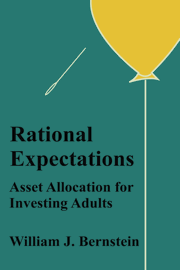
The fourth and final book in the “Investing for Adults” series by William Bernstein is Rational Expectations: Asset Allocation for Investing Adults. In Book 1: The Ages of the Investor, I learned to take advantage of a lucky streak in stocks and stop when I’ve won the game. In Book 2: Skating Where the Puck Was, I learned why it’s so hard to find any “new and improved” asset classes. In Book 3: Deep Risk, I learned about the scenarios that have led to permanent capital loss.

This final book includes the most specific advice about constructing your retirement portfolio. The entire series is great (and honestly not very long even read back-to-back), but this final book is especially dense with additional practical ideas for those that are already comfortable with investing basics. This isn’t at all scientific, but upon counting my Kindle highlights, Book 4 had 75 highlighted passages vs. 33, 25, and 36 respectively for Books 1-3. I’m only going to touch on the few that directly impacted my own portfolio construction.

Stocks. Here is an excerpt regarding how much of your portfolio should be allocated to international stocks.

Deployment among stock asset classes is relatively easier. The obvious place to start is with the total world stock market, as mirrored reasonably well by the FTSE Global All Cap Index, which in early 2014 was split 48/52 between U.S. and foreign equities. From there, we make three adjustments to the foreign allocation, two down and one up. First, the downs: if you’re like most people, your retirement liabilities will be in dollars, so a 52% foreign allocation is inappropriately high. Second, foreign stocks not only are slightly more difficult and expensive to trade but also are subject to foreign tax withholding. This presents no problem in taxable accounts, since those taxes will offset your liability to the IRS, but you lose that deduction if you hold foreign stocks in a sheltered account.

The up adjustment is a temporary one, since foreign stocks, as was discussed in chapter 1, currently have higher expected returns. So at the time of this writing, a foreign stock allocation somewhere in the 30% to 45% region seems reasonable.

Simplifying all that, as of early 2014, the middle recommendation would be roughly 60/40 US/international while the world market cap weighting was roughly 50/50. A little home bias is recommended for US investors.

As of mid-2020, the world market cap weighting is 57% US and 43% International (source), which you might round to 60/40. The adjustments are mostly the same, except that foreign stocks probably have even slightly higher future expected returns as the US stocks keep climbing. If you want to maintain a slight home bias, I would speculate this might change the recommended range closer to 65/35 or 70/30?

Bonds. The recommended list includes short-term US Treasuries/TIPS, bank CDs, and investment-grade municipal bonds. Bernstein is not a fan of corporate bonds.

Sooner or later, we’re going to have an inflationary crisis, and in such an environment, long duration will be a killer. Stick to short Treasuries, CDs, and munis.

Own municipal bonds via a low-cost Vanguard open-ended mutual fund for the diversification. Own Treasury bonds and TIPS directly, as there is no need for mutual funds or ETFs since they all have the same level of risk. Own bank CDs and credit union certificates under the FDIC and NCUA insurance deposit limits.

Asset location. I found this advice about spreading your holdings across Traditional IRAs, Roth IRAs, and taxable accounts to be very useful and practical. Importantly, this may be somewhat different that what you have read elsewhere. I don’t want to summarize incorrectly, so I will just use the excerpts:

To the extent that you wish to rebalance the asset classes in your portfolio, all sales should be done within a sheltered account. If possible, you should house enough of each stock asset class in a sheltered account so that sales may be accomplished free from capital gains taxes. Next, all of the REIT allocation certainly belongs in the sheltered portfolio, since the lion’s share of their long-term returns come from nonqualified dividends.

The real difference made by location occurs at the level of overall account returns. In terms of tax liability, Traditional IRA/Defined Contribution > Taxable > Roth IRA. This means that, optimally, you’d like to arrange the expected returns of each account accordingly, with the highest returns (i.e., highest equity allocation) optimally occurring in the Roth, and the lowest returns (i.e., lowest stock allocation) in your Traditional IRA/Defined Contribution pool. To the extent that this is true, it conforms with the stocks-in-the-taxable-side argument. That said, for optimal tax-free rebalancing, unless your Roth IRA is much bigger than your traditional IRA, you’re still going to want some stock assets in the latter.

It is definitely nice to be able to rebalance and not have to worry about picking stock lots, making sure you have the right cost basis at tax time, and paying capital gains taxes.

Protecting Your Portfolio From Hyperinflation, Deflation, Confiscation, and Devastation

The third book in the “Investing for Adults” series by William Bernstein is Deep Risk: How History Informs Portfolio Design. As before, I’m just trying to pull out a few practical takeaways rather than summarize the entire book. In Book 1: The Ages of the Investor, I learned to take advantage of a lucky streak in stocks and stop when I’ve won the game. In Book 2: Skating Where the Puck Was, I learned why it’s so hard to find any “new and improved” asset classes.

The main problem addressed in this book is “deep risk”, the permanent loss of real (inflation-adjusted) capital. This contrasts with “shallow risk”, in which the value of something usually rebounds within 5-7 years or less.

Here are some deep risks that you can offset by purchasing insurance (and be happy if you never have to use it!).

  • Death of income earner.
  • Long-term health disability.
  • Legal risk – lawsuit with large judgment.
  • Select types of asset loss (i.e. theft, building fire).

Unfortunately, there are other deep risks against which you can’t buy insurance.

  • Hyperinflation, prolonged and severe.
  • Deflation, prolonged and severe.
  • Confiscation by government.
  • Devastation (war).

Over an extended period of time, history has shown us that “safe” bonds are often more sensitive to deep risk than stocks. Many countries saw 100% losses for their bondholders, while partial ownership in a business survived wars and regime changes. An example given was in Germany after World War II. Bonds are also at risk for inflation, while a 30-year fixed-rate mortgage (a negative bond) can be a great inflation hedge.

A portfolio of internationally-diversified stocks is the most practical way to protect yourself from both inflation and deflation. Historically, inflation is much more likely than deflation. You might have an event in one country, but it would be very rare to have a large majority of nations experience severe inflation and low stock returns all at the same time. In such a case you’d be looking at global devastation.

As for local confiscation and local devastation, you would be looking at foreign-held assets, foreign property, perhaps the right passports, and a plan to escape in a timely manner. This sounds like something that a billionaire might pay someone else to set up, but not so sure how practical it would be for most people.

Bernstein offers his own summary:

This booklet’s primary advice regarding risky assets is loud and clear: your best long-term defense against deep risk is a globally value-tilted diversified equity portfolio, perhaps spiced up with a small amount of precious metals equity and natural resource producers, TIPS, and, if to your taste, bullion and foreign real estate.

I admit that I am somewhat fascinated by worst-case scenarios, and I recommend reading the entire book for the full discussion. But in the end, my primary takeaway is that if you have a globally-diversified stock portfolio, you’ve done most of what you can in terms of deep risk. The rest is the same advice as before: consider TIPS if you have enough money, maximize Social Security, and keep some nice safe bonds and bank CDs for short-term needs (shallow risk).

Best Interest Rates on Cash – July 2020

The Fed rate is still at zero, which has bought us back to the time when anything above 2% APY is newsworthy (and there ain’t much news). The only reason to pay attention is that being willing to switch bank accounts can still beat out Treasury bonds and/or brokerage cash sweep options that also pay nearly zero.

Here’s my monthly roundup of the best interest rates on cash for July 2020, roughly sorted from shortest to longest maturities. I track these rates because I keep 12 months of expenses as a cash cushion and also invest in longer-term CDs (often at lesser-known credit unions) when they yield more than bonds. Check out my Ultimate Rate-Chaser Calculator to see how much extra interest you’d earn by moving money between accounts. Rates listed are available to everyone nationwide. Rates checked as of 7/5/2020.

High-yield savings accounts
While the huge megabanks make huge profits while paying you 0.01% APY, it’s easy to open a new “piggy-back” savings account and simply move some funds over from your existing checking account. The interest rates on savings accounts can drop at any time, so I list the top rates as well as competitive rates from banks with a history of competitive rates. Some banks will bait you with a temporary top rate and then lower the rates in the hopes that you are too lazy to leave.

  • Patriot Bank has the top rate at the moment at 1.40% APY guaranteed until 8/31/2020 (last month it was 1.75% APY guaranteed until 7/31/20). I wouldn’t count on anything after the guarantee, as nearly every place else is below that with most likely headed back to the ~1% APY range. There are several other established high-yield savings accounts at above 1% APY for now.

Short-term guaranteed rates (1 year and under)
A common question is what to do with a big pile of cash that you’re waiting to deploy shortly (just sold your house, just sold your business, legal settlement, inheritance). My usual advice is to keep things simple and take your time. If not a savings account, then put it in a flexible short-term CD under the FDIC limits until you have a plan.

  • No Penalty CDs offer a fixed interest rate that can never go down, but you can still take out your money (once) without any fees if you want to use it elsewhere. Marcus has a 7-month No Penalty CD at 1.00% APY with a $500 minimum deposit. Ally Bank has a 11-month No Penalty CD at 0.95% APY for all balance tiers. CIT Bank has a 11-month No Penalty CD at 0.75% APY with a $1,000 minimum deposit. You may wish to open multiple CDs in smaller increments for more flexibility.
  • Pen Air Federal Credit Union has a 12-month CD at 1.25% APY ($500 min). Early withdrawal penalty is 180 days of interest. Anyone can join this credit union via partner organization ($3 one-time fee).

Money market mutual funds + Ultra-short bond ETFs
If you like to keep cash in a brokerage account, beware that many brokers pay out very little interest on their default cash sweep funds (and keep the difference for themselves). The following money market and ultra-short bond funds are NOT FDIC-insured and thus come with a possibility of principal loss, but may be a good option if you have idle cash and cheap/free commissions.

  • Vanguard Prime Money Market Fund currently pays an 0.18% SEC yield. The default sweep option is the Vanguard Federal Money Market Fund which has an SEC yield of 0.12%. You can manually move the money over to Prime if you meet the $3,000 minimum investment.
  • Vanguard Ultra-Short-Term Bond Fund currently pays 1.18% SEC yield ($3,000 min) and 1.28% SEC Yield ($50,000 min). The average duration is ~1 year, so there is more interest rate risk.
  • The PIMCO Enhanced Short Maturity Active Bond ETF (MINT) has a 1.10% SEC yield and the iShares Short Maturity Bond ETF (NEAR) has a 1.19% SEC yield while holding a portfolio of investment-grade bonds with an average duration of ~6 months. Note that there was a sudden, temporary drop in net asset value during the recent market stress.

Treasury Bills and Ultra-short Treasury ETFs
Another option is to buy individual Treasury bills which come in a variety of maturities from 4-weeks to 52-weeks. You can also invest in ETFs that hold a rotating basket of short-term Treasury Bills for you, while charging a small management fee for doing so. T-bill interest is exempt from state and local income taxes. Right now, this section probably isn’t very interesting as T-Bills are yielding close to zero!

  • You can build your own T-Bill ladder at TreasuryDirect.gov or via a brokerage account with a bond desk like Vanguard and Fidelity. Here are the current Treasury Bill rates. As of 7/2/2020, a new 4-week T-Bill had the equivalent of 0.13% annualized interest and a 52-week T-Bill had the equivalent of 0.16% annualized interest.
  • The Goldman Sachs Access Treasury 0-1 Year ETF (GBIL) has a 0.09% SEC yield and the SPDR Bloomberg Barclays 1-3 Month T-Bill ETF (BIL) has a -.02% (!) SEC yield. GBIL appears to have a slightly longer average maturity than BIL.

US Savings Bonds
Series I Savings Bonds offer rates that are linked to inflation and backed by the US government. You must hold them for at least a year. There are annual purchase limits. If you redeem them within 5 years there is a penalty of the last 3 months of interest.

  • “I Bonds” bought between May 2020 and October 2020 will earn a 1.06% rate for the first six months. The rate of the subsequent 6-month period will be based on inflation again. More info here.
  • In mid-October 2020, the CPI will be announced and you will have a short period where you will have a very close estimate of the rate for the next 12 months. I will have another post up at that time.

Prepaid Cards with Attached Savings Accounts
A small subset of prepaid debit cards have an “attached” FDIC-insured savings account with exceptionally high interest rates. The negatives are that balances are capped, and there are many fees that you must be careful to avoid (lest they eat up your interest). Some folks don’t mind the extra work and attention required, while others do. There is a long list of previous offers that have already disappeared with little notice. I don’t personally recommend nor use any of these anymore.

  • The only notable card left in this category is Mango Money at 6% APY on up to $2,500, along with several hoops to jump through. Requirements include $1,500+ in “signature” purchases and a minimum balance of $25.00 at the end of the month.

Rewards checking accounts
These unique checking accounts pay above-average interest rates, but with unique risks. You have to jump through certain hoops, and if you make a mistake you won’t earn any interest for that month. Some folks don’t mind the extra work and attention required, while others do. Rates can also drop to near-zero quickly, leaving a “bait-and-switch” feeling. If you want rates above 2% APY, this is close to the only game in town.

  • Consumers Credit Union Free Rewards Checking (my review) still offers up to 4.09% APY on balances up to $10,000 if you make $500+ in ACH deposits, 12 debit card “signature” purchases, and spend $1,000 on their credit card each month. The Bank of Denver has a Free Kasasa Cash Checking offering 3% APY on balances up to $25,000 if you make 12 (temporarily 6 due to COVID-19) debit card purchases and at least 1 ACH credit or debit transaction per statement cycle. If you meet those qualifications, you can also link a savings account that pays 2% APY on up to $50k. Thanks to reader Bill for the tip. Find a locally-restricted rewards checking account at DepositAccounts.

Certificates of deposit (greater than 1 year)
CDs offer higher rates, but come with an early withdrawal penalty. By finding a bank CD with a reasonable early withdrawal penalty, you can enjoy higher rates but maintain access in a true emergency. Alternatively, consider building a CD ladder of different maturity lengths (ex. 1/2/3/4/5-years) such that you have access to part of the ladder each year, but your blended interest rate is higher than a savings account. When one CD matures, use that money to buy another 5-year CD to keep the ladder going. Some CDs also offer “add-ons” where you can deposit more funds if rates drop.

  • Georgia’s Own Credit Union has a 5-year certificate at 1.70% APY ($500 min), 4-year at 1.50% APY, 3-year at 1.45% APY, and 2-year at 1.25% APY. Beware that the early withdrawal penalty for the 5-year is 450 days of interest. Anyone can join via partner organization for one-time $10 fee.
  • You can buy certificates of deposit via the bond desks of Vanguard and Fidelity. You may need an account to see the rates. These “brokered CDs” offer FDIC insurance and easy laddering, but they don’t come with predictable early withdrawal penalties. Vanguard has a 5-year at 0.80% APY right now. Be wary of higher rates from callable CDs listed by Fidelity.

Longer-term Instruments
I’d use these with caution due to increased interest rate risk, but I still track them to see the rest of the current yield curve.

  • Willing to lock up your money for 10 years? You can buy long-term certificates of deposit via the bond desks of Vanguard and Fidelity. These “brokered CDs” offer FDIC insurance, but they don’t come with predictable early withdrawal penalties. Vanguard has a 5-year at 0.95% APY right now. Watch out for higher rates from callable CDs from Fidelity.
  • How about two decades? Series EE Savings Bonds are not indexed to inflation, but they have a unique guarantee that the value will double in value in 20 years, which equals a guaranteed return of 3.5% a year. However, if you don’t hold for that long, you’ll be stuck with the normal rate which is quite low (currently a sad 0.10% rate). I view this as a huge early withdrawal penalty. But if holding for 20 years isn’t an issue, it can also serve as a hedge against prolonged deflation during that time. As of 7/2/2020, the 20-year Treasury Bond rate was 1.20%.

All rates were checked as of 7/5/2020.