 Investment research firm Morningstar has released their annual 529 College Savings Plans analyst ratings for 2019. While the full ratings and plan analysis for every individual plan are restricted to paid premium members, the vast majority are mediocre and can be ignored. You choices are pretty much (1) your in-state plan for the tax benefits or (2) the best overall plan if you don’t have good in-state perks.
Here are the Gold-rated plans for 2019 (no particular order). Morningstar uses a Gold, Silver, or Bronze rating scale for the top plans and Neutral or Negative for the rest.
- My529, formerly the Utah Educational Savings Plan
- Invest529 College Savings Plan, Virginia
- Bright Start College Savings, Illinois
- Scholarshare 529 College Savings Plan, California
The top 3 were Gold last year as well. California Scholarshare is a new addition, upgraded from Silver. The Vanguard 529 Plan from Nevada was removed, downgraded to Silver. The reason stated was because their expenses were low, but not as low as the rest of the Gold-rated plans above.
Here are the consistently top-rated plans from 2011-2019. This means they were rated either Gold or Silver (or equivalent) for every year the rankings were done from 2011 through 2018. These were also the same as last year. No particular order.
- T. Rowe Price College Savings Plan, Alaska
- Maryland College Investment Plan
- Vanguard 529 College Savings Plan, Nevada
- CollegeAdvantage 529 Savings Plan, Ohio
- CollegeAmerica Plan, Virginia (Advisor-sold)
- My529, formerly the Utah Educational Savings Plan
The “Five P” criteria.
- People. Who’s behind the plans? Who are the investment consultants picking the underlying investments? Who are the mutual fund managers?
- Process. Are the asset-allocation glide paths and funds chosen for the age-based options based on solid research? Whether active or passive, how is it implemented?
- Parent. How is the quality of the program manager (often an asset-management company or board of trustees which has a main role in the investment choices and pricing)? Also refers to state officials and their policies.
- Performance. Has the plan delivered strong risk-adjusted performance, both during the recent volatility and in the long-term?
- Price. Includes factors like asset-weighted expense ratios and in-state tax benefits.
State-specific tax benefits. Remember to first consider your state-specific tax benefits via the tools from Morningstar, SavingForCollege, or Vanguard. Morningstar estimates that an upfront tax break of at least 5% can make it worth investing in your in-state plan even if it is not a top plan (assuming that is required to get the tax benefit).
If you don’t have anything compelling available, anyone can open a 529 plan from any state. I would pick from the ones listed above. Also, if you have money in an in-state plan now but your situation changes, you can roll over your funds into another 529 from any state. (Watch out for tax-benefit recapture if you got a tax break initially.)
My picks. Overall, the plans are getting better and most Gold/Silver picks are solid. If your state doesn’t offer a significant tax break, I have recommended these two plans to my friends and family:
- Nevada 529 Plan has low costs, solid automated glide paths, a variety of Vanguard investment options, and long-term commitment to consistently lowering costs as their assets grow. (It is not the rock-bottom cheapest, but this is often because other plans don’t offer much international exposure, which usually costs more.) This is only plan that Vanguard puts their name on, and you can manage it within your Vanguard.com account. This is the keep-it-simple option.
- Utah 529 plan has low costs, investments from Vanguard and DFA, and has highly-customizable glide paths. Over the last few years, the Utah plan has also shown a consistent effort towards passing on future cost savings to clients. This is the option for folks that enjoy DIY asset allocation. Since I like to DIY, the vast majority of my family’s college savings is in this plan.
I feel that a consistent history of consumer-first practices is important. Sure, you can move your funds if needed, but wouldn’t you rather watch your current plan just keep getting better every year?


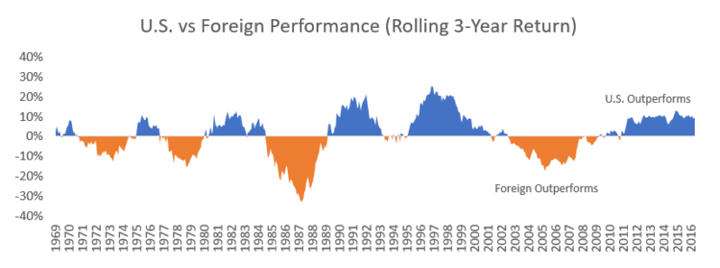
 One of the common reasons given for only investing the S&P 500 or only US-based companies is that the businesses operate globally. “McDonald’s and Coca-Cola sell burgers and soda everywhere. Disney is everywhere. ExxonMobil sells energy around the world.” I understand the sentiment, but how about some real numbers? The Morningstar article

 All this talk about portfolio rebalancing is to improve your risk-adjusted return, not to maximize absolute returns. You are trying to squeeze the most return out of a given degree of risk. Otherwise, if you do nothing eventually whatever has a higher return (historically always stocks) will outperform and take over the portfolio.
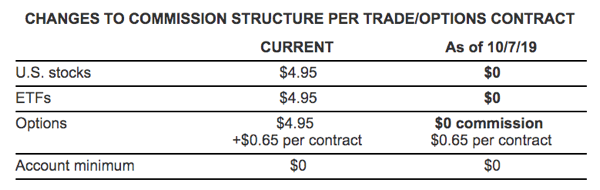
 Fidelity, Schwab, TD Ameritrade, E-Trade, Interactive Brokers, Ally Invest all now offer free stock trades. Vanguard offers free trades on all ETFs, not just their own. The new differentiators are things like user interface, customer service, and interest on cash sweep accounts. How about some cash in my pocket too?
 Robinhood brokerage has finally re-launched the high-interest cash sweep option after their failed (and illegal?) 2018 mash-up of checking accounts and SIPC-insurance.
  The financial news industry loves to provide constant updates of the S&P 500 along with endless guesses as to why it blipped up or down. I like reading about finance and it still drives me crazy! It just makes people focus on the short-term and think of the stock market like a roulette wheel. If you step back and take a longer-term view, here is a basic model for explaining the total return of the stock market:




 The Best Credit Card Bonus Offers – 2025
 Big List of Free Stocks from Brokerage Apps
 Best Interest Rates on Cash - 2025
 Free Credit Scores x 3 + Free Credit Monitoring
 Best No Fee 0% APR Balance Transfer Offers
 Little-Known Cellular Data Plans That Can Save Big Money
 How To Haggle Your Cable or Direct TV Bill
 Big List of Free Consumer Data Reports (Credit, Rent, Work)