How To Lose Your Money Investing

Sometimes the best solution to a problem comes by approaching it backwards. Charlie Munger often spoke about the principle of inversion. Instead of looking for things that you should do to achieve a goal, make a list of things you would do to make sure you never reach that goal. Then do whatever you can to avoid those things.

Safal Niveshak offers us this related graphic in his post 5 Ways to Destroy Your Wealth. I’m always a sucker for a clever Venn diagram…
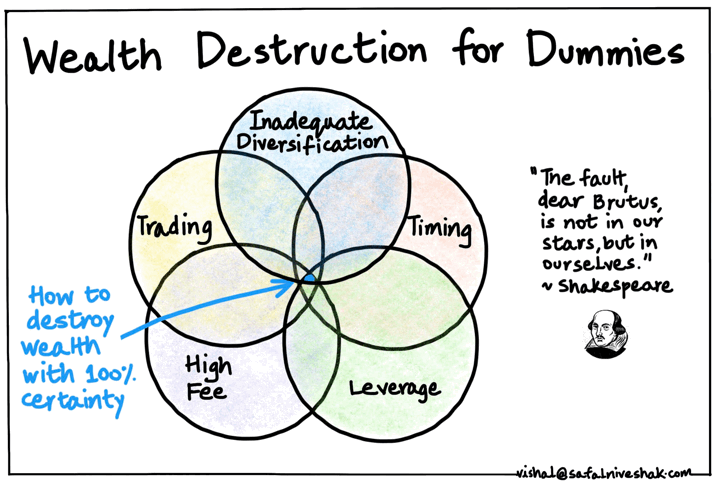
Definitely a good list. However, I would say this graphic is more focused on “How To Destroy Wealth Investing“, as I can think of plenty of other ways to destroy wealth…

My Money Blog Portfolio Income and Withdrawal Rate – September 2019 (Q3)

dividendmono225One of the biggest problems in retirement planning is making sure a pile of money lasts throughout your retirement. I have read hundreds of articles about this topic, and there is no single solution. My imperfect (!) solution is to first build a portfolio designed for total return using assets that have enough faith in to hold through an extended downturn. I do not look for the highest income – no specialized ETFs, no high-dividend-only stocks, no high-yield bonds.
Then, only after that do I check out how much it distributes in dividends and interest. Dividends are the portion of profits that businesses have decided they don’t need to reinvest into their business. The analogy I fall back on is owning a rental property. If you are reliably getting rent checks that increase with inflation, you can sit back calmly and ignore what the house might sell for on the open market.

I track the “TTM Yield” or “12-Month Yield” from Morningstar, which the sum of a fund’s total trailing 12-month interest and dividend payments divided by the last month’s ending share price (NAV) plus any capital gains distributed over the same period. I prefer this measure because it is based on historical distributions and not a forecast. Below is a very close approximation of my investment portfolio (2/3rd stocks and 1/3rd bonds).

Asset Class / Fund % of Portfolio Trailing 12-Month Yield (Taken 9/17/19) Yield Contribution
US Total Stock
Vanguard Total Stock Market Fund (VTI, VTSAX)
25% 1.85% 0.46%
US Small Value
Vanguard Small-Cap Value ETF (VBR)
5% 2.35% 0.12%
International Total Stock
Vanguard Total International Stock Market Fund (VXUS, VTIAX)
25% 3.05% 0.76%
Emerging Markets
Vanguard Emerging Markets ETF (VWO)
5% 2.71% 0.14%
US Real Estate
Vanguard REIT Index Fund (VNQ, VGSLX)
6% 3.29% 0.20%
Intermediate-Term High Quality Bonds
Vanguard Intermediate-Term Treasury ETF (VGIT)
17% 2.20% 0.37%
Inflation-Linked Treasury Bonds
Vanguard Short-Term Inflation-Protected Securities ETF (VTIP)
17% 2.12% 0.36%
Totals 100% 2.41%


Here is a chart showing how this 12-month trailing income rate has varied over the last five years.

One of the things I like about using this number is that when stock prices drop, this percentage metric usually goes up – which makes me feel better in a gloomy market. When stock prices go up, this percentage metric usually goes down, which keeps me from getting too euphoric. I see it as a very conservative, valuation-based withdrawal rate metric due to our very long retirement horizon of 40+ years.

In practical terms, I let all of my dividends and interest accumulate without automatic reinvestment. I treat this money as my “paycheck”. Then, as with my real paycheck, I can choose to either spend it or reinvest in more stocks and bonds. This number does not dictate how much we actually spend every year, but it gives me an idea of how comfortable I am with our withdrawal rate.

I am a proponent of aggressively saving, and then using the potential income that brings to improve your daily lifestyle. Instead of sitting on a beach, we used our nest egg to allow us to work less hours in a more flexible manner as parents of young children. Others may use it to start a new business, travel around the world, do charity or volunteer work, and so on. The income from our portfolio lets us “work less and live more” now as I now fear running out of time more than running out of money.

(If you’re still in the accumulation phase, you don’t really need to worry about this number. I believe a 3% withdrawal rate remains a reasonable target for something retiring young (before age 50) and a 4% withdrawal rate is a reasonable target for one retiring at a more traditional age (closer to 65). If you are young, instead focus on your earning potential via better career moves, investing in your skill set, and/or look for entrepreneurial opportunities where you own equity in a business.)

My Money Blog Portfolio Asset Allocation Update, September 2019 (Q3)

portpie_blank200

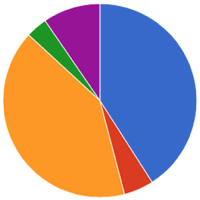
Here’s my portfolio update for the third quarter of 2019. Most of my dividends arrive on a quarterly basis, and this helps me determine where to reinvest them. These are my real-world holdings, including 401k/403b/IRAs, taxable brokerage accounts, and savings bonds but excluding our house, cash reserves, and a few side investments. The goal of this portfolio is to create sustainable income that keeps up with inflation to cover our household expenses.

Actual Asset Allocation and Holdings

I use both Personal Capital and a custom Google Spreadsheet to track my investment holdings. The Personal Capital financial tracking app (free, my review) automatically logs into my accounts, adds up my balances, tracks my performance, and calculates my asset allocation. I still use my manual Google Spreadsheet (free, instructions) because it helps me calculate how much I need in each asset class to rebalance back towards my target asset allocation.

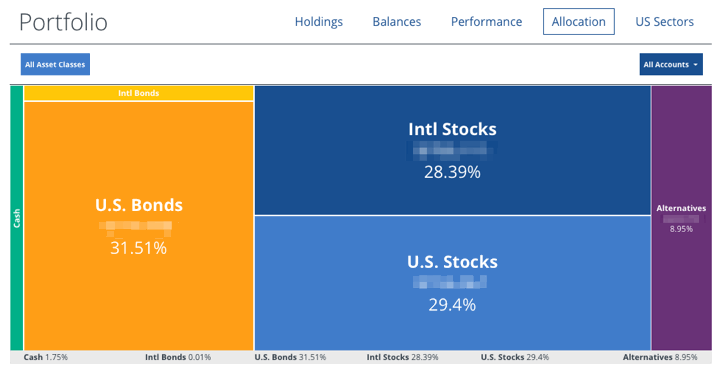
Here are my YTD performance and current asset allocation visually, per the “Holdings” and “Allocation” tabs of my Personal Capital account, respectively:

Stock Holdings
Vanguard Total Stock Market Fund (VTI, VTSAX)
Vanguard Total International Stock Market Fund (VXUS, VTIAX)
WisdomTree SmallCap Dividend ETF (DES)
Vanguard Small Value ETF (VBR)
Vanguard Emerging Markets ETF (VWO)
Vanguard REIT Index Fund (VNQ, VGSLX)

Bond Holdings
Vanguard Limited-Term Tax-Exempt Fund (VMLTX, VMLUX)
Vanguard Intermediate-Term Tax-Exempt Fund (VWITX, VWIUX)
Vanguard Intermediate-Term Treasury Fund (VFITX, VFIUX)
Vanguard Inflation-Protected Securities Fund (VIPSX, VAIPX)
Fidelity Inflation-Protected Bond Index Fund (FIPDX)
iShares Barclays TIPS Bond ETF (TIP)
Individual TIPS securities
U.S. Savings Bonds (Series I)

Target Asset Allocation. Our overall goal is to include asset classes that will provide long-term returns above inflation, distribute income via dividends and interest, and finally offer some historical tendencies to balance each other out. I make a small bet that US Small Value and Emerging Markets will have higher future long-term returns (along with some higher volatility) than the more large and broad indexes, although I could be wrong.

I don’t hold commodities, gold, or bitcoin. While you could argue for each of these asset classes, I believe that it is important to imagine an asset class doing poorly for a long time, with bad news constantly surrounding it, and only hold the ones where you still think you can maintain faith based on a solid foundation of knowledge and experience. That’s just not the case for me with certain asset classes.

Stocks Breakdown

  • 38% US Total Market
  • 7% US Small-Cap Value
  • 38% International Total Market
  • 7% Emerging Markets
  • 10% US Real Estate (REIT)

Bonds Breakdown

  • 33% US Treasury Bonds, intermediate
  • 33% High-Quality Municipal Bonds (taxable)
  • 33% US Treasury Inflation-Protected Bonds (tax-deferred)

I have settled into a long-term target ratio of 67% stocks and 33% bonds (2:1 ratio) within our investment strategy of buy, hold, and occasionally rebalance. I will use the dividends and interest to rebalance whenever possible in order to avoid taxable gains. (I allow it drift a bit either way.) With a self-managed, simple portfolio of low-cost funds, we minimize management fees, commissions, and taxes.

Holdings commentary. On the stocks side, somehow despite all of the various news stories stock prices have been resilient. I’m like a lot of other people and waiting for the next recession to come, but I also know to stay in the game. US stocks have beaten international stocks for a while, but I remain satisfied with my mix, knowing that I will own whatever successful businesses come out of the US, China, or wherever in the future.

On the bond side, my primary objective is to hold high-quality bonds with a short-to-intermediate duration of under 5 years or so. This means US Treasuries, TIPS, or investment-grade municipal bonds. I don’t want to worry about my bonds. I then tweak the specific breakdown based on my tax-deferred space available, the tax-effective rates of muni bonds, and the real interest rates of TIPS. Right now, it is roughly 1/3rd Treasuries, 1/3 Muni bonds, and 1/3rd TIPS. It looks like I need to redirect my dividends into more bonds.

Performance commentary and benchmarks. According to Personal Capital, my portfolio went up 13% so far in 2019. I see that during the same period the S&P 500 has gone up nearly 20%, Foreign Developed stocks up nearly 13%, and the US Aggregate bond index was up about 7%.

An alternative benchmark for my portfolio is 50% Vanguard LifeStrategy Growth Fund and 50% Vanguard LifeStrategy Moderate Growth Fund – one is 60/40 and the other is 80/20 so it also works out to 70% stocks and 30% bonds. That benchmark would have a total return of +14.82% for 2019 YTD.

I’ll share about more about the income in a separate post.

Reminder: Nobody Can Predict Future Interest Rates (Especially the Experts)

The financial prediction industry is simply mind-boggling to me. There is zero long-term memory or accountability. You can make all the predictions you want about the stock market, gold prices, and interest rates, and nobody remembers your bad calls. You get a contrarian call right, and all of a sudden you’re on all the TV interviews and news articles.
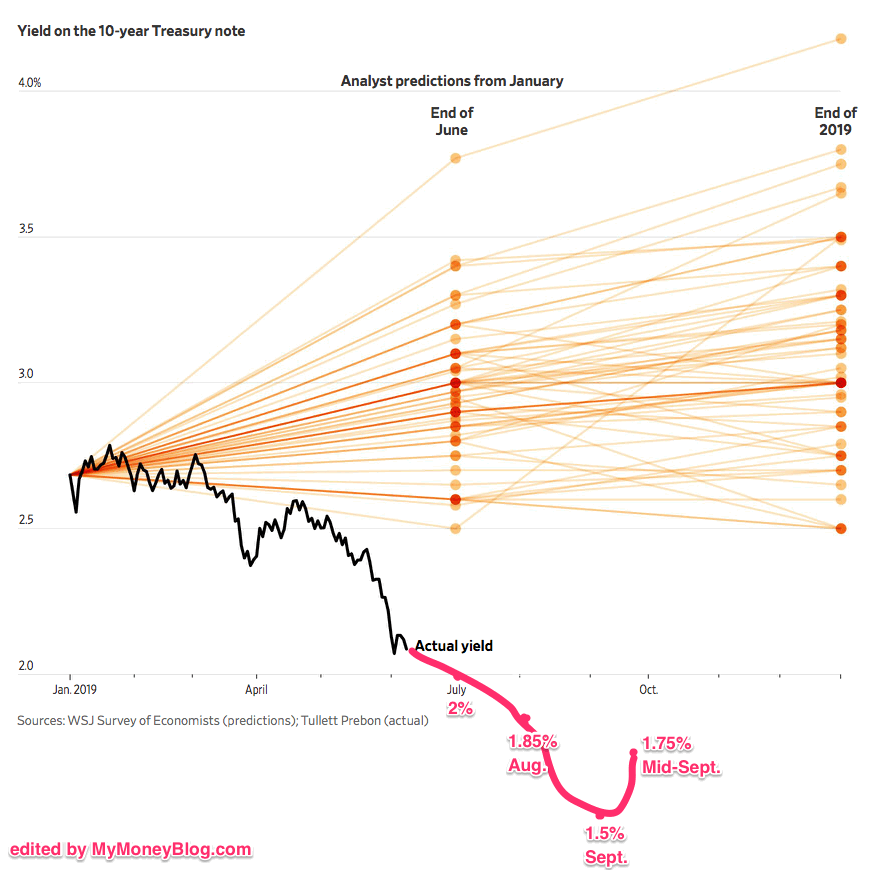
Allow me to remind you of what the Wall Street Journal’s panel of economists predicted in January 2019 as to what interest rates would look like the rest of the year (WSJ source). I have updated the chart with the current rates (click to enlarge). This was less than 10 months ago!

Apologies for the sloppy graphics, but you can see that 10-year rates dropped down to 2% in July, down even further to 1.5% at the beginning of September, with a slight bounce up to around 1.75% today. Not a single prediction was even close to reality.

When I was stocking up on 4% APY 5-year CDs last year, I was reading comments like “Why lock in such a low rate? You’re going to see much higher rates soon!”. Now, all of the comments are “You better lock in that 3% CD before rates drop further!”

Predicting interest rates even only as far as the next 12 months, is incredibly hard. You can’t do it reliably. Nobody can do it reliably. You might get it right, but that is called luck and not skill.

Individual investors don’t have an advantage in predicting future rates, but they do have their own set of special advantages. As an individual investor, you can purchase certificates from any FDIC-insured bank or NCUA-insured credit union if the interest rate is better than the comparable US Treasury. Over the last couple of years, I was able to buy multiple 5-year CDs at 4% APY when the 5-year Treasury was well below 3%. You have to act decisively, but any individual can do it. Pension funds and other institutional investors can’t.

I have a ladder of 5-year CDs. Each year, I buy a 5-year CD when a compelling interest rate arises. I don’t care about the rate direction, as long as I get about 1% above US Treasuries. After 5 years of doing this, you will have a ladder of CDs such that each year one CD is maturing and you can simply reinvest the funds each year. If I managed to put one year of expenses into each rung of this ladder, I now have 5 years of expenses in the bank, fully-insured and ready to go in case of financial emergency. An extra 1% on each $100,000 is $1,000 a year. That’s real money.

If this sounds like too much trouble to open accounts at multiple banks, you can always still with a Total US Bond fund (like AGG or BND). You’re essentially buying an ladder of bonds. BND has an average effective maturity of 8 years and average duration of 6 years. You might also buy it automatically inside a Vanguard Target Retirement Fund. Just keep buying it and ignore any talk about “The Fed”. Keep the chart above in your mind.

Best Interest Rates on Cash – September 2019

Here’s my monthly roundup of the best interest rates on cash for September 2019, roughly sorted from shortest to longest maturities. I track these rates because I keep a full 12 months of expenses as a cash cushion and also invest in longer-term CDs (often at lesser-known credit unions) when they yield more than bonds. Check out my Ultimate Rate-Chaser Calculator to get an idea of how much extra interest you’d earn if you are moving money between accounts. Rates listed are available to everyone nationwide. Rates checked as of 9/3/19.

High-yield savings accounts
While the huge megabanks like to get away with 0.01% APY, it’s easy to open a new “piggy-back” savings account and simply move some funds over from your existing checking account. The interest rates on savings accounts can drop at any time, so I prioritize banks with a history of competitive rates. Some banks will bait you and then lower the rates in the hopes that you are too lazy to leave.

Short-term guaranteed rates (1 year and under)
A common question is what to do with a big pile of cash that you’re waiting to deploy shortly (just sold your house, just sold your business, legal settlement, inheritance). My usual advice is to keep things simple and take your time. If not a savings account, then put it in a flexible short-term CD under the FDIC limits until you have a plan.

  • No Penalty CDs offer a fixed interest rate that can never go down, but you can still take out your money (once) without any fees if you want to use it elsewhere. Marcus Bank has a 7-month No Penalty CD at 2.25% APY and a 11-month No Penalty CD at 2.20% APY with a $500 minimum deposit. Ally Bank has a 11-month No Penalty CD at 2.20% APY with a $25,000 minimum deposit. You may wish to open multiple CDs in smaller increments for more flexibility.
  • Total Direct Bank has a 12-month CD at 2.60% APY ($25,000 minimum) with an early withdrawal penalty of 3 months of interest. Navy Federal Credit Union has a special 9-month CD at 2.50% APY ($1,000 minimum), but you must have a military affiliation to join (includes being a relative of a veteran).

Money market mutual funds + Ultra-short bond ETFs
If you like to keep cash in a brokerage account, beware that many brokers pay out very little interest on their default cash sweep funds (and keep the difference for themselves). The following money market and ultra-short bond funds are not FDIC-insured, but may be a good option if you have idle cash and cheap/free commissions.

  • Vanguard Prime Money Market Fund currently pays an 2.12% SEC yield. The default sweep option is the Vanguard Federal Money Market Fund, which has an SEC yield of 2.08%. You can manually move the money over to Prime if you meet the $3,000 minimum investment.
  • Vanguard Ultra-Short-Term Bond Fund currently pays 2.21% SEC yield ($3,000 min) and 2.31% SEC Yield ($50,000 min). The average duration is ~1 year, so there is more interest rate risk.
  • The PIMCO Enhanced Short Maturity Active Bond ETF (MINT) has a 2.40% SEC yield and the iShares Short Maturity Bond ETF (NEAR) has a 2.41% SEC yield while holding a portfolio of investment-grade bonds with an average duration of ~6 months.

Treasury Bills and Ultra-short Treasury ETFs
Another option is to buy individual Treasury bills which come in a variety of maturities from 4-weeks to 52-weeks. You can also invest in ETFs that hold a rotating basket of short-term Treasury Bills for you, while charging a small management fee for doing so. T-bill interest is exempt from state and local income taxes.

  • You can build your own T-Bill ladder at TreasuryDirect.gov or via a brokerage account with a bond desk like Vanguard and Fidelity. Here are the current Treasury Bill rates. As of 9/3/19, a 4-week T-Bill had the equivalent of 2.07% annualized interest and a 52-week T-Bill had the equivalent of 1.74% annualized interest (!).
  • The Goldman Sachs Access Treasury 0-1 Year ETF (GBIL) has a 1.99% SEC yield and the SPDR Bloomberg Barclays 1-3 Month T-Bill ETF (BIL) has a 1.92% SEC yield. GBIL appears to have a slightly longer average maturity than BIL.

US Savings Bonds
Series I Savings Bonds offer rates that are linked to inflation and backed by the US government. You must hold them for at least a year. There are annual purchase limits. If you redeem them within 5 years there is a penalty of the last 3 months of interest.

  • “I Bonds” bought between May 2019 and October 2019 will earn a 1.90% rate for the first six months. The rate of the subsequent 6-month period will be based on inflation again. More info here.
  • In mid-October 2019, the CPI will be announced and you will have a short period where you will have a very close estimate of the rate for the next 12 months. I will have another post up at that time.

Prepaid Cards with Attached Savings Accounts
A small subset of prepaid debit cards have an “attached” FDIC-insured savings account with exceptionally high interest rates. The negatives are that balances are capped, and there are many fees that you must be careful to avoid (lest they eat up your interest). Some folks don’t mind the extra work and attention required, while others do. There is a long list of previous offers that have already disappeared with little notice. I don’t personally recommend nor use any of these anymore.

  • The only notable card left in this category is Mango Money at 6% APY on up to $2,500, but there are many hoops to jump through. Requirements include $1,500+ in “signature” purchases and a minimum balance of $25.00 at the end of the month.

Rewards checking accounts
These unique checking accounts pay above-average interest rates, but with unique risks. You have to jump through certain hoops, and if you make a mistake you won’t earn any interest for that month. Some folks don’t mind the extra work and attention required, while others do. Rates can also drop to near-zero quickly, leaving a “bait-and-switch” feeling. I don’t use any of these anymore, but the Orion offer is worth consideration.

  • The newest one is Orion FCU Premium Checking at 4.00% APY on balances up to $30,000 if you meet make $500+ in direct deposits and 8 debit card “signature” purchases each month. One has been around for while is the Consumers CU Free Rewards Checking at up to 5.09% APY on balances up to $10,000 if you meet make $500+ in ACH deposits, 12 debit card “signature” purchases, and spend $1,000 on their credit card each month. Find a locally-restricted rewards checking account at DepositAccounts.
  • If you’re looking for a high-interest checking account without debit card transaction requirements then the rate won’t be as high, but take a look at MemoryBank at 1.40% APY.

Certificates of deposit (greater than 1 year)
CDs offer higher rates, but come with an early withdrawal penalty. By finding a bank CD with a reasonable early withdrawal penalty, you can enjoy higher rates but maintain access in a true emergency. Alternatively, consider building a CD ladder of different maturity lengths (ex. 1/2/3/4/5-years) such that you have access to part of the ladder each year, but your blended interest rate is higher than a savings account. When one CD matures, use that money to buy another 5-year CD to keep the ladder going. Some CDs also offer “add-ons” where you can deposit more funds if rates drop.

  • You could build a CD ladder at First National Bank of America at 2.85% APY for 5-year, 2.75% APY for 4-year, 2.65% APY for 3-year, 2.60% APY for 2-year, and 2.50% APY for 1-year.
  • 5-year CD rates have been dropping at many banks and credit unions, following the overall interest rate curve. A good rate is now about 3.00% APY, with Commonwealth One Federal Credit Union offering a 5-year CD at 3.11% APY ($1,000 minimum) with an early withdrawal penalty of 180 days of interest. Higher rates with $50k an $100k deposits. Anyone can join this credit union via partner organization.
  • Navy Federal Credit Union has a special 18-month cert at 3.00% APY ($1,000 minimum) and a 5-year cert at 3.25% APY, but you must have a military affiliation to join (includes being a relative of a veteran).
  • You can buy certificates of deposit via the bond desks of Vanguard and Fidelity. You may need an account to see the rates. These “brokered CDs” offer FDIC insurance and easy laddering, but they don’t come with predictable early withdrawal penalties. The rates are not interesting right now. As of this writing, Vanguard is showing a 2-year non-callable CD at 1.80% APY. Watch out for higher rates from callable CDs listed by Fidelity.

Longer-term Instruments
I’d use these with caution due to increased interest rate risk, but I still track them to see the rest of the current yield curve.

  • Willing to lock up your money for 10+ years? You can buy long-term certificates of deposit via the bond desks of Vanguard and Fidelity. These “brokered CDs” offer FDIC insurance, but they don’t come with predictable early withdrawal penalties. As of this writing, I am seeing no inventory on 7-year and 10-year CDs. Watch out for higher rates from callable CDs from Fidelity.
  • How about two decades? Series EE Savings Bonds are not indexed to inflation, but they have a unique guarantee that the value will double in value in 20 years, which equals a guaranteed return of 3.5% a year. However, if you don’t hold for that long, you’ll be stuck with the normal rate which is quite low (currently a sad 0.10% rate). I view this as a huge early withdrawal penalty. However, you could also view it as a hedge against prolonged deflation, but only if you can hold on for 20 years. As of 9/3/19, the 20-year Treasury Bond rate was 1.77%.

All rates were checked as of 9/3/19.

Public App Review (Matador): Free Dollar-Based Stock Trades, Free Stock Slice

Updated. Public, formerly known as Matador, is a new brokerage app that combines several different features that you might have seen separately elsewhere:

  • Free dollar-based stock trades with no minimum balance. Not only can you trade any stock for free, you can also choose to trade fractional shares in real-time for free as well. For example, Google stock may trade at over $1,000 a share, but you can buy just $50 worth if you want with no commission.
  • Free stock slice via referral. Details below.
  • Social investing. You can “follow” other investors and see their portfolio holdings and recent trade activity.

Referral bonus details. Here is my Public referral link for a free slice of stock. Thanks if you use it! The updated terms of this detail are a bit vague – my app just says a “free slice of stock”. Here is their link with full terms. Sounds like the value varies, up to $50. Note that you are not allowed to withdraw the value of the free stock received for up to 90 days after the free promotional stock is received.

Interest on cash sweep. You may have seen that Public used to offer 2.5% interest on idle cash up to $10,000. This was a pretty high interest rate at the time, but as after the Fed rate drops in early 2020, it was apparently unsustainable. As of March 30th, 2020, Public stopped paying interest on idle cash.

Other inner details. Public (formerly Matador) is part of T3 Securities, which is a broker-dealer member of FINRA and SIPC. The clearing firm is Apex Clearing, as with many other similar apps. Public uses Plaid to link your external bank accounts for ACH transfers, which is a widely-used third-party service. The default setting is free paperless trade confirmations and statements, otherwise a physical trade confirmation is $2 a pop and a paper statement is $5 a pop.

Inflation-Adjusted (Real) US Treasury Bond Yield, 1955-2019

I was looking for a historical chart of the 30-year US Treasury yield that adjusted for inflation, as the yields were much higher in the 1970s and 1980s but inflation was quite high as well. The closest I could find was this chart of the inflation-adjusted (real) 10-year US Treasury yield. (Please let me know if you have something better.)

Taken from Bonds Are Frickin’ Expensive, Cliff Asness of AQR takes the nominal 10-year Treasury yield and subtracts the 3-year trailing annualized CPI inflation. I prefer the use of hard numbers over a forecast.

You can see that in the past, the inflation-adjusted yield has varied quite widely. There have been zero and negative real yields, and there have been really high positive real yields. From a historical perspective, right now bonds do not yield very much and the overall curve is rather flat. The article concludes:

So, the bottom line is, as measured by real bond yield, U.S. Treasury bonds are really frickin’ expensive. Measured by the slope of the yield curve they are really frickin’ expensive. But, measured by the average of these two simple variables, they are 60+ year just about record-low frickin’ expensive. This result is not caused by, but is certainly exacerbated by, the (perhaps) surprisingly uncorrelated nature of slope and real bond yield, thus making both so low and at the same time considerably more surprising.

The usual disclaimer against timing bond rates is thrown in there, but it felt only half-hearted.

I have no plans to sell my high-quality bonds because they have historically been a reliable buffer against stock drops:

Still, it would sure be nice if they actually gave me some positive real return…

The Case Against REITs as a Separate Asset Class Holding

Morningstar has another educational article about investing in REITs as a separate asset class (free registration may be required). The entire article is worth a read, as it does a good job of summarizing the basic arguments for either carving out a special place in your portfolio for REITs, or simply leaving it at the ~4% market weighting that exists in most broad US index funds. For those already familiar with that, the historical charts add additional depth.

Historical correlations. This M* chart tracks the rolling 36-month correlation between the Vanguard Real Estate Index Fund (VGSIX) and Vanguard Total stock Market Index Fund (VTSMX), Vanguard Total International Stock Index Fund (VGTSX), and Vanguard Total Bond Market Index Fund (VBMFX). Note that the popular Vanguard Real Estate ETF (VNQ) has the same underlying holdings as VGSIX.

Sometimes the correlation between REITs and the overall stock market is very high, close to 1, but at other times it is closer to 0.5.

Historical return vs. volatility. Here’s a good stat: From 1972 to 2018, REITs have had a slightly higher average total annual return than the US Total Stock Market (11.4% vs. 10.3%), but also a higher average standard deviation (16.9% vs. 15.5%).

My take. I agree that REITs are not an “alternative” asset class on the level of fine art, music royalties, or Bitcoin. I think common sense would predict that publicly-traded corporations that own commercial property would be at least moderately correlated with the overall stock market. Historically, REITs provided a slightly higher return than stocks but also slightly higher price volatility. Using a broad REIT fund instead of a stock fund (or vice versa) is only going move the needle a relatively small amount.

However, I do see real estate as “different”. It has the limited availability of a commodity like gold or silver, yet it is productive like a factory. Land can produce rent, timber, or food (farmland). I could own single family rentals or farmland, but personal experiences have taught me that the higher potential returns also come with higher potential headaches. I’m willing to give up some of the return and simply hold REITs which don’t have be dealing with chasing late rent, fixing damages, civil lawsuits, and governmental bureaucracy.

Thus, I do hold a dedicated REIT portfolio allocation via the Vanguard REIT ETF and mutual funds. If I’m lucky they will add a bit of diversification and/or extra return, but even if they just offer more of the same, that’s good enough. (I noticed that the M* article author also discloses that he holds VNQ.) If you are interested in something closer to direct real estate ownership, see my Fundrise vs. Vanguard ETF experiment where I track my small side investment.

There Is No 100% Safe Portfolio: The Future May Not Look Like The Past

Last week, the yield on the 30-year US Treasury bond dropped below 2% for the first time in history. Many other articles will try to explain why this happened, and what this means for the future. Not me. I have no clue what’s coming and don’t think anyone else does either. Here’s the historical yield chart via Financial Times:

Reader skg recently shared that the original 1992 edition of Your Money or Your Life by Vicki Robin and Joe Dominguez is now available online (partially to promote the new 2018 edition).

I rate this book a “must read” for those interested in a philosophical inspiration behind financial independence. However, the specific investing advice inside was to put all of your money into a ladder of 30-year US treasury bonds. Here an excerpt from the book on what they were looking for:

1. Your capital must produce income.
2. Your capital must be absolutely safe.
3. Your capital must be in a totally liquid investment. You must be able to convert it into cash at a moment’s notice, to handle emergencies.
4. Your capital must not be diminished at the time of investment by unnecessary commissions, “loads,” “promotional” or “distribution” expenses (often called “12b- 1 fees”), management fees or expense fees.
5. Your income must be absolutely safe.
6. Your income must not fluctuate. You must know exactly what your income will be next month, next year and twenty years from now.
7. Your income must be payable to you, in cash, at regular intervals; it must not be accrued, deferred, automatically reinvested, etc. You want complete control.
8. Your income must not be diminished by charges, management fees, redemption fees, etc.
9. The investment must produce this regular, fixed, known income without any further involvement or expense on your part. It must not require maintenance, management, geographic presence or attention due to “acts of God.”

That sounds pretty good, right? But then you have to remember that Joe retired about 1970 and this book was written about 1990. Look again at rates from 1970-1990 in the chart above. Another excerpt:

For most of this century, up until the late 1960s, interest rates were under 5 percent. Since their peak in 1981, long-term interest rates have been wending their way back down toward their historical norms. You did not need to catch the bond market at those abnormal highs in order to reach FI. Even at 5 or 6 percent, this program will work.

In 1969, when Joe reached FI, his capital was invested in bonds with interest averaging 6.85 percent and maturities extending into the 1990s. Through a few judicious bond swaps, and with no income other than the income from the bonds, his portfolio now has an average yield of 9.85 percent and maturities extending to the year 2007 on average.

Note that bolded quote “Even at 5 or 6 percent, this program will work”. Well, what about 2%? It probably wasn’t even on his radar as a possibility at that time. I’m sure something else will happen in the next 30 years that isn’t on my radar now.

Even buying the safest bonds in the world and locking them in for the longest period possible is not free from risk. Long-term bonds can still be one component of a diversified portfolio, assuming you understand when it will do well and when it won’t. However, it is important to realize that owning 100% long-term bonds at 2% leaves you very vulnerable to future inflation.

This is only a small part of the book, and there is additional discussion about being flexible in your own spending:

Your choices, attitudes, beliefs, habits, tastes, fears and desires have the ultimate effect on your bottom line.

Bottom line. Every time I see the line “for the first time in history”, I am reminded that no portfolio is 100% safe. We can look back at history as guide, but also accept its limitations. Even buying the safest bonds in the world and locking them in for the longest period possible is not free from risk. Preparing for retirement isn’t just about your investment portfolio, but also having adequte insurance coverage and your ability to be flexible in both spending and earning.

Maximizing Retirement Time: Being Flexible in Both Work Income and Spending

When it comes to Financial Independence Retire Early (FIRE), many people get turned off because they define retirement as “never, ever working again for money”. Financial independence fits better with my goal of spending the most of your limited time on Earth aligned with your values.

If the idea is to maximize your independent time, then you have to accept that luck matters. This chart from Michael Kitces explores equally likely scenarios from someone spending down a $1,000,000 portfolio of 60% stocks and 40% bonds.

Equally likely:

  • Ending up broke or feel alarmingly like you are headed towards broke.
  • Ending up with many, many times more money than you started with.

Is retiring as soon as you reach the 4% rule too risky because you might run out of money? Or is working longer for 3% too risky because you might have wasted years of your life working when you didn’t need to?

Let’s look again at some charts from Engaging Data. Here are sample results for the early retirement scenario at 4% withdrawal rate at age 40 ($40k from a $1m 65/35/5 portfolio, retirement horizon 50 years, female longevity table).

  • Red – Alive, but ran out of money.
  • Light green – Alive, with less money than you started with.
  • Green – Alive, with between 100% and 200% of what you started with.
  • Dark green – Alive, with over 200% of what you started with.
  • Grey – Dead.

Here is retired at 40 with a lower 3% withdrawal rate ($30k from a $1m 65/35/5 portfolio, retirement horizon 50 years, female longevity table):

Notice at even with the riskier 4% withdrawal rate, you have roughly a 60% chance that your portfolio never goes below the starting balance for as long as you are alive. That means you just spend your 4% every year and it just replenishes itself over and over. Sure, the 3% chart looks safer as there is no red “failure” area. But is that chance of failure worth working maybe another 10 years to go from 25x expenses (4%) to 33x expenses (3%)?

If your portfolio value drops early in retirement, flexible withdrawals are one important tool to improve your portfolio survival odds. However, what about flexible income as well?

What if you retired earlier so that if things go well, you get more retirement years, but if things go bad, then you fall back on some part-time back-up work? Your main risk is of poor returns in the first 10 years of retirement or so. You would accept the chance that you might have to do a little work again to prop your portfolio up during that time. A good part-time job would have the following characteristics:

  • Scales up and down easily. Ideally, you could spend 10 hours a week, 20 hours a week, or 40 hours a week on it as necessary. This could mean hourly shift work or flexible self-employment.
  • Higher-paid skilled work that is at least partially satisfying. Unskilled work will be the easiest to obtain, but the pay will be low. Uber/Lyft driver, food delivery, home health aide, retail, warehouse, etc. You want something where your special skills are compensated accordingly.
  • Minimal maintenance. For some jobs, if you aren’t constantly putting in hours, you’ll become obsolete and won’t be able to start back up again. There may be professional licenses to maintain, etc.

Here’s a brief list of ideas:

  • Healthcare. Many positions in the healthcare field can be part-time and hourly, from doctor to nurses to technician positions.
  • Elder care. This may be related to healthcare, but the overall aging population is another trend to consider.
  • Accounting. An accountant or someone with similar skills can usually find work during tax season, assisting other accountants.
  • Tech. There is often consulting or project work available, if you keep your contacts and skills up-to-date.
  • Passion work. Turn your hobbies into work. You could be a travel guide, taking people on hikes, tours, kayaking, etc. Carpentry projects could turn into an Etsy store. If you like to fix things, become the neighborhood handyperson.
  • Real estate. I tend to break up residential real estate investing into two parts – the actual ownership and the property management. Property management is basically a part-time job which you can do yourself, and the effective wage can be quite high if you are skilled at managing tenants. (The catch is that you can also lose money if you are unskilled at it.)
  • Teaching and kid-related. People are having fewer kids, but spending more on each one. Sleep training consultant. Potty training consultant. Academic tutoring at any age. Sports coaching at any age. Chess coaching. Language coaching. Musical coaching. These all command premium hourly rates.

I am a conservative person at heart, and I know that I would worry about my family’s finances if my portfolio dropped significantly from my retirement date. Therefore, I am both using a conservative withdrawal method and maintaining a semi-retired work schedule for the time being. I don’t have the luxury of a full traditional retirement, but I like the balance so far.

Bottom line. Living off of an investment portfolio of stocks and bonds depends a lot on luck. One way to deal with this is to be flexible with your withdrawals. Good luck means spending more, bad luck means spending less. This flexibility may allow you to retire earlier with a smaller portfolio balance. However, you could also plan for a little work income to offset early bad luck with portfolio returns. If you instead have early good luck with market returns, then you’ve just won many more years of free time.

Portfolio Charts Tool Tests Flexible Withdrawals in Retirement

You’ve probably heard of the “4% rule” when withdrawing income from a retirement portfolio. I think using such a rule is fine when you are early in the accumulation phase, although I like the “3% rule” better for early (long) retirements. But heck, reach 25x expenses first and then reassess. However, when it’s actually time to spend down that money, the execution can be tricky. If you start out taking 4% on a $1,000,000 portfolio ($40,000) and then the market drops 50%, will you really take $40,000 (8%) out of your sub-$500,000 portfolio the next year?
Being flexible in your withdrawals works better with both theoretical backtests and natural tendencies. If my portfolio drops 50%, I’m going to tighten the belt and spend less money the next year. Some people may not want to admit this, but I would consider taking on a part-time job again in a severe event. I collect part-time job ideas as part of this Plan B.

On the flip side, if you’ve used a lot of portfolio simulators like FIRECalc and Engaging Data, you’ll notice that your portfolio sometimes gets crazy huge. If your portfolio doubles in size, you might decide to live it up a bit and spend more than 4% of your original amount (inflation-adjusted).

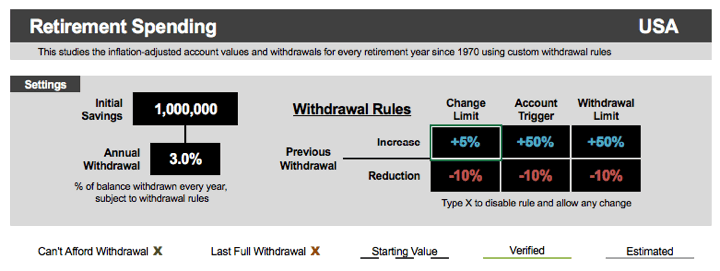
Accordingly, I was impressed to see that Portfolio Charts updated their already-useful Retirement Spending Tool to account for flexible portfolio withdrawals. Everything has been elegantly simplified into four variables:

Withdrawal Rate: the percentage of the portfolio you withdraw every year to fund your retirement expenses

Change Limit: The maximum amount that a withdrawal can increase or decrease from year to year

Account Trigger: A simple rule for when you’re allowed to increase or decrease spending based on how the portfolio is doing relative to its original value

Withdrawal Limit: The minimum or maximum withdrawal you realistically need to pay the bills and live a happy life regardless of what a flexible spending strategy might recommend

Keep in mind that the spending is already inflation-adjusted, i.e. it increases each year with inflation even with no change. Here’s a screenshot:

Take some time to play around with the many combinations. You could see what happens if you let the withdrawals vary wildly. You could see what happens if you only allow the withdrawal amount vary within a tight range. How does your portfolio balance change? For example, I thought about starting with a relatively conservative number like 3% base withdrawal rate, but also be willing to drop it to 2.7% (10% less) if the portfolio drops by 10% in value. Meanwhile, I’d wait until the portfolio increases by 50% before I start paying cash to fly business class everywhere (#goals).

If I were to have a wish list for a new feature, I would like it to show me the minimum balance that the portfolio reached during any of the scenarios. This would let me know the maximum drawdown experienced using my set of variables, as the chart is a little hard to read.

Best Interest Rates on Cash – August 2019

Here’s my monthly roundup of the best interest rates on cash for August 2019, roughly sorted from shortest to longest maturities. The target for the Fed Funds Rate was just cut by 0.25% as of 8/1/19, so look out for small rate drops this month (probably right after I publish this post). Check out my Ultimate Rate-Chaser Calculator to get an idea of how much extra interest you’d earn if you are moving money between accounts. Rates listed are available to everyone nationwide. Rates checked as of 8/4/19.

High-yield savings accounts
While the huge megabanks like to get away with 0.01% APY, it’s easy to open a new “piggy-back” savings account and simply move some funds over from your existing checking account. The interest rates on savings accounts can drop at any time, so I prioritize banks with a history of competitive rates. Some banks will bait you and then lower the rates in the hopes that you are too lazy to leave.

  • Popular Direct is at 2.55% APY with $5,000 minimum. I don’t like this bank because they always create a “new” account instead of giving old customers the higher rate automatically, but it’s the top rate. Betterment Everyday Savings just dropped to 2.44% APY with a no minimum balance requirement ($10 min to open). There are several other established high-yield savings accounts at 2% APY and up, although some have had small drops recently too.

Short-term guaranteed rates (1 year and under)
A common question is what to do with a big pile of cash that you’re waiting to deploy shortly (just sold your house, just sold your business, legal settlement, inheritance). My usual advice is to keep things simple and take your time. If not a savings account, then put it in a flexible short-term CD under the FDIC limits until you have a plan.

  • No Penalty CDs offer a fixed interest rate that can never go down, but you can still take out your money (once) without any fees if you want to use it elsewhere. Marcus Bank has a 13-month No Penalty CD at 2.35% APY with a $500 minimum deposit. Ally Bank has a 11-month No Penalty CD at 2.30% APY with a $25,000 minimum deposit. You may wish to open multiple CDs in smaller increments for more flexibility.
  • Quontic Bank has a 12-month CD at 2.70% APY and $1,000 minimum with an early withdrawal penalty of 12 months (!) of interest. Andrews Federal Credit Union has a 8-month special at 2.86% APY and $1,000 minimum – anyone can join via partner organization for a small fee.

Money market mutual funds + Ultra-short bond ETFs
If you like to keep cash in a brokerage account, beware that many brokers pay out very little interest on their default cash sweep funds (and keep the difference for themselves). The following money market and ultra-short bond funds are not FDIC-insured, but may be a good option if you have idle cash and cheap/free commissions.

  • Vanguard Prime Money Market Fund currently pays an 2.24% SEC yield. The default sweep option is the Vanguard Federal Money Market Fund, which has an SEC yield of 2.21%. You can manually move the money over to Prime if you meet the $3,000 minimum investment.
  • Vanguard Ultra-Short-Term Bond Fund currently pays 2.40% SEC yield ($3,000 min) and 2.50% SEC Yield ($50,000 min). The average duration is ~1 year, so there is more interest rate risk.
  • The PIMCO Enhanced Short Maturity Active Bond ETF (MINT) has a 2.52% SEC yield and the iShares Short Maturity Bond ETF (NEAR) has a 2.53% SEC yield while holding a portfolio of investment-grade bonds with an average duration of ~6 months.

Treasury Bills and Ultra-short Treasury ETFs
Another option is to buy individual Treasury bills which come in a variety of maturities from 4-weeks to 52-weeks. You can also invest in ETFs that hold a rotating basket of short-term Treasury Bills for you, while charging a small management fee for doing so. T-bill interest is exempt from state and local income taxes.

  • You can build your own T-Bill ladder at TreasuryDirect.gov or via a brokerage account with a bond desk like Vanguard and Fidelity. Here are the current Treasury Bill rates. As of 8/1/19, a 4-week T-Bill had the equivalent of 2.11% annualized interest and a 52-week T-Bill had the equivalent of 1.89% annualized interest (!).
  • The Goldman Sachs Access Treasury 0-1 Year ETF (GBIL) has a 2.27% SEC yield and the SPDR Bloomberg Barclays 1-3 Month T-Bill ETF (BIL) has a 2.04% SEC yield. GBIL appears to have a slightly longer average maturity than BIL.

US Savings Bonds
Series I Savings Bonds offer rates that are linked to inflation and backed by the US government. You must hold them for at least a year. There are annual purchase limits. If you redeem them within 5 years there is a penalty of the last 3 months of interest.

  • “I Bonds” bought between May 2019 and October 2019 will earn a 1.90% rate for the first six months. The rate of the subsequent 6-month period will be based on inflation again. More info here.
  • In mid-October 2019, the CPI will be announced and you will have a short period where you will have a very close estimate of the rate for the next 12 months. I will have another post up at that time.

Prepaid Cards with Attached Savings Accounts
A small subset of prepaid debit cards have an “attached” FDIC-insured savings account with exceptionally high interest rates. The negatives are that balances are capped, and there are many fees that you must be careful to avoid (lest they eat up your interest). Some folks don’t mind the extra work and attention required, while others do. There is a long list of previous offers that have already disappeared with little notice. I don’t personally recommend nor use any of these anymore.

  • The only notable card left in this category is Mango Money at 6% APY on up to $2,500, but there are many hoops to jump through. Requirements include $1,500+ in “signature” purchases and a minimum balance of $25.00 at the end of the month.

Rewards checking accounts
These unique checking accounts pay above-average interest rates, but with unique risks. You have to jump through certain hoops, and if you make a mistake you won’t earn any interest for that month. Some folks don’t mind the extra work and attention required, while others do. Rates can also drop to near-zero quickly, leaving a “bait-and-switch” feeling. I don’t use any of these anymore, either.

  • The best one right now is Orion FCU Premium Checking at 4.00% APY on balances up to $30,000 if you meet make $500+ in direct deposits and 8 debit card “signature” purchases each month. The APY goes down to 0.05% APY and they charge you a $5 monthly fee if you miss out on the requirements. There is also the TAB Bank 4% APY Checking, which I don’t like due its vague terms. Find a locally-restricted rewards checking account at DepositAccounts.
  • If you’re looking for a high-interest checking account without debit card transaction requirements then the rate won’t be as high, but take a look at MemoryBank at 1.60% APY.

Certificates of deposit (greater than 1 year)
CDs offer higher rates, but come with an early withdrawal penalty. By finding a bank CD with a reasonable early withdrawal penalty, you can enjoy higher rates but maintain access in a true emergency. Some CDs offer an “add-on” features that gives you the option of adding funds if rates drop. Alternatively, consider building a CD ladder of different maturity lengths (ex. 1/2/3/4/5-years) such that you have access to part of the ladder each year, but your blended interest rate is higher than a savings account. When one CD matures, use that money to buy another 5-year CD to keep the ladder going.

  • You could build a CD ladder at First National Bank of America at 2.90% APY for 5-year, 2.80% APY for 4-year, 2.75% APY for 3-year, 2.70% APY for 2-year, and 2.60% APY for 1-year.
  • 5-year CD rates have been dropping at many banks and credit unions, following the overall interest rate curve. A good rate is now about 3.00% APY, with Hiway Federal Credit Union offering 3.20% APY ($25,000 min) or 3.00% APY ($500 min) on a 5-year CD with an early withdrawal penalty of 12 months of interest. Anyone can join this credit union via partner organization Minnesota Recreation and Park Foundation ($10 fee).
  • Navy Federal Credit Union has a special 5-year CD at 3.50% APY ($1,000), but you must have a military affiliation to join (includes being a relative of a veteran). NavyFed also has an 18-month CD at 3.00% APY.
  • GTE Financial Credit Union has a promotional add-on CD that allows unlimited additional funds after CD opening. You can open a 5-year CD with $500 minimum at 3.04% APY.
  • You can buy certificates of deposit via the bond desks of Vanguard and Fidelity. You may need an account to see the rates. These “brokered CDs” offer FDIC insurance and easy laddering, but they don’t come with predictable fixed early withdrawal penalties. Nothing special right now. As of this writing, Vanguard is showing a 2-year non-callable CD at 2.10% APY and a 5-year non-callable CD at 2.25% APY. Watch out for higher rates from callable CDs listed by Fidelity.

Longer-term Instruments
I’d use these with caution due to increased interest rate risk, but I still track them to see the rest of the current yield curve.

  • Willing to lock up your money for 10+ years? You can buy long-term certificates of deposit via the bond desks of Vanguard and Fidelity. These “brokered CDs” offer FDIC insurance, but they don’t come with predictable fixed early withdrawal penalties. As of this writing, I am seeing no inventory on 7-year and 10-year CDs. Watch out for higher rates from callable CDs from Fidelity. Matching the overall yield curve, current CD rates do not rise much higher as you extend beyond a 5-year maturity.
  • How about two decades? Series EE Savings Bonds are not indexed to inflation, but they have a unique guarantee that the value will double in value in 20 years, which equals a guaranteed return of 3.5% a year. However, if you don’t hold for that long, you’ll be stuck with the normal rate which is quite low (currently a sad 0.10% rate). I view this as a huge early withdrawal penalty. However, you could also view it as a hedge against deflation, but only if you can hold on for 20 years. As of 8/1/19, the 20-year Treasury Bond rate was 2.21%.

All rates were checked as of 8/4/19.