Vanguard Personal Advisor Services Portfolio Rebalancing Rules

vglogoIf you read about investing in stocks and bonds, there is a lot of discussion about rebalancing your portfolio. Should you rebalance? When? How often? How much? Carl Ozeck contributes his thoughts on the Vanguard Blog article Capital gains are a good thing. However, sometimes you just like to see what the professionals actually settle on.

In Vanguard Personal Advisor Services®, we use a “time-and-threshold” blend for our rebalancing strategy. We review the portfolio quarterly and rebalance if its asset allocation has deviated by 5 percentage points or more. Blending these triggers results in a more complex strategy, but it has merit. If we use this strategy on a 60% stock, 40% bond portfolio, the average portfolio turnover would be about 1.95%2 and average Sharpe ratio about 0.51. This shows that rebalancing can help you mitigate your risk while spreading out rebalancing events over time.

Vanguard Personal Advisor Services (my review) is an add-on service where they actually manage your portfolio and perform the trades on your behalf. The cost is 0.30% of assets annually. Their paid service performs a quarterly check-in, and rebalances if a 5% threshold band is exceeded. I think this is a good rule to save as a “default” and then adjust as needed for your own circumstances.

For our portfolio, I also perform quarterly check-ins and then rebalance with the free cash from dividends and interest. If possible, investments from work income are also directed in a manner to help rebalance. I only rebalance further if a 5% threshold has still been exceeded after all that for at least two quarterly check-ins.

Worthy Bonds Review: 5% Interest, Backed By Small Business Inventory Loans

Worthy Bonds are a fintech startup that offers you 5% interest by “supporting your fellow humans”. You can invest a little bit at a time, even doing “round-ups” of your purchases. However, whenever you see an interest rate well above FDIC-insured accounts, you have to dig deeper! The basic business model is that Worthy will pay you 5% interest and then take that money to loan out to small business owners (inventory-backed loans) at much higher interest rates, with Worthy keeping any difference as their profit. Here’s why I don’t like that structure.

You are buying bonds issued by a single start-up. Worthy Bonds are really just 36-month bonds issued by Worthy Peer Capital, Inc. In other words, it’s a bond backed by a single corporation, in this case a very young startup that has never been profitable. The bonds are not rated and not traded publicly. Worthy is not a bank. Your funds are not FDIC-insured. They do promise to invest your money into “fellow humans”, which in reality are small business loans secured by the value of their inventory. Which brings me to…

Inventory-backed loans are NOT low-risk loans. Worthy makes a big deal about how they make “asset-backed loans” which are amongst the safest loans out there. Yes, these loans are less risky than unsecured loans like credit card debt, but if you perform some basic research about inventory financing, you’ll see that there are still many risks involved. From Investopedia:

Lenders may view inventory financing as a type of unsecured loan because if the business can’t sell its inventory, the bank may not be able to either. This reality may partially explain why, in the aftermath of the credit crisis of 2008, many businesses found it more difficult to obtain inventory financing.

The easiest way to confirm this is to ask the market. A bond backed by Microsoft might yield about 3.5% interest. Now pretend that you are a small business looking for an inventory loans. Online lenders quote rates varying from 10% APR to 100% APR. Now, which is really “low risk”? From Fundbox:

Yes, applying for an inventory loan is an easy and fast process; however, approval isn’t. Because the merchandise purchased will be considered as collateral, lenders will have to assess just how risky your business is. If they determine that you will have a challenging time selling your products, then that means they will have an equally hard time unloading the inventory in the event you can’t repay your loan, and they end up with it. […] Inventory financing typically comes with higher interest rates. Lenders feel they need extra security as there is no personal guarantee or collateral involved other than the inventory.

The loans they have taken out so far have 7.44% to 18% annual interest rates, plus collateral management fees of 6% to 12% annually. This is taken directly from their SEC filings:

As of December 31, 2018 we had entered in to three loan receivable agreements for an aggregate amount of $1,200,000, with small business borrowers. The loans pay interest at varying rates ranging from 0.62% per month to 1.5% per month and collateral management fees ranging from of 0.5% to 1% per month.

Limited upside, unlimited downside. I’m not saying inventory loans are a bad deal, if you are compensated properly for the risk. If Worthy was more of an “access” play, where they took a small cut (maybe 1%) of these risky business loans and gave you the rest, I would be more interested. However, this is more of a “we do fancy stuff in the background, and give you 5% and make you think that’s a good deal” play. Even if their loans work out and they get 10% or 20% or ???, you just get 5%. Meanwhile, if these loans go sour, and Worthy runs out of venture capital, then you may be stuck losing everything you put in. What happens when a company borrows money against their warehouse holding $10 million “value” of fidget spinners, but suddenly they are no longer trendy?

They advertise that you can take your money out at any time, but they don’t advertise as heavily that this is all unless they default. Everything can look great, until one day it doesn’t. There is no FDIC insurance coming to the rescue. Worthy is doubly-exposed in the event of a recession. Inventory loans will default at higher rates, and their venture capital backing may also dry up. At this time, they also don’t have a bankruptcy remote vehicle where the inventory loans are directly connected to your investments.

Bottom line. Worthy Bonds are one of the many fintech startups out there asking for your money. If you look past the 5% interest and slick app, the underlying investment is small business inventory loans, which carry a meaningful risk of loss and usually charge north of 10% annual interest to the borrowers. However, Worthy Bonds limit your upside to 5% interest, while the downside is unlimited.

If you want to invest in corporate bonds for about 5% interest, I would recommend Vanguard High-Yield Corporate Fund Investor Shares (VWEHX). The SEC yield is right about 5%, and you get a diversified portfolio of 500 different bonds from rated businesses after they charge a low .23% expense ratio (less if you buy Admiral Shares). That 0.23% is the only gap between the market returns of the underlying bonds and what you receive.

Peerstreet Case Study #1: 90-Day Late Condo Near-Foreclosure Recovery

I’ve invested over $50,000 of my “alternative” money into PeerStreet real estate notes because of the ability to diversify into 50+ different high-interest loans backed by physical real estate. Here is a case study from one of my first loans where I was worried it was going to turn out badly, but it turned around. This was much different than my experiences with Prosper and LendingClub, where 90-days late almost always eventually results in a total loss. You can find additional case study links and the most recent update to my overall portfolio performance in my Peerstreet review.

Initial investment details.

  • Property: 2 bedroom, 1 bath, 975 sf condo in Salem, MA.
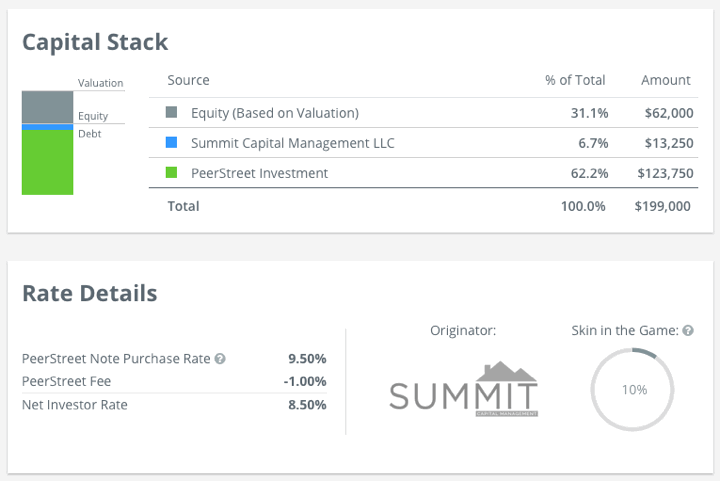
  • Net Investor Rate/Term: 8.50% APR.
  • Amount invested: $1,073.
  • Term: 24 months with extension option.
  • Total loan amount: $123,750 from Peerstreet and $13,250 from loan originator (10% “skin in the game”).
  • Appraised at $199,000 = 62% LTV.
  • Loan secured by the property in first position.
  • Stated goal is buy-to-rent.

Here is the Zillow listing. The buyer appeared to get a condo for a good price ($130k). The unit last sold for $155k in 2016.

Timeline.

  • May 2017. Loan originated. Maturity is set for June 2018.
  • May 2017 to June 2018. Interest-only payments made as agreed upon. (My portion was taken out July 2017.)
  • June 2018. Borrower requests extension.
  • August 2018. 6-month extension approved and extension fee paid.
  • November 2018. Borrower requests another extension. Additional 4-month extension granted.
  • April 2019. Payments stop coming in. Loan is late. Full balance of loan is due.
  • June 2019. Now 60+ days late. Still no payments. Demand letter sent. Foreclosure process initiated.
  • July 2019. At around 90 days late, the loan was suddenly brought current and paid off. All back interest (including default interest) and fees paid.

If you look at the MLS data, they tried to list it in March 2019 for $288,000 and then reduced to $249,000 in May 2019. The listed was removed, so I’m not sure who paid off the loan, perhaps the borrower or the loan originator somehow refinanced it elsewhere. The price wasn’t unreasonable, as the neighboring unit sold for $268,000 in May 2018 (2 bed/1 bath/1,000 sf). Notice that for this note, the loan originator put up 10% of the loan, so it had “skin in the game”. I don’t know if that made a difference.

Final numbers. I invested $1,073 in July 2019 and got paid $192.27 of interest and $1,073 of principal for a total of $1,265.27 as of July 2019. (This was an automated reinvestment which included whatever cash was in my account, thus the odd numbers.) This works out to a 17.92% total return over two years, which is 8.59% annualized return. The number was a little higher than the stated interest rate due the various penalty fees the borrower paid. These numbers are net of all PeerStreet fees.

I haven’t had a Peerstreet loan go through the entire process of foreclosure yet, but will write another update if/when that happens.

Bottom line. The vast majority of my Peerstreet loans have been paid back in full in a timely manner. Some of them end up with issues like late payments, sporadic payments, and/or repeated loan extensions, like this one. This one ended up as an example of an investment that looked like it was heading for foreclosure at nearly 90 days late with little communication, but bounced back and ended up being paid in full.

If you are interested, you can sign up and browse investments at PeerStreet for free before depositing any funds or making any investments. You must qualify as an accredited investor (either via income or net worth) to invest. If you already invest with them, they now sync with Mint.com.

Best Interest Rates on Cash – July 2019

Here’s my monthly roundup of the best interest rates on cash for July 2019, roughly sorted from shortest to longest maturities. Rates are dropping a bit, but it still pays to shop around. Check out my Ultimate Rate-Chaser Calculator to get an idea of how much extra interest you’d earn if you are moving money between accounts. Rates listed are available to everyone nationwide. Rates checked as of 7/2/19.

High-yield savings accounts
While the huge megabanks like to get away with 0.01% APY, it’s easy to open a new “piggy-back” savings account and simply move some funds over from your existing checking account. The interest rates on savings accounts can drop at any time, so I prioritize banks with a history of competitive rates. Some banks will bait you and then lower the rates in the hopes that you are too lazy to leave.

  • Wealthfront Cash is at 2.57% APY with no minimum balance. Note that while this account is FDIC-insured, there is no routing number since your money is split amongst four banks and thus you must initiate all transfers through Wealthfront. Northpointe Bank is at 2.55% APY with $25,000 minimum (but guaranteed for 3 months). CIT Bank Savings Builder dropped to 2.30% APY with a $100 monthly deposit (no minimum balance requirement). There are several other established high-yield savings accounts at 2% APY and up, although some have had small drops recently too.

Short-term guaranteed rates (1 year and under)
A common question is what to do with a big pile of cash that you’re waiting to deploy shortly (just sold your house, just sold your business, legal settlement, inheritance). My usual advice is to keep things simple and take your time. If not a savings account, then put it in a flexible short-term CD under the FDIC limits until you have a plan.

  • No Penalty CDs offer a fixed interest rate that can never go down, but you can still take out your money (once) without any fees if you want to use it elsewhere. Marcus Bank has a 13-month No Penalty CD at 2.35% APY with a $500 minimum deposit. Ally Bank has a 11-month No Penalty CD at 2.30% APY with a $25,000 minimum deposit. You may wish to open multiple CDs in smaller increments for more flexibility.
  • MapleMark Bankt has a 12-month CD at 2.86% APY and $25,000 minimum with an early withdrawal penalty of 6 months of interest. Andrews Federal Credit Union has a 8-month special at 2.86% APY and $1,000 minimum – anyone can join via partner organization for a small fee.

Money market mutual funds + Ultra-short bond ETFs
If you like to keep cash in a brokerage account, beware that many brokers pay out very little interest on their default cash sweep funds (and keep the difference for themselves). The following money market and ultra-short bond funds are not FDIC-insured, but may be a good option if you have idle cash and cheap/free commissions.

  • Vanguard Prime Money Market Fund currently pays an 2.34% SEC yield. The default sweep option is the Vanguard Federal Money Market Fund, which has an SEC yield of 2.30%. You can manually move the money over to Prime if you meet the $3,000 minimum investment.
  • Vanguard Ultra-Short-Term Bond Fund currently pays 2.44% SEC yield ($3,000 min) and 2.54% SEC Yield ($50,000 min). The average duration is ~1 year, so there is more interest rate risk.
  • The PIMCO Enhanced Short Maturity Active Bond ETF (MINT) has a 2.63% SEC yield and the iShares Short Maturity Bond ETF (NEAR) has a 2.60% SEC yield while holding a portfolio of investment-grade bonds with an average duration of ~6 months.

Treasury Bills and Ultra-short Treasury ETFs
Another option is to buy individual Treasury bills which come in a variety of maturities from 4-weeks to 52-weeks. You can also invest in ETFs that hold a rotating basket of short-term Treasury Bills for you, while charging a small management fee for doing so. T-bill interest is exempt from state and local income taxes.

  • You can build your own T-Bill ladder at TreasuryDirect.gov or via a brokerage account with a bond desk like Vanguard and Fidelity. Here are the current Treasury Bill rates. As of 7/2/19, a 4-week T-Bill had the equivalent of 2.22% annualized interest and a 52-week T-Bill had the equivalent of 1.92% annualized interest (!).
  • The Goldman Sachs Access Treasury 0-1 Year ETF (GBIL) has a 2.27% SEC yield and the SPDR Bloomberg Barclays 1-3 Month T-Bill ETF (BIL) has a 2.19% SEC yield. GBIL appears to have a slightly longer average maturity than BIL.

US Savings Bonds
Series I Savings Bonds offer rates that are linked to inflation and backed by the US government. You must hold them for at least a year. There are annual purchase limits. If you redeem them within 5 years there is a penalty of the last 3 months of interest.

  • “I Bonds” bought between May 2019 and October 2019 will earn a 1.90% rate for the first six months. The rate of the subsequent 6-month period will be based on inflation again. More info here.
  • In mid-October 2019, the CPI will be announced and you will have a short period where you will have a very close estimate of the rate for the next 12 months. I will have another post up at that time.

Prepaid Cards with Attached Savings Accounts
A small subset of prepaid debit cards have an “attached” FDIC-insured savings account with exceptionally high interest rates. The negatives are that balances are capped, and there are many fees that you must be careful to avoid (lest they eat up your interest). Some folks don’t mind the extra work and attention required, while others do. There is a long list of previous offers that have already disappeared with little notice. I don’t personally recommend or use any of these anymore.

  • The only notable card left in this category is Mango Money at 6% APY on up to $2,500, but there are many hoops to jump through. Requirements include $1,500+ in “signature” purchases and a minimum balance of $25.00 at the end of the month.

Rewards checking accounts
These unique checking accounts pay above-average interest rates, but with unique risks. You have to jump through certain hoops, and if you make a mistake you won’t earn any interest for that month. Some folks don’t mind the extra work and attention required, while others do. Rates can also drop to near-zero quickly, leaving a “bait-and-switch” feeling. I don’t use any of these anymore, either.

  • The best one right now is Orion FCU Premium Checking at 4.00% APY on balances up to $30,000 if you meet make $500+ in direct deposits and 8 debit card “signature” purchases each month. The APY goes down to 0.05% APY and they charge you a $5 monthly fee if you miss out on the requirements. There is also the TAB Bank 4% APY Checking, which I don’t like due its vague terms. Find a local rewards checking account at DepositAccounts.
  • If you’re looking for a high-interest checking account without debit card transaction requirements then the rate won’t be as high, but take a look at MemoryBank at 1.60% APY.

Certificates of deposit (greater than 1 year)
CDs offer higher rates, but come with an early withdrawal penalty. By finding a bank CD with a reasonable early withdrawal penalty, you can enjoy higher rates but maintain access in a true emergency. Alternatively, consider building a CD ladder of different maturity lengths (ex. 1/2/3/4/5-years) such that you have access to part of the ladder each year, but your blended interest rate is higher than a savings account. When one CD matures, use that money to buy another 5-year CD to keep the ladder going.

  • You could build a CD ladder at First National Bank of America at 3.15% APY for 5-year, 3.05% APY for 4-year, 2.95% APY for 3-year, 2.85% APY for 2-year, and 2.75% APY for 1-year.
  • 5-year CD rates have been dropping at many banks and credit unions, following the overall interest rate curve. A good rate is now about 3.00% APY, with Citizens State Bank offering 3.20% APY ($1,000 minimum) on a 5-year CD with an early withdrawal penalty of 12 months of interest.
  • You can buy certificates of deposit via the bond desks of Vanguard and Fidelity. You may need an account to see the rates. These “brokered CDs” offer FDIC insurance and easy laddering, but they don’t come with predictable fixed early withdrawal penalties. Nothing special right now. As of this writing, Vanguard is showing a 2-year non-callable CD at 2.15% APY and a 5-year non-callable CD at 2.30% APY. Watch out for higher rates from callable CDs listed by Fidelity.

Longer-term Instruments
I’d use these with caution due to increased interest rate risk, but I still track them to see the rest of the current yield curve.

  • Willing to lock up your money for 10+ years? You can buy long-term certificates of deposit via the bond desks of Vanguard and Fidelity. These “brokered CDs” offer FDIC insurance, but they don’t come with predictable fixed early withdrawal penalties. As of this writing, Vanguard is offering 2.60% APY on a 10-year CD. Watch out for higher rates from callable CDs from Fidelity. Matching the overall yield curve, current CD rates do not rise much higher as you extend beyond a 5-year maturity.
  • How about two decades? Series EE Savings Bonds are not indexed to inflation, but they have a unique guarantee that the value will double in value in 20 years, which equals a guaranteed return of 3.5% a year. However, if you don’t hold for that long, you’ll be stuck with the normal rate which is quite low (currently a sad 0.10% rate). I view this as a huge early withdrawal penalty. You could also view it as long-term bond and thus a hedge against deflation, but only if you can hold on for 20 years. As of 7/2/19, the 20-year Treasury Bond rate was 2.29%.

All rates were checked as of 7/2/19.


Is Your Stock Broker Quietly Charging As Much As a Robo-Advisor?

Here’s an educational post on How Discount Brokerages Make Money by Patrick McKenzie. It seems reasonable that a DIY investor understand these sources of revenue at a basic level: net interest, commissions, asset management fees, wealth management fees, securities lending, and payment for order flow.

For me, the biggest takeaway is that brokers make a lot more money quietly shorting you on cash interest than upfront from the big-banner-ad commission fees. Did you know that only 7% of Schwab’s revenue comes from commission? Meanwhile, a whopping 57% of Schwab’s revenue comes from net interest, which is the spread between what they earn on cash and what they pay you. E-Trade, 67%. TD Ameritrade, 51%. See you Are You Quietly Losing Money via Your Brokerage Cash Sweep Account?

I’ve mentioned this before, most recently in my Schwab Intelligent Portfolios review. Schwab makes a ton of money on your idle cash, and it is NOT an accident that they force you to own cash in their automated portfolios.

Right now, Schwab only pays you a sad 0.26% APY on your cash sweep. Both you and Schwab can earn much more than that elsewhere with essentially no risk, which leads to an interesting observation from the article:

Brokerage customers keep ~10% of their assets in cash. The 200 basis point spread between cash in brokerage accounts and money market funds or insured bank accounts, all of which are functionally riskless, is equivalent to a 20 bps asset management fee across the portfolio.

This is an important perspective. It’s one thing to pay a robo-advisor like Wealthfront or Betterment 0.25% annually and get some value out of it, and it’s another to effectively pay 0.20% for absolutely nothing. Add in your stock commissions, and you might even be paying more than a robo-advisor. If you keep a big balance in a bad cash sweep, you should really zap it into a top-yielding cash equivalent or buy a short-term Treasury Bill within that brokerage account. These days it’s all just a matter of clicks.

If that’s too much trouble every month, consider automatic dividend reinvestment or a one-time move to a broker with better cash sweep. My idle cash at Vanguard is in the Vanguard Federal Money Market Fund earning 2.29% with zero effort. At the very minimum, you should be aware of this hidden cost and acknowledge that it’s part of what you’re paying every month.

(A second takeaway is that the author believes that Robinhood gets more money for payment flow than other major brokers because they have a higher percentage of options trades than other brokers, and options order flow is more valuable than regular equity trades.)

Stocks and Bonds Asset Class Correlations 2009-2019

Morningstar has an educational series on How and Why to Invest in Bonds, and one of the included articles What Role Do Bonds Play in a Portfolio? had an interesting chart of the correlations between several major asset classes for the past decade up to mid-2019:

You can see above that US and international stocks are closely (but not perfectly) correlated, which means that they tend to move in the same direction. However, junk bonds also tend to move very closely with US stocks.

The least correlated asset against US stocks was intermediate government bonds. In fact, they actually tended to go up a little when stocks go down. This is one of the reasons why I own short and intermediate Treasury bonds as part of my bond portfolio, while at the same time avoiding high-yield or investment-grade corporates.

There is also another correlation chart of the Great Financial Crisis of October 2007 to February 2009, which had similar overall results. The least correlated assets were again short-term and intermediate-term government bonds.

You can also explain this diversification intuitively without numbers. I love my shares of businesses (stocks), and much of them time they are going to chug along nicely. However, we know that there will be periods when they are in big trouble and the outlook is bleak. Weak companies will be going bankrupt, while many others teeter dangerously close to the edge. Do you want to own debt backed by those same companies at the same time? It’s a double-whammy when both your stock and bond holdings are going down at the same time.

I am also concerned by recent reports of record amounts of “barely” investment-grade debt. There is a thin line between being rated investment-grade and
“junk”. Do the ratings tend to land on the investment-grade side of that line because the ratings agencies themselves are being paid by those same companies? (Again, remember those mortgage-backed securities of the financial crisis.) I’d rather not to have to worry about that possibility. I like the simplicity and the “sleep better at night” safety of owning bonds backed by the US government instead. I do also own municipal bonds in my taxable accounts, which for some reason were not included in this chart.

Related past posts:

Jack Bogle on Mailbox Money

While poking around the Bogleheads investing forum, I came across a thread discussing a 2015 ETF.com interview with the late Jack Bogle that touches on the topic of mailbox money in retirement. First, a nice dose of Bogle common sense:

If anybody were to give you a blueprint, I would say put your hand over your wallet. There are no blueprints. There is common sense, and the obvious principle here is to be more conservative and more protective when you’re older than when you’re younger. When you’re young, you have a small amount of capital, you can take more risk, you’ve got years to recoup, and you don’t care about income. When you’re older you want to protect what you have; if you’re wrong, you don’t have a lot of time to recoup, and on balance you want more income.

Bogle on the idea of Social Security and stock dividends as mailbox money:

But you ought to think about all sources of your retirement income. Having said that, when you own an equity portfolio, don’t get into it for market reasons, get into it for income reasons. Oversimplifying, what you want to do when you retire is walk out to the mailbox on Social Security day and on dividend payment day for the funds—assuming they’re the same day—and make sure you have two envelopes out there. One is your fund dividend and the other is your Social Security check. The Social Security will keep up with inflation year after year, and dividends are likely to increase year after year. They have been going up. Every once in a while there is an interruption, such as the Great Depression of the early 1930s. And many bank stocks eliminated their dividends in 2008, so there was obviously a drop. But it has long since recovered, and then some.

Bet on the dividends, and not on the market price. You’ve got those two envelopes and that’s your retirement. If you have a pension plan (one that is not likely to go bankrupt—and a lot of them are likely to) that is a third envelope. You want to be concerned about whether you have enough income to pay utility bills, pay for your food, pay your rent or your mortgage, whatever it might be, every month. You want income to help you pay those bills. And in the retirement stage, that’s what investing should be about—regular checks from dividends and/or from Social Security and/or from a pension account.

The problem is that the yield on the Vanguard Total US Stock Market (VTSAX) or S&P 500 Index fund is only about 2%. That’s a lot less income than most people would like out of their portfolio. Here’s Bogle on a high-dividend stock strategy:

If you really need the dividend income, I see nothing wrong with overweighting high-dividend stocks, knowing you’re taking a small risk of falling significantly behind the total market. But you can own blue chip stocks, and you’re going to get a higher dividend, a situation I think would be attractive to an awful lot of investors. But once you depart from the market portfolio, you’re taking on extra risk. Any strategy may have done very well in the past, but in this business, the past is not prologue.

The draw here is that the low-cost Vanguard High Dividend Yield Index Fund (VHYAX) sends out bigger income “checks”, currently an SEC yield of 3.37% as of 5/31/19. However, roughly speaking, the dividend payout from high-dividend stocks is going to be more likely to drop with poor market conditions.

Alternative #1: Low-cost Value funds. While not from this interview, Bogle has said elsewhere that he thinks that Large-Cap Growth and Large-Cap Value stocks will have roughly the same average returns over the long run. The difference is that in Value you’ll get a slightly bigger share of returns in the form of dividends and a little less in share price appreciation. Growth is the opposite – less dividends and more price appreciation. Therefore, if you wanted to create a little more “mailbox money” than the S&P 500, you may consider buying the Vanguard Value Index Fund (VVIAX) or Vanguard Value ETF (VTV) with a current SEC yield of about 2.8%.

Alternative #2: Low-cost Dividend Appreciation fund. I can’t find any Bogle commentary on this strategy, but you could also buy into the Vanguard Dividend Appreciation ETF (VIG), which invests in companies with at least ten consecutive years of increasing dividends. This fund also has a ~2% yield similar to the S&P 500, but historically they offer a more stable and steadily growing income stream without sacrificing too much in total return.

In the end, treating your dividend checks as retirement income is not all that different than taking out about conservative 3% a year from your portfolio. If you really wanted to make your income checks equal 3%, you can do some tweaks like going with the Vanguard Value Index fund and the Vanguard Total Bond fund and get very close without “reaching for yield” with junk bonds or niche investments. My portfolio is different and yet the income still gets close to 3% when I track the dividends and interest every 3 months.

Bogle would also remind you to make sure you are investing in low-cost, passive funds so you aren’t giving away 1% off the top to a fund manager. If you have a DIY mindset, you also avoid paying a financial advisor taking out another 1%. Paying both of those and you’ll be missing 2/3rds of your potential mailbox money.

Immediate Annuity Payout Rates vs. Long-Term Bond Interest Rates

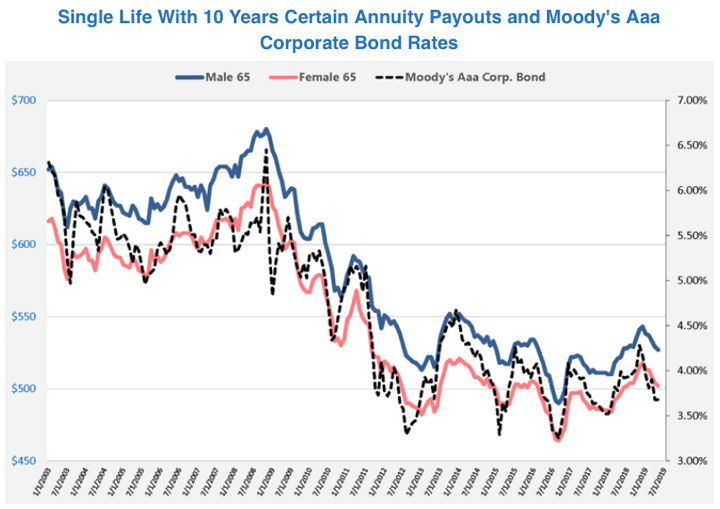
I’m still learning about immediate annuities as a potential future income stream, and came across this ImmediateAnnuities.com article about the relationship between immediate annuity payout rates and interest rates. (Note: I am not talking about indexed or variable annuities. Those I avoid completely.) The chart below shows the close relationship between the payout rate for a common type of immediate annuity (single life, 10-year guaranteed payout) and the interest rate on high-quality long-term corporate bonds.

At the same time, there is much less correlation between the payout rates and short-term interest rates. The “Fed Funds Rate” that you hear about all the time in the financial media is a short-term rate set by the Federal Reserve.

Even though annuities like to tout themselves as “guaranteed”, nominal annuities with a fixed payout are still exposed to inflation risk. For example, your contract might state a fixed payout of $1,000 a month for the rest of your life, but if inflation spikes, that $1,000 won’t go nearly as far. With 3% average inflation, your effective paycheck shrinks to only $640 of equivalent buying power after 15 years. With 4% inflation, it shrinks to $550 of buying power.

Right now, long-term interest rates are near historical low and thus so are payouts. You could argue that your downside potential is much greater than the upside as historically there are many more examples of extended periods of high inflation than extended periods of deflation. I don’t want to buy a 20-year bond paying the current market rate of 3.5%, but I really don’t want to locked in what is essentially a lifetime bond paying 4%.

Now, if you are definitely going to buy an annuity, the article does make a valid point that if you wait a year for rates to increase, that’s one less year of income you earn from a lifetime annuity. You may also opt to hedge your inflation risk elsewhere.

I’m still decades away from the age when I would like to buy an annuity, but I do think now is a very tough time for current retirees trying to create guaranteed income. The income available from “safe” investments are so low, and you do even worse after taxes. However, I simply don’t buy into the theory that inflation has gone away forever, and I personally would have a hard time buying an annuity at current rates.

Home Bias Against International Stocks: Lower Past Performance vs. Cheaper Valuations

globe

One the big decisions in portfolio construction is how much to allocate between US stocks and non-US stocks. You won’t find universal agreement on a correct answer, but this Morningstar article Investors Have Fewer Reasons Than Ever for Home Bias by Ben Johnson does a nice job of outlining the factors behind “home bias”:

“Home bias” is the term used to describe investors’ tendency to tilt their portfolios in favor of domestic stocks (bonds, too, but I’m going to focus on stocks). Here, I’ll discuss how home bias is measured, the factors that underpin this phenomenon, and why it’s probably a good idea to expand your horizons a bit.

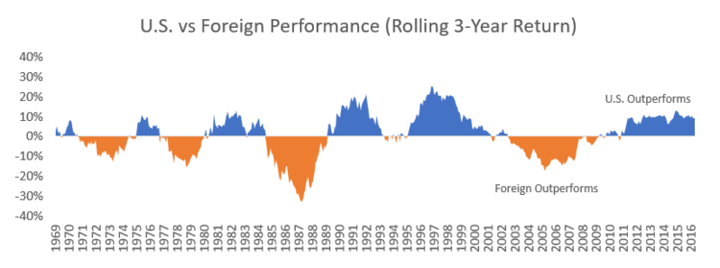
Sometimes the US outperforms international stocks for a while. Sometimes it lags. Here is a chart from Factor Investor that helps you visualize these past cycles:

us_intl_cycle

Right now, the market cap of the world’s publicly-traded businesses split at roughly 55% US and 45% international. This ratio has been flipped in the past (45% US/55% International) but the US has performed much better in the past decade.

Right now, the US looks great but International stocks have much higher earnings yields. The most interesting chart from the Morningstar article shows the current Shiller P/E Ratio amid the range of historical valuations for major indexes including the S&P 500, MSCI EAFA (Developed International), and MSCI EM (Emerging Markets). You can see that US stocks are currently on the high (expensive) side, while the international stocks are on the low (cheap) side.

It’s a tug of war. US stocks have done better recently. US stocks have a rosier outlook, which results in them being more expensive. International stocks have a bleaker outlook, but the price-to-earning ratios are much cheaper. If you own a Vanguard Target Retirement 20XX Fund or a LifeCycle Fund, you own 60% US/40% International. Most of the other Target Date Funds break it down differently, so you’ll have to check. I am in the market-weight camp and hold either 50/50 for simplicity. I have seen opinions of what is “best” change over time, and that supports the advice of having a written investment policy statement of what you believe and why.

My Money Blog Portfolio Income and Withdrawal Rate – June 2019 (Q2)

dividendmono225One of the biggest problems in retirement planning is making sure a pile of money lasts through your retirement. I have read hundreds of articles about this topic, and still haven’t a perfect solution to this problem. Most recently, I looked into the idea of buying a ETF that tracks stocks with 10+ year histories of growing dividends.

The imperfect (!) solution I chose is to first build a portfolio designed for total return and enough downside protection such that I can hold through an extended downturn. As you will see below, the total income is a little under 3% of the portfolio annually. I could easily crank out a portfolio with a 4% income rate, or even 5% income. But you have to take some additional risks to get there.

Starting with a more traditional portfolio, only then do I try to only spend the dividends and interest. The analogy I fall back on is owning a rental property. If you are reliably getting rent checks that increase with inflation, you can sit back calmly and ignore what the house might sell for on the open market. With this method, I am more confident that the income cover our expenses for the rest of our lives.

I track the “TTM Yield” or “12 Mo. Yield” from Morningstar, which the sum of a fund’s total trailing 12-month interest and dividend payments divided by the last month’s ending share price (NAV) plus any capital gains distributed over the same period. (Index funds have low turnover and thus little in capital gains.) I like this measure because it is based on historical distributions and not a forecast. Below is a very close approximation of my investment portfolio (2/3rd stocks and 1/3rd bonds).

Asset Class / Fund % of Portfolio Trailing 12-Month Yield (Taken 6/13/19) Yield Contribution
US Total Stock
Vanguard Total Stock Market Fund (VTI, VTSAX)
25% 1.99% 0.50%
US Small Value
Vanguard Small-Cap Value ETF (VBR)
5% 2.20% 0.11%
International Total Stock
Vanguard Total International Stock Market Fund (VXUS, VTIAX)
25% 3.00% 0.75%
Emerging Markets
Vanguard Emerging Markets ETF (VWO)
5% 2.69% 0.13%
US Real Estate
Vanguard REIT Index Fund (VNQ, VGSLX)
6% 3.96% 0.24%
Intermediate-Term High Quality Bonds
Vanguard Intermediate-Term Tax-Exempt Fund (VWIUX)
17% 2.79% 0.47%
Inflation-Linked Treasury Bonds
Vanguard Inflation-Protected Securities Fund (VAIPX)
17% 2.66% 0.45%
Totals 100% 2.65%


Over the last 12 months, my portfolio has distributed 2.65% of its current value as income. One of the things I like about using this number is that when stock prices drop, this percentage metric usually goes up – which makes me feel better in a gloomy market. When stock prices go up, this percentage metric usually goes down, which keeps me from getting too happy. This also applies to the relative performance of US and International stocks. In this way, this serves as a rough form of a valuation-based dynamic withdrawal rate.

In practical terms, I let all of my dividends and interest accumulate without automatic reinvestment. I like to look at this money as my “paycheck” arriving on a regular basis. Then, as with my real paycheck, I can choose to either spend it or reinvest in more stocks and bonds. This gets me used the feeling of living off my portfolio and learning to ignore the price swings.

We are a real 40-year-old couple with three young kids, and this money has to last us a lifetime (without stomach ulcers). This number does not dictate how much we actually spend every year, but it gives me an idea of how comfortable I am with our withdrawal rate. We spend less than this amount now, but I like to plan for the worst while hoping for the best. For now, we are quite fortunate to be able to do work that is meaningful to us, in an amount where we still enjoy it and don’t feel burned out.

Life is not a Monte Carlo simulation, and you need a plan to ride out the rough times. Even if you run a bunch of numbers looking back to 1920 and it tells you some number is “safe”, that’s still trying to use 100 years of history to forecast 50 years into the future. Michael Pollan says that you can sum up his eating advice as “Eat food, not too much, mostly plants.” You can sum up my thoughts on portfolio income as “Spend mostly dividends and interest. Don’t eat too much principal.” At the same time, live your life. Enjoy your time with family and friends. You may be more likely to run out of time than run out of money.

In the end, I do think using a 3% withdrawal rate is a reasonable target for something retiring young (before age 50) and a 4% withdrawal rate is a reasonable target for one retiring at a more traditional age (closer to 65). If you’re still in the accumulation phase, you don’t really need a more accurate number than that. Focus on your earning potential via better career moves, investing in your skillset, and/or look for entrepreneurial opportunities where you own equity in a business.

Official Warren Buffett / Berkshire Hathaway Book Reading List 2019

At every annual shareholder meeting, Berkshire Hathaway publishes an official reading list and sells discounted copies through a local Omaha bookstore called The Bookworm. Both Warren Buffett and Charlie Munger have consistently attributed a significant part of their success to their constant reading:

“I insist on a lot of time being spent, almost every day, to just sit and think. That is very uncommon in American business. I read and think. So I do more reading and thinking, and make less impulse decisions than most people in business. I do it because I like this kind of life.” – Warren Buffett

“In my whole life, I have known no wise people (over a broad subject matter area) who didn’t read all the time—none. Zero. You’d be amazed at how much Warren reads—and how much I read. My children laugh at me. They think I’m a book with a couple of legs sticking out.” – Charlie Munger

Here is the 2019 annual meeting handout. Since they don’t archive these handouts and books are removed each year, I decided to track the changes here. I just bought a used copy of the Lowenstein biography of Warren Buffett and a copy of the Secret Millionaire’s Club (For Kids) from Amazon and the 50th anniversary book direct from Berkshire.

New additions for 2019

The Moment of Lift: How Empowering Women Changes the World by Melinda Gates. From the Amazon page: For the last twenty years, Melinda Gates has been on a mission to find solutions for people with the most urgent needs, wherever they live. Throughout this journey, one thing has become increasingly clear to her: If you want to lift a society up, you need to stop keeping women down. In this moving and compelling book, Melinda shares lessons she’s learned from the inspiring people she’s met during her work and travels around the world. As she writes in the introduction, “That is why I had to write this book?to share the stories of people who have given focus and urgency to my life. I want all of us to see ways we can lift women up where we live.”

Letters to Doris – One Woman’s Quest to Help Those with Nowhere Else to Turn. From the Amazon page: The Letters Foundation is a foundation of last resort that provides humanitarian grants to people experiencing a crisis when no other options exist. These one-time grants provide a hand-up to individuals as they work to stabilize their lives. Established by siblings Warren and Doris Buffett, the Letters Foundation reads and replies to letters from individuals living within the United States.

The Future Is Asian: Commerce, Conflict, and Culture in the 21st Century by Parag Khanna. (Charlie’s Pick) From the Amazon page: There is no more important region of the world for us to better understand than Asia – and thus we cannot afford to keep getting Asia so wrong. Asia’s complexity has led to common misdiagnoses: Western thinking on Asia conflates the entire region with China, predicts imminent World War III around every corner, and regularly forecasts debt-driven collapse for the region’s major economies. But in reality, the region is experiencing a confident new wave of growth led by younger societies from India to the Philippines, nationalist leaders have put aside territorial disputes in favor of integration, and today’s infrastructure investments are the platform for the next generation of digital innovation.

Saudi America: The Truth about Fracking and How It’s Changing the World by Bethany McLean. (Charlie’s Pick) From the Amazon page: Investigative journalist Bethany McLean digs deep into the cycles of boom and bust that have plagued the American oil industry for the past decade, from the financial wizardry and mysterious death of fracking pioneer Aubrey McClendon, to the investors who are questioning the very economics of shale itself. McLean finds that fracking is a business built on attracting ever-more gigantic amounts of capital investment, while promises of huge returns have yet to bear out. Saudi America tells a remarkable story that will persuade you to think about the power of oil in a new way.

Berkshire 50th Anniversary

About Warren Buffett

About Charlie Munger

On Investing

General Interest

Books from past lists, likely removed due to space constraints.

Here are my own posts related to the books listed above:

Vanguard Target Date Retirement Funds Nudge Younger Investors To Own More Stocks

Vanguard has a blog post about their Target Retirement 20XX funds (TDFs) with a few interesting stats (via Abnormal Returns):

  • 97% of all Vanguard retirement plan participants had a target-date fund as an available investment option.
  • 77% of all Vanguard retirement plan participants owned a target-date fund.
  • 52% of all Vanguard retirement plan participants owned a target-date fund as their sole investment.

These all-in-one funds are getting more and more popular. So what is the effect of owning these TDFs as compared to the old method where you had to do your own mixing and matching of various funds? In general, the effect was to nudge younger investors to own more stocks. Here’s their chart comparing asset allocation holdings by age in 2004 and 2018. (The earliest TDFs were born in 2003 and still had a small percentage of assets in 2004.)

I find the 2004 “hump” curve to be interesting. The average young investor in 2014 was risk-averse and increased their stock holding up until the peak at about age 40, gradually going back to owning more bonds after that. The youngest investors (under 25) used to only hold 55% stocks on average, as opposed to 88% stocks today (90% stocks is the what the current Vanguard target-date funds own at that age). On an individual level, did most of them hold a 50/50 split or were half of them 100% stocks and the other half 100% cash?

I have recommended the Vanguard Target Retirement Funds to my own family members for its low costs and broad diversification. Vanguard obviously thinks this modern glide path is an improvement, but I hope that young people will keep holding onto the fund during the next bear market. That’s the true test of whether this new system is better.