The Personal Finance Index Card: Book Version Differences

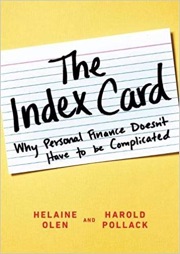
After rediscovering the young adult versions of fitting personal finance advice on an index card, I decided to go back and read the book The Index Card: Why Personal Finance Doesn’t Have to Be Complicated by Helaine Olen and Harold Pollack. (I was able to find it via library eBook.)

I noticed that the book version of the “index card” was slightly different. The original card had 9 items, but two of them were merged away into each other (401k/IRAs) and (Pay Attention to Fees/Buy Index Funds). I bolded the new additions below. (You can see all chapters on the Amazon page.)

  1. Strive to Save 10 to 20 Percent of Your Income
  2. Pay Your Credit Card Balance in Full Every Month
  3. Max Out Your 401(k) and Other Tax-Advantaged Savings Accounts
  4. Never Buy or Sell Individual Stocks
  5. Buy Inexpensive, Well-Diversified Indexed Mutual Funds and ETFs
  6. Make Your Financial Advisor Commit To a Fiduciary Standard
  7. Buy a Home When You Are Financially Ready
  8. Insurance – Make Sure You’re Protected
  9. Do What You Can To Support the Social Safety Net
  10. Remember The Index Card

Here again is the original:

Here are my notes on the newly-addressed topics of home-buying and insurance.

Home-buying. This will always be a hard topic because it mixes in emotion, personal history, peer pressure, and all that fuzzy stuff. If you want to own a home, you need to make sure the purchase won’t blow up your overall financial picture. Nothing really surprising, but still good advice.

  • Get your debt under control first.
  • Save up as close to a 20% down payment as you can.
  • Stick with a 15 or 30 year fixed-rate mortgage.
  • Prioritize what you really want and need in a home. Stay within your budget.
  • Location, location, location.

Insurance. There are low-probability events that can destroy decades of hard work, and that’s why humans invented insurance to spread the risk. Here are their cut-to-the-chase bullet points:

  • Emergency fund – Maintain one!
  • Life insurance – If you’re young(ish), just buy 30-year level term insurance.
  • Property insurance – Raise your deductible as high as you can handle.
  • Health insurance – Always sure you stay in-network.
  • Liability insurance – Coverage for at least twice your net worth.

I’m glad that this book still retained its “quick-and-dirty” nature. No single rule will cover every scenario, but it’s good to have a clear and concise collection of the big points along with just enough explanation that you understand the basic reasoning behind it.
Vanguard to Launch Low-Cost Commodity Strategy Fund

Vanguard announced in a press release that it is creating a new actively-managed mutual fund using the Bloomberg Commodity Total Return Index as a benchmark. The Vanguard Commodity Strategy Fund will have an estimated 0.20% expense ratio and June 2019 launch date.

bcom

The fund will at least initially not be directly targeted at retail investors, as it will only be available as Admiral Shares with a $50,000 investment minimum. Considering that commodities are usually only included in portfolio as a hedge at around 5% allocation, you would need a $1 million portfolio to justify putting $50,000 into commodities.

The direct competition is the PIMCO Commodity Real Return Strategy Fund (PCRIX) which has a 1.24% expense ratio and about $5 billion in assets. GraniteShares also released some low-cost commodity ETFs in 2017, including the GraniteShares Bloomberg Commodity Broad Strategy No K-1 ETF (COMB) with a 0.25% expense ratio. This means that the new Vanguard fund will become the lowest-cost commodity fund available by a small margin.

Here’s a quick summary of the Bloomberg Commodity Total Return index:

The Bloomberg Commodity Total Return index is composed of futures contracts and reflects the returns on a fully collateralized investment in the BCOM. This combines the returns of the BCOM with the returns on cash collateral invested in 13 week (3 Month) U.S. Treasury Bills.

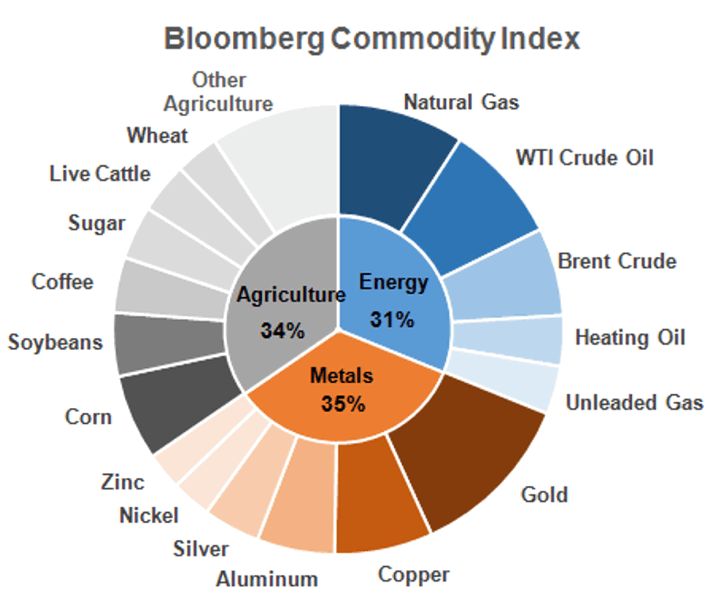
BCOM is the Bloomberg Commodity Index, which incudes aluminum, coffee, copper, corn, cotton, crude oil, gold, diesel, lean hogs, live cattle, natural gas, nickel, silver, soybeans, sugar, unleaded gas, wheat, and zinc (image source).

There is active debate as to whether commodities should be included in your portfolio. My take is that commodities futures may offer the draw of being a diversification and/or inflation hedge, but I don’t want to pay the price of possibly lower returns, higher volatility, and higher complexity. As in other areas of life, sometimes the “insurance” is worth the cost, and sometimes it isn’t.

Bottom line. Vanguard is launching a commodities fund. If you like low-cost access to the commodities asset class, this looks to be a positive development even though right now it has a $50,000 investment minimum. Where will Vanguard expand to next with its growing appetite for assets?

Buying The Haystack: Sleeping Well Because I’ll Own The Winners

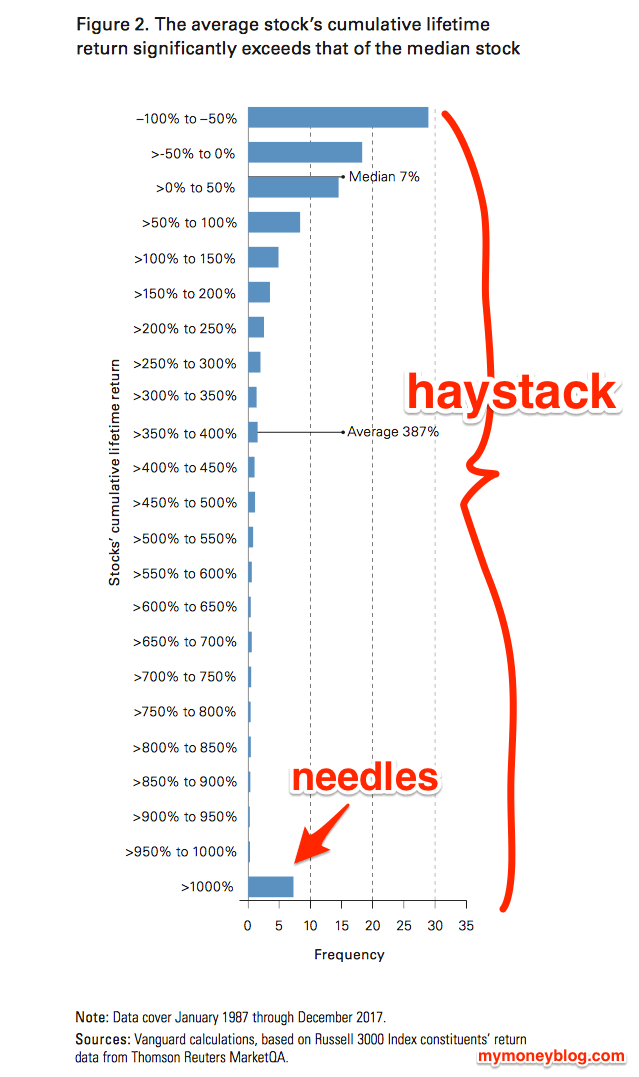
Vanguard has a new research paper on How to increase the odds of owning the few stocks that drive returns [pdf], found via How Concentration Affects Portfolio Performance by Michael Batnick. Inside, there is a chart that sorts the individual returns of the US stock market (Rusell 3000) over the last 30 years (1987-2017) into total performance buckets. What happens to the stock prices of individual companies over 30 years? Lots of big losers. A few huge winners.

The whitepaper has a lot of math and investment jargon that you can read for yourself. Let’s skip to the conclusion here:

Historical cumulative returns of individual stocks are skewed whereby overall market returns are determined by a small minority of stocks. Therefore, all else being equal, a more diversified portfolio is more likely to hold these outperforming stocks while displaying a lower dispersion of portfolio returns. We conducted simulations of various portfolio sizes and showed that those portfolios with fewer holdings underperformed those with more holdings, leading to a higher return hurdle to overcome.

As the late Jack Bogle told us: “Don’t look for the needle in the haystack. Just buy the haystack.”

I don’t know which will be the most successful US companies in the future, but I know that I will own them via the total US index fund in my portfolio. I will own the next Amazon, Google, Facebook, Apple, or Visa. I’ll also own whoever disrupts them after that. Since I own a big chunk of global stocks inside the Vanguard Total International Stock Index fund, I’ll be covered if they come from the other side of the world.

Now, when you own the entire haystack, you will get the losers as well as the winners. Also, I won’t be as rich as if I invested in them when operated out of a dorm room. It just turns out that in this capitalist structure, owning them all still works out pretty darn well. I will own shares of all these businesses in proportion to their market value, and by extension a share of their profits. Some of those profits will be reinvested for future growth, and some will be sent to me as cash dividends every three months. I’ll happily spend those dividends, and the let rest grow into more dividends in the future.

Schwab Commission-Free ETF List Review (Updated 2019)

ETFs are surpassing mutual funds as the standard building blocks of stock and bond portfolios. Here’s a closer look at the latest updates to the Charles Schwab commission-free ETF list. While the commercials often focus on quantity instead of quality, I will do the opposite. Here are the factors that I think are important:

  • Total Assets. This is a measure of popularity and reputation. A more popular ETF will have a smaller bid/ask spread and won’t have to liquidate in a bear market. A more reputably ETF manager will have lower index tracking error. However, ETF size isn’t everything.
  • Index/Asset Class. What index does it track? Does that index cover an asset class that I want to include??
  • Cost. What is the expense ratio? Low costs are important.

Schwab Commission-Free ETF full list. This Schwab ETF OneSource page includes a full list of their 503 commission-free ETFs.

Brief history of changes. In early February 2019, Schwab announced that it would increase the number of commission-free ETFs on their list to 503 as of March 1st, 2019, including no early redemption fees (no minimum holding period). Here is the list of 246 added ETFs, including 90 iShares ETFs.

Schwab’s ETF OneSource started in February 2013 with 103 commission-free ETFs including many in-house ETFs. Schwab has become very competitive with Vanguard and iShares by developing their own brand of low-cost, index ETFs. Outside providers now include: Aberdeen Standard Investments, ALPS Advisors, DWS Group, Direxion, Global X ETFs, IndexIQ, Invesco, iShares ETFs, John Hancock Investments, J.P. Morgan Asset Management, OppenheimerFunds, PIMCO, State Street Global Advisors SPDR® ETFs, USCF, WisdomTree and Charles Schwab Investment Management.

In March 2017, Schwab dropped their standard stock commission to $4.95 per trade + $0.65 per options contract. In addition, expenses for the Schwab market cap-weighted index mutual funds were lowered to match their Schwab ETF equivalents. Schwab Index mutual funds now have no investment minimum.

Largest ETFs on Schwab Commission-Free ETF list. Here are the top 20 most popular ETFs on their list, sorted by largest total assets. Also listed are the asset class and expense ratios.

ETF Name (Ticker) Asset Class Expense Ratio
iShares Core U.S. Aggregate Bond ETF (AGG) US Total Bond 0.05%
iShares iBoxx $ Investment Grade Corporate Bond ETF (LQD) US Corporate Bonds 0.15%
iShares Edge MSCI Min Vol USA ETF (USMV) US Low Volatility 0.15%
iShares TIPS Bond ETF (TIP) US Inflation-Protected Bond 0.19%
iShares 1-3 Year Treasury Bond ETF (SHY) Short-Term Treasury Bond 0.15%
iShares J.P. Morgan USD Emerging Markets Bond ETF (EMB) Emerging Markets Bond 0.39%
Schwab International Equity ETF (SCHF) International Developed 0.06%
iShares MBS ETF (MBB) US Mortage-Backed Bonds 0.09%
iShares MSCI Japan ETF (EWJ) International Country Stock 0.47%
iShares iBoxx $ High Yield Corporate Bond ETF (HYG) US High-Yield Corporate Bond 0.49%
Invesco S&P 500® Equal Weight ETF (RSP) US Large-Capk 0.20%
Schwab U.S. Large-Cap ETF (SCHX) US Large Cap Blend 0.03%
Schwab U.S. Broad Market ETF (SCHB) US Total Stock 0.03%
iShares 7-10 Year Treasury Bond ETF (IEF) Interm-Term Treasury Bond 0.15%
iShares National AMT-Free Muni Bond ETF (MUB) Municipal Bond 0.07%
iShares 20+ Year Treasury Bond ETF (TLT) Long-Term Treasury Bond 0.15%
iShares Edge MSCI Min Vol EAFE ETF (EFAV) International Developed Stock 0.20%
iShares Short-Term Corporate Bond ETF (IGSB) US Short-Term Corporate Bond 0.06%
Invesco S&P 500® Low Volatility ETF (SPLV) US Large-Cap Stock 0.25%
iShares Edge MSCI USA Quality Factor ETF (QUAL) US Large-Cap Stock 0.15%


Lowest Expense Ratio ETFs on Schwab Commission-Free ETF list. Here are the top 20 cheapest ETFs on their list, sorted by lowest expense ratio.

ETF Name (Ticker) Asset Class Expense Ratio
Schwab U.S. Broad Market ETF (SCHB) US Total Stock 0.03%
Schwab U.S. Large-Cap ETF (SCHX) US Large Cap Blend 0.03%
SPDR Portfolio Large Cap ETF (SPLG) US Large Cap Blend 0.03%
SPDR Portfolio Total Stock Market ETF (SPTM) US Total Stock 0.03%
SPDR Portfolio Developed World ex-US ETF (SPDW) International Developed Stock 0.04%
Schwab U.S. Aggregate Bond ETF (SCHZ) International Developed Large Cap Blend 0.04%
SPDR Portfolio Aggregate Bond ETF (SPAB) US Total Bond 0.04%
Schwab U.S. Large-Cap Growth ETF (SCHG) US Large-Cap Growth 0.04%
SPDR Portfolio S&P 500 Growth ETF (SPYG) US Large-Cap Growth 0.04%
Schwab U.S. Large-Cap Value ETF (SCHV) US Large-Cap Value 0.04%
SPDR Portfolio S&P 500 Value ETF (SPYV) US Large-Cap Value 0.04%
Schwab U.S. Mid-Cap ETF (SCHM) US Mid-Cap 0.04%
Schwab U.S. Small-Cap ETF (SCHA) US Small-Cap 0.04%
Schwab U.S. TIPS ETF (SCHP) US Inflation-Protected Bond 0.05%
Schwab 1000 Index ETF (SCHK) US Large-Cap Blend 0.05%
SPDR Portfolio Mid Cap ETF (SPMD) US Mid-Cap 0.05%
SPDR Portfolio Small Cap ETF (SPSM) US Small-Cap 0.05%
SPDR Bloomberg Barclays Corporate Bond ETF (CBND) US Corporate Bond 0.06%
Schwab International Equity ETF (SCHF) International Developed 0.06%
Schwab Intermediate-Term U.S. Treasury (SCHR) US Treasury Bond 0.06%


Commentary. Overall, Schwab’s OneSource ETF list does include a good mix of Schwab ETFs with good management, low costs, and low bid/ask spreads. There are also a few good iShares and SPDR ETFs that could be potential ETF pairs for tax-loss harvesting. A DIY investor should find it easy create a diversified portfolio of ETFs according to their desired asset allocation, if you know what you are looking for. With 500+ ETFs, many will be short-lived duds, while still others are ETFs that track a very similar index but are much more expensive than the competition.

Best Interest Rates on Cash – April 2019

Here’s my monthly roundup of the best interest rates on cash for April 2019, roughly sorted from shortest to longest maturities. The big news is that we are starting to see some slight rate drops in CDs! Folks who locked in at 4% APY may end up pleased they did. Check out my Ultimate Rate-Chaser Calculator to get an idea of how much extra interest you’d earn if you are moving money between accounts. Rates listed are available to everyone nationwide. Rates checked as of 4/3/19.

High-yield savings accounts
While the huge megabanks like to get away with 0.01% APY, it’s easy to open a new “piggy-back” savings account and simply move some funds over from your existing checking account. The interest rates on savings accounts can drop at any time, so I prioritize banks with a history of competitive rates. Some banks will bait you and then lower the rates in the hopes that you are too lazy to leave.

Short-term guaranteed rates (1 year and under)
A common question is what to do with a big pile of cash that you’re waiting to deploy shortly (just sold your house, just sold your business, legal settlement, inheritance). My usual advice is to keep things simple and take your time. If not a savings account, then put it in a flexible short-term CD under the FDIC limits until you have a plan.

  • No Penalty CDs offer a fixed interest rate that can never go down, but you can still take out your money (once) without any fees if you want to use it elsewhere. Purepoint Financial has a 13-month No Penalty CD at 2.50% APY with a $10,000 minimum deposit. Marcus Bank 13-month No Penalty CD at 2.35% APY with a $500 minimum deposit, Ally Bank 11-month No Penalty CD at 2.30% APY with a $25k+ minimum, and CIT Bank 11-month No Penalty CD at 2.05% APY with a $1,000 minimum. You may wish to open multiple CDs in smaller increments for more flexibility.
  • Colorado Federal Savings Bank has a 12-month CD at 2.86% APY ($5,000 minimum) with an early withdrawal penalty of 3 months of interest.

Money market mutual funds + Ultra-short bond ETFs
If you like to keep cash in a brokerage account, beware that many brokers pay out very little interest on their default cash sweep funds (and keep the difference for themselves). The following money market and ultra-short bond funds are not FDIC-insured, but may be a good option if you have idle cash and cheap/free commissions.

  • Vanguard Prime Money Market Fund currently pays an 2.46% SEC yield. The default sweep option is the Vanguard Federal Money Market Fund, which has an SEC yield of 2.36%. You can manually move the money over to Prime if you meet the $3,000 minimum investment.
  • Vanguard Ultra-Short-Term Bond Fund currently pays 2.71% SEC Yield ($3,000 min) and 2.81% SEC Yield ($50,000 min). The average duration is ~1 year, so there is more interest rate risk.
  • The PIMCO Enhanced Short Maturity Active Bond ETF (MINT) has a 2.84% SEC yield and the iShares Short Maturity Bond ETF (NEAR) has a 2.80% SEC yield while holding a portfolio of investment-grade bonds with an average duration of ~6 months.

Treasury Bills and Ultra-short Treasury ETFs
Another option is to buy individual Treasury bills which come in a variety of maturities from 4-weeks to 52-weeks. You can also invest in ETFs that hold a rotating basket of short-term Treasury Bills for you, while charging a small management fee for doing so. T-bill interest is exempt from state and local income taxes.

  • You can build your own T-Bill ladder at TreasuryDirect.gov or via a brokerage account with a bond desk like Vanguard and Fidelity. Here are the current Treasury Bill rates. As of 4/3/19, a 4-week T-Bill had the equivalent of 2.42% annualized interest and a 52-week T-Bill had the equivalent of 2.41% annualized interest.
  • The Goldman Sachs Access Treasury 0-1 Year ETF (GBIL) has a 2.30% SEC yield and the SPDR Bloomberg Barclays 1-3 Month T-Bill ETF (BIL) has a 2.25% SEC yield. GBIL appears to have a slightly longer average maturity than BIL.

US Savings Bonds
Series I Savings Bonds offer rates that are linked to inflation and backed by the US government. You must hold them for at least a year. There are annual purchase limits. If you redeem them within 5 years there is a penalty of the last 3 months of interest.

  • “I Bonds” bought between November 2018 and April 2019 will earn a 2.82% rate for the first six months. The rate of the subsequent 6-month period will be based on inflation again. More info here.
  • In mid-April 2019, the CPI will be announced and you will have a short period where you will have a very close estimate of the rate for the next 12 months. I will have another post up at that time.

Prepaid Cards with Attached Savings Accounts
A small subset of prepaid debit cards have an “attached” FDIC-insured savings account with exceptionally high interest rates. The negatives are that balances are capped, and there are many fees that you must be careful to avoid (lest they eat up your interest). Some folks don’t mind the extra work and attention required, while others do. There is a long list of previous offers that have already disappeared with little notice. I don’t personally recommend or use any of these anymore.

  • The only notable card left in this category is Mango Money at 6% APY on up to $2,500, but there are many hoops to jump through. Requirements include $1,500+ in “signature” purchases and a minimum balance of $25.00 at the end of the month.

Rewards checking accounts
These unique checking accounts pay above-average interest rates, but with unique risks. You have to jump through certain hoops, and if you make a mistake you won’t earn any interest for that month. Some folks don’t mind the extra work and attention required, while others do. Rates can also drop to near-zero quickly, leaving a “bait-and-switch” feeling. I don’t use any of these anymore, either.

  • The best one right now is Orion FCU Premium Checking at 4.00% APY on balances up to $30,000 if you meet make $500+ in direct deposits and 8 debit card “signature” purchases each month. The APY goes down to 0.05% APY and they charge you a $5 monthly fee if you miss out on the requirements. Find a local rewards checking account at DepositAccounts.
  • If you’re looking for a high-interest checking account without debit card transaction requirements then the rate won’t be as high, but take a look at MemoryBank at 1.60% APY.

Certificates of deposit (greater than 1 year)
CDs offer higher rates, but come with an early withdrawal penalty. By finding a bank CD with a reasonable early withdrawal penalty, you can enjoy higher rates but maintain access in a true emergency. Alternatively, consider building a CD ladder of different maturity lengths (ex. 1/2/3/4/5-years) such that you have access to part of the ladder each year, but your blended interest rate is higher than a savings account. When one CD matures, use that money to buy another 5-year CD to keep the ladder going.

  • Hanscom Federal Credit UnionBank has a 19-month CD special at 3.00% APY ($1,000 minimum) with an early withdrawal penalty of 6 months of interest. If you have a military relationship, Navy Federal Credit Union has a 6-month special at 3.00% APY and 17-month special at 3.25% APY.
  • 5-year CD rates have been dropping at many banks and credit unions, following the overall interest rate curve. A good rate is now about 3.25% APY, with The Federal Savings Bank offering 3.30% APY on a 5-year CD.
  • You can buy certificates of deposit via the bond desks of Vanguard and Fidelity. These “brokered CDs” offer FDIC insurance and easy laddering, but they don’t come with predictable fixed early withdrawal penalties. As of this writing, Vanguard is showing a 2-year non-callable CD at 2.45% APY and a 5-year non-callable CD at 2.80% APY. Watch out for higher rates from callable CDs listed by Fidelity.

Longer-term Instruments
I’d use these with caution due to increased interest rate risk, but I still track them to see the rest of the current yield curve.

  • Willing to lock up your money for 10+ years? You can buy long-term certificates of deposit via the bond desks of Vanguard and Fidelity. These “brokered CDs” offer FDIC insurance, but they don’t come with predictable fixed early withdrawal penalties. As of this writing, Vanguard is showing a 10-year non-callable CD at 3.10% APY. Watch out for higher rates from callable CDs from Fidelity. Matching the overall yield curve, current CD rates do not rise much higher as you extend beyond a 5-year maturity.
  • How about two decades? Series EE Savings Bonds are not indexed to inflation, but they have a guarantee that the value will double in value in 20 years, which equals a guaranteed return of 3.5% a year. However, if you don’t hold for that long, you’ll be stuck with the normal rate which is quite low (currently a sad 0.10% rate). I view this as a huge early withdrawal penalty. You could also view it as long-term bond and thus a hedge against deflation, but only if you can hold on for 20 years. As of 4/3/19, the 20-year Treasury Bond rate was 2.75%.

All rates were checked as of 4/3/19.


Barron’s Best Online Broker Rankings 2019

Each year, Barron’s releases their list of top online brokers. I like read and share it, hoping to find deeper insights into industry trends and specific broker features. However, this year their 2019 rankings article is firmly behind a paywall. That is certainly their right, but it also discourages sharing and discussion. (I am a paying subscriber to the NY Times, WSJ, and Bloomberg Businessweek, but not Barron’s.)
However, hidden in a Merill Edge press release, I found that Merrill paid for a full article reprint which lets anyone read the main article for free. I could not find a way to view the their secondary rankings, i.e. “Top 5 for Long-Term Investors” or “Top 5 for Occasional Traders”.

Their rankings only include 14 brokers this year, which means several are being left out. Firstrade and Vanguard were mentioned only to state that they both declined to participate. Robinhood wasn’t ranked, just quickly dismissed with an offhand “they take payment for order flow”, even though many other brokers on their list like E-Trade and TD Ameritrade also take payment for order flow. I mean, TD Ameritrade made $320 million from order flow in 2017 alone! WeBull wasn’t even mentioned.

Commentary. Here is my own list of brokers that I think are worth considering, along with their pros and cons. If a family or friend asked me what I thought were the best online brokers, this would be my reply.

Interactive Brokers

  • Pros: Best for active traders. Low average commissions for active traders. Best trading interface for active traders. Proof: Their average account makes ~500 trades a year. Good interest rate on cash sweep.
  • Cons: Minimum commission of $10 a month for accounts under $100,000, or a minimum commission of $20/month under $2,000. This means you must pay them $120/$240 a year no matter what. Not set up for newbies.

Fidelity

  • Pros: Good all-around broker. Best customer service in my experience. Free ETF list. No more mutual fund minimums. Good index fund selection.
  • Cons: $4.95/trade for stocks and ETFs not on their list. Average cash sweep options.

Vanguard

  • Pros: The classic broker for low-cost index fund lovers. $0 trades on all ETFs, both Vanguard and non-Vanguard (iShares, Schwab, etc). Free trades on Vanguard index and active mutual funds. Excellent index fund selection. Excellent cash sweep options. No direct profit motive.
  • Cons: Not good for active traders. They’ve had some struggles with customer service due to their huge growth.

Merrill Edge

  • Pros: Best for those with a Bank of America checking account. 30+ free trades/month when you move over $50,000+ in assets across Bank of America and Merrill (Preferred Rewards program), even if just moving over a bunch of low-cost ETFs. Good customer service.
  • Cons: Below-average cash sweep options. $6.95 trades without Preferred Rewards relationship.

M1 Finance

  • Pros: My favorite amongst the new crowd of app-centric brokers and robo-advisors. Free stock and ETF trades. Fractional share ownership means full investment of any dollar amount. You can fully customize an asset allocation “pie” using stocks or ETFs, and it will automatically rebalance for free with no management fees. Basically a free robo-advisor that is fully-customizable.
  • Cons: Newer startup. If you really want to add banking features, that will cost extra. (I’d just skip it.)

Disclosure: I am now an affiliate of M1 Finance and TD Ameritrade, and may be compensated if you click through my referral link and open a new account. I am not an affiliate of Interactive Brokers, Fidelity, Merrill Edge, or Vanguard.

Schwab Intelligent Portfolios Premium Feature Review: $30 a Month For Unlimited CFP Access

Schwab has revamped their Intelligent Portfolios “robo-advisor” service, renaming the upper tier to Schwab Intelligent Portfolios Premium and adding an in-depth financial plan and unlimited advice from a Certified Financial Planner for an additional upfront fee of $300 plus an ongoing $30 a month. Bloomberg compares this to a Netflix subscription:

Current users won’t have to pay the $300 fee, and they’ll be transitioned to the new pricing model as early as Thursday, but only once they have enough assets to make it more cost-efficient for them, at around the $125,000 level. The free version of the service, Schwab Intelligent Portfolios, which automatically builds and rebalances exchange-traded fund portfolios as well as offering more limited guidance, will continue charging no advisory fee.

Feature comparison. The base Intelligent Portfolios product including the following features:

  • Design and choose an appropriate asset allocation.
  • Construct and maintain (rebalance) portfolio using ETFs.
  • Tax-loss harvesting.
  • No advisory fee*.
  • No commissions.
  • $5,000 minimum balance.

* You might see this referred to as a “free” (as it is by Bloomberg above) in that it charges no advisory fee on top of the underlying fees of the portfolio components. I’ll argue below that is it not really “free”.

Schwab Intelligent Portfolios Premium adds the following:

  • Unlimited 1:1 guidance from a Certified Financial Planner (CFP).
  • Personalized Action Plan and portfolio review with a CFP® professional.
  • One-time $300 initial planning fee and $30/month for unlimited guidance.
  • $25,000 minimum balance.

I agree that is a big shift in the portfolio management industry. A major player now offers unlimited access to a CFP for a flat fee of $30/month. CFP access is becoming a commodity. If you pay $15 a month for Netflix and $50 a month for unlimited cell phone data, why not pony up $30 a month for unlimited financial advice? I have pointed out previously that an overlooked feature of Blooom 401k advisory services was that they include unlimited CFP access in their $10/month fee.

I really like the idea of paying a flat fee instead of an asset-based fee for financial advice. I think this move from a big name like Schwab will attract some large portfolios from DIY investors. If you had a $500,000 portfolio, this would only be 0.07% of assets annually. I really hope Vanguard comes out with a flat-fee pricing option while still keeping their ability to work with your existing portfolio. Most robo-advisors, including Schwab Intelligent Portfolios, make you sell out of all your current positions and rebuy using their model portfolios. I have a lot of capital gains already such that selling would cause tax issues.

Schwab Intelligent Portfolios still has the same “catch” in their fine print, however. Every Schwab Intelligent Portfolios client is forced to hold a cash position of about 8% of the total portfolio in cash. More importantly, you also don’t have a choice in how they define “cash”. Here’s the fine print:

The portfolios include a cash allocation to a deposit account at Schwab Bank. Our affiliated bank earns income on the deposits, and earns more the larger the cash allocation is. The lower the interest rate Schwab Bank pays on the cash, the lower the yield. Some cash alternatives outside of Schwab Intelligent Portfolios Solutions pay a higher yield.

My primary concern is NOT that holding 8% cash is bad. It’s that the Schwab cash component that they force you to use is bad. As of 3/31/19, Schwab cash pays only 0.70% APY while the Vanguard Prime Money Market fund earns 2.46% SEC yield and a one-month Treasury Bill has a 2.43% yield. This gap may narrow or widen in the future.

If you assume a 1.50% drag on a 8% cash allocation, that’s the equivalent paying a 0.12% fee because you are losing that much in potential interest. As you grow older and/or become more conservative, the cash allocation grows as well. It is a guaranteed profit source for Schwab, and thus a guaranteed loss for you (not free!). This loss is not “cash drag”. If you wanted to argue that the return on cash is worse than a bond fund, “cash drag” would be an additional cost on top of this issue.

This is the equivalent of them making you hold an S&P 500 ETF with a 1.50% expense ratio instead of an equally-available S&P 500 ETF with an 0.03% expense ratio. People would be up in arms about that, so why not put up a fuss about this? The net fee may be still be a reasonable size, but this is not the type of behavior I am looking for in a service that I am supposed to entrust with my life savings. Just be upfront and charge me a fee. If Schwab replaces their cash component with a competitive money market fund or a simple allocation to Treasury Bills (make your own ETF, Schwab!) then I would get much more excited about this product.

Bottom line. Schwab is adding the ability to get unlimited human advice from a Certified Financial Planner (CFP) for $300 upfront + a flat $30 a month. I think this is a bold move that will affect the overall industry, but I still have concerns about their overall robo-advisor product that includes a low-interest cash component.

Fidelity Commission-Free ETF List Review (Updated 2019)

ETFs are surpassing mutual funds as the standard building blocks of stock and bond portfolios. Therefore, I’m taking a closer look at the latest commission-free ETF lists from the major brokers. Unfortunately, the marketing often focuses on quantity instead of quality. Who cares if they offer 500+ ETFs, if I only need six good ones? Here are the factors that I think are important:

  • Total Assets. This is a measure of popularity and reputation. A more popular ETF will have a smaller bid/ask spread and won’t have to liquidate in a bear market. A more reputably ETF manager will have lower index tracking error. However, ETF size isn’t everything.
  • Index/Asset Class. What index does it track? Does that index cover an asset class that I want to include?
  • Cost. What is the expense ratio? Low costs are important.

Fidelity Commission-Free ETF full list. The main Fidelity ETF page currently advertises 357 commission-free ETFs (28 from Fidelity and 329 from iShares). The full list requires a log-in. Here is an outdated PDF which lists the 240 iShares ETFs (89 more have since been added). There are several good, low-cost options from the iShares Core Series of ETFs.

Recent changes. In early February 2019, Fidelity announced that it would match Schwab and increase the number of commission-free ETFs on their list to “more than 500” by the end of the month. However, in late February 2019 they announced that they added a few new Fidelity ETFs and 89 additional iShares ETFs (formerly 240) as part of a “first phase”.

In February 2017, Fidelity lowered the standard commission on online stock and ETF trades to $4.95 per trade, down from $7.95 previously. In August 2018, Fidelity announced a part of zero-expense ratio mutual funds, eliminated many account minimums, and cut a bunch of mutual fund expense ratios by getting rid of share classes.

Largest ETFs on Fidelity Commission-Free ETF list. Here are the top 20 most popular ETFs on their list, sorted by largest total assets. I have added in the asset class (index) and expense ratio.

ETF Name (Ticker) Asset Class Expense Ratio
iShares Core S&P 500 ETF (IVV) US Large Cap Blend 0.04%
iShares MSCI EAFE ETF (EFA) International Large Cap Blend 0.31%
iShares Core MSCI EAFE ETF (IEFA) International Large Cap Blend 0.08%
iShares Core U.S. Aggregate Bond ETF (AGG) US Total Bond 0.05%
iShares Core MSCI Emerging Markets ETF (IEMG) Emerging Markets Stock 0.14%
iShares Core S&P Mid-Cap ETF (IJH) US Mid Cap Blend 0.07%
iShares Russell 2000 ETF (IWM) US Small Cap Blend 0.19%
iShares Core S&P Small-Cap ETF (IJR) US Mid Cap Blend 0.07%
iShares Russell 1000 Growth ETF (IWF) US Large Cap Growth 0.20%
iShares Russell 1000 Value ETF (IWD) US Large Cap Value 0.20%
iShares MSCI Emerging Markets ETF (EEM) Emerging Markets Stock 0.67%
iShares iBoxx $ Investment Grade Corporate Bond ETF (LQD) US Corporate Bonds 0.15%
iShares Edge MSCI Min Vol USA ETF (USMV) US Low Volatility 0.15%
iShares S&P 500 Growth ETF (IVW) US Large Cap Growth 0.18%
iShares TIPS Bond ETF (TIP) US Inflation-Protected Bond 0.19%
iShares 1-3 Year Treasury Bond ETF (SHY) Short-Term Treasury Bond 0.15%
iShares Short Treasury Bond ETF (SHV) Short-Term Treasury Bond 0.15%
iShares Russell 1000 ETF (IWB) US Large Cap Blend 0.15%
iShares Core S&P Total U.S. Stock Market ETF (ITOT) US Total Stock 0.03%
iShares Russell Midcap ETF (IWR) US Total Stock 0.20%


Lowest Expense Ratio ETFs on Fidelity Commission-Free ETF list. Here are the top 20 cheapest ETFs on their list, sorted by lowest expense ratio.

ETF Name (Ticker) Asset Class Expense Ratio
iShares Core S&P Total U.S. Stock Market ETF (ITOT) US Total Stock 0.03%
iShares Core S&P 500 ETF (IVV) US Large Cap Blend 0.04%
iShares Core S&P U.S. Value ETF (IUSV) US Large Cap Value 0.04%
iShares Core S&P U.S. Growth ETF (IUSG) US Large Cap Growth 0.04%
iShares Core U.S. Aggregate Bond ETF (AGG) US Total Bond 0.05%
iShares Core MSCI International Developed Markets ETF (IDEV) International Developed Large Cap Blend 0.07%
iShares Short-Term Corporate Bond ETF (IGSB) US Short-Term Corporate Bond 0.06%
iShares Intermediate-Term Corporate Bond ETF (IGIB) US Interm-Term Corporate Bond 0.06%
iShares Broad USD Investment Grade Corporate Bond ETF (USIG) US Total Corporate Bond 0.06%
iShares 0-5 Year TIPS Bond ETF (STIP) US Inflation-Protected Bond 0.06%
iShares Core 1-5 Year USD Bond ETF (ISTB) US Short-Term Bond 0.06%
iShares 0-5 Year Investment Grade Corporate Bond ETF (SLQD) US Short-Term Corporate Bond 0.06%
iShares Core Total USD Bond Market ETF (IUSB) US Total Bond 0.06%
iShares Core S&P Mid-Cap ETF (IJH) US Mid Cap Blend 0.07%
iShares Core S&P Small-Cap ETF (IJR) US Mid Cap Blend 0.07%
iShares National AMT-Free Muni Bond ETF (MUB) Municipal Bond 0.07%
iShares S&P Short Term National AMT-Free Bond ETF (SUB) Short-Term Municipal Bond 0.07%
iShares Core U.S. REIT ETF (USRT) US Real Estate 0.08%
iShares Core High Dividend ETF (HDV) US High Dividend Stock 0.08%
iShares Core MSCI EAFE ETF (IEAFA) International Developed Large Stock 0.08%


Commentary. Fidelity’s list includes a good mix of iShares Core ETFs with good management, low costs, and low bid/ask spreads. An individual investor can easily create a diversified portfolio of ETFs according to their desired asset allocation. However, in their latest round of additions, they added a bunch of older iShares ETFs which were mostly more popular for professional traders and options buyers, not for long-term investors. For example, why would you buy EEM when you could buy IEMG with a much lower expense ratio? DIY investors need to choose carefully.

10-Year vs. 3-Month Yield Inversions and Recessions: It’s Time Make a Plan

Last Friday, the yield on the 10-year US Treasury note was a tiny bit less than that of the 3-month US Treasury bill. This is known as a yield inversion, and depending on which article you read, this specific type of yield inversion (10-year minus 3-month) has happened before each of the past 6, 7, or 9 recessions. More overview in this Bloomberg article:

Here is a FRED chart showing the difference between the 10-year and 3-month yields since 1978. The gray areas are recessions. (Click to enlarge.)

Yield inversion. Recession. Yield inversion. Recession. Every time.

This does not necessarily mean you should sell all your stocks now. You can see for yourself that there is a bit of lag time between the initial inversion and the official start of a recession. The length of time can vary, and it could be years. That means if you jump out of stocks now, things might still go up for a while. In addition, there’s no way to know the length or severity of the recession. How will you know when to jump back in stocks again? Lots of people sat out 2008 through 2018.

In my opinion, this is like your local fire department knocking on your door and reminding you to make an emergency plan for whatever disasters you are exposed to – fire, earthquakes, tornadoes, hurricanes. A hurricane may not hit soon, or even this year, or the next. You make the plan now, so you will be prepared and know exactly what to do when it does eventually hit.

You should know that you are going to do in a recession before the recession actually hits.

  • What will you do if you lose your job and can find another one immediately? What if your business revenue drops significantly?
  • Do you know what areas of spending you would cut if you really needed to? What can you liquidate easily for cash?
  • What will you do if your stocks lose up to 50% in value and stay that way for years? Will you hold? Sell or rebalance according to a preset rule?
  • What will you do if your home value drops by 20% or more?
  • Where can you borrow money if needed? Are you sure that line of credit will still be there?

I’ve thought about most of this, but I should create a written plan that my partner can follow even if I’m not around.

My Money Blog Portfolio Income and Withdrawal Rate – March 2019 (Q1)

dividendmono225One of the biggest problems in retirement planning is turning a pile of money into a reliable stream of income. I have read hundreds of articles about this topic, and I have not yet found a perfect solution to this problem. Everything has pros and cons: stocks, high-dividend stocks, bonds, annuities, real estate, and so on.

The imperfect (!) solution I chose is to first build a portfolio designed for total return and enough downside protection such that I can hold through an extended downturn. As you will see below, the total income is a little under 3% of the portfolio annually. I could easily crank out a portfolio with a 4% income rate, or even 5% income. But you have to take some additional risks to get there. With a total return-oriented portfolio, I am more confident that the (lower initial) income will grow at least as fast (and hopefully faster) than inflation.

Starting with a more traditional portfolio, I then try to only spend the dividends and interest. The analogy I fall back on is owning a rental property. If you are reliably getting rent checks that increase with inflation, you can sit back calmly and ignore what the house might sell for on the open market.

I track the “TTM Yield” or “12 Mo. Yield” from Morningstar, which the sum of a fund’s total trailing 12-month interest and dividend payments divided by the last month’s ending share price (NAV) plus any capital gains distributed over the same period. (Index funds have low turnover and thus little in capital gains.) I like this measure because it is based on historical distributions and not a forecast. Below is a very close approximation of my investment portfolio (2/3rd stocks and 1/3rd bonds).

Asset Class / Fund % of Portfolio Trailing 12-Month Yield (Taken 3/15/19) Yield Contribution
US Total Stock
Vanguard Total Stock Market Fund (VTI, VTSAX)
25% 1.81% 0.45%
US Small Value
Vanguard Small-Cap Value ETF (VBR)
5% 2.03% 0.10%
International Total Stock
Vanguard Total International Stock Market Fund (VXUS, VTIAX)
25% 2.89% 0.72%
Emerging Markets
Vanguard Emerging Markets ETF (VWO)
5% 2.63% 0.13%
US Real Estate
Vanguard REIT Index Fund (VNQ, VGSLX)
6% 4.21% 0.25%
Intermediate-Term High Quality Bonds
Vanguard Intermediate-Term Tax-Exempt Fund (VWIUX)
17% 2.86% 0.49%
Inflation-Linked Treasury Bonds
Vanguard Inflation-Protected Securities Fund (VAIPX)
17% 3.09% 0.53%
Totals 100% 2.67%


Using this metric, my maximum spending target is a 2.67% withdrawal rate. One of the things I like about using this number is that when stock prices drop, this percentage metric usually goes up… and that makes me feel better in a gloomy market. When stock prices go up, this percentage metric usually goes down, which keeps me from getting too happy. This also applies to the relative performance of US and International stocks. In this way, tracking yield adjusts in a very rough manner for valuation.

We are a real 40-year-old couple with three young kids, and this money has to last us a lifetime (without stomach ulcers). This number does not dictate how much we actually spend every year, but it gives me an idea of how comfortable I am with our withdrawal rate. We spend less than this amount now, but I like to plan for the worst while hoping for the best. For now, we are quite fortunate to be able to do work that is meaningful to us, in an amount where we still enjoy it and don’t feel burned out.

Life is not a Monte Carlo simulation, and you need a plan to ride out the rough times. Even if you run a bunch of numbers looking back to 1920 and it tells you some number is “safe”, that’s still trying to use 100 years of history to forecast 50 years into the future. Michael Pollan says that you can sum up his eating advice as “Eat food, not too much, mostly plants.” You can sum up my thoughts on portfolio income as “Spend mostly dividends and interest. Don’t eat too much principal.” At the same time, live your life. Enjoy your time with family and friends. You may be more likely to run out of time than run out of money.

In the end, I do think using a 3% withdrawal rate is a reasonable target for something retiring young (before age 50) and a 4% withdrawal rate is a reasonable target for one retiring at a more traditional age (closer to 65). If you’re still in the accumulation phase, you don’t really need a more accurate number than that. Focus on your earning potential via better career moves, investing in your skillset, and/or look for entrepreneurial opportunities where you get equity in a business.

TD Ameritrade Commission-Free ETF List = All of Them! October 2019

tda_200

Updated October 2019. TD Ameritrade has announced $0 commissions on online stock, ETF and option trades. Applies to U.S. exchange-listed stocks, ETFs, and options. A $0.65 per contract fee applies for options trades, with no exercise or assignment fees. No more worrying about looking through the free ETF list, because they are all free!

Original post:

TD Ameritrade has made several changes to their commission-free ETF trading program over the years. I am not an active trader, so that is the focus of this post. Most recently, they made an important shift from offering fewer, popular ETFs to offering a higher number of niche ETFs. In addition, TDA also has various promotions if you do decide to move over some assets.

Commission-free ETFs. Here is the current list of 300+ commission-free ETFs. ETFs held less than 30 days will be charged a short-term trading fee of $13.90. ETFs on the commission-free list cannot be used as collateral for a margin loan, nor can they be included in margin equity for 30 days after purchase.

(For posterity, here is the old ETF list [pdf] which ended in November 2017. These ETFs were chosen by 3rd-party Morningstar to be the best 100 ETFs from the biggest providers (Vanguard and iShares) and with the highest assets, highest trading volume, and lowest expense ratios.)

Current providers include AGFiQ QuantShares, First Trust Portfolios, iShares ETFs, J.P. Morgan Asset Management, PowerShares by Invesco, ProShares, State Street Global Advisors’ SPDR, and WisdomTree Investments.

The bad. Unfortunately, this move also puts TD Ameritrade more firmly into the pack of brokerage with ETF/mutual fund “supermarkets” based on who will pay them for shelf placement:

TD Ameritrade receives remuneration from certain ETFs (exchange-traded funds) that participate in the commission-free ETF program for shareholder, administrative and/or other services, generally ranging from the equivalent of approximately 15% to 30% of the ETFs’ annual net operating expense ratio.

This is a common arrangement and you’ll see the same thing at Schwab and Fidelity, but in my opinion you end up a bigger list of less-attractive products. They also tend to have higher expense ratios. In my opinion, the quantity has gone up, but the quality has gone down. Here are some examples that I’ve never even heard of before:

  • First Trust Alternative Absolute Return Strategy ETF
  • iShares Fallen Angels USD Bond ETF
  • PowerShares Optimum Yield Diversified Commodity Strategy No K-1 Portfolio
  • QuantShares US Market Neutral Anti-Beta Fund

The good. To be fair, there are still some iShares Core ETFs (though not the broadest ones) and some SPDR ETFs that cover broad indexes (though with lower asset size and trading volume). There are maybe 15-20 ETFs that I could see as part of a low-cost, long-term portfolio. A few examples:

  • SPDR Dow Jones Total Market (SPTM)
  • SPDR S&P World ex-US (SPDW)
  • SPDR Lehman Aggregate Bond (SPAB)
  • iShares 0-5 Year TIPS Bond ETF (STIP)
  • iShares Core International Aggregate Bond ETF (IAGG)
  • iShares Core U.S. REIT ETF (USRT)
  • iShares Global REIT ETF (REET)

However, I still don’t like that they changed it. You might have built up a position with $0 trades, and now it costs $6.95 per trade to buy more. You can try and switch to the closest approximate ETF, but what about next time they shake up the list? TD Ameritrade won “#1 for Long-Term Investing” in the Barron’s magazine 2018 rankings. I don’t know if long-term investors like to switch holdings every 7 years. Maybe the niche ETFs are a better draw for TDA’s target audience.

The competition. If you want to construct a low-cost, broadly-indexed ETF portfolio, I would compare with the offerings from Schwab, Vanguard, and Fidelity. None of those are an independent brokerage like TD Ameritrade, but they do offer commission-free trades on low-cost, broad ETFs. You could also look into the free trade offers from Bank of America ($50k+ in relationship assets), Robinhood (free share bonus), WeBull (free share bonus), and Firstrade.

My Money Blog Portfolio Asset Allocation and Performance, March 2019 (Q1)

portpie_blank200

Here’s my quarterly portfolio update for Q1 2019. Most of my dividends arrive on a quarterly basis, and this helps me decided where to reinvest them. These are my real-world holdings, including 401k/403b/IRAs and taxable brokerage accounts but excluding our house, cash reserves, and a few side investments. The goal of this portfolio is to create sustainable income to cover our household expenses for the next (hopefully) 40+ years. We are currently “semi-retired”, meaning we both work part-time while also spending a portion of our dividends and interest from this portfolio.

Actual Asset Allocation and Holdings

I use both Personal Capital and a custom Google Spreadsheet to track my investment holdings. The Personal Capital financial tracking app (free, my review) automatically logs into my accounts, adds up my balances, tracks my performance, and calculates my asset allocation. I still use my manual Google Spreadsheet (free, instructions) because it helps me calculate how much I need in each asset class to rebalance back towards my target asset allocation.

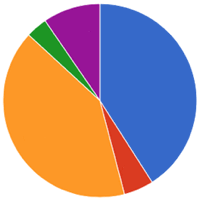
Here are my YTD performance and current asset allocation visually, per the “Holdings” and “Allocation” tabs of my Personal Capital account, respectively:

Stock Holdings
Vanguard Total Stock Market Fund (VTI, VTSMX, VTSAX)
Vanguard Total International Stock Market Fund (VXUS, VGTSX, VTIAX)
WisdomTree SmallCap Dividend ETF (DES)
Vanguard Small Value ETF (VBR)
Vanguard Emerging Markets ETF (VWO)
Vanguard REIT Index Fund (VNQ, VGSIX, VGSLX)

Bond Holdings
Vanguard Limited-Term Tax-Exempt Fund (VMLTX, VMLUX)
Vanguard Intermediate-Term Tax-Exempt Fund (VWITX, VWIUX)
Vanguard Intermediate-Term Treasury Fund (VFITX, VFIUX)
Vanguard Inflation-Protected Securities Fund (VIPSX, VAIPX)
Fidelity Inflation-Protected Bond Index Fund (FIPDX)
iShares Barclays TIPS Bond ETF (TIP)
Individual TIPS securities
U.S. Savings Bonds (Series I)

Target Asset Allocation. Our overall goal is to include asset classes that will provide long-term returns above inflation, distribute income via dividends and interest, and finally offer some historical tendencies to balance each other out. I make a small bet that US Small Value and Emerging Markets will have higher future long-term returns (along with some higher volatility) than the more large and broad indexes, although I could be wrong. I don’t hold commodities, gold, or bitcoin as they don’t provide any income and I don’t believe they’ll outpace inflation significantly.

I believe that it is important to imagine an asset class doing poorly for a long time, with bad news constantly surrounding it, and only hold the ones where you still think you can maintain faith based on a solid foundation of knowledge and experience.

Stocks Breakdown

  • 38% US Total Market
  • 7% US Small-Cap Value
  • 38% International Total Market
  • 7% Emerging Markets
  • 10% US Real Estate (REIT)

Bonds Breakdown

  • 50% High-quality, Intermediate-Term Bonds
  • 50% US Treasury Inflation-Protected Bonds

I have settled into a long-term target ratio of 67% stocks and 33% bonds (2:1 ratio) within our investment strategy of buy, hold, and occasionally rebalance. I will use the dividends and interest to rebalance whenever possible in order to avoid taxable gains. (I’m fine with it drifting to 65/35 or 70/30.) With a self-managed, simple portfolio of low-cost funds, we minimize management fees, commissions, and taxes.

Holdings commentary. On the bond side, I still like high-quality bonds with a short-to-intermediate duration of under 5 years or so. This means US Treasuries, TIPS, or investment-grade municipal bonds. I don’t want to worry about my bonds “blowing up”. Right now, my bond portfolio is about 1/3rd muni bonds, 1/3rd treasury bonds, and 1/3rd inflation-linked treasury bonds (and savings bonds).

On the stocks side, everything has had a nice bounce back up since the drop in late 2018. I didn’t really sweat the ride down, so I’m not celebrating the ride up. I remain satisfied with my mix, knowing that I will own whatever successful businesses come out of the US, China, or wherever in the future.

Performance commentary and benchmarks. According to Personal Capital, my portfolio went up 8.6% already so far in 2019. I see that during the same period the S&P 500 has gone up over 12%, Foreign Developed stocks up nearly 11%, and the US Aggregate bond index was up nearly 2%.

An alternative benchmark for my portfolio is 50% Vanguard LifeStrategy Growth Fund and 50% Vanguard LifeStrategy Moderate Growth Fund – one is 60/40 and the other is 80/20 so it also works out to 70% stocks and 30% bonds. That benchmark would have a total return of +8.6% for 2019 YTD. This quarter, I’m right at this benchmark with my customized portfolio.

I’ll share about more about the income aspect in a separate post.