 Instead of just looking at one year of returns, I prefer taking a longer view. Most successful savers invest money each year over a long period of time, these days often into a target-date fund (TDF). Don’t get caught up in the daily news reporting the recent performance of the Dow or S&P 500.
Investment benchmark. There are many possible choices for an investment benchmark, but I chose the Vanguard Target Retirement 2045 Fund. This all-in-one fund is low-cost, highly diversified, and available in many employer retirement plans as well open to anyone with an IRA. In the early accumulation phase, this fund is 90% stocks (both US and international) and 10% bonds (investment-grade domestic and international). I think it’s a solid default choice where you could easily do worse over the long run.
Investment amount. For the last decade, the maximum allowable annual contribution to a Traditional or Roth IRA has been roughly $5,000 per person. The maximum allowable annual contribution for a 401k, 403b, or TSP plan has been over $10,000 per person. If you have a household income of $67,000, then $10,000 is right at the 15% savings rate mark. Therefore, I’m going to use $10,000 as a benchmark amount. It’s easy to multiply the results as needed.
A decade of real-world savings. To create a simple-yet-realistic scenario, what would have happened if you put $10,000 a year into the Vanguard Target Retirement 2045 Fund, every year, for the past 10 years. You’d have put in $100,000 over time, but in more manageable increments. With the handy tools at Morningstar and a Google spreadsheet, we get this:

Investing $10,000 every year for the last decade would have resulted in a $57,000 investment gain. If, for example, you were a couple that both maxed out their 401k and IRAs at roughly $20k each or $40k total per year, that would leave you with a gain of roughly $230,000 over the last decade (and a total balance of $630,000).
Timing still matters, but not as much as you might think due to the dollar-cost averaging and longer time horizon. More importantly, you can’t control that part. You have much more control over how much you save. Here are previous results for January 2007 to December 2016 and January 2008 to December 2017.
Work on improving your career skills (or start your own business), save a big chunk of your income, and then invest it in productive assets. Keep calm and repeat. Our path to financial freedom can be mostly explained by such behavior. The only “secret” here is consistency. We maxed out both IRA and the 401k salary deferral limits nearly every year since 2004. You can build wealth with something as accessible and boring as the Vanguard Target Retirement fund. We received no inheritances and don’t pay a brilliant hedge fund manager.
 If you invest in stocks, you know that they go up and down. Below is an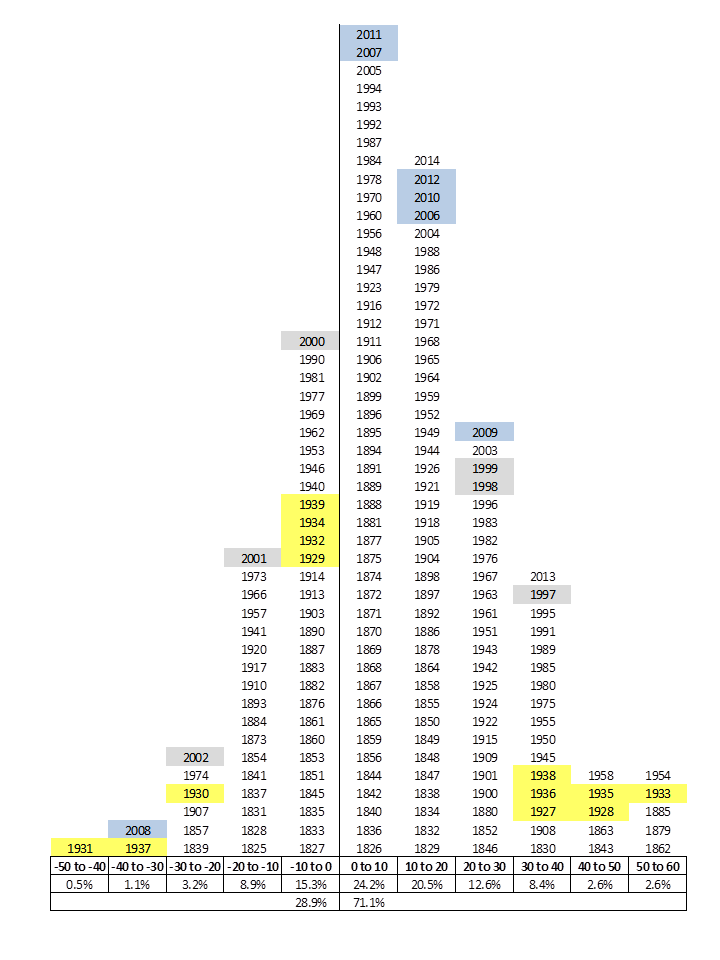

 Here’s my monthly roundup of the best interest rates on cash for January 2019, roughly sorted from shortest to longest maturities. Check out my

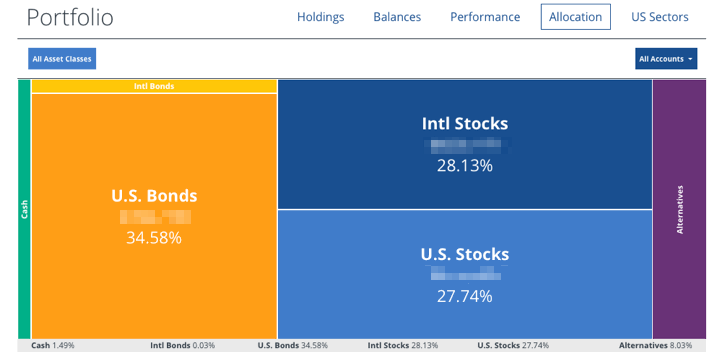
 Another one in the books! I don’t track the market daily as I think the discussion is full of noise and after-the-fact justifications. I check my portfolio quarterly to see where to reinvest dividends. At the end of the year, I like to record the annual returns for select asset classes as benchmarked by passive mutual funds and ETFs. Here is the 2018 data taken from Morningstar after market close 12/31/18.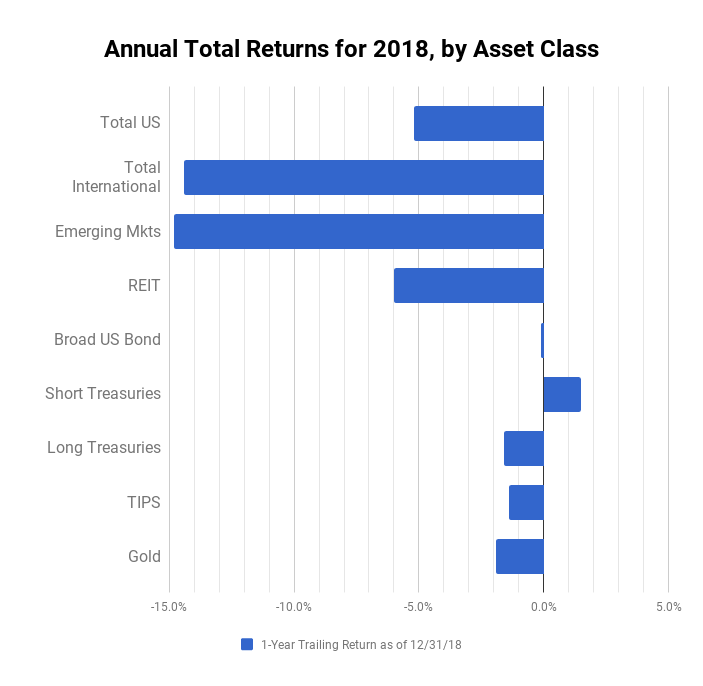

 I don’t really enjoy talking about stock market movements, but given that it has been the most common reader question recently and I wanted to start answering more reader questions, here we are. My overall take is the same:

 Vanguard has


 Investment research firm Morningstar has released their annual 529 College Savings Plans
  The Best Credit Card Bonus Offers – 2025
 Big List of Free Stocks from Brokerage Apps
 Best Interest Rates on Cash - 2025
 Free Credit Scores x 3 + Free Credit Monitoring
 Best No Fee 0% APR Balance Transfer Offers
 Little-Known Cellular Data Plans That Can Save Big Money
 How To Haggle Your Cable or Direct TV Bill
 Big List of Free Consumer Data Reports (Credit, Rent, Work)