 Series I Savings Bonds (aka “I Bonds”) are a unique investment sold directly to individuals by the US Treasury that pay out a variable interest rate linked to inflation. This post collects general reasons to own these savings bonds without going into the internal details of how they work. Please also see my related post Reasons To Own TIPS, Treasury Inflation-Protected Securities.
Backed by the US government and will never decrease in nominal value. If you buy an I Bond for $1,000, you’ll never get less than $1,000 back. Sometimes it’s nice to know that something will only go up in numerical value.
Pays interest that is the sum of a fixed rate and an inflation-linked rate. The fixed rate is set at purchase. The inflation-linked rate is reset every 6 months based on a preset formula tracking the CPI-U (Consumer Price Index for All Urban Consumers). This is unique and would come in helpful in times of unexpectedly higher inflation. I write about the upcoming I bond rate changes every 6 months as well.
Sold directly by US Treasury with no fees. You must either buy them directly online at TreasuryDirect.gov or via paper bonds via tax return. There are no purchase fees or annual maintenance fees.
Interest from I-Bonds are exempt from state and/or local income taxes. Same as with US Treasury bonds and TIPS.
Federal income tax on interest is not due until redemption. This means that you can defer paying taxes on accrued interest for up to 30 years. You don’t owe taxes until you cash out. This also means that you can time your eventual withdrawal during a year where you have the lowest tax rate (i.e. when your income drops after retirement).
Possible tax-free interest when used for qualified educational expenses. If you meet all the requirements, you can even avoid federal income taxes completely when paying qualified higher education expenses at an eligible institution. These include income phase-out limits.More information at this TreasuryDirect page. You can even contribute your proceeds to a 529 plan or Coverdell Educational Savings Account. Here are some tips from Finaid.org.
Series EE and I US Savings Bonds issued after December 31, 1989 may be redeemed tax-free in order to contribute the proceeds to a section 529 plan or Coverdell Education Savings Account. (To take advantage of this, file IRS Form 8815 to claim an exclusion for the interest after rolling the proceeds of these US Savings Bonds into a section 529 college savings plan or Coverdell Education Savings account. Write “529 College Savings Plan” or “Coverdell Education Savings Account” in the answer to 1(b), where it asks for the name of the educational institution. The specific citation in the tax code for this guidance is IRC Section 135(c)((2)(C).)
Reasons for NOT owning I Bonds.
- There are purchase limits for I Bonds of $10,000 per person per year in electronic format. You can also buy an additional $5,000 in paper bonds per year using your tax refund with IRS Form 8888. If you have children, you may be able to buy additional savings bonds by using a minor’s Social Security Number.
- The fixed rate has been low in recent years. Here, the inflation-linking may help you get an interest rate slightly above inflation, but after taxes, your net return may still lag inflation. For example if the fixed rate was zero and inflation was 2%, you would probably get less than a 2% return after taxes.
- As with interest earned from bank accounts and taxable bonds, interest is eventually taxed at ordinary income rates. Long-term capital gains and dividends from stocks are usually taxed at lower rate.
- You can’t redeem your savings bonds at all during the first 12 months. I believe there is a small exception if you can show yourself to be affected by an official natural disaster.
- If you redeem within the first 5 years, you will be subject to an early redemption penalty of your last 3 months of interest.
- TIPS are analyzed more deeply by financial professionals, and have not been found to lie on the “efficient frontier” curve. Thus, it is also unlikely that I bonds will optimal in that way.
- You may not want to open and track a separate Treasury Direct account just to hold your I Bonds.
- If you lose your online login and password to TreasuryDirect.gov and someone jumps through all the hoops necessary to steal your electronic I bonds, then the US Treasury will not reimburse you. If you lose paper bonds, there is a replacement policy.
TIPS vs. I Bonds.
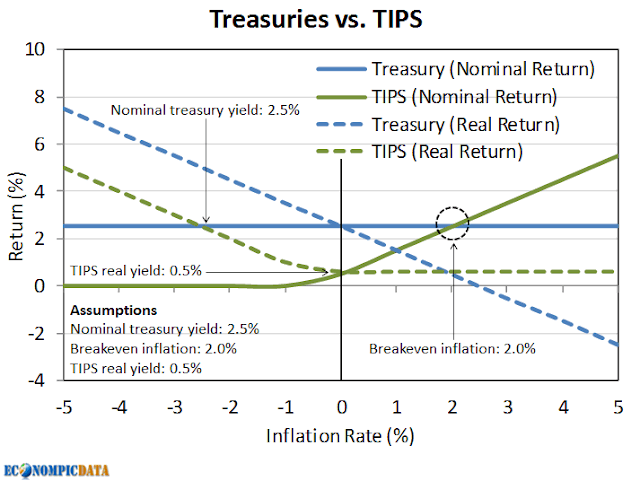
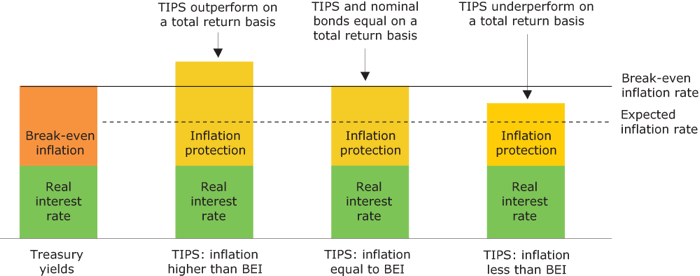
Both have interest that both linked to inflation and is exempt from state/local taxes. You should compare the fixed rate from I Bonds with the current real rate in the TIPS market. Things that might make I Bonds more attractive than TIPS include the tax-deferral ability and the ability to avoid taxes when spent on qualified educational expenses. Things that might makes TIPS more attractive are the intra-day liquidity at all times and the ability to buy unlimited amounts via your choice of broker.
I own both TIPS and I Bonds in my personal portfolio. Inflation-protected bonds are part of my chosen asset allocation, and I prefer to use a lot of my tax-deferred account space for REITs. Series I Bonds allow me to own inflation-linked bonds in effectively a tax-deferred manner. I may also be able to use the interest tax-free for educational expenses as I have three young kids with 12-16 years to go before college.


 After my last
 Chase just announced a new free stock trade program as part of a new online brokerage arm called You Invest. This means another megabank is moving more heavily into “relationship banking” where they hope you will keep your bank accounts, credit cards, brokerage accounts, and mortgage all at the same place. This is pretty significant as JP Morgan Chase is the largest US bank in terms of both market value and total customers (over 60 million).
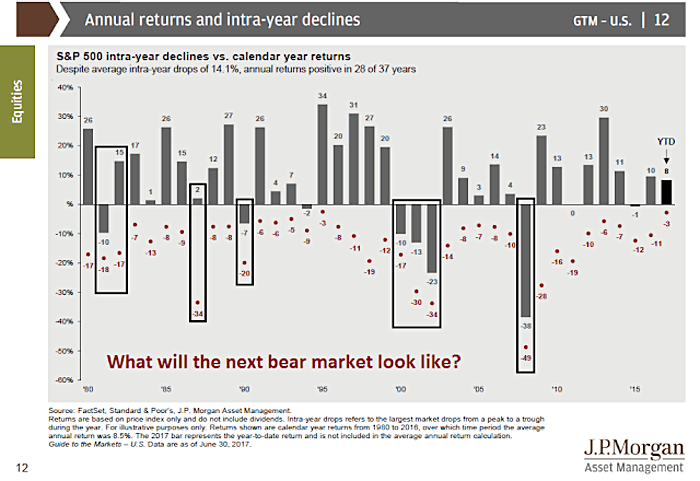
 When it comes to constructing a portfolio, I used to think it was all about numbers and optimization. When you pick an asset class based on historical data, that assumes you hold through both the good times and the really bad times. It has helped me to keep gathering nuggets of knowledge over time to maintain my faith during those really bad times.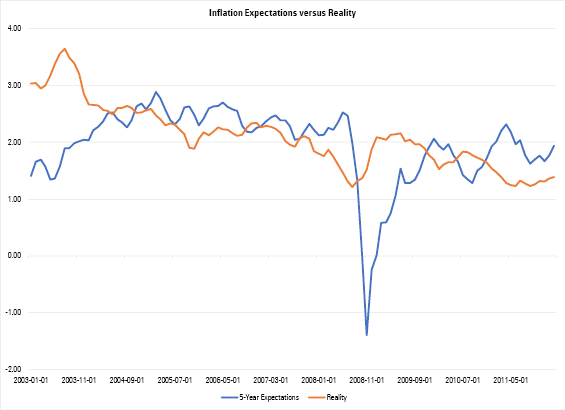
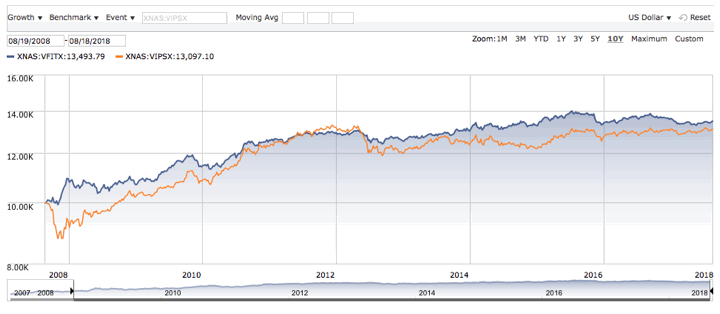
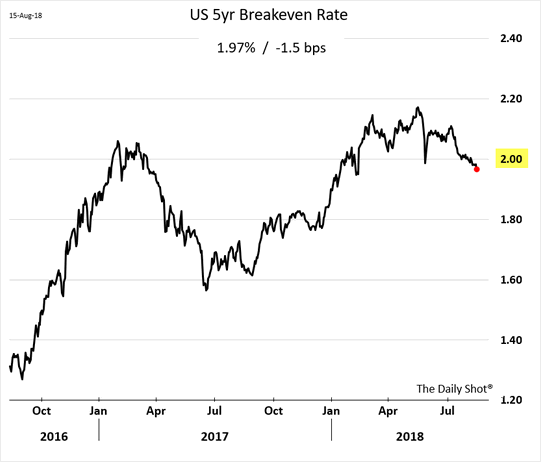
 I was surprised to read the NY Times article
 If you own bond mutual funds or ETFs, the most popular benchmark is the Bloomberg Barclays Aggregate Bond Index (AGG), which basically tracks all U.S. taxable investment-grade bonds, including US Treasury government bonds, investment-grade corporates, mortgage-backed bonds, and other asset-backed securities. The largest bond fund in the world is the
 Fidelity Investments
  Maybe folks are worried about the yield curve, maybe it’s the political drama, or maybe they just feel it in their bones – I’ve been getting more questions about if I think now is still a good time to invest.

 Like many others, I had a vague goal of $1 million net worth in my 20s. It’s easy to find a theoretical path a million. For example, $750 per month earning 8% returns for 30 years with get you there. Doing the actual earning, saving and investing is the hard part. It gets even harder during a bear market when your money feels like it is burning up in flames.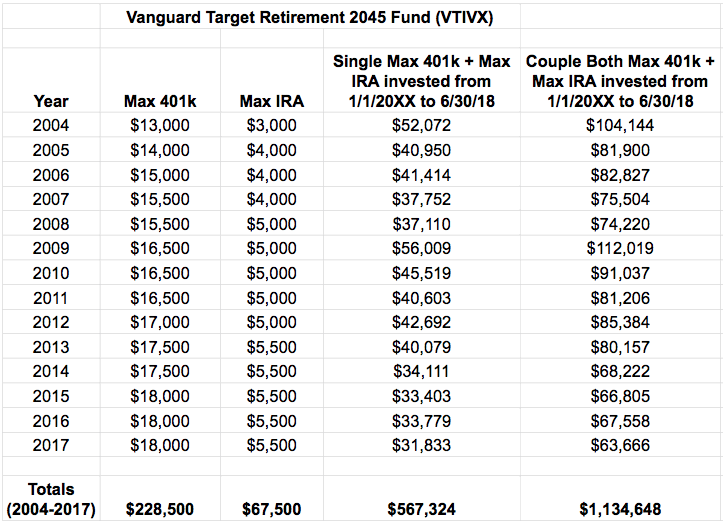
 The Best Credit Card Bonus Offers – 2025
 Big List of Free Stocks from Brokerage Apps
 Best Interest Rates on Cash - 2025
 Free Credit Scores x 3 + Free Credit Monitoring
 Best No Fee 0% APR Balance Transfer Offers
 Little-Known Cellular Data Plans That Can Save Big Money
 How To Haggle Your Cable or Direct TV Bill
 Big List of Free Consumer Data Reports (Credit, Rent, Work)