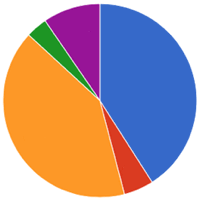
Here’s my quarterly portfolio update for Q2 2018. These are my real-world holdings and includes 401k/403b/IRAs and taxable brokerage accounts but excludes our house, cash reserves, and a few side investments. The goal of this portfolio is to create enough income to cover our regular household expenses. As of 2018, we are “semi-retired” and spending some of the dividends and interest from this portfolio.
Actual Asset Allocation and Holdings
I use both Personal Capital and a custom Google Spreadsheet to track my investment holdings. The Personal Capital financial tracking app (free, my review) automatically logs into my accounts, tracks my balances, calculates my performance, and gives me a rough asset allocation. I still use my custom Rebalancing Spreadsheet (free, instructions) because it tells me where and how much I need to direct new money to rebalance back towards my target asset allocation.
Here is my portfolio performance for the year and rough asset allocation (real estate is under alternatives), according to Personal Capital:


Here is my more specific asset allocation, according to my custom spreadsheet:

Stock Holdings
Vanguard Total Stock Market Fund (VTI, VTSMX, VTSAX)
Vanguard Total International Stock Market Fund (VXUS, VGTSX, VTIAX)
WisdomTree SmallCap Dividend ETF (DES)
Vanguard Small Value ETF (VBR)
Vanguard Emerging Markets ETF (VWO)
Vanguard REIT Index Fund (VNQ, VGSIX, VGSLX)
Bond Holdings
Vanguard Limited-Term Tax-Exempt Fund (VMLTX, VMLUX)
Vanguard Intermediate-Term Tax-Exempt Fund (VWITX, VWIUX)
Vanguard High-Yield Tax-Exempt Fund (VWAHX, VWALX)
Vanguard Inflation-Protected Securities Fund (VIPSX, VAIPX)
iShares Barclays TIPS Bond ETF (TIP)
Individual TIPS securities
U.S. Savings Bonds (Series I)
Target Asset Allocation. Our overall goal is to include asset classes that will provide long-term returns above inflation, distribute income via dividends and interest, and finally offer some historical tendencies to balance each other out. I personally believe that US Small Value and Emerging Markets will have higher future long-term returns (along with some higher volatility) than US Large/Total and International Large/Total, although I could be wrong. I don’t hold commodities, gold, or bitcoin as they don’t provide any income and I don’t believe they’ll outpace inflation significantly.
I think it’s important to imagine an asset class doing poorly for a long time, with bad news constantly surround it, and only hold the ones where you still think you can maintain faith.
Stocks Breakdown
- 38% US Total Market
- 7% US Small-Cap Value
- 38% International Total Market
- 7% Emerging Markets
- 10% US Real Estate (REIT)
Bonds Breakdown
- 50% High-quality, Intermediate-Term Bonds
- 50% US Treasury Inflation-Protected Bonds
I have settled into a long-term target ratio of 67% stocks and 33% bonds (2:1 ratio) within our investment strategy of buy, hold, and occasionally rebalance. With a self-managed, simple portfolio of low-cost funds, we minimize management fees, commissions, and taxes.
Real-world asset allocation details. No major changes from the last quarterly update. For both simplicity and cost reasons, I am no longer buying DES/DGS and will be phasing them out whenever there are tax-loss harvesting opportunities. New money is going into the more “vanilla” Vanguard versions: Vanguard Small Value ETF (VBR) and Vanguard Emerging Markets ETF (VWO).
My taxable muni bonds are split roughly evenly between the three Vanguard muni funds with an average duration of 4.5 years. I am still pondering going back to US Treasuries due to changes in relative interest rates and our marginal income tax rate. Issues with high-quality muni bonds are unlikely, but still a bit more likely than US Treasuries.
The stock/bond split is currently at 70% stocks/30% bonds. Once a quarter, I reinvest any accumulated dividends and interest that were not spent. I don’t use automatic dividend reinvestment. Looks like we need to buy more bonds and emerging markets stocks.
Performance and commentary. According to Personal Capital, my portfolio has basically broken even so far in 2018 (+1.5% YTD). I see that during the same period the S&P 500 has gained 6.5% (excludes dividends) and the US Aggregate bond index lost 1.7%. My portfolio is relatively heavy in international stocks which have done worse than US stocks so far this year.
An alternative benchmark for my portfolio is 50% Vanguard LifeStrategy Growth Fund (VASGX) and 50% Vanguard LifeStrategy Moderate Growth Fund (VSMGX), one is 60/40 and one is 80/20 so it also works out to 70% stocks and 30% bonds. That benchmark would have a total return of +2.8% YTD (as of 7/25/18).
As usual, I’ll share about more about the income aspect in a separate post.
 Vanguard recently released How America Saves 2018 report [PDF], which looks at the nearly 5 million 401k, 403b, and other defined-contribution retirement plans that they service. If you are curious about how your 401k stats compare with others, there is a great deal of information in this report. Here are a few quick stats based on 2017 data:
 I can’t recall the exact source or quote, but I read something along the lines of this in a forum recently:

 T. Rowe Price has a brochure The Benefit of Saving Regularly For Retirement [pdf] which has the common advice that you target saving at least 15% of your gross income each year to prepare for retirement. Of course, the earlier you start, the better. The added wrinkle here is that they offer an alternative route if you find 15% a stretch when you are young.
 Vanguard made a splash last week when it announced that it will offer commission-free trades on all ETFs in it brokerage accounts. Vanguard ETFs had been free to trade already. Starting in August, they will add nearly 1,800 ETFs from competitors including Blackrock (iShares), Schwab, State Street (SPDR), Powershares, WisdomTree, etc. Also see
  Every time a large corporation stumbles, you will see something along these lines:
  If you have researched retirement at all (early or otherwise), you’ve probably ran across various retirement calculators online. You input how much money you have (or plan to have), your asset allocation, and it spits out some numbers. This


 Should a person who retires at age 70 withdraw the same amount of money from their portfolio as someone who is age 40? You’re talking about a retirement period that is likely twice as long as the other. In an article titled
  When it comes to making your portfolio last a lifetime, you may be surprised at how long that might be. According to this Vanguard longevity tool, for a couple both age 40 today, there is a 50% chance that one will live to 88. That’s 48 years.
 Here’s an interactive “game” at


 The
The 
 The Best Credit Card Bonus Offers – 2025
 Big List of Free Stocks from Brokerage Apps
 Best Interest Rates on Cash - 2025
 Free Credit Scores x 3 + Free Credit Monitoring
 Best No Fee 0% APR Balance Transfer Offers
 Little-Known Cellular Data Plans That Can Save Big Money
 How To Haggle Your Cable or Direct TV Bill
 Big List of Free Consumer Data Reports (Credit, Rent, Work)