Principles by Ray Dalio – YouTube Summary For Short Attention Spans

dalioPrinciples: Life and Work by Ray Dalio is a bestselling book by the billionaire investor and founder of Bridgewater Associates. The book outlines both his personal development and investment philosophies and has been on my reading list for a while. If you’re like me and haven’t quite gotten around to reading it, you might be in luck.

Mr. Dalio just released a series of animated YouTube videos where he breaks down his “Principles for Success” into 8 videos at about 4 minutes each. Instead of reading a review or even paying for an “executive summary”, you can get a 30-minute version straight from the source. Here’s the trailer (embedded below) and first episode:

The YouTube channel also contains a few other longer videos dealing with the book content.

Barron’s Best Stock Brokerage Rankings 2018

barrons2018Barron’s has released their 2018 online broker rankings. The considerations include trading experience/technology, usability, mobile trading, range of offerings, research tools, customer service, and cost.

The Barron’s list always comes from the perspective of their subscriber base – high-net-worth active investors – which may or may not describe you. The overall winner this year was Interactive Brokers. Last year’s winner Fidelity Investments was pushed back to #2. Thankfully, Barron’s also supplied separate rankings for novice investors, long-term investors, and those that value in-person service:

Top 5 Brokers for Novice Investors

  1. TD Ameritrade.
  2. Fidelity
  3. Merrill Edge
  4. Charles Schwab
  5. Ally Invest

Top 5 Brokers for Long-Term Investing

  1. TD Ameritrade.
  2. Fidelity
  3. Charles Schwab
  4. Merrill Edge
  5. E-Trade

Top 5 Brokers for In-Person Service

  1. Merrill Edge.
  2. Charles Schwab
  3. Fidelity
  4. TD Ameritrade
  5. E-Trade

Commentary. A few thoughts on the rankings and other overlooked brokers:

Interactive Brokers is hard to argue against for very active traders. Their average account made 476 trades last year! However, they have a minimum commission of $10 a month for accounts under $100,000, or a minimum commission of $20/month under $2,000. You must pay them $120/$240 a year no matter what. That doesn’t work out for me, as some months I don’t trade at all. IB is not for newbies.

TD Ameritrade recently showed a lack of commitment to their commission-free ETF list and went for quantity over quality. The free ETF list is still decent, but that move didn’t scream “long-term” in my book. I think the customer service is solid, and some people may feel better knowing that they merged with Scottrade and their physical branch network. (E*Trade ate OptionsHouse. Schwab ate OptionsXpress. TD Ameritrade ate Scottrade. Ally ate TradeKing, now Ally Invest.)

Vanguard was included this year for the first time in recent memory, and they were promptly knocked to the bottom for being the most expensive broker due to their high trading costs on non-Vanguard ETFs and mutual funds. Vanguard doesn’t court active traders, and active traders probably won’t like it at Vanguard.

Robinhood was ignored again this year, despite the fact they have free trades and recently added a web interface for trading and free options trading. They probably would have also ranked low due to limited feature set.

M1 Finance is another free investing app that just popped on my radar. It lets you pick a customized basket of individual stocks (or ETFs) and then lets you buy them with zero commission. I used to worry that Robinhood was alone, but now there is competition. Maybe Barron’s will notice one day.

I keep most of my long-term assets directly at Vanguard along with a Solo 401k at Fidelity. My (much more modest) individual stock trading is done through Merrill Edge. I’m happy with them so far. If you have $50,000 in assets across Merrill Lynch, Merrill Edge, and Bank of America accounts, you get 30 free trades per month. That’s already more trades than I need, but $100k in combined assets gets you 100 free trades per month.

Disclosure: I am now an affiliate of M1 Finance and TD Ameritrade, and may be compensated if you click through my referral link and open a new account. I am not an affiliate of Interactive Brokers, Fidelity, Merrill Edge, or Vanguard.

Savings I Bonds May 2018 Interest Rate: 2.22% Inflation Rate, 0.30% Fixed Rate

sb_poster

Update 5/1/18. The fixed rate will be 0.30% for I bonds issued from May 1, 2018 through October 31, 2018. The variable inflation-indexed rate for this 6-month period will be 2.22% (as was predicted). The total rate on any specific bond is the sum of the fixed and variable rates, changing every 6 months. If you buy a new bond in May 2018, you’ll get 2.52% for the first 6 months. Not bad. See you again in mid-October 2018 for the next early prediction.

Original post 4/11/18:

Savings I Bonds are a unique, low-risk investment backed by the US Treasury that pay out a variable interest rate linked to inflation. You could own them as a replacement for cash reserves (they are liquid after 12 months) or bonds in your portfolio.

New inflation numbers were just announced at BLS.gov, which allows us to make an early prediction of the May 2018 savings bond rates a couple of weeks before the official announcement on the 1st. This also allows the opportunity to know exactly what a April 2018 savings bond purchase will yield over the next 12 months, instead of just 6 months.

New inflation rate prediction. September 2017 CPI-U was 246.819. March 2018 was 249.554, for a semi-annual increase of 1.11%. Using the official formula, the variable component of interest rate for the next 6 month cycle will be 2.22%. You add the fixed and variable rates to get the total interest rate. If you have an older savings bond, your fixed rate may be very different than one from recent years.

Tips on purchase and redemption. You can’t redeem until 12 months have gone by, and any redemptions within 5 years incur an interest penalty of the last 3 months of interest. A known “trick” with I-Bonds is that if you buy at the end of the month, you’ll still get all the interest for the entire month as if you bought it in the beginning of the month. It’s best to give yourself a few business days of buffer time. If you miss the cutoff, your effective purchase date will be bumped into the next month.

Buying in April 2018. If you buy before the end of April, the fixed rate portion of I-Bonds will be 0.1%. You will be guaranteed a total interest rate of 2.58% for the next 6 months (0.10 + 2.48). For the 6 months after that, the total rate will be 0.10 + 2.22 = 2.32%.

Let’s look at a worst-case scenario, where you hold for the minimum of one year and pay the 3-month interest penalty. If you theoretically buy on April 30th, 2018 and sell on April 1, 2019, you’ll earn a ~2.04% annualized return for an 11-month holding period, for which the interest is also exempt from state income taxes. If you held for three months longer, you’d be looking at a ~2.10% annualized return for a 14-month holding period (assuming my math is correct). Compare with the best interest rates as of April 2018.

Buying in May 2018. If you buy in May 2018, you will get 2.22% plus a newly-set fixed rate for the first 6 months. The new fixed rate is unknown, but is loosely linked to the real yield of short-term TIPS, which has been rising a bit. The current real yield of 5-year TIPS is ~0.56%. My best guess is that it will be 0.20% or 0.30%. Every six months, your rate will adjust to your fixed rate (set at purchase) plus a variable rate based on inflation.

If you have an existing I-Bond, the rates reset every 6 months depending on your purchase month. Your bond rate = your specific fixed rate (set at purchase) + variable rate (minimum floor of 0%).

So, which one? Buying in April 2018 would lock in a 11-14 month return equal to the top 12-month CD rates, which isn’t bad (plus the interest is exempt from state and local income taxes). If inflation picks up in the next year, you could still keep the bond and have potential upside. I would choose this option if I was treating savings bonds as short-term CD alternatives. However, if you buy in May 2018, your (real) fixed rate may be higher. This helps in the long run if you intend to keep these savings bonds indefinitely. I am a long-term holder (see below), so I am waiting until May.

Unique features. Due to their annual purchase limits, you should still consider their unique advantages before redeeming them. These include ongoing tax deferral (you don’t owe tax until redemption), exemption from state income taxes, and being a hedge against inflation (and even a bit of a hedge against deflation). There are also potential benefits when using the proceeds for college.

Over the years, I have accumulated a nice pile of I-Bonds and now consider it part of the inflation-linked bond allocation inside my long-term investment portfolio.

Annual purchase limits. The annual purchase limit is now $10,000 in online I-bonds per Social Security Number. For a couple, that’s $20,000 per year. Buy online at TreasuryDirect.gov, after making sure you’re okay with their security protocols and user-friendliness. You can also buy an additional $5,000 in paper bonds using your tax refund with IRS Form 8888. If you have children, you may be able to buy additional savings bonds by using a minor’s Social Security Number.

For more background, see the rest of my posts on savings bonds.

[Image: 1946 Savings Bond poster from US Treasury – source]

Betterment Review: Customized Asset Allocation, Human Financial Advisors

bment1707_0Updated April 2018 with custom ETF allocations. Betterment is an independent hybrid digital/human advisor that will manage a diversified mix of low-cost index funds and help you decide how much you’ll need to save for retirement. (By independent, I mean that they are not tied to a specific brand of funds like Vanguard or Schwab). Betterment is also an RIA, which means they have a legal fiduciary duty to keep client interests first. They frequently announce new features and improvements, so I will work to keep this feature list updated.

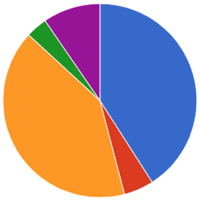
Diversified portfolio of high-quality, low-cost ETFs. Their portfolios are a diversified mix of several asset classes including: US Total, US Large Value, US Mid Value, US Small Value, International Developed, Emerging Markets, US Corporate Bonds, US Total Bond, Inflation-Protected Treasuries, Muni Bonds, International Bonds, and Emerging Market Bonds. For the most part, Vanguard and iShares ETFs are used.

The traditional Betterment portfolio has a more pronounced tilt towards the size premium and value premium than the cap-weighted indexes. You could argue the finer points of whether this will really create higher risk-adjusted returns, but overall it is backed by academic research. Betterment has also added a Socially Responsible Investing (SRI) portfolio option.

In April 2018, Betterment added Flexible Portfolios which lets you manually adjust the percentages of each asset class. As a DIY investor with assets spread across multiple accounts, this customization has been something I’ve been waiting for. This option is currently available only to clients with $100,000+ in assets.

betterment_flex

Both the SRI and Flexible Portfolio options will work with Tax Loss Harvesting and Tax Coordination features (see below).

Free access to human advice for everyone. In July 2017, Betterment announced that all of their customers can message a licensed financial experts. Digital members (0.25% annual fee) can ask questions any time via their mobile app. Digital members should expect an answer in approximately one business day. Betterment Premium members (0.40% annual fee) have unlimited e-mail and direct phone access to “Certified Financial Planner professionals”. From their press release:

Our experts can assist with deciding which funds to move to Betterment, setting goals (like saving for college, a house, or retirement), and identifying which Betterment tax features may be right. They can also help you make important investment decisions, like choosing risk levels, amounts to invest, and types of accounts.

Reading between the lines, Digital members get “licensed financial experts” while Premium members get “Certified Financial Planner professionals”. This suggests that while Digital members will still get fiduciary (client-first) advice, Premium members will get priority access to the more-experienced advisors in exchange for paying their higher fee.

bment1707

Retirement planning software with external account balances. RetireGuide is Betterment’s retirement planning software, first launched in April 2015. This service links your external accounts from other banks, brokerages, and 401k plans (similar to Mint and Personal Capital) in order to see your balances without having to manually input them. According to their methodology guide [pdf], they don’t analyze your transactions to estimate savings rate, they are just pulling in balances.

Example questions: How much do I have invested elsewhere? Am I saving enough money? How much estimated income will I have in retirement? Your future Social Security income is estimated for your based on your chosen retirement age and birthdate. You can change many of the variables as you like.

Account types. Betterment now supports taxable joint accounts, trust accounts, 401k rollovers, Traditional IRAs, Roth IRAs, SEP IRAs, and Inherited IRAs.

Tax-efficent asset location. Tax-Coordinated Portfolio will place different asset classes in your taxable accounts vs. tax-deferred accounts (IRAs, 401ks) for a higher after-tax return. In addition, if you have multiple types of accounts at Betterment (i.e. both IRA and taxable), it will manage multiple accounts as a single portfolio, placing assets that are taxed more into more favorably taxed accounts (like IRAs). Note that this only works across accounts that are held at Betterment. It does not adjust for non-Betterment accounts. This is called their Tax-Coordinated Portfolio (TCP).

Use dividends and new contributions to rebalance. They will use your dividends and new contributions to rebalance your asset classes in order to minimize sells and thus minimize capital gains.

Daily tax-loss harvesting. Betterment’s Tax-loss Harvesting+ (TLH+) software monitors your holdings daily and attempts to find opportunities to harvest tax losses by switching between “similar but not substantially identical” ETFs. If you can delay paying taxes and reinvest them, this can result in a greater after-tax return. The exact “tax alpha” of this practice depends on multiple factors like portfolio size and tax brackets. You can read the Betterment side of things in their whitepaper. Here is an outside viewpoint arguing for more conservative estimates.

My opinion is that there is long-term value in tax-loss harvesting and especially daily monitoring to capture more losses. However, I also think it’s wise to use a conservative assumption as to the size of that value. (DIY investors can perform their own tax-loss harvesting as well on a less-frequent basis. I do it myself, but it’s rather tedious and I’m definitely not doing it more often than once a year. I would gladly leave it to the bots if it was cheap enough.)

Invest your excess cash automatically. Automatic contributions are good, but perhaps you don’t want to commit to a set amount each month. (Ideally, you do commit to a set amount, and this service invests more money on top of that.) Called SmartDeposit, you link your checking account and choose your Checking Account Ceiling and Max Deposit amount. If your checking account balance goes above the ceiling, Betterment will automatically sweep over money and invest it for you. Betterment will account for future scheduled deposits so you don’t over-contribute.

Fee schedule. Betterment has a fee structure with two tiers.

  • Betterment Digital. No minimum balance. Digital portfolio management and guidance. Unlimited access to “licensed financial experts” via mobile app with ~1 business day turnaround time. Flat fee of 0.25% of assets annually. The management fee on any assets over $2 million is waived.
  • Betterment Premium. $100,000 minimum balance. Digital portfolio management and guidance. Unlimited access to “CFP professionals” financial experts” via e-mail or phone. Includes more in-depth advice on investments outside of Betterment. Flat fee of 0.40% of assets annually. The management fee on any assets over $2 million is waived.

In my opinion, the main concern of any outside advisor is the same: you are handing over control to someone else. Betterment could change their investment philosophy, their pricing structure, and feature set in the future. Digital advisors are constantly changing, and some of their new features could be great or it could just be a fad.

Bottom line. Betterment is an independent digital advisory firm with nearly $10 billion in assets, which means they aren’t tied to any specific brand of funds like Vanguard, Fidelity, or Schwab. Their main differentiators from the other independent firms (see my Wealthfront review) are (1) access to human advice available to all customers and now (2) the ability to customize your target asset allocation ($100k+ in assets). Other notable features include: Retirement planning software that syncs with external accounts, tax-loss harvesting, tax-coordinated portfolios (when you have both IRA/401k and taxable at Betterment), and SmartDeposit which automatically invests excess cash from your checking account.

Reader Question: Tracking Asset Allocation Across Multiple Investment Accounts

portpie_blank200Here’s a reader question regarding my most recent portfolio asset allocation update. It has been edited for clarity and to remove personal details by request:

Thank you for posting the quarterly finance updates. I would like to do something similar to track the returns by asset class but unfortunately, I have my funds across multiple accounts. Some of my funds are in Roth, Rollover IRA and a 401k from current employer. My wife has her funds in similar retirement accounts. How do I consolidate all my investment funds to get a holistic view and correct asset allocation? Also, how do I get Vanguard funds when my 401k options are limited?

First of all, everything may look neater in my updates, but I also have my funds spread across multiple accounts. My wife and I have funds spread across Roth IRA, Traditional IRA (at least temporarily), 401k/403b, Self-Employed 401(k), taxable brokerage accounts, savings bonds, and bank CDs.

Here are the details on how I do my quarterly update.

1803_pc2b

  1. I pull up my custom Google Spreadsheet and make a fresh duplicate of the most recent worksheet. I change the label to a brief datestamp so the labels aren’t too wide. “17.12” indicates December 2017, “1803” indicates March 2018, and so on. I keep all my old snapshots as tabs. This is handy because I can go back and remember what my portfolio looked like back in March 2009, for example.
  2. I log into each individual account one-by-one directly at the provider website. I could use an aggregator, but I do this just to make sure my addresses/passwords are correct in my trusty password manager and everything looks right. No new sub-accounts, no errors, new secure messages, etc. I pull up my holdings and type in the balances manually into the proper asset class cell. The spreadsheet adds them up.
  3. For most of my funds, the asset class is readily available. For example, I know that the Vanguard Emerging Markets Stock Index fund is going under “Emerging Markets”. If you aren’t sure or if the fund includes multiple asset classes (Target Retirement fund, LifeCycle fund, etc), you can either use a service like Personal Capital (free registration required) for a quick-and-easy analysis or Morningstar X-Ray (free TRP registration required) for a manual-but-deeper analysis.
  4. For the most part, the spreadsheet does the rest. The pie charts automatically update to show me my overall holistic breakdown. It shows me how far off I am from my target values, both in terms of percentage and dollar amounts.

trackaa1

When your 401k options are limited, here’s how I would pick the best choice available. I would start by narrowing it down to the cheapest index funds available. Look at all the expense ratios. These days, at least one should be under 0.30%. You can verify using the ticker symbol on Morningstar. For example, for a while my best 401k option was a proprietary S&P 500 index fund. So I bought that, and adjusted my holdings elsewhere. Later on, they added Vanguard Total International Stock index fund and a Schwab brokerage window. There are probably 10-15 other funds on the menu that I have no interest in owning. A Target fund might be the most reasonable choice. Remember to roll your 401k over to an IRA when you switch employers.

Firstrade Commission-Free ETF Program Review – Includes Vanguard, iShares Core, Schwab Index ETFs

firstradefree1

Online brokerage Firstrade just announced a new Commisssion-Free ETF program that includes 700+ ETFs from 40 fund families. This is a bold move as it includes both a lot of ETFs (quantity) but also the best ETFs (quality) from providers like Vanguard, iShares, WisdomTree, SPDR State Trust, and Schwab.

Firstrade already cut their standard trade commission to $2.95 per trade in 2017. The program is designed for long-term investors and the ETFs must be held for at least 30 days (if less than 30 days, the commission is the standard $2.95). Leveraged ETFs are not included. There is no need for any special enrollment for this ETF program.

Low-cost, broadly-diversified ETFS across major asset classes. Here is a partial list of ETFs that I noticed:

Vanguard (52 ETFs total)

  • Vanguard S&P 500 ETF (VOO)
  • Vanguard Total International Stock ETF (VXUS)
  • Vanguard Dividend Appreciation ETF (VIG)
  • Vanguard Small-Cap Value ETF (VBR)
  • Vanguard FTSE Developed Markets ETF (VEA)
  • Vanguard FTSE All-Wld ex-US ETF (VEU)
  • Vanguard Global ex-US Real Est ETF (VNQI)
  • Vanguard FTSE Emerging Markets ETF (VWO)
  • Vanguard Short-Term Infl-Prot Secs ETF (VTIP)
  • Vanguard Total International Bond ETF (BNDX)

Notably absent: Vanguard Total Stock Market ETF (VTI)

iShares (173 ETFs total)

  • iShares Core S&P Total US Stock Mkt ETF (ITOT)
  • iShares Core S&P 500 ETF (IVV)
  • iShares Core MSCI Total Intl Stk ETF (IXUS)
  • iShares Core US REIT ETF (USRT)
  • iShares Core MSCI EAFE ETF (IEFA)
  • iShares Core MSCI Emerging Markets ETF (IEMG)
  • iShares Core Dividend Growth ETF (DGRO)
  • iShares Core US Aggregate Bond ETF (AGG)
  • iShares Core International Aggt Bd ETF (IAGG)
  • iShares Short Maturity Bond ETF (NEAR)

Schwab (20 ETFs total)

  • Schwab US Broad Market ETF (SCHB)
  • Schwab US Dividend Equity ETF (SCHD)
  • Schwab Emerging Markets Equity ETF (SCHE)
  • Schwab International Equity ETF (SCHF)
  • Schwab US REIT ETF (SCHH)
  • Schwab US TIPS ETF (SCHP)
  • Schwab US Aggregate Bond ETF (SCHZ)

With this move, they take the title of “Largest Commission-Free ETF Program” from TD Ameritrade. Here’s their comparison chart.

firstradefree2

My take. Overall, competition is good and I always like to see lower prices for long-term ETF investors. Additional considerations:

  • Sustainable? This list is very similar to what TD Ameritrade used to offer commission-free, at least in terms of offering the most popular ETFs. However, TD Ameritrade eventually went for quantity over quality, dropping most of their widely-held ETFs and replacing them with niche ETFs and index ETFs from SPDR. One can only assume this is a loss-leader offering for Firstrade. Will it last?
  • Truly simple portfolios can just stick to the source. If you really want to construct a simple portfolio, you can open an account at Vanguard, Fidelity (iShares), and Schwab and buy ETFs (limited to their family) with no commission. The benefit is that in-house discounts are much more likely to stay free.
  • Tax-loss harvesting. A potential benefit of using a brokerage account is if you do tax-loss harvesting with ETFs. For example, you could sell iShares Core S&P Total US Stock Mkt ETF (ITOT) and buy Schwab US Broad Market ETF (SCHB), all commission-free and in the same account. With the big list above, ETF pairing for almost every asset class are available.

New account promotions. Firstrade is also offering the following new account cash + free trades promotions based on opening deposit. You can get up to $300 cash and 500 free trades. They will also cover up to $200 in account transfer fees when you switch from another broker and $25 in wire fees when you wire money to Firstrade.

Bottom line. Firstrade has a new Commisssion-Free ETF program that offers both quantity (700+ ETFs from 40 fund families) and quality (top-rated and popular ETFs from Vanguard, iShares, and others) for long-term investors (30-day minimum holding period). The standard commission on other stocks and ETFs is $2.95. This sure looks nice, but I hope it is sustainable. We recently saw TD Ameritrade cut back on their Commisssion-Free ETF program.

My Money Blog Portfolio Asset Allocation, March 2018

portpie_blank200

Here is a First Quarter 2018 update for my primary investment portfolio. These are my real-world holdings, not a recommendation. It includes tax-deferred 401k/403b/IRAs and taxable brokerage accounts and excludes our primary home, cash reserves, and a few side investments. The goal of this portfolio is to create enough income to cover our regular household expenses. As of 2018, we have started the phase of “early retirement” where we are spending some of the dividends and interest from this portfolio.

Actual Asset Allocation and Holdings

I use both Personal Capital and a custom Google Spreadsheet to track my investment holdings. The Personal Capital financial tracking app (free, my review) automatically logs into my accounts, tracks my balances, calculates my performance, and gives me a rough asset allocation. I still use my custom Rebalancing Spreadsheet (free, instructions) because it tells me where and how much I need to direct new money to rebalance back towards my target asset allocation.

Here is my portfolio performance for the year and rough asset allocation (real estate is under alternatives), according to Personal Capital:

1803_pc1b

1803_pc2b

Here is my more specific asset allocation, according to my custom spreadsheet:

1803_spread1

Stock Holdings
Vanguard Total Stock Market Fund (VTI, VTSMX, VTSAX)
Vanguard Total International Stock Market Fund (VXUS, VGTSX, VTIAX)
WisdomTree SmallCap Dividend ETF (DES)
WisdomTree Emerging Markets SmallCap Dividend ETF (DGS)
Vanguard Small Value ETF (VBR)
Vanguard Emerging Markets ETF (VWO)
Vanguard REIT Index Fund (VNQ, VGSIX, VGSLX)

Bond Holdings
Vanguard Limited-Term Tax-Exempt Fund (VMLTX, VMLUX)
Vanguard Intermediate-Term Tax-Exempt Fund (VWITX, VWIUX)
Vanguard High-Yield Tax-Exempt Fund (VWAHX, VWALX)
Vanguard Inflation-Protected Securities Fund (VIPSX, VAIPX)
iShares Barclays TIPS Bond ETF (TIP)
Individual TIPS securities
U.S. Savings Bonds (Series I)

Target Asset Allocation. Our overall goal is to include asset classes that will provide long-term returns above inflation, distribute income via dividends and interest, and finally offer some historical tendencies to balance each other out. I personally believe that US Small Value and Emerging Market will have higher future long-term returns (along with some higher volatility) than US Large/Total and International Large/Total, although I could be wrong. I don’t hold commodities futures or gold (or bitcoin) as they don’t provide any income and I don’t believe they’ll outpace inflation significantly. I also try to imagine each asset class doing poorly for a long time, and only hold the ones where I think I can maintain faith.

Stocks Breakdown

  • 38% US Total Market
  • 7% US Small-Cap Value
  • 38% International Total Market
  • 7% Emerging Markets
  • 10% US Real Estate (REIT)

Bonds Breakdown

  • 50% High-quality, Intermediate-Term Bonds
  • 50% US Treasury Inflation-Protected Bonds

I have settled into a long-term target ratio is 67% stocks and 33% bonds (2:1 ratio) within our investment strategy of buy, hold, and rebalance. With a self-managed, simple portfolio of low-cost funds, we minimize management fees, commissions, and income taxes.

Real-world asset allocation details. For both simplicity and cost reasons, I am no longer buying DES/DGS and will be phasing them out whenever there are tax-loss harvesting opportunities. New money is going into the more “vanilla” Vanguard versions: Vanguard Small Value ETF (VBR) and Vanguard Emerging Markets ETF (VWO).

I’m still a bit underweight in TIPS and REITs mostly due to limited tax-deferred space as I don’t want to hold them in a taxable account. My taxable muni bonds are split roughly evenly between the three Vanguard muni funds with an average duration of 4.5 years. I have been seriously thinking of going back to US Treasuries due to changes in relative interest rates and our marginal income tax rate.

My stock/bond split is currently at 69% stocks/31% bonds. I continue to invest new money on a monthly basis in order to maintain the target ratios. Once a quarter, I also reinvest any accumulated dividends and interest that we did not spend. I don’t use automatic dividend reinvestment. First of all, we spend some of our dividends now. In addition, I can usually avoid creating any taxable transactions unless markets are really volatile.

Performance and commentary. According to Personal Capital, my portfolio has basically broken even so far in 2018 (-0.70% YTD). I see that during the same period the S&P 500 has lost 0.63% (excludes dividends) and the US Aggregate bond index has actually lost 1.55%.

An alternative benchmark for my portfolio is 50% Vanguard LifeStrategy Growth Fund (VASGX) and 50% Vanguard LifeStrategy Moderate Growth Fund (VSMGX), one is 60/40 and one is 80/20 so it also works out to 70% stocks and 30% bonds. That benchmark would have a total return of -0.98% YTD (as of 4/9/18).

In a separate post, I’ll share about more about the income aspect.

Graphic: The Fall of Pensions, The “Rise” of 401ks and IRAs

pension401kIRA

Above is a historical chart of US household retirement assets that helps visualize the shift from mostly pensions to mostly a combination of defined contribution plans (401k, 403b, etc) and IRAs. Pension share has gone from nearly 80% of total assets in the 1980s to about 40% today. The blips upwards in 2001 and 2009 are more a function of stock market drops than anything else. I find it interesting that annuity use is not increasing at all, i.e. people are not creating more “DIY pensions”. Found via WSJ Daily Shot.

Below is a graphic of the percentage of households who have any retirement plan at all, grouped by income percentile. This means it counts any family with one person with any retirement plan of any type with any amount saved. Via Bloomberg article about state-mandated Roth IRAs.

ira_bloomberg

My big-picture concern is – What happens when those who started jobs in the 1980s and 1990s retire in the 2030s and 2040s with no pensions? As shown above, the majority of the lowest-income workers have no retirement plan at all. If you include the highest-paid workers, the average 401(k) at retirement age is currently about $100,000. In contrast, I ran an annuity quote and a pension that pays $50,000 a year inflation-adjusted is roughly the equivalent of having $1,000,000 saved in a 401(k).

More individuals are finding themselves in charge of their own retirement every day, whether they like it or not. This is a very serious responsibility. Warren Buffett has a plaque in his office with the following saying on it:

A fool and his money are soon invited everywhere.

Lots of money floating around means lots of “helpers” will pop up. Big banks. Start-up smartphone apps. Even Overstock.com now wants to help you with investing. Read the Gotrocks parable and beware high-fee helpers.

From Retired Couple Next Door to Lottery-Hacking Millionaires

scratchoffBack in 2011, a Boston Globe article came out about how a few folks repeatedly won tens of thousands of dollars on a Massachusetts lottery ticket game due to how the jackpot rolled over if it went unclaimed long enough. Essentially, at certain times the odds showed a expected positive return for everyone, but you’d have to buy a lot of tickets to even out the chances of bad luck. (This is why folks can win in the short-term in Las Vegas casinos, but the house always wins over a large number of bets.)

Mark Kon, a professor of math and statistics at Boston University, calculated that a bettor buying even $10,000 worth of tickets would run a significant risk of losing more than they won during the July rolldown week. But someone who invested $100,000 in Cash WinFall tickets had a 72 percent chance of winning. Bettors like the Selbees, who spent at least $500,000 on the game, had almost no risk of losing money, Kon said.

The Globe article basically made the bettors out to be villains, the “rich” against the “poor”. This Felix Salmon article argues that the game was fine, as technically everyone had the same odds (rich or poor) and the game actually generated a lot of money for the state. Buying that many tickets also took a lot of work:

As a result, while some people did indeed essentially treat Cash WinFall as a full-time job, it wasn’t necessarily a particularly lucrative or easy job for any given individual: it would take one couple ten hours a day, for ten days, to sort through their tickets to find the winners, the proceeds from which would then be shared among 32 consortium members. On top of that, every member of every consortium could reasonably expect to be audited by the state Department of Revenue every year. Which isn’t exactly fun.

A new HuffPost longform article takes a deeper, more personal look at the retired “couple next door” who discovered the edge and eventually made millions off of it. All that it required was “6th grade math”, according to Jerry and Marge Selbee:

The brochure listed the odds of various correct guesses. Jerry saw that you had a 1-in-54 chance to pick three out of the six numbers in a drawing, winning $5, and a 1-in-1,500 chance to pick four numbers, winning $100. What he now realized, doing some mental arithmetic, was that a player who waited until the roll-down stood to win more than he lost, on average, as long as no player that week picked all six numbers. With the jackpot spilling over, each winning three-number combination would put $50 in the player’s pocket instead of $5, and the four-number winners would pay out $1,000 in prize money instead of $100, and all of a sudden, the odds were in your favor. If no one won the jackpot, Jerry realized, a $1 lottery ticket was worth more than $1 on a roll-down week—statistically speaking.

“I just multiplied it out,” Jerry recalled, “and then I said, ‘Hell, you got a positive return here.’”

How much did they win?

By 2009 they had grossed more than $20 million in winning tickets—a net profit of $5 million after expenses and taxes—but their lifestyle didn’t change. Jerry and Marge remained in the same house, hosting a family gathering each Christmas as they always had. Though she could have chartered a private jet and taken everyone to Ibiza, Marge still ran the kitchen, made her famous toffee candy and washed dishes by hand. It didn’t occur to her to buy a dishwasher.

Would you have done the same thing if you knew about this edge? In my opinion, this is what makes the story fascinating. First, you have to find the inefficiency. Then you have to trust your findings enough to bet on them. You must risk your time and money upfront, throw in some ingenuity, and profit only if you are right. Then you have to bet big enough to make your winnings significant before the edge disappears (and they all eventually do). Putting all those things together is quite difficult. I’d be willing to bet some other people discovered the positive expected return, but still didn’t take the risk.

With Cash WinFall, if you had a knack for math, you could get an edge. If you were willing to spend the money, you could get an edge. If you put in the hours, you could get an edge. And was that so terrible? How was it Jerry’s fault to solve a puzzle that was right there in front of him? How was it Marge’s fault that she was willing to break her back standing at a lottery terminal, printing tickets?

Berkshire Hathaway 2017 Annual Letter by Warren Buffett

brk2016Berkshire Hathaway (BRK) has released its 2017 Letter to Shareholders. Instead of reading various media coverage about one aspect, I recommend reading the entire thing straight from the source. It’s only 17 pages long and (as always) written in a straightforward and approachable fashion. Even if you aren’t interested in BRK stock at all, reading the letter can be educational for individual investors of any experience level. Here are my personal notes with quoted exceprts.

Never use borrowed money to invest (leverage).

Our aversion to leverage has dampened our returns over the years. But Charlie and I sleep well. Both of us believe it is insane to risk what you have and need in order to obtain what you don’t need. We held this view 50 years ago when we each ran an investment partnership, funded by a few friends and relatives who trusted us. We also hold it today after a million or so “partners” have joined us at Berkshire.

There is simply no telling how far stocks can fall in a short period. Even if your borrowings are small and your positions aren’t immediately threatened by the plunging market, your mind may well become rattled by scary headlines and breathless commentary. And an unsettled mind will not make good decisions.

Lack of acquisitions. Berkshire hates paying too much for a company. They are also quite patient. Right now, there are many other competing buyers willing to pay high prices, so that is why their cash hoard keeps growing.

The less the prudence with which others conduct their affairs, the greater the prudence with which we must conduct our own.

Cash (Treasury Bills) is king.

During the 2008-2009 crisis, we liked having Treasury Bills – loads of Treasury Bills – that protected us from having to rely on funding sources such as bank lines or commercial paper. We have intentionally constructed Berkshire in a manner that will allow it to comfortably withstand economic discontinuities, including such extremes as extended market closures.

At yearend Berkshire held $116.0 billion in cash and U.S. Treasury Bills (whose average maturity was 88 days), up from $86.4 billion at yearend 2016. This extraordinary liquidity earns only a pittance and is far beyond the level Charlie and I wish Berkshire to have. Our smiles will broaden when we have redeployed Berkshire’s excess funds into more productive assets.

Be patient.

The light can at any time go from green to red without pausing at yellow.

Wells Fargo and Bank of America stock. If you’re looking for individual stock ideas, many people copycat the holdings of Berkshire Hathaway.

Charlie and I view the marketable common stocks that Berkshire owns as interests in businesses, not as ticker symbols to be bought or sold based on their “chart” patterns, the “target” prices of analysts or the opinions of media pundits.

I would also consider the overlap between the holdings of Berkshire Hathaway and Daily Journal Corporation (Chairman Charles Munger). Both have significant stakes in Wells Fargo and Bank of America in an approximate 3:2 ratio. (Both also own a much smaller amount of US Bancorp.) Keep in mind these are bought for the long run:

Stocks surge and swoon, seemingly untethered to any year-to-year buildup in their underlying value. Over time, however, Ben Graham’s oft-quoted maxim proves true: “In the short run, the market is a voting machine; in the long run, however, it becomes a weighing machine.”

Hedge fund bet. As expected, the S&P 500 index fund won against a group of actively-managed hedge funds, but there were some interesting details in the final results. Something to discuss further in a separate post.

Risk vs. time horizon.

Investing is an activity in which consumption today is foregone in an attempt to allow greater consumption at a later date. “Risk” is the possibility that this objective won’t be attained.

I want to quickly acknowledge that in any upcoming day, week or even year, stocks will be riskier – far riskier – than short-term U.S. bonds. As an investor’s investment horizon lengthens, however, a diversified portfolio of U.S. equities becomes progressively less risky than bonds, assuming that the stocks are purchased at a sensible multiple of earnings relative to then-prevailing interest rates.

Past shareholder letters.

Recent Timeline of Stock Market Corrections

The currently-accepted definition of a “market correction” is a price drop of 10% from its peak. There have now been five corrections to the S&P 500 stock index since the bear market of 2009 (seven if you count the 9.8% and 9.9% drops). Here’s a nice visual timeline from the NY Times.

correct1

Here’s a corresponding list of all the cited reasons from Bloomberg for the corrections and near-corrections.

correct2

If you look at all of those concerns, they all seemed pretty legitimate and scary at the time. The general idea of these articles is that corrections happen regularly, so don’t freak out. Of course, I could also repeat another one of those investing truisms: “A bear market is coming. I’m not saying it’s now… but you know, there will be another bear market in the future.”

This is another item in my big folder of things that are “interesting but not going to change my investment plan”. My plan remains still to buy, hold, rebalance, and keep collecting those dividends and interest payments. David Merkel has a nice summary of how to create a portfolio that allows this hands-off attitude:

[…] my final point is this: size your position in risk assets to the level where you can live with it under bad conditions, and be happy with it under good conditions.

Robinhood App Review: Free Stock Trades, Free Options Trading, No Minimum Balance

robin0

Updated. Robinhood is one of the new wave of brokerage apps. They started with free stocks trades, but have since expanded their suite of services to the following:

  • Free stock and ETF trades. No minimum balance requirement.
  • Free options trading. No commission and no per contract fee, plus no exercise or assignment fees.
  • Free trading of Bitcoin and other cryptocurrencies 24/7.
  • Free share of stock for new users with referral.

Top alternatives to Robinhood.

  • WeBull (free stock bonus). WeBull app is also good for active traders with free stock trades and free options trades, but adds a real customer service phone number where you can talk to a human, as opposed to Robinhood’s email address.
  • SoFi Invest ($75 bonus). SoFi also offers free stock trades and “slices” (fractional shares), along with a sign-up bonus and free tickets to events (SoFi is short for Social Finance).
  • Firstrade. Firstrade includes free trades of mutual funds, which is rare… if that is your thing.

Background. I’ve been Robinhood beta user since mid-2014. I was skeptical as I’ve been an long-time early adopter of free trading platforms (read: cheapskate investor). In August 2015, they rolled out both iOS and Android app and reported processing over 2 million free trades. In 2017, they reached over a million users. In 2017, Bloomberg reported them raising money at a $1.3 billion valuation. In 2020, CNBC reported them raising money at an $8 billion valuation!

Application process. You must provide your personal information including Social Security number, net worth, income, investing experience, etc. This is the same as any other brokerage firm, but this may also be the first such account for many users. Everything was done online; there were no paper documents that required mailing or faxing.

Core features review.

  • Legit. Robinhood Financial is a member of the SIPC which protects the securities in your account up to $500,000. Data is encrypted with SSL. Apex is their clearing firm.
  • $0 commission trades. Yes, it works, all with no minimum balance requirement.
  • Market orders, limit orders, stop limit orders, and stop orders available. Certain orders may be entered as good for the day or good till canceled (GTC).
  • No short-selling.
  • Free options trading: No commission and no per contract fee upon buying or selling options, as well as no exercise or assignment fees. Level 2 self-directed options strategies (buying calls and puts, selling covered calls and puts) as well as Level 3 self-directed options strategies such as fixed-risk spreads (credit spreads, iron condors), and other advanced trading strategies are available.
  • Customer service limitations. The Robinhood customer service phone number is (650) 940-2700 during during market hours (9:30am – 4:00pm EST), however many readers have reported difficulty getting through. (Update: I no longer see any mention of this phone number on their website.) They want you to use their customer service email “support@robinhood.com”. The lack of instant customer service via phone is one major way that Robinhood is not the same as a major brokerage account like Fidelity or Schwab.

Funds transfers. You can manually link any bank account with your routing number and account number, but you can also directly use your username and password at these banks: Chase, Bank of America, Citibank, Wells Fargo, U.S. Bank, Charles Schwab, PNC, Silicon Vally Bank, and USAA. ACH transfers are free and take approximately 3 business days (same as other brokerages). There is also a automatic deposits feature where you can schedule ACH transfers on a weekly, biweekly, monthly, or quarterly basis.

ACAT account transfers. Robinhood now accepts incoming stock transfers from outside brokerage accounts. To do this, go your app account menu, select “Banking”, then select “Stock Transfer” and follow the on-screen instructions. Incoming transfers are free. Outgoing transfers will incur a $75 fee.

Robinhood Instant. Robinhood Instant is a free upgrade that gets you a “limited margin account” that has the following features:

  • Immediate access to funds from selling stock. That means you can reinvest those funds without waiting two days for settlement. (All brokerage margin accounts offer this.)
  • Limited instant deposits. Use up to $1,000 of your pending bank deposits right away. No waiting 2-3 days for a bank transfer to complete.

What’s the catch? Getting free trades is great, but be aware of the following:

  • Although they announced that a web interface is available, I have been on the waitlist since early November (currently #600,000 in line). Full rollout is not scheduled until some time in 2018. Everyone can access their account via a mobile Apple iOS or Android device (iPhone, iPad, iPod Touch, Android phone, Android tablet).
  • There are unofficial sites that use the Robinhood API to provide web access, but I would be wary of sharing your login credentials with a 3rd-party.
  • I’m currently on a wait list for the free options trading as well.
  • Broker-assisted phone trades are $10 each, according to their fee schedule.
  • Electronic statements are the default and only free option. I don’t even see an option to enable paper statements in the app, but according to their fee schedule paper statements cost $5 a pop.

How do they make money? First, Robinhood will make some money the same way other brokers do: collect interest on your idle cash, charge you interest for margin loans, and sell order flow. The most innovative prospect is to the plan to sell API access to other financial apps.

The fact that Robinhood sells order flow may leave you with a slightly worse execution price as compared to other brokers with more complex order routing. If you are making large value trades, then this small percentage difference may add up to something significant that matters more than commission price. With my tiny order volume, I am fine with them selling my order flow if they are giving me commission-free trades.

Robinhood Gold is their premium service tier that gives you extending trading hours and interest-free margin for $10 a Month. My Robinhood Gold review.

User interface. Over the last 10 years, I’ve opened an account at the majority of the “discount” brokerage firms. I’ve had $0 trades before, along with $2 trades, $2.50 trades, $4.95 trades and so on. What makes Robinhood special is their modern, app-centric approach. I agree with this quote from Wired:

But the app’s simplicity is meant to be about more than style. Ease of access and understanding is meant to make Robinhood compulsively engaging for a new generation of investors that don’t find the stock market very accessible from the mobile screens at the center of their lives.

Screenshots.

robin1 robin2

robin3 robin4

Recap. Robinhood delivers on their $0 stock trades promise with no minimum balance. The app interface is clean and intuitive. Customer service can be slow to respond as they direct you to contact them only via email.